© 2016 IJSRSET | Volume 2 | Issue 4 | Print ISSN : 2395-1990 | Online ISSN : 2394-4099 Themed Section: Engineering and Technology
An Intelligent Content Classification Algorithm for
Effective E-Learning
1
N. Partheeban,
2Dr. N. Sankar Ram
1Research scholar, Anna University, Chennai, Tamilnadu, India 2
Professor, Department of Computer Science and Engineering, R.M.K College of Engineering and Technology, Anna University, Chennai, Tamilnadu, India
ABSTRACT
In this paper, we propose a new content recommendation system called Intelligent Content
Recommendation System for E-Learning for selecting and retrievingthe exact e-content for teaching the
subject “Software Engineering” based on group discussions through the social media. In this process, we
analyze the various contents pertaining to the subject Software Engineeringand select the suitable
e-content for recommending to the students and industrial people such as software developers. For this
purpose, we use an intelligent preprocessing technique and also propose a new classification algorithm
called Intelligent Ranked Document Classification algorithm for classifying and ranking the e-contents. In
addition, we use the existing New Weighted Fuzzy C-Means clustering algorithm to help the decision
making system to recommend suitable contents using fuzzy rules. The main advantage of the proposed
system is that it provides different types of contents which are suitable to different types of learners
accurately.
Keywords:
Feature Selection, Enhanced MSVM, Weighted Fuzzy C-Means, Ranking, Clustering,
Classification, Semantic Analysis.
I.
INTRODUCTION
Learning computer science needs theoretical
knowledge and programming skills. Theoretical
knowledge can be gained through reading books
and by undergoing mathematics courses. On the
other hand, the learning for working professionals
and academicians is different from the learning
methodologies used for students. Most of the
people who work on software industries know the
art of programming. Similarly, academicians and
students of computer science are familiar with
programming languages. Such people can develop
real world application programs using the
programming languages and database systems
known to them. However, software development is
a skill which can be enhanced only by practicing
the software development life cycle models and
good software engineering principles. Hence, it is
necessary to learn the principles of software
engineering at various levels. For a new
programmer or an undergraduate student, a first
course on software engineering is necessary. Such a
course can be taught effectively by introducing the
principles of software engineering using a book or
material written in simple English with real life
examples.
process models. Similarly, special materials must
be provided for topics such as requirements
engineering, risk management, quality management,
configuration management, cohesion and coupling,
implementation methodologies, object oriented
analysis and design, software metrics, software
project management, software architecture and
other aspects of the software engineering. Here,
mathematical proofs must be provided and suitable
theories like automata, statistics and other
mathematical concepts must be discussed with rigor.
Hence,
e-learning of the subject
software
engineering needs the provision of different types
of e-learning contents which are prepared using
experts, validated using practitioners and verified
using researchers. It needs the application of
techniques from Artificial intelligence, Natural
language processing, Theory of computation with
special automata theory, soft computing techniques
and knowledge base systems. In addition, the data
mining principles such as classification, clustering
and association rule mining are also important for
analyzing the e-learning contents before they are
delivered to the users.
In this paper, we propose a new e-learning
recommendation
system
which
recommends
relevant materials for e-learning by the application
of a classification algorithm based on Enhanced
Multiclass SVM with ranking and a clustering
algorithm called New Weighted Fuzzy C-Means
Clustering
algorithm
for
extracting
and
recommending the effective contents. In this work,
we have taken Anna University undergraduate
students who know C and C++ programming
languages, Master of Computer Applications
students who know Python, C, C++ and Oracle. In
addition, we have considered the passed out
students of Anna University, Chennai, the post
graduate students who are doing project and
research scholars who are working in the areas of
software engineering methodologies. This work
was tested with different number of documents
which are prepared for providing e-learning
materials on software engineering. In addition to
this, the proposed methodologies have been tested
using bench mark datasets on e-learning from the
UCI Repository. From the experiments conducted
with 300 undergraduate students of computer
science and Information Technology, 180 students
of Master of Computer Applications and 120
students of post graduate studies in computer
science and engineering, software engineering and
information technology, it is observed that the
proposed system was able to provide more relevant
materials to all groups of students.
The reminder of this paper is organized as follows:
Section 2 provides the survey of related works.
Section 3 depicts the architecture of the
recommendation system proposed in this paper.
Section 4 explains the methodology and the newly
proposed algorithms in detail. Section 5 details the
results obtained from this work and provides
suitable discussions. Section 6 gives conclusion on
this
work
and
suggests
suitable
future
enhancements.
II.
METHODS AND MATERIAL
1. Literature Survey
Many research works have been done by various researchers in the area of e-learningduring the recent years. Among them, Mohamed et al [2] proposed a vision for future Knowledge Management (KM) approaches which aim to fulfill the needs of the new knowledge landscape by introducing the Learning as a Network (LaaN) theory.This learning theory is characterized by the convergence of KM and TEL within a learner-centric knowledge environment.
fuzzy rules obtained from thehuman experts were in-sufficient, their workadopted a hybrid approach that combined the Fuzzy Inference System with the Neural Network for determining a complete fuzzy rule system. The ANFIS approach has successfully solved the problem of incompleteness in thefuzzy rule base made by the human expert. By training the Neural Network to apply the human expert’s fuzzy rule base to different training data, the Neural Network was able to recognize other decisions that were previously not detected.Ganapathy et al [6] proposed a new temporal fuzzy min-max neural classifier for effective classification.
Ekaterina Gilman et al [5] identified needs of four user roles in ubiquitous learning systems, i.e., learner, instructor, developer, and researcher. They analyzed the state of the art techniques in ubiquitous learning and found that roles other than learners have not received much attention in the literature. Finally, they proposedmethods for supporting different needs identified on four user roles by adding meta-level functionality to ubiquitous learning systems. Their proposal adds self-introspective capabilities to such systems to serve their users better.Sannasi et al [3] proposed new intelligent agent based preprocessing and classification algorithms for effective decision making on any dataset.
Rodrigues et al [11] discussed the potential of online social networks in the development of students learning process, describing the most relevant available applications. Their new structure gives users spaces to contact each other’s and share information between them. They can have numerous websites with several available services that will allow, for instance, contact with groups of people with common interests or websites where one can make or edit existing content, such as wikis. Their paper also presented modules that incorporate these features and demonstrated their integration in an e-learning platform.
In spite of the presence of all these works in the literature, the existing systems are not providing contents to the learners based on the abilities flexibly. Moreover, most of the existing systems are working based on syntax analysis alone. Hence, in this paper a new content recommendation system which considers user levels for providing most relevant contents is
proposed. The proposed system uses preprocessing, classification, ranking and clustering techniques to identify the most relevant content.
2. Proposed Work
This proposed model consists of three major subsystems namely the preprocessing module, content recommendation module and the decision manager. The recommendation system developed in this work consists of three major modules namely preprocessing module, ranking and classification module, and the clustering module.
2.1 Preprocessing
An Intelligent Agent based Attribute Selection algorithm (IAASA) [3] is used for effective content preprocessing. This algorithm is useful for effective classification and also helpful for better content recommendation.
2.2 Classification
Now, the classification module uses the Intelligent Agent based Enhanced Multiclass Support Vector Machine (IAEMSVM) [3] to classify the subject contents into software engineering contents, software project management content, software process models content, software analysis and design contents, software testing contents, software maintenance contents and contents not related to software engineering. The steps of this algorithm are as follows:
Intelligent Ranked Document Classification
Algorithm
Input : Parsed documents Output : Classified documents
Step 1: Read the sentences in the document one by one. Step 2: Perform semantic analysis and find the nature of sentences.
Step 3: Apply IAEMSVM [3] to put a label to each sentence.
Step 4: Collect all labels and contact the decision manager to put a final label.
Step 5: If the label is software engineering then accept this content
Step 7: Apply the existing ranking algorithm [9] to put rank for the relevant content.
2.3 Clustering
In this work, the classified contents are grouped using the existing clustering algorithm called New Weighted Fuzzy C-Means clustering algorithm [10]. This clustering algorithm is useful for grouping the classified or recommended content.
III.
RESULTS AND DISCUSSION
In this work, we used the benchmark data set which is collected from UCI Repository [8]for carrying out the experiments. The data set contains 500 e-content documents. In our experiments, we used all the e-content documents for training and also used our own dataset which is prepared by own from Anna University, Chennai student forums for testing. The training datasetare either labeled as Beginners, Normal learners and Expert learners. Similarly, the test data are also labeled as Beginners, Normal learners and Expert learners.
In this work, all the experiments have been carried out with the WEKA tool as the software. Moreover, the proposed method have been simulated in JAVA (in Intel core i3 with 3GB RAM)for the feature selection, accuracy calculation and the attack detection in the intrusion detection system.
The five experiments have been conducted for evaluating the preprocessing algorithm over the documents which are grammatically corrected. Figure 1 shows the performance analysis of the proposedrecommendation system with preprocessing algorithm on the grammatically corrected documents. We have considered the various numbers of sentences such as 500, 550, 470, 650 and 720.
Figure 1. Performance Analysis of the preprocessing algorithm
From this figure, it can be observed that the performance of the proposed preprocessing algorithm accuracy is significantly changed according to the number of sentences considered for experiments.
Figure 2 shows the accuracy analysis between the proposed recommendation system with preprocessing and classification module and the existing HITS [8]. Here, we have considered the various documents such as 50, 100, 150, 200, 250 and 300 for experiments.
Figure 2. Performance Analysis between the proposed system and HITS
From this figure, it can be observed that the performance of the proposed system is better than the existing algorithm.
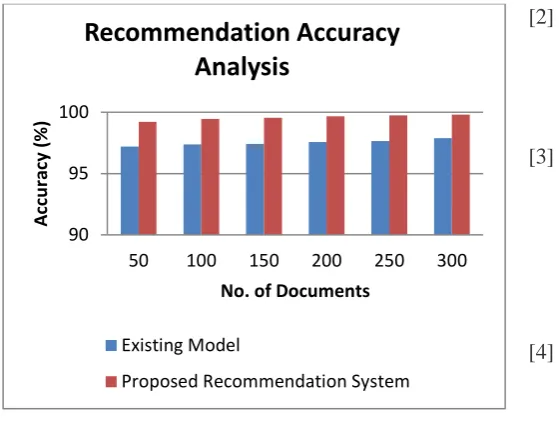
Figure 3 shows the accuracy analysis between the proposed recommendation system (Preprocessing + Classification + Clustering) and the existing model. Here, we have considered the various documents such as 50, 100, 150, 200, 250 and 300 for experiments.
450 500 550 600 650 700 750
1 2 3 4 5
N
o
. o
f Sen
te
n
ce
s
Experiments
Performance Analysis
No. of sentences Provided
No. of sentences parsed directly
97 98 99 100
1 2 3 4 5
A
cc
u
rac
y (
%
)
Experiments
Performance Analysis
HITS
Figure 3. Accuracy Analysis between the proposed recommendation and existing model
From this figure, it can be observed that the accuracy analysis of the proposed recommendation system is better than the existing model. Thus is due to the uses of intelligent agents in preprocessing and classification and weighted fuzzy rules in clustering process.
IV.
CONCLUSION AND FUTURE WORKS
In this paper, a new content recommendation system is proposed and implemented for E-Learning using social network analysis and intelligent techniques. For this purpose, a new ranked document classification algorithm is proposed and the New Weighted Fuzzy C-means clustering algorithm is used for effective decision making. Moreover, an effective agent based preprocessing algorithm also used for better performance. Experiments were conducted with students, developers and faculty members using different level of contents. Further works in this direction can be the creation of a bench mark datasetand effective preprocessing algorithm to further improve the performance of the system.
V.
REFERENCES
[1] KatrienVerbert, Nikos Manouselis, Xavier Ochoa,
Martin Wolpers, HendrikDrachsler, IvanaBosnic, Erik Duval, “Context-Aware Recommender Systems forLearning: A Survey and Future Challenges”, IEEE Transactions On Learning Technologies, Vol. 5, No. 4, pp. 318- 335, 2012.
[2] Mohamed Amine Chatti, Ulrik Schroeder, and
Matthias Jarke, “LaaN: Convergence ofKnowledge Management and Technology-Enhanced Learning”, IEEE Transactions on Learning Technologies, Vol. 5, No. 2, pp. 177- 189, 2012.
[3] SannasiGanapathy, KanagasabaiKulothungan,
SannasyMuthurajkumar, MuthusamyVijayalakshmi, PalanichamyYogesh, ArputharajKannan, “Intelligent feature selection and classification techniques for intrusion detection in networks: a survey”, EURASIP Journal on Wireless Communications and Networking, Vol. 2013, pp. 1-16, 2013.
[4] Ahmed Al-Hmouz, Jun Shen, Rami Al-Hmouz, and
Jun Yan, “Modeling and Simulation of an Adaptive Neuro-Fuzzy Inference System (ANFIS) for Mobile Learning”, IEEE Transactions on Learning Technologies, Vol. 5, No. 3, pp. 226- 237, 2012.
[5] Ekaterina Gilman, Ivan Sanchez Milara, Marta
Cortes, and JukkaRiekki, “Towards User Support in UbiquitousLearning Systems”, IEEE Transactions on Learning Technologies, Vol. 8, No. 1, pp. 55-68, 2015.
[6] Ganapathy S, Sethukkarasi R, Yogesh P,
Vijayakumar P, Kannan A, “An intelligent temporal pattern classification system using fuzzy temporal rules and particle swarm optimization”, Sadhana, Vol.39, No.2, pp. 283-302, 2014.
[7] P. Vate-u-lan.(2008). Borderless e-learning: HITS
Model for Web 2.0. [Online]. Available:
http://ejournals.thaicyberu.go.th/index.php/ictl/articl e/view/59/62.
[8] Murphy P M and Aha D W 1995 UCI Repository of
Machine Learning Databases, (Machine-Readable Data Repository). Irvine, CA: Dept. Inf. Comput. Sci., University of California.
[9] SaiRamesh L, SannasiGanapathy, Bhuvaneshwari R,
KanagasabaiKulothungan, V. Pandiyaraju,
ArputharajKannan, “Prediction of User Interests for Providing Relevant Information Using Relevance Feedback and Re-ranking”, International Journal of Intelligent Information Technologies, Vol.11, No.4, pp. 55-71, 2015.
[10] Ganapathy S, Kulothungan K, Yogesh P, Kannan A,
“A Novel Weighted Fuzzy C–Means Clustering Based on Immune Genetic Algorithm for Intrusion Detection”, Procedia Engineering, Vol. 38, pp. 1750-1757, 2012.
[11] Rodrigues J.J.P.C, SabinoF.M.R, Zhou L,
“Enhancing e-learning experience with onlinesocial networks”, IET Communications, 2011, Vol. 5, No. 8, pp. 1147–1154, 2011.
90 95 100
50 100 150 200 250 300
A
cc
u
rac
y (
%
)
No. of Documents
Recommendation Accuracy
Analysis
Existing Model
![Figure 2 shows the accuracy analysis between the proposed recommendation system with preprocessing and classification module and the existing HITS [8]](https://thumb-us.123doks.com/thumbv2/123dok_us/1181977.1620881/4.595.303.557.421.582/figure-accuracy-analysis-proposed-recommendation-preprocessing-classification-existing.webp)