Calhoun: The NPS Institutional Archive
Theses and Dissertations Thesis Collection
2013-12
An analysis of internal controls and
procurement fraud deterrence
Tan, Li Huang Joyce
Monterey, California: Naval Postgraduate School
NAVAL
POSTGRADUATE
SCHOOL
MONTEREY, CALIFORNIA
THESIS
Approved for public release; distribution is unlimited AN ANALYSIS OF INTERNAL CONTROLS AND
PROCUREMENT FRAUD DETERRENCE by
Li Huang Joyce Tan December 2013
Thesis Co-Advisors: Juanita M. Rendon
i
REPORT DOCUMENTATION PAGE Form Approved OMB No. xxxxx
Public reporting burden for this collection of information is estimated to average 1 hour per response, including the time for reviewing instruction, searching existing data sources, gathering and maintaining the data needed, and completing and reviewing the collection of information. Send comments regarding this burden estimate or any other aspect of this collection of information, including suggestions for reducing this burden, to Washington headquarters Services, Directorate for Information Operations and Reports, 1215 Jefferson Davis Highway, Suite 1204, Arlington, VA 22202-4302, and to the Office of Management and Budget, Paperwork Reduction Project (0704-0188) Washington DC 20503.
1. AGENCY USE ONLY (Leave blank) 2. REPORT DATE December 2013
3. REPORT TYPE AND DATES COVERED Master’s Thesis
4. TITLE AND SUBTITLE: AN ANALYSIS OF INTERNAL CONTROLS AND PROCUREMENT FRAUD DETERRENCE
5. FUNDING NUMBERS 6. AUTHOR(S) Li Huang Joyce Tan
7. PERFORMING ORGANIZATION NAME(S) AND ADDRESS(ES) Naval Postgraduate School
Monterey, CA 93943-5000
8. PERFORMING ORGANIZATION REPORT NUMBER
9. SPONSORING /MONITORING AGENCY NAME(S) AND ADDRESS(ES) N/A
10. SPONSORING/MONITORING AGENCY REPORT NUMBER
11. SUPPLEMENTARY NOTES The views expressed in this thesis are those of the author and do not reflect the official policy or position of the Department of Defense or the U.S. government. IRB protocol number N/A
12a. DISTRIBUTION / AVAILABILITY STATEMENT Approved for public release; distribution is unlimited
12b. DISTRIBUTION CODE A
13. ABSTRACT (maximum 200 words)
The rise in globalization, coupled with the use of technology to accelerate approval, and payable cycles, the increase of outsourcing of goods and services, and the pressure to cut costs, have resulted in government organizations being more exposed to the risk of fraud in their procurement process. Hence, appropriate internal controls and fraud prevention strategies are necessary for deterring, detecting, and managing procurement fraud.
The purpose of this research was to develop a guideline to help government organizations design an effective system of internal controls to deter fraud in public procurement processes and practices. This was done through a review, analysis, and discussion of 20 case studies of actual fraud incidents. In each case study, internal control weaknesses were identified and analyzed in terms of the fundamental principles that are associated with the five internal control components. The analysis revealed that the majority of the organizations in the case studies lacked three internal control components, namely control environment, control activities, and monitoring activities. Recommendations for improvements for each case study were presented by applying relevant internal controls into its procurement process to deter procurement fraud. The areas for further research were also provided.
14. SUBJECT TERMS Procurement fraud, Internal Controls, fraud prevention, control environment, control activities, monitoring activities
15. NUMBER OF PAGES 147 16. PRICE CODE 17. SECURITY CLASSIFICATION OF REPORT Unclassified 18. SECURITY CLASSIFICATION OF THIS PAGE Unclassified 19. SECURITY CLASSIFICATION OF ABSTRACT Unclassified 20. LIMITATION OF ABSTRACT UU
ii
iii
Approved for public release; distribution is unlimited
AN ANALYSIS OF INTERNAL CONTROLS AND PROCUREMENT FRAUD DETERRENCE
Li Huang Joyce Tan
Civilian, Defence Science & Technology Agency, Singapore B.A., National University of Singapore, 1994
Submitted in partial fulfillment of the requirements for the degree of
MASTER OF BUSINESS ADMINISTRATION from the
NAVAL POSTGRADUATE SCHOOL December 2013
Author: Li Huang Joyce Tan
Approved by: Juanita M. Rendon Thesis Advisor
Rene G. Rendon Co-Advisor
William Gates, PhD
iv
v
ABSTRACT
The rise in globalization, coupled with the use of technology to accelerate approval, and payable cycles, the increase of outsourcing of goods and services, and the pressure to cut costs, have resulted in government organizations being more exposed to the risk of fraud in their procurement process. Hence, appropriate internal controls and fraud prevention strategies are necessary for deterring, detecting, and managing procurement fraud.
The purpose of this research was to develop a guideline to help government organizations design an effective system of internal controls to deter fraud in public procurement processes and practices. This was done through a review, analysis, and discussion of 20 case studies of actual fraud incidents. In each case study, internal control weaknesses were identified and analyzed in terms of the fundamental principles that are associated with the five internal control components. The analysis revealed that the majority of the organizations in the case studies lacked three internal control components, namely control environment, control activities, and monitoring activities. Recommendations for improvements for each case study were presented by applying relevant internal controls into its procurement process to deter procurement fraud. The areas for further research were also provided.
vi
vii
TABLE OF CONTENTS
I. INTRODUCTION...1 A. BACKGROUND ...1 B. PURPOSE OF RESEARCH ...1 C. RESEARCH QUESTIONS ...1 D. METHODOLOGY ...3E. BENEFITS AND LIMITATIONS...3
F. ORGANIZATION OF REPORT ...4
G. SUMMARY ...4
II. LITERATURE REVIEW ...7
A. INTRODUCTION...7
B. PUBLIC PROCUREMENT PROCESS ...7
1. Procurement Planning ...8
a. Determining and Defining the Procurement Requirement ...8
b. Conducting Market Research ...9
c. Developing Requirement Documents ...10
d. Initial Consideration of Contract Type, Risk Assessment, and Special Terms and Conditions ...10
2. Solicitation Planning ...11
a. Determining the Appropriate Procurement Method ...11
b. Selecting the Appropriate Contract Type ...12
c. Developing Solicitation Documents ...13
d. Establishing Evaluation Criteria ...14
3. Solicitation ...15
4. Source Selection ...15
5. Contract Administration ...17
a. Monitoring and Measuring Contractor’s Performance ...17
b. Management of Contract Changes...18
6. Contract Closeout/Termination ...19
a. Contract Termination ...19
b. Contract Closeout ...19
C. INTERNAL CONTROL COMPONENTS...20
1. Key Concepts of COSO’s Internal Control Framework ...22
2. Objectives of the COSO Internal Control Framework ...22
a. Operation Objectives ...23
b. Reporting Objectives ...23
c. Compliance Objectives ...23
3. Five COSO Internal Control Components ...23
a. Control Environment ...23
b. Risk Assessment ...25
c. Control Activities ...25
viii
e. Monitoring Activities...27
4. Fundamental Principles Supporting Internal Control Components ...28
D. DEFINING AND DIFFERENTIATING TYPES OF PROCUREMENT FRAUD ...30
1. Fraud Definition ...30
2. Differentiating Types of Procurement Fraud...31
a. Collusion between Employees and Contractors ...31
b. Employees Acting Alone ...33
c. Collusion among Contractors or Contractor Acting Alone ..34
E. APPLICATION OF COSO INTERNAL CONTROL COMPONENTS IN THE PUBLIC PROCUREMENT PROCESS ...36
1. Control Environment...37
a. Principle 1: Organization Demonstrates Commitment to Integrity and Ethical Values ...37
b. Principle 2: Exercises Oversight Responsibility ...37
c. Principle 3: Establishes Structure, Authority and Responsibility ...38
d. Principle 4: Demonstrates Commitment to Competence ...40
e. Principle 5: Enforces Accountability ...41
2. Risk Assessment ...41
a. Principle 6: Specifies Suitable Objectives ...41
b. Principles 7 and 8: Identifies and Analyzes Risks (including Fraud Risk) ...42
c. Principles 9: Identifies and Analyzes Significant Change ....43
3. Control Activities ...44
4. Information and Communication ...45
5. Monitoring Activities ...46
F. SUMMARY ...47
III. CASE STUDIES OF PROCUREMENT FRAUD INCIDENTS ...49
A. INTRODUCTION...49
B. CASE STUDIES ...49
C. ANALYSIS OF CASE STUDIES ...49
1. Case Study 1 (Navy Bribery Scheme) ...49
a. Internal Control Weakness in the Procurement Process ...49
b. Type of Fraud Scheme Used ...52
2. Case Study 2 (U.S. Army Corps of Engineers Fraud) ...52
a. Internal Control Weakness in the Procurement Process ...52
b. Type of Fraud Scheme Used ...53
3. Case Study 3 (Bribery and Fraud Lands Program Manager in Jail) and Case Study 4 (Misconduct of a First Lieutenant) ...54
a. Internal Control Weakness in the Procurement Process ...54
b. Type of Fraud Scheme Used ...55
4. Case Studies 5 to 8...56
ix
b. Type of Fraud Scheme Used ...57
5. Case Studies 9 to 15...57
a. Internal Control Weakness in the Procurement Process ...57
b. Type of Fraud Scheme Used ...59
6. Case Study 16 (Special Operations Command Bribery Scandal Nabs Two Retired Officers) ...60
a. Internal Control Weakness in the Procurement Process ...60
b. Type of Fraud Scheme Used ...61
7. Case Study 17 (Awarding Contracts to Spouse Earns Couple One Year in Prison) ...61
a. Internal Control Weakness in the Procurement Process ...61
b. Type of Fraud Scheme Used ...62
8. Case Study 18 (Marine Corps Say Goodbye to Officers who Schemed with Thai Vendors) ...62
a. Internal Control Weakness in the Procurement Process ...62
b. Type of Fraud Scheme Used ...63
9. Case Study 19 (Friends in Low Places) ...64
a. Internal Control Weakness in the Procurement Process ...64
b. Type of Fraud Scheme Used ...65
10. Case Study 20 (Patrick Air Force Base Engineer Violates Conflict of Interest Statute)...65
a. Internal Control Weakness in the Procurement Process ...65
b. Type of Fraud Scheme Used ...66
D. SUMMARY ...68
IV. ANALYSIS AND RECOMMENDATIONS ...69
A. INTRODUCTION...69
B. RECOMMENDATIONS ...69
1. Case Study 1 (Navy Bribery Scheme) ...69
a. Control Environment ...69
b. Risk Assessment ...70
c. Control Activities ...71
d. Monitoring Activities...73
2. Case Study 2 (U.S. Army Corps of Engineers Fraud Case) ...73
a. Control Environment ...73
b. Control Activities ...74
c. Monitoring Activities...74
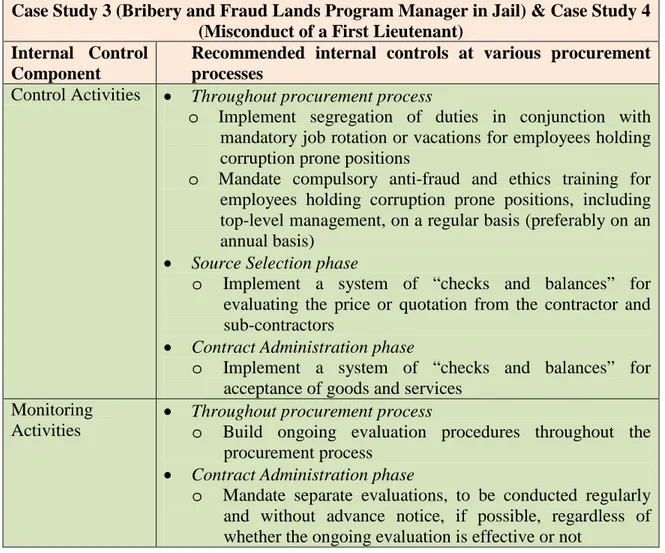
3. Case Study 3 (Bribery and Fraud Lands Program Manager in Jail) & Case Study 4 (Misconduct of a First Lieutenant)...75
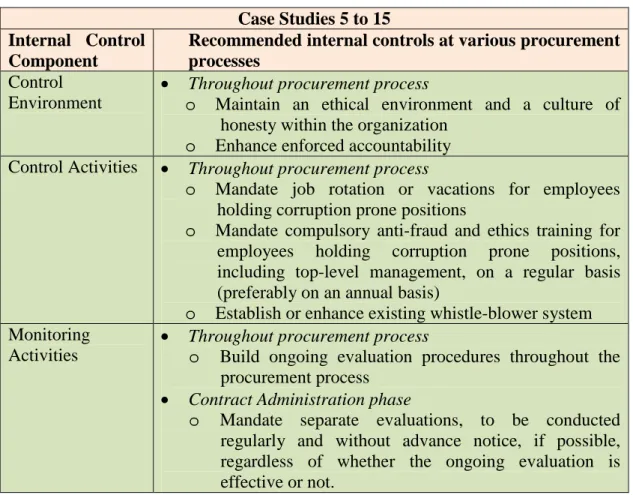
a. Control Activities ...75 b. Monitoring Activities...76 4. Case Studies 5 to 15...76 a. Control Environment ...76 b. Control Activities ...76 c. Monitoring Activities...77
x
5. Case Study 16 (Special Operations Command Bribery Scandal
Nabs Two Retired Officers) ...78
a. Control Activities ...78
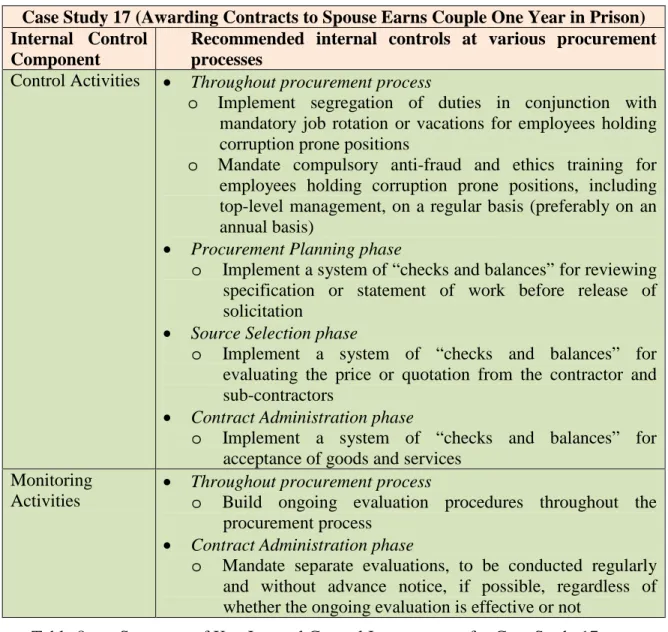
6. Case Study 17 (Awarding Contracts to Spouse Earns Couple One Year in Prison) ...78
a. Control Activities ...78
b. Monitoring Activities...79
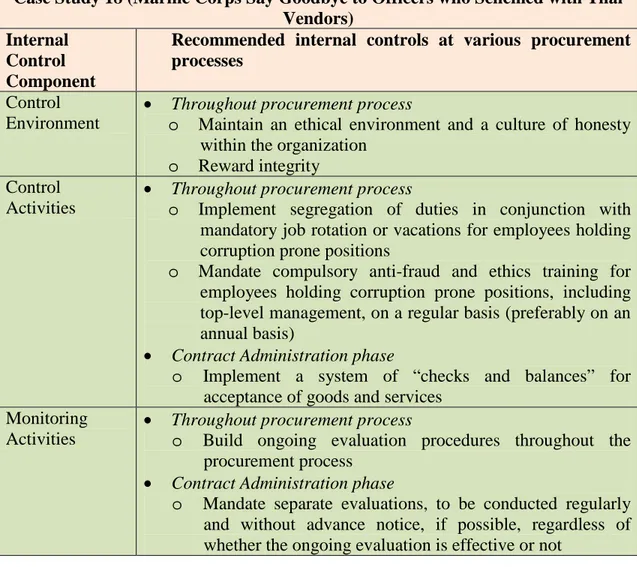
7. Case Study 18 (Marine Corps Say Goodbye to Officers who Schemed with Thai Vendors) ...79
a. Control Environment ...80
b. Control Activities ...80
c. Monitoring Activities...81
8. Case Study 19 (Friends in Low Places) ...81
a. Control Environment ...81
b. Control Activities ...82
c. Monitoring Activities...83
9. Case Study 20 (Patrick Air Force Base Engineer Violates Conflict of Interest Statute)...83
a. Control Environment ...83
b. Control Activities ...83
c. Monitoring Activities...84
10. Other General Improvements ...92
a. Control Environment ...93
b. Risk Assessment ...93
C. SUMMARY ...93
V. SUMMARY, CONCLUSIONS, AND AREAS FOR FURTHER RESEARCH ..95
A. SUMMARY ...95
B. CONCLUSION ...95
1. Research Questions ...95
a. How are Internal Controls and Procurement Processes Integrated? ...96
b. What Factors Contribute to Public Procurement Fraud Incidents? ...98
c. How Can Internal Controls within the Procurement Processes Deter Public Procurement Fraud? ...98
2. Areas for Further Research ...99
APPENDIX A. CODE OF ETHICS FOR GOVERNMENT SERVICE...101
APPENDIX B. NCMA’S CODE OF ETHICS ...103
APPENDIX C. CODE OF PROFESSIONAL ETHICS FOR CERTIFIED FRAUD EXAMINERS ...105
APPENDIX D. PROCUREMENT FRAUD CASES ...107
xi
LIST OF REFERENCES ...119 INITIAL DISTRIBUTION LIST ...125
xii
xiii
LIST OF TABLES
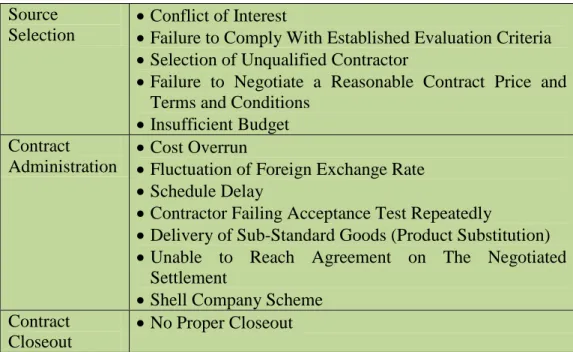
Table 1. Examples of Typical Risks and Fraud Vulnerability in Procurement
Process. Adapted from Office of the Inspector General, n.d. ...43
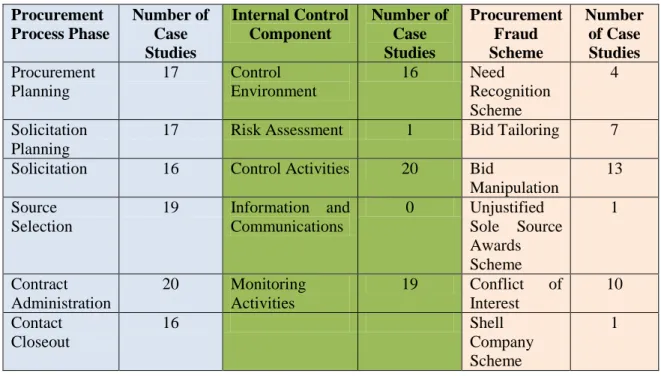
Table 2. A Summary of the Case Studies Analysis. ...67
Table 3. Summary of Key Internal Control Improvement for Case Study 1. ...85
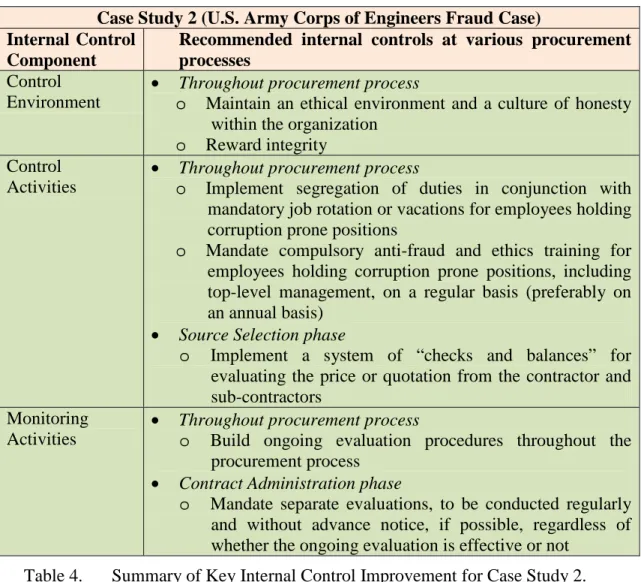
Table 4. Summary of Key Internal Control Improvement for Case Study 2. ...86
Table 5. Summary of Key Internal Control Improvement for Case Studies 3 and 4. ....87
Table 6. Summary of Key Internal Control Improvement for Case Studies 5 to 15. ....88
Table 7. Summary of Key Internal Control Improvement for Case Study 16. ...88
Table 8. Summary of Key Internal Control Improvement for Case Study 17. ...89
Table 9. Summary of Key Internal Control Improvement for Case Study 18. ...90
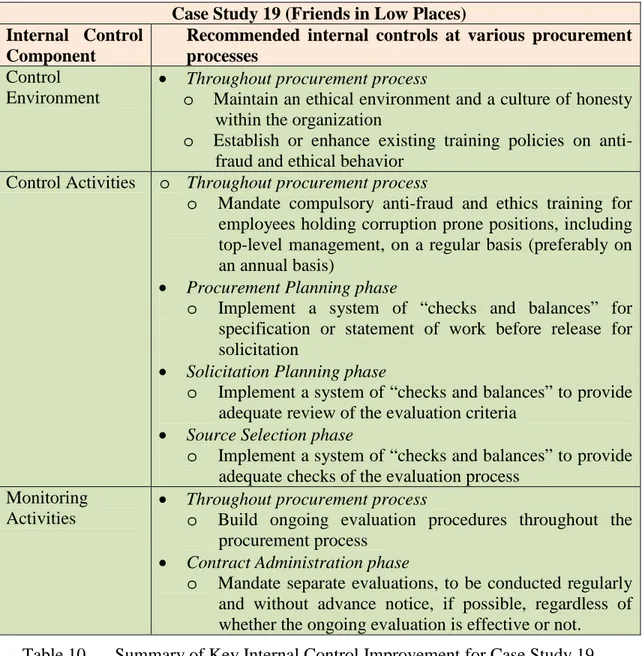
Table 10. Summary of Key Internal Control Improvement for Case Study 19. ...91
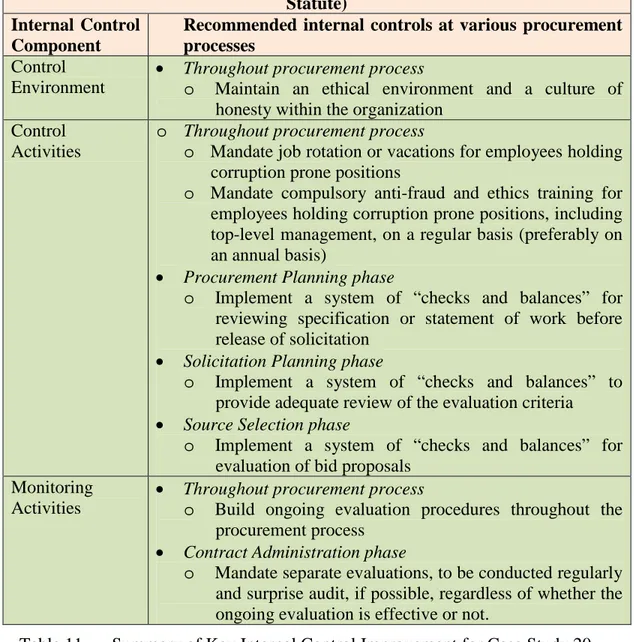
Table 11. Summary of Key Internal Control Improvement for Case Study 20. ...92
xiv
xv
LIST OF FIGURES
xvi
xvii
LIST OF ACRONYMS AND ABBREVIATIONS
ACFE Association of Certified Fraud Examiners
AGO Auditor-General’s Office
ASB Asian Development Bank
CICA Competition in Contracting Act
COSO Committee of Sponsoring Organization of the Treadway
Commission
COR Contracting Officer Representative
COTRs Contracting Officer Technical Representatives
DCAA Defense Contract Audit Agency
DCMA Defense Contract Management Agency
DOD IG Department of Defense Inspector General
DOI Department of the Interior
DOT Department of the Treasury
EVM Earned Value Management
FAR Federal Acquisition Regulation
GAO Government Accountability Office
GDP Gross Domestic Product
LPTA Lowest Price Technically Acceptable
NCMA National Contract Management Association
NECI National Education Consulting Inc
OECD Organisation For Economic Co-operation Development
OMB Office of Management and Budget
SEC U.S. Securities and Exchange Commission
SOO Statement of Objectives
SOW Statement of Work
SSA Source-Selection Authority
xviii
xix
ACKNOWLEDGMENTS
First, I wish to thank my organization, the Defence Science and Technology Agency, for this invaluable opportunity to pursue the MBA at the Naval Postgraduate School. Next, I would like to express my deep gratitude to Professor Juanita M. Rendon and Professor Rene G. Rendon, my thesis advisors, for their professional and patient guidance, valuable support, and useful critiques and recommendations on this project.
xx
I.
INTRODUCTION
A. BACKGROUND
Perhaps, the first recorded instance of fraud occurred in 300 B.C., when a Greek merchant named Hegestratos took up a loan known as bottomry and agreed to pay it back with interest when he received his goods. The moneylender could confiscate Hegestratos’ boat and goods if he failed to pay back the loan. Hegestratos’ plan was to sink his empty boat, pocket the loan, and sell the goods. The plan did not work out since he drowned while trying to escape from his crew when they caught him in the act (Beattie, 2009).
The origin of fraud is traced as far back as 300 B.C. However, it was the rise in globalization in the last decade that drove companies to grow in international markets and that took fraud to its height. As correctly predicted in the first edition of the Fraud Examiners’ Manual in 1989, the Association of Certified Fraud Examiners (ACFE) claimed that “fraud will be the crime of choice for the 21st century” (ACFE, 2013, p. 1). The rise in globalization, coupled with the use of technology to accelerate approval and payable cycles, the increase of outsourcing of goods and services and the pressure to cut costs, have resulted in government organizations being more exposed to the risk of fraud in their procurement process. Hence, appropriate internal controls and fraud prevention strategies are necessary for deterring, detecting, and managing procurement fraud.
B. PURPOSE OF RESEARCH
The purpose of this research is to develop a guideline to help government organizations design an effective system of internal controls to deter fraud in public procurement processes and practices.
C. RESEARCH QUESTIONS
According to the 2012 Global Fraud Study conducted by ACFE, of the 1,388 cases of occupational fraud reported by the certified fraud examiners who investigated
them, purchasing is one of the six areas where the majority of fraudulent activities were committed (ACFE, 2012). This trend was similar to the findings in ACFE’s 2010 study. Procurement fraud is pervasive, and organizations are vulnerable to fraud in their procurement process. Government organizations are generally more susceptible to fraud due to the complex nature of purchases and the enormous amount of funds involved. The ACFE study (2012) found that government and public administration is one of the industries most commonly victimized by fraud. Moreover, as the amount of public funds being channeled into the market through public procurement procedures increases, the procurement process continues to be highly vulnerable to fraudulent activities (Organisation For Economic Co-operation Development (OECD), 2013). According to the OECD, government procurement constitutes about 15% of the Gross Domestic Product (GDP) and 80% of world merchandise and commercial services exports in 1998 (OECD, 2005). Data has also shown that governments in the Asia-Pacific region generally pay about 20% to 100% more for public goods and services due to procurement fraud (Asian Development Bank (ASB) & OECD, 2007). This means that government organizations have less money to fund public services such as education, health, and public transportation needed to reduce poverty and improve their citizens’ quality of life (ASB & OECD, 2007).
In addition, procurement fraud damages the government organizations’ reputation, causes financial loss, and undermines the public’s confidence in the governmental structure and management. While the risk of fraud cannot be eliminated entirely, it can be greatly reduced with an appropriate procurement fraud prevention strategy. Hence, in recent years, worldwide efforts have been channeled into fighting corruption and promoting integrity in public procurement. For example, among other things, in an effort to combat corruption, Section 302 of the Sarbanes-Oxley Act of 2002 requires that Chief Executive Officer and Chief Financial Officer certify on a quarterly basis that they have internal controls and have evaluated the effectiveness of these internal controls within the previous 90 days (SOX-Online, 2012). In addition, Section 406 of the Sarbanes-Oxley Act of 2002 requires that all publicly held companies establish a code of ethical conduct and business ethics for their directors and employees (U.S. Securities and Exchange Commission (SEC), 2003).
The proper application and enforcement of internal controls in the procurement process can help to deter fraudulent activities within government organizations. By analyzing the internal control components and how they can be used to deter procurement fraud through a detailed analysis of case studies of procurement fraud incidents, this research project aims to answer the following questions:
1. How are internal controls and procurement processes integrated? 2. What factors contribute to public procurement fraud incidents?
3. How can internal controls within the procurement processes deter public procurement fraud?
D. METHODOLOGY
This research consists of a detailed review of recent literature regarding internal controls and the procurement process and recent procurement fraud case analysis. The literature review includes a discussion of the public procurement process, the internal control components and the types of procurement fraud. The literature review will also discuss how internal controls can be integrated into the public procurement process to deter fraudulent activities. The procurement fraud case studies will be drawn mainly from the Encyclopedia of Ethical Failure (updated as of July 2013) (Department of Defense General Counsel’s Office, 2013) compiled by the Standards of Conduct Office of the Department of Defense General Counsel’s Office, Early Bird Current News, and other news articles. The literature review will be followed by a review and analysis of procurement fraud cases to identify weaknesses in internal controls or lack of internal controls within the procurement process. Finally, this research will conclude with recommendations for improvements in the procurement process to deter procurement fraud and areas for further research. These recommendations serve to provide guidelines for other government organizations to develop and design an effective system of internal controls to deter fraud.
E. BENEFITS AND LIMITATIONS
This research will analyze and discuss how internal controls and procurement processes are integrated. One benefit of this analysis will shed light on the extent of
integration of internal control components in the public procurement process. Another benefit of this research is to identify the factors that contribute to public procurement fraud incidents through detailed analysis of case studies of procurement fraud incidents. The result will provide insight on the areas of weaknesses in internal control or lack of internal controls in public procurement. A final benefit of this research is to analyze how internal controls can be integrated within the procurement processes to deter public procurement fraud. This analysis will emphasize and highlight the importance of the integration of internal controls into the procurement process to deter procurement fraud.
As this research focuses primarily on literature reviews which are limited to collecting and analyzing past information across various government organizations, the research findings will be limited in context. Moreover, the research findings are generalized to all government procurement fraud.
F. ORGANIZATION OF REPORT
This thesis is composed of five chapters including this introduction chapter. Chapter II consists of a literature review of the procurement process, internal control components, types of procurement fraud and the integration of internal controls in the procurement process. The literature review in Chapter II focuses on building the basic foundation of the research. Building on this foundation, Chapter III examines case studies of procurement fraud incidents and identifies internal control weaknesses or lack of internal controls in these cases. Chapter IV provides recommendations for improvement by discussing the relevant internal controls in the procurement process to deter procurement fraud so as to provide guidelines for other government organizations to be able to develop and design an effective internal control system to deter fraud. Chapter V consists of a summary, conclusion and areas for further research.
G. SUMMARY
This chapter provided an introduction and overview of the research. The extent of government organizations’ exposure to procurement fraud was reviewed, which emphasized the need to put in place effective internal controls within the procurement process to deter procurement fraud. Government organizations are more exposed to
fraud due to the rise in globalization, the increased use of technology in the procurement process, proliferation of outsourcing of goods and services and pressure to cut costs. Public procurement is also most vulnerable to fraud considering the complexity of purchases and the enormous size of its financial flows to the market. As stated by Cendrowski, Martin, & Petro (2006) in The Handbook of Fraud Deterrence, the removal of opportunity (which is one of the three elements in the fraud triangle), that focuses on augmenting the system of internal controls, is probably the most effective tool to fraud deterrence. Therefore, it is essential that proper application and enforcement of internal controls be employed in the procurement process to help deter fraudulent acts within government organizations.
The objective of this research, which is to provide a guideline for government organizations to develop and design an effective system of internal controls to deter fraud in the public procurement process, was presented. This was followed by the framing of the three research questions, the benefits, and the limitations of the research. Lastly, the methodology of the research was summarized. The following chapter lays the foundation of this research by reviewing the literature on public procurement processes, internal control components, types of procurement fraud and the application of internal control components in the procurement process to deter procurement fraud.
II.
LITERATURE REVIEW
A. INTRODUCTION
In this chapter, a literature review of the public procurement processes, internal control components and the different types of procurement fraud are presented. In addition, a discussion on the integration of internal control components in the procurement process is presented. This review builds the basic foundation of knowledge for this research and sets the stage for the subsequent chapters. The public procurement process is discussed in the following section.
B. PUBLIC PROCUREMENT PROCESS
A main difference between public procurement and private sector procurement is that public procurement is subject to more stringent legislative regulations and controls. The main reasons for the stringent regulations and controls are to ensure that the taxpayers’ money is spent effectively and economically, that contracts are awarded to suppliers on a fair, transparent and value-for-money basis, and that any fraudulent acts by the buyers and/or suppliers are prevented. For example, the U.S. federal government procurement is governed by the Federal Acquisition Regulation (FAR) (FAR, 2013), while the government procurement process in the United Kingdom (UK) is governed by the European Union Procurement Directives and the UK Procurement Regulations (UK Cabinet Office, 2013). Often, public procurement officers are also governed by a set of stricter rules and regulations as a high standard of discipline and conduct is expected of these public officers. Generally, private sector procurement officers are not subject to any legislative requirements to conduct a competitive procurement process. Private sector procurement is governed by its organization’s procurement guidelines, which are formulated to meet the organization’s objectives. However, if the organization’s procurement guidelines mandate the use of a competitive procurement process, the principles of fairness, transparency and value-for-money will apply as in the public sector (National Education Consulting Inc (NECI), 2013).
The public procurement process can be categorized into six phases, namely procurement planning, solicitation planning, solicitation, source selection, contract administration and contract closeout (Rendon & Snider, 2008). Together, these phases provide direction for the government organizations to purchase public goods and services in the most effective and economical manner based on the principles of fairness, transparency and value of money. In addition, these processes assist the government organizations in their planning and executing of procurement strategy. These processes ensure that the organizations’ purchases stay within the allocated budget throughout the product lifecycle and meet the user’s requirements and that the contractor performs in accordance with the contract (Rendon & Snider, 2008). The following section discusses each of these phases and their associated activities.
1. Procurement Planning
The procurement process starts with the procurement planning phase, which involves recognizing and identifying the organization’s needs and determining the user’s specific requirements, the mode of purchase, the quantity to purchase and the period of purchase so as to meet the organization’s specific needs (Rendon & Snider, 2008). The main activities of the procurement planning phase include determining and defining the procurement requirement, conducting market research, developing requirement documents (such as specifications, statement of work (SOW), or statement of objectives (SOO)), developing preliminary budgets and cost estimates, and considering initial contract types, risk assessment and special terms and conditions (Rendon, 2007). These activities, which play a significant role in determining the contracting strategy of the purchase, have to be duly documented for subsequent review and approval (Rendon & Snider, 2008).
a. Determining and Defining the Procurement Requirement
The activity of determining and defining the requirement initiates the procurement process. In this activity, the organization first identifies its need in terms of functions to be performed, performance and technical characteristics. Next, it defines the needs or requirements by considering the following questions (Rendon, 2007):
• Do the requirements encourage bidders to supply commercial items or non-development items (if commercial items are not available)?
• Can the requirements be altered appropriately such that they can be met by commercial items or non-development items?
• Do the organizations want to make the goods or perform the services themselves in-house or buy the goods or services from an outside supplier or adopt a hybrid approach through joint-partnership with the outside supplier?
The answers to these questions serve to drive the organization to encourage competition wherever possible and expedite the subsequent procurement processes by scoping the contracting alternatives. Once the requirement is approved, the procurement process officially begins.
b. Conducting Market Research
After the requirement has been identified and defined, the next activity is to conduct market research. Market research is the process of collecting and analyzing information to determine if there are available potential suppliers and products within the markets to meet the organization’s needs (FAR, 2013). The degree of market research effort depends on the level of risk of the requirement. For small and simple acquisitions, a check of past contracts may suffice. However, for complex acquisitions, an extensive market research is required. For example, under FAR market research is required for acquisitions with an estimated value above the simplified acquisition threshold of $150,000 or when there is no adequate cost information (FAR, 2013). The result of market research is then used to decide if there are potential sources and products within the market that can satisfy the requirement. In addition, the market survey result also determines if commercial items or non-development items are available to meet the requirement, and if not, whether the requirements can be refined such that commercial or non-developmental items could be incorporated at the component level (FAR, 2013). Lastly, the market survey can be used to establish a “ball-park” cost estimate of the requirement. All these results will affect the subsequent activities and phases of the procurement process.
c. Developing Requirement Documents
Subsequent to the completion of the market analysis and the refinement of requirements (if required), the next step is to develop the requirement documents. The requirement documents consist of specifications, SOW, or SOO. A specification is a document that spells out the detailed technical requirements and delivery schedule for the goods or services that a contractor is required to meet. The SOW is a document that states the detailed non-specification of the work and delivery schedule that a contractor is required to fulfill or perform under the contract. Both the specifications and SOW are often incorporated as an integral part of the resultant contract. Specifications and SOWs must be written in a clear and comprehensive manner to avoid any future misinterpretation and disputes. Specifying brand names in specifications and SOWs is not allowed, unless the word “or equivalent” is included (FAR, 2013). The SOO, on the other hand, captures only the fundamental and top-level objectives of the requirement to allow bidders to have the flexibility to develop cost-effective and innovative solutions to meet the organization’s needs. The SOO does not become part of the contract. The bidders use the SOO to develop their own SOW, and the successful bidder’s SOW is incorporated as an integral part of the resultant contract (FAR, 2013).
d. Initial Consideration of Contract Type, Risk Assessment, and Special Terms and Conditions
Another important factor that impacts the success of the resultant contract is the contract type used (e.g., fixed-price contract or cost-reimbursement contract) considering the nature and risk associated with the requirement. Therefore, early assessment and consideration of contract type and risk assessment and exchange of such information during the procurement planning phase allow organizations to identify and address or resolve concerns early in the procurement process. Early consideration of any special terms and conditions for special circumstances of the specific procurement which are not addressed in the standard terms and conditions is also crucial. Unique or special procurement requirements may constitute including exceptions to the standard terms and conditions or further tailoring some of the conditions (Rendon, 2007).
2. Solicitation Planning
Solicitation planning begins once the organization has gone through the procurement planning phase. In this phase, solicitation documents are prepared to support the solicitation based on the information collected during the procurement planning phase (Garrett & Rendon, 2005). The main activities in the solicitation planning phase consist of determining the appropriate procurement method, selecting the appropriate contract type, developing the solicitation documents, such as finalizing specifications, SOW, or SOO, and contract terms and conditions and establishing evaluation criteria (Rendon & Snider, 2008).
a. Determining the Appropriate Procurement Method
The appropriate procurement method to be used varies for different types of goods and/or services as it is conditional on the estimated value of the requirement, the nature and specifications of the requirement, availability of potential suppliers and availability of period contract or framework agreement. The estimated value of the requirement will determine the procurement method. For example, depending on the estimated value of the purchase, the procurement method for Singapore Government purchases could be by way of a small value purchase (up to S$3,000), quotations (between S$3000 up to S$7,000), or tender (more than S$70,000) (Ministry of Finance, Singapore, 2013). Similarly, in the U.S. federal government, the procurement method could be by way of a micro-purchase (up to $3,000), simplified acquisition procedures (between $3,000 to $150,000), sealed bidding or negotiated procurement (more than $150,000) (FAR, 2013).
Another important part of determining the appropriate procurement method involves selecting the appropriate mode of solicitation/tender procedures for a procurement activity. Open competition, where any supplier can participate, is the preferred mode of most government organizations. Open competition assures that organizations procure the goods and services in the most efficient and economical manner. Government organizations, in particular, find competition crucial for ensuring fairness and transparency in their procurement process. Many government organizations
demonstrate their commitment to open competition by limiting the circumstances whereby limited competition or non-competition can be used. For example, the Federal Government’s Competition in Contracting Act (CICA) of 1984 requires that its agencies and departments use “full and open competition” in purchasing goods and services. As listed in FAR 6.302 (2013), there are seven exceptions to CICA. Some of the commonly used exceptions include instances when only one responsible source is available and when there is an unusual and compelling urgency. A Justification and Approval is required for exception to full and open competition (FAR, 2013). Similarly, the Singapore Government has open tenders as a norm to ensure fairness and transparency in their procurement process as well as to obtain value for money through open competition (Ministry of Finance, 2013).
b. Selecting the Appropriate Contract Type
As previously mentioned, one crucial factor that contributes to a successful procurement is selecting the appropriate contract type to be used. In the solicitation planning phase, government organizations use the information on contract types and risk assessment that they gathered from the procurement planning phase to decide on the appropriate contract type to be used. The two major contract types are fixed-price and cost-reimbursement contracts (Rendon & Snider, 2008).
The commonly used price contracts include firm-fixed price, fixed-price contracts with economic fixed-price adjustment and fixed-fixed-price incentive contracts. In a firm-fixed price contract, the contract price payable does not change regardless of eventual actual cost incurred by the contractor in the performance of the contract. In a firm-fixed price contract, the contractor assumes all cost risk. As for a fixed-price contract with economic price adjustment, the contract price payable is adjusted for economic uncertainties such as price of fuel, steel or copper and electricity, which tends to fluctuate over times. The formula for the economic price adjustment is often pre-agreed upon prior to contract award and stated in the contract for ease of post-management. Fixed-price incentive contracts, on the other hand, cater to profit adjustment depending on the contractor’s performance. Contractors receive a higher profit if they achieve better performance results and vice versa. Besides motivating
contractors to enhance their contract performance, fixed-price incentive contracts also serve as a deterrent for contractors not to underperform; otherwise, they will receive a lower profit (Rendon & Snider, 2008).
In a cost-reimbursement contract, the contractor is reimbursed for the allowable costs incurred in accordance with the contract terms and conditions. Some commonly used cost-reimbursement contracts include cost contract, cost-plus-fixed-fee contract and cost-plus-incentive fee. In a cost-plus-fixed-fee contract, organizations pay the allowable incurred cost plus a fixed profit (fee) regardless of the actual cost of performing the contract. As for cost-plus-incentive contract, an organization pays the allowable incurred cost plus a certain amount of fee (subject to a minimum and maximum fee) depending on the contractor’s effort in cost reduction. The contractor will be rewarded with more fees if it can perform the contract at less than the pre-agreed target cost and vice versa (Rendon & Snider, 2008).
Period contracts, also known as indefinite-delivery contracts, can be implemented in a fixed-price or cost-reimbursement contract or a hybrid of both contract types. It is often used for a recurring requirement when the exact time and quantities are unknown upon contract award.
While fixed-price contracts are preferred by government organizations as they are less risky, they may not be the appropriate contract type for a requirement where cost could not be reasonably estimated due to the high degree of uncertainties in achieving the desired organization’s needs such as research and development requirements. Hence, according to the FAR, choosing the appropriate contract type is “generally a matter for negotiation and requires the exercise of sound judgment” (FAR, 2013, §16.103(a), p 16.1-1).
c. Developing Solicitation Documents
With the requirement, appropriate procurement method, and contract type identified, the next step is to start developing the solicitation documents, also known as tender documents elsewhere, such as in the UK and Singapore. The solicitation document is a document that the government organizations send to bidders (or tenderers
in the context of the UK and Singapore) to request for an offer or information for purchases. The solicitation documents must contain all of the necessary information, such as the description of goods and services, specifications, SOW, and SOO, contract terms and conditions, delivery or performance schedules, solicitation closing date, etc., to enable the bidders to submit a timely and comprehensive offer or information. The main types of solicitation documents include the Request for Quotation (RFQ), Invitation for Bids (IFB) and Request for Proposals (RFP). The type of solicitation documents to use is conditional on the procurement method adopted. For example, the U.S. federal government uses the RFQ for simplified acquisition procedures, while it uses the IFB and RFP for sealed bidding and negotiated contracts, respectively (Rendon & Snider, 2008).
d. Establishing Evaluation Criteria
The purpose of establishing the evaluation criteria is to provide a tool to be used during the source selection process for objectively determining which offers received provide the best value to fulfill the organization’s requirement. Evaluation criteria include the “key areas of importance” and “emphasis to be considered” in the source selection process (FAR, 2013, §15.304(b), p. 15.3-1). Offers received must be evaluated solely based on the pre-determined evaluation criteria and procurement method to ensure a fair and transparent evaluation. In determining best value, price alone is often not the primary evaluation criteria. Some non-price criteria, such as quality, availability, reliability, maintainability and past contractor performance are evaluated together to determine the best value for purchases. Organizations may choose to award contracts on the basis of the lowest acceptable price, also known as Lowest Price Technically Acceptable (LPTA) in the U.S. federal government, or most economical offer, also known as a tradeoff process in the U.S. federal government. When the evaluation method is based on the lowest acceptable price, the contract is awarded to the supplier who submitted the lowest price that meets all of the technical requirements. However, if the evaluation method is based on the most economically advantageous offer, the price and non-price factors with relative weighting for each criterion are used to determine the best value for the organization’s requirement. Regardless of which evaluation method is used, once the potential contractor is selected, cost or price analysis of the potential
contractor’s offered price is conducted to determine if the proposed price is fair and reasonable. After analysis, if the contracting officer assesses that the price is not fair and reasonable, negotiations may be conducted with the potential contractor to lower the price.
3. Solicitation
With the completion of the solicitation planning phase, the government organizations start the solicitation phase by soliciting proposals or offers from industry on how their requirements can be met. Solicitation documents can be issued either by mail or electronically on the Internet, as in the case of open solicitation or tender. For example, all federal solicitations with estimated purchase values exceeding $25,000 must be advertised on the Government Point of Entry which is located at http://www.fedbizopps.gov (Rendon & Snider, 2008). The government organizations in Singapore are required to post open tender notices openly on the Government Electronic Business website located at www.gebiz.gov.sg (Ministry of Defence, 2013). Advertising government opportunities electronically on the Internet benefits both the government, in terms of increased competition which results in lower price and better quality, and suppliers, in terms of enjoying broader access to government solicitations which may have been hidden in the past. In a limited competition process where requirements are exempted from competition, solicitation documents are sent to one or a few shortlisted suppliers to request for offers. Some government organizations also conduct pre-proposal conferences for complex requirements by posting a draft solicitation document to facilitate the solicitation process before the release of the final solicitation document. Such pre-proposal conferences aim to explain complex requirements to potential bidders, identify new sources in the case of limited solicitations and address any queries or questions from the suppliers or changes from the conferences that can be made before the release of the final solicitation document (Rendon & Snider, 2008).
4. Source Selection
The purpose of source selection is to select the proposal that gives the best value based on the pre-determined evaluation criteria and procurement method. The main
activities in the source selection phase consist of evaluating the received offers and conducting negotiations with the potential contractor to resolve differences and reach an agreement that achieves the most cost-effective outcome for the organization. Proposal evaluation involves assessing the bidders’ proposals based on the pre-established evaluation criteria and procurement method to select the proposal that offers the best value. Basically, contracts can be awarded on the basis of the lowest acceptable price (or LPTA) or most economically advantageous offer (or tradeoff process). In an LPTA process, the proposal with the lowest price that meets all the technical requirements is deemed to provide the best value. In the tradeoff process, best value is defined as a process whereby the technical evaluation factors, collectively, are more important than price (FAR, 2013, §15.101), and “the perceived benefits of the higher priced proposal shall merit the additional cost” (FAR, 2013, §15.101-1(c), p. 15.1-1).
Therefore, in such cases, it may be in the best interest of the government organization to award the contract “to other than the lowest priced offeror or other than the highest technically rated offeror” (FAR, 2013, §15.101-1, p. 15.1-1). As such, FAR Part 15.101 requires that all solicitations indicate whether all the technical evaluation factors combined are significantly more important than, equal to, or significantly less important than price or cost (FAR, 2013, §15.101). Negotiations are conducted with potential contractors whose proposals offer the best value to resolve differences and reach an agreement on all aspects of the contracts such as the price, schedule, special terms, technical issues and performance incentives. However, in the case of LPTA, negotiations with potential contractors are limited to price related issues. A formal source selection organization is often set up to manage negotiated procurements as they involve more complex source selection processes. In the U.S. federal government, the source selection organization is comprised of the source-selection authority (SSA), who manages the evaluation process and selection of the proposal with the best value, the source-selection advisory council, who provides advice to SSA, the source-selection evaluation team, who is a cross-functional team who evaluates contract proposals and the contracting officer, who is the point of contact with the industry who manages information exchanges with the bidders during the source selection phase (Rendon & Snider, 2008).
5. Contract Administration
Contract administration, also known as post-award administration, begins when the contract is awarded to the successful contractor. Contract administration plays a critical role in ensuring the success of the resultant contract as it makes sure that parties perform in accordance with the contractual requirements. For example, a contractor is required to provide services or supply goods in accordance with the contractual requirements, while the government organization is responsible to pay the contractor promptly when work has been completed. It is important to note that issues which are unforeseeable at the time of award are sure to occur during the course of the contract. Therefore, an effective contract administration is essential to ensure that issues are identified and dealt with early. The contract administration activities vary from contract to contract. Generally, the more complex a contract, the more activities are expected. The main activities in the contract administration phase include monitoring and measuring the contractor’s performance and monitoring and managing the change-control process (Rendon & Snider, 2008).
a. Monitoring and Measuring Contractor’s Performance
Monitoring and measuring the contractor’s performance is a process of observing the contractor’s performance, collecting information and measuring the contractor’s actual contract achievement. The reason for observing, collecting and measuring achievement is to establish a basis for comparing it with the planned achievement stated in the contract in order to exert control. It is the process of “quantifying” the work done by the contractor. The effort involved in the monitoring and measuring tasks depends on the size and complexity of the contract. In a small and simple contract, an occasional phone call to check on the contractor’s performance and visual inspection of the item will suffice. However, for a large and complex contract, the organization will require extensive reports, regular progress meetings, technical reviews, formal testing, and audits to ascertain the contractor’s performance. In the U.S. federal government, designated administrative contracting officers and contracting officer technical representatives (COTRs) are assigned to monitor the contractor’s performance. (Rendon & Snider, 2008) The government contracting officer and COTR may be
stationed physically at the contractor’s premises to assess the contractor’s performance. The contractor’s performance is monitored and measured against general control points, including cost, schedule and compliance with specifications, SOW, SOO, quality, and compliance with terms and conditions. A quantitative method used in contract administration to measure performance is earned value management (EVM). EVM measures performance by comparing the actual cost, schedule, and performance results with established cost, schedule and performance baselines. EVM is effective as it highlights potential issues relating to cost, schedule and performance. EVM helps the contractor and organization to identify issues and deal with them early in the process (Rendon & Snider, 2008).
b. Management of Contract Changes
Management of contract changes is important as it is the process for preventing unnecessary and unauthorized changes and incorporating necessary changes into the contract. Effective contract change management is achieved through establishing sound and formal contract change procedures, restricting the number of people authorized to make and approve changes and formally documenting the changes (Rendon & Snider, 2008). There are three types of contract changes, namely: unilateral, bilateral and constructive changes. Unilateral changes occur when the contracting officer issues a change without requiring any consent from the contractor. Such unilateral changes, which often are administrative changes, such as a change in point of contact details and do not involve any monetary adjustment, are stated and legalized in the contract. Bilateral changes, on the other hand, require both the contractor and contracting officer to agree on the changes including changes on terms, specifications, schedule and cost. Bilateral changes are not contractually binding until the authorized personnel of both the contractor and organization have formally incorporated the change. Constructive changes are informal agreements between the contractor and unauthorized official without complying with the proper legal and regulatory procedures. Such unauthorized commitments include work that is often beyond the scope of the contract such as accelerated delivery schedule and additional work. Effective contract change management serves to prevent the occurrence of such constructive changes.
6. Contract Closeout/Termination
Contract closeout is the last phase of the procurement process. In the contract closeout phase, a contract can either be successfully completed or suffer a termination under default or convenience (Rendon & Snider, 2008).
a. Contract Termination
A contract may be terminated when the contractor defaults on the contract or when the government organization decides to cancel the requirement prematurely for any reason other than the contractor’s default. The former is known as contract termination for default, while the latter is known as contract termination for convenience. Every government contract contains a clause on contract termination for default which gives the government the right to terminate the contract unilaterally, in part or in whole, if the contractor defaults on the contract. In such a termination, the contractor, besides not being paid for any work in progress, is often required to pay any excess re-procurement costs. The default contractor will also receive a poor past-performance assessment from the government organization. Under termination for convenience, the contractor is entitled to a negotiated settlement for the work done and a reasonable profit (FAR, 2013, §49).
b. Contract Closeout
Contract closeout occurs when the contractor completes the contract. The closeout process includes activities such as final acceptance of goods and services, final payment and documentation of the contractor’s past performance report. The extent of effort involved in contract closeout depends on the size and complexity of the contract itself. For a small and simple contract, contract closeout is generally straightforward. However, for a high dollar value and complex contract, which involves progress payments or termination issues, the procurement officer has to ensure that the contract is properly closed out. Typically, the contract is considered completed when (FAR, 2013, §4.8):
• the contractor has completed the deliveries and performed all of the services and the government has accepted the goods and services;
• all of the optional requirements (if any) have expired;
• the government organization has given the contractor a notice of complete contract termination, and
• the government organization has ensured that all of the contractual obligations are fulfilled and that the post-sales support and services (such as warranties) are clearly defined.
Thus far, this chapter has discussed the six phases of the public procurement process. An effective procurement is not achieved by simply following the six phases of the procurement process. It requires proper internal controls to be incorporated into the procurement process. In the next section, a review of the literature covering the internal control components in the public procurement process is presented.
C. INTERNAL CONTROL COMPONENTS
A good internal control system is a key factor in helping organizations achieve its goals and missions and reduces operational problems or risks such as potential fraudulent activities (Government Accountability Office (GAO), 1999). An organization’s success is dependent on its familiarity with the nature of risks that may occur in the environment and the enterprise itself, as well as by the adequate risk management. In the past, the concept of internal control was focused on accounting controls with respect to safeguarding assets and reliability of financial records. However, with rapidly changing economic and competitive environments, the scope of internal controls has expanded beyond the accounting arena. Today, internal control is viewed as “a process, effected by an entity’s board of directors, management, and other personnel, designed to provide reasonable assurance regarding the achievement of objectives relating to operations, reporting, and compliance” (Committee of Sponsoring Organizations of the Treadway Commission (COSO), 2013, p. 3).
For example, to improve its internal control systems to combat potential fraud, waste and abuse, the U. S. Office of Management and Budget (OMB) issued OMB Circular A-123 entitled “Management’s Responsibility for Internal Control” (OMB,
2004), and Congress enacted the Federal Managers Financial Integrity Act (Heim & Steinberg, 1984). An internal control system is also viewed as the first line of defense against fraudulent activities (Staats, 1980). One of the most widely-recognized and used models which presents good internal control practice is the COSO model, defined by the Committee of Sponsoring Organizations of the Treadway Commission. In fact, OMB’s standards of internal control systems are identical to those used by COSO. OMB Circular A-123 requires that every federal agency develop and maintain internal controls that align with the COSO model (Candreva, 2006; OBM, 2004).
In addition, GAO is in the process of revising the standards for internal control in the federal government by incorporating the new COSO internal controls standards which were updated in 2013 (GAO, 1999; GAO, 2013; COSO, 2013).
The COSO, which was formed in 1985, is a joint initiative of five private sector organizations, namely the Financial Executives International, the American Institute of Certified Public Accountants, the American Accounting Association, the Institute of Internal Auditors and the Institute of Management Accountants. COSO’s mission is to provide “thought leadership through the development of comprehensive frameworks and guidelines on enterprise risk management, internal control, and fraud deterrence designed to improve organizational performance and governance and to reduce the extent of fraud in organizations” (COSO, 2008, p. 1).
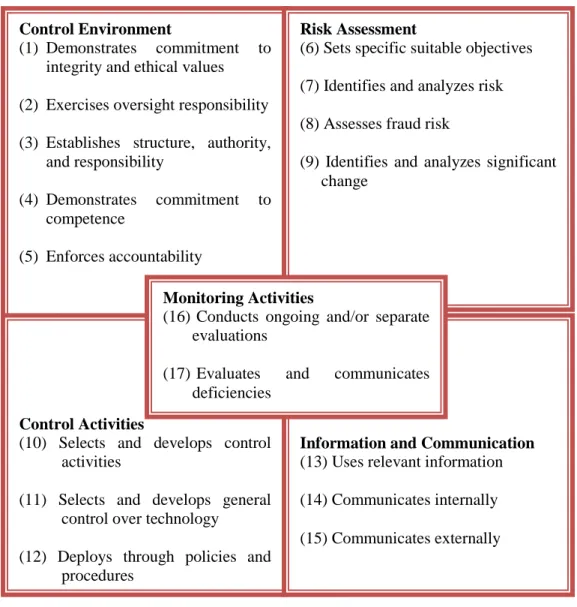
With the intention of developing frameworks to provide guidance to organizations in their development and maintenance of systems of internal control effectively and efficiently, this led to the publication of the COSO model in 1992, and its subsequent amendments in 1994 and 2013, titled Internal Control—Integrated Framework. According to the COSO’s Internal Control Framework, there are five integrated components, namely control environment, risk assessment, control activities, information and communication and monitoring activities (COSO, 2013). In the following section, a literature review is presented covering the key concepts and objectives of the COSO’s Internal Control Framework that sets the foundation of internal control standards. The following section also discusses each of the five components including the fundamental principles supporting each of the five components.
1. Key Concepts of COSO’s Internal Control Framework
• Internal control directs the organization towards the achievement of objectives in one or more separate but overlapping categories to include operations, reporting and compliance.
• Internal control is a process. It is not a single, separate event but a chain of continuous actions and activities taking place throughout the entire organization’s operations. Internal control is vital to the organization in achieving its objectives and should form an integral part of the organization’s system to control and guide its operations (GAO, 1999; COSO, 2013).
• Internal control is implemented by people as it is people who make internal controls work. Managers are responsible for establishing good internal controls within the organization. Managers establish the objectives, devise and put in place the appropriate control measures and subsequently, keep track and measure the effectiveness of internal controls. Internal control is not just about policy, procedure manuals, systems, and forms. Internal control is about the people at every level of an organization. The people at every level in the organization play an important role in making internal control systems work.
• Internal control provides reasonable (not absolute) assurance in meeting an organization’s objectives. An effective internal control system should be designed and implemented on the basis of cost and benefits. Regardless of how robust the internal control system is designed and implemented, internal control does not provide a total and complete guarantee that the organization’s objectives will be met. Factors such as human error and errors in judgment that are beyond management’s control can disrupt the organization’s effort in achieving its objectives (GAO, 1999; COSO, 2013).
• Internal control is flexible and should be adjusted depending on the organization’s structure, management’s decisions, and legal or regulatory requirements.
2. Objectives of the COSO Internal Control Framework
The COSO framework is designed to provide reasonable assurance for three distinct but overlapping categories of objectives. The purpose of this design is to allow organizations to have a directed focus on differing aspects of internal controls to meet their separate needs. These objectives include:
a. Operation Objectives
Operation objectives focus on the “effectiveness and efficiency of the entity’s operations, including operational and financial performance goals, and safeguarding of assets against loss” (COSO, 2013, p. 3).
b. Reporting Objectives
Reporting objectives focus on the reliability, timeliness, and transparency of financial and non-financial reporting (both internal and external) (COSO, 2013, p. 3).
c. Compliance Objectives
Compliance objectives focus on compliance with applicable laws and regulations to which the organization is required to adhere (COSO, 2013).
3. Five COSO Internal Control Components
Internal control components are standards that support an organization in more effectively handling changing economic and competitive environments, evolving business models, and managing risk. COSO’s Internal Control Framework consists of five components resulting from the way management runs a business and integrates internal controls within the management process. The five components serve as a general framework to provide guidance to management in their effort to develop policies, procedures and practices that are appropriate for their operations (GAO, 1999; COSO, 1992; COSO, 2013). These components, when combined and operating together, represent the minimum level of quality standards required by an organization to achieve their objective. At the same time, they provide the standards upon which a system of internal controls is to be measured. The five internal control components include those described in the following subsections.
a. Control Environment
The control environment represents the “atmosphere in which members of the organization carry out their control activities and responsibilities” (Godwin, 2010, p.