ISSN: 2319-8753
I
nternational
J
ournal of
I
nnovative
R
esearch in
S
cience,
E
ngineering and
T
echnology
(An ISO 3297: 2007 Certified Organization)
Vol. 3, Issue 11, November 2014
Solving Fuzzy Network Problems by
Defuzzification Techniques
Alaulden N. A.
1, Sanar M. Y.
2Professor, Department of Mathematics and Computer Applications, College of Science, Al-Nahrain University,
Baghdad-Iraq1
Research scholar, Department of Mathematics and Computer Applications, College of Science, Al-Nahrain University,
Baghdad-Iraq2
ABSTRACT: This paper developed two defuzzification approaches to convert the coefficients and the variables of the fuzzy linear programming problems (FLPP) into crisp (deterministic) linear programming problem (CLPP) based on philosophies of probability density function, and ranking measures. The case study is considered from a real problem to verify our results, using “MATLAB2010R” software.
KEYWORDS: Project network, Fuzzy Network, Defuzzification Techniques.
I. INTRODUCTION
In recent years, the range of project management applications has greatly expanded. Project management concerns the scheduling and controlling of activities (tasks) in such a way that the project can be completed in as little time as possible. A path through a project network is one of the routes from the starting node to the ending node. The length of a path is the sum of the durations of the activities on the path. The project duration equals the length of the longest path through the project network. The longest path is called the critical path of the network.
Fuzzy set theory has been proposed to handle non crisp parameters (fuzzy) by generalizing the notion of membership in a set. Essentially, in a fuzzy set each element is associated with a point value selected from the unit interval [0,1], which is an arbitrary grade of truth referred to as the grade of membership in the set. The main objective in FLP is to find the best solution possible with imprecise, vague, uncertain or incomplete information.
Many previous studies on fuzzy project management network are reviewed before. Prade (1979) first applied fuzzy set theory into the project scheduling problem. Furthermore, Chanas and Kamburowski (1981), Dubios and Prade (1979), Hapke and Kaufmann (1993), Kaufmann and Gupta (1988) and Ke and Liu (2010) discussed various types of project scheduling problems with fuzzy activity duration times.
The theory of fuzzy mathematical programming was first proposed by Tanaka et al. (1974) based on the fuzzy decision framework of Bellman and Zadeh (1970) to address the impreciseness and vagueness of the parameters in problems with fuzzy constraints and objective functions. Zimmermann (1978) introduced the first formulation of FLP. Zimmermann (1978, 1987) used Bellman and Zadeh’s (1970) interpretation that a fuzzy decision is a union of goals and constraints. In the past decade, researchers have discussed various properties of FLPP. Luhandjula (1989) and Zhang et al. (2003) introduced a number of optimal solutions to the FLPP and developed a number of theorems for converting the FLPP to multi-objective optimization problems. Stanciulescu (2003) proposed a method to lower–upper-bounded fuzzy decision variables that set up also the upper bounds of the decision variables. Ganesan and Veeramani (2006) proposed a FLP model with symmetric trapezoidal fuzzy numbers. They proved fuzzy analogues of some important LP theorems and obtained some interesting results which in turn led to the solution for FLPP without converting them into crisp LPP. Ebrahimnejad (2011) showed that the method proposed by Ganesan and Veermani (2006) stops in a finite number of iterations and proposed a revised version of their method that was more efficient and robust in practice. MahdaviAmiri and Nasseri (2006) proposed a FLP model where a linear ranking function was used to order trapezoidal fuzzy numbers. They established the dual problem of the LPP with trapezoidal fuzzy variables and deduced some duality results to solve the FLPP directly with the primal simplex tableau.
ISSN: 2319-8753
I
nternational
J
ournal of
I
nnovative
R
esearch in
S
cience,
E
ngineering and
T
echnology
(An ISO 3297: 2007 Certified Organization)
Vol. 3, Issue 11, November 2014
proposed a new method to find the fuzzy optimal solution of full FLPP with equality constraints. They used the concept of the symmetric triangular fuzzy numbers and introduced an approach to defuzzify a general fuzzy quantity. They first approximated the fuzzy triangular numbers to its nearest symmetric triangular numbers, with the assumption that all decision variables were symmetric triangular. They then converted every FLP model into two crisp complex LP models and used a special ranking for fuzzy numbers to transform their full FLP model into a multiobjective linear programming where all variables and parameters were crisp. Kumar et al. (2011) further studied the full FLPP with equality introduced by ZadehLotfi et al. (2009) and proposed a new method for finding the fuzzy optimal solution in these problems. Ebrahimnejad (2010) introduced a new primal-dual algorithm for solving FLPP by using the duality results proposed by MahdaviAmiri and Nasseri (2007). Ebrahimnejad (2011) has also generalized the concept of sensitivity analysis in FLPP by applying fuzzy simplex algorithms and using the general linear ranking functions on fuzzy numbers.
In this study, we are resent analytical methods to specify the critical path in a project network with continuous fuzzy activity durations by identifying the longest path algorithm. This study investigates specifically the continuous fuzzy problems and their applications in project network. we propose two fuzzy models for solving FLPP in which the variables and the coefficients of the objective function are characterized by fuzzy numbers. We transform a FLP model into a conventional LP model by applying two defuzzification approaches, the first approach using probability density function, while the second approach using ranking method to have crisp optimal solution.
II. BASIC CONCEPTS
In this section, we are presented basic concepts of fuzzy set theory, fuzzy network and fuzzy linear programming problems. Usually the structures embedded in fuzzy set theories are less rich than the Boolean lattice of classical set theory. Moreover, there is also some arbitrariness in the choice of the valuation set for the elements: the real interval [0,1] is most commonly used.
Definition (1) Fuzzy Sets, [21],[22],[23]:
Let 𝑈 be a universe set. A fuzzy set 𝑨 of 𝑼 is defined by a membership function µ𝐴 𝑥 → [0,1], where µ𝐴 𝑥
indicatesthe degree of 𝑥 in 𝑨 which defined as following:
µ =
0, −∞, 𝑎1
𝑓1 𝑥 , 𝑎1, 𝑎2
1, 𝑎2, 𝑎3
𝑓2 𝑥 , [𝑎3, 𝑎4]
0, [𝑎4, +∞)
(1)
where𝑎1, 𝑎2, 𝑎3 and 𝑎4are real number, note that 𝑓1 𝑥 and𝑓2 𝑥 are may be linear or convex nonlinear function.
Definition (2) Normal Fuzzy Subset, [21],[22],[23]:
A fuzzy subset 𝑨 of universe set 𝑼 is normal if 𝒔𝒖𝒑𝒙∈𝑼𝝁𝑨 𝒙 = 𝟏
Definition (3) Convex Fuzzy Subset, [21],[22],[23]:
A fuzzy subset 𝐴 of universe set 𝑈 is convex iff µ𝐴(𝜆𝑥 + 1 − 𝜆 𝑦) ≥ (µ𝐴(𝑥) ∧ µ𝐴(𝑦)), ∀𝑥, 𝑦 ∈ 𝑈, ∀𝜆 ∈ 0,1 .
Definition (4) Fuzzy Number, [24]:
A fuzzy number 𝐴 is a convex normalized fuzzy set 𝐴of the real line R such that: 1. It exists exactly one 𝑥0∈ R with 𝜇𝐴 𝑥0 = 1 (𝑥0is called the mean value of 𝐴).
2. 𝜇𝐴 (𝑥)is piecewise continuous.
Definition (5) Triangular Fuzzy Number, [21],[22],[23]:
A triangular fuzzy number 𝐴 is a fuzzy number with a piecewise linear membership function µ𝐴 defined by:
µ𝐴 =
𝑥−𝑎1
𝑎2−𝑎1, 𝑎1≤ 𝑥 < 𝑎2 1, 𝑥 = 𝑎2
𝑎3−𝑥
𝑎3−𝑎2, 𝑎2< 𝑥 ≤ 𝑎3
0, 𝑜𝑡𝑒𝑟𝑤𝑖𝑠𝑒.
(2)
ISSN: 2319-8753
I
nternational
J
ournal of
I
nnovative
R
esearch in
S
cience,
E
ngineering and
T
echnology
(An ISO 3297: 2007 Certified Organization)
Vol. 3, Issue 11, November 2014
Definition (6) Trapezoidal Fuzzy Number, [21],[22],[23]:
A trapezoidal fuzzy number 𝑨 is a fuzzy number with a membership function µ𝑨 defined by:
µ𝐴 =
𝑥−𝑎1
𝑎2−𝑎1, 𝑎1≤ 𝑥 < 𝑎2 1, 𝑎2≤ 𝑥 < 𝑎3
𝑎4−𝑥
𝑎4−𝑎3, 𝑎3< 𝑥 ≤ 𝑎4 0, 𝑜𝑡𝑒𝑟𝑤𝑖𝑠𝑒.
(3)
which can be denoted as quartet (𝑎1, 𝑎2, 𝑎3, 𝑎4).
Definition (7) Fuzzy Critical Path, [25]:
The fuzzy set 𝑃 in set 𝑃 with the membership function 𝜇𝑃 : P → 0; 1 determined by formula:
𝜇𝑃 𝑝 = sup 𝑡𝑖𝑗∈ℝ+, 𝑖,𝑗 ∈𝐴
and p is critical with activity times equal to 𝑡𝑖𝑗, 𝑖,𝑗 ∈𝐴
min(𝑖,𝑗 )∈𝐴𝜇𝑇 𝑖𝑗 𝑡𝑖𝑗 , 𝑝 ∈ 𝑃 (4)
is called the fuzzy critical path in a network where A is a set of arcs (activities).
We say that a path p is fuzzy critical with the degree 𝜇𝑃 (𝑝). The value 𝜇𝑃 (𝑝) stands for the path degree of criticality,
possibility of the criticality of path 𝑝. To put it in another way, 𝜇𝑃 determines a possibility distribution of the criticality
of the path in the set 𝑃 which is generated by possibility distributions of activities duration times 𝜇𝑇 𝑖𝑗, (𝑖; 𝑗) ∈ 𝐴 (generated according to extension principle of Zadeh – if the criticality, or lack of it, is treated as the activities duration times function in the network).
Definition (8) Fuzzy Critical Activity, [25]:
The fuzzy set 𝐴 (𝐸 ) in set 𝐴(𝑉) with the membership function determined by the formula:
𝜇𝐴 𝑘, 𝑙 = sup 𝑡𝑖𝑗∈ℝ+, 𝑖,𝑗 ∈𝐴
and (𝑘,𝑙) is critical with activities times equal to 𝑡𝑖𝑗, 𝑖,𝑗 ∈𝐴
min(𝑖,𝑗 )∈𝐴𝜇𝑇 𝑖𝑗 𝑡𝑖𝑗 , 𝑘, 𝑙 ∈ 𝐴, (5)
𝜇𝐸 𝑘 = sup 𝑡𝑖𝑗∈ℝ+, 𝑖,𝑗 ∈𝐴
and k is critical with activities duration times
equal to 𝑡𝑖𝑗, 𝑖,𝑗 ∈𝐴
min(𝑖,𝑗 )∈𝐴𝜇𝑇 𝑖𝑗 𝑡𝑖𝑗 , 𝑘 ∈ 𝑉, (6)
is called the fuzzy critical activity (event) in a network where A is a set of arcs (activities).
III.PROPOSED DEFUZZIFICATION TECHNIQUES
In the situations in which there are fuzzy variables, defuzzification can be considered as decision-making problem under fuzzy constraints.
Definition (9) Defuzzification, [26]:
Deffuzification is a mapping from space of fuzzy action defined over an output universe into a space of nonfuzzy (crisp) actions.
The following defuzzification techniques are proposed:
III-1Defuzzification with Probability Density Function from Membership Function:
III-1-1 Fuzzy Number with Linear Membership Function:
If we considered 𝐴 is fuzzy number with membership function defined as (1), where 𝑓1 𝑥 and 𝑓2 𝑥 are linear function.
Let the function fdefined by 𝑓 𝑥 = 𝑐µ𝐴 (𝑥) is a probability density function associated with 𝐴 , where c can be
obtained by the property that −∞∞ 𝑓 𝑥 𝑑𝑥 = 1 as following:
Case (I): By considering 𝐴 is a triangular fuzzy number where 𝐴 = (𝑎1, 𝑎2, 𝑎3),
then by using the property that 𝑎𝑎3𝑓 𝑥 𝑑𝑥
1 = 1 we obtain 𝑐 =
ISSN: 2319-8753
I
nternational
J
ournal of
I
nnovative
R
esearch in
S
cience,
E
ngineering and
T
echnology
(An ISO 3297: 2007 Certified Organization)
Vol. 3, Issue 11, November 2014
Case (II)By considering 𝐴 is a trapezoidal fuzzy number where 𝐴 = (𝑎1, 𝑎2, 𝑎3, 𝑎4),
then by using the property that 𝑎4𝑓 𝑥 𝑑𝑥
𝑎1 = 1 we obtain 𝑐 =
2 𝑎4+𝑎3−𝑎2−𝑎1.
III-1-2Fuzzy Number with convex Nonlinear Membership Function:
If we considered 𝐴 is fuzzy number with membership function defined as (1), where 𝑓1(𝑥) and 𝑓2(𝑥) are convex
nonlinear function.
In this case, we are using any approximated methods to linearized 𝑓1(𝑥), 𝑓2(𝑥), and then we processed as in (III-1-1).
Now, we are using the following transformation called Mellin Transform to find the expected value.
Definition (10) Mellin Transform, [27]:
The Mellin transform𝜇𝑋 𝑠 of a probability density function f(x), where x is positive, is defined as
𝜇𝑋 𝑠 = 𝑥𝑠−1𝑓 𝑥 𝑑𝑥
∞
0 (7)
whenever the integral exist.
Now it is possible to think of theMellin transform in terms of expected values recall that the expected value of any function g(x) of the random variable X, whose distribution is f(x), is given by
𝐸 𝑔 𝑥 = −∞∞ 𝑔 𝑥 𝑓 𝑥 𝑑𝑥(8)
There for it follows that
𝜇𝑋 𝑠 = 𝐸[𝑥𝑠−1] = 𝑥𝑠−1𝑓 𝑥 𝑑𝑥
∞
0 (9)
Hence
𝐸 𝑥𝑠 = 𝑀
𝑋 𝑠 + 1 (10)
Thus, the expectation of random variable X is 𝐸 𝑥 = 𝑀𝑋 2 .
Now, if we let 𝐴 = (𝑎1, 𝑎2, 𝑎3, 𝑎4) an arbitrary trapizoidal fuzzy number, then the density function f(x) corresponding
to 𝐴 is as follows:
𝑓𝐴 𝑥 =
2(𝑥−𝑎1)
(𝑎4+𝑎3−𝑎2−𝑎1)(𝑎2−𝑎1), 𝑎1≤ 𝑥 < 𝑎2 2
𝑎4+𝑎3−𝑎2−𝑎1, 𝑎2≤ 𝑥 ≤ 𝑎3 2 𝑎4−𝑥
𝑎4+𝑎3−𝑎2−𝑎1 𝑎4−𝑎3 , 𝑎3< 𝑥 ≤ 𝑎4 0, 𝑜𝑡𝑒𝑟𝑤𝑖𝑠𝑒.
(11)
The Mellin transform is the obtained by:
𝑀𝐴 𝑠 = 𝑥𝑠−1𝑓𝐴 𝑥 𝑑𝑥
∞
0 =
2
𝑎4+𝑎3−𝑎2−𝑎1 𝑠2+𝑠
𝑎4𝑠+1−𝑎3𝑠+1 𝑎4−𝑎3 −
𝑎2𝑠+1−𝑎1𝑠+1
𝑎2−𝑎1 (12)
and
𝐸 𝐴 = 𝑀𝐴 2 =
1
3 𝑎1+ 𝑎2+ 𝑎3+ 𝑎4 +
𝑎1𝑎2−𝑎3𝑎4
𝑎4+𝑎3−𝑎2−𝑎1 (13)
III-2Extended Ranking Method:
Yager (1981) proposed a procedure for ordering fuzzy sets in which a ranking indexℜ(𝐴 )is calculated for the fuzzy number (considering triangular case) 𝐴 = (𝑎1, 𝑎2, 𝑎3) from its µ-cut 𝐴µ= 𝑎1+ 𝑎2− 𝑎1 µ, 𝑎3− 𝑎3− 𝑎2 µ
according to the following formula:
ℜ 𝐴 =1
2 𝑎1+ 𝑎2− 𝑎1 µ 𝑑µ
1
0
+ 𝑎3− 𝑎3− 𝑎2 µ 𝑑µ
1
0
=𝑎1+2𝑎2+𝑎3
4 . (14)
So based on ranking approach, we built the extended ranking method as follows:
III-2-1Fuzzy Number with Linear Membership Function:
If we considered 𝐴 is fuzzy number with membership function defined as (1), where 𝑓1 𝑥 and 𝑓2 𝑥 are linear function,
then our approach can be illustrated in the following two cases:
Case (I)By considering 𝐴 is a triangular fuzzy number where 𝐴 = (𝑎1, 𝑎2, 𝑎3),
by setting
𝑓 𝑥 = 𝑐𝜇 , where 𝑐 = 2
ISSN: 2319-8753
I
nternational
J
ournal of
I
nnovative
R
esearch in
S
cience,
E
ngineering and
T
echnology
(An ISO 3297: 2007 Certified Organization)
Vol. 3, Issue 11, November 2014
then
𝑓𝐴 𝑥 =
2(𝑥−𝑎1)
(𝑎3−𝑎1)(𝑎2−𝑎1), 𝑎1≤ 𝑥 < 𝑎2 2
𝑎3−𝑎1, 𝑥 = 𝑎2 2 𝑎3−𝑥
𝑎3−𝑎1 𝑎3−𝑎2 , 𝑎2< 𝑥 ≤ 𝑎3 0, 𝑜𝑡𝑒𝑟𝑤𝑖𝑠𝑒.
(15)
by setting
𝑓1 𝑥 =
2(𝑥−𝑎1)
(𝑎3−𝑎1)(𝑎2−𝑎1) (16)
𝑓2 𝑥 =
2(𝑎3−𝑥)
(𝑎3−𝑎1)(𝑎3−𝑎2) (17) then
𝐸1(𝐴 ) = 𝑓1−1 𝑦 𝑑𝑦
1
0
= 𝑎3− 𝑎1 𝑎2− 𝑎1 𝑦
2 + 𝑎1
1
0
𝑑𝑦
= (𝑎3−𝑎1)(𝑎2−𝑎1)
4 + 𝑎1. (18)
𝐸2(𝐴 ) = 𝑓2−1 𝑦 𝑑𝑦
1
0
= 𝑎3−
𝑎3− 𝑎1 𝑎3− 𝑎2 𝑦
2
1
0
𝑑𝑦
= 𝑎3−
𝑎3−𝑎1 𝑎3−𝑎2
4 . (19)
where𝐴 is denoted to the fuzzy stochastic variable of the fuzzy number 𝐴 Then the expected interval of fuzzy stochastic variable 𝐴 can be expressed as:
𝐸𝐼 𝐴 = 𝐸1 𝐴 , 𝐸2 𝐴 . (20)
and the expected value is given by:
𝐸𝑉 𝐴 =𝐸1 𝐴 +𝐸2 𝐴
2 =
2𝑎2−𝑎3−𝑎1 𝑎3−𝑎1
8 +
𝑎1+𝑎3
2 (21) Case (II)By considering 𝐴 is a trapezoidal fuzzy number where 𝐴 = (𝑎1, 𝑎2, 𝑎3, 𝑎4),
by setting
𝑓 𝑥 = 𝑐𝜇 , where 𝑐 = 2
𝑎4+𝑎3−𝑎2−𝑎1 then
𝑓𝐴 𝑥 =
2(𝑥−𝑎1)
(𝑎4+𝑎3−𝑎2−𝑎1)(𝑎2−𝑎1), 𝑎1≤ 𝑥 < 𝑎2 2
𝑎4+𝑎3−𝑎2−𝑎1, 𝑎2≤ 𝑥 ≤ 𝑎3 2 𝑎4−𝑥
𝑎4+𝑎3−𝑎2−𝑎1 𝑎4−𝑎3 , 𝑎3< 𝑥 ≤ 𝑎4 0, 𝑜𝑡𝑒𝑟𝑤𝑖𝑠𝑒.
(22)
by setting
𝑓1 𝑥 =
2(𝑥−𝑎1)
(𝑎4+𝑎3−𝑎2−𝑎1)(𝑎2−𝑎1) (23)
𝑓2 𝑥 =
2(𝑎4−𝑥)
(𝑎4+𝑎3−𝑎2−𝑎1)(𝑎4−𝑎3) (24) then
𝐸1(𝐴 ) = 𝑓1−1 𝑦 𝑑𝑦
1
0
= 𝑎4+ 𝑎3− 𝑎2−𝑎1 𝑎2− 𝑎1 𝑦
2 + 𝑎1
1
0
𝑑𝑦
= (𝑎4+𝑎3−𝑎2−𝑎1)(𝑎2−𝑎1)
4 + 𝑎1 (25)
𝐸2(𝐴 ) = 𝑓2−1 𝑦 𝑑𝑦
1
0
= 𝑎4−
𝑎4+ 𝑎3− 𝑎2−𝑎1 𝑎4− 𝑎3 𝑦
2
1
0
𝑑𝑦
= 𝑎4−
𝑎4+𝑎3−𝑎2−𝑎1 𝑎4−𝑎3
4 . (26)
where𝐴 is the fuzzy stochastic variable of the fuzzy number 𝐴
ISSN: 2319-8753
I
nternational
J
ournal of
I
nnovative
R
esearch in
S
cience,
E
ngineering and
T
echnology
(An ISO 3297: 2007 Certified Organization)
Vol. 3, Issue 11, November 2014
𝐸𝐼 𝐴 = [𝐸1 𝐴 , 𝐸2 𝐴 ] (27)
and the expected value is given by:
𝐸𝑉 𝐴 =𝐸1 𝐴 +𝐸2 𝐴
2 =
𝑎4+𝑎3−𝑎2−𝑎1 [ 𝑎2−𝑎1 −(𝑎4−𝑎3)
8 +
𝑎1+𝑎4
2 . (28)
III-2-2 Fuzzy Number with convex Nonlinear Membership Function:
If we considered 𝐴 is fuzzy number with membership function defined as (1), where 𝑓1(𝑥) and 𝑓2(𝑥) are convex
nonlinear.
In this case, we are using any approximated methods to linearized 𝑓1(𝑥),𝑓2(𝑥), and then we processed as in (III-2-1).
IV.CASE STUDY
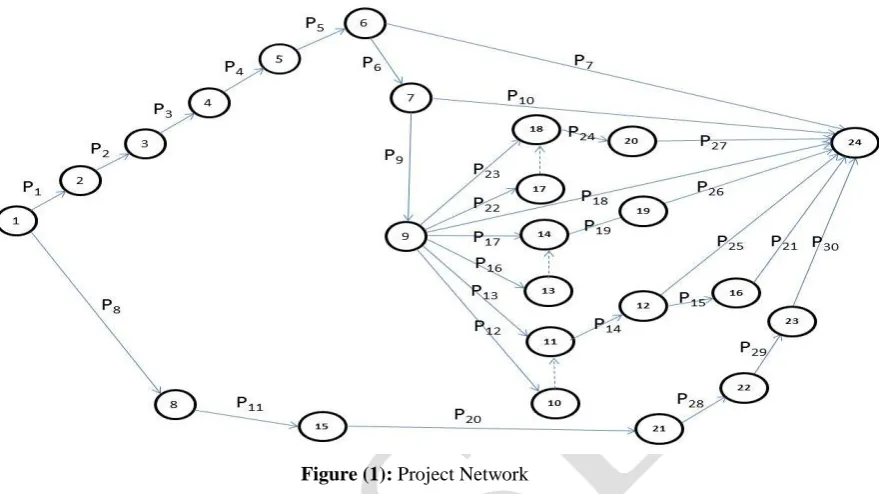
We are considering a project network, figure (1), taken from [29] as a case study.As shown in table (1); the 30 activities are listed with their fuzzy operation times which illustrated by trapezoidal fuzzy number.
Table (1): Construction Project
ActivityItem Activity Description PrecedenceItem Fuzzy Operation Time (per day)
P1 Concrete works foundation - (25,28,30,35)
P2 Insulation works P1 (3,4,4,5)
P3 Parking area + Roads + Landscape P2 (25,29,30,35)
P4 Back filling works P3 (3,7,12,15)
P5 Sub-base P4 (5,6,6,10)
P6 Steel structure erection P5 (26,30,35,40)
P7 Under ground drainage system P5 (7,10,10,13)
P8 Water tank - civil works - (15,21,21,25)
P9 Steel structure testing P6 (2,3,4,5)
P10 Roofing works P6 (9,10,12,15)
P11 Water tank – finishing P8 (6,7,8,10)
P12 HVAC works - 1st fix P9 (12,14,14,16)
P13 Fire fighting works 1st fix P9 (7,9,11,12) P14 Electrical system works - 1st fix P12, P13 (5,6,7,10)
P15 Flooring P14 (7,9,11,12)
P16 HVAC work-2nd fix P9 (12,14,14,16)
P17 Fire fighting works – 2 nd
fix P9 (7,9,11,12)
P18 Cladding works P9 (15,24,25,30)
P19 Electrical system works - 2nd fix P16,P17 (5,6,7,10)
P20 Water tank – MEP P11 (9,11,12,14)
P21 Finishing works P15 (15,18,18,20)
P22 HVAC works - 3rd P9 (12,14,14,16)
P23 Fire fighting work - 3rd fix P9 (7,9,11,12) P24 Electrical system works -3rd fix P22,P23 (5,6,7,10)
P25 Plumbing works - 1st fix P14 (5,6,6,8)
P26 Plumbing works – 2nd fix P19 (5,6,6,8)
P27 Plumbing works - 3rd fix P24 (5,6,6,8)
P28 Water tank testing P20 (1,2,2,3)
P29 Testing and commissioning P28 (1,2,2,3)
ISSN: 2319-8753
I
nternational
J
ournal of
I
nnovative
R
esearch in
S
cience,
E
ngineering and
T
echnology
(An ISO 3297: 2007 Certified Organization)
Vol. 3, Issue 11, November 2014
Figure (1): Project Network
In order to solve such problem, two methods are derived in [29] to convert the fuzzy time number to crisp time number and find the optimum value for objective function and the critical path for activities by using two different linear programming models.
In this paper, two defuzzification approaches are implemented using FLPP to solve this problem as following:
IV-1 First Approach:
In this approach our problem can be expressed as the following (0-1) integer model (one objective function) with fuzzy time number, which can be written as:
Maximize
(25,28,30,35)P1 + (3,4,4,5)P2 + (25,29,30,35)P3 + (3,7,12,15)P4 + (5,6,6,10)P5 + (26,30,35,40)P6 + (7,10,10,13)P7 + (15,21,21,25)P8 + (2,3,4,5)P9 + (9,10,12,15)P10 + (6,7,8,10)P11 + (12,14,14,16)P12 + (7,9,11,12)P13 + (5,6,7,10)P14 + (7,9,11,12)P15 + (12,14,14,16)P16 + (7,9,11,12)P17 + (15,24,25,30)P18 + (5,6,7,10)P19 + (9,11,12,14)P20 + (15,18,18,20)P21 + (12,14,14,16)P22 + (7,9,11,12)P23 + (5,6,7,10)P24 + (5,6,6,8)P25 + (5,6,6,8)P26 + (5,6,6,8)P27 + (1,2,2,3)P28 + (1,2,2,3)P29 + (5,7,7,9)P30
Subject to P1 + P8 =1 P1 = P2 P2 = P3 P3 = P4 P4 = P5 P5 = P6 + P7 P6 = P9 + P10 P8 = P11 P11 = P20 P20 = P28 P28 = P29 P29 = P30
P9 = P12 + P13 + P16 + P17 + P18 + P22 + P23 P12 + P13 = P14
ISSN: 2319-8753
I
nternational
J
ournal of
I
nnovative
R
esearch in
S
cience,
E
ngineering and
T
echnology
(An ISO 3297: 2007 Certified Organization)
Vol. 3, Issue 11, November 2014
P15 = P21 P16 + P17 = P19 P19 = P26 P22 + P23 = P24 P24 = P27
P7 + P10 + P18 + P21 + P25 + P26 + P27 + P30 = 1
Now, by using the first technique that we constructed in section(III-1-1) to convert the FLPP into CLPP, we can rewrite the objective function with crisp numbers as:
Maximize
27P1 + 4P2 + 28.625P3 + 11.125P4 + 5.625P5 + 30.625P6 + 10P7 + 22.5P8 + 3.5P9 + 10P10 + 7.375P11 + 14P12 + 10.375P13 + 6P14 + 10.375P15 + 14P16 + 10.375P17 + 30.5P18 + 6P19 + 10.75P20 + 16.875P21 + 14P22 + 10.375P23 + 6P24 + 6.125P25 + 6.125P26 + 6.125P27 + 2P28 + 2 P29 + 7P30.
On solving CLPP by implementing (0-1)ILP, the following optimal solutions are obtained: 1→2→3→4→5→6→7→9→10→11→12→16→24,
which has the maximum time value = 157.75 days.
IV-2 Second Approach:
This approach can be shown using the constructed equation (28) to find the expected (crisp) time for each activity fuzzy time number 𝐴 𝑖 = 𝑎1, 𝑎2, 𝑎3, 𝑎4 , 𝑖 = 1,2, … . ,30, and choosing several values for ∝-cut (∝=0, 0.1, 0.25, 0.5,
0.75, 1) and solve the problem considering the following model: Minimize
Z = t24− 𝑡1
Subject to
𝑡2− t1≥ te1
t3− t2≥ te2
t4− t3≥ te3
t5− t4≥ te4
t6− t5≥ te5
𝑡7− t6≥ te6
t24− 𝑡6≥ te7
t8− t1≥ te8
𝑡9− t7≥ te9
t24− t7≥ te10
t15− t8≥ te11
t10− t9≥ te12
𝑡11− t9≥ te13
t12− t11≥ te14
t16− t12≥ te15
t13− 𝑡9≥ te16
t14− t9≥ te17
𝑡24− t9≥ te18
t19− t14≥ te19
t21− t15≥ te20
t24− t16≥ te21
t17− 𝑡9≥ te22
𝑡18− t9≥ te23
t20− t18≥ te24
t24− t12≥ te25
t24− t19≥ te26
t24− t20≥ te27
t22− t21≥ te28
𝑡23− t22≥ te29
ISSN: 2319-8753
I
nternational
J
ournal of
I
nnovative
R
esearch in
S
cience,
E
ngineering and
T
echnology
(An ISO 3297: 2007 Certified Organization)
Vol. 3, Issue 11, November 2014
ti≥ 0, i = 1,2,3, … ,24.
where 𝑡𝑒𝑗, j=1,2,…,30 are the expected times that obtained by equation (28).
The six α-cuts were used in the our LP model resulting six different LP models to be solved by “MATLAB/R2010b” software, which was employed to developed a code to solve these Linear models. Table (2) shows the solution of the six LP corresponding to all α-cuts, it is obvious that the critical path (t1→ t2→t3→t4→t5→t6→t7→t9→t11→t12→t16→t24) is the only solution for all LP.
The solution should lies between the values of 161days (upper) and 158.5 days (lower) after been rank.
Table(2):Summary Results of Extended Ranking Method for Different Values of α-cuts.
α-cut value Critical paths duration Criticality state
0 t1→ t2→t3→t4→t5→t6→t7→t9→t11→t12→t16→t24 161 strong
0.1 t1→ t2→t3→t4→t5→t6→t7→t9→t11→t12→t16→t24 160.95 weak
0.25 t1→ t2→t3→t4→t5→t6→t7→t9→t11→t12→t16→t24 160.375 Strong
0.5 t1→ t2→t3→t4→t5→t6→t7→t9→t11→t12→t16→t24 159.75 Weak
0.75 t1→ t2→t3→t4→t5→t6→t7→t9→t11→t12→t16→t24 159.25 Strong
1 t1→ t2→t3→t4→t5→t6→t7→t9→t11→t12→t16→t24 158.5 Strong
V. CONCLUSIONS
Over the past few decades, researchers have proposed many FLP models with different levels of sophistication. However, many of these models have limited real-world applications because of their methodological complexities and flexible assumption. In contrast, our proposed approaches in this study are straight forward and flexible. The managerial of the proposed approaches are their applicability to a wide range of real-word problems such as performance evaluation.We proposed our models with two new defuzzification methods for solving FLPP in which the objective function are characterized by fuzzy numbers.
In the first method, we transformed our FLP model into zero-one integer linear programming (0-1ILP) model by using a new defuzzification technique with probability density function from membership function to obtain the crisp optimal solutions.In the second method, we proposed a LP model with fuzzy variables in both the objective function and the constraints using a new defuzzification technique by implementing the extended ranking method for identifying the crisp optimal solutions.We demonstrated the details of the two proposed methods with a case study taking from [29]. The tables results show us the same optimal critical path for different values of membership, which give us more credit to our proposed defuzzification methods.
REFERENCES
[1] Prade H., “Using fuzzy set theory in a scheduling problem: a case study”, Fuzzy Sets and Systems, Vol. 2, pp. 153-165,1979.
[2] Chanas S. and Kamburowski J., “The use of fuzzy variables in PERT”, Fuzzy Sets and Systems,Vol. 5, pp. 11-19,1981.
[3] Dubios D. and Prade H.,“Decision-making under fuzziness”, Advances in Fuzzy Set Theory and Applications, North-Holland, Amsterdam, pp.
279-302, 1979.
[4] Hapke M. and Slowinski R., “A DSS for resource-constrained project scheduling under uncertainty”, Journal of Decision Systems, Vol. 2, pp.
111-128, 1993.
[5] Kaufmann A. and Gupta M.M., “Fuzzy Mathematical Models in Engineering and Management Science”, North-Holland, Amsterdam, 1988.
[6] Ke H. and Liu B.D., “Fuzzy project scheduling problem and its hybrid intelligent algorithm”, Applied Mathematical Modelling, Vol. 34, pp.
301-308,2010.
[7] Tanaka, H., Okuda, T., &Asai, K.,“On fuzzy mathematical programming”, Journal of Cybernetics, Vol. 3, Issue 4, pp. 37-46, 1974.
[8] Bellman, R. E., &Zadeh, L. A.,“Decision making in a fuzzy environment”, Management Science, Vol. 17, Issue 4, pp. 141-164, 1970.
[9] Zimmerman, H. J.,“Fuzzy programming and linear programming with several objective functions”, Fuzzy Sets and Systems,Vol. 1, pp. 45-55,
1978.
[10] Zimmermann, H. J.,“Fuzzy sets, decision making and expert systems”, Boston, MA: Kluwer Academic, 1987.
[11] Luhandjula, M. K.,“Fuzzy optimization: An appraisal”, Fuzzy Sets and Systems, Vol. 30, Issue 3, pp. 257-282, 1989.
[12] Zhang, G., Wu, Y. H., Remias, M., & Lu, J.,“Formulation of fuzzy linear programming problems as four-objective constrained optimization
problems”, Applied Mathematics and Computation, Vol. 139, Issue 2-3, pp. 383-399, 2003.
[13] Stanciulescu, C., Fortemps, P., Installé, M., & Wertz, V.,“Multiobjective fuzzy linear programming problems with fuzzy decision variables”,
ISSN: 2319-8753
I
nternational
J
ournal of
I
nnovative
R
esearch in
S
cience,
E
ngineering and
T
echnology
(An ISO 3297: 2007 Certified Organization)
Vol. 3, Issue 11, November 2014
[14] Ganesan, K., &Veeramani, P.,“Fuzzy linear programs with trapezoidal fuzzy numbers”, Annals of Operations Research, Vol. 143, Issue 1, pp.
305-315, 2006.
[15] Ebrahimnejad, A.,“Some new results in linear programs with trapezoidal fuzzy numbers: Finite convergence of the Ganesan and Veeramani’s
method and a fuzzy revised simplex method”, Applied Mathematical Modelling, Vol. 35, Issue 9, pp. 4526-4540, 2011.
[16] Mahdavi-Amiri, N., &Nasseri, S. H., “Duality in fuzzy number linear programming by use of a certain linear ranking function”, Applied
Mathematics and Computation, Vol. 180, pp. 206-216, 2006.
[17] ZadehLotfi, F., Allahviranloo, T., AlimardaniJondabeh, M., &Alizadeh, L.,“Solving a full fuzzy linear programming using lexicography
method and fuzzy approximate solution”, Applied Mathematical Modelling, Vol. 33, Issue 7, pp. 3151-3156, 2009.
[18] Kumar, A., Kaur, J., & Singh, P.,“A new method for solving fully fuzzy linear programming problems”, Applied Mathematical Modelling,
Vol. 35, Issue 2, pp. 817-823, 2011.
[19] Ebrahimnejad, A., Nasseri, S. H., Lotfi, F. H., &Soltanifar, M.,“A primal-dual method for linear programming problems with fuzzy variables”,
European Journal of Industrial Engineering, Vol. 4, Issue 2, pp. 189-209, 2010.
[20] Mahdavi-Amiri, N., &Nasseri, S. H., “Duality results and a dual simplex method for linear programming problems with trapezoidal fuzzy
variables”, Fuzzy Sets and Systems, Vol. 158, Issue 17, pp. 1961-1978, 2007.
[21] Saneifared R.,“Ranking L-R Fuzzy Number with Weighted Averaging Based on Levels”, International Journal of Industrial Mathematics, Vol.
2,pp. 163-173, 2009.
[22] Heilpern S.,“The Expected Value of a Fuzzy Number”, Fuzzy Sets and Systems, Vol. 47,pp. 81-86, 1992.
[23] Kauffman A., Gupta M.M., “Introduction to Fuzzy Arithmetic: Theory and Application”, Van Nostrand Reinhold, New York, 1991.
[24] Dubios D. and Prade H., “Fuzzy Sets and Systems: Theory and Applications”, Fuzzy Sets, Vol. 9, 1980.
[25] Chanas S., and Zielinski P., “Critical path analysis in the network with fuzzy activity times”,Vol. 122, pp. 195-204, 2001.
[26] D. H. Rao, S. S. “Saraf. Study of Defuzzification Methods of Fuzzy Logic Controller for Speed Control of a DC Motor”, IEEE Transactions,
pp. 782-787, 1995.
[27] Yoon, K.P.,“A probabilistic approach to rank complex fuzzy numbers”, Fuzzy Sets and Systems, Vol. 80, pp. 167-176, 1996.
[28] Yager, R.R., “A procedure for ordering fuzzy subsets of the unit interval”, Information Science, Vol. 24, Issue 2, pp. 143-161, 1981.
[29] Mohamed F. El-Santawy, Soha M. Abd-Alla,“The Longest Path Problem in Fuzzy Project Networks: A Case Study”, Gen. Math. Notes, Vol.
3, Issue 2, pp. 97-107, 2011.
BIOGRAPHY
Prof.Dr.Alaulden N. Ahmed is specialist in different areas of Operation Researches. He received his Ph.D in 1986 from UK. He supervised of more than 50 M.Sc. students and 5 Ph.D students.