© 2017, IJCSMC All Rights Reserved 15 Available Online atwww.ijcsmc.com
International Journal of Computer Science and Mobile Computing
A Monthly Journal of Computer Science and Information Technology
ISSN 2320–088X
IMPACT FACTOR: 6.017IJCSMC, Vol. 6, Issue. 12, December 2017, pg.15 – 19
The Comparison between Leach Protocol
and Pegasis Protocol based on Lifetime
of Wireless Sensor Networks
Payal Jain
1, Dr. Anu Chaudhary
21
Research Scholar, Mewar University Chittorgarh, Rajasthan
2
Professor, IT Department AKGEC, GZB
1
[email protected], [email protected]
Abstract--- Energy efficiency of the wireless sensor network mainly depends on the Routing protocols. In this paper two hierarchal protocols are used. There are various hierarchal protocols but we will discuss the two protocols i.e. LEACH and PEGASIS. Low Energy Adaptive Clustering Hierarchy (LEACH) and Power Efficient Gathering in Sensor Information System (PEGASIS). Hierarchal protocol uses the data aggregation clustering. Data aggregation is a process to reduce the duplicity of data transmission. Comparison is to be done between the Leach protocol and Pegasis protocol in terms of energy efficiency using Matlab.
Keywords: WSN, LEACH, PEGASIS, Matlab.
INTRODUCTION:
© 2017, IJCSMC All Rights Reserved 16
As sensor nodes are generally battery-powered devices, the critical aspects to face concern how to reduce the energy consumption of nodes, so that the network lifetime can be to reasonable times. WSNs possible today due to technological advancement in various domains, it envisioned to become an essential part of our lives[7], it designs Constraints need to be satisfied for realization of sensor networks and also tremendous research efforts being made in different layers of WSNs protocol stack. The factors Influencing WSN Design is: extended
• Fault tolerance • Scalability • Production costs • Hardware constraints • Sensor network topology • Environment
• Transmission media • Power Consumption • Sensing
• Communication • Data processing •
ROUTING PROTOCOLS IN WSN: 1. Location based protocols 2. Data-centric protocols 3. Hierarchal based protocols 4. Mobility based protocols 5. Multi-path based protocols 6. QOS based protocols
In this paper the routing protocols used are the hierarchal based protocols i.e. Leach and Pegasis. Comparison of both the protocols is done in the terms of network lifespan[14].
LEACH
© 2017, IJCSMC All Rights Reserved 17
PEGASIS
Power efficient gathering in sensor information systems. Pegasis follows the chain based approach and greedy algorithm[6].The sensor nodes organize themselves to form the chain or it uses the greedy approach. If any of the node dies in between then the chain is reconstructed to bypass the dead node, One leader node is assigned and that node will transmit the data to the base station(BS)[12].The main goal of Pegasis is to receive and transmit data to and from the nearest neighbour and take turns being the leader for transmission to the BS[13].Gathered data moves from node to node, get fused and eventually a designated node transmits to the base station. Leader of each node is selected randomly. All the data is collected to the leader node, get fused and send it to the base station[9].
TABLE I.
COMPARATIVE TABLE FOR LEACH AND PEGASIS
LEACH PROTOCOL PEGASIS PROTOCOL
LEACH is an hierarchical routing protocol PEGASIS is an hierarchical routing protocol
LEACH is cluster-based hierarchy PEGASIS is a chain-based approach
Supports data aggregation No data aggregation occurs
No of dead nodes are more No of dead nodes are less
Simulation Result:
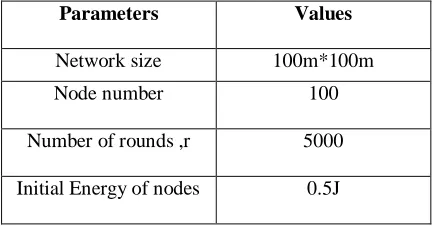
In this section, the performance of proposed work has been evaluated by carrying out simulations. Now to prove the effectiveness of the proposed approach is done using MATLAB [11]. Let us assume 100 sensor nodes having the area of network 100*100m.sq in which (50, 50) nodes are randomly distributed in four regions.
TABLE 1
THE SIMULATION PARAMETERS ARE SHOWN IN:
Parameters Values
Network size 100m*100m
Node number 100
Number of rounds ,r 5000
Initial Energy of nodes 0.5J
© 2017, IJCSMC All Rights Reserved 18
LEACH:
PEGASIS:
In the above figure simulation is carried out inside the sensing field. As the number of rounds increases, number of alive nodes decreases due to power consumption, the results show that PEGASIS has higher network lifetime as compared to LEACH and it increases with the increase in percentage of nodes death.
CONCLUSIONS
© 2017, IJCSMC All Rights Reserved 19
References
[1] J. N. Al-karaki , Ahmed E. Kamal, “Routing Techniques in Wireless Sensor Networks: A Survey,” IEEE Wireless Communications, December 2004
[2] M. Younis, M. Youssef and K. Arisha, “Energy-Aware Routing in Cluster-Based Sensor Networks,” in the Proceedings of the 10th IEEE/ACM(MASCOTS2002), Fort Worth, TX, October 2002.
[3] Stephanie Lindsey, Cauligi S. Raghavendra,” PEGASIS: Power-Efficient Gathering in Sensor Information Systems”, 2010. [4] Chunyao FU1, Zhifang JIANG1, Wei WEI2 and Ang WEI,” An Energy Balanced Algorithm of LEACH Protocol in WSN”, 2013.
[5] D. Estrin, Y. Xu, and J. Heidemann. Geography-informed Energy Conservation for Ad-Hoc Routing. In Proceedings of the 7th Annual ACM/IEEE International Conferenceon Mobile Computing and Networking (MOBICOM), Rome,Italy, pages 70–84, J sensor networks. In 1st International Workshop on Parallel and Distributed Computing Issues in Wireless Networks and Mobile Computing.
[6] Stephanie Lmdsey and CauligiS.Raghavendra, “PEGASIS: Power-Efficient Gathering in Sensor Information Systems”, IEEE 2002.
[7] Ossama Younis, Student Member, IEEE, and Sonia Fahmy, Member, IEEE,”HEED: A Hybrid,Energy-Efficient, Distributed Clustering Approach for Ad Hoc Sensor Networks”,2004.
[8] Chunyao FU1, Zhifang JIANG1, Wei WEI2 and Ang WEI,” An Energy Balanced Algorithm of LEACH Protocol in WSN”, 2013.
[9] Devasenal , Sowmya, “A Study of Power and Energy Efficient Clustering Protocols in Wireless Sensor Networks”, 2013. [10] Dipti Balkrushna Ram, Grishma ShaileshKumar Shah,”Analysis of Different Hierarchical Protocol of Wireless Sensor Networks”, 2013.
[11] Jalal Habibi, Amir G.Aghdam and Ali Ghrayeb,”Framework for Evaluating the Best Achievable Performance by Distributed Lifetime-efficient Routing Schemes in Wireless Sensor Networks”, IEEE Transactions on Wireless Comunication, 2015.
[12] Di Tang Tongtong Li Jian Ren Jie Wu, “Cost-Aware SEcure Routing (CASER) Protocol Design for Wireless Sensor Networks”, IEEE Transactions on Parallel and Distributed Systems, Vol .13, April 2014.
[13] http://en.wikipedia.org/wiki/Sensor_Networks