Volume 5, No. 3, March-April 2014
International Journal of Advanced Research in Computer Science
REVIEW ARTICLE
Available Online at www.ijarcs.info
Review on Network and Device Aware QOS Approach for Cloud Based Mobile
Streaming
Reshma T R
Department of Computer Science & Engineering Nehru college of Engineering & Research Centre
Kerala, India
Jasmine Joseph
Department of Computer Science & Engineering Nehru college of Engineering & Research Centre
Kerala, India
Abstract: Multimedia services provide an efficient, flexible, and scalable data processing method and offer a solution for the user demands of high quality and diversified multimedia. As intelligent mobile phones, tablets and wireless networks have begun popularize, network services for users are no longer limited to the home. The public has started to use mobile devices to view the multimedia videos by means of streaming. All multimedia file format is not supported by the mobile devices. Users always expect to watch file at anytime from anywhere, no matter what changes occur in the network environments. To overcome the limited bandwidth available for mobile streaming and different device requirements, presented a network and device-aware Quality of Service approach that provides multimedia data suitable for a terminal unit environment. It further considering the overall network environment and adjusting the interactive transmission frequency and the dynamic multimedia transcoding. Based on the bandwidth value the appropriate transcoding format is selected, hence avoiding the wastage of the bandwidth and the terminal power. QoS approach could provide efficient self adaptive multimedia streaming services for varying bandwidth environments.
Keywords: Cloud multimedia, Adaptive QoS, Network and device aware.
I. INTRODUCTION
Cloud computing is the use of are delivered as a service over a the shaped symbol as an abstraction for the complex infrastructure it contains in system diagrams. Cloud computing entrusts remote services with a user's data, software and computation. The basic technique of cloud computing is derived from distributed computing and grid computing. To provide rich media services, multimedia computing has emerged as a noteworthy technology to generate, edit, process, and search media contents, such as images, video, audio, graphics, and so on. For multimedia applications and services over the Internet and mobile wireless networks, there are strong demands for cloud computing because of the significant amount of computation required for serving millions of Internet or mobile users at the same time. In recent years, as mobile devices have developed rapidly, users have been able to access network services anywhere and at anytime. Especially with the development of 3G and 4G networks, multimedia services have become universal application services. Cloud multimedia services provide an efficient, flexible, and scalable data processing method and offer a solution for the user demands of high quality and diversified multimedia. Multimedia applications and services over wireless networks is challenging due to constraints and heterogeneities such as limited battery power, limited bandwidth, random time-varying fading effect, different protocols and standards, stringent QoS requirements.
Sharing is an integral part of cloud service. The request of easy sharing is the main reason the multimedia contents occupy a large portion of cloud storage space.
Conventionally, multimedia sharing happens only when the person who shares the contents and the person who is
shared with are both online and have a high-data-rate connection. Cloud computing is now turning this synchronous process into an asynchronous one and is making one-to-many sharing more efficient. Instantaneous music and video sharing can be achieved via streaming. Compared to the conventional streaming services operating through proprietary server farms of streaming service providers, cloud-based streaming can potentially achieve much a lower latency and provide much a higher bandwidth. Media is usually streamed from prerecorded files but can also be distributed as part of a live broadcast feed. In a live broadcast, the video signal is converted into a compressed digital signal and transmitted from a Web server a same time. Streaming media is transmitted by a server application and received and displayed in real-time by a client application called a media player. A media player can be either an integral part of a browser, a plug-in, a separate program, or a dedicated device, such as an iPod. Frequently, video files come with embedded players. YouTube videos, for example, run in embedded media technologies have improved significantly since the 1990s, when delivery was typically uneven. However, the quality of streamed content is still dependent upon the user's connection speed. Streaming media is video or audio content sent in compressed form over the Internet and played immediately, rather than being saved to the hard drive. With streaming media, a user does not have to wait to download a file to play it. Because the media is sent in a continuous stream of data it can play as it arrives. Users can pause, rewind or fast-forward, just as they could with a downloaded file, unless the content is being streamed live. Here are some advantages of streaming media:
b. Allows content deliverers to monitor what visitors are watching and how long they are watching it.
c. Provides an efficient use of bandwidth because only the part of the file that's being transferred is the part that’s being watched.
d. Provides the content creator with more control over his intellectual property because the video file is not stored on the viewer's computer. Once the video data is played, it is discarded by the media player.
Video communication over mobile broadband networks today is challenging due to limitations in bandwidth, different device requirements and difficulties in maintaining high reliability, quality, and latency demands imposed by rich multimedia applications. As the number of network users is rapidly increasing, bandwidth insufficiency will occur and then network multimedia services will be affected significantly. Differing from general services that have a high acceptance rate for packet loss, multimedia packets emphasize the correctness, sequence order and real-time nature of packets. When a multimedia video service is applied, the service quality declines greatly while trying to meet the demands of video transmission. As the Internet becomes the ultimate archive for all of the personal stuffs like photos, emails, etc and it's mixed with the full streaming of content, bandwidth becomes the new hard drive. This will be the big and hard media hurdle. Here have issues of bandwidth throttling and the ability to have unlimited data is becoming a topic of heated discourse. Unlimited data through high speed and mobile access is inevitability and it's also going to be an amazing media experience for the consumer. Getting the content producers, hardware manufacturers and access providers to play nicely is where the challenge lies. This form of streaming is inevitable, and once consumers experience it and understand it. The Internet speed is actually the bandwidth available to accept data from the Internet into the system. Measured in megabits per second (Mbps), it's the amount of data that can be transferred from the cloud to the connected devices in one second.
II. RELATED WORK
For multimedia videos, stability is of the greatest importance. No matter what the service is, users will always expect powerful, sound and stable functions. Users expect to watch videos smoothly and at a certain level of quality, no matter what changes occur in the network environment. However, the existing video platforms often provide inconsistent playback, resulting from the fluctuation of network on-line quality, especially with mobile devices, which have limited bandwidth and terminal unit hardware resources. Users often view live videos that freeze have intermittent sound, or even failure to operate. Therefore, how to execute smooth playback with limited bandwidth and the different hardware specifications of mobile streaming is an interesting challenge. In the previous service, the mobile device side exchanges information with the cloud environment, so as to determine an optimum multimedia video. Scholars have done numerous researches toward conventional platform or CDN to store different movie formats in a multimedia server, to choose the right video stream according to the current network situation or the hardware calculation capabilities. To solve this problem, many researchers have attempted dynamic encoding to
transfer media content, but still cannot offer the best video quality [3]. By the use of multimedia content and applications the network traffic is increased.
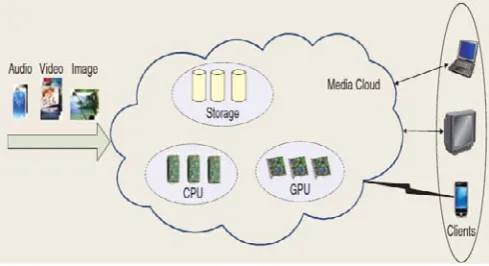
[image:2.595.318.563.244.377.2]Multimedia cloud computing is address from multimedia-aware cloud or media cloud and cloud-aware multimedia or cloud media perspectives. Multimedia-aware cloud, addresses how a cloud can provide QoS for multimedia services. Cloud media focuses on how multimedia can perform its content storage, processing, adaptation, rendering and so on. To achieve a high QoS for multimedia services, have a media-edge cloud or MEC architecture, in which storage, central processing unit or CPU, and graphics processing unit or GPU clusters are presented at the edge to provide distributed parallel processing and QoS adaptation for various types of devices [2]. The architecture is shown in Fig.1.
Figure 1. Multimedia Cloud Computing Architecture
Using a general-purpose cloud in the Internet to deal with multimedia services may suffer from unacceptable media QoS or QoE. Mobile devices have limitations in memory, computing power, and battery life. Thus have even more prominent needs to use a cloud to address the tradeoff between computation and communication. It is foreseen that cloud computing could become a disruptive technology for mobile applications and services. In mobile media applications and services, because of the power requirement for multimedia and the time-varying characteristics of the wireless channels, QoS requirements in cloud computing for mobile multimedia applications and services become more stringent than those for the Internet cases.
cross-layer part of the architecture is confined into the client proxy which is the only component that depends on the mobile device operating system. a server-proxy is needed for each corresponding client, even if a given server-proxy may serve more than one client simultaneously. In addition, the server-proxy should be located close to the client so as to reduce the network latency and optimize the server’s responsiveness. The disadvantage of cross layer architecture is the impact of dependability issues, such as fault tolerance and security, on their design.
Kim et al. [5] introduced the seamless streaming of multimedia content that ensures Quality of Service over heterogeneous networks has been a desire for many multimedia services, for which the multimedia contents should be adapted to usage environments such as network characteristics, terminal capabilities, and user preferences. Scalability in video coding is a good feature to meet the requirement of heterogeneous networks. The access and consumption of multimedia content over heterogeneous networks by using diverse terminals in a seamless and transparent way, which is referred to as Universal multimedia access or UMA, has being recognized as an essential application in convergent environment. In UMA, video adaptation that is performed according to usage environments such as network characteristics, terminal capabilities, and user preferences, is required to maximize consumer experience and ensure Quality of Service.
Currently, the Joint Video Team of the ISO/IEC Moving Picture Experts Group and the ITU-T Video Coding Experts Group is standardizing a new scalable video coding standardization, called as SVC, which will become an extension to H.264/MPEG-4 AVC. Transcoding is a technology used to reformat video content so that it can be viewed on any of the increasing number of diverse devices on the market. A dynamic adaptation method of Scalable Video Coding using MPEG-21 Digital Item Adaptation or DIA that can provide an optimally adapted video stream over heterogeneous networks. This method provides scalability at a bit-stream level simultaneously with similar coding efficiency as H.264/MPEG-4 AVC [6]. There are some issues to be necessarily considered in video adaptation. First, complexity of adaptation process should be as low as possible to react immediately to time varying network conditions. Second, video bit-stream has to be
transmitted and stored with a variety of spatio-temporal resolution and bit-rate, which provides flexibility in the video adaptation. The video adaptation should be performed in an interoperable way to be deployed across heterogeneous service environment.
Tan et al. [7] described media cloud that provides a cost-effective and powerful solution for the coming tide of the media consumption. The integration of cloud computing and media processing is called media cloud. The emergence of media cloud not only has great impact on the related research and technologies such as the architecture of the cloud computing platform, media processing, storing, delivery, and sharing, but also has profound impact on the commercial model, industry strategy, and even the society. Media cloud architecture consisting of five components
a. Cloud administrative services.
b. Ingest services which accept media input from a wide range of sources.
c. Streaming services.
d. Video services which manage and deliver videos across media channels to various clients.
e. Storage subsystems for content cache and movement, storage, and asset management.
To reduce delay and jitter of media streaming, hence providing better QoS of multimedia services, a MEC architecture is introduced. In this architecture, an MEC is a cloudlet which locates at the edge of the cloud. Within an MEC, it uses P2P technology for distributed media data storage and computation. It’s composed of storage, CPU, and GPU clusters. The MEC stores, processes, and transmits media data at the edge, thus achieving a shorter delay. It is not unique that proxy is adopted to seamlessly integrate media cloud with the outside world, hence provides a solution for some of the heterogeneity problems. The challenges of media cloud are seamless integrating existing systems to the media cloud, exerting the power of media cloud, making the media cloud highly scalable to adapt to new services and applications, making the media cloud profitable and finding innovative and suitable applications for media cloud.
A. Comparison on Quality of service approaches:
The parameters scalability, self adaptive service and quality of services are analyzed below in the Table.I.
Table.1 Comparsion On QoS Approaches
Section Approach Used Scalability Self Adaptive
Service
Quality Of Service
Multimedia Clod Computing MEC Architecture Medium Yes High
Dynamic and Interoperable Dynamic SVC
UMA and MPEG-21 DIA Good Yes Medium
Seamless Support Cross Layer Architecture Poor No Medium
Media Cloud P2P Based MEC Architecture
Good. No Medium
Wireless Interactive Multimedia Streaming
Dual Bit Stream Least Cost Scheme
Good Yes High
III. NETWORK AND DEVICE-AWARE QOS APPROACH
The wireless communications and networking protocols will ultimately bring video to our lives anytime, anywhere, and on any device. In network and device-aware QoS
approach the following parameters dynamically adjust the communication mechanism and manage multimedia files to provide self-adaptive multimedia streaming services according to the environmental parameters of various devices in a cloud environment. The major contributions are a. Different from mobile streaming, this approach
mobile dynamic mobile environments. This can provide a more stable streaming service for an unstable network. Compared to a stable network, the losses of bandwidth and power in the terminal units caused by excessive packet transmission can be reduced.
b. For the device parameters, this used a Bayesian network environment and a multi-variable linear regression model to predict whether the multimedia files in different formats would conform to the required real-time needs for the streaming mechanism and to consider whether the overall electric consumption of the device could provide a complete multimedia file playback service.
c. This determined the optimum image adjustment layers according to the environmental parameters like arithmetic capability, electric quantity of the battery, electric consumption rate and bandwidth fed back from the device for SVC multimedia files, so as to obtain a better dynamic adjustment mechanism and to avoid the provision of a fixed quality which would reduce the image quality.
d. This used a virtual environment to simulate the overall cloud multimedia environment for the proposed mechanism, and then used stream-limiting software to realize a prototype module of the overall architecture. The feasibility of the proposed method was validated and the related experiment was analyzed by constructing the prototype environment.
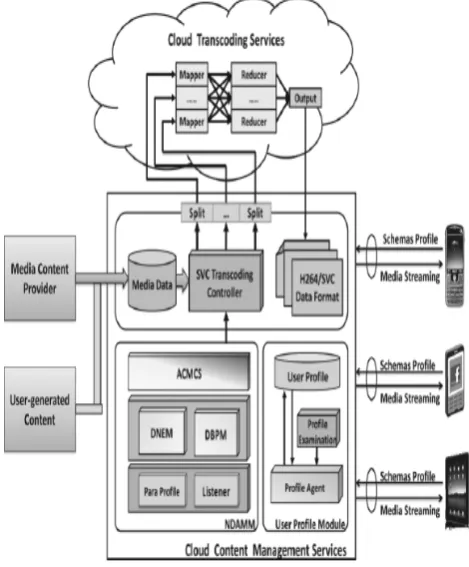
The system provided an efficient interactive streaming service for diversified mobile devices and dynamic network environments. When a mobile device requests a multimedia streaming service, it transmits its hardware and network environment parameters to the profile agent in the cloud environment, which records the mobile device codes and determines the required parameters, and then transmits them to the Network and Device-Aware Multi-layer Management or NDAMM. The NDAMM determines the most suitable SVC code for the device according to the parameters, and then the SVC Transcoding Controller or STC hands over the transcoding work via map-reduce to the cloud, in order to increase the transcoding rate. Finally, the multimedia video file is transmitted to the mobile device through the service. The architecture is given in the Fig.2. There are 6 modules in this architecture. They are explained below.
A. User Login Module:
[image:4.595.317.552.61.345.2]Only the trusted users are permitted to request and access the multimedia file via Network QoS system. There are two options in it, watch the videos which are stored in the server and user can upload the video directly to the server. The new user can signup to the system and enter their details like user name, password and email id. Only it is entered that user got the permission to access the file as needed. The admin can view the userlog details like name of the media file viewed, name of the user who viewed the file with date and time also by entering the username and password. Only the admin can view these details.
Figure 2. Structure of Cloud-based Mobile Streaming
B. User Profile Module:
The profile agent is used to receive the mobile hardware environment parameters and create a user profile. The mobile device transmits its hardware specifications in XML-schema format to the profile agent in the cloud server. The XML-schema is metadata, which is mainly semantic and assists in describing the data format of the file. An additional profile examination is needed to provide the test performance of the mobile device and sample relevant information. Through this function, the mobile device can generate an XML-schema profile and transmit it to the profile agent. The profile agent determines the required parameters for the XML schema and creates a user profile, and then transmits the profile to the DAMM for identification.
C. Network and Device Aware Multi-Layer
Management(NDAMM):
CPU operating speed. Db and Db rate represent the existing energy of the mobile device and energy consumption rate, and BW, BWavg, and BWstd represent the existing, average and standard deviation values of the bandwidth. When this parameter form is maintained, the parameters can be transmitted to the network estimation module and the device-aware Bayesian prediction module for relevant prediction.
D. Dynamitic Network Estimation Module (DNEM):
The DNEM is mainly based on the measurement-based prediction concept, however it further develops the Exponentially Weighted Moving Average or EWMA. The EWMA uses the weights of the historical data and the current observed value to calculate gentle and flexible network bandwidth data for the dynamic adjustment of weights. In order to determine the precise network bandwidth value, the EWMA filter estimates the network bandwidth value in which is the estimated bandwidth of the t time interval, is the sum of bandwidth of the t-1 time interval, and the estimation difference.
E. Network and Device-Aware Bayesian Prediction
Module (NDBPM):
The SVC hierarchical structure provides scalability of the temporal, spatial and quality dimensions. This module determines how to choose an appropriate video format according to the available resources of various devices. For that purpose, the study adopted Bayesian theory to infer whether the video features conformed to the decoding action.
The inference module was based on the following two conditions:
a. The LCD brightness does not always change. Users are sensitive to brightness, they dislike video brightness that repeatedly changes.
b. The energy of the mobile device shall be sufficient for playing a full multimedia video full multimedia service must be able to last until the user is satisfied. The bit rate depends on the frame rate and resolution.
F. Proposed Adaptive Communication and Multi-
Layer Content Selection:
When the predicted bandwidth state and the Bayesian predictive network are determined, the cloud system will further determine the communication and the required multimedia video files according to the information. It is based on communication decision & SVC multi-layer content decision.
When the bandwidth interval is completed, the appropriate resolution and frame rate can then be determined as the streaming data. When the mobile device transmits the current network and hardware features to the cloud environment, the NDAMM will predict the bandwidth at the next time point according to the bandwidth and standard deviation and will identify whether the bandwidth state is stable or not. The DBPM infers whether the multimedia video, at different resolutions and frame rates, can complete smooth decoding and whether the hardware can provide complete video playback services, according to the profile examination and subsequent hardware features. Finally the video is played.
IV. EXPERIMENTAL ANALYSIS
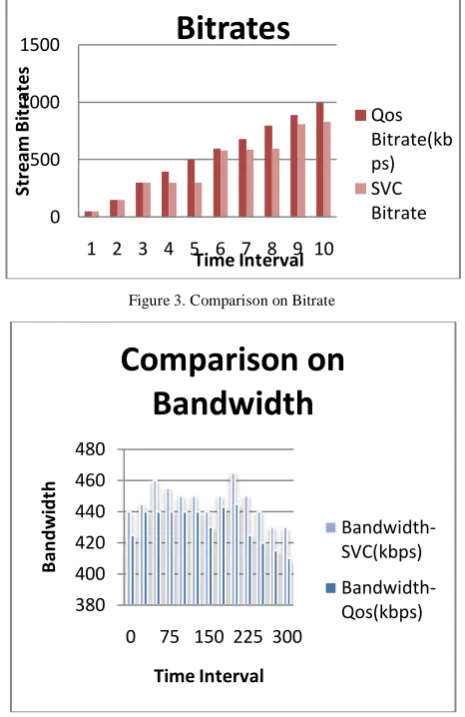
[image:5.595.321.554.276.635.2]According to the experimental result in the previous section, the real-time coding was difficult; therefore, the video was transcoded off-line and the network and hardware features were turned into profiles to be handed over to the system. After coding, the wireless base station limited stream for the simulation experiment. This study first considered the video quality in a static network. The result is shown in the following Fig. 3 and 4. Wireless multimedia streaming was carried out at a fixed bandwidth. It was observed that in the case of stream limiting caused by a fixed bandwidth, the mechanism proposed in this study used the network mean value as the intermediate unit of the video quality. This had a better effect in comparison to the other two fixed quality codings, but the overall improvement effect was not obvious. For a dynamic network, this study used bandwidth-recording software to record at intervals of 3 seconds.
Figure 3. Comparison on Bitrate
Figure 4. Comparison on Bandwidth
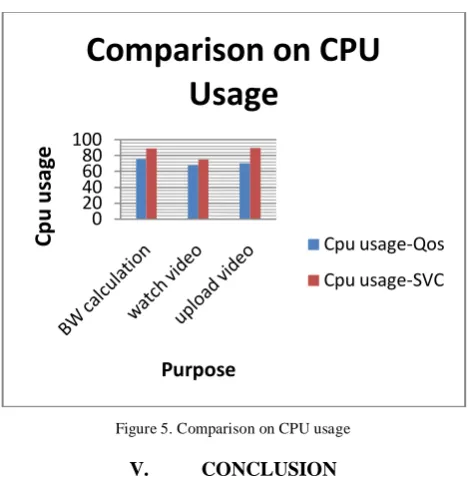
For mobile multimedia services, the characteristics of the mobile devices had to be considered. Different battery energy were set and the number of applications was increased to change the CPU load, and the instances of video freeze in the three network states were compared. The result is shown in the Fig.5 . It was obvious that decoding was likely to fail at a high CPU utilization rate. In terms of battery energy, although it reduced the multimedia resolution and frame rate, complete multimedia playback service could be assured. According to the test result, the effects of the CPU were mostly seen in the frame rate, and
0 500 1000 1500
1 2 3 4 5 6 7 8 9 10
St
re
am
B
it
ra
te
s
Time Interval
Bitrates
Qos Bitrate(kb ps) SVC Bitrate
380 400 420 440 460 480
0 75 150 225 300
Ba
ndw
idt
h
Time Interval
Comparison on
Bandwidth
the battery energy parameters could be improved effectively by changing the multimedia resolution.
Figure 5. Comparison on CPU usage
V. CONCLUSION
Investigated the challenges in multimedia streaming and proposed the Network and Device Aware QoS approach which provide efficient self-adaptive multimedia streaming services for varying bandwidth environments. It is analyzed and evaluated against the parameters like bitrate, bandwidth and CPU usage. Based on the device parameters and bandwidth the appropriate file format is selected. Hence the power and bandwidth are efficiently utilized.
VI. REFERENCES
[1] Chin-Feng Lai, Honggang Wang, Han-Chieh Chao, and Guofang Nan,”A network and device aware QoS approach for
cloud based mobile streaming”, IEEE Trans. multimedia., vol.15, no. 4, june 2013.
[2] Wenwu Zhu, Chong Luo, Jianfeng Wang, and Shipeng Li, “Multimedia cloud computing” in IEEE Signal Process. Mag., vol. 28, no. 3, pp. 59–69, 2011.
[3] K. E. Psannis, Y. Ishibashi, and M.G.Hadjinicolaou, “QoS for wireless interactive multimedia streaming,” in Proc. ACM Workshop QoS and Security for Wireless and Mobile Networks, 2007, pp. 168–171.
[4] S. Ferretti, V. Ghini, F. Panzieri, and E. Turrini, “Seamless support of multimedia distributed applications through a cloud,” in Proc. IEEE 3rd Int. Conf. Cloud Comput. (CLOUD), 2010, pp. 548–549.
[5] H.Choi, J. W.Kang, and J. G. Kim, “Dynamic and interoperable adaptation of SVC for QoS-enabled streaming,” IEEE Trans. Consum. Electron., vol. 53, no. 2, pp. 384– 385, 2007.
[6] H. Sohn, H. Yoo, Y. B. Lee, C. S. Kim, W. D. Neve, and Y. M. Ro, “MPEG-21 Based scalable bitstream adaptation using medium grain scalability,” in Proc. IEEE Region 10 Conf., 2008, pp. 1–5.
[7] M. F. Tan and X. Su, “Media cloud:When media revolution meets rise of cloud computing,” in Proc. IEEE 6th Int. Symp. Service Oriented Syst. Eng., 2011, pp. 251–261.
[8] H.Choi, J. W.Kang, and J. G. Kim, “Dynamic and interoperable adaptation of SVC for QoS-enabled streaming,” IEEE Trans. Consum. Electron., vol. 53, no. 2, pp. 384–385, 2007.
[9] Z. Zheng, Y. Zhang, and M. R. Lyu, “Cloudrank: A QoS-driven component ranking framework for cloud computing,” in Proc. IEEE Symp. Reliable Distributed Syst., 2010, p. 18493.
0 20 40 60 80 100
Cpu us
ag
e
Purpose