Unsupervised learning of agglutinated morphology using nested
Pitman-Yor process based morpheme induction algorithm
Abstract
In this paper we describe a method to morphologically segment highly ag-glutinating and inflectional languages from Dravidian family. We use nested Pitman-Yor process to segment long agglutinated words into their basic components, and use a corpus based morpheme induction algorithm to per-form morpheme segmentation. We test our method in two languages, Malay-alam and Kannada and compare the re-sults with Morfessor Categories-MAP.
1 Introduction
Morphological processing is an important task for natural language processing systems, such as information retrieval systems. In the case of languages with agglutinated and rich morphol-ogy, such as Dravidian family of languages, morphological processing is more important because one word can actually be the combi-nation of several others, each with a number of morphological/flexive markers. Properly iden-tifying morphemes in agglutinated words is es-sential for tasks such as information retrieval and machine translation.
Consider the following example from Malay-alam, a language from south Dravidian family having 38 millions of native speakers and one of the classical languages of India. A word in Malayalam ( ഴകളയി ,puḻakaḷayirunnu, there were rivers), here root word is ( ഴ,
puḻa, river) is inflected with plural marker (ക , kal, Plural marker) and it also contains verb phrase(ആയി , ayirunnu were) all of them are joined together with orthographic changes. It is possible to have orthographic changes when words are combined, because of morpho-phonemic change called sandhi, which
makes the task of segmenting Dravidian lan-guages challenging. Dravidian lanlan-guages are agglutinated like Turkish and inflected like Finnish. Other than agglutination and in-flection, Orthographic changes in morpheme boundaries occurs due to sandhi changes and alpha syllabic writing system. In this case the job of a morphological analyzer is to seg-ment the large word sequence ( ഴകളയി ,
puḻakaḷayirunnu, there were rivers) into( ഴ,
puḻa ��� ക , kal, ആയി,ayi, ഉ , unnu), which are the constituent morphemes. In the above word phrase orthography of constituent mor-phemes are different when they combined to in the form a word due to alpha-syllabic script that capture phonological changes. This prop-erty makes morphological processing of this languages challenging. As morpheme bound-aries are marked at syllabic level, morpheme boundaries can occur inside ligatures an di-graphs. In this paper we are developing a non parametric Bayesian models based on nested Pitman-Yor process on syllable level to seg-ment long words into individual components and learn their morphological segmentation.
Dravidian family of languages are least resourced so we use corpora created from Wikipedia for conducting the experiments. We define a nested Pitman-Yor process based model for segmentation of agglutinated long sequence of words and defined model inferred using a parallel blocked Gibbs sampling algo-rithm. It is a generative approach in which we consider syllables are the basic units that are combined in context (agglutination) to form words. Once the algorithm achieves the seg-mentation on corpus created from Wikipedia, we use a heuristic search based algorithms to achieve final morphological segmentation. We test our algorithm pipeline in the case of two highly agglutinated and inflected
lan-Arun Kumar
Universitat Oberta Catalonia, UPC
[email protected]
guages, Malayalam and Kannada from Dra-vidian family. As the gold standard segmen-tation is not available for evaluation, we cre-ated a gold standard segmentation file for both languages and evaluate the results. We man-ually analyze the errors in morphological seg-mentation to get the idea of errors that are produced by them system and to improve the system performance in further studies. In sec-tion 2 we describe previous work Bayesian non-parametric and morphological processing of agglutinating languages. In section 3 we scribe Pitman-Yor models, and Section 4 de-scribes the used algorithm for morphological segmentation. Sections 5 and 6 present the results and error analysis, and finally, section 7 presents the conclusions and future work of our research.
2 Related Work
In this section we describe related works car-ried out on Bayesian non-parametric mod-els to learn morphology of languages. Re-search works in unsupervised learning of mor-phology are also relevant. Hammarström and Borin (Hammarström and Borin, 2011) pro-vide a detailed survey of the topic. Morfes-sor (Creutz and Lagus, 2002; Creutz and oth-ers, 2006; Creutz et al., 2007) based on Min-imum Description Length principle is the ref-erence model for highly inflecting languages, such as Finnish. Goldwater et al. (Goldwa-ter et al., 2009) introduce a word segmenta-tion model based on Dirichlet Process mix-ture to model words and their contextual de-pendencies. They test their method on pho-netic scripts of child speech. Following this line of research, Naradowsky & Goldwater (Naradowsky and Goldwater, 2009) incorpo-rated English spelling rules to the morpho-logical model to achieve better results for En-glish phonetic script segmentation. Following these studies, Teh (Teh, 2006) introduced a Bayesian language model based on Pitman-Yor process and a new sampling procedure for the model. Lee et al. (Lee et al., 2011) modeled syntactic context to achieve better morphological segmentation. Dreyer & Eis-ner (Dreyer and EisEis-ner, 2011) identified mor-phological paradigms using Dirichlet Process Mixture models and seed paradigms. Can and
Manandhar (Can and Manandhar, 2012) clus-tered morphological paradigms using Hierar-chical Dirichlet Process models, and Sirts & Goldwater (Sirts and Goldwater, 2013) used adapter grammar to achieve morphological segmentation. Nested Pitman-Yor process is an extension of above Dirichlet process, used to produce word segmentation of languages, such as Japanese (Mochihashi et al., 2009) and creation of language models for speech recog-nition (Mousa et al., 2013). These works are also relevant in the case of Bayesian non para-metric models for learning morphology.
In the case of the Dravidian languages, un-supervised techniques are rarely applied. For the larger languages of the family (Telugu, Tamil, Kannada and Malayalam) there are studies that use supervised techniques. Those studies in the case of Malayalam are the fol-lowing: Vasudevan & Bhattacharya (N and Bhattacharyya, 2013) propose a stemmer for Indian languages, such as Hindi, Marathi and Malayalam based on suffix lists. Idicula & David (Idicula and David, 2007) present a morphological analyzer for Malayalam based on Finite state Transducers and inflectional rules.
3 Pitman-Yor Process language model
Pitman-Yor process (Pitman, 2002) a general-ization of Dirichlet process and it is a stochas-tic process. Goldwater et al. (Goldwater et al., 2009) and Teh (Teh, 2006) use it for language modeling. It is represented as:
G∼P Y(G0, d, θ)
The stochastic process generates a discrete probability distribution G similar to another given distribution G0. G0 is called base mea-sure,dis a discount factor andθ is a variable that controls similarity between both distribu-tionsG0 and G.
A unigram language model can be expressed as a Pitman-Yor process as:
G1=p(w) ∀w∈L
where w ranges over all words in the lexicon (L).
In the case of a bigram distribution, we have
that have got higher ranks are selected for in-duction purposes.
The second part of the algorithm aims to identify composite suffixes. As the Dravid-ian language family is highly inflectional large number of composite affixes are present in the vocabulary. For example in Malayalam, (ആ ക െട, āḷukaḷuṭe, belongs to men) has a composite suffix (ക െട , kaluṭe) formed by suffixes (ക , kalഉെട, uṭe). We remove these composite suffixes from list of suffixes, other-wise it can lead to under segmentation. The third step of our morpheme identification algo-rithm is to identify possible roots. We take a wordwfrom the counter and then we compose it with suffixes in the counter table. Thus, if
x+w (wherex is an induced prefix) orw+y (wherexis an induced suffix) is present in the corpus, we considerwas a root and it is added to the root list. This procedure is continued until we get root, prefix and suffix lists. Using the proposed list of roots, prefixes and suffixes overall corpus is segmented to morphemes.
5 Data and Experiments
To validate our model and algorithm, we tested our algorithm on Malayalam and Kan-nada corpus. As Malayalam and Kannada are least resourced languages, we used a cor-pus crawled from Wikipedia containing 10 mil-lion words both languages, which are manually processed. As a first step of our experiments, we converted the Unicode encoded file to cor-responding ISO romanized form for internal processing. We create word list of 10 mil-lion words annd add a space between charac-ters, For example, A Kannada word ( ಾ , Vidyārthi, student) is represented as V i d y ā r t h i and it converted into constituent syllables.
Second step of the experiment consists of ap-plying our nested Pitman-Yor model and infer-ence algorithm to the data. For this the data is fed to the sampling algorithm for 100 iter-ations. Depending on the number of tokens, time taken for convergence varies. Our algo-rithm took 3 hours to converge in a machine with a 4-core processor with four threads in execution.
Next step is to apply our morpheme iden-tification and evaluation algorithm to
in-duce morpheme. Once the process is com-pleted the system produces morphological segmentation of input words. For evalua-tion, we manually segmented 10,000 words of Malayalam and Kannada. The seg-mentation in the gold standards as follows (മ ഷ െറ,, manuṣyanṟe, of human) The seg-mentation is (മ ഷ ,manuṣyan ഇ െറ, inṟe Genitive case marker). We measured preci-sion (P), recall (R) and F-measure (F) of pre-dicted morpheme boundaries. We used pro-grams provided by morpho-challenge (Virpioja et al., 2011) team for evaluation.
In order to get a comparison result, we train Morfessor Categories-MAP 0.9.2 1 with same
10 million words for 10 Epoch and create the model. Using the model produced we segment the gold standard file and apply evaluation al-gorithm.
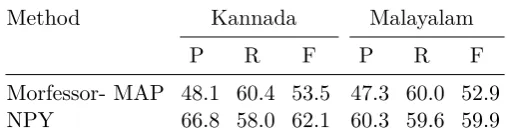
Results of the experiments shown in Table1
Table 1: Results compared to Morfessor-MAP
Method Kannada Malayalam
P R F P R F
Morfessor- MAP 48.1 60.4 53.5 47.3 60.0 52.9 NPY 66.8 58.0 62.1 60.3 59.6 59.9
6 Error Analysis
We analyzed the results of experiments to get an insight errors that need to be solved in fu-ture research. We are listing the errors that are produced by our algorithms and Morfessor-MAP. In the case of our algorithm, it has two major steps one is to identify accurate word boundaries and other is to find accurate mor-pheme boundaries.
• Morfessor and our system fail to iden-tify character combinations which need to considered as single character so it seg-mented digraphs and ligatures. In the case of our system it as we use a internal notation it did not segment the digraphs and ligatures.
• In the case of loaned root words, both sys-tems fails to identify the morphemes.
Jason Naradowsky and Sharon Goldwater. 2009. Improving morphology induction by learning spelling rules. In IJCAI, pages 1531–1536.
Graham Neubig. 2014. Simple, correct paralleliza-tion for blocked gibbs sampling. In Technical Report, November.
Jim Pitman. 2002. Combinatorial stochastic pro-cesses. Technical report, Technical Report 621, Dept. Statistics, UC Berkeley, 2002. Lecture notes for St. Flour course.
Kairit Sirts and Sharon Goldwater. 2013.
Minimally-supervised morphological
segmen-tation using adaptor grammars. TACL,
1:255–266.
Yee Whye Teh. 2006. A hierarchical bayesian language model based on pitman-yor processes. In Proceedings of the 21st International Confer-ence on Computational Linguistics and the 44th Annual Meeting of the Association for Com-putational Linguistics, ACL-44, pages 985–992, Stroudsburg, PA, USA. Association for Compu-tational Linguistics.
Sami Virpioja, Ville T. Turunen, Sebastian
Spiegler, Oskar Kohonen, and Mikko Kurimo.
2011. Empirical comparison of evaluation
methods for unsupervised learning of
morphol-ogy. Traitement Automatique des Langues,