CHROMOSOMAL INTERCHANGES I N MAIZE
E. G . ANDERSON
California Institute of Technology, Pasadena, California Received February 19, 1934
INTRODUCTION
Chromosomal interchanges, or reciprocal translocations, in maize are of primary interest because of the opportunities they offer for the study of chromosome behavior and crossing over. The great volume of work which has been done on crossing over and on translocations in Drosophila has yielded an abundance of statistical data on crossing over and chromosome distribution. For this type of work Drosophila is admirably adapted, and great advances in the statistical analysis of crossing over not only have been made but continue still to be made. But for the cytological study of the chromosomal basis of crossing over, Drosophila is less well adapted. Maize, on the other hand, while not so well fitted for crossing over statis- tics, has the exceptional merit of being excellent material for the cytologi- cal study of the earlier stages of meiosis. This presents the opportunity of making studies on the chromosome mechanism in which crossing over statistics and cytological observations are intimately correlated. A begin- ning has already been made as for example in the studies on the behavior of ring fragments (MCCLINTOCK 1932b) and on crossing over in the ninth chromosome (CREIGHTON and MCCLINTOCK 1931), in interchange T8-9
(BURNHAM 1934c), in maize-teosinte hybrids (BEADLE 1932a) and in trisomics (RHOADES 1933a). But in order to take full advantage of the opportunities presented, it is first necessary to build up a fair knowledge of such items as the location of given genes on the observed chromosome thread, and the linkage relationships of conspicuous markers on the chromosomes; also to make available means of marking or of controlling desired portions of chromosomes.
For building up the required groundwork chromosomal interchanges are of especial value. The synaptic pairing of the interchanged chromosomes with their normal homologs may be observed a t mid-prophase when the chromosomes are spun out as long thin threads with their finer structures most clearly visible and with the homologous threads closely conjugated. This makes it possible to determine rather accurately the correspondence of loci on the linkage maps with visible points on the chromosomes them- selves, and prepares the way for direct observation of the stages immedi- ately following crossing over. Interchanges are also of great value as means
of marking or controlling chromosomes or parts of chromosomes which are being studied.
CHROMOSOMAt INTERCHANGES IN MAIZE 71
The need of a combined genetical and cytological study of an extensive series of interchanges in maize led the writer to assemble a large number of cultures from partially sterile plants, mostly from X-ray treatment. Those which gave consistent rings or chains of chromosomes at diakinesis have been subjected to tests for the chromosomes involved in the interchange. The purpose of this paper is to summarize these tests and to establish the chromosome constitution of each of the interchanges. Studies are in progress on the prophase cytology and linkage relationships. Reports on these studies will follow as the studies are completed.
The writer wishes to acknowledge his indebtedness to Dr. C. R. BURN-
HAM for the use of his unpublished interchanges as testers, and to Miss
GERTRUDE GEERTSEN, laboratory technician, whose skill and industry have made possible the large number of microscopic preparations required.
GENERAL CHARACTERISTICS O F INTERCHANGES I N MAIZE
The behavior of interchanges may be illustrated by a brief review of some of the earlier reported cases. Semisterile-1 (T1-2a), reported by BRINK (1927) and later studied by BRINK and BURNHAM (1929), BRINK and COOPER (1931, 1932a) and COOPER and BRINK (1931) is a typical example. The chromosomes involved are No. 1 and No. 2. The semisterile plants are heterozygous for the interchange. When selfed they give fifty percent of semisterile plants, and fifty percent of normals. But the nor- mals are of two types, (1) ordinary or standard normals having only normal chromosomes and giving fully fertile plants in outcrosses to stand- ard stocks, and (2) homozygous interchanges (X-normals) having both interchanged chromosomes homozygous and giving only semisterile plants in outcrosses to standard stocks. These homozygous interchange plants are normal, fully fertile plants not visibly different from the ordinary standard normals.
72
E.
G. ANDERSONhaves in outcrosses like a dominant gene a t the locus of the interchange in both linkage maps.
Cytological examination shows a cross-shaped figure a t mid-prophase with a change of partners a t the cross or point of interchange. At all points homologs are paired as in normal chromosomes. The chromosomes begin separating a t late pachytene or diplotene, continuing separation until a t diakinesis only the ends remain joined. By this stage the chromosomes have also shortened and thickened, giving the typical ring configurations characteristic of interchanges. At anaphase these rings separate or are pulled apart, two chromosomes going normally to each pole.
Semisterile-2 (T8-9a) has been studied in more detail by BURNHAY (1930, 1934c), MCCLINTOCK (1930, 1931s) and CREIGHTON and Mc- CLINTOCK (1931). It differs from semisterile-1 in showing somewhat more pollen sterility (59 percent). The chromosome distribution is a little more irregular, figures often showing three of the chromosomes from the ring going to one pole and one to the other. The ring occasionally opens into a chain of four chromosomes a t diakinesis.
A low sterile described by BURNHAM (1932a) differs in that it forms chains consistently but never rings. The interchange has taken place in the satellite of chromosome 6. The point of interchange was within one or two chromomeres of the end of the chromosome. The interchanged end of the satellite did not show pairing with the normal satellite. This gave a T-shaped pachytene figure, opening out to form a chain of diakinesis. One
of the duplicate-deficient classes of spores lacked only a few chromomeres of having all parts of the chromosomes represented and did not form visibly bad pollen. A low sterile not involving chromosome 6 has been described by BRINK and COOPER (1932~).
A more extreme case has been described by CLARKE and ANDERSON (1934) in which chains are found in only a portion of the diakinesis figures, the majority showing two slightly unequal “pairs.” Here the interchange is also in the satellite of chromosome 6 and likewise near the end of chromo- some 3. The visible sterility is again about 25 percent.
Two interchanges reported by BURNHAM (1932b, 1934a) show a great amount of non-homologous pairing (see also MCCLINTOCK 1932a, 1933). Such non-homologous pairing is rather frequent in many of the inter- changes and is generally associated with a reduction of crossing over.
CHROMOSOMAL INTERCHANGES IN MAIZE 73
studied. A complete list with citations to literature is included in the cata- log of interchanges on page 77.
TERMINOLOGY
The large number of interchanges now being investigated in maize makes it convenient to apply a uniform set of names or symbols for them. The capital letter T will be used as a general designation of interchanges. It will be used in the same way that we ordinarily use the gene symbol for a dominant gene. The specific interchange will be designated by numbers which indicate the chromosomes involved. These may be followed by the letters a, b, c, etc. when dealing with more than one interchange between the same chromosomes.
The ten chromosomes of maize are numbered from the longest to the shortest. The following list gives the linkage group associated with each chromosome.
1. P b r f b m 5. bml pr vz 8. j
2. lg B sk
3. a na tsc
6.
Y
PI sm7.
gll ra9. yg2 c Sh wx
10. R g nl 4. su
TU
glsSOURCES OF MATERIAL
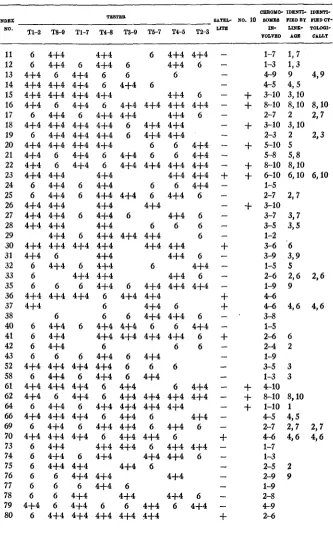
Most of the interchanges reported in this paper came from four lots of mature seed submitted to X-rays. Details of treatment dosage and sources of interchanges are given in the appendix. The seed was grown and the plants selfed. Ears which did not look well-filled were selected for further study. The plants from these ears were examined for pollen sterility. Each culture giving partially sterile plants was given an index number under which it appears in table 1 and in the appendix.
A few additional interchanges were obtained from other sources. Of those listed in table 1, No. 52 was obtained by Dr. L. J. STADLER, also from X-ray treatment; Nos. 33, 122, and 133 were picked up from untreated stocks; and No. 129 was obtained by Dr. G. W. BEADLE from his “sticky chromosome” line (BEADLE 1932b). The writer is indebted to Dr. STADLER
and Dr. BEADLE for the two semisterile lines obtained from them. METHOD OF IDENTIFICATION OF CHROMOSOMES
74 E. G . ANDERSON
will be obtained. Eight interchanges were chosen from among the limited number available a t the time for use as testers. They were available in homozygous form or could be gotten in homozygous condition very quickly.
T1-2 Semisterile-1 BRINK 1927 T8-9 Semisterile-2 BURNHAM 1930 T1-7 Semisterile-3 BURNHAM 1930
T4-8 Culture 6467 ANDERSON and CLOKEY 1934 T3-9 Culture 6465 ANDERSON and CLOKEY 1934 T5-7 Semisterile-6 BURNHAM unpublished T4-5 Culture 6472 ANDERSON and CLOKEY 1934 T2-3 Semisterile-7 BURNHAM unpublished
The above tests furnish ready means of identifying all chromosomes ex- cept 6 and 10. Chromosome 6, the satellited chromosome, is attached to the nucleolus. The attachment of the ring to the nucleolus served to identify chromosome 6 as one member of the interchange. Chromosome 10 was determined by elimination and also by examination of the free pairs a t diakinesis. This was usually done in the intercrosses with TS-9 where the two next smallest chromosomes were included in the ring. The small size and rather characteristic appearance of chromosome 10 served to identify it.
I n the course of further work on these interchanges, more detailed studies are made a t the mid-prophase or pachytene stage. At this stage it is possible to recognize each of the chromosomes. These prophase studies thus serve to verify the chromosome identifications. Likewise the identifi- cations are verified when genetic data are obtained showing linkage of the semisterility with genes of the corresponding linkage groups.
DATA
CHROMOSOMAL. INTERCHANGES I N MAIZE 75
TABLE 1
Chromosome conjigwations in crosses of new interchanges with known interchange testers.
CBBDYO- IDENTE IDENTI-
BATEL- NO. 10 BOY108 PIEDBY P'IEDCI-
IN- L I M - TDLWI-
TESl2?B
INDDX
VOLVED AQE CALLI
T1-2 T8-9 T1-7 T4-8 T3-9 T5-7 T4-5 T2-3
-
NO. 11 12 13 14 15 16 17 18 19 20 21 22 23 24 25 26 27 28 29 30 31 32 33 35 36 37 38 40 41 42 43 52 58 61 62 64 66 69 70 73 74 75 76 77 78 79 806 4+4 4+4 6 44-4 4+4 -
6 4+4 6 4+4 6 4+4 6 -
44-4 6 4+4 6 6 6
44-4 44-4 4+4 6 4+4 6 -
4+4 4+4 4+4 4+4 4+4 6 -
4+4 6 4+4 6 4+4 44-4 44-4 44-4 -
6 4+4 6 4+4 4+4 4+4 6 -
44-4 44-4 4+4 4+4 6 44-4 44-4 -
6 4+4 4+4 4+4 6 4+4 4+4 -
4+4 4+4 4+4 4+4 6 6 4+4 - 4+4 6 4+4 6 44-4 6 6 44-4 - 4+4 6 4+4 6 44-4 4+4 4+4 44-4 -
4+4 4+4 4+4 4+4 4+4
+
6 4+4 6 4+4 6 6 4+4 -
6 4+4 6 4+4 4+4 6 4+4 6 -
4+4 4+4 4+4 4+4
4+4 4+4 6 4+4 6 4+4 6
-
4+4 4+4 4+4 6 6 6
-4+4 6 4+4 4+4 4+4 6
-4+4 4+4 4+4 4+4 4+4 4+4
+
44-4 6 4+4 4+4 6
-
6 4+4 6 4+4 6 4+4
-
6 4+4 4+4 4+4 6 -
6 6 6 4+4 6 4+4 4+4 4+4 -
44-4 44-4 44-4 6 4+4 4+4
+
4+4 6 4+4 6
+
6 6 6 4+4 4+4 6 -
6 4+4 6 4+4 4+4 6 6 4+4 -
6 4+4 4+4 4+4 4+4 4+4 6
+
6 4+4 6 6 6
-6 6 6 4+4 6 4+4
-
44-4 44-4 4+4 4+4 6 6 6
-
6 44-4 6 4+4 6 4+4
-
44-4 44-4 4+4 6 4+4 6 4+4 - 4+4 6 4+4 6 4+4 44-4 4+4 4+4
-
6 44-4 6 4+4 44-4 4+4 4+4 - 4+4 4+4 4+4 6 4+4 6 4+4 -
6 4+4 6 4+4 4+4 6 4+4 6 -
44-4 44-4 4+4 6 4+4 4+4 6
+
6 4+4 4+4 4+4 6 4+4 4+4 -
6 4+4 6 4+4 4+4 4+4 6 -
6 4+4 4+4 4+4 6
-
6 6 4+4 4+4 4+4
6 6 4+4 4+4 4+4 6 -
44-4 6 4+4 6 6 4+4 6 4+4 -
6 4+4 4+4 4+4 4+4 4+4
+
-
-
-
- 6 6 6 44-4 61-7 1,7 1-3 1,3 4-9 9 4,9 4 5 4,s
+
3-10 3,lO+
8-10 8,lO 8,lO+
3-10 3,lO2-7 2 2,7
2-3 2 2,3
5-8 5,8
+
5-10 5+
8-10 8,lO+
6-10 6,lO 6,lO1-5 2-7 2 , 7
+
3-10 3-7 3,7 3-5 3,s 1-2 3-6 '6 3-9 3,91-5 5 2-6 2,6 2,6 1-9 9 4-6
4-6 4,6 4,6 3-8
1-5 2-6 6 2 4 2 1-9 3-5 3 1-3 3
+
4-10+
8-10 8,lO+
1-10 14-5 4,s
2-7 2,7 2,7
46 4,6 4,6
1-7
76 E. G. ANDERSON
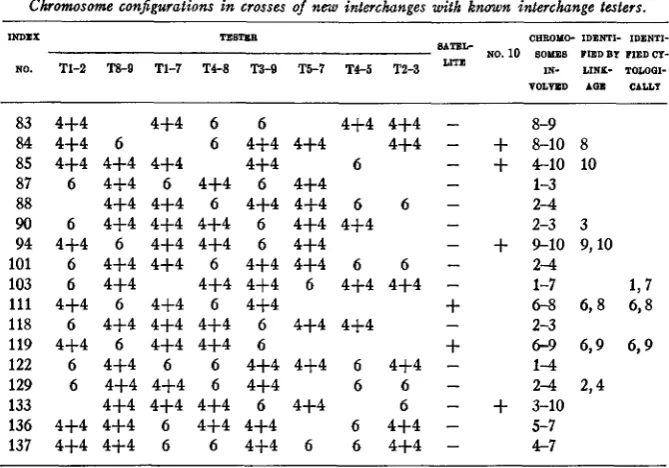
TABLE 1 (Continued)
Chromosome configurations in crosses o j new interchanges urith known interchange testers.
INDXX TB8TP.B CBBOYO- IDENTI- IDBNTI-
NO. 10 SOYE8 PIED BY PIED CY-
NO. T1-2 TS-9 T1-7 T 4 S T3-9 T5-7 T4-5 T2-3 um IN- LINP- TOMQI-
8ATEL-
VOLVED AQB CALLI
83 84 85 87 88 90 94 101 103 111 118 119 122 129 133 136 137
~ ~ ~~ ~
4+4 4+4 6 6 4+4 4+4 - 8-9
4+4 6 6 4+4 4+4 4+4 -
+
8-10 84+4 4+4 4+4 4+4 6 -
+
4-10 106 4+4 6 4+4 6 4+4 - 1-3
6 4+4 4+4 44-4 6 4+4 4+4 - 2-3 3 6 44-4 4+4 6 4+4 4+4 6 6 - 2-4
6 4+4 4+4 4+4 6 4+4 4+4 - 1-7 1 , 7
4+4 4+4 6 4+4 4+4 6 6 - 2 4
4+4 6 4+4 4+4 6 4+4 -
+
9-10 9,lO4+4 6 4+4 6 4+4
+
6-8 6 , 8 6,84+4 6 4+4 4+4 6
+
6-9 6,9 6 , 96 4+4 4+4 4+4 6 4+4 4+4 - 2-3
6 4+4 6 6 4+4 4+4 6 4+4 - 1 4
6 4+4 4+4 6 4+4 6 6 - 2 4 2,4
4+4 4+4 4+4 6 4+4 6 -
+
3-104+4 4+4 6 4+4 4+4 6 4+4 - 5-7 4+4 4+4 6 6 4+4 6 6 4+4 - 4-7
In addition to the above interchanges there were obtained from the X-rayed cultures a number of partial sterile lines which did not con- sistently show rings or chains of chromosomes a t diakinesis. These range from fairly good semisteriles to low steriles and to types with part of the pollen small and often incompletely filled. One such culture has been studied (CLARKE and ANDERSON 1934) and shown to be an interchange involving the satellitk of chromosome 6 and the end of the long arm of chromosome 3. It is probable that many of the others are also interchanges occurring so near the ends of the chromosomes that a chromosome ring is either not formed or is so loosely held together that it most frequently separates into two “pairs.”
CATALOG OF KNOWN INTERCHANGES I N MAIZE
CHROMOSOMAL INTERCHANGES IN MAIZE
77
other subjects (BRINK 1932, BRINK and COOPER 1932b, BURNHAM 1934b). A number of papers dealing with the production (SPRAGUE 1930, STADLER 1931, BEADLE 1932b) or cytology (MCCLINTOCK 1931b, 1933) of chromo- some aberrations mention interchanges not included in this catalog.
BTUBOL OLD NAME OB " s E B "BENCBS
T1-2a T1-2b T1-3a T1-3b T1-3c T1-3d T 1 4 T1-5a T1-5b Tl-5c T1-6a T1-6b T1-7a Tl-7b T1-7c T1-7d T1-9a Tl-9b T1-9c T1-loa T2-3a T23c T23d T24a T24b T24c T24d T2-5a T2-6a T1-lob T23b T2-5b T2-6b T2-6~ T2-6d T2-6e T2-7a T2-7b T 2 - 7 ~ T2-8 T2-9a T2-9b T2-10 Semisterile-1 29 12 58 74 87 122 24 32 40 Semisterile-5
Low sterile Semisterile-3 11 73 103 35 77 43 6466 64 Semisterile-7 19 90 118 42 88 101 129 Semisterile- 75
647 1
33 41 80 17 25 69 78 6460 76 6473
-
BRINK 1927, BRINK and BURNHAM 1929, BIUNK and COOPER 1931, 1932a) COOPER and BRINK 1931
COOPER and BRINK 1931, BRINK and COOPER 1932a
BURNHAM 1932a
BURNHAM 1930
ANDERSON and CLOKEY 1934
BURNHAM, unpublished
RHOADES 1931,19
BURNHAM 1932b
ANDERSON and CLOKEY 1934
ANDERSON and CLOKEY 1934
78 E. G. ANDERSON
SYMBOL OLD NAME OR NUMBm BJI?ERENC&S
T3-Sa T3-5b T 3 - 5 ~ T3-6a T3-7a T3-8a T3-9a T3-10a T3-6b T3-7b T3-8b T3-9b T3-10b T3-10~ T3-10d T4-Sa T45b T4-5c T45d T4-6a T46b T46c T47
T 4 8 T49a T4-loa T4-lob T5-7a T4-9b T5-6 T5-7b T5-7c T5-8 T5-9 T6-8 T6-9a T6-9b T8-9a T5-10 T6-10 T8-9b T8-10a T8-10b T8-10c T8-1Od T9-10 - 6468 28 52 30 125 6474 27 6477 38 6465 31 15 18 133 26 6472 6462 14 66 37 70 36 137 6467 13 79 61 85 6452 Semisterile-6 6475 136 21 20 111 6470 119 23 Semisterile-2 - 83 16 22 62 84 94 m-sterile
ANDERSON and CLOKEY 1934
CLARKE and ANDERSON 1934 ANDERSON and CLOKEY 1934
ANDERSON and CLOKEY 1934
ANDERSON and CLOKEY 1934
ANDERSON and CLOKEY 1934 ANDERSON and CLOKEY 1934
ANDERSON and CLOKEY 1934
ANDERSON and CLOKEY 1934 BURNHAM unpublished ANDERSON and CLOKEY 1934
BURNHAM 1934a
ANDERSON and CLOKEY, 1934 ANDERSON 1934
BUR" 1930, 1934c, MCCLINTOCK 1930, 1931a, CREIGFLTON and MCCLINTOCK 1931, BEADLE 1932a
CHROMOSOMAL. INTERCHANGES I N MAIZE 79
DISTRIBUTION O F INTERCHANGES
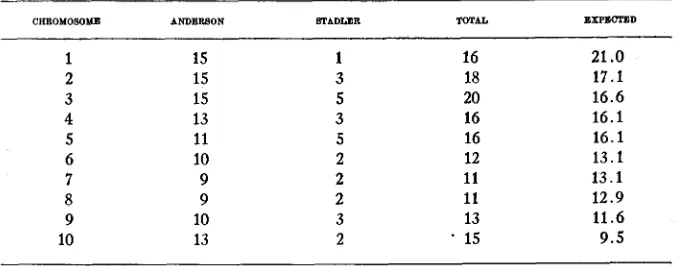
The interchanges following X-ray treatment reported by ANDERSON and CLOKEY (1934) and the ones reported in this paper form a fairly ran- dom sample of those which consistently form rings or chains a t diakinesis. They may be used for comparing the frequency with which each chromo- some becomes involved in interchanges. These frequencies are summarized in table 2. Each chromosome is well represented. The frequencies are in
TABLE 2
Comparison of frequencies of interchanges after X-ray in the &$?rent chromosomes.
CHROMOSOME ANDERSON STADLER TCWAL EXPEC€ED
1 15 1 16 21
.o
2 15 3 18 17.1
3 15 5 20 16.6
4 13 3 16 16.1
5 11 5 16 16.1
6 10 2 12 13.1
7 9 2 11 13.1
8 9 2 11 12.9
9 10 3 13 11.6
10 13 2
.
15 9.5reasonably close proportion to the lengths of the different chromosomes. The probability of a deviation as great as that observed is about 0.7, show- ing a close fit. Most of the deviation is due to chromosome 1 being low and chromosome 10 being high.
ISOLATION AND VIABILITY O F HOMOZYGOUS INTERCHANGES
In order to obtain stocks homozygous for each of the interchanges, the method used by BRINK and BURNHAM (1929) has been followed. The heterozygous interchange (semisterile) plants are self-pollinated or crossed to other semisterile plants from the same source. One half of the progeny obtained are semisterile, the other half, normal. The normals are of two types, ordinary normals and homozygous interchanges. These are not dis- tinguishable in appearance but may be distinguished by outcrossing to known standard stocks. Each plant tested is also selfed or crossed to a re- lated semisterile. In practice it was found useful to cross to a semisterile in an outcross family in order to avoid too much inbreeding.
80 E. G. ANDERSON
marked contrast to the results obtained in Drosophila. In maize the elimination for chromosome unbalance is far more stringent in the haploid gametophyte generation than in the diploid sporophyte. This is shown by the failure of deficiencies from X-rays to be transmitted beyond the im- mediate generation in which they appear (STADLER 1931, MCCLINTOCK 1931b) and also by the early elimination of the duplicate-deficient spores from the semisteriles. The elimination is more severe in the male gameto- phyte than in the female as shown by the differential transmission of trisomic types in reciprocal crosses. It is anticipated that a small proportion of interchanges will be transmitted less freely through the male than through the female. A few of those listed have indicated such behavior but the data are not as yet sufficient.
The interchanges thus far described in maize have been rather simple types, relatively free from complications and not involving more than two chromosomes. The contrast with Drosophila translocations is quite marked. This serves to emphasize the selective elimination in the gameto- phyte generation. Presumably the interchanges recovered in maize are only a small proportion of those which occur, an indefinite but large pro- portion beng weeded out by this selective elimination.
SUMMARY
Sixty-four additional chromosomal interchanges in maize are described. A catalog list is given of the known chromosomal interchanges in maize. The relative frequency of interchanges following X-ray treatment is tabulated for the ten chromosomes. The distribution is approximately proportional to the relative lengths of the chromosomes.
All the interchanges adequately tested are viable in homozygous con- dition, indicating that selection is more stringent in the haploid gameto- phyte than in the zygote.
Evidence is presented to establish the chromosome constitution of each.
APPENDIX
Sources of interchanges from X-ray treatment
CHROMOSOMAL INTERCHANGES I N MAIZE 81 Lot 1. Pedigree 541 1-9 X 5409-1 1
Sixty-minute treatment.
94 (9-10) 16 (8-10)
6452 (5-6) A and C 1934 12 (1-3)
103 (1-7) 58 (1-3)
101 (2-4) 125 (3-6) C and A 1934 11 (1-7)
42 (2-4)
Fifty -minute treatment.
43 (1-9) 79 (4-9)
Lot 2. Pedigree 5534-11x5547-6 Sixty-minute treatment.
19 (2-3) 69 (2-7) 20 (5-10)
{:;
14 (4-5)
17 (2-7) 15 (3-10)
62 (8-10) 35 (1-9)
64 (1-10) 36 (4-6)
66 (4-5) 70 (4-6)
18 (3-10)
27 (3-7) 80 (2-6)
28 (3-5) 30 (3-6)
29 (1-2) 31 (2-9)
Fifty-minute treatment,
Lot 3. Pedigree 5538-3 X5543-5 Sixty-minute treatment
111 (6-8) 74 (1-3)
21 (5-8) 136 (5-7)
73 (1-7)
83 (8-9) 84 (8-10)
37 (4-6) 22 (8-10)
Fif ty-minu te treatment
Lot 4. Pedigree 5539-9 X 5433-21 Sixty-minute treatment.
24 (1-5) 40 (1-5)
38-( 3-8) 25 (2-7)
137 (4-7)
{l;;
:z;
82 E. G. ANDERSON
23 (6-10) 77 (1-9) 75 (2-5) 76 (2-9)
Fifty-minute treatment. 85 (4-10)
87 (1-3)
88 (2-4) 90 (2-3)
LITERATURE CITED
ANDERSON, E. G., 1934 A chromosomal interchange in maize involving the attachment to the
ANDERSON, E. G. and C L O ~ Y , I. W., 1934 Chromosomes involved in a series of interchanges in
BEADLE, G. W., 1932a The relation of crossing over to chromosome association in Zea-Euchlaena
nucleolus. Amer. Nat. 68: 345-350.
maize. Amer. Nat. 68: 440-445.
hybrids. Genetics 17: 481-501.
193213 A gene for sticky chromosomes in Zea mays. Z.I.A.V. 63: 195-217.
1932 Are the chromosomes aggregates of groups of physiologically interdependent genes?
BRINK, R. A. and BURNHAY, C. R., 1929 Inheritance of semi-sterility in maize. Amer. Nat. 63:
BRINK, R. A. and COOPER, D. C., 1931 The association of semisterile-1 in maize with two linkage groups. Genetics 16: 595-628.
1932a A strain of maize homozygous for segmental interchanges involving both ends of the
P-br chromosome. Proc. Nat. Acad. Sci. Washington 18: 441-447.
19321, Chromosome rings in maize and Oenothera. Proc. Nat. Acad. Sci. Washington 18: 4 4 7 4 5 5 .
1932c A structural change in the chromosomes of maize leading to chain formation. Amer. Nat. 66: 310-322.
BURNHAY, C. R., 1930 Genetical and cytological studies of semisterility and related phenomena in maize. Proc. Nat. Acad. Sci. Washington 16: 269-277.
1932a An interchange in maize giving low sterility and chain configurations. Proc. Nat. Acad. Sci. Washington 18: 434-440.
1932b The association of non-homologous parts in a chromosomal interchange in maize. Proc. Sixth Int. Congress Genetics 2: 19-20.
1934a Chromosomal interchanges in maize: Reduction of crossing over and the association of non-homologous parts (abstract). Amer. Nat. 68: 81-82.
19341, Linkage relations of certain factors and their serial order in chromosome 5 in maize (abstract). Amer. Nat. 68: 82.
1934c Cytogenetic studies of an interchange between chromosomes 8 and 9 in maize. Genetics
19: 4 3 W 7 .
CLARKE, A. E. and ANDERSON, E. G., 1934 A chromosomal interchange in maize without ring formation. Amer. J. Bot. In Press.
COOPER, D. C. and BRINK, R. A., 1931 Cytological evidence for segmental interchange between non-homologous chromosomes in maize. Proc. Nat. Acad. Sci. Washington 17: 334-338. CREIGHTON, H. B. and MCCLINTOCK, B., 1931 A correlation of cytological and genetical crossing
over in Zea mays. Proc. Nat. Acad. Sci. Washington 17: 492497.
MCCLINTOCK, BARBARA, 1930 A cytological demonstration of the location of an interchange be- tween two non-homologous chromosomes of Zea mays. Proc. Nat. Acad. Sci. Washing- ton 16: 791-796.
BRINK, R. A., 1927 The occurrence of semi-sterility in maize. J. Hered. 18: 266-270. Amer. Nat. 66: 444451.
CHROMOSOMAL INTERCHANGES I N MAIZE 83
1931a The order of the genes t sk and wx in Zea mays with reference to a cytologically known point in the chromosome. Proc. Nat. Acad. Sci. Washington 17: 485491.
1931b Cytological observations of deficiencies involving known genes, translocations and an inversion in Zea mays. Missouri Agric. Expt. Sta. Res. Bull. 163: 1-30.
1932a Cytological observations in Zea on the intimate association of non-homologous parts of chromosomes in the mid-prophase of meiosis and its relation to diakinesis configura- tions. Proc. Sixth. Int. Congress Genetics 2: 126128.
1932b A correlation of ring-shaped chromosomes with variegation in Zea mays. Proc. Nat. Acad. Sci. Washington 18: 677-681.
1933 The association of non-homologous parts of chromosomes in the mid-prophase of meiosis in Zea mays. Zeit. Zellforsch. U. mik. Anat. 19: 191-237.
REOADES, M. M., 1931 Linkage values in an interchange complex in Zea. Proc. Nat. Acad. Sci. Washington 17: 694-698.
1933a An experimental and theoretical study of chromatid crossing over. Genetics 18: 535- 555.
193313 A cytogenetical study of a reciprocal translocation in Zea. Proc. Nat. Acad. Sci. Wash- ington 19: 1022-1031.
SPRAGUE, G. F., 1930 Some genetic effects of electromagnetic treatment in maize (abstract). Anat. Rec. 47: 382.
STADLER, L. J., 1931 The experimental modification of heredity in crop plants. I. Induced chromo-