Non-malleability under Selective Opening Attacks: Implication
and Separation
Zhengan Huang1, Shengli Liu1, Xianping Mao1, and Kefei Chen2,3
1. Department of Computer Science and Engineering, Shanghai Jiao Tong University, Shanghai 200240, China 2. School of Science, Hangzhou Normal University, Hangzhou 310036, China
3. State Key Laboratory of Mathematical Engineering and Advanced Computing, Wuxi 214000, China [email protected], {slliu, maoxp, kfchen}@sjtu.edu.cn?
Abstract. We formalize the security notions of non-malleability under selective opening attacks (NM-SO security) in two approaches: the indistinguishability-based approach and the simulation-based approach. We explore the relations between NM-SO security notions and the known selective opening security notions, and the relations between NM-SO security notions and the standard non-malleability notions.
Keywords: public-key encryption, non-malleability, selective opening attack.
1 Introduction
Non-malleability. The basic goal of public-key encryption (PKE) schemes is to guarantee the privacy of messages. The universally accepted formalization for this is semantic security proposed in [10], which requires that it be infeasible to learn any useful information of the message from the ciphertext. However, some cryptographic applications in a complex setting suggest that non-malleability is necessary. Non-malleability (NM), introduced by Dolev, Dwork and Naor [8] in 1991, requires that given a challenge ciphertext, it be infeasible to generate ciphertexts whose decryptions are related to the decryption of the challenge ciphertext. Nowa-days, two main kinds of formalizations (indistinguishability-based [5] and simulation-based [8]) of non-malleability are widely accepted, especially the first one. (Actually, there is another for-malization of non-malleability, comparison-based non-malleability [1][5].) Similar to semantic security, the formal security definitions of indistinguishability-based non-malleability (IND-NM) and simulation-based non-malleability (SIM-NM) consider all the three kinds of standard at-tacks: chosen-plaintext attacks (CPA), non-adaptive chosen-ciphertext attacks (CCA1) [18] and adaptive chosen-ciphertext attacks (CCA2) [20][8][9]. The combination of SIM-NM, IND-NM and CPA, CCA1, CCA2 gives six specific security notions (e.g., IND-NM-CPA security). The relations among these six security notions were figured out in [5][19].
Selective opening attacks. In Eurocrypt 2009, Bellare et al. [4] introduced the notion of selective opening security (SOA security) for sender corruptions. Roughly speaking, selective opening attack (for sender corruptions) is as follows:nsenders encrypt their own messages with the public key of a single receiver. The adversary can corrupt some of these senders, by opening their ciphertexts, i.e., obtaining their messages and the random coins which were used during the encryption. The goal of SOA security is to guarantee the privacy of the unopened messages.
?
In [4], Bellare et al. presented two SOA security notions, the indistinguishability-based one (IND-SO) and the simulation-based one (SIM-SO). Later, Hemenway et al. [14] introduced the notions of IND-SO-CCA1/CCA2 security and SIM-SO-CCA1/CCA2 security. Over the years, several PKE schemes were proposed and proved to possess SOA security [11][14][12][15]. The relations between IND-SO-CPA security and SIM-SO-CPA security were clarified by B¨ohl et al. [3]. Bellare et al. [2] separated IND-CPA (even IND-CCA2) and SIM-SO-CPA security. Recently, Hofheinz and Rupp [17] showed a separation between IND-CCA2 and IND-SO-CCA2 security, and a “partial” equivalence between IND-CPA and IND-SO-CPA security.
To the best of our knowledge, how to formalize non-malleability under selective opening attacks remains elusive. Very recently, Hofheinz and Rupp referred to “NM-SO-CPA security” in [17]. But they did not present any formal definition.
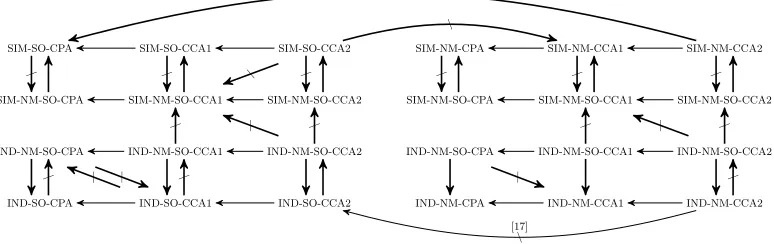
Our contributions. This paper focuses on security notions and their relations. We first for-malize the notion of simulation-based non-malleability under selective opening attacks (SIM-NM-SO), and the notion of indistinguishability-based non-malleability under selective opening attacks (IND-NM-SO). We figure out the relations among SIM-NM-SO-CPA(/CCA1/CCA2) se-curity, IND-NM-SO-CPA(/CCA1/CCA2) sese-curity, SIM/IND-SO-CPA(/CCA1/CCA2) security and non-malleability security SIM/IND-NM-CPA(/CCA1/CCA2). Specifically, our results are as follows (see Figure 1). Below, we useSEC1⇒SEC2to indicate thatSEC1implies SEC2, and SEC1;SEC2to indicate the existence of some PKE scheme achievingSEC1but notSEC2, for
any two security notionsSEC1and SEC2.
1. NM-SO versus SO:
(a) Simulation-based (Section 4): i. “SIM-NM-SO-ATK ⇒
: SIM-SO-ATK”, for any ATK∈ {CPA, CCA1, CCA2}. ii. For those PKE schemes having an invertible decryption algorithm (Definition 8), if
the range of its decryption algorithm is recognizable, “SIM-SO-CCA2 ⇔ SIM-NM-SO-CCA2”.
(b) Indistinguishability-based (Section 5): i. “IND-NM-SO-CPA :
; IND-SO-CCA1”. ii. “IND-NM-SO-CCA1/CPA ⇒
: IND-SO-CCA1/CPA”, but “IND-NM-SO-CCA2⇔ IND-SO-CCA2”.
2. NM-SO versus NM:
(a) Simulation-based (Section 6): i. “SIM-NM-SO-ATK ⇒
: SIM-NM-ATK”, for any ATK ∈ {CPA, CCA1, CCA2}. In fact, we have a stronger result: “SIM-NM-CCA2 ; SIM-NM-SO-CPA”, which
sug-gests “SIM-NM-ATK0 ;SIM-NM-SO-ATK00”, for any ATK0,ATK00∈ {CPA, CCA1,
CCA2}.
(b) Indistinguishability-based (Section 7):
i. “IND-NM-SO-ATK⇒ IND-NM-ATK”, for any ATK∈ {CPA, CCA1, CCA2}.
ii. “IND-NM-CCA2;IND-NM-SO-CCA2”, and “IND-NM-SO-CPA;IND-NM-CCA1”.
3. SIM-NM-SO versus IND-NM-SO (Section 8):
“IND-NM-SO-ATK;SIM-NM-SO-ATK”, for any ATK∈ {CCA1, CCA2}. In fact, we have
a stronger result: “IND-NM-SO-CCA2 ; SIM-NM-SO-CCA1”.
SIM-SO-CPA SIM-SO-CCA1 SIM-SO-CCA2 SIM-NM-CPA SIM-NM-CCA1 SIM-NM-CCA2
SIM-NM-SO-CPA SIM-NM-SO-CCA1 SIM-NM-SO-CCA2 SIM-NM-SO-CPA SIM-NM-SO-CCA1 SIM-NM-SO-CCA2
IND-NM-SO-CPA IND-NM-SO-CCA1 IND-NM-SO-CCA2 IND-NM-SO-CPA IND-NM-SO-CCA1 IND-NM-SO-CCA2
IND-SO-CPA IND-SO-CCA1 IND-SO-CCA2 IND-NM-CPA IND-NM-CCA1 IND-NM-CCA2
\
[17]
\ \ \
\ \
\ \ \ \
\
\
\ \ \
\ \ \
\
\ \
\
Fig. 1.Relations among SO-NM securities, SO securities and NM securities.
secure; Any IND-SO-CCA2 secure encryption scheme (e.g., [14][12]) is IND-NM-SO-CCA2 se-cure.
Techniques for the implications. For two main non-trivial implication results, we provide their high-level descriptions of the reasonings here.
– For our contribution 1.(a).ii., the key point is how to construct a SIM-NM-SO-CCA2 simu-latorSN S from a SIM-SO-CCA2 simulatorS. GivenS’s outputoutS, if it is a valid message, SN S can simply generate a ciphertext by encrypting it, such that the decryption of SN S’s output equalsoutS. The barrier is that whenoutS is not a valid message, this method doesn’t work. To overcome this issue, we apply the idea from [19], assuming that there is an algo-rithm F recovering ciphertexts from decrypted messages. Under this assumption, SN S can use F to recover a ciphertext from outS, if outS falls into the range of decrypted messages. However, this method fails if outS does not belong to the range of the decryption algorithm Dec. This problem can be solved by assuming that the range of the decryption algorithm Dec is recognizable. With the recognizable property of Dec, SIM-SO-CCA2 security ensures that S’s output outS is almost always in the range of Dec as long as the SIM-SO-CCA2 adversary’s final output is in the range.
– For our contribution 2.(a).i., the key point is constructing a SIM-NM-ATK simulator SN from a SIM-NM-SO-ATK simulatorSN S. Note thatSN S has the ability, which SN doesn’t, to ask an opening query. To overcome this issue, we consider a special “half-uniform” message distribution (see Definition 9), which consists of two independent distributions and the second is a uniform one. Correspondingly, the challenge message vector generated from this specific distribution also consists of two parts. IfSN S outputs a “half-uniform” distribution and asks to open the uniform part,SN can always answer it on its own by returning a uniformly chosen message vector. However, SN still cannot deal with a misbehaved SN S which outputs other distributions or it does not open the uniform part. To solve this problem, we construct a behaved SIM-NM-SO-ATK adversaryAN S, which always outputs a half-uniform distribution and asks to open the uniform part, and then SIM-NM-SO-ATK security guarantees SN S is behaved, except with negligible probability.
the SIM-based notions first. A SIM-NM security notion requires that the decryptions of both of the adversary’s and the simulator’s outputs be indistinguishable. Note that a non-NM secu-rity notion only requires that their outputs be indistinguishable. We can provide a uniformly distributed string, which leads to a special ciphertext (e.g., decrypted to sk), to the adversary through the decryption oracle. It is hard for any SIM-NM simulator to generate such a cipher-text, since it has no access to the decryption oracle. This feature can be used to separate some SIM-based NM and non-NM security notions (in a SOA or non-SOA setting). For the IND-based notions, note that even under CPA attacks, an IND-NM adversary can make aone-time parallel decryption queryafter receiving the challenge ciphertext. This feature can be used to separate some IND-based NM and non-NM security notions (in a SOA or non-SOA setting).
Open question.The primary open question is to figure out the relations between SIM-NM-SO and IND-NM-SO security notions. The barriers we encounter are as follows. For NM security notions, there is always a parallel decryption processafter the adversary receiving the challenge ciphertext. This fact makes the relation between these two notions (even under CPA attacks) similar to that between SIM-SO-CCA2 and IND-SO-CCA2 security. Besides that, we also need to deal with the aforementioned issue, i.e., the SIM-NM-SO simulator’s output always contains a ciphertext vector.
2 Preliminaries
Notations. Throughout this paper, we use κ as the security parameter, and as the empty string. For n ∈ N+, let [n] denote the set {1,2,· · · , n}. Let Un denote a uniform distribution
over{0,1}n. For a finite setS, lets← S denote the process of sampling an elementsuniformly at random fromS. For a probabilistic algorithm A, let RA denote the randomness space of A. We lety←A(x;R) denote the process of runningAon inputxand inner randomnessR∈ RA, and outputting y. We write y ← A(x) for y ← A(x;R) with uniformly chosen R ∈ RA. If A’s running time is polynomial in κ, we say that A is a probabilistic polynomial-time (PPT) algorithm. For two sequences of random variables X ={Xκ}κ∈N and Y ={Yκ}κ∈N, if for any PPT algorithmD,|Pr[D(Xκ,1κ) = 1]−Pr[D(Yκ,1κ) = 1]|is negligible inκ, we say thatX and Y are computationally indistinguishable (denoted by X≈c Y).
We use boldface letters for vectors. For a vectorm(resp. a finite setS), we let|m|(resp.|S|) denote the length of the vector (resp. the size of the set). For a set I ={i1, i2,· · · , i|I|} ⊆[|m|],
letm[I] = (m[i1],m[i2],· · · ,m[i|I|]). We writem∈mto denotem∈ {m[i]|i∈[|m|]}, extending
the set membership notation to vectors.
Public-key encryption.A public-key encryption (PKE) scheme is a tuple of algorithmsPKE= (Gen,Enc,Dec). The key generation algorithm Gen takes a security parameter κ as input and outputs a public/secret key pair (pk, sk). The encryption algorithm Enc takes a public key pk and a message m as input, and outputs a ciphertext c. The decryption algorithm Dec takes a secret keysk and a ciphertextc as input, and outputs a message m or a failure symbol⊥. For correctness, we require that for (pk, sk) ← Gen(1κ) and c ← Enc(pk, m), Dec(sk, c) = m with overwhelming probability.
Decryption oracles.For simplicity, we will use the notationsO1(·) andO2(·) in all the security notions throughout the paper. In a chosen-plaintext attack (CPA), both the oraclesO1(·) and
O2(·) always return . In a non-adaptive chosen-ciphertext attack (CCA1), O1(·) =Dec(sk,·), andO2(·) still returnswhatever it is queried. In an adaptive chosen-ciphertext attack (CCA2), both O1(·) and O2(·) areDec(sk,·), with the only exception that O2(·) returns when queried
on a ciphertext appeared in the challenge ciphertext vector.
Non-malleability for encryption.The first definition of non-malleability for encryption was proposed by Dolev, Dwork and Naor [8][9] in 1991. Their definition is simulation-based. Several years later, comparison-based and indistinguishability-based definitions of non-malleability were proposed [1][5], and their relations were explored in [5][19]. We recall the simulation/indistinguish-ability-based definitions in [19] as follows.
Definition 1 (SIM-NM security).A public-key encryption schemePKE= (Gen,Enc,Dec)is SIM-NM-ATK secure, if for any stateful PPT adversary A= (A1, A2), there is a stateful PPT
simulator S= (S1, S2), such that
ExpSIM-NM-ATK-RealPKE,A (κ)≈c ExpSIM-NM-ATK-IdealPKE,S (κ),
where ATK∈ {CPA, CCA1, CCA2}, ExpSIM-NM-ATK-RealPKE,A (κ)andExpSIM-NM-ATK-IdealPKE,S (κ) are de-fined in Table 1.
Definition 2 (IND-NM security). A public-key encryption scheme PKE = (Gen,Enc,Dec) is IND-NM-ATK secure, if for any stateful PPT adversary A = (A1, A2, A3), its advantage
AdvIND-NM-ATKPKE,A (κ) is negligible, where ATK∈ {CPA, CCA1, CCA2}. Here
AdvIND-NM-ATKPKE,A (κ) :=|Pr[ExpIND-NM-ATK-1PKE,A (κ) = 1]−Pr[ExpIND-NM-ATK-0PKE,A (κ) = 1]|,
where the experimentExpIND-NM-ATK-PKE,A b(κ) (b∈ {0,1}) is defined in Table 1, and we require that in the experiment, |m0|=|m1|, and |m0[i]|=|m1[i]| for anyi∈[|m0|].
Remark 1. Note that in Definition 1 and Definition 2, we do not require that |y| = |m| or
|y| = |mb|. We also note that the ciphertexts contained in y may be invalid, i.e., ⊥ ∈ x. Ac-cording to [19], these two definitions are stronger than the versions which require that y must be valid ciphertexts.
Selective opening security for encryption.Simulation-based and indistinguishability-based selective opening security notions were presented by Bellare et al. [4] in Eurocrypt 2009. We follow [4][14][3] for the definition.
Definition 3 (SIM-SO security [3]).A public-key encryption schemePKE= (Gen,Enc,Dec) is SIM-SO-ATK secure, if for any stateful PPT adversary A= (A1, A2, A3), there is a stateful
PPT simulator S= (S1, S2, S3), such that
ExpSIM-SO-ATK-RealPKE,A (κ)≈c ExpSIM-SO-ATK-IdealPKE,S (κ),
Table 1.SIM-NM, SIM-SO, IND-NM and IND-SO experiments
SIM-NM experiment:
ExpSIM-NM-ATK-Real
PKE,A (κ): Exp
SIM-NM-ATK-Ideal
PKE,S (κ): (pk, sk)←Gen(1κ) (pk, sk)←Gen(1κ) (M, s)←AO11(·)(pk) (M, s)←S1(pk)
m← M m← M
c←Enc(pk,m) (y, σ)←S2(s)
(y, σ)←AO2(·)
2 (c, s) Fori∈[|y|],
Fori∈[|y|], Ify[i] = COPY, thenx[i] := COPY Ify[i]∈c, thenx[i] := COPY else, x[i] :=Dec(sk,y[i])
else,x[i] :=Dec(sk,y[i]) return (M,m,x, σ) return (M,m,x, σ)
SIM-SO experiment:
ExpSIM-SO-ATK-RealPKE,A (κ): ExpSIM-SO-ATK-IdealPKE,S (κ):
(pk, sk)←Gen(1κ) (M, s1)←S1(1κ)
(M, s1)←A O1(·)
1 (pk) m← M
m← M (I, s2)←S2(s1)
r←(REnc)|m| outs←S3(m[I], s2)
c←Enc(pk,m;r) return (M,m, I, outs) (I, s2)←A
O2(·)
2 (c, s1)
outA←A
O2(·)
3 (m[I],r[I], s2)
return (M,m, I, outA)
IND-NM experiment: IND-SO experiment:
ExpIND-NM-ATK-b
PKE,A (κ): Exp
IND-SO-ATK-b
PKE,A (κ): (pk, sk)←Gen(1κ) (pk, sk)←Gen(1κ) (m0,m1, s)←A
O1(·)
1 (pk) (M,ResampM, s1)←A O1(·)
1 (pk)
c←Enc(pk,mb) m0← M
(y, σ)←AO22(·)(c, s) r←(REnc)|m0|
Fori∈[|y|], c←Enc(pk,m0;r)
Ify[i]∈c, thenx[i] := COPY (I, s2)←A O2(·)
2 (c, s1)
else,x[i] :=Dec(sk,y[i]) m1←ResampM(I,m0[I])
b0←AO32(·)(x, σ) b0←AO32(·)(mb,r[I], s2)
returnb0 returnb0
For indistinguishability-based selective opening (IND-SO) security notion, we restrict mes-sage distributions to be efficiently re-samplable. In [3], the IND-SO security notion with this restriction is called “weak” IND-SO security, and the one without this restriction is called “full”. But there is no PKE achieving full IND-SO-CPA security yet.
Definition 4 (Efficiently re-samplable).A message distributionMis efficiently re-samplable, if there is a PPT algorithm ResampM, such that for any m sampled from M and any subset
I ⊆[|m|], ResampM(I,m[I]) samples from M|I,m[I], i.e., m0 ← ResampM(I,m[I]) is sampled
from the distributionM, conditioned on m0[I] =m[I].
Definition 5 (IND-SO security). A public-key encryption scheme PKE = (Gen,Enc,Dec) is IND-SO-ATK secure, if for any stateful PPT adversary A = (A1, A2, A3), its advantage
AdvIND-SO-ATKPKE,A (κ) is negligible, where ATK∈ {CPA, CCA1, CCA2}. Here
where the experiment ExpIND-SO-ATK-PKE,A b(κ) (b∈ {0,1}) is defined in Table 1.
3 Non-malleability under selective opening attack
In this section, we formalize non-malleability under selective opening attacks for PKE. We con-sider simulation-based and indistinguishability-based formalizations of this security, which we call SIM-NM-SO security and IND-NM-SO security, respectively.
Simulation-based selective opening non-malleability.The simulation-based notion of non-malleability under selective opening attacks combines SIM-NM security and SIM-SO security. Informally, a SIM-NM-SO-ATK adversary is a SIM-NM-ATK adversary being allowed to make an additional selective opening query. Similarly, the related simulator is also allowed to make an opening query. The formal definition is as follows.
Definition 6 (SIM-NM-SO security).A public-key encryption schemePKE= (Gen,Enc,Dec) is SIM-NM-SO-ATK secure, if for any stateful PPT adversary A = (A1, A2, A3), there is a
s-tateful PPT simulator S = (S1, S2, S3), such that
ExpSIM-NM-SO-ATK-RealPKE,A (κ)≈c ExpSIM-NM-SO-ATK-IdealPKE,S (κ),
where ATK ∈ {CPA, CCA1, CCA2}, ExpSIM-NM-SO-ATK-RealPKE,A (κ) and ExpSIM-NM-SO-ATK-IdealPKE,S (κ) are defined as follows:
ExpSIM-NM-SO-ATK-RealPKE,A (κ):
(pk, sk)←Gen(1κ) (M, s1)←A
O1(·)
1 (pk)
m← M
r←(REnc)|m| c←Enc(pk,m;r) (I, s2)←A
O2(·)
2 (c, s1)
(y, σ)←AO2(·)
3 (m[I],r[I], s2)
Fori∈[|y|],
Ify[i]∈c, thenx[i] := COPY else,x[i] :=Dec(sk,y[i]) return (M,m, I,x, σ)
ExpSIM-NM-SO-ATK-IdealPKE,S (κ):
(pk, sk)←Gen(1κ) (M, s1)←S1(pk)
m← M (I, s2)←S2(s1)
(y, σ)←S3(m[I], s2)
Fori∈[|y|],
Ify[i] = COPY, thenx[i] := COPY else,x[i] :=Dec(sk,y[i])
return (M,m, I,x, σ)
Definition 7 (IND-NM-SO security).A public-key encryption schemePKE= (Gen,Enc,Dec) is IND-NM-SO-ATK secure, if for any stateful PPT adversary A = (A1, A2), its advantage
AdvIND-NM-SO-ATKPKE,A (κ) is negligible, where ATK∈ {CPA, CCA1, CCA2}. Here
AdvIND-NM-SO-ATKPKE,A (κ) :=|Pr[ExpIND-NM-SO-ATK-1PKE,A (κ) = 1]−Pr[ExpIND-NM-SO-ATK-0PKE,A (κ) = 1]|,
where the experiment ExpIND-NM-SO-ATK-PKE,A b(κ) (b ∈ {0,1}) and the related oracles are defined as follows. In experiment ExpIND-NM-SO-ATK-PKE,A b(κ), we require that adversary A2 access to both
oraclesOpenb,M,m0,r(·) andPsk,c(·) just once respectively.
ExpIND-NM-SO-ATK-PKE,A b(κ): (pk, sk)←Gen(1κ) (M,ResampM, s1)←A
O1(·)
1 (pk)
m0← M
r←(REnc)|m0| c←Enc(pk,m0;r)
b0←AOpenb,M,m0,r(·),Psk,c(·),O2(·)
2 (c, s1)
returnb0
OracleOpenb,M,m0,r(I):
m1←ResampM(I,m0[I])
return (mb,r[I])
OraclePsk,c(y):
Fori∈[|y|],
Ify[i]∈c, thenx[i] := COPY else,x[i] :=Dec(sk,y[i]) returnx
Remark 2. In [11][3], the notions of traditional selective opening security were generalized to a new version, where the adversary is allowed to make multiple opening queries adaptively. SIM-NM-SO security and IND-NM-SO security can also be naturally generalized to the similar notions. In this paper, for simplicity, when we talk about selective opening attack (i.e., SIM/IND-SO security or SIM/IND-NM-SIM/IND-SO security), we just consider the adversaries making one round of opening query. However, all the results investigated in this paper can be extended to the generalized notions.
4 Relations between SIM-NM-SO securities and SIM-SO securities
In this section, we explore the relations between SIM-NM-SO securities and SIM-SO securities, showing that SIM-NM-SO-ATK security is strictly stronger than SIM-SO-ATK security, for any ATK∈ {CPA, CCA1, CCA2}.
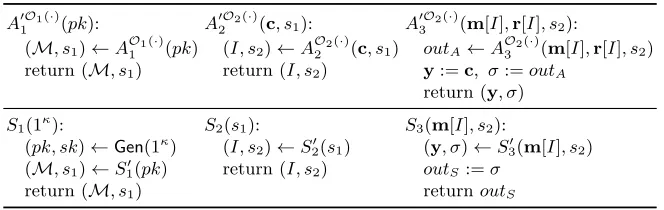
SIM-NM-SO-ATK ⇒ SIM-SO-ATK. We provide a high-level description of the reasoning here.
Given any SIM-SO-ATK adversaryA= (A1, A2, A3) for an encryption schemePKE, we
con-struct a SIM-NM-SO-ATK adversaryA0(in Table 2). IfExpSIM-NM-SO-ATK-RealPKE,A0 (κ) := (M,m, I,x,
σ), thenExpSIM-SO-ATK-RealPKE,A (κ) = (M,m, I, σ). SIM-NM-SO-ATK security guarantees that there is a simulatorS0with respect toA0, such thatExpSIM-NM-SO-ATK-IdealPKE,S0 (κ)
c
≈ExpSIM-NM-SO-ATK-RealPKE,A0 (κ),
i.e., (MS0,mS0, IS0,xS0, σS0)
c
≈(M,m, I,x, σ). Hence, (MS0,mS0, IS0, σS0)
c
≈(M,m, I, σ). Based onS0, we can construct a SIM-SO-ATK simulatorS(in Table 2), such thatExpSIM-SO-ATK-IdealPKE,S (κ) := (MS0,mS0, IS0, σS0). Hence, we have the following theorem.
Theorem 1. (SIM-NM-SO-ATK⇒SIM-SO-ATK).For any ATK∈ {CPA, CCA1, CCA2},
Table 2.Constructions of adversaryA0= (A01, A02, A03) and simulatorS = (S1, S2, S3)
A10O1(·)(pk): A20O2(·)(c, s1): A 0O2(·)
3 (m[I],r[I], s2):
(M, s1)←A O1(·)
1 (pk) (I, s2)←A
O2(·)
2 (c, s1) outA←A
O2(·)
3 (m[I],r[I], s2)
return (M, s1) return (I, s2) y:=c, σ:=outA return (y, σ)
S1(1κ): S2(s1): S3(m[I], s2):
(pk, sk)←Gen(1κ) (I, s2)←S20(s1) (y, σ)←S30(m[I], s2)
(M, s1)←S10(pk) return (I, s2) outS:=σ return (M, s1) returnoutS
SIM-SO-ATK ;SIM-NM-SO-ATK. Now we show that SIM-SO security is strictly weaker
than SIM-NM-SO-ATK security. Formally, we have the following theorem.
Theorem 2. (SIM-SO-ATK;SIM-NM-SO-ATK).For any ATK∈ {CPA, CCA1, CCA2},
there is a SIM-SO-ATK secure PKE scheme, which is not SIM-NM-SO-ATK secure.
We prove this theorem with two counterexamples.
In the case of ATK = CPA, we consider the Goldwasser-Micali probabilistic encryption scheme (the GM scheme) [10]. In [4], Bellare et al. pointed out that the GM scheme is SIM-SO-CPA secure. We claim that the GM scheme is not SIM-NM-SIM-SO-CPA secure because of its homomorphic property. Roughly speaking, let the challenge ciphertext vector c be generated from a random message vector m. We can construct an adversary A who encrypts bit 0 to obtain a ciphertext y0, and then outputs y := (y0 ·c[i])i∈[n] 6= c. Obviously, the decryption of
y is x:= (0⊕m[i])i∈[n] =m. However, no PPT simulatorS can output a ciphertext vectory
satisfying x = m, since m was uniformly chosen and no information about m is leaked to S except the opened messages.
In the case of ATK∈ {CCA1, CCA2}, we show a counterexample as follows. The main idea of our counterexample is similar to that in [19]. Let PKE = (Gen,Enc,Dec) be an encryption scheme. We construct a new scheme PKEg = (Gen,g Enc,g Decg):
To prove that PKEg is not SIM-NM-SO-CCA1/CCA2 secure, consider the adversary A:
A obtains θ by querying the decryption oracle on input (c,0,1κ), and outputs a ciphertext whose decryption is ⊥. Notice that any PPT simulator S has no information about the u-niformly chosen θ, since it cannot access to the decryption oracle. So the probability that the simulator outputs a ciphertext whose decryption is ⊥ is negligible. Consider the distin-guisher D: On input (M,m, I,x, σ), return 1 if and only if ⊥ ∈ x. Then D can distinguish ExpSIM-NM-SO-CCA1/CCA2-Real
g
PKE,A (κ) and Exp
SIM-NM-SO-CCA1/CCA2-Ideal
g
PKE,S (κ). Hence, PKEg is not
SIM-NM-SO-CCA1/CCA2 secure. Now, what remains is to prove the SIM-SO-CCA1/CCA2 security ofPKEg, which is guaranteed byPKE’s SIM-SO-CCA1/CCA2 security. The formal proof will be
given in Appendix A.
Remark 3. The aforementioned analysis actually shows that PKEg is not SIM-NM-SO-CCA1
secure,even ifPKEis SIM-SO-CCA2 secure. So we have a stronger conclusion: “SIM-SO-CCA2
; SIM-NM-SO-CCA1”, and a similar analysis gives “SIM-SO-CCA2; SIM-NM-CCA1”.
Table 3.PKEg = (Geng,Encg,Dec)g
g
Gen(1κ):
g
Enc(pk, mf ): Dec(g fsk,ec):
(pk, sk)←Gen(1κ) c←Enc(pk, m) Parseec= (c, b, ϑ)
θ← {0,1}κ return
e
c:= (c,1,0κ) Ifb= 0 andϑ= 1κ, then returnθ
f
pk:=pk Ifb= 0 andϑ=θ, then return⊥
f
sk:= (sk, θ) Ifb= 1 andϑ= 0κ, setm=Dec(sk, c) return (fpk,skf) Ifm=⊥, then return 0; else, returnm
Otherwise, return 0
secure, but meanwhile SIM/IND-NM-SO-CPA insecure.
A note on SIM-NM-SO-CCA2. In [19], Pass et al. specified a special condition (i.e., the message space and the range of the decryption algorithm are identical), under which IND-NM-CCA1/CCA2 security and SIM-NM-IND-NM-CCA1/CCA2 security are equivalent. Interestingly, we find that under this condition, if the range of the decryption algorithm is recognizable (i.e., roughly speaking, there is a polynomial-time algorithm, which can determine whether an element is in the range of the decryption algorithm), then SIM-SO-CCA2 security implies SIM-NM-SO-CCA2 security (i.e., these two security notions are equivalent).
Below we recall the special condition proposed in [19], which we name “invertible decryption”.
Definition 8 (Invertible decryption). Let PKE= (Gen,Enc,Dec) be a PKE scheme. Dec is invertible if there exists a PPT algorithmF, such that for any ciphertextc,Dec(sk,F(pk,Dec(sk, c))) =Dec(sk, c), where (pk, sk)←Gen(1κ).
Theorem 3. If a SIM-SO-CCA2 secure PKE scheme has an invertible decryption algorithm, and the range of the decryption algorithm is recognizable in polynomial time, then the scheme is also SIM-NM-SO-CCA2 secure.
Proof. Let PKE = (Gen,Enc,Dec) be a SIM-SO-CCA2 secure encryption scheme, such that it has an inverting algorithm F, and the range of Dec is recognizable. Now we prove PKE is SIM-NM-SO-CCA2 secure.
For any PPT adversary A= (A1, A2, A3) attackingPKEin the sense of SIM-NM-SO-CCA2,
we construct a PPT adversary A0 = (A01, A02, A03) attacking PKEin the sense of SIM-SO-CCA2 as follows.
Receiving a public keypk,A01 runsA1 on the input of pk. For any decryption queryc0 asked
by A1, A01 sends c0 to its own decryption oracle, and then returns the answer to A1. At some
point,A1 returns a message distributionM. Then,A01 outputsMto the challenger.
On the other side, the challenger samples m ← M and r ← (REnc)|m|, and generates c∗ ←Enc(pk,m;r).
Receiving c∗ from the challenger, A02 runs A2 on the input of c∗. For any decryption query
c0 asked by A2, A02 answers with its own decryption oracle as before (of course, both A2 and
A02 are not allowed to query c0 ∈c∗). At some point,A2 returns a subset I ⊂ [|c∗|]. Then, A02
outputsI to the challenger.
Receivingm[I] andr[I],A03 runsA3 on the input ofm[I] andr[I]. For any decryption query
c0 asked by A3, A03 answers it as before. At last, A3 returns its final output (y, σ). Then, A03
decryption oracle and denote the decryption byx[i]; ify[i]∈c∗, set thatx[i] := COPY. Finally, A03 outputsoutA0 := (x, σ).
That is the description of adversaryA0.
Notice thatA0perfectly simulates the real experimentExpSIM-NM-SO-ATK-RealPKE,A (κ) forA. Hence,
ExpSIM-SO-CCA2-RealPKE,A0 (κ) = (M,m, I, outA0) = (M,m, I,x, σ) =ExpSIM-NM-SO-CCA2-RealPKE,A (κ). (1)
Since PKEis SIM-SO-CCA2 secure, there is a PPT simulatorS0 = (S10, S20, S30) such that
ExpSIM-SO-CCA2-IdealPKE,S0 (κ)
c
≈ExpSIM-SO-CCA2-RealPKE,A0 (κ). (2)
Now, based on S0, we construct a simulator S = (S1, S2, S3) in the sense of
SIM-NM-SO-CCA2.
Receiving a public keypk,S1runsS10 on the input of 1κ. ThenS1 outputs theMS0 returned
by S10.
On the other side, the challenger samples mS0 ← MS0, without returning anything toS.
Later, S20 outputs a subset IS0.S2 outputsIS0 to the challenger.
Upon receiving mS0[IS0], S3 runs S0
3 on the input of mS0[IS0], obtaining S0
3’s final output
outS0. After parsing outS0 = (xS0, σS0), S3 checks whether there is some i0 ∈ [|xS0|] such that
xS0[i0] 6= COPY and meanwhile xS0[i0] is not in the range of Dec. It is feasible to check that
in polynomial time since the range ofDec is recognizable. If there is such ani0, thenS3 aborts
by outputting a random string. Otherwise, S3 generates yS (where |yS| = |xS0|) as follows:
For i= 1,2,· · ·,|yS|, if xS0[i] = COPY, then set yS[i] = COPY; otherwise, generate yS[i] ←
F(pk,xS0[i]). After that, S3 outputs (yS, σS0).
That is the description of simulator S.
Let baddenote the event that S aborts. If baddoes not occur, then for any j∈[|xS0|] such
that xS0[j]6= COPY, there is some ciphertext b
cj (not has to be valid), such that Dec(sk,bcj) =
xS0[j]. We have Dec(sk,yS[j]) =Dec(sk,F(pk,Dec(sk, b
cj))) =Dec(sk,bcj) =xS0[j]. In this case,
ExpSIM-NM-SO-CCA2-IdealPKE,S (κ) = (MS0,mS0, IS0,xS0, σS0)
= (MS0,mS0, IS0, outS0)
=ExpSIM-SO-CCA2-IdealPKE,S0 (κ).
So for any PPT algorithm D,
|Pr[D(ExpSIM-NM-SO-CCA2-IdealPKE,S (κ)) = 1]−Pr[D(ExpSIM-SO-CCA2-IdealPKE,S0 (κ)) = 1]| ≤Pr[bad].
Notice that if Pr[bad] is negligible, then we have
ExpSIM-NM-SO-CCA2-IdealPKE,S (κ)≈c ExpSIM-SO-CCA2-IdealPKE,S0 (κ). (3)
Combining equations (1),(2) and (3) gives
ExpSIM-NM-SO-CCA2-RealPKE,A (κ)≈c ExpSIM-NM-SO-CCA2-IdealPKE,S (κ).
AlgorithmD0(M,m, I, out): Parseout= (x, σ) Fori∈[|x|],
Ifx[i]6= COPY andx[i] is not in the range ofDec, then return 1 Return 0
It is obvious that Pr[D0(ExpSIM-SO-CCA2-RealPKE,A0 (κ)) = 1] = 0, and Pr[D0(ExpSIM-SO-CCA2-IdealPKE,S0 (κ)) =
1] = Pr[bad]. In other words,
Pr[bad] =|Pr[D0(ExpSIM-SO-CCA2-RealPKE,A0 (κ)) = 1]−Pr[D0(ExpSIM-SO-CCA2-IdealPKE,S0 (κ)) = 1]|.
Hence, equation (2) guarantees that Pr[bad] is negligible. So we finish the proof of Theorem
3. ut
5 Relations between IND-NM-SO securities and IND-SO securities
In this section, we explore the relations between IND-NM-SO securities and IND-SO securities. First of all, for any ATK ∈ {CPA, CCA1, CCA2}, an IND-NM-SO-ATK adversary is more powerful than an IND-SO-ATK adversary in that it can make an additional query to oracle Psk(·). Intuitively, IND-NM-SO-ATK security implies IND-SO-ATK security. Further more, any IND-SO-CCA2 adversaryAis able to access to the decryption oracle after receiving the challenge ciphertext vector. So providing A the ability to make a parallel decryption query yields no additional power. The above analysis results in the following theorem.
Theorem 4. (IND-NM-SO-ATK⇒ IND-SO-ATK, IND-NM-SO-CCA2 ⇔
IND-SO-CCA2). For any ATK ∈ {CPA, CCA1, CCA2}, IND-NM-SO-ATK security implies IND-SO-ATK security. Further more, if IND-SO-ATK=CCA2, these two securities are equivalent.
IND-NM-SO-CPA :
; IND-SO-CCA1. Formally, we have the following theorem. This is an direct extension of the conclusion in [1]. So we just provide a high-level description of the reasoning here.
Theorem 5. (IND-NM-SO-CPA :
; IND-SO-CCA1). There is an IND-SO-CCA1 secure
PKE scheme, which is not IND-NM-SO-CPA secure; vice verse.
The direction:.Note that after receiving the challenge ciphertext, the IND-SO-CCA1
adver-sary cannot access to the decryption oracle, but the IND-NM-SO-CPA adveradver-sary still can make a parallel decryption query. Based on this observation, any PKE scheme, achieving IND-SO-CCA1 but not IND-SO-CCA2 security, might be used as a counterexample. The following schemePKE0, with message space {0,1}κ, is from [1]. If the basic schemePKE = (Gen,Enc,Dec) is IND-SO-CCA1 secure, then we can prove that PKE0 is IND-SO-CCA1 secure but not IND-NM-SO-CPA secure. The formal proof is in Appendix B.
The direction;.Note that an IND-NM-SO-CPA adversary can make just a one-time
decryp-tion query (although it is parallel), but an IND-SO-CCA1 adversary can query the decrypdecryp-tion oracle polynomial times. Based on this observation, we provide a PKE scheme PKE00, which is identical to the scheme PKEg in Section 4, except that during the decryption, roughly, the
Table 4.PKE0= (Gen0,Enc0,Dec0) Gen0(1κ): Enc0
(pk0, m): Dec0(sk0, c): (pk, sk)←Gen(1κ) c1 ←Enc(pk, m) Parsec= (c1, c2)
pk0:=pk c2 ←Enc(pk, m) m=Dec(sk, c1)
sk0:=sk (Note:mis the bitwise complement ofm) returnm
return (pk0, sk0) returnc:= (c1, c2)
adversary can obtain θ by querying the decryption oracle on input (c,0,1κ), so it can obtain the original sk by querying on (c,0, θ). Hence, PKE00 is not IND-SO-CCA1 secure. However, the IND-NM-SO-CPA adversary cannot make any other decryption query after the the parallel decryption query. Notice thatθ is uniformly chosen, soPKE00 can be proved IND-NM-SO-CPA secure. The formal proof is in Appendix B.
Remark 5. Since IND-SO-CCA1 (resp. IND-NM-SO-CCA1) security implies IND-SO-CPA (resp. IND-NM-SO-CPA) security, we have the following corollary.
Corollary 1. (IND-SO-CPA/CCA1;IND-NM-SO-CPA/CCA1).IND-SO-CPA/CCA1
security is strictly weaker than IND-NM-SO-CPA/CCA1 security.
6 Relations between SIM-NM-SO securities and SIM-NM securities
SIM-NM-SO-ATK ⇒ SIM-NM-ATK. Compared with the conclusion that
“SIM-NM-SO-ATK ⇒ SIM-SO-ATK”, this conclusion is not that obvious. That is because, compared with the SIM-NM-SO-ATK adversary, although the SIM-NM-ATK adversary is less powerful (i.e., not allowed to make any opening query), the corresponding simulator also has less information (i.e., not allowed to make any opening query) about the message vector. Formally, we have the following theorem.
Theorem 6. (SIM-NM-SO-ATK⇒SIM-NM-ATK).For any ATK∈ {CPA, CCA1, CCA2},
SIM-NM-SO-ATK security implies SIM-NM-ATK security.
For convenience, we firstly define a special message distribution, and then turn to the formal proof.
Definition 9 ((n1, n2)-half-uniform distribution).A distributionMis(n1, n2)-half-uniform,
if it satisfies the following three properties: (1)For anym← M,|m|= 2n1; (2)M=MA||(Un2)
n1,
whereMAis independent of(Un2)
n1; (3)The description ofMconsists of two descriptions (i.e.,
MA and(Un2)
n1).
Remark 6. In Table 1, every “M” returned by A1 or S1 actually stands for the description
of message distribution M. The above property (3) requires that receiving a description of an (n1, n2)-half-uniform distribution M, any one can efficiently extract the description of the
related distribution MA.
Proof. We prove that “SIM-NM-SO-CCA2 security ⇒ SIM-NM-CCA2 security”. The proof in the case of CPA/CCA1 is similar, which we will omit here.
LetPKE= (Gen,Enc,Dec) be a SIM-NM-SO-CCA2 secure encryption scheme. For any PPT adversary A = (A1, A2) attacking PKE in the sense of SIM-NM-CCA2, we construct a PPT
Receiving a public keypk,A01 runsA1 on the input of pk. For any decryption queryc0 asked
by A1, A01 sends c0 to its own decryption oracle, and then returns the answer to A1. At some
point,A1 returns a message distributionMA. Without loss of generality, we assume that all the message vectors sampled fromMAhave the same size (denoted byn1), i.e., for anymA← MA,
|mA|=n1. Then, A10 outputs MA0 := MA||(Un
2)
n1, where n
2 is also an integer polynomial in
κ.
On the other side, the challenger chooses mA0 ← MA0 (i.e., samples mA ← MA, mU ←
(Un2)
n1, and sets m
A0 :=mA||mU) andr←(REnc)2n1, and generatesc∗←Enc(pk,mA0;r).
Upon receiving c∗ from the challenger, A02 outputs IA0 := {n1+ 1, n1+ 2,· · ·,2n1} as its
opening query.
Receiving mA0[IA0] andr[IA0] from the challenger, A30 parsesc∗ =cA||cU, such that |cA|= |cU| =n1. Then, A03 runs A2 on the input ofcA. For any decryption query c0 asked by A2, if
c0 ∈/ cU,A03 answers this query with its own decryption oracle; otherwise,A03 answers this query
withmA0[IA0], sincemA0[IA0] =mU. Finally, receiving A2’s final output (y, σ),A03 generates its
own ciphertext vectory0, where|y0|=|y|, as follows: For i∈[|y0|],
– If y[i]∈ cU and meanwhile y[i]∈/ cA, then A03 recovers the decryption of y[i] (denoted by
x[i]) frommA0[IA0] =mU, and generatesy0[i]←Enc(pk,x[i]) such thaty0[i]∈/ cAScU. It is
easy forA03 to generate such ay0[i], sincePKEis a probabilistic encryption scheme achieving SIM-NM-SO-CCA2 security.
– Otherwise, set thaty0[i] :=y[i].
A03 returns (y0, σ) as its final output. That is the description of adversaryA0.
Note thatA0 perfectly simulates the real experiment ExpSIM-NM-CCA2-RealPKE,A (κ) forA, and the decryptions ofy0 and yare identical (denoted byx). We have that
ExpSIM-NM-SO-CCA2-RealPKE,A0 (κ) = (MA0,mA0, IA0,x, σ)
= (MA||(Un2)
n1,m
A||mU,{n1+ 1, n1+ 2,· · · ,2n1},x, σ), (4)
and
ExpSIM-NM-CCA2-RealPKE,A (κ) = (MA,mA,x, σ). (5) Since PKE is SIM-NM-SO-CCA2 secure, there is a PPT simulator S0 = (S10, S02, S30), such that
ExpSIM-NM-SO-CCA2-IdealPKE,S0 (κ)
c
≈ExpSIM-NM-SO-CCA2-RealPKE,A0 (κ). (6)
Now, based onS0, we show a simulatorS = (S1, S2) in the sense of SIM-NM-CCA2.
Receiving a public keypk,S1 obtains a message distributionMS0 by runningS10 on the input
of pk. After receiving an opening query IS0 from S0
2,S1 runs as follows: IfMS0 is not (n1, n2
)-half-uniform (for somen1, n2 that are both polynomial inκ), orIS0 6={n1+ 1, n1+ 2,· · · ,2n1}
for the n1 determined by MS0, then S aborts (with S1 outputting MS =Un
3 for some integer
n3, and S2 outputting randomly chosen (yU, σU)); Otherwise, S1 parses MS0 =MS||(Un
2)
n1,
and outputs MS to the challenger.
On the other side, the challenger samples mS← MS, without returning anything toS. S2 samples mU ← (Un2)
n1, and runs S0
3 on the input of mU. Finally, S2 outputsS30’s final
output (yS0, σS0).
Let baddenote the event thatS aborts, andxS0 denote the decryption ofyS0.
Then, whenbad does not occur, both of the following equations hold,
ExpSIM-NM-SO-CCA2-IdealPKE,S0 (κ) = (MS||(Un2)n1,mS||mU,{n1+ 1, n1+ 2,· · · ,2n1},xS0, σS0), (7)
ExpSIM-NM-CCA2-IdealPKE,S (κ) = (MS,mS,xS0, σS0). (8)
Hence, for any PPT distinguisher D, we denote its advantage by
AdvD :=|Pr[D(ExpSIM-NM-CCA2-RealPKE,A (κ)) = 1]−Pr[D(ExpSIM-NM-CCA2-IdealPKE,S (κ)) = 1]|
= |Pr[D(ExpSIM-NM-CCA2-RealPKE,A (κ)) = 1]−Pr[D(ExpSIM-NM-CCA2-IdealPKE,S (κ)) = 1|¬bad]·Pr[¬bad]
− Pr[D(ExpSIM-NM-CCA2-IdealPKE,S (κ)) = 1|bad]·Pr[bad]| ≤ |Pr[D(ExpSIM-NM-CCA2-RealPKE,A (κ)) = 1]−Pr[D(ExpSIM-NM-CCA2-IdealPKE,S (κ)) = 1|¬bad]·Pr[¬bad]|
+ Pr[bad].
To bound the inequality, we present the following two lemmas and postpone their proofs.
Lemma 1. |Pr[D(ExpSIM-NM-CCA2-RealPKE,A (κ)) = 1]−Pr[D(ExpSIM-NM-CCA2-IdealPKE,S (κ)) = 1|¬bad]·
Pr[¬bad]| is negligible.
Lemma 2. Pr[bad] is negligible.
Hence, AdvD is negligible. So we conclude that
ExpSIM-NM-CCA2-RealPKE,A (κ)≈c ExpSIM-NM-CCA2-IdealPKE,S (κ), which means thatPKEis SIM-NM-CCA2 secure.
So what remains is to prove Lemma 1 and Lemma 2.
Proof. (of Lemma 1)
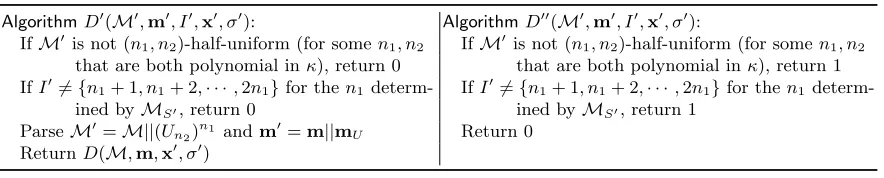
Based on the aforementionedD, we show an algorithmD0, distinguishingExpSIM-NM-SO-CCA2-RealPKE,A0 (κ)
and ExpSIM-NM-SO-CCA2-IdealPKE,S0 (κ), described in Table 5.
Combining equations (4), (5), (7) and (8), it is not hard to see that D0 has the following properties:
– D0(ExpSIM-NM-SO-CCA2-RealPKE,A0 (κ)) =D(ExpSIM-NM-CCA2-RealPKE,A (κ)).
– If baddoes not occur, thenD0(ExpSIM-NM-SO-CCA2-IdealPKE,S0 (κ)) =D(ExpSIM-NM-CCA2-IdealPKE,S (κ)).
– If badoccurs, then D0(ExpSIM-NM-SO-CCA2-IdealPKE,S0 (κ)) = 0.
Let AdvD0 denoteD0’s advantage. So we have that
AdvD0 :=|Pr[D0(ExpSIM-NM-SO-CCA2-RealPKE,A0 (κ)) = 1]−Pr[D0(ExpSIM-NM-SO-CCA2-IdealPKE,S0 (κ)) = 1]|
= |Pr[D0(ExpSIM-NM-SO-CCA2-RealPKE,A0 (κ)) = 1]
− Pr[D0(ExpSIM-NM-SO-CCA2-IdealPKE,S0 (κ)) = 1|¬bad]·Pr[¬bad]|
= |Pr[D(ExpSIM-NM-CCA2-RealPKE,A (κ)) = 1]
− Pr[D(ExpSIM-NM-CCA2-IdealPKE,S (κ)) = 1|¬bad]·Pr[¬bad]|
Table 5.AlgorithmD0and AlgorithmD00
AlgorithmD0(M0
,m0, I0,x0, σ0): AlgorithmD00(M0
,m0, I0,x0, σ0): IfM0
is not (n1, n2)-half-uniform (for somen1, n2 IfM0is not (n1, n2)-half-uniform (for somen1, n2
that are both polynomial inκ), return 0 that are both polynomial inκ), return 1 IfI06={n1+ 1, n1+ 2,· · ·,2n1}for then1 determ- IfI06={n1+ 1, n1+ 2,· · ·,2n1}for then1
determ-ined byMS0, return 0 ined byMS0, return 1
ParseM0
=M||(Un2)
n1 andm0=m||m
U Return 0 ReturnD(M,m,x0, σ0)
Proof. (of Lemma 2)
Note that bad occurs if and only if MS0 is not an (n1, n2)-half-uniform distribution, or IS0 6= {n1+ 1, n1+ 2,· · · ,2n1}for then1 determined byMS0. Hence, whetherbadoccurs can be check
in polynomial time. Consider the PPT algorithmD00 described in Table 5.
From equation (4), it is easy to see that Pr[D00(ExpSIM-NM-SO-CCA2-RealPKE,A0 (κ)) = 1] = 0.
We also notice that Pr[D00(ExpSIM-NM-SO-CCA2-IdealPKE,S0 (κ)) = 1] = Pr[bad]. Then, we have
Pr[bad] =|Pr[D00(ExpSIM-NM-SO-CCA2-RealPKE,A0 (κ)) = 1]−Pr[D00(ExpSIM-NM-SO-CCA2-IdealPKE,S0 (κ)) = 1]|.
Therefore, equation (6) guarantees that Pr[bad] is negligible. ut u t
Remark 7. We can also prove Theorem 6 by simply constructing a “non-opening” SIM-NM-SO-ATK adversary, which is a copy of the SIM-NM-ATK adversary, and using the related SIM-NM-SO-ATK simulator as the SIM-NM-ATK simulator. Hence, our aforementioned proof actually shows that even considering constrained SIM-NM-SO-ATK adversary (i.e., “open-ing” adversary), Theorem 6 still holds. We note that all the simulation-based security no-tions (e.g., SIM-SO-ATK security) in this paper are described as “ExpSIM-XX-ATK-RealPKE,A (κ) ≈c
ExpSIM-XX-ATK-IdealPKE,S (κ)”, free of “relation R”. For formal definitions of SIM-NM-ATK security (resp. SIM-SO-ATK security) defined with “relation R”, we refer the readers to the papers [5] (resp. [4]). We note that if considering the simulation-based security notions described with “re-lationR”, the conclusion of Theorem 6 might need to be reconsidered.
SIM-NM-ATK ; SIM-NM-SO-ATK. We will show that the IND-CCA2 secure
Cramer-Shoup scheme [6][7] (the CS scheme) is NM-CCA2 secure. But the CS scheme is not SIM-SO-CPA secure [2]. According to Theorem 1, it is not SIM-NM-SIM-SO-CPA secure either. Conse-quently, “SIM-NM-ATK0;SIM-NM-SO-ATK00”, for any ATK0,ATK00∈ {CPA,CCA1,CCA2}.
To show that the CS scheme is SIM-NM-CCA2 secure, we use the following two facts: (1) For any PKE scheme having an invertible decryption algorithm, it is IND-NM-CCA2 secure iff it is SIM-NM-CCA2 secure [19, Theorem 6]. (2) IND-CCA2 security is equivalent to IND-NM-CCA2 security, since the parallel decryption query provides no additional ability to the adversary in the case of CCA2. So what remains is to show that the CS scheme has an invertible decryption algorithm. Let (Enc,Dec) denote the corresponding encryption/decryption algorithms. Following the notations of [7], any valid ciphertextψof the CS scheme has the formψ:= (a,a, c, dˆ )∈G4, the message space is G, and the range of Dec is GS{
reject}, where G is a group of prime
7 Relations between IND-NM-SO securities and IND-NM securities
In this section, we explore the relations between IND-NM-SO securities and IND-NM securities. Our conclusions are as follows.
Theorem 7. (IND-NM-CCA2 ; IND-NM-SO-CCA2). There is an IND-NM-CCA2
se-cure PKE scheme, which is not IND-NM-SO-CCA2 sese-cure.
Theorem 8. (IND-NM-SO-ATK⇒IND-NM-ATK).For any ATK∈ {CPA, CCA1, CCA2},
IND-NM-SO-ATK security implies IND-NM-ATK security.
Notice that IND-NM-CCA2 (resp. IND-NM-SO-CCA2) security is equivalent to IND-CCA2 (resp. IND-SO-CCA2) security, so Theorem 7 is directly from [17], which separated IND-CCA2 security and IND-SO-CCA2 security.
The conclusion of Theorem 8 is not surprising at all. Intuitively, compared with the adversary considered in the notion of IND-NM security, the one considered in the notion of IND-NM-SO security is similar but more powerful. One subtlety here is that the ways that message vectors are sampled in these two notions are different. Due to space limitations, we provide the proof of this theorem in Appendix C.
Remark 8.In Section 5, we have showed that “IND-NM-SO-CPA ; IND-SO-CCA1” by
uti-lizing schemePKE00 as a counterexample. With a similar analysis, it is easy to see that PKE00 is not IND-NM-CCA1 secure. So we conclude that “IND-NM-SO-CPA; IND-NM-CCA1”.
8 Relations between SIM-NM-SO securities and IND-NM-SO securities
In this section, we explore the relations between SIM-NM-SO securities and IND-NM-SO secu-rities. Formally, we have the following conclusion. Its proof is similar to that of Theorem 2 and [19, Theorem 4], so we just provide a sketch here.
Theorem 9. (IND-NM-SO-CCA1/CCA2;SIM-NM-SO-CCA1/CCA2).For any ATK∈
{CCA1,CCA2}, there is an IND-NM-SO-ATK secure PKE scheme, which is not SIM-NM-SO-ATK secure.
Proof. (Sketch) Let PKE= (Gen,Enc,Dec) be an IND-NM-SO-CCA1/CCA2 secure encryption scheme. We construct the scheme PKEg = (Gen,g Enc,g Decg) described in Table 3. Note that in
Section 4, we have shown thatPKEg is not SIM-NM-SO-CCA1/CCA2 secure, and the reasoning
there does not involve the security of the basic schemePKE. So here we just need to prove that
g
PKEachieves IND-NM-SO-CCA1/CCA2 security.
For any PPT adversaryAeattackingPKEg in the sense of IND-NM-SO-CCA1/CCA2 with
non-negligible advantage, roughly speaking, we construct a PPT adversaryAattacking PKE(in the sense of IND-NM-SO-CCA1/CCA2) as follows: Receiving the public key,Achoosesθ← {0,1}κ, and uses thisθ and its own decryption oracle to answer Ae’s decryption queries. A outputs the
same message distribution M as Ae does, transforms any component c[i] of its own challenge
ciphertext vector into (c[i],1,0κ) to get a modified challenge ciphertext vector and passes the modified one toAe.Auses its own opening oracle to answerAe’s opening query. Finally,Areturns
e
A’s final output. Notice that A perfectly simulates the IND-NM-SO-CCA1/CCA2 experiment (aboutPKEg) forAe. SoA’s advantage is also non-negligible, contradicting the assumption. ut
Remark 9.Note thatPKEg is not SIM-NM-SO-CCA1 secure,even ifPKEis IND-NM-SO-CCA2
9 Constructions
Fortunately, there are some known selective opening secure PKE schemes achieving SIM/IND-NM-SO securities. Details are as follows.
SIM-NM-SO-CCA2 secure construction.The Fehr-Hofheinz-Kiltz-Wee encryption scheme (the FHKW scheme) is SIM-SO-CCA2 secure [11][15][16]. We claim that the decryption algorith-m of the FHKW schealgorith-me is invertible, and the range of the decryption algorithalgorith-m is recognizable. Hence, according to Theorem 3, the FHKW scheme is SIM-NM-SO-CCA2 secure. Our claim is justified as follows.
According to [11], any valid ciphertext of the FHKW scheme has the form (X1,· · · , XL, T), and the message space is{0,1}L. For any ciphertext of the form (X
1,· · · , XL, T), whereXi ∈ X andT ∈ X T, its decryption is anL-bit string. SinceX andX T are both efficiently recognizable, any invalid ciphertext (X1,· · ·, XL, T) (i.e.,Xi∈ X/ for somei, orT /∈ X T) will be decrypted to
⊥. In other words, the range of the decryption algorithm is{0,1}LS{⊥}
, which is recognizable. As to the special inverting algorithm F, we construct it as follows: Let (Enc,Dec) denote the encryption/decryption algorithms of the FHKW scheme. For any ciphertext c, we have that Dec(sk, c) ∈ {0,1}LS{⊥}
. If Dec(sk, c) ∈ {0,1}L, F runs Enc(pk,Dec(sk, c)) and returns the generated ciphertext; IfDec(sk, c) =⊥,Freturns an arbitrary ciphertext (X1,· · ·, XL, T) where
Xi ∈ X/ orT /∈ X T.
IND-NM-SO-CCA2 secure construction. According to Theorem 4, IND-NM-SO-CCA2
security is equivalent to IND-SO-CCA2 security. So any IND-SO-CCA2 secure encryption scheme (e.g. the PKE scheme constructed from all-but-many lossy trapdoor functions [12]) meets IND-NM-SO-CCA2 security.
Acknowledgments. The authors would like to thank the anonymous reviewers of ACNS 2015 for their helpful comments. This work is funded by the Specialized Research Fund for the Doctor-al Program of Higher Education under Grant 20110073110016, the Scientific Innovation Projects of Shanghai Education Committee under Grant 12ZZ021, and the National Natural Science Foundation of China under Grants 61170229, 61373153, 61133014 and 61472114.
References
1. M. Bellare, A. Desai, D. Pointcheval and P. Rogaway. Relations among notions of security for public key encryption schemes. In: CRYPTO 1998. LNCS, vol. 1462, Springer, Heidelberg (1998)
2. M. Bellare, R. Dowsley, B. Waters and S. Yilek. Standard security does not imply security against selective-opening. In: Eurocrypt 2012. LNCS, vol. 7237, pp. 645-662. Springer, Heidelberg (2012)
3. F. B¨ohl, D. Hofheinz and D. Kraschewski. On definitions of selective opening security. In: PKC 2012. LNCS, vol. 7293, pp. 522-539. Springer (2012)
4. M. Bellare, D. Hofheinz and S. Yilek. Possibility and impossibility results for encryption and commitment secure under selective opening. In: Eurocrypt 2009. LNCS, vol. 5479, pp. 1-35. Springer, Heidelberg (2009) 5. M. Bellare and A. Sahai. Non-malleable encryption: Equivalence between two notions, and an
indistinguishability-based characterization. In: CRYPTO 1999. LNCS, vol. 1666, pp. 519-536. Springer, Hei-delberg (1999)
6. R. Cramer and V. Shoup. A practical public key cryptosystem provably secure against adaptive chosen ciphertext attack. In: CRYPTO 1998. Springer Berlin Heidelberg, 1998: 13-25.
8. D. Dolev, C. Dwork and M. Naor. Non-Malleable Cryptography. In 23rd ACMSymposium on the Theory of Computing, 1991, pages 542-552.
9. D. Dolev, C. Dwork and M. Naor. Nonmalleable cryptography. SIAM J.Comput. 30(2), 391-437 (2000) 10. S. Goldwasser and S. Micali. Probabilistic encryption. In: Journal of computer and system sciences 28.2:
270-299 (1984)
11. S. Fehr, D. Hofheinz, E. Kiltz and H. Wee. Encryption schemes secure against chosen-ciphertext selective opening attacks. In: Eurocrypt 2010. LNCS, vol. 6110, pp. 381-402. Springer, Heidelberg (2010)
12. D. Hofheinz. All-but-many lossy trapdoor functions. In: Eurocrypt 2012. LNCS, vol. 7237, pp. 209-227. Springer, Heidelberg (2012)
13. J. Huang and X. Lai. Revisiting key schedules diffusion in relation with round functions diffusion. In: Designs Codes & Cryptography 73.1(2014):85-103.
14. B. Hemenway, B. Libert, R. Ostrovsky and D. Vergnaud. Lossy encryption: Constructions from general assumptions and efficient selective opening chosen ciphertext security. In: Asiacrypt 2011. LNCS. Springer (2011)
15. Z. Huang, S. Liu and B. Qin. Sender-Equivocable Encryption Schemes Secure against Chosen-Ciphertext Attacks Revisited. In: PKC 2013, pp. 369-385. Springer Berlin Heidelberg, 2013.
16. Z. Huang, S. Liu, B. Qin and K. Chen. Fixing the Sender-Equivocable Encryption Scheme in Eurocrypt 2010. In: Intelligent Networking and Collaborative Systems (INCoS), 2013 5th International Conference on. IEEE, 2013: 366-372.
17. D. Hofheinz and A. Rupp. Standard versus Selective Opening Security: Separation and Equivalence Results. In: TCC 2014. LNCS, vol. 8349, pp. 591-615. Springer, Heidelberg (2014)
18. M. Naor and M. Yung. Public-key cryptosystems provably secure against chosen ciphertext attacks. In: Proceedings of the twenty-second annual ACM symposium on Theory of computing, pp. 427-437. ACM, 1990.
19. R. Pass, A. Shelat and V. Vaikuntanathan. Relations among notions of non-malleability for encryption. In: ASIACRYPT 2007. pp. 519-535. Springer Berlin Heidelberg, 2007.
20. C. Rackoff and D. R. Simon. Non-interactive zero-knowledge proof of knowledge and chosen ciphertext attack. In: CRYPTO 1991, pp. 433-444. Springer Berlin Heidelberg, 1992.
Appendix A. Proof of Theorem 2
Proof. (of Theorem 2.)
We prove that “SIM-SO-CCA2 security ; SIM-NM-SO-CCA2 security” as follows. The proof
in the case of CCA1 is similar, and that in the case of CPA is obvious, which we will omit here. Assuming thatPKEis SIM-SO-CCA2 secure, for the new schemePKEg described in Section 4,
we prove the following two lemmas. Lemma 3 claims thatPKEg achieves SIM-SO-CCA2 security.
Lemma 4 claims thatPKEg is SIM-NM-SO-CCA2 insecure. Hence, we finish the proof of Theorem
2.
Lemma 3. PKEg is SIM-SO-CCA2 secure.
Proof. (of Lemma 3)
For any PPT adversaryAe= (Af1,Af2,Af3) attackingPKEg in the sense of SIM-SO-CCA2, we show
a PPT adversaryA= (A1, A2, A3) attacking PKEin the sense of SIM-SO-CCA2 as follows.
Receiving a public key pk, A1 samples θ ← {0,1}κ, and sends pkf = pk to Af1. For any
decryption query ec= (c, b, ϑ) asked by Af1,A1 answers like this:
Case 1. Ifb= 0 and ϑ= 1κ, thenA1 returns θtoAf1.
Case 2. Ifb= 0 and ϑ=θ, thenA1 returns⊥ toAf1.
Case 3. If b = 1 and ϑ = 0κ, then A1 sends c to its own decryption oracle. After receiving
m=Dec(sk, c),A1 checks whether m =⊥. If m =⊥, then A1 returns 0 to Af1; else, it returns
Case 4. If (b, ϑ) is not in any of the aforementioned forms, then A1 returns 0 toAf1.
When Af1 finishes all its decryption queries, it returns a message distribution M. Then A1
outputsMas its final output.
On the other side, the challenger chooses m← M and r←(REnc)|m|, and generates c∗ ←
Enc(pk,m;r).
Upon receivingc∗from the challenger,A2setsec ∗
such that|ec∗|=|c∗|andec∗[i] := (c∗[i],1,0κ) for anyi∈[|ec∗|]. Then,A2 sends ec
∗
toAf2. For any decryption queryec= (c, b, ϑ) asked by Af2,
A2 answers as A1 does, with the only exception that if ec ∈ ec ∗
, then A2 returns . When Af2
finishes all its decryption queries, it outputs a subset I ⊆[|ec∗|].A2 outputsI to the challenger.
Upon receivingm[I] andr[I] from the challenger,A3 passes them toAf3. For any decryption
query asked by Af3,A3 answers asA2 does. Finally, Af3 returns out e
A. Then A3 outputsoutA:= out
e
A.
That is the description of adversaryA. It is obvious that
ExpSIM-SO-CCA2-RealPKE,A (κ) =ExpSIM-SO-CCA2-Real
g
PKE,Ae
(κ) = (M,m, I, out
e
A). (9)
Since PKEis SIM-SO-CCA2 secure, there is a simulator S= (S1, S2, S3), such that
ExpSIM-SO-CCA2-IdealPKE,S (κ)≈c ExpSIM-SO-CCA2-RealPKE,A (κ). (10) Note that in the sense of SIM-SO-CCA2, a simulator does not receive any public key or ciphertext, and is not allowed to ask any decryption query either. Hence, simulator S in the ideal experiment forPKEcan be used as a simulator in the ideal experiment forPKEg. Therefore,
setting Se:=S, we have that
ExpSIM-SO-CCA2-Ideal
g
PKE,Se
(κ) =ExpSIM-SO-CCA2-IdealPKE,S (κ). (11)
Combining equations (9),(10) and (11), we have that
ExpSIM-SO-CCA2-Real
g
PKE,Ae
(κ)≈c ExpSIM-SO-CCA2-Ideal
g
PKE,Se
(κ).
Therefore, PKEg is SIM-SO-CCA2 secure. ut
Lemma 4. PKEg is not SIM-NM-SO-CCA2 secure.
Proof. (of Lemma 4)
Consider an adversaryB = (B1, B2, B3) as follows: After receiving the public keypkf,B1makes a
decryption query (c0,0,1κ), wherec0is an arbitrary element in the ciphertext space. ThenB1 will
receive θ. In the end of the real experiment ExpSIM-NM-SO-CCA2-Real
g
PKE,B,R (κ),B3 returns ((c
0,0, θ), σ)
asB’s final output, whereσis an arbitrary string. Since the decryption of (c0,0, θ) is⊥, we have thatExpSIM-NM-SO-CCA2-Real
g
PKE,B (κ) = (M,m,⊥, I, σ) for some M,m, I.
However, for any PPT simulatorS, in the ideal experimentExpSIM-NM-SO-CCA2-Ideal
g
Consider the distinguisher D: On input (M,m,x, I, σ), return 1 if and only if ⊥ ∈ x and
|x|= 1. Then we have that
Pr[D(ExpSIM-NM-SO-CCA2-Real
g
PKE,B (κ)) = 1] = 1,
and for any PPT simulator S,
Pr[D(ExpSIM-NM-SO-CCA2-Ideal
g
PKE,S (κ)) = 1] =
1 2κ.
Therefore, PKEg is not SIM-NM-SO-CCA2 secure. ut
u t
Appendix B. Proof of Theorem 5
Proof. (of Theorem 5)
The direction :.Let’s prove that IND-NM-SO-CPA : IND-SO-CCA1.
Let PKE = (Gen,Enc,Dec) be an IND-SO-CCA1 secure encryption scheme with message space {0,1}κ. For any m ∈ {0,1}κ, let m denote its bitwise complement. Similarly, for any m∈ {0,1}κ×n, letm denote the bitwise complement of m (i.e., for i∈[n], m[i] is the bitwise complement ofm[i]). We construct a new schemePKE0= (Gen0,Enc0,Dec0) as follows.
Gen0(1κ):
(pk, sk)←Gen(1κ) pk0:=pk
sk0 :=sk return (pk0, sk0)
Enc0(pk0, m): c1 ←Enc(pk, m)
c2 ←Enc(pk, m)
returnc:= (c1, c2)
Dec0(sk0, c):
Parsec= (c1, c2)
m=Dec(sk, c1)
returnm
Similar to the proof of Theorem 2, for the new scheme PKE0, we prove the following two lemmas. Lemma 5 claims that PKE0 achieves IND-SO-CCA1 security. Lemma 6 claims that PKE0 is IND-NM-SO-CPA insecure. Hence, we finish the proof of The direction :.
Lemma 5. PKE0 is IND-SO-CCA1 secure.
Proof. (of Lemma 5)
For any PPT adversary A0 = (A01, A02, A03) attacking PKE0 in the sense of IND-SO-CCA1, we show a PPT adversaryA= (A1, A2, A3) attackingPKEin the sense of IND-SO-CCA1 as follows.
Receiving a public keypk,A1 passespk0=pktoA01. For any decryption queryc0 := (c01, c02)
asked by A01,A1 sends c01 to its own decryption oracle, and passes the message, returned from
the oracle, toA01. When A01 finishes all its decryption queries, it returns a message distribution
M0 and a PPT algorithmResamp0M0(·,·). Without loss of generality, we assume that n=|m0|
for any m0 ← M0.A
1 sets the following new message distributionM:
m← M means that m0← M0, m:=m0||m0 .
ResampM(I,m[I]): SetI0 :=IT
[n] For i∈I\I0,
ifi modn /∈I,
set m[i mod n] =m[i] (i.e., the bitwise complement ofm[i]), andI0=I0S
{i mod n}
x←Resamp0M0(I0,m[I0])
Setmresm:=x||x Return mresm
Then,A1 outputs (M,ResampM(·,·)).
On the other side, the challenger samplesb← {0,1},m0 ← M,r←(REnc)2n, and generates
a challenge ciphertext vector,c←Enc(pk,m0;r).
Receiving c from the challenger,A2 sets that c∗ := ((c[i],c[i+n])i∈[n]) and sends c∗ toA02.
The latter returns a subsetI0 ⊆[n]. A2 sets thatI :=I0S {i+n|i∈I0}, and outputs I.
Upon receiving a message vectormbandr[I] from the challenger,A3parsesmb:=m
(1)
b ||m
(2)
b , where |m(1)b | = |mb(2)| = n. A3 also sets that r0[I0] := ((r[i],r[i+n])i∈I0). Finally, A3 sends
(m(1)b ,r0[I0]) to A03, and outputs what A03 returns. That is the construction of adversaryA.
Note that A perfectly simulates the experimentExpIND-SO-CCA1-PKE0,A0 b(κ) (b∈ {0,1}) forA0, and
A succeeds in outputtingb0 =b if and only ifA0 also succeeds. So we have that
AdvIND-SO-CCA1PKE,A (κ) =AdvIND-SO-CCA1PKE0,A0 (κ).
u t
Lemma 6. PKE0 is not IND-NM-SO-CPA secure.
Proof. (of Lemma 6)
We show a PPT adversaryB = (B1, B2), attacking PKE0 in the sense of IND-NM-SO-CPA, as
follows.
At first, receiving a public key pk0,B1 returns a uniform distributionMover{0,1}2κ (since
M is a uniform distribution, the related PPT algorithm ResampM(·,·) is obvious, which we
omit here). The challenger chooses m0 ← M, generates a challenge ciphertext vector c ←
Enc0(pk0,m0), and sendsc toB2. Specifically,
c= (c[1],c[2]) := ((c[1]1,c[1]2),(c[2]1,c[2]2)),
where (c[i]1,c[i]2) =Enc0(pk0,m0[i]) = (Enc(pk0,m0[i]),Enc(pk0,m0[i])) fori∈[2].
For the opening query, B2 outputs I := {1}. The challenger samples b ← {0,1}, m1[2] ←
{0,1}κ, sets that
m1= (m1[1],m1[2]) := (m0[1],m1[2]),
and returnsmb and the randomness,r[1], used in the process of Enc0(pk0,m0[1]).
For the parallel decryption query,B2outputsc0:= (c[2]2,c[2]1). Note thatc0is the encryption
of m0[2]. So if c0 ∈/ c, B2 will receive m0[2]. Then B2 can recover m0[2] and compare it with
mb[2]. If c0 ∈ c, B2 will receive . Finally, B2 outputs 0 if and only if B2 receives m0[2] and
m0[2] =mb[2].
Since c0 ∈c if and only if m0[2] =m0[1], we have Pr[c0∈c] = 21κ.
In the case of c0 ∈/ c, it is easy to see that when b = 0, B2 will definitely output 0; when
b= 1, B2 will output 1 except for the casem0[2] =m1[2].
Hence,B’s advantage
AdvIND-NM-SO-CPAPKE0
,B (κ) =|Pr[Exp
IND-NM-SO-CPA-1
PKE0,B (κ) = 1]−Pr[Exp
IND-NM-SO-CPA-0
PKE0,B (κ) = 1]| =|(Pr[ExpIND-NM-SO-CPA-1PKE0,B (κ) = 1 |c0 ∈c]·Pr[c0 ∈c]
+ Pr[ExpIND-NM-SO-CPA-1PKE0,B (κ) = 1|c0 ∈/ c]·Pr[c0∈/ c]) −(Pr[ExpIND-NM-SO-CPA-0PKE0,B (κ) = 1 |c0 ∈c]·Pr[c0 ∈c]
+ Pr[ExpIND-NM-SO-CPA-0PKE0,B (κ) = 1|c0 ∈/ c]·Pr[c0∈/ c])|
=|( 1
2κ ·1 + (1− 1 2κ)
2)−( 1
2κ ·1 + (1− 1 2κ)·0)|
= (1− 1
2κ)
2,
which is overwhelming. ut
The direction ;.Let’s prove that IND-NM-SO-CPA ; IND-SO-CCA1.
LetPKE= (Gen,Enc,Dec) be an IND-NM-SO-CPA secure encryption scheme. We construct a new schemePKE00= (Gen00,Enc00,Dec00) as follows.
Gen00(1κ):
(pk, sk)←Gen(1κ) θ← {0,1}κ
pk00:=pk sk00:= (sk, θ) return (pk00, sk00)
Enc00(pk00, m): c←Enc(pk, m) returnc00 := (c,1,0κ)
Dec00(sk00, c00):
Parsec00 = (c, b, ϑ)
Ifb= 0 and ϑ= 1κ, then return θ Ifb= 0 and ϑ=θ, then return sk
If b = 1 and ϑ = 0κ, then return m = Dec(sk, c)
Otherwise, return COPY
Similar to the proof of Theorem 2, assuming thatPKEis IND-NM-SO-CPA secure, we prove the following two lemmas. Lemma 7 claims that PKE00 achieves IND-NM-SO-CPA security. Lemma 8 claims that PKE00 is IND-SO-CCA1 insecure. Hence, we finish the proof of The direction ;.
Lemma 7. PKE00 is IND-NM-SO-CPA secure.
Proof. (of Lemma 7)
For any PPT adversary A00 = (A001, A002) attacking PKE00 in the sense of IND-NM-SO-CPA, we show a PPT adversaryA= (A1, A2) attackingPKEin the sense of IND-NM-SO-CPA as follows.
Receiving a public key pk, A1 samples θ ← {0,1}κ, and sends pk00 = pk to A001. Then A1
On the other side, the challenger samples b ← {0,1},m0 ← M,r ← (REnc)[|m0|], and
generates a challenge ciphertext vector,c←Enc(pk,m0;r).
After receivingcfrom the challenger,A2generates a new ciphertext vectorc00:= ((c[i],1,0κ)i∈[|c|]),
and passesc00 toA002.A2 answers A002’s opening query and parallel decryption query as follows:
– Opening query: Upon receiving I ⊆ [|c00|] from A002, A2 submits I to its opening oracle
Openb,M,m0,r(·). ThenA2 returns the received tuple (mb,r[I]) toA 00
2.
– Parallel decryption query:Upon receiving y00, for i∈[|y00|], A2 parsesy00[i] = (y0i, bi, ϑi), where bi ∈ {0,1} and ϑi ∈ {0,1}κ. A
2 generates a new decryption query y, such that
|y| = |y00| and for i ∈ [|y00|]: if bi = 1 and ϑi = 0κ, then y[i] = y0i; otherwise, y[i] = c[1]. Then, A2 submits y as its own parallel decryption query. Receiving the decryption x, A2
resets x as follows: For i∈ [|x|], if bi = 0 and ϑi = 1κ, then resetx[i] = θ. After that, A2
sends xtoA002.
Eventually,A2 outputs the bit b0, returned byA002, as its final output.
That is the construction of A. Now we analyzeA’s advantage.
Let baddenote the event that in the parallel decryption queryy00 made byA00, there exists some i ∈ [|y00|], such that bi = 0 and ϑi = θ. Notice that for any b ∈ {0,1}, the experiment simulated byAis identical toExpIND-NM-SO-CPA-PKE00,A00 b(κ) except thatbadoccurs. Sinceθis uniformly
random chosen from {0,1}κ by A, and that A00 have no information about θ before its parallel
decryption query, the probability thatbadoccurs is Pr[bad]≤ 2lκ, wherel:=|y00|.
Hence, we have that for any b∈ {0,1},
|Pr[ExpIND-NM-SO-CPA-PKE,A b(κ) = 1]−Pr[ExpPKEIND-NM-SO-CPA-00,A00 b(κ) = 1]| ≤Pr[bad]≤
l 2κ. Because
AdvIND-NM-SO-CPAPKE00,A00 (κ) =|Pr[ExpIND-NM-SO-CPA-1PKE00,A00 (κ) = 1]−Pr[ExpIND-NM-SO-CPA-0PKE00,A00 (κ) = 1]| ≤ |Pr[ExpIND-NM-SO-CPA-1PKE00,A00 (κ) = 1]−Pr[ExpIND-NM-SO-CPA-1PKE,A (κ) = 1]|
+|Pr[ExpIND-NM-SO-CPA-1PKE,A (κ) = 1]−Pr[ExpIND-NM-SO-CPA-0PKE,A (κ) = 1]|
+|Pr[ExpIND-NM-SO-CPA-0PKE,A (κ) = 1]−Pr[ExpIND-NM-SO-CPA-0PKE00,A00 (κ) = 1]| ≤AdvIND-NM-SO-CPAPKE,A (κ) + 2l
2κ,
we have that
AdvIND-NM-SO-CPAPKE,A (κ)≥AdvIND-NM-SO-CPAPKE00,A00 (κ)−
2l 2κ.
u t
Lemma 8. PKE00 is not IND-SO-CCA1 secure.
Proof. (of Lemma 8)
Consider an adversary A = (A1, A2, A3) as follows: After receiving the public key pk00, A1
makes a decryption query (c0,0,1κ), where c0 is an arbitrary element in the ciphertext space. After receivingθ,A1 makes another decryption query (c0,0, θ). ThenA1 will receive the original
secret keysk. Withsk, the adversary can decrypt any challenge ciphertext vectorc on its own.
So PKE00 is not IND-SO-CCA1 secure. ut