Title: Community knowledge about tuberculosis and perception about tuberculosis
1
associated stigma in Pakistan
2
Author names and affiliation: Syed Mustafa Ali1, Naveed Anjum1, Muhammad Ishaq1, Farah 3
Naureen1, Arif Noor1, Aamna Rashid1, Syed Muslim Abbas2, Kerri Viney3 4
1. Mercy Corps, Park Road, Chak Shehzad, Islamabad, Pakistan 5
2. Fatima Memorial Hospital, College of Medicine and Dentistry, Shadman Raod, Lahore, 6
Pakistan 7
3. Karolinska Institutet, Department of Public Health, Stockholm, Sweden 8
Corresponding Author name and address: Syed Mustafa Ali and Mercy Corps, Lane 9, 9
Park Road, Chak Shehzad, Islamabad, Pakistan. [email protected]; 10
Tuberculosis (TB) associated stigma is well-documented phenomenon that may contribute 11
to sub-optimal TB care in Pakistan. The objective of study was to assess TB related 12
knowledge and perceived stigma among community members. This was cross-sectional 13
survey using convenience sample of 183 individuals recruited between October and 14
December 2017. A validated stigma measurement tool developed by Van Rie et al. was 15
adapted. Data was analyzed using SPSS version 20.0. 183 individuals (73% males; n=134) 16
participated in survey. Eighty-seven percent were aware that TB is curable disease (n=159) 17
and 91% thought that it could be transmitted by coughing (n=167). However, respondents 18
also thought that TB was spread through contaminated food (73%; n=134), sharing meals 19
(55%; n=100), sharing utensils (53%; n=96) and by having sexual intercourse with a TB 20
patient (51%; n=93). Fifty-seven percent (n=104) associated TB with high levels of stigma. 21
Persons who had less than six years of education (crude OR = 1.2; 95% CI: 0.89, 1.72) and 22
lacked knowledge that TB is curable (crude OR = 3.42; 95% CI: 1.20, 9.70) were more likely 23
to associate TB with stigma. In addition, females (crude OR = 1.33; 95% CI: 0.87, 2.04) and 24
those who were unemployed (crude OR = 1.06; 95% CI: 0.65, 1.74) were also more likely to 25
associate TB with stigma. We found an association between lack of knowledge about TB and 26
perceived stigma. This highlights need for improved education and awareness about TB. 27
Keywords: Social stigma, Tuberculosis, Knowledge, Stigma measurement, Pakistan. 28
Introduction 29
Described as the world’s leading infectious disease killer, tuberculosis (TB) continues to 30
affect an estimated 10.4 million people worldwide every year.1 Pakistan is one of the 30 high 31
burden TB countries globally that, combined, account for 56% of the global TB burden [1]. 32
Lack of disease-specific knowledge may contribute to the high TB burden in Pakistan [2]. 33
Prior knowledge about disease is known to determine a person’s response to the disease [3]. 34
Prevailing misconceptions about TB leads to social discrimination [4],social aversion [5] and 35
stigmatization. Additionally, TB knowledge and stigmatization are linked with health care 36
seeking behavior and subsequent health care provision [6]. 37
Stigmatization is a complex phenomenon that affects institutional, community and 38
individual-level attitudes. Its identification, characterization and measurement over time 39
makes it challenging in regards to measuring the development of de-stigmatization-focused 40
interventions [7,8]. 41
The concept of stigma was first introduced by Goffman in 1963 and was described as a trait 42
that lowers an individual from a usual person to a tainted one [9]. Stigma generates a sense 43
of disvalue [10] and stigmatized individuals may internalize feelings of guilt, shame and 44
disgust [9]. A set of behaviors may then be produced that put a stigmatized individual at risk, 45
such as avoidance behavior, withdrawal from interpersonal relationships, self-isolation and 46
delayed health seeking behavior [11,12]. In addition, the stigmatization and the behaviors 47
that rise from it may result in psychological stress, depression, fear, and further 48
deterioration of health [13-15]. Stigma is also a social determinant of health that is 49
promulgated by community norms and it is likely to influence inter- and intrapersonal 50
attitudes [8]. 51
Globally, a number of studies have examined TB associated stigma and its consequences have 52
been documented in a number of setting [16]. Stigma negatively impacts on public health 53
efforts to diagnose TB early and treat it [10]. For instance, stigma is a factor which 54
TB associated stigma is thought to be a major problem in Pakistan, perpetuated by myths 56
and misconceptions about the disease. In the context of Pakistan, there are some qualitative 57
data available on TB associated stigma [6,19],however none of the quantitative studies have 58
used validated stigma measurement scales to quantify it. 59
Therefore, we aimed to assess community knowledge about TB and perceptions of TB 60
associated stigma by interviewing a sample of people attending private health care clinics in 61
Pakistan. The objectives of this study were twofold: i.e., (1) to assess TB related knowledge, 62
and (2) to assess perceived stigma associated with TB. The findings of this study will inform 63
the development of educational and awareness raising activities to reduce TB related stigma. 64
65
Material and Methods: 66
Study Setting
67
There are 75 districts who are participating in the Public Private Mix (PPM) model of the 68
national TB control program in Pakistan. In the PPM Model there are approximately 2,000 69
private healthcare providers who are involved in the implementation of PPM interventions 70
and who are providing free TB treatment services. They are trained on Directly Observed 71
Therapy (DOT) implementation and on the provision of standardized TB prevention and are 72
services. A team of trained public health professionals visit them regularly and check their 73
compliance to treatment protocols. 74
Study Design
75
This was a cross sectional survey using a convenience sample. 76
Sampling Approach
77
A sample of 27 clinics was selected using convenience sampling from the twenty-four 78
districts participating in the PPM model. Survey participants, more than 18 years of age, 79
regardless of sex and education were then randomly selected from outpatient department of 80
these health care facilities as they visited the facility for consultation related to a general 81
Data Collection
83
The data collection tool was used the stigma measurement scale [20] developed by Van Rie 84
et al., with minor modifications for the linguistic and socio-cultural context of Pakistan. The 85
tool consists of two sub-scales: (1) a sub-scale for measuring the community’s perception 86
about TB, and (2) a sub-scale for measuring the community’s knowledge about TB. 87
Demographic information were also collected. 88
17 questions constitute the perception sub-scale, where each question consists of four 89
responses (i.e., strongly agree, agree, disagree and strongly disagree). ‘Strongly agree’ and 90
‘agree’ represent the presence of perceived stigma and ‘strongly disagree’ and ‘disagree’ 91
represent the absence of perceived stigma. The knowledge sub-scale includes a range of 92
questions concerning facts about TB causation and acquisition with closed responses of ‘Yes’, 93
‘No’ or ‘Don’t Know’. Demographic information were also collected. 94
Face-to-face interviews were administered by trained interviewers at the PPM-enrolled 95
primary healthcare clinic between October and December 2017. Interviews were conducted 96
within clinic attendees within the premises of the health care clinic, ensuring privacy and 97
confidentiality. These interviews were carried out during routine monitoring visits of the 98
public health professionals. 99
Data Analysis
100
Data were collected in ODK Collect and were exported to SPSS for analysis (IBM Corp. 101
Released 2011 SPSS Statistics for Windows, Version 20.0 Amonk, NY: IBM Corps.). 102
The presence of stigma (i.e., a response of strongly agree or agree) was assigned a score of 1, 103
whereas the absence of stigma (i.e., a response of strongly disagree or disagree) was assigned 104
0. A total stigma score was calculated by summing the scores of all questions. A mean stigma 105
score (i.e., 44) was calculated by using the total stigma score (n=8142) as the numerator and 106
the study population as denominator (n=183). Stigma scores range from 1 to 4, where the 107
number corresponds to the degree of stigmatization, i.e., the higher the number, the higher 108
is the level of stigma. Respondents who had an individual total stigma score higher than the 109
respondents with an individual total stigma score less than the mean score were categorized 111
as persons with low levels of stigma towards TB. Others variables such as location, 112
educational level, employment status, knowledge about TB (i.e., TB is curable and TB spreads 113
through coughing) were dichotomized for the analysis. We used descriptive analyses 114
calculating numbers, proportions and odds ratios, with 95% confidence intervals. 115
116
Ethical Approval
117
Ethical approval was provided by the Ethical Review Board of Health Oriented Preventive 118
Education (HOPE), which is recognized by the United States Department of Health and 119
Human Services Office for Human Research Protection (OHRP). Oral informed consent was 120
obtained from each participant. 121
122
Results: 123
A total of 183 individuals (n=134, 73% males; n=49, 27% females) participated in the study 124
with a mean age of 37 years (±12) (Table 1). Seventy-three percent (n=134) were aged 25-125
54 years and 69% (n=127) resided in urban areas (Table 1). Fifty-one percent of the 126
respondents (51%; n=93) were recruited from the province of Punjab (Table 1). The 127
majority were Muslim (91%; n=167) and 32% (n=58) had 13-16 years of education (Table 128
1). Twenty-eight percent (n=52) of respondents were illiterate. In terms of occupation, 26% 129
of respondents (n=48) were not employed (i.e., unemployed, housewife, student), 30% 130
(n=55) were labourers, 19% (n=35) were involved in a business and the remaining 25% 131
(n=45) were either government employees or in the private sector. (See Table 1). 132
Table 1: Socio-demographic characteristics of study participants
133
Characteristics Variables Number (percentage)
Sex Male 134 (73)
Female 49 (27)
Age (years) Early working age (15-24) 31 (17)
Prime working age (25-35) 66 (36)
Prime working age (36-54) 68 (37)
Mature working age (55-64) 13 (7)
Mean Age (SD) 37 (±12)
Years of Education Illiterate 52 (28)
Till primary (1-5) 32 (18)
6-8 27 (15)
9-12 14 (8)
13-16 58 (32)
Occupation Unemployed 4 (2)
Housewife 28 (15)
Student 16 (9)
Laborer 55 (30)
Small scale business owner 17 (9)
Business (or landlord) 18 (10)
Government employee 3 (2)
Private sector employee 42 (23)
Religion Muslim 167 (91)
Christian 1 (0.5)
Hindu 15 (8.5)
Location Urban 127 (69)
Rural 56 (31)
Province Punjab 93 (51)
Sindh 57 (31)
Khyber Pakhtunkhwa 12 (7)
Balochistan 21 (11)
Total 183
134
Community Perceptions about Tuberculosis 135
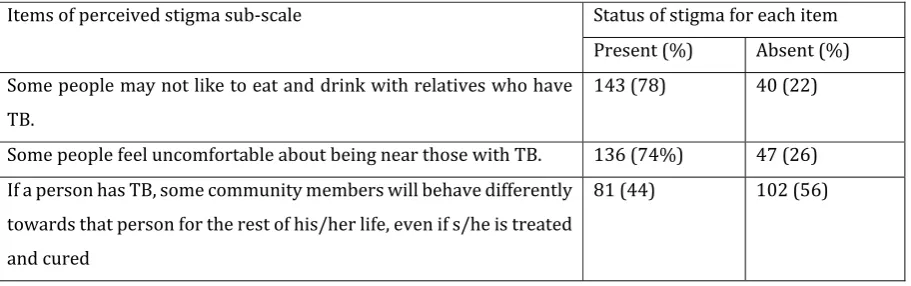
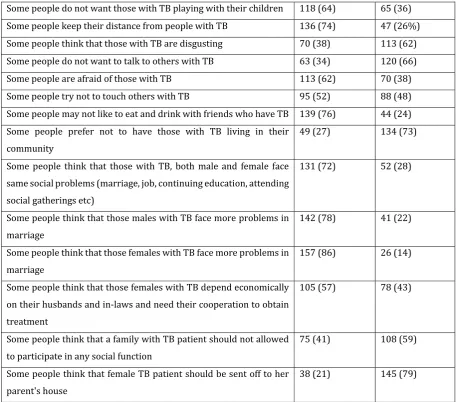
Seventy-four percent of respondents(n=136) stated that people would feel uncomfortable if 136
they were close to a person with TB and 38% (n=78) of respondents commented that people 137
would think that a person with TB is disgusting (Table 2). Sixty-two percent of respondents 138
(n=113) expressed their fear of someone with TB, however, approximately half of the 139
respondents (52%; n=95) said that some people try not to touch others with TB (Table 2). 140
Twenty-seven percent of respondents (27%; n=49) said that people would not prefer a 141
143
Social Isolation 144
The respondents stated that people with TB may not like to eat and drink with relatives 145
(78%; n=143) and friends (76%; n=139) and 74%; (n=136) said that people keep their 146
distance from a person with TB (Table 2). However, relatively fewer respondents (34%; 147
n=63) said that some people do not want to talk to a person with TB (Table 2). Approximately 148
half of the respondents (52%; n=95) commented that some people do not try to touch others 149
with TB and 41% (n=75) said that some people think that a family with TB patient should 150
not allowed to participate in any social gathering (Table 2). Forty-four percent of the 151
respondents (n=81) said that community members will behave differently towards persons 152
with TB for the rest of their lives, even if they have been treated. (Table 2). 153
154
Gender Perspectives Regarding Tuberculosis 155
Seventy-two percent of respondents (n=131) thought that a person with TB faces social 156
challenges such as diminished marriage prospects, continuation of employment, continuing 157
education and attending social gatherings. Specifically, 78% of the respondents thought that 158
a male with TB may face problems in finding a wife, however, a higher proportion (86%; 159
n=157) of respondents stated that a female with TB faced diminished marriage prospects. 160
More than half of the respondents (57%; n=105) thought that females with TB are dependent 161
upon the support of their husbands and their husbands’ parents to receive treatment. 162
Approximately one fifth of respondents (21%; n=38) said that some people think that a 163
female with TB should be sent back from her husbands’ family home to her parent’s home 164
(Table 2). 165
Table 2: Level of Perceived Stigma Associated with Tuberculosis
166
Items of perceived stigma sub-scale Status of stigma for each item
Present (%) Absent (%)
Some people may not like to eat and drink with relatives who have TB.
143 (78) 40 (22)
Some people feel uncomfortable about being near those with TB. 136 (74%) 47 (26) If a person has TB, some community members will behave differently
towards that person for the rest of his/her life, even if s/he is treated and cured
Some people do not want those with TB playing with their children 118 (64) 65 (36)
Some people keep their distance from people with TB 136 (74) 47 (26%)
Some people think that those with TB are disgusting 70 (38) 113 (62)
Some people do not want to talk to others with TB 63 (34) 120 (66)
Some people are afraid of those with TB 113 (62) 70 (38)
Some people try not to touch others with TB 95 (52) 88 (48)
Some people may not like to eat and drink with friends who have TB 139 (76) 44 (24) Some people prefer not to have those with TB living in their
community
49 (27) 134 (73)
Some people think that those with TB, both male and female face same social problems (marriage, job, continuing education, attending social gatherings etc)
131 (72) 52 (28)
Some people think that those males with TB face more problems in marriage
142 (78) 41 (22)
Some people think that those females with TB face more problems in marriage
157 (86) 26 (14)
Some people think that those females with TB depend economically on their husbands and in-laws and need their cooperation to obtain treatment
105 (57) 78 (43)
Some people think that a family with TB patient should not allowed to participate in any social function
75 (41) 108 (59)
Some people think that female TB patient should be sent off to her parent's house
38 (21) 145 (79)
167
Knowledge about Tuberculosis 168
Almost 90% of community members were aware that TB is curable disease (87%; n=159) 169
and that it spreads by coughing (91%; n=167). However, community members also stated 170
that it was transmitted through contaminated food (73%; n=134), sharing meals (55%; 171
n=100), unclean water and food (62%; n=114), sharing eating utensils (53%; n=96), 172
touching (33%; n=61) and by having sex with a person with TB (51%; n=93). Half of the 173
respondents (50%; n=91) said that emotional stress is a cause of TB and 30% of the 174
respondents (n=54) thought that TB leads to infertility (Table 3). 175
Table 3: Knowledge about Tuberculosis among Community Members
176
TB is curable 159 (87)
TB patient also has HIV/AIDS 45 (25)
TB leads to infertility 54 (30)
Emotional stress is a cause of TB 91 (50)
Perceived mode of TB transmission
Contaminated food 134 (73)
Cough 167 (91)
Sharing meal with a person with TB 100 (55)
Unclean water and food 114 (62)
Sharing utensils with a person with TB 96 (53)
Touching a person with TB 61 (33)
Sex with a person with TB 93 (51)
177
Factors Associated with Stigma 178
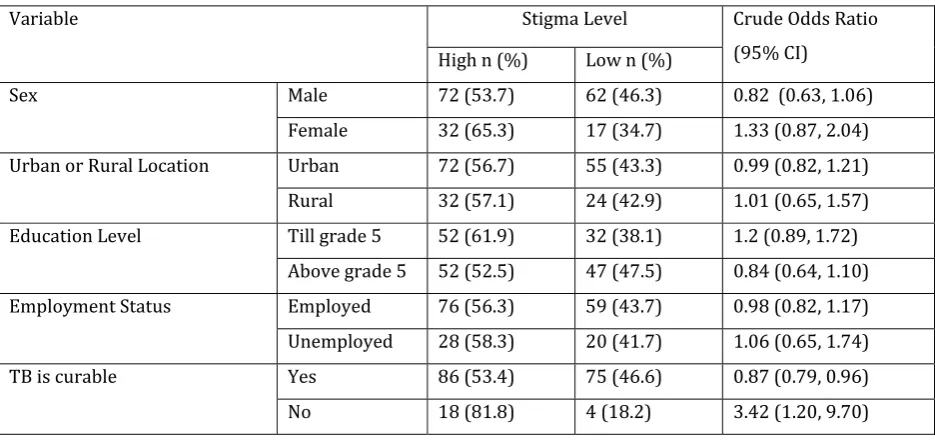
More than half of the respondents (57%; n=104) associated TB with high levels of stigma 179
(Table 4). Individuals with education less than 6th grade were more likely to associate 180
stigma with TB than those with higher levels of education (crude OR = 1.2; 95% CI: 0.89, 181
1.72) (Table 4). Respondents who lacked knowledge that TB is curable were also more likely 182
to associate TB with stigma (crude OR = 3.42; 95% CI: 1.20, 9.70). Similarly, those who lacked 183
knowledge that TB is spread by coughing were also more likely to associate stigma with TB 184
(crude OR = 1.27; 95% CI: 0.49, 3.34) (Table 4). 185
Table 4: Factors associated with perceived stigma about tuberculosis
186
Variable Stigma Level Crude Odds Ratio
(95% CI)
High n (%) Low n (%)
Sex Male 72 (53.7) 62 (46.3) 0.82 (0.63, 1.06)
Female 32 (65.3) 17 (34.7) 1.33 (0.87, 2.04)
Urban or Rural Location Urban 72 (56.7) 55 (43.3) 0.99 (0.82, 1.21)
Rural 32 (57.1) 24 (42.9) 1.01 (0.65, 1.57)
Education Level Till grade 5 52 (61.9) 32 (38.1) 1.2 (0.89, 1.72)
Above grade 5 52 (52.5) 47 (47.5) 0.84 (0.64, 1.10)
Employment Status Employed 76 (56.3) 59 (43.7) 0.98 (0.82, 1.17)
Unemployed 28 (58.3) 20 (41.7) 1.06 (0.65, 1.74)
TB is curable Yes 86 (53.4) 75 (46.6) 0.87 (0.79, 0.96)
TB spreads through cough Yes 94 (56.3) 73 (37.5) 0.98 (0.89, 1.07)
No 10 (62.5) 6 (37.5) 1.27 (0.49, 3.34)
187
Discussion 188
Stigma associated with health conditions, such as HIV/AIDS, leprosy, TB, mental illness and 189
epilepsy, is a global and social phenomenon that affects individuals suffering from disease, 190
and their families. As a result, the effectiveness of public health programs in preventing, 191
diagnosing and treating these conditions may also be affected [21]. Accordingly, 192
organizational and community norms that result in the stigmatization of TB, are believed to 193
damage efforts to prevent, diagnose and treat TB [18]. In our study, TB was perceived as a 194
stigmatized health condition by community members from outpatient clinics. However, the 195
level of stigma varied by sex, educational level, employment status and the degree of disease-196
specific knowledge. 197
In our study, the majority of the community were aware that TB spreads through coughing 198
(91%) and that it is curable (87%). These are similar findings to those of other studies, for 199
example in Brazil, 91% of individuals believed that TB spreads through coughing [22]. 200
However, in Somalia this figure was lower at 59% [23]. However, while many understood 201
the correct mode of TB transmission, there was also a sizeable proportion of respondents 202
who had incorrect knowledge about TB transmission. For example, half of the respondents 203
considered stress as cause of TB, a similar finding that was also reported in Karachi, Pakistan 204
(57%) [24] and in Vanuatu (17%) [25]. Similarly, in our study 53% considered sharing 205
utensils as a potential mode of TB transmission, a common finding in other studies; 57% in 206
Pakistan [24] and 36% in Somalia [23]. 207
Existing literature highlights the significance of community based awareness strategies to 208
eliminate misconceptions and wrong beliefs about TB [26,27]. However, studies are scarce, 209
and few focus on interventions among community members. In a recent systematic review, 210
which focused on evidence based interventions to reduce TB related stigma, only two of 211
seven interventions were aimed at reducing TB related stigma in the community [28]. In one 212
of these studies, conducted in Nigeria, 10 community volunteers were trained to provide TB 213
education to the community and to detect and refer persons with presumptive TB to a nearby 214
scores increased significantly and mean attitude scores (including stigmatizing attitudes) 216
decreased significantly after the intervention, indicating a positive effect of community 217
education [30]. In the other study on a community based stigma reduction intervention, 218
knowledge and attitude surveys were conducted in different areas of Bangladesh, some of 219
which had received community based educational interventions about TB and leprosy [30]. 220
In the areas that had received the educational intervention there were better levels of 221
knowledge about TB symptoms (90% thought that cough was a symptom in the areas that 222
received the educational intervention vs. 44% in the non-intervention areas) [30]. Moreover, 223
in the intervention areas 76% of respondents said that they would not buy goods from a 224
shopkeeper with TB, whereas in the intervention areas this figure was reversed [30]. In 225
addition, there are a number of other studies which focus on interventions to reduce stigma, 226
aimed at TB patients. 227
Demissie et al. (2003) reported that ‘TB Clubs’ were helpful in eliminating stigmatizing 228
attitudes and enhancing patient’s compliance to treatment through the exchange of patient 229
support and information [31]. During the gatherings of TB Club members and general 230
communities, dissemination of education material was influential in changing people’s 231
attitudes towards TB. In addition to these TB specific interventions, broader rights based 232
approaches may also reduce TB. Smith (2002) has emphasized a broader rights-based 233
approach to TB care that aims to shift from disease-specific knowledge to enforcement of 234
rights, such as access to care and prevention services, confidentiality of patient’s 235
information, that will reduce stigma, discrimination and inequalities in health [32]. 236
Our study focused on the examination of perceived stigma, which should be given serious 237
consideration because it reflects the prevalence of stigmatized beliefs and attitude of the 238
community [33]. We found that unemployment, being female, living in a rural location and 239
incorrect knowledge about TB causation and transmission were associated with TB related 240
stigmatization, although only the belief that TB was not curable was statistically significant. 241
Another study conducted in Chine among TB patients also noted a statistically significant 242
association between less TB knowledge and TB related stigma [34]. 243
The cultural context and social practices construct a socio-cultural sphere of human activity 244
that is highly relevant for TB including community norms about TB and perceptions of 245
systems that require an inter-disciplinary response, beyond the purely biomedical model of 247
disease causation, incorporating important social knowledge and concepts such as stigma 248
[35,36]. TB related stigma is acknowledged to shape poor health seeking behavior and to 249
negatively impact on health outcomes [37]. Therefore, social scientists emphasize the need 250
for examination of unequal power distribution in social and economic contexts that positions 251
individuals in this world differently increasing their vulnerability [38]. In addition, 252
characteristics of the healthcare system and the conditions in which people born, live, work 253
and grow (known as social determinants) influence the health status of individual and 254
community at large [39,40]. Consequently, intersectionality has emerged as a conceptual 255
framework to unfold these complexities with an aim to reduce difference or inequalities [41]. 256
Intersectional approaches examine the hierarchies of race, class, gender and other social 257
identities to unlock the complexities that lie in a social phenomenon and its effect on 258
individual’s health or health outcome [41]. 259
Conclusion 260
Pakistan is a high incidence TB country, and TB is a stigmatized disease, with many 261
misconceptions about how it is caused. TB associated stigma remains, despite decades of TB 262
control efforts at the national level to correct misconceptions about the disease. Stigma was 263
significantly associated with lack of knowledge about TB. However, it is acknowledged that 264
these are often difficult to design, implement and evaluate and there is limited evidence on 265
their effectiveness. Additional research on the effectiveness of educational interventions to 266
reduce TB related stigma are needed. Our study also highlights that stigma and its 267
intersection with society, should be further examined if the issue is to be comprehensively 268
addressed. 269
Data Availability: 270
The survey data used to support the findings of this study are available from the 271
corresponding author upon request. 272
Funding: 273
This research received no external funding 274
SMA conceived research idea and developed its methodology and NA, FN, AR contributed in 276
its refinement. SMA, MI, AR supervised the data collection and checked data for quality. SMA, 277
NA, SMA and KV planned and conducted data analysis. SMA drafted paper and KV 278
contributed significantly to the discussion section. NA, FN, AN and KV reviewed draft several 279
times and suggested changes. KV proofread the final version. All researcher read the final 280
version of the draft before submission. 281
Conflict of Interest: 282
The authors declare no conflict of interest 283
References: 284
1. World Health Organization. Global Tuberculosis Report 2017; Geneva: WHO 285
2. Ali S S, Rabbani F, Siddiqui U N, Zaidi A H, Sophie A, Virani S J, Younus N A. 286
Tuberculosis: do we know enough? A study of patients and their families in an 287
outpatient hospital setting in Karachi, Pakistan. Int J Tuberc Lung Dis 2003; 7: 1052-288
1058 289
3. Williams G, Alarcon E, Jittimanee S, Walusimbi M, Sebak M, Berga E, Villa T S. Best 290
practice for the care of patients with tuberculosis. A guide for low income countries. 291
International Union against Tuberculosis and Lung disease 2007; Paris, France. 292
4. Baral S C, Karki D K, Newell J N. Causes of stigma and discrimination associated with 293
tuberculosis in Nepal: a qualitative study. BMC Public Health 2007; 2:211 294
5. Khan A, Walley J, Newell J, Imdad N. Tuberculosis in Pakistan: socio-cultural 295
constraints and opportunities in treatment. Social Science and Medicine 2000; 50: 296
247-254. 297
6. Hoa N P, Thorson A E, Long N H, Diwan V K. Knowledge of tuberculosis and associated 298
health-seeking behavior among rural Vietnamese adults with a cough for at least 299
three weeks. Scand J Public Health 2003; 62: 59-65. 300
7. Parker R, Aggleton P. HIV and AIDS-related stigma and discrimination: a conceptual 301
framework and implications for action. Social Science and Medicine 2003; 57: 13-24. 302
8. Heijnders M, Van Der Meij S. The fight against stigma: An overview of stigma 303
reduction strategies and interventions. Psychology, Health and Medicine 2006; 11(3): 304
9. Goffman E. Stigma: Notes on the Management of Spoiled Identity. New York: Simon & 306
Schuster; 1963 307
10.Link B, Phelan J. Conceptualizing stigma. Annual Review of Sociology 2001; 27:363-308
385. 309
11.Smith R, Rossetto K, Peterson B L. A meta-analysis of disclosure of one’s HIV-positive 310
status, stigma and social support. AIDS care 2008; 20:1266-1275. 311
12.Collins P Y, Von-Unger H, Armbrister A. Church ladies, good girls, and locas: stigma 312
and the intersection of gender, ethnicity, mental illness and sexuality in relation to 313
HIV risk. Social Science and Medicine 2008; 67:389-397. 314
13.Woith W M, Rappleyea M L. Emotional representation of tuberculosis with stigma, 315
treatment delay, and medication adherence in Russia. Journal of Health Psychology 316
2016; 21(5): 770-780. 317
14.Nicholls P G, Wiens C, Smith W C. Delay in presentation in the context of local 318
knowledge and attitude towards leprosy – The results of qualitative fieldwork in 319
Paraguay. International Journal of Leprosy and Other Mycobacterial Diseases 2003; 320
71: 198 – 209. 321
15.Piot P, Coll Seck A M. International response to the HIV/AIDS epidemic: Planning for 322
success. Bulletin of the World Health Organization 2001; 79: 1106 – 1112. 323
16.Courtwright A, Turner A N. Tuberculosis and stigmatization: pathways and 324
interventions. Public Health Reports 2010; 125 (Suppl 4): 34-42. 325
17.Li Y, Ehiri J, Tang S, Li D, Bian Y, Lin H, Marshall C, Cao J. Factors associated with 326
patient, and diagnostic delays in Chinese TB patients: a systematic review and meta-327
analysis. BMC medicine 2013; 11:156. 328
18.Xu W, Lu W, Zhou Y, Zhu L, Shen H, Wang J. Adherence to anti -tuberculosis treatment 329
among pulmonary tuberculosis patients: a qualitative and quantitative study. BMC 330
Health Services Research 2009; 9:169. 331
19.Liefooghe R, Michiels N, Habib S, Moran M B, De Muynck A. Perception and social 332
consequences of tuberculosis: A focus group study of tuberculosis patients in Sialkot, 333
Pakistan. Social Science and Medicine 1995; 41(12): 1685-1692. 334
20.Van Rie A, Sengupta S, Pungrassami P, Balthip Q, Choonuan S, Kasetjaroen Y, Strauss 335
HIV/AIDS in southern Thailand: exploratory and confirmatory factor analyses of two 337
new scales. Tropical Medicine & International Health 2008; 13: 21-30. 338
21.Van Brakel W H. Measuring health-related stigma—A literature review. Psychology, 339
Health and Medicine 2006; 11(3): 307-334. 340
22.FreitasI I M, PopolinI M P, TousoI M M, YamamuraI M, RodriguesI L B B, NetoI M S, 341
CrispimI J A, Arcêncio R A. Factors associated with knowledge about tuberculosis and 342
attitudes of relatives of patients with the disease in Ribeirão Preto, São Paulo, Brazil. 343
Revista Brasileira de Epidemiologia 2015; 18(2): 326-340 344
23.Tolossa D, Medhin G, Legesse M. Community knowledge, attitude and practices 345
towards tuberculosis in Shinile town, Somali regional state, eastern Ethiopia: a cross-346
sectional study. BMC Public Health 2014; 14(804): 1-13. 347
24.Khan J A, Irfan M, Zaki A, Beg M, Rizvi N. Knowledge, attitude and misconception 348
regarding tuberculosis in Pakistani Patients. Journal of Pakistan Medical Association 349
2006; 56:211-214. 350
25.Viney K A, Johnson P, Tagaro M, Fanai S, Linh N N, Kelly P, Harley D and Sleigh A. 351
Tuberculosis patients’ knowledge and beliefs about tuberculosis: a mixed methods 352
study from the Pacific Island nation of Vanuatu. BMC Public Health 2014; 14:467. 353
26.Getahun H, Aragaw D. Tuberculosis in rural northwest Ethiopia: community 354
perspective. Ethiop Med J 2001; 39: 283-291. 355
27.Singh M M, Bano T, Pagare D, Sharma N, Devi R, Mehra M. Knowledge and attitude 356
towards tuberculosis in a slum community of Delhi. J Commun Dis 2002; 34: 203-214. 357
28.Sommerland N, Wouters E, Mitchell E M H, Ngicho M, Redwood L, Masquillier C, van 358
Hoorn R, van den Hof S, Van Rie A. Evidence-based interventions to reduce 359
tuberculosis stigma: a systematic review. Int J Tuberc Lung Dis 2017; 21(11): S81-360
S86. 361
29.Balogun M, Sekoni A, Meloni S T, Odukoya O, Onajole A, Longe-Peters O, Ogunsola F, 362
attitudes among adults in a periurban community in Southwest Nigeria. Am J Trop 364
Med Hyg 2015; 92(3): 625-632. 365
30.Croft R P, Croft R A. Knowledge, attitude and practice regarding leprosy and 366
tuberculosis in Bangladesh. Lepr Rev 1999; 70(1): 34-42. 367
31.Demissie M, Getahun H, Lindtjorn B. Community tuberculosis care through ‘TB clubs’ 368
in rural North Ethiopia. Social Science and Medicine2003; 56:2009 – 2018. 369
32.Smith M. Stigma. Advances in Psychiatric treatment 2002; 8: 317 – 325. 370
33.Creamers A L, de Laat M M, Kapata N, Gerrets R, Klipstein-Grobusch K and Grobusch 371
M P. Assessing the consequences of stigma for tuberculosis patients in urban Zambia. 372
PLoS ONE 2015; 10(3): e0119861. doi:10.1371/journal.pone.0119861 373
34.Yin X, Yan S, Tong Y, Peng X, Yang T, Lu Z, Gong Y. Status of tuberculosis-related stigma 374
and associated factors: a cross-sectional study in central China. Tropical Medicine and 375
International Health 2018; 23(2): 199-205. 376
35.Mason P H, Roy A, Spillane J, Singh P. Social, historical and cultural dimensions of 377
tuberculosis. Journal of Biosocial Science 2016; 48 (2): 206e232. 378
36.Mason P H, Degeling C, Denholm J. Sociocultural dimensions of tuberculosis: an 379
overview of key concepts. International Journal of Tuberculosis and Lung Disease 380
2015; 19(10): 1135e1143. 381
37.Abebe G, Deribew A, Apers L, Woldemichael K, Shiffa J, Testaye M, Abdissa A, Deribie 382
F, Jira C, Bezabih M, Aseffa A, Duchateau and Colebunders R. Knowledge, health 383
seeking behavior and perceived stigma towards tuberculosis among tuberculosis 384
suspects in a rural community in Southwest Ethiopia. PLoS ONE 2010; 5(10):e13339. 385
38.Guidroz K, Berger M T. A Conversation with Founding Scholars of Intersectionality: 386
Kimberle Crenshaw, Nira Yuval-Davis, and Michelle Fine. In: Berger M T, Guidroz K, 387
editors. The Intersectional Approach: Transforming the Academy Through Race, 388
Class & Gender. The University of North Carolina Press; Chapel Hill, NC: 2009. 389
39.Hankivsky O. Women’s health, men’s health, and gender and health: implications of 390
40.World Health Organization. Final report of the commission on social determinants of 392
health. Closing the gap in a generation: health equity through action on the social 393
determinants of health. World Health Organization; Geneva: 2008. 394
41.McCall L. Introduction. In: Berger, MT.; Guidroz, K., editors. The Intersectional 395
Approach: Transforming the Academy Through Race, Class & Gender. The University 396