Original Research Article
Knowledge, attitude and practices study on reproductive health among
adolescent school students in a city of Central India
Anil Singh Baghel
1, Sanjay Kumar Chourasiya
2*, Ravindra Pal
3, Ruchika Sharda
2INTRODUCTION
The International conference on population and development (ICPD) in 1994 was given an international consensus definition to sexual and reproductive health. It defined reproductive health as a state of complete physical, mental and social well-being in all matters relating to the reproductive system and its functions and processes.1
Reproductive health is a crucial part of general health and a central feature of human development. It does not start
out from a list of diseases or problems-sexually transmitted diseases, maternal mortality-or from a list of programmes-maternal and child health, safe motherhood, family planning. Reproductive health instead must be understood in the context of relationships: fulfilment and risk; the opportunity to have a desired child or alternatively, to avoid unwanted or unsafe pregnancy.2
Adolescence is a complex period of myriad of physiological as well psychological changes. This is a time for them to prepare for making responsibilities, a time of exploration and widening horizons and a time to ensure healthy all-around development.
ABSTRACT
Background: Ujjain is holy city of Lord Mahankal. It is an ancient city on the eastern bank of the Kshipra River. There were total 2508students studying in 11th and 12th standards in various higher secondary schools of Ujjain city. Reproductive health is a crucial part of general health and a central feature of human development. It is a reflection of health during childhood and crucial during adolescence and adulthood, sets the stage for health beyond the reproductive years. Adolescence is a complex period of myriad of physiological as well psychological changes. This is a time for them to prepare for making responsibilities, a time of exploration and widening horizons and a time to ensure healthy all-around development. Adolescents lack knowledge regarding reproductive health problems. The present study is conducted to assess the knowledge, attitude and practices regarding selected aspects of reproductive health with special reference to knowledge of Reproductive tract infections (RTI) among adolescent school students.
Methods: This was a cross sectional study carried out among randomly selected school students of Ujjain city.
Results: It was observed that 86% of the students had adequate knowledge in the area of pregnancy and care during pregnancy. The mean score percentage of reproductive tract infection was found to be 56.92%. 90.50% students agreed that Menstruation is normal phenomenon.
Conclusions: There is need of imparting sex education in schools across the country with the help of specially trained teachers and peer educators.
Keywords: Adolescent, Reproductive health, Reproductive tract infection, Sex education
Department of Community Medicine, 1Government Medical College, Dungarpur, Rajasthan, 2Ruxmaniben Deepchand
Gardi Medical College, Ujjain, 3Medical Officer, Taal, Madhya Pradesh, India
Received: 21 May 2019
Revised: 17 July 2019
Accepted: 19 July 2019
*Correspondence:
Dr. Sanjay Kumar Chourasiya,
E-mail: [email protected]
Copyright: © the author(s), publisher and licensee Medip Academy. This is an open-access article distributed under the terms of the Creative Commons Attribution Non-Commercial License, which permits unrestricted non-commercial use, distribution, and reproduction in any medium, provided the original work is properly cited.
According WHO, adolescence is a period of a life between 10 to 19 years.3
Early adolescence: 10-14 years. Late adolescence: 15-19 years.
The largest generation of adolescents in history 1.2 billion strong is preparing to enter adulthood in rapidly changing world.4 According to WHO estimates, one in every five people in the world is an adolescent.5
Focusing on adolescent reproductive health is both a challenge and an opportunity for health care providers. While adolescence generally is a healthy period of life, many adolescents are less informed, less experienced, and less comfortable accessing health services for reproductive health than adults.6
Adolescents often lack basic reproductive health information, knowledge, and access to affordable confidential health services for reproductive health. Many do not feel comfortable in discussing reproductive health with parents.7 The absolute number of adolescents aged 10-19 years in India is 25,31,60,473 as per Census 2011 comprising 20.9 per cent of the total population of the country. Of these, 133.4 million are boys and 119.8 are girls, constituting 52.7 per cent and 47.3 per cent of the adolescent population respectively.8
Adolescent lack knowledge regarding reproductive health problems which lead to depression, mental stress and seeking of advice from quacks and incompetent persons for knowledge on the reproductive health problem which is undesirable. Moreover, the routine health services do not provide adequate care of the adolescent health problem which exaggerates the problems further. Understanding their awareness about related issues will help us in giving education based on need. Keeping in view the above-mentioned facts present study is conducted to assess the knowledge, attitude and practices regarding selected aspects of reproductive health with special reference to knowledge of reproductive tract infections (RTI) among adolescent school students.
METHODS
Study type
This was a cross sectional study carried out among selected school students of Ujjain city of Madhya Pradesh state of central India. Ujjain is holy city of Lord Mahankal. It is an ancient city of Malwa region, on the eastern bank of the Kshipra River.9
Study setting
The study was conducted in three randomly selected higher secondary schools. Amongst which one was boys’ school, one was girls’ school and one was co-education school. Schools were visited when students are easily
available and non examination time. The study period was from December 2017 to June 2018.
Study universe
Students of age group of 16-19 years enrolled in selected higher secondary school during the data collection period of study comprised the study universe. As per the records obtained from the office of District Education Officer, Ujjain there were total two thousand five hundred eight (2508) students studying in eleventh (11th) and twelfth (12th) standards in various higher secondary schools.10
Sampling
The sample size derived for the study was according to probable percentage of knowledge score more than 50% was about 41% in a pilot study conducted on hundred (100) school students (Fifty were boys and fifty were girls).The pilot study was done on students from other schools with the help of self-administered structured
questionnaire, and prevalence of knowledge of
reproductive health among study subject was used for calculating the final sample size of the study.
The formula applied for sample size calculation was 𝑛 =4𝑝𝑞𝐿2
Where, p=probable percentage of knowledge, q=1−p and L=allowable error.
For this study L was presumed to be 10% of p giving a power of (1−L) i.e., 90% to study. p was taken as 41% on the basis of pilot study.
Sample size= 4×41× 59
4.12
The sample size derived was 576. For equal distribution purpose it is rounded to 600. Equal no of study participants was taken i.e., 200 students selected from each school by using random sampling method.
Data collection
two independent translators and discrepancies were resolved with expert advice. Before starting the collection of data, permission from District Education authorities and the principles of respected schools was taken and they were explained about purpose of the study. Instructions were explained to fill up the structured
questionnaire. Questionnaires were checked for
completeness and correctness before entering into the work sheet. Data validation checks were performed at a regular interval for data entered into the worksheet of Microsoft excel. The data collected were analysed with SPSS version 18. Reliable tests wherever required used for analysis. The level of significance was taken as p<0.05. The study was approved by the Institutional Ethical Committee of Ruxmaniben Deepchand Gardi Medical College, Ujjain and a written informed consent was obtained from parents/guardians of the study participants. Students were assured of confidentiality of the study.
RESULTS
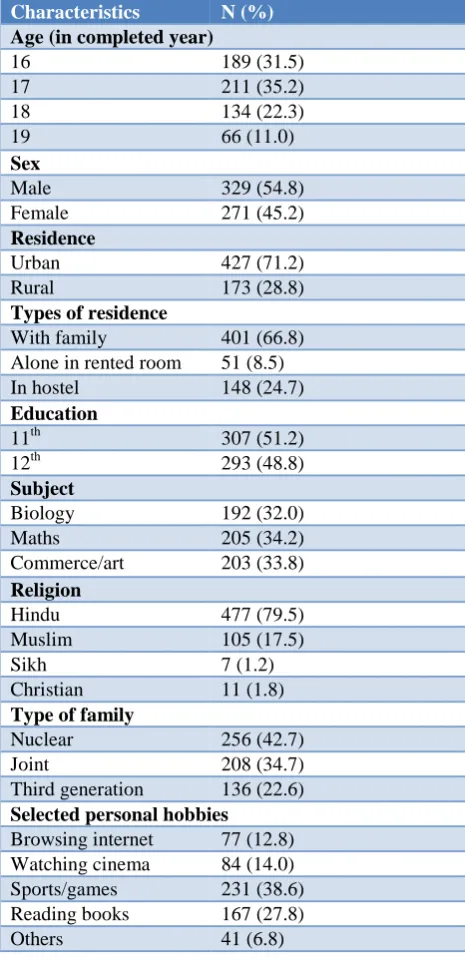
A total of 600 students were selected for the study. Amongst them 35.2% of the students were of 17 years old. 71.2% of students were from urban area and 66.8% were residing with family. Regarding subjects 32.0% of students were from biology and 68.0% were from other subjects. Majority of them belongs to Hindu (79.5%) religion (Table 1).
Table 2 reveals mean, standard deviation (SD) and mean score percentage of knowledge on reproductive health over 5 dimensions. Findings shows that mean percentage of overall knowledge score in the area of reproductive health was 60.73%. Among these 5 dimensions more knowledge was found to be in the area of pregnancy and care 86%. The mean score percentage of contraceptive method is 58.50%, in the area of anatomy and physiology of reproductive system was 57.90% and in the area of reproductive tract infection was 56.92%. The least knowledge score was of menstruation which was about 56.20%.
As shown in Table 3 that mean score of female’s students regarding knowledge on reproductive health found to be comparatively more than the male students. Independent ‘t’ test was used for assessing the statistical significance and it was found to be statistically significant at p<0.05.
Table 4 shows that mean score knowledge of 12th standard student found to be comparatively more than the 11th standard. Independent ‘t’ test was used for assessing the statistical significance and it was found to be not significant at p<0.05.
The above table shows that mean score knowledge of RTI in adolescent female found to be comparatively more than the adolescent male. Independent ‘t’ test was used for assessing the statistical significance and it was found to be significant at p<0.05.
Table 1: Socio-demographic characteristics of study participants (n=600).
Characteristics N (%)
Age (in completed year)
16 189 (31.5)
17 211 (35.2)
18 134 (22.3)
19 66 (11.0)
Sex
Male 329 (54.8)
Female 271 (45.2)
Residence
Urban 427 (71.2)
Rural 173 (28.8)
Types of residence
With family 401 (66.8)
Alone in rented room 51 (8.5)
In hostel 148 (24.7)
Education
11th 307 (51.2)
12th 293 (48.8)
Subject
Biology 192 (32.0)
Maths 205 (34.2)
Commerce/art 203 (33.8)
Religion
Hindu 477 (79.5)
Muslim 105 (17.5)
Sikh 7 (1.2)
Christian 11 (1.8)
Type of family
Nuclear 256 (42.7)
Joint 208 (34.7)
Third generation 136 (22.6)
Selected personal hobbies
Browsing internet 77 (12.8)
Watching cinema 84 (14.0)
Sports/games 231 (38.6)
Reading books 167 (27.8)
Others 41 (6.8)
Table 6 represents the mean score of knowledge on reproductive health over the different categories of social class. To assess the significance of mean score of knowledge over the five categories of social class, ANOVA test (Analysis of variance) was used and it was found to be not significant at p<0.05 level.
Table 2: Knowledge regarding reproductive health among study participants (n=600).
Serial no.
Area of knowledge Maximum
score
Mean
score S.D.
Mean score
N (%) 1 Anatomy and physiology of reproductive system 10 5.79 2.57 57.9
2 Menstruation 5 2.81 1.40 56.2
3 Pregnancy and care 4 3.44 0.87 86
4 Contraceptive method 2 1.17 0.82 58.5
5 Reproductive tract infection (RTI) 12 6.83 3.00 56.92
Total Over all knowledge 33 20.04 6.71 60.73
Table 3: Mean score of knowledge on reproductive health by sex (n=600).
Sex No. Mean S.D. T value P value
Male 329 19.35 7.19
2.782 0.006
Female 271 20.88 5.98
Table 4:Educational status wise comparison of knowledge on reproductive health (n=600).
Education status No. Mean S.D. T value P value
11th 307 19.84 6.80
0.770 0.441
12th 293 20.26 6.62
Table 5: Mean score of knowledge on RTI by sex (n=600).
Sex No. Mean S.D. T value P value
N (%)
Male 329 (54.8) 6.56 3.10 2.465 0.014
Female 271 (45.2) 7.17 2.84
Table 6: Mean score of knowledge amongst students on reproductive health by social class (n=600).11
Social class No. Mean S.D. F value P value
I 105 20.90 6.09
2.331 0.055
II 184 20.65 6.80
III 202 19.74 6.96
IV 101 18.52 6.38
V 8 21.62 7.84
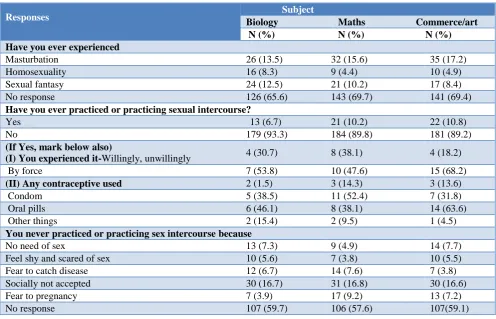
Around 15% of students in all the three streams i.e., biology, maths and commerce have experienced masturbation while homosexuality is practiced in 8.3% in biology group, 4.4% in maths, and 5% in commerce, while sexual fantasy is experienced by 12.5% in biology group, 10.2% in maths group, and 8.4% in commerce/arts group. Around 66% students in biology group, 70% in maths and commerce/arts had no response. It also shows that 93% students in biology group, 90% student’s maths group, 90% students in commerce group have not practiced or practicing sexual intercourse.
A total of 72.69% of girl’s student use sanitary napkin during menses, while only 65% of girls from girl’s school disposed used material in waste bin. Practices of changing pad twice daily followed by only 62% in girl’s
school compared to 80% in co-education girls’ students. Figure 1: Attitude towards reproductive health among
Table 7: Subject wise distribution of student’s responses about practices related to sexual behaviour (n=600).
Responses Biology Subject Maths Commerce/art
N (%) N (%) N (%) Have you ever experienced
Masturbation 26 (13.5) 32 (15.6) 35 (17.2)
Homosexuality 16 (8.3) 9 (4.4) 10 (4.9)
Sexual fantasy 24 (12.5) 21 (10.2) 17 (8.4)
No response 126 (65.6) 143 (69.7) 141 (69.4)
Have you ever practiced or practicing sexual intercourse?
Yes 13 (6.7) 21 (10.2) 22 (10.8)
No 179 (93.3) 184 (89.8) 181 (89.2)
(If Yes, mark below also)
(I) You experienced it-Willingly, unwillingly 4 (30.7) 8 (38.1) 4 (18.2)
By force 7 (53.8) 10 (47.6) 15 (68.2)
(II) Any contraceptive used 2 (1.5) 3 (14.3) 3 (13.6)
Condom 5 (38.5) 11 (52.4) 7 (31.8)
Oral pills 6 (46.1) 8 (38.1) 14 (63.6)
Other things 2 (15.4) 2 (9.5) 1 (4.5)
You never practiced or practicing sex intercourse because
No need of sex 13 (7.3) 9 (4.9) 14 (7.7)
Feel shy and scared of sex 10 (5.6) 7 (3.8) 10 (5.5)
Fear to catch disease 12 (6.7) 14 (7.6) 7 (3.8)
Socially not accepted 30 (16.7) 31 (16.8) 30 (16.6)
Fear to pregnancy 7 (3.9) 17 (9.2) 13 (7.2)
No response 107 (59.7) 106 (57.6) 107(59.1)
Table 8: Responses of girl’s students regarding menstrual hygiene practices by type of school (n=271).
Responses
Type of school
Girls school
Co-education school N (%) N (%) What material you used during menses?
Sanitary napkin or pad 144 (72.0) 53 (74.6)
Old and waste cloths 7 (3.5) 5 (7.0)
Clean homemade napkin 49 (24.6) 13 (18.3)
What you do with used material?
Dump in waste bin 136 (68.0) 55 (77.5)
Throw any where 36 (18.1) 8 (11.3)
Reused after wash 28 (14.1) 8 (11.3)
How many times you change used pad/cloths per day?
One 13 (6.5) 6 (8.6)
Two 124 (61.8) 57 (80.3)
Three-four 56 (28.1) 6 (8.4)
Whenever soaked 7 (3.5) 2 (2.8)
DISCUSSION
Reproductive health remains a critical universal issue for all humans in the world. The subject of sex in developing countries like India has been neglected and is still
considered a taboo. The sexual and reproductive health of adolescent people remains a neglected area of public health. Adolescents are at high risk of unintended pregnancy, RTIs, STDs including HIV/AIDS, because of their lack of information, limited access to sexual and reproductive health information and services. The present study is an attempt to assess the knowledge, attitude and practices about reproductive health with special reference of knowledge of RTIs in adolescent’s school students in a city of central India, so as to find areas of interventions and an effective sexual and reproductive health education programme.
they found mean score percentage of menstrual hygiene, in the area of anatomy and physiology of reproductive health and about family planning was 53.7%, 49.7% and 42.2% respectively.12 Similarly, Handa et al in their study reported that the mean percentage score obtained by students was 60.39% for human reproductive system and 63.01% for sexual growth and development during puberty.13 In contrast to our study, a study conducted by Rizwan et al among married women in rural Haryana found that the knowledge about RTIs among them was poor. Almost 47% had not heard about RTI. No one knew the actual cause of RTIs and many did not know the effects of RTIs on women's health.14 The highest mean percentage score 62.20% in the area of reproductive tract infection, indicate that minimum awareness deficit existed in this area.
In our study response to statement “masturbation is harmful for health”, we observed that 67.20% of the students were disagree it is harmful but 32.80% students were agreed. In our study we also find that there is significant relation between the knowledge of RTI and sex of participants. Female have more knowledge than male students. There exists a significant relation between the knowledge on RTI and subjects have chosen Biology as their core subject. It was found to be significant at p<0.05. There is a significant relation between the knowledge on RTI and type of school. Independent ‘t’ test was worked out to determine the statistical significance of the mean score, it was found to be significant at p<0.05. In contrast to our study, study conducted by Awasthi et al 1980 on school going teenagers, showed that males had better knowledge on biological aspect of reproduction. Students of higher age group (17-19 years) and lower socio-economic status had better knowledge. Female students had better knowledge on psychological aspect of reproduction sex, but males scored better on knowledge about reproductive system.15 Similar to our study Sophia et al 2005 in their study observed that the score of subjects those who are studying science was found to be 52.7 which is comparatively more than the mean score of students those who are chosen arts as a subject 39.43.12
In present study response to statement “sex with multiple partners can cause STDs”, we found that most of the students (78.20%) were agree but 21.80% students were disagreed. In co-education schools 88% of students agreed that sex with multiple partners can cause STDs while it is 75% in Boys and Girls school, in contrast to these Wilberforce et al in their study on 400 non-medical university students found that 89.25% knew that sex with multiple partner is predisposing factors for STD.16 The present study found that 94% of students knew that condom will prevent the spread of HIV/AIDS infection in contrast to our study Mittal K et al found that only 11.3% of the girls knew correctly about safe sexual intercourse.17 There are very few studies from India that evaluated masturbation among girls and boys. In our study we found that 67.20% of the students were disagree
that masturbation is harmful for health, Shashikumar et al (1998) in their study among Indian urban school adolescents found that more boys (45.9%) than girls (12.7%) indulged in the practice of masturbation, only 14% boys and 9.2% girls were concerned about its effects on health.18 In contrast to our study Lal et al reported 51.2% boys and 15.3% girls disagreeing that masturbation is harmful.19 Similarly study conducted by Francis as more than 60% girls were not knowing about masturbation and about 20% thought that it is unhealthy or dirty.20 The fact that menstruation is normal phenomenon was known to 90% of our study subjects.
Limitations
Since the study was confined to 600 adolescent students of 3 selected government schools only so limits generalization. The questionnaire used to collect information on knowledge, attitude and practices of adolescent students regarding reproductive health was structured which accounted for a restricted response.
CONCLUSION
In our study we found that the baseline knowledge of the adolescent in most of the aspects of the reproductive health was low. This study highlights the need for imparting training of the students in reproductive health education.
Funding: No funding sources Conflict of interest: None declared
Ethical approval: The study was approved by the Institutional Ethics Committee
REFERENCES
1. Myntti C, Webb F. Rethinking sexual and
reproductive health research. In: Khanna J, Van Look PFA, eds. New priorities and approaches in post International conference on population and development (ICPD)-era, Reproductive health research-the new directions. WHO, Geneva: Bienniel report; 1996-97.
2. Guidelines on reproductive health. United Nations Population Information Network (Popin). Available at http://www.un.org/popin/unfpa/taskforce/guide/ iatfreph.gdl.html. Accessed 12 June 2018.
3. Park K. Park’s Textbook of Preventive and Social Medicine. 21st ed. Jabalpur, India: Banarsidas Bhanot; 2014: 546.
4. State of world population 2003 UNFPA. Available at https://www.unfpa.org/publications/state-world-population-2003. Accessed 01 January 2018.
5. Blum RW, Mmari KN. Risk and Protective Factors
of Child and Adolescent Health and Development (CAH) World Health Organization, 2005.
6. Population Reference Bureau and Centre for
Population Options. The World's Youth 1994: A special focus on reproductive health. Washington, DC: Population Reference Bureau; 1994.
7. PATH (Program for Appropriate Technology in
Health). Improving interactions with clients: a key to high-quality services. Outlook 1999;17(2).
Available at www.path.org/files/eol17_2.pdf.
Accessed 04 February 2018.
8. A profile of adolescents and youth in India. Census
2011. UNFPA. Available at https://india.unfpa.org /sites/default/files/pubpdf/AProfileofAdolescentsand YouthinIndia_0.pdf. Accessed 04 February 2018.
9. District administration Ujjain. Available at
http://ujjain.nic.in/GeneralInformation.html. Accessed 01 January 2018.
10. Madhya Pradesh district school education portal. Available at http://www.educationportal.mp.gov.in/ ujjain. Accessed 01 January 2018.
11. Shaikh Z, Pathak R. Revised Kuppuswamy and B G
Prasad socio economic scales for 2016.
2017;4(4):997-8.
12. Sophia, Sangitha N. A study to assess the
knowledge regarding selected aspects of
reproductive health among adolescent girls with a view to develop a health education package at BES College, Bangalore, India; 2005: 60-61.
13. Ameeta H. Sex education for adolescents, Swasth Hind; 1994: 164-167.
14. Rizwan AS, Rama SR, Gupta V, Nikita N. A cross
sectional study on knowledge, awareness and
practices regarding RTIs/STDs among married tribal women (aged 25-45 years) in Northern India, 2018. Indian Dermatol Online J. 2015;6(1).
15. Awasthi NN, Mathur BD, Mitra R. A study on the sex knowledge of school going teenagers of Jhansi, U.P. J Fam Welfare. 1980;27(1):35-45.
16. Sekirime WK, Tamale J, Lule JC, Wabwire-Mangen
F. Knowledge, attitude and practice about sexually transmitted diseases among University students in Kampala. Afr Health Sci. 2001;1(1):16-22.
17. Mittal K, Goel MK. Knowledge Regarding
Reproductive Health among Urban Adolescent Girls of Haryana. Ind J Commun Med. 2010;35(4):529-30.
18. Ramadugu S, Ryali V, Srivastava K, Bhat PS,
Prakash J. Ind Psychiatry J. 2011;20(1):49-55.
19. Lal SS, Vasan RS, Sarma PS, Thankappan KR.
Knowledge and attitude of college students in Kerala towards HIV/AIDS, sexually transmitted diseases and sexuality. Natl Med J India. 2000; 13(5):231-6.
20. Francis PT, Gill JS, Chowdhury S. Knowledge
beliefs and attitudes regarding AIDS, STDS and human sexuality among senior secondary students of Delhi. Ind J Commun Med. 1994;19(1):16-20.