On the Effective Deployment of
Current Machine Translation
Technology
UNIVERSITAT POLIT`ECNICA DE VAL`ENCIA
DEPARTAMENTO DE SISTEMAS INFORM ´ATICOS Y COMPUTACI ´ON
On the Effective Deployment of Current
Machine Translation Technology
By
Jes´
us Gonz´alez Rubio
written under the direction ofDr. Daniel Ortiz Mart´ınez and Prof. Francisco Casacuberta May 8, 2014
On the Effective Deployment of Current Machine Translation Technology
By
Jes´us Gonz´alez Rubio
A thesis dissertation submitted to the
Departamento de Sistemas Inform´aticos y Computaci´on, Universitat Polit`ecnica de Val`encia
in partial fulfillment of the requirements for the degree of
Doctor en Inform´atica written under the direction of
Dr. Daniel Ortiz-Mart´ınez and Prof. Francisco Casacuberta Valencia, Spain, May 8, 2014
Work supported by the European Union 7th Framework Program (FP7/2007-2013) under the CasMaCat project (grants agreement no 287576), and by the EC (FEDER/FSE) and the Spanish MEC/MICINN under the MIPRCV “Consolider Ingenio 2010” program (CSD2007-00018) and the FPU scholarship AP2006-00691.
A mi madre por su paciencia infinita y a mi padre que no pudo verla terminada
Copyright Note
I hereby declare that this dissertation describes my own original work devel-oped under the direction of my two supervisors Dr. Daniel Ortiz-Mart´ınez and Prof. Francisco Casacuberta. Further, I have acknowledged all sources used and have cited these in the reference section.
The work described in Chapter3, however, is a result of a collaboration be-tween me and Jos´e Ram´on Navarro-Cerd´an. The research interest of J. Ram´on Navarro-Cerd´an is focused on statistics. His part in the collaboration was to provide the background in statistical multivariate analysis required to develop the dimensionality reduction methods described in that chapter. For my part, I was in charge of applying this statistical background to the task of interest. This includes integrating the different dimensionality reduction methods into the data-flow of the system, implementing the heuristic feature selection meth-ods described in the chapter, designing and performing the experimentation, and writing the publications derived from this research line.
Lastly, the different pieces of software that implement the developments described in this dissertation have been mostly implemented over previous libraries and translation toolboxes. I have acknowledged all these previous software by citing them in the reference section.
Agradecimientos
La elaboraci´on de una tesis doctoral es un camino solitario que, parad´ojicamente, no podr´ıa recorrerse sin la colaboraci´on de un gran grupo de personas. En es-tas l´ıneas quisiera agradecer su apoyo a todos aquellos que de una forma u otra han contribuido a la consecuci´on de esta tesis.
En primer lugar quisiera dar las gracias a todos mis compa˜neros del PRHLT que, tras todos estos a˜nos, se han convertido en una segunda familia para mi. Especialmente a mis directores: a Paco que me dio la oportunidad de dedicarme a la investigaci´on por lo que siempre le estar´e agradecido y a Dani que me ha guiado para superar los vericuetos del dia a dia de la investigaci´on acad´emica. Digo PRHLT pero deber´ıa decir UPV ya que sin la gente del ITI y del DSIC estos a˜nos habr´ıan sido mucho m´as arduos y, sin duda alguna, mucho menos excitantes. Las discusiones durante el caf´e o las pausas tomando el sol en la terraza son momentos que siempre me acompa˜nar´an.
Por supuesto, no puedo dejar de dar las gracias a todos los amigos que he ido haciendo desde que vine a Valencia a estudiar Inform´atica all´a por el a˜no 2000: a mis compa˜neros de carrera que me acompa˜naron en los primeros a˜nos, a los miembros de ITI-spam por su flujo inacabable de propuestas de procrastinaci´on, a la pandi de hijos de puta por acogerme como uno m´as y ser unos excelentes compa˜neros de fiesta, y a Philipp, Sonia y Toni por su amistad incondicional todos estos a˜nos.
Y, hablando de amistad, no puedo olvidarme de aquellos a los que conoc´ı mucho antes de venir a Valencia y que, por fortuna, aun puedo seguir llamando amigos. Gente, no podr´ıa haberlo hecho sin vosotros.
Finalmente, me gustar´ıa dar las gracias a mi familia que siempre me apoy´o. Especialmente a mis padres que lo dieron todo para que yo pudiese llegar a d´onde estoy ahora.
A todos, gracias.
Abstract
Machine translation is a fundamental technology that is gaining more im-portance each day in our multilingual society. Companies and particulars are turning their attention to machine translation since it dramatically cuts down their expenses on translation and interpreting. However, the output of current machine translation systems is still far from the quality of translations gen-erated by human experts. The overall goal of this thesis is to narrow down this quality gap by developing new methodologies and tools that improve the broader and more efficient deployment of machine translation technology.
We start by proposing a new technique to improve the quality of the translations generated by fully-automatic machine translation systems. The key insight of our approach is that different translation systems, implement-ing different approaches and technologies, can exhibit different strengths and limitations. Therefore, a proper combination of the outputs of such differ-ent systems has the potdiffer-ential to produce translations of improved quality. We present minimum Bayes’ risk system combination, an automatic approach that detects the best parts of the candidate translations and combines them to generate a consensus translation that is optimal with respect to a par-ticular performance metric. We thoroughly describe the formalization of our approach as a weighted ensemble of probability distributions and provide effi-cient algorithms to obtain the optimal consensus translation according to the widespread BLEU score. Empirical results show that the proposed approach is indeed able to generate statistically better translations than the provided candidates. Compared to other state-of-the-art systems combination methods, our approach reports similar performance not requiring any additional data but the candidate translations.
Then, we focus our attention on how to improve the utility of automatic translations for the end-user of the system. Since automatic translations are not perfect, a desirable feature of machine translation systems is the ability to predict at run-time the quality of the generated translations. Quality es-timation is usually addressed as a regression problem where a quality score is predicted from a set of features that represents the translation. However,
sequence, quality estimation systems for machine translation have to utilize a large number of weak features to predict translation quality. This involves several learning problems related to feature collinearity and ambiguity, and due to the “curse” of dimensionality. We address these challenges by adopting a two-step training methodology. First, a dimensionality reduction method computes, from the original features, the reduced set of features that bet-ter explains translation quality. Then, a prediction model is built from this reduced set to finally predict the quality score. We study various reduction methods previously used in the literature and propose two new ones based on statistical multivariate analysis techniques. More specifically, the proposed di-mensionality reduction methods are based on partial least squares regression. The results of a thorough experimentation show that the quality estimation systems estimated following the proposed two-step methodology obtain bet-ter prediction accuracy that systems estimated using all the original features. Moreover, one of the proposed dimensionality reduction methods obtained the best prediction accuracy with only a fraction of the original features. This feature reduction ratio is important because it implies a dramatic reduction of the operating times of the quality estimation system.
An alternative use of current machine translation systems is to embed them within an interactive editing environment where the system and a human ex-pert collaborate to generate error-free translations. This interactive machine translation approach have shown to reduce supervision effort of the user in comparison to the conventional decoupled post-edition approach. However, interactive machine translation considers the translation system as a passive agent in the interaction process. In other words, the system only suggests trans-lations to the user, who then makes the necessary supervision decisions. As a result, the user is bound to exhaustively supervise every suggested transla-tion. This passive approach ensures error-free translations but it also demands a large amount of supervision effort from the user.
Finally, we study different techniques to improve the productivity of cur-rent interactive machine translation systems. Specifically, we focus on the de-velopment of alternative approaches where the system becomes an active agent in the interaction process. We propose two different active approaches. On the one hand, we describe an active interaction approach where the system informs the user about the reliability of the suggested translations. The hope is that this information may help the user to locate translation errors thus improving the overall translation productivity. We propose different scores to measure
translation reliability at the word and sentence levels and study the influence of such information in the productivity of an interactive machine translation system. Empirical results show that the proposed active interaction protocol is able to achieve a large reduction in supervision effort while still generating translations of very high quality. On the other hand, we study an active learn-ing framework for interactive machine translation. In this case, the system is not only able to inform the user of which suggested translations should be supervised, but it is also able to learn from the user-supervised translations to improve its future suggestions. We develop a value-of-information criterion to select which automatic translations undergo user supervision. However, given its high computational complexity, in practice we study different selection strategies that approximate this optimal criterion. Results of a large scale ex-perimentation show that the proposed active learning framework is able to obtain better compromises between the quality of the generated translations and the human effort required to obtain them. Moreover, in comparison to a conventional interactive machine translation system, our proposal obtained translations of twice the quality with the same supervision effort.
Resumen
La traducci´on autom´atica es una tecnolog´ıa fundamental que cada d´ıa est´a ganando m´as importancia en nuestra sociedad pluriling¨ue. Compa˜n´ıas y par-ticulares est´an volviendo su atenci´on hacia la traducci´on autom´atica ya que les permite reducir dram´aticamente sus gastos en traducci´on e interpretaci´on. Sin embargo, las traducciones generadas por los actuales sistemas de traducci´on autom´atica est´a a´un lejos de la calidad de las traducciones generadas por traductores expertos. El objetivo general de esta tesis es reducir este salto de calidad mediante el desarrollo de nuevas metodolog´ıas y herramientas que permitan un despliegue m´as amplio y eficiente de la tecnolog´ıa actual en tra-ducci´on autom´atica.
Comenzamos proponiendo una nueva t´ecnica para mejorar la calidad de las traducciones generadas por los sistemas de traducci´on autom´atica. La idea clave de nuestra propuesta es que diferentes sistemas de traducci´on, que im-plementen diferentes enfoques o tecnolog´ıas, pueden mostrar diferentes puntos fuertes y limitaciones. Por lo tanto, una combinaci´on adecuada de las salidas de diferentes sistemas puede producir traducciones de mayor calidad. Pre-sentamos minimum Bayes’ risk system combination, una propuesta que au-tom´aticamente detecta las mejores partes de las traducciones candidatas y las combina para generar una traducci´on consenso que es ´optima respecto a una medida particular de calidad. Describimos en profundidad la formalizaci´on de nuestro enfoque como una suma ponderada de distribuciones de probabilidad y proporcionamos algoritmos eficientes para obtener la traducci´on consenso ´
optima de acuerdo con la conocida medida de evaluaci´on BLEU. Los resulta-dos emp´ıricos muestran que el m´etodo propuesto es realmente capaz de generar traducciones estad´ısticamente mejores que las traducciones candidatas propor-cionadas. En comparaci´on con otros m´etodos de combinaci´on de sistemas del estado del arte, nuestro m´etodo obtiene un rendimiento similar no requiriendo informaci´on adicional mas all´a de las traducciones candidatas.
A continuaci´on, centramos nuestra atenci´on en como mejorar la utilidad de las traducciones autom´aticas para el usuario final del sistema. Dado que las traducciones autom´aticas no son perfectas, una caracter´ıstica deseable de
calidad se aborda generalmente como un problema de regresi´on en el que se predice un valor de calidad a partir de un conjunto de caracter´ısticas que representan la traducci´on. Sin embargo, aunque el concepto de calidad en la traducci´on es intuitivamente claro, no existe consenso sobre cuales son las car-acter´ısticas que realmente dan cuenta de ´el. Como consecuencia, los sistemas de estimaci´on de la calidad para traducci´on tienen que utilizar un gran n´umero de caracter´ısticas d´ebiles para predecir la calidad de las traducciones. Esto implica diversos problemas de aprendizaje relacionados con la colinearidad y ambig¨uedad de las caracter´ısticas, y tambi´en debidos a la “maldici´on” de la dimensionalidad. Nosotros abordamos estos retos adoptando una metodolog´ıa de entrenamiento en dos pasos. En primer lugar, un m´etodo de reducci´on de la dimensionalidad calcula a partir de las caracter´ısticas originales el conjunto de caracter´ısticas que mejor explica la calidad de las traducciones. A contin-uaci´on, construimos un modelo de predicci´on a partir de este conjunto reducido de caracter´ısticas para predecir finalmente el valor de calidad. Estudiamos var-ios m´etodos de reducci´on previamente utilizados en la literatura y proponemos dos nuevos m´etodos basados en t´ecnicas estad´ısticas de an´alisis multivariante. M´as espec´ıficamente, los m´etodos propuestos para reducir la dimensionalidad se basan en la regresi´on por m´ınimos cuadrados parciales (en ingl´es, partial least squares regression). Los resultados de una experimentaci´on exhaustiva muestran que los sistemas de estimaci´on de la calidad estimados siguiendo la metodolog´ıa en dos pasos propuesta obtienen una predicci´on m´as precisa que los sistemas estimados utilizando todas las caracter´ısticas originales. Lo que es m´as, uno de los m´etodos propuestos para reducir la dimensionalidad obtuvo las predicciones m´as precisas necesitando s´olo una fracci´on de las car-acter´ısticas originales. Este ratio de reducci´on en el n´umero de caracter´ısticas es particularmente importante porque implica una reducci´on dr´astica en los tiempos de respuesta del sistema de estimaci´on de la calidad.
Un uso alternativo de los sistemas de traducci´on autom´atica actuales es in-corporarlos a un entorno interactivo de edici´on en el que el sistema y un usuario experto colaboran para generar traducciones correctas. Esta traducci´on au-tom´atica interactiva ha demostrado ser capaz de reducir el esfuerzo de super-visi´on del usuario en comparaci´on con un sistema de post-edici´on desacoplado. Sin embargo, la traducci´on autom´atica interactiva considera al sistema de tra-ducci´on un agente pasivo en el proceso interactivo. En otras palabras, el sis-tema s´olo sugiere traducciones al usuario quien entonces toma las decisiones de supervisi´on necesarias. Como resultado, el usuario est´a obligado a supervisar
exhaustivamente cada traducci´on sugerida. Esta metodolog´ıa pasiva asegura la obtenci´on de traducciones sin errores pero tambi´en exige un gran esfuerzo de supervisi´on por parte del usuario.
Finalmente, estudiamos diferentes t´ecnicas para mejorar la productividad de los sistemas actuales de traducci´on autom´atica interactiva. Espec´ıficamente, nos centramos en el desarrollo de metodolog´ıas alternativas en las que el sis-tema se convierte en un agente activo en el proceso interactivo. Proponemos dos metodolog´ıas activas diferentes. Por un lado, describimos una metodolog´ıa activa de interacci´on en la que el sistema informa al usuario sobre la fiabili-dad de las traducciones sugeridas. Nuestra intuici´on es que esta informaci´on puede ayudar al usuario a localizar los errores de traducci´on, mejorando por lo tanto la productividad del sistema. Proponemos diferentes valores para medir la fiabilidad de las traducciones tanto a nivel de palabra como a nivel de tra-ducci´on completa y estudiamos la influencia que tiene dicha informaci´on en la productividad de un sistema de traducci´on autom´atica interactiva. Los resul-tados emp´ıricos muestran que el protocolo activo de interacci´on propuesto es capaz de lograr grandes reducciones en el esfuerzo de supervisi´on y, al mismo tiempo, generar traducciones de muy alta calidad. Por otro lado, estudiamos un marco de aprendizaje activo para la traducci´on autom´atica interactiva. En este caso, el sistema no s´olo es capaz de informar al usuario sobre que traduc-ciones deber´ıan ser supervisadas sino que tambi´en es capaz de aprender las traducciones supervisadas por el usuario de forma que mejora sus sugerencias futuras. Desarrollamos un criterio de valor-de-informaci´on para seleccionar las traducciones autom´aticas que deber´ıan ser supervisadas por el usuario. Sin embargo, dada su alta complejidad computacional, en la practica estudiamos diferentes estrategias de selecci´on que aproximan este criterio ´optimo. Los resultados de una experimentaci´on a gran escala muestran que el marco de aprendizaje activo propuesto es capaz de obtener mejores compromisos entre la calidad de las traducciones generadas y el esfuerzo de supervisi´on requerido para obtenerlas. Lo que es m´as, en comparaci´on con un sistema de traducci´on autom´atica interactiva convencional, nuestra propuesta obtiene traducciones del doble de calidad con el mismo esfuerzo de supervisi´on.
Resum
La traducci´o autom`atica ´es una tecnologia fonamental que cada dia est`a gua-nyant m´es import`ancia en la nostra societat pluriling¨ue. Companyies i par-ticulars estan tornant la seva atenci´o cap a la traducci´o autom`atica ja que redueix dram`aticament les seves despeses en traducci´o i interpretaci´o. No ob-stant aix`o, la sortida dels actuals sistemes de traducci´o autom`atica est`a en-cara lluny de la qualitat de les traduccions generades per traductors experts. L’objectiu general d’aquesta tesi ´es reduir aquesta difer`encia de qualitat mit-jan¸cant el desenvolupament de noves metodologies i eines que permeten un desplegament m´es ampli i eficient de la tecnologia en traducci´o autom`atica.
Comencem proposant una nova t`ecnica per millorar la qualitat de les tra-duccions generades pels sistemes de traducci´o autom`atica. La idea clau de la nostra proposta ´es que diferents sistemes de traducci´o, que implementen diferents enfocaments o tecnologies, poden mostrar diferents punts forts i li-mitacions. Per tant, una combinaci´o adequada de les sortides de diferents sis-temes pot produir traduccions de major qualitat. Presentem minimum Bayes’ risk system combination, una proposta que autom`aticament detecta les millors parts de les traduccions candidates i les combina per generar una traducci´o consensuada que ´es `optima respecte a una mesura particular de qualitat. De-scrivim en profunditat la formalitzaci´o del nostre enfocament com una suma ponderada de distribucions de probabilitat i proporcionem algoritmes eferents per obtenir la traducci´o consensuada `optima d’acord amb la molt utilitzada mesura d’avaluaci´o BLEU. Els resultats emp´ırics mostren que el m`etode pro-posat ´es realment capa¸c de generar traduccions estad´ısticament millors que les traduccions candidates proporcionades. En comparaci´o amb altres m`etodes de combinaci´o de sistemes de l’estat de l’art, el nostre m`etode obt´e un rendiment semblant i, a mes, no requerix informaci´o addicional llevat de les traduccions candidates.
A continuaci´o, centrem la nostra atenci´o en com millorar la utilitat de les traduccions autom`atiques per a l’usuari final del sistema. At`es que les traduc-cions autom`atiques no s´on perfectes, una caracter´ıstica desitjable dels sistemes de traducci´o autom`atica ´es l’habilitat de predir en temps d’execuci´o la qualitat
d’un conjunt de caracter´ıstiques que representen la traducci´o. No obstant aix`o, encara que el concepte de qualitat en la traducci´o ´es intu¨ıtivament clar, no hi ha consens sobre quines s´on les caracter´ıstiques que realment donen compte d’ell. Com a conseq¨u`encia, els sistemes d’estimaci´o de la qualitat per traducci´o han d’utilitzar un gran nombre de caracter´ıstiques febles per predir la qualitat de les traduccions. Aix`o implica diversos problemes d’aprenentatge relacionats amb la colinearidad i ambig¨uitat de les caracter´ıstiques, i tamb´e a causa de la “maledicci´o” de la dimensionalitat. Nosaltres abordem aquests reptes adoptant una metodologia d’entrenament en dos passos. En primer lloc, un m`etode per reduir la dimensionalitat calcula, a partir de les caracter´ıstiques originals, el conjunt de caracter´ıstiques que millor explica la qualitat de les traduccions. A continuaci´o, constru¨ım un model de predicci´o a partir d’aquest conjunt redu¨ıt de caracter´ıstiques per predir finalment el valor de qualitat. Estudiem diver-sos m`etodes de reducci´o pr`eviament utilitzats en la literatura i proposem dos nous m`etodes basats en el t`ecniques estad´ıstiques d’an`alisi multivariant. M´es espec´ıficament, els m`etodes proposats per reduir la dimensionalitat es basen en la regressi´o per m´ınims quadrats parcials (en angl`es, partial least squares regression). Els resultats d’una experimentaci´o exhaustiva mostren que els sis-temes d’estimaci´o de la qualitat estimats seguint la metodologia en dos passos proposta obtenen una predicci´o m´es precisa que els sistemes estimats utilitzant totes les caracter´ıstiques originals. El que ´es m´es, un dels m`etodes proposats per reduir la dimensionalitat hi va obtenir les prediccions m´es precises amb nom´es una fracci´o de les caracter´ıstiques originals. Aquesta r`atio de reducci´o en el nombre de caracter´ıstiques ´es important perqu`e implica una reducci´o dr`astica en els temps d’operaci´o del sistema d’estimaci´o de la qualitat.
Un ´us alternatiu dels sistemes de traducci´o autom`atica actuals ´es incorporar-los a un entorn interactiu d’edici´o en el qual el sistema i un usuari expert col·laboren per generar traduccions correctes. Aquesta traducci´o autom`atica interactiva ha demostrat que redueix l’esfor¸c de supervisi´o de l’usuari en com-paraci´o amb un sistema de post-edici´o desacoblat. No obstant aix`o, la tra-ducci´o autom`atica interactiva considera al sistema de traducci´o un agent pas-siu en el proc´es interactiu. En altres paraules, el sistema nom´es suggereix traduccions a l’usuari qui llavors pren les decisions de supervisi´o necess`aries. Com a resultat, l’usuari est`a obligat a supervisar exhaustivament cada tra-ducci´o suggerida. Aquesta metodologia passiva assegura l’obtenci´o de traduc-cions sense errors per`o tamb´e exigeix un gran esfor¸c de supervisi´o per part de l’usuari.
Finalment, estudiem diferents t`ecniques per millorar la productivitat dels sistemes actuals de traducci´o autom`atica interactiva. Espec´ıficament, ens cen-trem en el desenvolupament de metodologies alternatives en que el sistema es converteix en un agent actiu en el proc´es interactiu. Proposem dues metodolo-gies actives diferents. D’una banda, descrivim una metodologia activa d’interac-ci´o en la qual el sistema informa a l’usuari sobre la fiabilitat de les traduccions suggerides. La nostra intu¨ıci´o ´es que aquesta informaci´o pugua ajudar l’usuari a localitzar els errors de traducci´o, millorant per tant la productivitat del sis-tema. Proposem diferents valors per mesurar la fiabilitat de les traduccions tant a nivell de paraula com a nivell de traducci´o completa i estudiem la influ`encia que t´e aquesta informaci´o en la productivitat d’un sistema de tra-ducci´o autom`atica interactiva. Els resultats emp´ırics mostren que el protocol actiu d’interacci´o proposat ´es capa¸c d’aconseguir grans reduccions en l’esfor¸c de supervisi´o i tot i aix´ı generar traduccions de molt alta qualitat. D’altra banda, estudiem un marc d’aprenentatge actiu per a la traducci´o autom`atica interactiva. En aquest cas, el sistema no nom´es ´es capa¸c d’informar l’usuari sobre quines traduccions haurien de ser supervisades sin´o que tamb´e ´es capa¸c d’aprendre les traduccions supervisades per l’usuari de manera que millora els seus suggeriments futurs. Desenvolupem un criteri de valor-de-informaci´o per seleccionar les traduccions autom`atiques que haurien de ser supervisades per l’usuari. No obstant aix`o, atesa la seua alta complexitat computacional, en la pr`actica estudiem diferents estrat`egies de selecci´o que aproximen aquest criteri `optim. Els resultats d’una experimentaci´o a gran escala mostren que el marc d’aprenentatge actiu proposat ´es capa¸c d’obtenir millors compromisos entre la qualitat de les traduccions generades i l’esfor¸c de supervisi´o requerit per obtenir-les. El que ´es m´es, en comparaci´o amb un sistema de traducci´o au-tom`atica interactiva, la nostra proposta obt´e traduccions del doble de qualitat amb el mateix esfor¸c de supervisi´o.
Contents
Preface 1
1 Preliminaries and Goals 7
1.1 Research scope . . . 8 1.2 Classification of MT Systems . . . 10 1.2.1 By Type of Input . . . 10 1.2.2 By Application . . . 10 1.2.3 By Level of Analysis . . . 11 1.2.4 By Core Technology . . . 12
1.3 Statistical Machine Translation . . . 14
1.3.1 Decision Theory . . . 14
1.3.2 Source-channel Model . . . 16
1.3.3 Maximum Entropy Model . . . 17
1.4 Estimating the Quality of MT Outputs . . . 18
1.5 Interactive Machine Translation . . . 20
1.6 Assessment Criteria . . . 24
1.6.1 Translation Quality . . . 25
1.6.2 Supervision Effort . . . 27
1.6.3 Statistical Significance of Results . . . 29
1.7 Scientific Goals . . . 30
1.7.1 Combination of Machine Translation Systems . . . 31
1.7.2 Machine Translation Quality Estimation . . . 32
1.7.3 Active Protocols for Interactive Machine Translation . . 33
1.8 Summary . . . 34
2 Minimum Bayes’ Risk System Combination 35
2.1 Introduction . . . 36
2.2 MBRSC Model . . . 38
2.3 MBRSC Risk Computation . . . 40
2.4 MBRSC Search . . . 44
2.4.1 Sentence Selection Search Algorithm . . . 46
2.4.2 Greedy Gradient Ascent Search Algorithm . . . 47
2.4.3 Dynamic-Programming-Based Search Algorithms . . . . 49
2.5 Experiments . . . 55
2.5.1 Comparative Experiments . . . 55
2.5.2 Comparison to State-of-the-art Methods . . . 66
2.6 Summary . . . 68
3 Machine Translation Quality Estimation 71
3.1 Introduction . . . 72
3.2 Proposed Training Methodology for QE . . . 74
3.3 Dimensionality Reduction . . . 76
3.3.1 Motivation . . . 76
3.3.2 Dimensionality Reduction Problem and Approaches . . 76
3.3.3 Heuristic Feature Selection Methods . . . 77
3.3.4 DR Methods Based on Statistical Multivariate Analysis 78
3.4 Machine Learning Models . . . 83
3.4.1 Linear Regression . . . 83
3.4.2 Support Vector Machines . . . 84
3.4.3 Regression Trees . . . 85 3.5 Features . . . 86 3.5.1 Data . . . 86 3.5.2 Sentence-Based Features . . . 87 3.5.3 Subsequence-Based Features . . . 89 3.6 Experiments . . . 96 3.6.1 Evaluation Criteria . . . 96
3.6.2 Experiments to Determine the Best Configuration of the Proposed Training Methodology . . . 97
3.6.3 Exhaustive Experiments with Several Feature Sets . . . 104
3.7 Summary . . . 114
4 Active Interaction for Interactive MT 117
4.1 Introduction . . . 118
4.2 Implementation of Active Interaction for IMT . . . 120
4.2.1 Word-Level Active Interaction . . . 121
4.2.2 Sentence-Level Active Interaction . . . 123
4.3.1 Corpus and Methodology . . . 124
4.3.2 User Simulations . . . 126
4.3.3 Assessment Measures . . . 127
4.4 Experiments . . . 128
4.4.1 In-Laboratory Experiments for Word-Level
Active Interaction . . . 128
4.4.2 In-Laboratory Experiments for Sentence-Level
Active Interaction . . . 132
4.4.3 Experiments with Actual Human Translators . . . 134
4.5 Summary . . . 139
5 Active Learning for Interactive MT 141
5.1 Introduction . . . 142
5.2 Active Learning for IMT . . . 144
5.2.1 Translation Work-Flow and Supervision Protocol . . . . 145
5.2.2 Sentence Sampling Strategies . . . 148
5.2.3 On-line Training for SMT . . . 156
5.3 Experiments . . . 156
5.3.1 Methodology and Data . . . 157
5.3.2 Evaluation Measures . . . 158
5.3.3 Conventional Active Learning Results . . . 158
5.3.4 Cost-Sensitive Active Learning Results . . . 160
5.4 Summary . . . 164
6 Conclusions 167
6.1 Scientific Contributions . . . 168
6.1.1 Combination of Machine Translation Systems . . . 168
6.1.2 Machine Translation Quality Estimation . . . 169
6.1.3 Active Protocols for Interactive Machine Translation . . 170
6.2 Publications . . . 173
6.2.1 Combination of Machine Translation Systems . . . 173
6.2.2 Machine Translation Quality Estimation . . . 173
6.2.3 Active protocols for IMT . . . 174
6.2.4 Additional Research Directions . . . 176
6.3 Future Work . . . 177
6.3.1 Machine Translation System Combination . . . 178
6.3.2 Machine Translation Quality Estimation . . . 178
6.3.3 Active Protocols for IMT . . . 178
C Computation of N-Gram Feature Expectations 187
D On-Line Learning for SMT 189
E Symbols and Acronyms 193
E.1 Mathematical symbols . . . 193
E.2 Acronyms . . . 194
List of Figures 195
List of Tables 197
Preface
Natural language processing (NLP) is the computerized approach to generate and understand human languages, both oral or written. NLP is part of the ar-tificial intelligence research field, and its origins can be found in the disciplines of linguistics,computer science and cognitive psychology. The goal of NLP is to accomplish human-like language processing for a broad range of tasks or ap-plications, for instance information retrieval, information extraction, question answering, summarization, machine translation, dialog systems, etc.
This thesis explores the area of machine translation (MT), which was the first computer-based application related to natural language. MT investigates the use of computers to translate text (or speech) from a source language into a target language. The first proposals for MT using computers date back to the 1950s. These first attempts, based on information theory, took advantage of the expertise in breaking enemy codes during the second world war and speculated about the underlying principles of natural language. Even after more than 50 years of research, MT remains an open problem.
Different technologies have been proposed in the literature to address MT. These technologies can be classified into two main approaches: rule-based ap-proaches and corpus-based apap-proaches. Rule-based systems uses a set of trans-lation rules created by human translators to generate their output. In contrast, corpus-based systems automatically extract such translation rules from a set of translation examples, also known as corpus or parallel text.
This thesis approaches MT under the statistical framework. Statistical MT (SMT) systems are a type of corpus-based MT systems that use parallel texts to estimate the parameters of a set of statistical models that shape the translation process. Different statistical translation models have been proposed in the literature. Initial SMT models considered the word as the fundamental unit of translation. This simple conception of the translation process does not allow to obtain good translation results due to its inability to capture context information. To solve this problem, a new family of SMT models replaced the words by sequences thereof as the fundamental unit of translation. Among the different multi-word SMT models that have been proposed so far, the
so-These phrases are not linguistically motivated; instead, they are automatically extracted from corpora using statistical methods.
Despite the success of phrase-based models, current MT systems are still not able to produce ready-to-use translations. Indeed, the output of MT sys-tems usually require human post-editing in order to achieve high-quality trans-lations.This motivates an alternative application of MT system where they col-laborate with a human user to generate the final translations. This alternative application receives the name of computer-assisted translation (CAT). CAT is a broad and imprecise term covering a wide range of tools. In this thesis, we sill focus on a specific instantiation of the CAT paradigm which receives the name of interactive MT (IMT). In the IMT framework, the user incrementally generates the desired translation in a series of interactions with the system. This approach allows the system to take advantage of the knowledge of the human translator in contrast to the conventional decoupled post-editing CAT approach.
The overall goal of this thesis is to improve the deployment of current MT technology. To accomplish this general goal, we develop contributions in three different research lines:
1. Combination of MT systems. As we have said, the output of current MT systems is usually error-prone, however, different systems imple-menting different MT technologies exhibit different advantages and lim-itations. Therefore, a proper combination of the output of different sys-tems has the potential to integrate their advantages and get rid of their limitations. So far, system combination approaches for MT either imple-ment sophisticated classifiers to select one of the provided translations, or generate new translations by combining the best subsequences of the provided outputs. We present minimum Bayes’ risk system combination (MBRSC), a system combination method for MT that gathers together the advantages of sentence-selection and subsequence-combination meth-ods in a unified multi system minimum Bayes’ risk framework. We de-scribe the formal derivation of the model as a weighted ensemble of probability distributions and provide efficient algorithms to obtain the minimum Bayes’ risk consensus translation. Regarding the search for the consensus translation, we describe two different formulations for a risk based on the widespread BLEU score, and study different algorithms to obtain the translation of maximum expected BLEU.
2. Estimation of MT quality. From the point of view of the end-user, a desirable characteristic to improve the utility of MT systems is the ability to predict at run-time the quality of the generated translations. For instance, this information can help a user to decide if a translation is good for publishing as is. Quality estimation (QE) for MT is usually addressed as a regression problem where a learning model is used to pre-dict a quality score from a (usually highly-redundant) set of features that represent the translation. This redundancy hinders model learning, and thus penalizes the performance of QE systems. We address QE as a two-step regression problem where multiple features are combined to predict a quality score. Given a set of features, we first automatically extract the latent variables that better explain translation quality, and then use them to predict the quality score. We propose different dimensionality reduction methods based on partial least squares regression and com-pare them against several reduction methods previously used in the QE literature. Moreover, we study how the use of such reduction methods influence the performance of different learning models.
3. Active protocols for IMT. IMT systems have shown to reduce the user effort required to supervise automatic translations in comparison to a decoupled post-edition approach. However, IMT considers the trans-lation system as a passive agent in the interaction process. That is, the translation system simply responds to the user interactions. We propose two different IMT approaches where the MT system takes an active part in the interaction with the user. On the one hand, we describe an active interaction approach where the translation system proactively informs the user about the reliability of the suggested translations. We propose various efficient scores to measure translation reliability both at the word and sentence level and study how the availability of such information in-fluences the interaction between the human user and the system. On the other hand, we describe an active learning framework for IMT. In this framework, the user is asked to supervise only a subset of the auto-matic translations, and the corresponding user-validated translations are used to update the underlying translation model embedded within the IMT system. We propose different measures to decide which automatic translations should be supervised and study how this active learning framework influences the overall user-system translation productivity.
2. Minimum Bayes’ risk system combination
3. Machine translation
quality estimation 4. Active interaction forinteractive MT
5. Active learning for interactive MT 1. Preliminaries and
Goals
6. Conclusions
The content of each chapter is as follows:
Chapter 1 introduces the discipline of MT (particularly the SMT frame-work), the previous approaches presented in the literature to estimate the quality of MT output, and the IMT framework. Next, we present the automatic evaluation measures that were used to empirically evalu-ate the proposed methods. Finally, we stevalu-ate the general goal of this thesis and the particular goals of each of the research directions explored.
Chapter 2 describes the proposed system combination method, MBRSC. We thoroughly describe the formal derivation of the method and the algo-rithms proposed to implement it. The chapter ends with a description of the empirical results of the evaluation of MBRSC.
Chapter 3 describes the proposed QE methodology, and the dimensional-ity reduction methods studied to implement it. Finally, we present the empirical results of a thorough evaluation with multiple different corpus.
Chapter 4 proposes a new active interaction protocol for IMT and describes its application both at the word and sentence levels. The chapter ends with a description of the results obtained in the evaluation of the pro-posed active interaction protocol.
Chapter 5 proposes a new active learning framework for IMT and describes the different strategies implemented to select which automatic transla-tions should be supervised by the user. Lastly, we present the results of the experimentation carried out to evaluate the proposed active learning framework.
Chapter 6 presents a summary or the work presented in this thesis, including a list of scientific publications, followed by a list of future directions for further developments of the work presented here.
Additionally, we complete the previous content with a set of appendices:
Appendix A describes the practical implementation of IMT using word-graphs. This is the implementation used in the IMT systems described in Chapter 4 and Chapter5.
Appendix B shows a detailed derivation to compute the free parameters of the linear BLEU definition. The linear BLEU is used in Chapter2as an efficient approximation to the exact BLEU risk.
Appendix C describes how to compute n-gram-based feature expectations from word-graphs or translation forests. These expectations are used by the BLEU-based risk function introduced in Chapter 2.
1
ChapterPreliminaries and Goals
The translation of foreign language texts by computers was one of the first tasks that the pioneers of computing and artificial intelligence set themselves.
Machine translation (MT) is again becoming an important field of research and development as the need for translations of technical and commercial doc-umentation is growing well beyond the capacity of the translation profession. However, despite intensive research through the last fifty years, MT remains an open problem. Current state-of-the-art MT systems are far from gener-ating error-free translations. Indeed, their translations usually require to be post-edited by human experts in order to be publishable.
This chapter provides an introduction to the general approaches that have been proposed to deal with the MT problem. We then identify the potential drawbacks of current MT technology and examine the challenges and research opportunities available to overcome them. Finally, we describe the research lines explored in this thesis to improve the efficient deployment of current MT technology.
Chapter Outline
1.1 Research scope . . . 8
1.2 Classification of MT Systems . . . 10
1.3 Statistical Machine Translation . . . 14
1.4 Estimating the Quality of MT Outputs . . . 18
1.5 Interactive Machine Translation . . . 20
1.6 Assessment Criteria . . . 24
1.7 Scientific Goals . . . 30
1.1
Research scope
Natural language processing (NLP) is a field of computer science and linguis-tics concerned with the interactions between computers and human (natural) languages. Specifically, the process of a computer extracting meaningful in-formation from natural language input and/or producing natural language output. The complexity of natural language makes NLP an hectic research field that combines theory, methodologies and experts from computer science, linguistics and cognitive psychology. NLP addresses a wide range of challenging applications, including information retrieval, information extraction question-answering, summarizing, machine translation, dialog systems, etc.
This thesis explores the area of machine translation (MT), the NLP disci-pline that investigates the use of computer software to translate text or speech from one natural language to another.
MT is a fundamental technology that is emerging as a core component of NLP systems. In the multi-lingual society we live in, phenomena such as glob-alization and technological development have dramatically increase the needs of translation between languages. A good example of multilingualism with high translation needs can be found in the European Union (EU) political institutions. The EU is an economic and political confederation of 27 member states and has 23 official languages. Important documents, such as legislation, are translated into every official language. Additionally, the European Parlia-menta provides translation into all languages for documents and its plenary
sessions. According to [EC, 2009], the EU employs 1750 translators work-ing full time on translatwork-ing documents and on other language-related tasks, accompanied by some 600 support staff in management, secretarial, communi-cation, information technology and training functions. To cope with a level of demand that fluctuates in response to political imperatives, the EU used ex-ternal translation providers which generated approximately one fourth of the EU translation output. The EU also maintained a web translation unit spe-cialized in the translation of web pages. As a result, in 2008 the EU translation services translated more than 1.800.000 pages and spent about one thousand million Euros on translation and interpreting.
Besides being an expensive and time-consuming task, the problem with translation by expert human translators is that, with growing globalization, the demand for high-quality translation has been steadily increasing. Nowa-days, there are just not enough qualified translators available to satisfy it. This has dramatically raised the need for improved MT technologies.
a
1.1. Research scope
The idea of MT may be traced back to the 17th century when philosophers such as Leibniz and Descartes put forward theoretical proposals for codes which would relate words between languages. In the 1950s, the Georgetown experiment [IBM, 1954; Hutchins, 2005] involved fully automatic translation of over sixty Russian sentences into English. The experiment was a great suc-cess and ushered in an era of substantial funding for MT research. The authors claimed that within three to five years, MT would be a solved problem. How-ever, real progress was much slower. After the ALPAC report [ALPAC,1966], which found that the ten-year-long research had failed to fulfill expectations, funding was greatly reduced. Beginning in the late 1980s, as computational power increased and became less expensive, more interest was shown in sta-tistical models for MT.
The first proposal for MT using computers was put forward in the 1950s, and was based on the information theory [Shannon,1948]. It was initiated by a famous publication of Weaver[1955] where the problem of MT was tackled with cryptanalytic techniques inherited from the World War II. This initial intensive research period was followed by a discreet and pragmatic epoch af-ter the ALPAC report. The contributions in the statistical MT field were minor until the early nineties, when the IBM group presented the Candide system [Berger et al.,1994], a statistical MT system [Brown et al.,1990,1993] that was demonstrated to be competitive with state-of-the-art rule-based sys-tems built from expert linguistic knowledge. Since then, the development of statistical MT has experienced a major boost that seems to have reached a technical plateau nowadays [Lopez, 2008]. Despite the intensive research, it seems that many experts in the area agree that the performance of MT technology after more than fifty years of developments leaves much to be de-sired [NIST, 2006; Callison-Burch et al., 2012]; fully-automatic high-quality MT remains an open problem.
In this thesis, we explore three different research lines to improve the broader deployment of current error-prone MT technology. First, we focus on the improvement of fully-automatic MT technology by proposing a system combination approach that combines the outputs of different MT systems into a new improved consensus translation. Then, we propose a new methodology to estimate at run-time the quality of the translations automatically generated so we can improve their utility for the end-user. For example, by informing the user of unreliable translations that should be revised before publication. Finally, we focus on the computer-assisted translation technology. Specifically, we study different approaches to improve the user-machine interaction with the objective of boosting the productivity of such systems.
The rest of this chapter is organized as follows. In Section 1.2, we present a classification of the different strategies and technologies that have been his-torically applied to tackle the MT problem. In Section1.3, we further describe in detail the statistical approach to MT since it is the approach on which this thesis is focused. In section 1.4, we formalize the quality estimation task and further describe some of its application to MT. In Section1.5, we formalize the interactive MT approach and present some details of how it is implemented in practice. In Section1.6, we describe the different assessment measures typ-ically used to evaluate translation quality, user translation-supervision effort, and quality estimation accuracy. In Section 1.7 we present the research lines explored in this thesis to improve the practical deployment of current MT technology and the specific goals pursued to accomplish the general goal of the thesis. Finally, we summarize the contents of this chapter in Section1.8.
1.2
Classification of MT Systems
The great variety of MT approaches proposed in the literature can be distin-guished according to different criteria. We distinguish the type of the input provided to the system, the application for which the system is used, the level of analysis, and the core technology used.
1.2.1 By Type of Input
Most MT systems deal with text input. In this case, the input text can typi-cally be expected to be grammatitypi-cally correct and well-formed. More complex is the case of speech translation [Vidal,1997; Ney, 1999; Casacuberta et al.,
2004] where the system has to deal with speech recognition errors and spon-taneous speech phenomena such as ungrammatical utterances, false starts or hesitations. In this thesis, we focus on translation of text input.
1.2.2 By Application
There are various types of applications for MT technology. Ingisting, the goal is to decide whether a text in a foreign language contains relevant informa-tion. Typically a human translation would then be performed to extract this information. In post-editing applications, the aim is to produce an approxi-mated translation of the input that will be corrected by a human translator in a separated step. In interactive applications, a human translator and an MT system collaborate to generate the translation. The MT system produces translations that are amended by the user. Whenever a translation is wrong,
1.2. Classification of MT Systems
Source text
Target text
direct translation
transfer
Interlingua text
analysis
generation
Figure 1.1: Bernard Vauquois’ pyramid showing comparative depths of intermediary representation, interlingual machine translation at the peak, followed by transfer-based, then direct translation.
the system considers the feedback of the user to perform a new translation. Such process is repeated until the provided translation matches the user’s expectations. Finally, in fully automatic applications, the computer is used to directly produce final translations. Using state-of-the-art technology, high quality translations can only be produced for very restricted domains like weather forecast [Langlais et al.,2005] or hotel reception questions [Amengual et al.,2000].
1.2.3 By Level of Analysis
We can distinguish three different types of MT systems according to the level of analysis of the source sentence before translating: direct translation, trans-fer approach and interlingua approach. Figure 1.1shows the Vauquois’ pyra-mid [Vauquois,1975], the standard visualization of these three approaches.
Direct Translation
This is the simplest approach and thus it was adopted by the first MT systems. The direct approach performs a word-by-word translation from the source language into the target language. It can include a morphosyntactic analysis of the source text to capture grammar categories and other morphological information, but it typically excludes relationships between groups of words.
Transfer Approach
The transfer approach divides the translation process intro three steps: analy-sis, transfer, and generation. In the analysis step, the input text is syntactically and semantically analyzed to produce an abstract representation of the source sentence. In the transfer step, this representation is transferred into a corre-sponding representation in the target language. In the generation step, a target language sentence is produced from this target language representation.
Interlingua Approach
In the interlingua approach, a deep fine-grained analysis is performed to ob-tain a representation of the input text in an abstract language-independent representation, the so-called interlingua. Then, the interlingua representation is used to produce the target language sentence. In other words, the input text is first understood, and then translated. The main advantage of the interlin-gua over other MT approaches is that the development of translation systems between all pairs of a set ofnlanguages is more efficient. Only nsystems are needed, one system to translate between each language and interlingua. In contrast the transfer or the direct translation approaches requires n·(n−1) systems, one system between each pair of languages.
1.2.4 By Core Technology
The vast majority of introductory works on MT [Hutchins and Somers,1992;
Trujillo,1999;Lopez,2008] classify MT systems depending on the translation technology that they use. We can identify two main approaches: rule-based systems, and corpus-based systems. Nevertheless, despite using opposite tech-nologies, a number of proposals that combine both approaches can be found in the literature [Chen and Chen,1996;Lagarda et al.,2009].
Rule-based Approaches
Rule-based systems are characterized by a set of rules which are aimed at describing the translation process. Typically, these rules that depend on the specific source and target languages are specified manually by a human ex-pert. This is a very slow and expensive process for which linguistic experts are needed. Rule-based systems were the predominant MT approach during the 1970s and 1980s, as expemplified by the Systran system [Toma,1977]. How-ever, due to their high cost, nowadays are mainly used to translate for very specific domains. For example, PAHOMTS [Aymerich and Camelo, 2009] is
1.2. Classification of MT Systems
a rule-based MT system is specialized in translating text of the medical and pharmaceutical domains.
Corpus-based Approaches
Under this empirical approach, the knowledge sources to develop MT systems are computed automatically by analyzing example translations (also known as parallel texts, or translation corpora). The main advantage of the corpus-based approach is that it allow for a very quick development of MT systems for new language pairs and/or new domains under the assumption that a suitable amount of training data is available. Corpus-based approaches can be classified into two groups: example-based approaches, and statistical MT approaches.
• Example-based approach:Also known asmemory-based approach, it is characterized by its use of translation examples as its main knowledge base at run-time [Somers, 1999, 2003]. Example-based MT rejects the idea that people translate by doing deep linguistic analysis. Instead it is founded on the belief that people translate firstly by decomposing a sentence into certain segments, then by translating these segments, and finally by properly composing these fragments into one long sentence. Translation memories [Kay,1998] are a popular approach to implement example-based MT. TRADOS [SDL,2013] and D´ej`a Vu [Atril,2013] are two commercial MT systems based on translation memories.
• Statistical approach:Statistical MT (SMT) systems generate the trans-lations on the basis of statistical models whose parameters are derived from the analysis of the parallel corpora. SMT can be implemented in a number of ways including well-known machine learning approaches such as neuronal networks [Casta˜no and Casacuberta,1997], finite state trans-ducers [Knight and Al-Onaizan, 1998; Casacuberta and Vidal, 2004], and structured prediction methods [Liang et al., 2006]. In comparison with other MT approaches, SMT is mathematically well-founded, non language-dependent, efficient, and allows for a fast development of MT systems provided that parallel corpora is available. These are some of the reasons why SMT is the most widely-studied MT approach nowadays. Next section provides a formal description of the SMT approach.
1.3
Statistical Machine Translation
We now review the statistical pattern recognition approach to the translation problem, namely the statistical machine translation (SMT) approach. SMT formalizes MT as a decision problem where it is necessary to decide upon a sequence of target language words given a sequence of source language words. SMT considers every sentence in the target language as a possible translation of any source sentence, and uses the Bayesian decision theory [Duda et al.,
2001] to select the correct translation. Thus, we first describe the Bayesian decision theory in Section 1.3.1, and then, we present the two main SMT formulations of the translation problem: the classical source-channel model in Section1.3.2, and the direct maximum entropy model in Section1.3.3.
1.3.1 Decision Theory
Bayesian decision theory is a fundamental statistical approach that quanti-fies the trade-off between various decisions using probabilities and costs that accompany such decisions. Statistical pattern recognition uses the decision theory to solve many practical classification problems. A classification prob-lem is stated as the probprob-lem of choosing which class a given object belongs to. Let X be the domain of the objects that a classification system might ob-serve; andY the set of classes (y1,y2, . . . ,y| Y |). Then, a classification system
is characterized by a function that maps each object to one class, the so-called classification function C :X → Y [Duda et al.,2001].
The performance of a classification function is usually measured as a func-tion of the classificafunc-tion error. However, there are problems in which all the classification errors do not have the same repercussions. Therefore, a function that ranks these mistakes should be provided. The loss function, L(y,y0), eval-uates the loss that is incurred by the classification function when classifying the object xin to the class y, knowing that the correct class isy0.
Within this framework, the performance of a given classifier can be mea-sured by its global risk that characterizes the contribution of all objects in the performance of the classifier. The global risk R(C) of a classifier C is formally defined as followsb:
R(C) =EX[R(C(x)|x)] =
Z
X
R(C(x)|x)·Pr(x)·dx (1.3.1)
bThe notation convention will be as follows. The symbol Pr(·) is used to denote general
probability distributions with (nearly) no specific assumptions. In contrast, for model-based probability distributions, the generic symbol P(·) is used.
1.3. Statistical Machine Translation
where R(C(x)|x) is the conditional risk givenx, i.e. the expected loss of clas-sifyingxin the classy= C(x) determined by the classifier C. This conditional risk is expressed as follows:
R(C(x)|x) = X
y0∈Y
L(C(x),y0)·Pr(y0|x) (1.3.2)
In practice however, calculating the global risk when comparing systems requires the classification of all possible objects. Therefore, an empirical risk on a test set T is usually computed instead of the global risk:
RT(C) = 1 | T | X x∈T R(C(x)|x) (1.3.3)
Minimizing the conditional risk for each object xis a sufficient condition to minimize the global risk. Therefore, the optimal classification rule for loss function L(y,y0), namely the minimum Bayes’ risk (MBR) classifier, is the one that minimizes the conditional risk for each object [Duda et al.,2001]:
ˆ y=C(b x) = arg min y∈Y R(y|x) = arg min y∈Y X y0∈Y L(y,y0)·Pr(y0 |x) (1.3.4)
where xis the object to be classified, and ˆy is the class selected by the MBR classifierC(b x). Depending on the loss function of interest, there exist different
optimal classification rules.
A common practical approach is to consider that each classification error has the same importance. This is can be done by assuming a 0−1 loss function which only distinguishes two sorts of actions: wrong classification (loss of 1) and correct classification (zero loss):
L0−1(y,y0) =
0 y=y0
1 otherwise (1.3.5)
If we consider the 0-1 loss function, the minimum Bayes’ risk classifier in Equation (1.3.4) can be greatly simplified. This approach is known in the literature as the optimal Bayes’ classification rule [Duda et al.,2001]:
ˆ
y= C(x) = arg max
y∈Y
Pr(y|x) (1.3.6)
1.3.2 Source-channel Model
Following the decision theory, translation can be formalized as follows. The objects that the classification system might observe are now sequences of words (sentences) in a source language; and the set of classes is the set of all possible sequences of words (translations) in a target language. Given a source sentence
f in the source languageF, the goal is to obtain its equivalent translation ein the target language E. From the set of all possible target language sentences, we are interested in that ˆewith the highest probability:
ˆ
e= arg max
e∈E
Pr(e|f) (1.3.7)
However, Pr(e|f) is usually difficult to estimate so the Bayes’ rule [Bayes,
1763] is usually applied to achieve the following decomposition: ˆ
e= arg max
e∈E
Pr(e)·Pr(f |e)
Pr(f) = arg maxe∈E
Pr(e)·Pr(f |e) (1.3.8) where the term Pr(f) has been dropped since it does not depend on the max-imization variablee.
Equation (1.3.8) is known as the source-channel model for SMT [Brown et al., 1990], and sometimes it is also referred as the “fundamental equation of SMT” [Brown et al.,1993]. Those SMT models that implement this source-channel approach are usually referred to as generative models. Here, the term Pr(e|f) has been decomposed into a language model Pr(e) and a translation model Pr(f |e). Intuitively, the translation model models the correlation be-tween the source and target sentences, but can be also be understood as a map-ping between source and target words. The language model on the other hand measures the well-formedness of the candidate translation. Typically, Equa-tion (1.3.8) is favored over the direct translation model of Equation (1.3.7) with the argument that it yields a modular approach. Instead of modeling one probability distribution, we model two different knowledge sources that can be trained independently.
Typically, training is performed by applying the well-known maximum like-lihood approach. If the language model Pr(e)≈Pγ(e) depends on parameters
γ, and the translation model Pr(f |e) ≈Pθ(f |e) depends on parameters θ, then the optimal parameter values are obtained by maximizing the likelihood
1.3. Statistical Machine Translation
on a parallel training corpus {(fn,en)}Nn=1 [Brown et al.,1993]:
b γ= arg max γ N Y n=1 Pγ(en) (1.3.9) b θ= arg max θ N Y n=1 Pθ(fn|en) (1.3.10)
Various SMT systems were developed following this approach [Brown et al.,
1993;Vogel et al.,1996]. Yet, among other problems [Och and Ney,2002], the decision rule stated in Equation (1.3.8) is optimal under the assumption of a 0−1 loss function. This loss function is better known in SMT as thesentence error rate (SER), and it is a particularly inadequate performance measure. SER considers that there is an error if the translation given by the system is not identical to the reference translation. In other words, SER considers a translation to be completely erroneous even though it differs in only one word from the reference. SER provides a rough and superficial evaluation of the translation quality and is rarely used in favor of other more sophisticated evaluation measures. Two excellent discussions on the use of different loss functions in SMT can be found in [Andr´es-Ferrer et al.,2008;Schlueter et al.,
2012].
1.3.3 Maximum Entropy Model
An alternative to the source-channel approach is to directly model the pos-terior probability Pr(e | f) in Equation (1.3.7) using the maximum entropy framework [Berger et al.,1996;Papineni et al.,1998;Och and Ney,2002]. The SMT models that implement this approach are usually referred as log-linear modelsc. Log-linear models are characterized by a set of feature functions hm(e,f) and a corresponding set of free parameters λm. Formally, the direct
translation probability is modeled as follows:
Pr(e|f)≈Pλ(e|f) = exp X m λmhm(e,f) ! X e0∈E exp X m λmhm(e0,f) ! (1.3.11) c
Similarly as done in the source-channel approach, we can ignore the de-nominator during the search process because it does not depend on the hy-pothesized translation. The final decision rule is then stated as follows:
ˆ e= arg max e∈E X m λmhm(e|f) (1.3.12)
Note the source-channel approach in Equation (1.3.8) is a special case of the maximum entropy approach where only the following two feature functions are used and their weights are set to one:
h1(e,f) = log(Pγb(e)) (1.3.13) h2(e,f) = log(Pbθ(f |e)) (1.3.14) We can again use the maximum likelihood criterion to optimize the pa-rametersλm in Equation (1.3.12): b λ= arg max λ N Y n=1 Pλ(en,fn) (1.3.15)
This maximization problem can be solved by using thegeneralized iterative scaling(GIS) algorithm [Darroch and Ratcliff,1972]. However, the application of the GIS algorithm is very costly due to the necessity of computing the normalization factor present in Equation (1.3.11).
Alternatively, the maximum likelihood criterion can be replaced by a crite-rion based on automatic evaluation methods. In this case, we assume that the best model is the one that produces the smallest overall error with respect to a given error function. This new optimization approach is known asminimum error rate training(MERT) algorithm [Och,2003]. MERT can be implemented by means of different optimization algorithms:Och[2003] proposed the use of the Powell’s conjugate gradient descent method [Powell,1964], but alternative algorithms such as the downhill-simplex algorithm [Nelder and Mead, 1965] or themargin infused relaxed algorithm (MIRA) [Crammer and Singer,2003] can also be used.Cherry and Foster[2012] provide a thorough comparison of several parameter-tuning strategies for maximum entropy SMT models.
1.4
Estimating the Quality of MT Outputs
Although significant progress has been observed in the overall quality of MT technology in recent years, fully-automatic MT systems are not robust enough
1.4. Estimating the Quality of MT Outputs
and the quality of the generated translations can vary considerably across translation segments. Thus, the capability of predicting the reliability of the generated translations is a desirable feature of currently error-prone MT tech-nology. The estimation of the quality of MT translations is particularly ap-pealing when we consider the end-user of the MT system. In this context, quality estimates can help the user to get the most of MT technology in a number of scenarios, for example:
• A professional translator can use an estimation of the quality to decide if a translation is worth to be post-edited, or it will cost more to post-edit the translation than translate it from scratch [Specia et al.,2009a].
• If source sentences are not available, or if the user is not fluent in the source language, quality estimates can be used to inform the user about the quality of the translations, e.g. to highlight certain translations as “not reliable” [Blatz et al.,2004;Specia et al.,2009b].
• If multiple translations for a given source sentence are available, quality estimates can help to decide which translation is the “best” and, thus, should be selected [Nomoto,2004;Ueffing and Ney,2005].
Historically, translation quality assessment has been done manually by human experts. These experts need to read the automatic translation and the source text to be able to judge whether the translation is good or not which, obviously, is a very time consuming task particularly for long sentences. Moreover, in some cases it may not be even possible to assess translation quality. If the human expert do not speak the source language, he may be able to judge the fluency of the translation but can not say anything about its adequacy. Therefore, automatic quality assessment of MT translations is a crucial problem for the practical deployment of MT technology.
This task, referred to as confidence or quality estimation (QE), is con-cerned about predicting MT output quality without any information about the expected output. We distinguish the task of QE from that of MT evalua-tion (further discussed in Secevalua-tion 1.6.1) by the need in the latter of reference translations. The goal of MT evaluation is to compare an automatic trans-lation to one (or several) reference transtrans-lation(s) and provide a quality score which reflects how close the two translations are. In QE, the task consists in estimating the quality of the translation given only the source sentence, the translation, and, possibly, some information about the translation process.
The different QE approaches proposed in the literature can be distin-guished according to different criteria. According to the translation element for
which quality information is computed, we can distinguish between word-level QE [Gandrabur and Foster,2003;Ueffing and Ney,2007;Sanchis et al.,2007], sentence-level QE [Blatz et al.,2004;Quirk,2004;Gamon et al.,2005;Specia et al.,2009b], or document-level QE [Soricut and Echihabi,2010]. Depending on the type of the quality score to be predicted, we can distinguish between approaches that predict a probability of correction, i.e. a binary score [Blatz et al.,2004;Quirk,2004;Gamon et al.,2005;Ueffing and Ney,2007;Sanchis et al.,2007], and approaches that estimate a continuous quality score [Specia et al.,2009b]. Finally, depending on the estimation model, we can distinguish between QE approaches that compute a direct estimation of the quality by means of a single indicator function, and systems that use a machine learning model to predict the quality score from several indicators, namely features, that represent the translation.
Nowadays, QE is typically addressed as a regression problem. Let x be a feature vector representing the translation, and y be the quality score asso-ciated to the translation. The features in x may capture different aspects of the translation. In general, features may depend on the source sentence and / or the translation, but should not depend, for example, on the reference translation which would be unavailable at testing time. The basic approach is to define a function, namely a parametrized model, M(x;θ) (where θ is a
parameter vector) intended to be correlated with the corresponding quality score y. Since the way in which y and x actually relate is usually unknown,
M(·;θ) is instantiated to different flexible models, such as support vector
ma-chines [Cortes and Vapnik,1995], whose free parametersθcan be estimated to fit a given data set{xn, yn}Nn=1. This point of view provides a solid framework
where to derive accurate frameworks. In exchange, usually a large amount of effort is usually required from translation experts to define adequate features.
1.5
Interactive Machine Translation
The application of statistical pattern recognition techniques to the field MT has allowed the development of new MT systems with less effort than it was previously required under the formerly dominant rule-based paradigm [Koehn,
2010]. However, the quality of the translations produced by any fully-automatic (statistical, memory-based or rule-based) MT system still remain below than that of human translation. This quality could be enough for many applica-tions, but for others, the output of the MT systems has to be revised by a human expert to reach publishable level. This approach, where computer soft-ware supports and facilitates the translation process of a human user is known
1.5. Interactive Machine Translation
y
y
k
x
Interactive
MT System
feedback/interactionsx
^
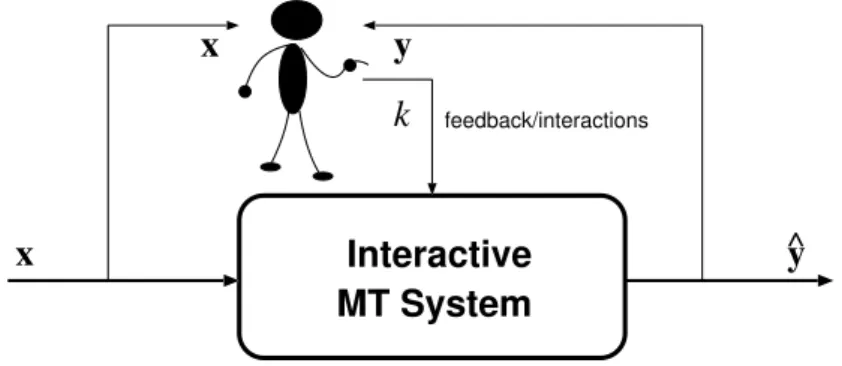
Figure 1.2:Diagram of an interactive MT system. To translate a source sentence x, the user interacts with the system accepting or correcting the proposed translations y. User feedbackk is used by the system to improve its suggestions.
ascomputer assisted t