PARALLEL GRASP ALGORITHM WITH DELAY AND
DELAY VARIATION FOR RENDEZVOUS POINT
SELECTION IN PIM-SM MULTICAST ROUTING
1 YOUSSEF BADDI, 2 MOHAMED DAfiR ECH-CHERIF El KETTANI
Information Security Research Team – ISeRT, ENSIAS Mohammed V-Souissi University, Rabat, Morocco E-mail: [email protected], [email protected]
ABSTRACT
Many multicast routing protocols has proposed to support efficient multimedia application, PIM-SM protocol remains the most used multicast routing protocol; they propose using a Shared Rendezvous Point Tree SRPT to forward multicast packets. The prime problem concerning SRPT construction is to determine an optimal multicast router in the network as root; this problem is called RP selection. This problem influences the multicast routing tree structure, and therefore influences performances of the multicast session and multicast routing scheme. Determination of a best RP position is an NP complete problem, first proposed by Wall, which needs to be solved with a heuristic algorithm. In this paper we propose a new RP selection algorithm based on Parallel GRAS Procedure. 2DV-PGRASP-RP selects RP by considering cost, delay and delay variation functions and can be easily integrated to bootstrap RP protocol used by PIM-SM. Simulation results show that good performance is achieved in multicast cost.
Keywords: 2DV-PGRASP-RP; PIM-SM; Multicast IP; SRPT; RP; GRASP; BootStrap RP
1 INTRODUCTION
Steve Deering [1] is the first to propose a Multicast IP technique to ensure one-to- multiple and multiples-to-multiple communication. Multicast IP entrust the task of data duplication to the network. In this model of communication, the sources send a data packet in a single copy and network takes care to duplicate it as many copies as multicast group members. Consequently; Multicast Internet Protocol (MIP) is a bandwidth-conserving technology that reduces largely traffic. Many applications take advantage of multicast include videoconferencing, corporate communications, distance learning, and distribution of software, and news.
PIM-SM [2] is a multicast routing protocol based in Shared Rendezvous Point Tree SRPT [3] to forward multicast packets. Construction of this kind of tree requires the selection of a center router called "Rendezvous point" RP. Find out an optimal position of this router is known by Rendezvous RP selection Problem RPSA. This problem directly impact tree structure and multicast routing scheme performances.
Current implementations of the PIM-SM [2] protocol decide on the RP router administratively
[4]. As defined in RFC4601 [2], PIM-SM uses bootstrap RP [5] to select one Rendezvous Point RP to be used by all multicast groups. In Bootstrap RP [5] the Rendezvous Point RP selection is made on a list of candidate routers according to the priority of each one, this method of selection does not assume the choose an optimal Rendezvous Point RP and do not take into account the distribution of multicast group members, which affects the performance of the multicast session, and leads to high cost, high delay, and high delay Variation. RP selection problem first proposed by Wall [6], is an NP complete problem [7], [8], [9] which needs to be solved with a heuristic algorithm.
In this paper we adopted a heuristic search algorithm [4], named GRASP [10], to present a parallel distributed proposal algorithm to solve the problem of RP selection Problem RPSP in PIM-SM [2] protocol. The main advantage of using a heuristic search algorithm is to avoid exploring an exponential number of solutions providing a near optimal value.
in literature. Section 5 describes the proposed 2DV-PGRASP-RP algorithm. Simulation results are reported in section 6. Finally, Section 7 provides concluding remarks.
2 RP SELECTION PROBLEM
The main roles of a multicast routing protocol are managing multicast groups and routing multicast messages through a minimum multicast tree in order to reach all multicast group members, which facilitates the operation of multicast packet replication. Constructing a multicast tree covering all multicast groups members and sources at a time is known by the minimum Steiner tree problem MST [11], this problem is NP complete [7], [8], [9], it tray to find a low-cost tree by minimizing cost and transmission delay. Because of the difficulties in obtaining MST [11], especially in larger graphs, it is often deemed acceptable to use near optimal tree to replace SMT by using a heuristic algorithm. Multicast routing protocols are divided according to multicast tree types used into two kinds; it can be shared across all sources using a Rendezvous Point router (SRPT tree) or may be source based tree [12].
Several multicast routing protocols in the literature use Shared Rendezvous Point Tree SRPT; the prominent is Protocol Independent Multicasting-Sparse mode PIM-SM [2]. Current implementation of the PIM-SM [2] protocol divide the tree construction problem into two sub-problems: the first one is RP selection problem and then routing selection problem. PIM-SM [2] uses for RP selection a special router called Bootstrap router (BSR) [5], which notifies a set of candidate Rendezvous Points. BSR router uses Hash function to select one Rendezvous Point RP, this hash function is based on router priority declared by each Rendezvous Points candidates and his IP address. Both of these parameters do not guarantee the selection of an optimal RP and don’t car in topology and group distribution. This leads to high cost, high delay, high congestion and traffic concentration.
Rendezvous Point selection problem first proposed by Wall [6], is an NP complete problem [7], [8], [9], which needs to be solved with a heuristic algorithm.
In this paper, we propose a new RP selection Algorithm 2DV-PGRASP-RP as an extension to Bootstrap mechanism based in Greedy Randomized Adaptive Search Procedure GRASP with a weighted function taking as parameters cost, delay
and delay variation metrics. Greedy Randomized Adaptive Search Procedure has already been used to resolve many problems [13], [14], [15], but not yet in Rendezvous point selection problem. 2DV-PGRASP-RS can simultaneously minimize the cost, delay and delay variation of the multicast tree.
3 MATHEMATIC MODELING
A computer network is modeled as a simple directed and connected graph G = (N, E), where N is a finite set of nodes and E is the set of edges (or links) connecting the nodes. Let |N| be the number of network nodes and |E| the number of network links. An edge e ∈ E connecting two adjacent nodes u ∈ N and v∈ N will be denoted by e(u,v), the fact that the graph is directional, implies the existence of a link e(v,u) between v and u. Each edge is associated with two positive real value: a cost function C(e) = C(e(u,v)) represents link utilization (may be either monetary cost or any measure of resource utilization), and a delay function D(e) = D(e(u,v) ) represents the delay that the packet experiences through passing that link including switching, queuing, transmission and propagation delays. We associate for each path P(v0 ,vn ) = (e(v0 ,v1 ) , e(v1 ,v2 ) , . . . , e(vn-1 ,vn ) ) in the network two metrics:
A multicast tree TM(S, C, D) is a sub-graph of G spanning the set of sources node S ⊂ N and the set of destination nodes D ⊂ N with a selected Rendezvous Point RP. Let |S| be the number of multicast destination nodes and |D| is the number of multicast destination nodes.
We also introduce a Delay Variation (7) function defined as the difference between the Maximum (5) and minimum (6) end-to-end delays along the multicast tree from the source to all destination nodes and is calculated as follows:
Rendezvous Point RP selection problem tries to find an optimal node C in the network with an optimal function Opt_F by minimizing in the first time the cost function C(TM (S, C, D)) and in the second a Delay and delay variation bound as follows:
4 LITERATURE REVIEW
To improve Rendezvous Point RP selection mechanism several proposals and algorithms are proposed in the literature. A variety of these algorithms are compared in [7]. Among proposed selection algorithms, we find the Random Selection, in which, the center is chosen randomly among the network.
Topology-Based Algorithm [8] selects a single Rendezvous Point RP closest to topology center by using the domain topology and sub-graph constructed from the multicast group. In order to reduce the search area used by the Topology-Based Algorithm, and to select a distributed Rendezvous Points RPs for all multicast groups in the network domain and close to the group members, [8] proposed group-based algorithm.
Tournament-based algorithm proposed by Shukla, Boyer, and Klinke [16] executes a Distributed tournament between nodes to determine
a center; Tabu Search algorithm for RP selection (TRPSA) [17] is a distributed Rendezvous Point selection algorithm, based on dynamic meta-heuristic Tabu Search TS algorithms proposed first by Glover [18] to solve combinatorial optimization problems in PIM-SM protocol [2]. We cite also our algorithms VNS-RP [19] and VND-CS [20] based in VNS [21] and VND [22] heuristics successively.
All these algorithms select Rendezvous Point RP based in basic heuristics and do not consider QoS constraints. This kind of RP selection algorithm can provide every member of the group with a cost function.
There are also many well-known approaches to select RP router satisfying delay and delay-variation constraints. Delay Variation Multicast Algorithm (DVMA) was proposed by G. N Rouskas, I. Baldine [23] to resolve the Delay and Delay Variation Bounded Multicasting Network (DVBMN) problem. DVMA tries to find a sub-network given a source and a set of destinations that satisfies the QoS (Quality of Service) requirements on the maximum delay from the source to any of the destinations and on the maximum inter-destination delay variance: it starts with a source-based tree spanning some and not always all multicast members satisfying the delay constraint only. Then the algorithm searches through the candidate paths satisfying the delay and delay-variation constraints from a non-tree member node to any of the tree nodes.
Delay and Delay Variation Constraint Algorithm (DDVCA) was proposed by Sheu and Chen [24] based on the Core Based Tree (CBT) [3]: the main objective of DDVCA is to find as much as possible core router spanning a multicast tree with a smaller multicast delay variation under the multicast end-to-end delay constraint. To do that, DDVCA first calculates the delay of the least delay path from the destination nodes to all the nodes. The node that has the minimum delay-variation is selected as the core node.
KIM et.al [25] has proposed another efficient RP selection algorithm based also on CBT like DDVCA [24] to build a core based multicast tree under delay and delay-variation bound. First, AKBC finds a set of candidate core nodes that have the same associated multicast delay-variation for each destination node. Then, it selects a final core node from this set of candidate core nodes that has the minimum potential delay-variation.
network environment that has no direction. To overcome this limitation, Ahn, Kim and Choo [26] proposed AKC (Ahn Kim Choo) to build a multicast tree with low delay-variation in a realistic network environment that has two-way directions. This algorithm works efficiently in the asymmetric network.
The last core selection algorithm, proposed by Sahoo and. al [27], is based on dynamic meta-heuristic Tabu Search TS algorithms, proposed first by Glover [24], to solve combinatorial optimization problems. Tabu Search algorithm for RP selection (TRPSA) [24] is a distributed core selection algorithm to find a local solution after a certain finite number of iterations by using memory structures that describe the visited solutions. The basic idea of the TRPSA [24] algorithm is to mark the best local solution obtained in order to prevent the research process to return back to the same solution in subsequent iterations using a data structure to store the solutions already visited, this structure is called tabu list. However, the method requires a better definition of stopping criterion and effective management of the tabu list, since the choice of stopping criterion and tabu list size is critical and influences the performance of the algorithm.
However, these algorithms [24], [24], [24] select the best core node out of a set of candidate core nodes that have the same associated delay-variation. Therefore, these algorithms are restricted only to selecting the best core node, which may not generate an optimal delay-variation-based multicast tree in many cases. Also TRSPA doesn’t overcome this limitation because it just selects a local optimal node which may not generate an optimal delay and delay-variation-based multicast tree in all topology networks.
5 BASIC GREEDY RANDOMIZED
ADAPTIVE SEARCH
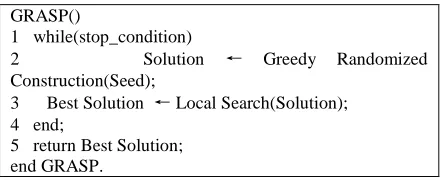
Contrary to all local search meta-heuristics based on deterministic local search methods, Feo and Resende (1999) proposed a Greedy Randomized Adaptive Procedure GRAS [24]. The basic idea of this meta-heuristics is to create a new solution iteratively, independent of previous ones. For this, two phases are necessary: first one is a construction phase using a randomized greedy algorithm; this non-deterministic phase allows to diversify the search and to obtain multiple starting solutions, this elements leads to the creation of a restricted candidate list (RCL) formed by the best starting solutions. The second phase is a local search phase
applies local improvement algorithms to each of these solutions. The best solution found during the various iterations is returned as result. The basic GRAS [24] algorithm is described in Figure1.
GRASP()
1 while(stop_condition)
2 Solution ← Greedy Randomized Construction(Seed);
3 Best Solution ← Local Search(Solution); 4 end;
[image:4.612.308.528.161.251.2]5 return Best Solution; end GRASP.
Figure 1. Basic Greedy randomized adaptive search Algorithm
GRASP [24] has been applied successfully to a wide variety of NP-hard problems to select a global optimal solution such as the travelling salesman problem [24], Job Shop Scheduling Problems [24], and clustering problem [24].
Our proposal algorithm use a parallel version of GRASP search algorithm in bootstrap RP mechanism to select an optimal router to act as Rendezvous Point RP router in network topology. This selection use the weighted function defined in section 3.
6 2DV-PGRASP-RP BASED ALGORITHM
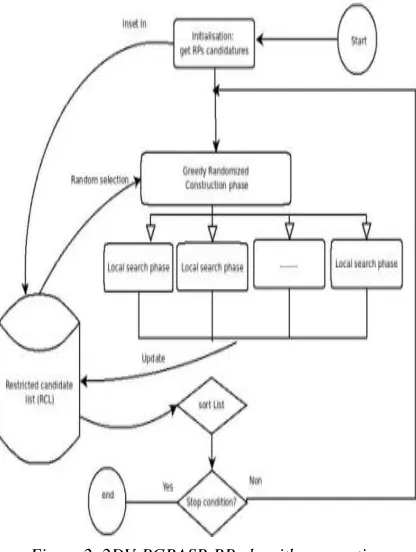
Fundamentals of 2DV-PGRASP-RP search are the use of flexible two phases, first a construction phase followed by a parallels local search processes to surmount local better solutions. Basic features that are needed to implement the 2DV-PGRASP-RP search are described briefly in this section. According to the features of RP selection, we take a first restricted candidate list (RCL) as the first set of candidate RPs.
6.1 Greedy Randomized Construction Phase
Our goal is to extend standardized Rendezvous Point selection mechanism, BootStrap RP [24], in version 2 of multicast routing protocol PIM-SM [2]. We use as initial state of 2DV-PGRASP-RP algorithm the list of candidate RPs sent to BSR router, this list will be inserted initially in the restricted candidate list (RCL).
[image:5.612.91.299.302.578.2]This phase of the 2DV-PGRASP-RP algorithm contains two functions, first used to sort elements of the restricted candidate list (RCL) using the cost function defined in formula (8), this function is the greedy part of the 2DV-PGRASP-RP algorithm. Followed by a random selection function, as a random part of the algorithm, this function selects a set of solutions that will be a set of initial solutions of the local search phase.
Figure 2. 2DV-PGRASP-RP algorithm execution
6.2 Restricted Candidate List (RCL)
The bootstrap RP uses a list of candidate RPs sent by each router wishing to act as a Rendezvous Point RP in the topology, the explicit request sent by each router candidate is associated with a priority value assigned by the router itself .
Unlike the static management of the list of candidate RPs proposed in Bootstrap RP, in our algorithm we use a restricted candidate list (RCL) dynamically powered by the phase of local search
iteratively, this by adding the best local solution at each iteration.
6.3 Local Search Phase
In recent years, several local search algorithms have been proposed. In our proposition local search phase usually improves the constructed solution in an iterative fashion by successively replacing the current solution by a better solution in the neighborhood of the current solution. They proceed from an initial solution generated randomly from restricted candidate list (RCL) and trays to find an optimum local solution , which improve each time the value of the cost function defined in formula (8).
The 2DV-PGRASP-RP is independent of de local search algorithm used; it can work with hill climbing, adaptive multi-start, variable depth search, simulated annealing, Tabu search (TS), others such as genetic search.
6.4 Stopping Conditions Phase
An iteration of the algorithm 2DV-PGRASP-RP is composed principally of a Greedy Randomized Construction phase, running a local search algorithm and a test of movement. In case of small problem instances, where the best solution is usually found very quickly, the stopping condition with a limit on the maximum number of iterations is sufficient. Therefore, a second stopping condition has been added for large-scale problems. This criterion is the maximum number of iterations after obtaining solutions with the same optimal function value.
7 SIMULATION RESULTS AND
ANALYSIS
In this section we perform many simulations to examine the performance of our algorithm 2DV-PGRASP-RP.
7.1 Simulation Topology And Parameters
To study the performance of our selection algorithm 2DV-PGRASP-RP, we use the network simulator NS2 [28] and the random graph generator GT-ITM [29]; we adopt Waxman [30] as the graph model. Our simulation studies were performed on a set of 100 random networks. The values of α = 0.2 and β = 0.2 were used to generate networks with an average degree between 3 and 4 in the mathematical model of Waxman.
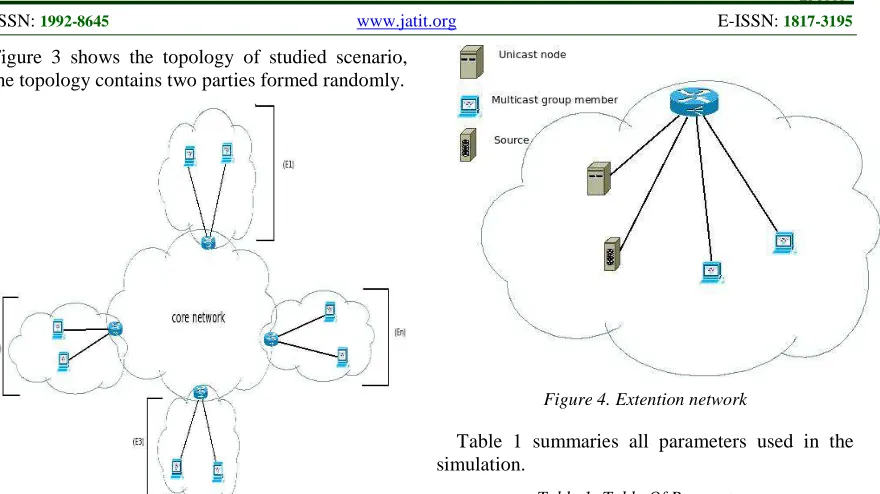
Figure 3 shows the topology of studied scenario, the topology contains two parties formed randomly.
Figure 3. Simulation topology
The ‘core network’ forms the first party and illustrates an autonomous domain representing the ‘internet network’ generated randomly by GT-ITM [] and a second party as a set of LAN network extensions E1, E2 …. En.
each extension Ei has been added to a random selected ‘core network’ edge router, this extension shown in Figure 4 contains the router edge as a designated router DR and a set of node classed as multicast group members, multicast sources and unicast nodes.
The studied scenario was designed in order to be more realistic, with a cases where multicast group members will receive packets from the multicast session and where a multicast group members will also communicate with other unicast nodes.
The simulation starts at t0=0s and lasts for 250s, 20% of the network nodes are multicast group members and 5% of the network nodes are multicast sources. Multicast group members receive data from the sources nodes and the other nodes communicate among themselves and send data to the sources nodes. In our simulations all sources sent UDP CBR traffic.
Figure 4. Extention network
Table 1 summaries all parameters used in the simulation.
Table 1: Table Of Parameters
Parameter Value
Network size 1000 Core network size 100 Extension network size 100 Multicast Group Members size 20% Multicast sources size 5% Waxman parameters α = 0.2 β
= 0.2 Node degree 3-4 Traffic type CBR Average packet size 1500 Average data sending rate of multicast sources
30
Persistent time of the multicast session 200s
7.2 Simulation Results
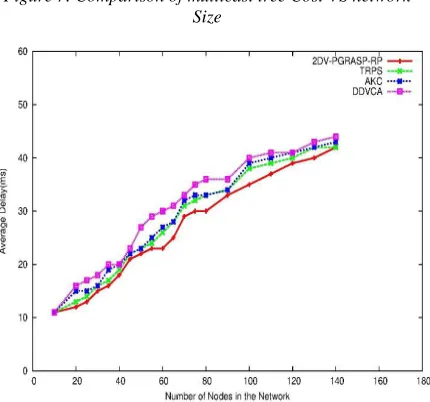
To demonstrate the performance of this algorithm (2DV-PGRASP-RP), we compare it with the following algorithms, including AKC [24], DDVCA [24], and Tabu RP Selection (TRPS) [24]. Multicast tree cost is computed with
function defined in formula (6) with wc=0.3 and wd=0.7.
[image:6.612.95.535.71.318.2]Delay Variation is the difference between the first time of the reception of a multicast packet by a receiver of the multicast group and the last reception of the same multicast packet by another receiver of the multicast group. In Figure 4 the Delay Variation is plotted as a function of the number of nodes in the network topology, it shows that 2DV-PGRASP-RP decrease more the delay variation to transmit multicast packet to all multicast group, this reduction is caused by the selection of an optimal Rendezvous Point, followed by others algorithms.
Figure 5. Comparison of delay VS network Size
Based on the cost function in the formula (8), Figure 5 presents a comparison study of multicast tree Cost generated by each algorithm, the performance of DDVCA selection is the worst, followed by AKC and TRPS, 2DV-PGRASP-RP shows better performances, and it has the minimal cost.
[image:7.612.91.291.248.456.2]Within our proposal RP selection, we separate the process of tree construction from RP selection. For tree construction, we modify CBT protocol used in NS2 simulator to measure the cost distance between the given pair of nodes using cost distance presented in formula (3). Construction tree delay designates the required time to build all multicast tree branches after receiving all membership requests explicitly sent by all receivers. Simulation results presented in Figure 6 shows that 2DV-PGRASP-R outperforms all others algorithms in Construction tree delay constraints when multicast group are widely localized.
Figure 6. Comparison of delay variation VS network Size
Figure 7. Comparison of multicast tree Cost VS network Size
[image:7.612.310.526.297.703.2] [image:7.612.313.521.305.483.2] [image:7.612.314.529.492.693.2]8 CONCLUSION
In this paper, we started with a brief overview of multicast IP technology and presentation of RP Selection Problem. This Rendezvous Point (RP) Selection problem directly affects the structure of the tree and the performance of the routing scheme of multicast accordingly. We reviewed and analyzed the cost and delay function for RP selection algorithms. We reviewed the RP selection algorithms proposed to date in literature. To solve these problems, 2DV-GRASP-RP is proposed based on GRASP algorithm. Simulation results indicate that this algorithm has good performance in multicast cost, End-To-End delay and other aspects. Our future work is focused on extending this algorithm to support multiple QoS criteria imposed by Mobile receivers across the network and a parallel execution to select multiples Active Rendezvous Points RPs.
REFRENCES:
[1] S. E. Deering et D. R. Cheriton, « Multicast Routing in Datagram Internetworks and Extended LANs », Acm Trans. Comput. Syst., vol. 8, p. 85–110, 1990.
[2] B. Fenner, M. Handley, H. Holbrook, and I. Kouvelas, Protocol Independent Multicast -
Sparse Mode (PIM-SM): Protocol
Specification (Revised). IETF, 2006.
[3] A. Ballardie, Core Based Trees (CBT version
2) Multicast Routing – Protocol Specification –. United States: RFC Editor, 1997.
[4] M. Ramalho, « Intra- and Inter-Domain Multicast Routing Protocols: A Survey and Taxonomy », Ieee Commun. Surv. Tutorials, vol. 3, no 1, p. 2–25, 2000.
[5] D. Estrin, M. Handley, H. Mark, A. Helmy, P. Huang, and D. Thaler, « A Dynamic Bootstrap Mechanism for Rendezvous-based Multicast Routing », in Proceedings of IEEE INFOCOM
’99, 1997.
[6] D. W. Wall, « Mechanisms for Broadcast and Selective Broadcast », Stanford University, Stanford, CA, USA, 1980.
[7] A. Karaman and H. Hassanein, « Core-selection algorithms in multicast routing - comparative and complexity analysis »,
Comput Commun, vol. 29, no 8, p. 998–1014,
2006.
[8] K. L. Calvert, E. W. Zegura, and M. J. Donahoo, « Core Selection Methods for Multicast Routing », 1995, p. 638–642.
[9] D. Zappala and A. Fabbri, « An Evaluation of Shared Multicast Trees with Multiple Active Cores », in ICN ’01: Proceedings of the First
International Conference on Networking-Part 1, London, UK, 2001, p. 620–629.
[10] T. A. Feo and M. G. C. Resende, « Greedy Randomized Adaptive Search Procedures », J.
Glob. Optim., vol. 6, p. 109–133, 1995.
[11] K. Mehlhorn, « A faster approximation algorithm for the Steiner problem in graphs »,
Inf Process Lett, vol. 27, no 3, p. 125–128,
mars 1988.
[12] L. Wei and D. Estrin, « The Trade-offs of Multicast Trees and Algorithms », 1994. [13] Y. Marinakis, A. Migdalas, et P. M. Pardalos,
« Expanding Neighborhood GRASP for the Traveling Salesman Problem », Comput Optim
Appl, vol. 32, no 3, p. 231–257, déc. 2005.
[14] S. Binato, W. J. Hery, D. M. Loewenstern, andM. G. C. Resende, « A greedy randomized adaptive search procedure for job shop scheduling », Ieee Trans Power Syst., vol. 16, p. 247–253, 2001.
[15] J. R. Cano, J. R. Cano, O. Cordón, O. Cordn, F. Herrera, F. Herrera, L. Sánchez, andL. Snchez, « A Greedy Randomized Adaptive Search Procedure to the Clustering Problem »,
Int. J. Intell. Fuzzy Syst., vol. 12, p. 235–242,
2000.
[16] S. B. Shukla, E. B. Boyer, andJ. E. Klinker, « Multicast Tree Construction in Network Topologies with Asymmetric Link Loads », 1994.
[17] W. Hua, M. Xiangxu, Z. Min, L. Yanlong, andothers, « Tabu search algorithm for RP selection in PIM-SM multicast routing »,
Comput Commun, vol. 33, no 1, p. 35–42, janv.
2010.
[18] F. Glover, « Tabu Search - Part II », Informs J.
Comput., vol. 2, no 1, p. 4–32, 1990.
[19] Y. Baddi andM. D. E. Kettani, « VNS-RP algorithm for RP selection in multicast routing protocol PIM-SM », in The 3rd International
Conference on Multimedia Computing and Systems (ICMCS’12), Tangier, Morocco, 2012.
[20] Y. Baddi andM. D. E. Kettani, « VND-CS: A Variable Neighborhood Descent Algorithm for Core selection Problem in multicast routing protocol », in Fourth International Conference
on Networked Digital Technologies 2012 (NDT 2012), Dubai, India, 2012.
[22] P. Hansen, N. Mladenović, andL. C. D. Gerad, « Variable neighborhood search: Methods and recent applications », in In Proceedings of
MIC’99, 1999, p. 275–280.
[23] G. N. Rouskas and I. Baldine, « Multicast Routing with End-to-End Delay and Delay Variation Constraints », North Carolina State University at Raleigh, Raleigh, NC, USA, 1995.
[24] P.-R. Sheu and S.-T. Chen, « A Fast and Efficient Heuristic Algorithm for the Delay- and Delay Variation Bound Multicast Tree Problem », in Proceedings of the The 15th
International Conference on Information Networking, Washington, DC, USA, 2001, p.
611–.
[25] M. Kim, Y.-C. Bang, H.-J. Lim, and H. Choo, « On Efficient Core Selection for Reducing Multicast Delay Variation under Delay Constraints », Ieice Trans., vol. 89-B, no 9, p. 2385 2393, 2006.
[26] Y. Ahn, M. Kim, Y.-C. Bang, and H. Choo, « On algorithm for the delay- and delay variation-bounded multicast trees based on estimation », in Proceedings of the First
international conference on High Performance Computing and Communications, Berlin,
Heidelberg, 2005, vol. 3726, p. 277–282. [27] S. P. Sahoo, M. R. Kabat, and A. K. Sahoo,
« Tabu Search Algorithm for Core Selection in Multicast Routing », in Proceedings of the
2011 International Conference on
Communication Systems and Network
Technologies, Washington, DC, USA, 2011, p.
17–21.
[28] T. Issariyakul and E. Hossain, Introduction to
Network Simulator NS2, 1re éd. Springer
Publishing Company, Incorporated, 2008. [29] H. Tangmunarunkit, R. Govindan, S. Jamin, S.
Shenker, and W. Willinger, « Network Topologies, Power Laws, and Hierarchy », 2001.