www.wjpr.net Vol 4, Issue 4, 2015. 966
METHOD DEVELOPMENT AND VALIDATION OF STABILITY
INDICATING RP-HPLC METHOD FOR SIMALTANEOUS
ESTIMATION OF AZILSARTAN AND CHLORTHALIDONE IN PURE
AND PHARMACEUTICAL DOSAGE FORM
N. Sunitha1*, Subash C Marihal 2, T.Sai Sushma3, A.Venu 3, B.V.Narasimha Rao3,
B.Appa Rao3
1
SIMS College of Pharmacy, Guntur - 522001, Andhra Pradesh, India. 2
HLT College of Pharmacy, Channapatna, Bengaluru, Karnataka, India. 3
Victoria College of Pharmacy, Guntur - 522005, Andhra Pradesh, India.
ABSTRACT
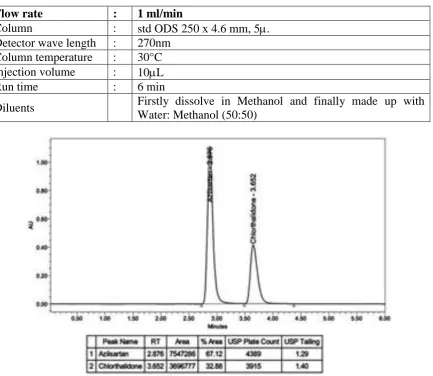
A simple, accurate, precise method was developed for the simultaneous estimation of the Azilsartan and Chlorthalidone in Tablet dosage form. Retention times of Azilsartan and Chlorthalidon ewere found to be 2.876min and 3.652min. %RSD of the Azilsartan and Chlorthalidone were and found to be 0.28 and 0.47 respectively. %Recover was obtained as 100.08 and 100.18 for Azilsartan and Chlorthalidone respectively. LOD, LOQ values are obtained from regression equations of Azilsartan and Chlorthalidone were 0.49, 1.49 and 0.74, 2.23 respectively. Regression equation of azilsartan is y = 18208x + 2709 and of Chlorthalidone is y = 29300x + 6534.
Regression co-efficient was 0.999. Retention times are decreased and that run time was decreased so the method developed was simple and economical that can be adopted in regular quality control test in industries.
KEYWORDS: Azilsartan and Chlorthalidone, RP-HPLC, Validation.
INTRODUCTION
Azilsartan[1-2] is chemically (5 – Methyl – 2 – oxo 1,3 – dioxol 4 – yl) methyl 2 – ethoxy -1 – {[ 2’- ( 5 - oxo -4,5 – dihydro - -1, 2, 4 – oxadiazol -3 - yl) biphenyl – 4 – yl ] methyl } - 1H – benzimidazole -7 – carboxylate. It is a white crystalline powder which is practically insoluble in water, freely soluble in methanol, dimethyl sulfoxide and dimethyl formamide,
Volume 4, Issue 4, 966-974. Research Article ISSN 2277– 7105
Article Received on 19 Jan 2015,
Revised on 14 Feb 2015, Accepted on 10 Mar 2015
*Correspondence for
Author
N. Sunitha
SIMS College of
Pharmacy, Guntur -
522001, Andhra Pradesh,
www.wjpr.net Vol 4, Issue 4, 2015. 967
soluble in acetic acid, slightly soluble in acetone and Acetonitrile and very slightly soluble in Tetra Hydro furan and 1- octanol.
Chlorthalidone[3-7] is chemically (RS)-2-Chloro-5-(1-hydroxy-3-oxo-2,3-dihydro-1H -isoindol-1-yl)benzene-1-sulfonamide. It is a thiazide type diuretic used to treat hypertension. It acts similarly to the thiazides in causing diuresis but does not have benzothiadiazine moiety in it. It acts at the proximal portion of the distal convoluted tubule of the nephron and shows longest duration of action when compared to other thiazide diuretics. Chlorthalidone is practically insoluble in water, ether and chloroform, soluble in methanol and slightly soluble in alcohol.
This Azilsartan Medoxomil and Chlorthalidone fixed-dose combination is found to show superior antihypertensive efficacy in blood pressure reduction in patients with stage 2 hypertension when compared with the maximum approved dose of olmesartan/hydrochlorothiazide.
The literature survey shows that spectroscopic and chromatographic methods[8-15] for individual drugs but there is only a single method available for quantitation of Azilsartan Medoxomil and Chlorthalidone in solid dosage forms simultaneously. Thus it is inevitable to develop such a sensitive, accurate, precise, rapid and economical method for routine analysis of this combination in pharmaceutical dosage form successfully.
Fig.1: Molecular structure of Azilsartan Fig.2: Molecular structure of chlorthalidone
MATERIALS AND METHODS
Materials
www.wjpr.net Vol 4, Issue 4, 2015. 968 Instrument
HPLC instrument used was of WATERS HPLC 2965 SYSTEM with auto injector and PDA Detector. Software used is Empower 2. UV-VIS spectrophotometer PG Instruments T60 with special bandwidth of 2mm and 10mm and matched quartz was be used for measuring absorbance for Azilsartan and Chlorthalidone solutions.
Method development
Optimization of the chromatographic conditions
The mobile phase consisted of buffer and acetonitrile taken in the ratio 45:55A.
Optimized Method
[image:3.595.88.522.356.732.2]Drugs were eluted with good retention time, resolution, all the system suitable parameters like Plate count and Tailing factor were within the limits.
Table 1:Optimization of the chromatographic conditions
Flow rate : 1 ml/min
Column : std ODS 250 x 4.6 mm, 5. Detector wave length : 270nm
Column temperature : 30°C Injection volume : 10L Run time : 6 min
Diluents Firstly dissolve in Methanol and finally made up with Water: Methanol (50:50)
www.wjpr.net Vol 4, Issue 4, 2015. 969 Preparation of buffer
Buffer: Accurately weighed and trasferred 1.36gm of potassium dihyrogen ortho phosphate in a 1000 ml of volumetric flask add about 900ml of milli-Q water added and degas to sonicate and finally make up the volume with water, then PH adjusted to 4.8 with dil. orthophosphoric acid solution.
Preparation of standard stock solutions
Standard preparation: (400ppm of Azilsartan and 125ppm of Chlorthalidone)
Accurately weighed and transferred 40mg and 12.5mg of Azilsartan and Chlorthalidone working standards into a 10 ml clean dry volumetric flask, add 7ml of diluent, sonicated for 30 minutes and make up to the final volume with diluents. From the above stock solution, 1 ml was pipeted out in to a 10ml volumetric flask and then make up to the final volume with diluent.
Sample preparation
5 tablets were weighed and calculate the average weight of each tablet then the weight equivalent to 5 tablets was transferred into a 50 mL volumetric flask, 30mL of diluent added and sonicated for 25 min, further the volume made up with diluent and filtered. From the filtered solution 1ml was pipeted out into a 10 ml volumetric flask and made up to 10 ml with diluent.
RESULTS AND DISCUSSION
Linearity: Six linear concentrations of azilsartan (100-600) and chlorthalidone (31.25ppm to 187.5ppm) are prepare and injected. Regression equation of the the azilsartan and chlorthalidone are found to be, y = 18203x + 5058 and y = 29259x + 12197 and regression co-efficient was 0.999.
www.wjpr.net Vol 4, Issue 4, 2015. 970 Precision
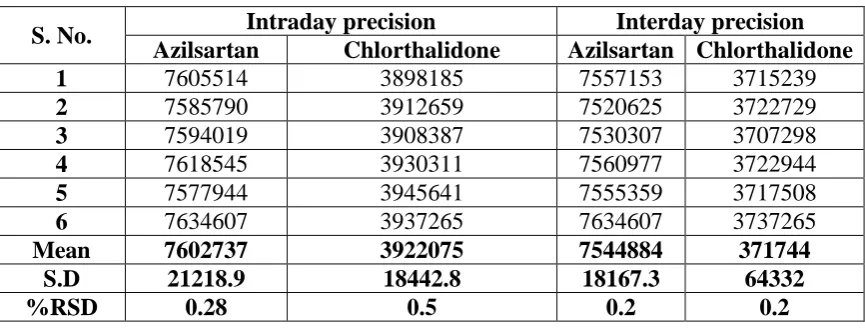
Intraday precision (Repeatability): Intraday Precision was performed and % RSD for Azilsartan and Chlorthalidonewere found to be 0.28% and 0.5% respectively.
Inter day precision: Inter day precision was performed with 24 hrs time lag and the %RSD obtained for Azilsartan and Chlorthalidone were 0.2 % and 0.2 %.
Table 2: Intraday precision and Interday precision data for Azilsartan and
Chlorthalidone
S. No. Intraday precision Interday precision
Azilsartan Chlorthalidone Azilsartan Chlorthalidone
1 7605514 3898185 7557153 3715239
2 7585790 3912659 7520625 3722729
3 7594019 3908387 7530307 3707298
4 7618545 3930311 7560977 3722944
5 7577944 3945641 7555359 3717508
6 7634607 3937265 7634607 3737265
Mean 7602737 3922075 7544884 371744
S.D 21218.9 18442.8 18167.3 64332
%RSD 0.28 0.5 0.2 0.2
Accuracy
Three concentrations 50%, 100%, 150%, were injected in a triplicate manner and amount Recovered and % Recovery were displayed. Each concentration was analyzed 3 times and average recoveries were measured.
Table 3: Accuracy data of Azilsartan and Chlorthalidone
Sample Amount taken
(µg/ml)
Amount recovered (µg/ml)
Recover
(%) % RSD
Azilsartan
50 200.22 100.11 0.60 100 401.56 100.39 0.70 150 597.54 99.59 0.40
Chlorthalidone
50 62.3 99.68 0.65 100 125.26 100.21 0.77 150 187.46 99.48 0.48
[image:5.595.82.515.242.407.2]www.wjpr.net Vol 4, Issue 4, 2015. 971 LOQ: Limit of Quantification was calculated by intercept method and LOQ for Azilsartan and Chlorthalidone are found to be 0.74 and 2.23 respectively.
Robustness: Small deliberate changes in method like flow rate, mobile phase ratio, and temperature are made but there were no recognized change in the result and are within range as per ICH guide lines.
Table 4: Results of robustness study
S.No Robustness condition %RSD
Azilsartan Chlorthalidone
1 Flow minus 0.31 0.31
2 Flow Plus 0.32 0.63
3 Mobile phase minus 0.41 0.31 4 Mobile phase Plus 0.33 0.32 5 Temperature minus 0.31 0.23 6 Temperature Plus 0.52 0.22
Assay: Standard preparations are made from the API and sample preparations are from formulation. Both sample and standards are injected six homogeneous samples. Drug in the formulation was estimated by taking the standard as the reference. The average % assay was calculated and found to be 100.08% and 100.18% for azilsartan and chlorthalidone respectively.
Table.5: Assay results
S.No % Assay
Azilsartan Chlorthalidone 1 100.11 99.57
2 99.85 99.94
3 99.96 99.83
4 100.29 100.39
5 99.75 100.78
6 100.50 100.57
Mean 100.08 100.18
SD 0.2793 0.47
% RSD 0.28 0.47
Degradation studies
www.wjpr.net Vol 4, Issue 4, 2015. 972 Table. 6: Degradation Data of azilsartan
S.No Degradation Condition
Azilsartan Chlorthalidone
% Drug Degraded Purity Angle Purity Threshold % Drug Degraded Purity Angle Purity Threshold
1 Acid 7.57633 2.053 7.968 7.24201 0.070 0.276 2 Alkali 6.09319 2.070 7.969 6.68862 0.154 0.280 3 Oxidation 5.39893 1.995 7.461 5.98028 0.120 0.279 4 Thermal 4.79276 2.067 7.643 4.52133 0.083 0.273 5 UV 1.52859 1.794 6.262 1.50644 0.098 0.277 6 Water 0.71269 1.794 6.338 0.64458 0.128 0.276
Table. 7: Data for degradation chromatogram
Thermal degradation chromatogram
S.No Peak Name RT Area %Area Purity1
Angle Purity1 Threshold USP Platecount USP Tailing
1 Azilsartan 2.877 7234607 66.97 2.067 7.643 4329 1.3 2 Chlorthalidone 3.657 3372726 33.03 0.083 0.275 3851 1.4
UV degradation chromatogram
1 Azilsartan 2.874 7482645 65.34 1.794 6.262 3807 1.3 2 Chlorthalidone 3.653 3844959 34.66 0.098 0.277 3599 1.4
Water degradation chromatogram
1 Azilsartan 2.876 7544643 65.50 1.794 6.338 3948 1.3 2 Chlorthalidone 3.656 3878604 34.50 0.128 0.276 3707 1.4
Water degradation chromatogram
1 Azilsartan 2.875 7188545 66.90 1.995 7.461 4342 1.3 2 Chlorthalidone 3.656 3670311 33.01 0.120 0.279 3844 1.4
Table. 8: Validation parameters
Parameters Azilsartan Chlorthalidone
Range (mcg / ml) 100-600 31.25-187.5 Optimized wavelength 270 270 Mobile phase
(Acetonitrile : Buffer)
Buffer: Acetonitrile:Methanol (50:40:10)
Buffer: Acetonitrile:Methanol (50:40:10)
Column ODS (250mm 4.6mm, 5µ) ODS (250mm 4.6mm, 5µ)
Retention time 2.876 3.652
Regression equation (Y) y = 18203x + 5058 y = 29259x + 12197 Correlation coefficient(r2) 0.999 0.999
Precision (% RSD) 0.28 0.47
% Recovery 100.08 100.18
LOD (mcg / ml) 0.49 0.74
LOQ(mcg / ml) 1.49 2.23
CONCLUSION
www.wjpr.net Vol 4, Issue 4, 2015. 973
accuracy, precision, limits of detection, and quantitation, and specificity. The method proved able to separate the peaks of active pharmaceutical ingredients (APIs) from the degradation products (produced during forced degradation studies).The results of the stress testing reveal that the method is selective and stability indicating. The proposed method is used to separate these drugs from their degradation products; excipients found in tablet dosage forms and can be applied to the analysis of samples obtained during stability studies.
REFERENCES
1. European Medicines Agency, “Edarbi (Azilsartan Medoxomil Potassium),” Assessment report Procedureno. EMEAHC, 2011; 002293.
2. Bakris GL, Sica D, Weber M, White WB, Roberts A, Perez A, et al. The comparative effects of azilsartan medoxomil and olmesartan on ambulatory and clinic blood pressure. Journal of clinical hypertension (Greenwich, Conn.) 2011; 13(2): 81-8.
3. Maryadele J. O’ Neil., The Merck Index, 14th edition, United States pharmaceutical company,USA, 2006; 2193,9131.
4. Sweetman Sean C., Martindale The Complete Drug Reference, Thirty-Sixth Edition, Pharmaceutical Press, London, 2009; 1243: 1409.
5. Indian pharmacopoeia,Ministry of health and family welfare, 6th edition, Indian pharmacopoeia commission, Ghaziabad, India, 2010; II(III): 1076-77, 2186-88.
6. British pharmacopoeia, 6th edition, British pharmacopoeia commission office, London, 2010; I(II): 484-85, 2042-44.
7. V. U. Raja Gorla, Ch. Nagraju, “New Simple Method for Determination of Azilsartan Medoxomil in Bulk and Pharmaceutical dosage forms,” International Journal of Pharmaceutical and Biomedical Sciences, Journal of AOAC International, 2013; 4(4): 1133-7.
8. Kasimala MB, Kasimala BB. Reverse Phase-HPLC Method Development and Validation for the Simultaneous Estimation of Azilsartan Medoxomil and Chlortalidone in Pharmaceutical Dosage Form; Jam online, 2012; 2(1): 117–126.
www.wjpr.net Vol 4, Issue 4, 2015. 974
10.Madhubabu K and Bikshalbabu J. Reverse phase HPLC method development and validation of Azilsartan Medoxomil and Chlorthalidone in pharmaceutical dosage form. Journal of Atoms and Molecules, 2012; 2(1): 117-26.
11.Masthanamma S K Pradeepthi J. Stability Indicating RP-HPLC Method for Determination of Azilsartan Medoxomil in Pharmaceutical Dosage Form; Research Journal of Pharmacy and Technology 2014; 7(2): 168-172.
12.Paras P, Hitendra S, HPLC, Article ID, Isrn. Vekariya and Joshi. Development and validation of RP-HPLC for Azilsartan Medoxomil Potassium Quantitation in Human Plasma by Solid Phase Extraction Procedure, 572170. http://dx.doi.org.10.1155//5721702013. 1-6 p.
13.Youssef RM, Maher HM, El-Kimary EI, Hassan EM, Barary MH. Validated stability-indicating methods for the simultaneous determination of amiloride hydrochloride, atenolol, and chlorthalidone using HPTLC and HPLC with photodiode array detector. Journal of AOAC International, 2013; 96(2): 313-23.
14.Pradeepthi J. Masthanamma SK. A Validated Spectrophotometric Method for Determination of Azilsartan Medoxomil in Pharmaceutical Dosage From. Journal of Scientific Research in Pharmacy, 2013; 2(4): 7-10.