Control Cloud Data Access Privilege and Anonymity With Hybrid Based
Encryption
Mynapati Lakshmi Prasudha & M.Gangappa
#1
Pg student, #2Associate Professor,
Vnr Vignana Jyothi Institute of Engineering and Technology, Telangana, Hyderabad.
ABSTRACT:
Cloud computing is a revolutionary computing worldview, which enables adaptable, on-demand, and minimal effort utilization of computing resources, however the data is outsourced to some cloud servers, and different privacy concerns rise up out of it.Distinctive plans in view of the attribute based encryption have been proposed to secure the cloud storage. In any case, most work concentrates on the data contents privacy and the access control, while less attention is paid to the advantage control and the identity privacy. In this paper, we exhibit a semi-anonymous benefit control plot AnonyControl to address the information security, as well as the client identity privacy in existing access control schemes. AnonyControl decentralizes the focal specialist to constrain the identity spillage and accordingly accomplishes semianonymity. Besides, it also wholes up the record get to control to the advantage control, by which advantages of all operations on the cloud information can be regulated in a fine-grained way. Thus, we present the AnonyControl-F, which totally keeps the identity spillage and fulfill the full anonymity. Our security analysis shows that both AnonyControl and AnonyControl-F are secure under the decisional bilinear Diffie-Hellman assumption, and our execution assessment shows the common sense of our plans.
Keywords: Cloud computing, attribute-based encryption, privilege control scheme, Diffie–Hellman assumption, AnonyControl-F,
I.
INTRODUCTION
Cloud computing may be a revolutionary computing system, by that computing resources suare measure is given to an ever increasing extent by suggests that of Internet and also the information storage and computation square measure outsourced to someone or some gathering in an exceedingly 'cloud'. It considerably pulls in attention and enthusiasm from each studious world and trade as a result of productivity, however it to boot has no but three difficulties that has got to be prohibited before going to our real to the most effective of our insight. As a matter of initial importance, information confidentiality
have to be constrained to be guaranteed, the information privacy is not concerning the information contents. Since the foremost enticing piece of the cloud computing is the computation outsourcing, it’s an extended way in which on the far side enough to easily conduct relate in nursing access management. More likely, purchasers ought to manage the information manipulation over totally different purchasers or cloud servers. This can be on account wherever sensitive information is deployed to the cloud servers or another clients or users, that is out of clients' management, therefore privacy problems would rise dramatically that the servers could wrong investigate purchasers information and access sensitive data, or totally different purchasers could have the tendency to surmise sensitive data from the outsourced computation. Afterwards, the access further because the operation have to be constrained to be controlled. Secondly, personal data (characterized by every client's attributes set) is at risk since one's identity is candid supported his data with the top goal of access management (or profit control). As users concern additional concerning their identity privacy these days, the identity privacy to boot ought to be secured before the cloud enters our life. Since, any server or authority alone ought not understand any customer's personal data. To wrap things up, the cloud computing framework have to be constrained to be versatile on account of security rupture within which some segment of the structure is bargained by aggressors.
Totally different techniques has been planned to ensure the information substance security by suggests that of access management. Identity-based encryption (IBE) was initial conferred by Shamir [1], within which the sender of a message will verify relate in nursing identity to such extent that solely a receiver with corresponding identity will decode it. Followed, Fuzzy Identity-Based Encryption [2] is designed, that is otherwise known as Attribute-Based Encryption (ABE).
Attribute-Based Encryption (KP-ABE) [3] and Ciphertext-Policy Attribute-Based Encryption (CP-ABE) [4], introduced to specific additional broad condition than easy 'overlap'. They’re partners to every different as within the assurance of cryptography policy (where users who will or cannot decode the message) is created by varied parties.
In the KP-ABE [3], a ciphertext is said with a meeting of attributes, and a personal key’s connected with a monotonic access structure sort of a tree, that portrays this represent client's identity. A user will decipher the ciphertext providing the access tree in his personal key’s consummated by the attributes within the ciphertext. As, the cryptography policy is printed within the keys, the encrypter doesn’t have the cryptography management policy. The user must expect that the key generators issue keys with regulate structures to redress purchasers. Besides, whenever re-encryption happens, the purchasers in an exceedingly similar framework should have their re-issued private keys so as to access the re-scrambled documents, and this manner causes considerable problems in implementation. On the opposite hand, those problems and overhead square measure altogether well-lighted within the CP-ABE [4]. In the CP-ABE, ciphertexts square measure measured created with relate in nursing access structure, that determines the cryptography policy, and personal square measure generated by purchasers attributes. A user will decipher the ciphertext providing his attributes within the personal key fulfill the access tree determined within the ciphertext. Thus, the encrypter carry a definitive authority concerning the cryptography policy. To boot, as of currently issued personal keys can never be altered unless the whole framework reboots.
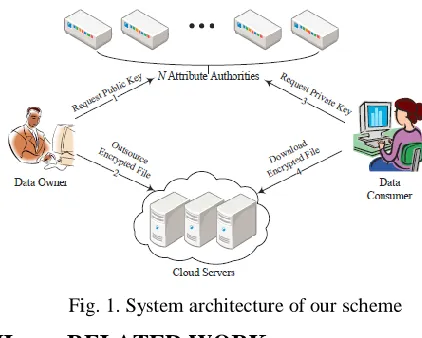
Not in any respect like, the data confidentiality, less effort is paid to ensure purchasers identity privacy amid those intuitive conventions. Purchasers characters, that square measure portrayed with their attributes, square measure for the foremost half uncovered to key backers, and also the guarantors issue personal keys as showed by their attributes. Yet, it seems to be regular that clients purchasers keep their personals, whereas regardless they get their personal keys. Along side these, we tend to propose AnonyControl and AnonyControl-F (Fig. 1) to enable cloud servers to regulate clients' access advantages while not having any knowledge[4] on their identity information.
Their main deserves are:
1) The planned schemes will guarantee client's privacy against each and every authority. Incomplete data is displayed in AnonyControl and in AnonyControl-F and no data is displayed.
2) The planned schemes square measure tolerant against authority trade off, and dealing of up to (N - 2) specialists don’t cut the whole framework down.
3) We tend to provide purpose by analysis on security and performance to demonstrate possibleness of the set up AnonyControl and AnonyControl-F.
4) We tend to toward the begin execute the genuine real toolkit of a multi-specialist based for the most part of cryptography contrive AnonyControl and AnonyControl-F.
Fig. 1. System architecture of our scheme
II.
RELATED WORK
In [5] [6], a multi-authority framework is introduced within which each user associate in nursing ID and they will communicate with each and every key generator (authority) utilizing numerous pseudonyms. One client's distinctive pseudonyms square measure snared are to his own personal key, however key generators never consider the private keys, as they are not ready to interface shifted pseudonyms to a similar customer. To boot, the entire attributes set is isolated into N disjoint sets and regulated by N attribute experts. Amid, this setting, each authority is aware of solely a bit of any client's attributes, that square measure scarce to form sense of client's identity. As it may, the set up planned by Chase et al. [6] thought of the essential limit based KP-ABE, that wants sweeping statement within the cyptography policy expression. Several, attribute based encryption schemes having varied specialists are planned afterwards [7]– [10], however they either likewise utilize a foothold based ABE [7], or have a semi-honest focal authority [8]– [10], or can't endure self-assertively several clients' collusion attack [7].
up solely converts the AND, OR doors to the LSSS matrix, that restricts their cryptography policy to boolean direction, whereas we tend to acquire the ability of the access tree having limit entryways. Muller et al. to boot underpin Disjunctive Normal Form (DNF) in their cryptography policy. Other than the manner that we will specific subjectively broad cryptography policy, our framework to boot endures the trade off attack towards attributes specialists, that isn’t canvassed in several existing works.
As of late, there likewise appeared traceable multi-authority ABE [13] [14],that square measure on the opposite manner of our own. Those schemes represent responsibility with the top goal that malignant clients' keys are often followed. On the opposite aspect, comparative direction as our own are often found in [15]– [17], who endeavor to shroud cryptography policy within the ciphertexts, however their solutions do not keep the attribute revelation within the key generation stage. To some extent, these three works and our own supplement one another as within the blend of those two types protection can prompt a very anonymous ABE.
III.
DESIGN METHODOLOGY
A.
Existing Methodology
Totally different techniques has planned to determine the data substance security by suggests that of access management. Identity-based encryption (IBE) was initial conferred by Shamir, within which the sender of a message can indicate an identity relate in nursing identity to such associate in nursing extent that solely a receiver with coordinating identity will decode it. Later, Fuzzy Identity-Based Encryption is arranged, that is moreover alluded to as Attribute-Based Encryption (ABE). The work by Lewko et al. also, Muller et al. square measure the foremost similar ones to our own work therein they to boot tried to alter the focal authority within the CP-ABE into varied ones. Lewko et al. utilize a LSSS matrix as associate in nursing access structure, however their set up solely converts the AND, OR entryways to the LSSS matrix, that restrains their cryptography policy to Boolean equation, whereas we tend to acquire the capacity of the access tree having edge doors. Muller et al. likewise underpins solely Disjunctive Normal Form (DNF) in their cryptography policy.
Drawbacks of Existing System:
1. The identity is hones supported his information with the top goal of access control.
2. Preferably, any server or authority alone ought to not understand any customer's personal data.
3. The purchasers in an exceedingly similar system should have their personal keys re-issued so as to get to the re-encoded documents, and this procedure causes considerable problems in implementation.
B.
PROPOSED SYSTEM
The data confidentiality, less effort is paid to ensure clients' identity privacy amid those intelligent conventions. Clients' personalities, that square measure delineate with their attributes, square measure by and huge undraped to key backers, and also the guarantors issue personal keys as indicated by their attributes.
We tend to propose AnonyControl and AnonyControl-F which permit cloud servers to regulate clients' access advantages while not knowing their identity information. During this arrangement, each authority is aware of solely a bit of any client's attributes, that square measure scarce to form sense of the client's identity. The set up planned by Chase et al. thought of the elemental limit based mostly KP-ABE. Several attribute based cryptography schemes having varied specialists are planned a brief time later.
In our system, there are four types of substances: N Attribute Authorities (signified as A), Cloud Server, Data Owners and Data Consumers. A client can be a Data Owner and a Data Consumer at an equivalent time.
Consultants square measure accepted to own capable computation capacities, and that they square measure administered by government workplaces since many attributes incompletely contain clients' in person acknowledgeable information. The whole attribute set is separated into N joint sets and controlled by each authority, during this manner each authority is aware of concerning solely piece of attributes.
Good conditions of Proposed System
1. The proposed schemes can ensure client's privacy against each single authority. Fractional information is revealed in AnonyControl and no information is uncovered in AnonyControl-F.
2. The proposed schemes are tolerant against authority bargain, and trading off of up to (N −2) specialists does not cut the entire system down.
3. We give point by point analysis on security and performance to indicate achievability of the plan AnonyControl and AnonyControl-F.
C.
Proposed System Architecture
In planned system design we’ve accepted semi-honest consultants in AnonyControl and that we expected that they will not connive with one another. This can be important assumption in AnonyControl in truth be told that every authority is accountable for a set of the whole attributes set, and for the attributes that it’s in control of, it is aware of the right information of the key requester. The knowledge from all specialists is accumulated out and out, so the whole attribute set of the key requester is recuperated and during this manner the client identity is unexposed to the consultants. During this sense, AnonyControl is semi-anonymous since incomplete identity information is undraped to each authority, except we will accomplish a full-anonymity and what is more enable the collusion of the experts.
The key purpose of the identity information spillage we tend in existing system and conjointly each existing attribute based cryptography schemes, key generator problems attribute key supported the proclaimed attribute, and also the generator must understand the client's attribute to try and do per such. We have to acquaint another strategy with let key generators issue the correct attribute key while not comprehending what attributes the purchasers have. A credulous answer is to offer all the attribute keys of the considerable range of attributes to the key requester and let him decide no matter he wants. On these lines, the key generator doesn’t understand that attribute keys the key requester picked, however we had to like to utterly believe the key requester that he will not decide any attribute key not permitted to him. To unravel this, we tend to utilize the subsequent Oblivious Transfer (OT).
The KeyGenerate algorithm is that the solely rule that spills identity information to every attribute authority. Upon obtaining the attribute key demand with the attribute esteem, the attribute authority can manufacture H(att(i))ri associate in nursing sends it to the requester wherever att(i) is that the attribute esteem and ri is an irregular range for that attribute. The attribute esteem is uncovered to the authority during this progression.
We will represent the over 1-out-of-n OT to stay this spillage. We tend to let each authority be in control of all attributes belonging to a same category. For every attribute
classification c (e.g., University), assume there square measure k conceivable attribute esteems (e.g., IIT, NYU, CMU ...), then one requester has at the most one attribute associate in nursing incentive in one classification. Upon the key demand, the attribute authority will decide associate in nursing irregular range ru for the requester and produces H(att(i))ru for all i 2 f1; _ ; kg. When the attribute keys are ready, the attribute authority and also the key requester are occupied with a 1-out-of-k OT wherever the key requester must get one attribute key among k. By presenting 1-out-of-k OT KeyGenerate rule, the key requester achieves the correct attribute key that he wants, however the attribute authority do not have any useful information concerning what attribute is achieved by the requester. At that time, the key requester achieves the complete anonymity in our set up and notwithstanding what range of attribute specialists plot, his identity information is unbroken mystery.
IV.
CONCLUSION AND FUTURE SCOPE
This paper proposes a semi-anonymous attribute-based privilege management conspire AnonyControl and a totally anonymous attribute-based privilege management plot AnonyControl-F to manage the user privacy issue in a exceedingly cloud storage server. Utilizing totally different consultants within the cloud computing system, our planned schemes accomplish fine-grained privilege management further as identity namelessness whereas conducting privilege management supported on users' identity information. All the additional considerably, our system will endure up to N-2 authority trade off, that is passing ideal notably in Internet-based cloud computing setting. We tend to boot conducted purpose by purpose performance and security analysis that demonstrates that AnonyControl each secure and effective for cloud storage system. The AnonyControl-F specifically acquires the safety of the AnonyControl and thus is equally secure because it has extra communication overhead is led to amid the 1-out-of-n negligent exchange.
One amongst the promising future works is to gift the effective user revocation system over our anonymous ABE. Supporting user revocation might be a vital issue within the real application, associate in nursing this can be an helpful investigate within the application of ABE schemes. Creating our schemes smart with existing ABE schemes [39]– [41] that support productive user revocation is one amongst our future works.
[1] A. Shamir, "Identity-based cryptosystems and mark schemes," in CRYPTO. Springer, 1985, pp. 47– 53.
[2] A. Sahai and B. Waters, "Fluffy identity-based encryption," in EUROCRYPT. Springer, 2005, pp. 457– 473.
[3] V. Goyal, O. Pandey, A. Sahai, and B. Waters, "Attribute-based encryption for fine-grained access control of scrambled data," in CCS. ACM, 2006, pp. 89– 98.
[4] J. Bethencourt, A. Sahai, and B. Waters, "Ciphertext-policy attributebased encryption," in S&P. IEEE, 2007, pp. 321– 334.
[5] M. Pursue, "Multi-authority attribute based encryption," in TCC. Springer, 2007, pp. 515– 534.
[6] M. Pursue and S. S. Chow, "Enhancing privacy and security in multiauthority attribute-based encryption," in CCS. ACM, 2009, pp. 121– 130.
[7] H. Lin, Z. Cao, X. Liang, and J. Shao, "Secure limit multi authority attribute based encryption without a focal authority," Information Sciences, vol. 180, no. 13, pp. 2618– 2632, 2010.
[8] V. Boˇzovi'c, D. Socek, R. Steinwandt, and V. I. Vill'anyi, "Multiauthority attribute-based encryption with honest-yet inquisitive focal authority," IJCM, vol. 89, no. 3, pp. 268– 283, 2012.
[9] F. Li, Y. Rahulamathavan, M. Rajarajan, and R.- W. Phan, "Low multifaceted nature multi-authority attribute based encryption conspire for portable cloud computing," in SOSE. IEEE, 2013, pp. 573– 577.
[10] K. Yang, X. Jia, K. Ren, and B. Zhang, "Dac-macintoshes: Effective data access control for multi-authority cloud storage systems," in INFOCOM. IEEE, 2013, pp. 2895– 2903.
[11] A. Lewko and B. Waters, "Decentralizing attribute-based encryption," in EUROCRYPT. Springer, 2011, pp. 568– 588.
[12] S. M¨uller, S. Katzenbeisser, and C. Eckert, "On multi-authority ciphertext-policy attribute-based encryption," Bulletin of the Korean Mathematical Society, vol. 46, no. 4, pp. 803– 819, 2009. 10
[13] J. Li, Q. Huang, X. Chen, S. S. Chow, D. S. Wong, and D. Xie, "Multiauthority ciphertext-policy attribute-based encryption with responsibility," in ASIACCS. ACM, 2011, pp. 386– 390.
[14] H. Mama, G. Zeng, Z. Wang, and J. Xu, "Completely secure multi-authority attribute-based double crosser following," JCIS, vol. 9, no. 7, pp. 2793– 2800, 2013.
[15] S. Hohenberger and B. Waters, "Attribute-based encryption with quick decryption," in PKC. Springer, 2013, pp. 162– 179.
[16] J. Hur, "Attribute-based secure data offering to shrouded strategies in shrewd matrix," TPDS, vol. 24, no. 11, pp. 2171– 2180, 2013.
[17] Y. Zhang, X. Chen, J. Li, D. S. Wong, and H. Li, "Anonymous attribute based encryption supporting productive decryption test," in ASIACCS. ACM, 2013, pp. 511– 516.
[18] D. Boneh and M. Franklin, "Identity-based encryption from the weil matching," in CRYPTO. Springer, 2001, pp. 213– 229.
[19] A. Sahai and B. Waters, "Fluffy identity-based encryption," EUROCRYPT, 2005.
[20] Z. Wan, M. Gu et al., "Various leveled attribute-set based encryption for versatile, adaptable and fine-grained access control in cloud computing," in ISPEC. Springer, 2011, pp. 98– 107.
[21] A. Kapadia, P. Tsang, and S. Smith, "Attribute-based distributing with concealed accreditations and shrouded strategies," NDSS, 2007.
[22] S. Yu, K. Ren, and W. Lou, "Attribute-based content distribution with concealed policy," in Workshop on Secure Network Protocols. IEEE, 2008.
[23] Z. Wan, J. Liu, and R. H. Deng, "Hasbe: A progressive attribute-based solution for adaptable and versatile access control in cloud computing," Information Forensics and Security, IEEE Transactions on, vol. 7, no. 2, pp. 743– 754, 2012.
[24] T. Jung, X. Mao, X.- Y. Li, S.- J. Tang, W. Gong, and L. Zhang, "Privacy protecting data aggregation without secure channel: Multivariate polynomial evaluation," in INFOCOM. IEEE, 2013, pp. 2634– 2642.
[25] T. Jung and X.- Y. Li, "Collusion-average privacy-saving whole and item calculation without secure channel," TDSC, 2014.
[26] X.- Y. Li and T. Jung, "Hunt me on the off chance that you can: privacy-safeguarding location inquiry benefit," in INFOCOM. IEEE, 2013, pp. 2760– 2768.
[27] L. Zhang, X.- Y. Li, Y. Liu, and T. Jung, "Obvious private multi-party computation: extending and positioning," in INFOCOM. IEEE, 2013, pp. 605– 609.
[29] C. Wang, Q. Wang, K. Ren, and W. Lou, "Privacy-safeguarding open reviewing for data storage security in cloud computing," in INFOCOM. IEEE, 2010.
[30] C. Wang, K. Ren, and J. Wang, "Secure and useful outsourcing of direct programming in cloud computing," in INFOCOM. IEEE, 2011.
[31] C. Wang, N. Cao, J. Li, K. Ren, and W. Lou, "Secure positioned keyword seek over encoded cloud data," in ICDCS. IEEE, 2010.
[32] Y. Liu, J. Han, and J. Wang, "Talk riding: anonymizing unstructured shared systems," TPDS, vol. 22, no. 3, pp. 464– 475, 2011.
[33] [Online]. Accessible: https://www.torproject.org/
[34] A. Shamir, "How to share a mystery," CACM, vol. 22, no. 11, pp. 612– 613, 1979.
[35] M. Naor and B. Pinkas, "Neglectful exchange and polynomial evaluation," in STOC. ACM, 1999, pp. 245– 254.
[36] S. Indeed, O. Goldreich, and A. Lempel, "A randomized convention for marking contracts," CACM, vol. 28, no. 6, pp. 637– 647, 1985.
[37] W.- G. Tzeng, "Effective 1-out-of-n negligent exchange schemes with all around usable parameters," TC, vol. 53, no. 2, pp. 232– 240, 2004.
[38] [Online]. Accessible: http://acsc.csl.sri.com/cpabe/
[39] W. Ren, K. Ren, W. Lou, and Y. Zhang, "Effective user revocation for privacy-mindful pki," in ICST, 2008, p. 11.
[40] M. Li, S. Yu, Y. Zheng, K. Ren, and W. Lou, "Adaptable and secure sharing of personal wellbeing records in cloud computing utilizing attributebased encryption," TPDS, vol. 24, no. 1, pp. 131– 143, 2013.