1
Sex Differences in Context-driven Reinstatement of Methamphetamine Seeking is
associated with distinct Neuroadaptations in the Dentate Gyrus
Yoshio Takashima1,2, Joyee Tseng2, McKenzie J. Fannon2, Dvijen C. Purohit2, Leon W. Quach2, Michael J. Terranova2, Khush M. Kharidia2, Robert J. Oliver2 and Chitra D. Mandyam1,2
1Department of Anesthesiology, University of California San Diego, 2VA San Diego Healthcare System, San Diego, CA, USA
Correspondence: Chitra D. Mandyam, Ph.D.; email: [email protected]
Short title: Methamphetamine reinstatement and hippocampal plasticity
Abstract word count: 284
Manuscript word count: 4590
Total number of figures: 6
Keywords: Granule Cell Neurons; electrophysiology; GluN; CaMKII; Choline acetyltransferase.
2
Abstract
The present study examined differences in operant responses in adult male and female rats during distinct phases of addiction. Males and females demonstrated escalation in methamphetamine (0.05 mg/kg, i.v.) intake with females showing enhanced latency to escalate, and bingeing. Following protracted abstinence, females show reduced responses during extinction, and have greater latency to extinguish compared with males, indicating reduced craving. Females demonstrated lower context-driven reinstatement compared to males, indicating that females have less motivational significance to the context associated with methamphetamine. Whole-cell patch-clamp recordings on dentate gyrus (DG) granule cell neurons (GCNs) were performed in acute brain slices from controls and methamphetamine experienced male and female rats and neuronal excitability were evaluated from GCNs. Reinstatement of methamphetamine seeking reduced spiking in males, and increased spiking in females compared to controls, demonstrating distinct neuroadaptations in intrinsic excitability of GCNs in males and females. Reduced excitability of GCNs in males were associated with enhanced levels of neural progenitor cells, expression of plasticity-related proteins including CaMKII and choline acetyltransferase in the DG. Enhanced excitability in females were associated with increased GluN2A/2B ratio, indicating changes in
postsynaptic GluN subunit composition in the DG. Altered intrinsic excitability of GCNs were associated with reduced mossy fiber terminals in the hilus and pyramidal
3 neuroimmune responses in both sexes. Together, the present results indicate sexually dimorphic adaptive biochemical changes in excitatory neurotransmitter systems in the DG and highlight the importance of including sex as a biological variable in exploring neuroplasticity and neuroimmune changes that predict enhanced relapse to
4
Introduction
Clinical and preclinical research indicates that female subjects, compared to male subjects, exhibit greater vulnerability toward drug abuse at stages of the addiction process that mark transitions in drug use, including drug initiation, bingeing and
dependence (Brady & Randall, 1999; Chen & Kandel, 2002; Carroll et al., 2009). Fewer women currently use methamphetamine than men (SAMHSA, 2015), whereas women show heavier methamphetamine use and display more acute dependence than men (Dluzen & Liu, 2008; Rungnirundorn et al., 2017). Preclinical studies have devoted minimal focus on sex differences in methamphetamine addiction using models of
extended access methamphetamine self-administration (Roth & Carroll, 2004; Kucerova et al., 2009; Holtz et al., 2012; Reichel et al., 2012). Based on the few studies, it is
evident that both sexes escalate methamphetamine intake during extended access methamphetamine self-administration conditions with enhanced methamphetamine consumption in females relative to males (Roth & Carroll, 2004; Reichel et al., 2012). Next, male rodents experience more severe withdrawal effects than females after psychostimulant use (Perry et al., 2008), suggesting that elevated methamphetamine use in females may be due to their greater sensitivity to rewarding effects of the drug (Schindler et al., 2002; Milesi-Halle et al., 2007) and to their resilience to the negative affect associated with withdrawal.
5 sex difference in extinction behavior is not evident when rats experience extinction sessions weeks into abstinence (Kerstetter et al., 2008; Anker et al., 2009; Reichel et al., 2012), suggesting that the period of abstinence predicts distinct neurobiological
alterations in male and female subjects that may relate to the behavioral responses. Furthermore, females show higher reinstatement of drug seeking behavior compared to males when reinstatement is triggered by the drug, stress or pharmacological stressors (Kerstetter et al., 2008; Anker et al., 2009; Holtz et al., 2012; Reichel et al., 2012), however, males show higher seeking when reinstatement is triggered by drug cues (Fuchs et al., 2005). These data suggest that differences in propensity to reinstatement in males and females is dependent on the reinstatement stimulus (i.e., drug, stress, or cue). Given these stimulus dependent sex differences in drug seeking, it is notable that, sex differences in relapse to drug seeking driven by drug context have not been
investigated.
Preclinical studies on sex differences in neural function in response to
6
Materials and Methods
Animals: Experimental procedures were carried out in strict adherence to the NIH Guide for the Care and Use of Laboratory Animals and approved by the Institutional Animal Care and Use Committee of VA San Diego Healthcare System. Thirty-seven adult male and twenty-eight adult female Long Evans rats (bred at the VA Vivarium), age matched, males weighing 200-250 g and females weighing 165-190 g, and 8 weeks old at the start of the experiment (Figure 1a), were housed two per cage in a temperature-controlled vivarium under a reverse light/dark cycle (lights off 8:00 AM–8:00 PM) and completed the study.
Training and maintenance on an extended access schedule of intravenous
methamphetamine self-administration: Twenty-two male and seventeen female rats underwent surgery for catheter implantation for intravenous self-administration. Rats were implanted with a sterilized silastic catheter into the right jugular vein under aseptic conditions and anesthesia. The distal end of the catheter was threaded under the skin to the back of the rat and exited the skin via a metal guide cannula (Galinato et al., 2014). Post-surgery care was provided with analgesics (Flunixin) and antibiotics
(Cefazolin (Sobieraj et al., 2014)). Catheters were flushed daily with heparinized saline and tested for patency using methohexital sodium (Brevital; (Galinato et al., 2014)). Four to five days after surgery, all rats were trained in an A/B/A between session
7 day for 14 days). In context A, during daily sessions, a response on the active lever resulted in a 4 second infusion (90-100 µl of methamphetamine), followed by a 20 second time-out period to prevent overdose. Each infusion was paired for 4 seconds with white stimulus light over the active lever (conditioned stimulus [CS]). Response during the time-out or on the inactive lever was recorded but resulted in no programmed consequences. All animals acquired methamphetamine self-administration and
experienced 14 sessions of extended access schedule after the priming sessions.
Progressive Ratio: The following day after extended access sessions, responding was reinforced on a progressive ratio (PR) schedule of reinforcement (Richardson &
Roberts, 1996). On this schedule, the number of responses required for reinforcement incremented progressively, and each session continued until a breakpoint (defined as the number of infusions obtained before 1h elapsed with no infusions) was reached. For example, in the PR schedule, the response requirement began at 1 response/injection and increased according to the following equation: responses/injection = [5 x e(injection number x 0.2)] – 5 (Wee et al., 2007). When a rat failed to achieve the response requirement within 1h, the session ended. A session length under a PR schedule was always set at 6h, and PR sessions did not exceed 3h across rats. Breakpoints were determined for 0.05 mg/kg/infusion of methamphetamine.
8 inactive lever were recorded and did not result in programmed consequences (i.e., no infusions and no conditioned stimulus presentations). In animals that demonstrated spontaneous seeking (evaluated as significant differences between active and inactive lever responses) on day 1 of extinction, extinction of spontaneous seeking was defined as reduced (<30%) active lever pressing on days 4-6 vs. day 1 of extinction and lack of significant differences between active and inactive lever responses (Shaham et al., 2003).
Reinstatement: Twenty-four hours after the final extinction session, animals underwent context-driven reinstatement in which they were placed into the methamphetamine- paired context (context A) for 1 h, during which they were connected to the infusion apparatus to allow for a similar interaction with the spatial elements of the context as during methamphetamine self-administration training. Lever presses were used as a measure of drug seeking, and responses on either the active or inactive lever were recorded and did not result in an infusion of fluids through the catheter or other programmed consequences (i.e., conditioned stimulus presentations). One hour after the end of the session, animals were either anesthetized and brain tissue was
processed for electrophysiology or euthanized by rapid decapitation for Western blotting or immunohistochemistry.
9 We therefore used behavior naïve controls in this study to determine reinstatement-induced changes in neurogenesis and plasticity related proteins in the DG in male and female rats.
Estrus Cycle Tracking: After the reinstatement session, all female rats were vaginally swabbed with a sterile cotton swab soaked in 0.9% saline. Samples were applied to Superfrost® Plus slides and dried overnight and stained with Cresyl Echt Violet Solution (Abcam) to determine stage of estrus based on cell morphology (Cora et al., 2015).
Slice preparation and electrophysiology: Slices for electrophysiology were prepared from methamphetamine naïve (control males, n=3 rats, n=8 cells; control females, n=3 rats, n=6 cells) and methamphetamine experienced rats (males, n=3 rats, n=12 cells; females, n=4 rats, n=19 cells) according to our recently published protocol (Takashima et al., 2018). Rats from each group were subjected to brief
10 made at room temperature using glass-pulled patch pipettes (Warner Instruments, OD = 1.50 mm, ID = 1.16 mm, length = 10 cm; 4-7 MΩ) filled with internal solution. GCNs in the dorsal DG were visualized and then targeted for whole-cell recording under infrared differential interference contrast videomicroscopy. Recordings were made from GCNs located in the middle or the outer third of the granule cell layer. Cells that were impaled were first screened to ensure that they were healthy. In voltage-clamp experiments the holding membrane potential was set to -68 mV. Series and input resistances were monitored before and after recordings; data were discarded if it increased by >10MΩ. In current-clamp experiments, currents were injected stepwise, in 20 pA increments. Step duration was 500 ms.
11 of the subsequent AP. Interspike intervals (ISIs) were measured as the time between first evoked AP peak to the second AP.
5-bromo-2′-deoxyuridine (BrdU) injections: Rats received one intraperitoneal injection of 150 mg/kg BrdU (Boehringer Mannheim Biochemica) dissolved in 0.9% saline and 0.007N NaOH at 20 mg/ml. Methamphetamine rats (n = 4 males, n = 7 females) were injected with BrdU after completion of their PR session; control rats (n = 4 males, n = 4 females) were injected on the same day.
Brain tissue collection for immunohistochemistry and Western blotting: BrdU injected rats and rats without BrdU (n = 8 control males, n = 4 control females, n = 15 reinstated males, n = 6 reinstated females) were killed by rapid decapitation and the brains were isolated, and dissected along the midsagittal plane. The left hemisphere was snap frozen for Western blotting analysis and the right hemisphere was postfixed in 4% paraformaldehyde for immunohistochemistry (Somkuwar et al., 2016a). For
immunohistochemistry, the tissue was sliced in 40µm sections along the coronal plane on a freezing microtome.
Immunohistochemistry (IHC): Every eighteenth section through the hippocampus (anterio-posterior -2.5 to -6.3 mm from bregma) was mounted on Superfrost® Plus slides and dried overnight (Somkuwar et al., 2016b). Sections were stained for Ki-67 (1:700, Rabbit polyclonal, Thermo Scientific), doublecortin (DCX, 1:500, Goat
polyclonal, Santacruz Biotechnology), BrdU (1:400; sheep polyclonal, Abcam),
12 (SGZ; i.e., cells that touched and were within three cell widths inside and outside the hippocampal granule cell-hilus border for Ki-67) and cells in the granule cell layer
(BrdU) were quantified with a Zeiss AxioImagerA2 (×400 magnification) using the optical fractionator method, in which sections through the DG (−1.4 to −6.7 mm from bregma (Paxinos & Watson, 1997)) were examined. In addition to cell counting, area measures of the granule cell layer was determined for each section for each animal using
StereoInvestigator software (MBF), and the raw cell counts per section per animal for Ki-67, BrdU were divided by the area of the granule cell layer and are indicated as cells per mm2 of the granule cell layer per animal. The density of DCX in hippocampal sections through the DG (−1.4 to −6.7 mm from bregma) was measured. The images were captured with Zeiss AxioImagerA2 at 10x to incorporate the entire granule cell layer. Greyscale, white-balanced images were captured with StereoInvestigator software (MicroBrightField) and were evaluated by quantifying DAB stain (% area stained) using ImageJ software (NIH). Briefly, DCX cells were contoured using the polygonal selection feature. A circular area above the granule cell layer was used to quantify non-specific/ background staining.
13 projections)) were evaluated by quantifying DAB stain (% area stained) using ImageJ software (NIH). Briefly, the mossy fiber tracts were contoured using the polygonal selection feature. A circular area above the CA3 was used to quantify non-specific/ background staining.
For both the DCX and mossy fiber density, the images was then converted to red-green-blue stacks. The green stack was used for quantification of DAB using the threshold function; the maximum and minimum threshold for all the images was set to 130 and 90, respectively. Area stained (% area) and the background was measured; specific staining was calculated by subtracting the background (Jensen, 2013). Analysis of microglial cells: Sections of the hippocampus, -2.56 to -3.8 mm to bregma were stained with rabbit anti-Iba-1 (019-19741, 1:1000; Wako) to determine changes in structure of microglial cells. To evaluate Iba1 morphology, a Zeiss Axiophot microscope and a computer-based system (Neurolucida; Micro-BrightField) was used to generate three-dimensional cell tracings that were subsequently visualized and analyzed using NeuroExplorer (MicroBrightField). In order for a cell to be selected the following four criteria were met: (1) the cell was in the region of interest (in the hilus touching the outer granule cell layer of the superior or inferior blade), (2) the cell was distinct from other surrounding cells to allow for identification of processes, (3) the cell was not truncated or broken, and (4) the cell exhibited dark, well filled staining (Takashima et al., 2018).
For each animal, 6 cells were traced at 40x magnification with an oil immersion lens (equipped with a 10x eye piece), and morphological measurements were analyzed separately. A 3D Sholl analysis was performed in which concentric spheres of
14 layered around the cell body until processes were completely encompassed. For each reconstructed cell, an estimate of area of the cell body and length of processes was obtained using the Sholl ring method.
Western blotting: Animals were euthanized via rapid decapitation under light isoflurane anesthesia (3-5%) 1 hour after end of reinstatement session. Brains were quickly removed and flash-frozen. Brain tissue was cut at the mid-sagittal axis and the right hemisphere was processed for Western blotting (Kim et al., 2015). Tissue punches from dorsal hippocampus enriched in the DG (did not include CA3 or CA1 areas) from 500 μm thick sections were homogenized on ice by sonication in buffer (320 mM sucrose, 5 mM HEPES, 1 mM EGTA, 1mMEDTA, 1% SDS, with Protease Inhibitor Cocktail and Phosphatase Inhibitor Cocktails II and III diluted 1:100; Sigma), heated at 100 °C for five minutes, and stored at−80 °C until determination of protein concentration by a
15 AB144P, molecular weight ~70 kDa). Blots were then washed with TBST and incubated for 1 h at room temperature with horseradish peroxide-conjugated goat antibody to rabbit or horseradish peroxide–conjugated goat antibody to mouse (1:5,000, BioRad) in TBST. Following subsequent washes, immunoreactivity was detected using
SuperSignal West Dura chemiluminescence detection reagent (Thermo Scientific) and images were collected using a digital imaging system (Azure Imager c600). For
normalization purposes, membranes were incubated with 0.125% coomassie stain for 5 minutes and washed three times for 5-10 minutes in destain solution. Densitometry was performed using ImageStudio software (Li-Cor Biosciences). The signal value of the band of interest following subtraction of the background calculation was then expressed as a ratio of the corresponding coomassie signal (following background subtraction). This ratio of expression for each band was then expressed as a percent of the drug naïve control male animals included on the same blot.
Statistical Analyses: The methamphetamine self-administration data is expressed as the total number of lever responses during the sessions of methamphetamine
self-administration. The effect of session duration on methamphetamine self-administration during the 6h session was examined over the 14 escalation sessions using a repeated-measures analysis of variance (ANOVA) followed by the Student-Newman-Keuls post hoc test. Differences in the rate of responding between the first and other escalation
16 interactions and group differences. For Western blotting analyses two-way ANOVA was conducted on raw data and percent change from respective controls was used for graphical representation. For electrophysiological studies, repeated measures two-way ANOVA was used to determine differences in intrinsic excitability, two-way ANOVA was used to detect differences in all other neuronal firing characteristics. When there were significant interactions post-hoc analysis were made with Student-Newman-Keuls post hoc test. The data are expressed as mean ± SEM in all graphs.
Results
Extended access to Meth self-administration resulted in escalation of Meth intake in
male and female rats and males show higher motivation to obtain methamphetamine.
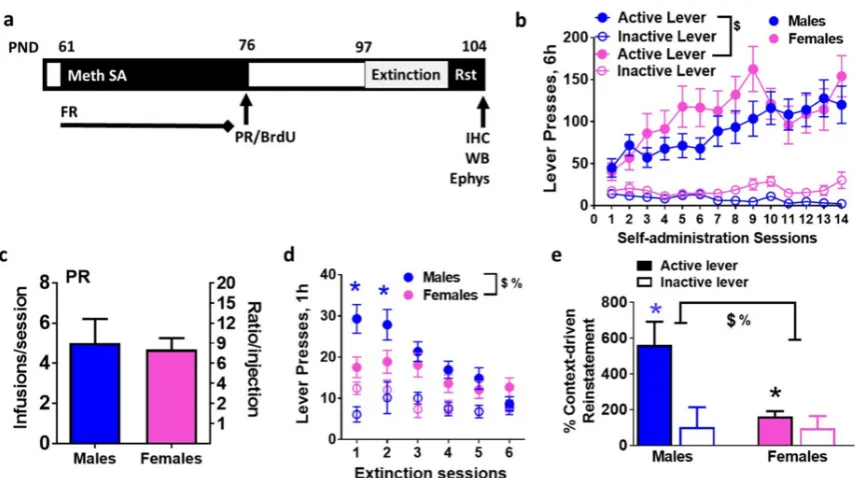
Rats experienced methamphetamine self-administration on a fixed-ratio schedule for 14 days (Figure 1a-b). Repeated measures two-way ANOVA of active lever responses did not detect a significant session x sex interaction (Figure 1b, F13,526= 0.8, p=0.6),
however, detected a significant effect of sex (Figure 1b, F1,526 =6.2, p=0.01) and sessions (Figure 1b, F13,526 =3.8, p< 0.001). No significant changes were observed in inactive lever responses. After the last fixed-ratio schedule session, all rats were tested on a PR schedule to identify differences in motivation to obtain methamphetamine. No differences were observed between males and females in the number of
17 Males and females distinctly extinguish operant behavior and demonstrate varied
context-driven reinstatement of methamphetamine seeking
After 21 days of forced abstinence from methamphetamine, rats experienced extinction sessions. During extinction sessions, methamphetamine was not available and lever responding on the first and second day of extinction significantly differed between males and females, as seen in Figure 1d. Repeated measures two-way ANOVA of active lever responses detected a significant sex x session interaction, F5,221 = 2.2, p = 0.05; a significant effect of sex, F1,221 = 8.3, p = 0.004; and effect of session F5,221 =8.3, p< 0.0001. Post-hoc analysis demonstrated higher responding in males on the first and second day of extinction compared with females (Figure 1d; p < 0.05). Males and females extinguished operant responses. Following extinction, rats were tested on context-driven reinstatement (Figure 1e). All male rats showed higher responding on the previously drug-paired lever during context-driven reinstatement when compared with the last extinction session (lever responses on the previously paired active lever: males; extinction day 6- 7.8 ± 1.5, reinstatement- 22.2 ± 4.2, paired t test; p = 0.004; females; extinction day 6- 13.2 ± 3.0, reinstatement- 17.9 ± 3.1, paired t test; p = 0.24). Two-way ANOVA demonstrated a significant sex x lever interaction (F1,63 =6.1, p= 0.01), main effect of sex F1,63 =6.4, p= 0.01 and main effect of lever F1,63 =10.8, p= 0.001 when percent context-driven reinstatement was analyzed (Figure 1e). Post-hoc
18 from controls and the number of lever responses during reinstatement did not differ between females in each phase.
Immunohistochemical analysis with markers of proliferation, differentiation and survival
reveal distinct effects of methamphetamine and abstinence on progenitor cells in males
and females
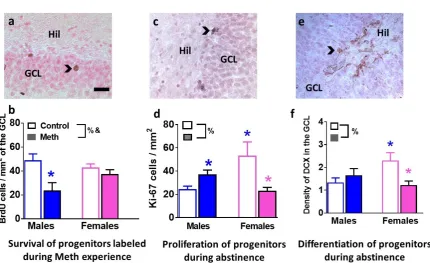
BrdU was injected to label neural progenitor cells (NPCs) that were born when rats had consumed methamphetamine. Twenty eight-day-old BrdU cells were quantified to determine whether survival of NPCs born during methamphetamine experience was distinctly altered in males and females (Figure 2a). Two-way ANOVA demonstrated a significant sex x reinstatement interaction (F1,15 =4.2, p= 0.05) and main effect of reinstatement F1,15 =10.3, p= 0.005 when number of BrdU cells were analyzed (Figure 2b). Post-hoc analysis revealed lower number of BrdU cells in reinstated males
compared to control males (p<0.05).
Immunohistochemistry with Ki-67 (marker for actively dividing NPCs) and DCX (marker for immature neurons) was performed to determine the effect of reinstatement on developmental stages of NPCs (Figure 2c, e). Two-way ANOVA demonstrated a significant sex x reinstatement interaction (F1,23 =12.9, p= 0.001) when number of Ki-67 cells were analyzed (Figure 2d). Post-hoc analysis revealed lower number of Ki-67 cells in females that experienced reinstatement and control males compared to control females, and higher number of Ki-67 cells in reinstated males compared to control males (p<0.05; Figure 2d). Two-way ANOVA demonstrated a significant sex x
19 (Figure 2f). Post-hoc analysis revealed lower levels of DCX cells in females that
experienced reinstatement and control males compared to control females (p<0.05;
Figure 2f).
Intrinsic firing properties of GCNs are differentially altered in male and female rats that
experienced context-driven methamphetamine seeking
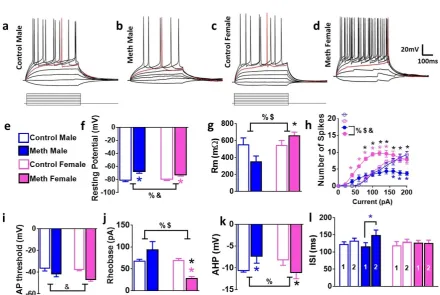
We next studied the intrinsic excitability of GCNs in male and female rats from control and reinstatement groups (Figure 3a-d). GCNs from male and female reinstated rats showed depolarized resting potentials compared with controls (Figure 3f). Two-way ANOVA demonstrated a significant sex x reinstatement interaction (F1,39 =4.9, p= 0.03) and a main effect of reinstatement (F1,39 =41.8, p< 0.0001). Post-hoc analysis revealed more depolarized resting potential in reinstated males and females compared to
controls and more depolarized resting potential in reinstated males compared to females that experienced reinstatement (p<0.05; Figure 3f). GCNs from male and female reinstated rats showed distinct alterations in membrane resistance compared with controls (Figure 3g). Two-way ANOVA demonstrated a significant sex x
reinstatement interaction (F1,39 =7.6, p= 0.008) and a main effect of sex (F1,39 =6.7, p= 0.01). Post-hoc analysis revealed lower membrane resistance in reinstated males compared to females (p<0.05; Figure 3g).
20 significant number of spikes x reinstatement interaction (F 30, 450 = 4.3, p<0.001),
significant increases in the number of spikes over current injections (F 10, 450 = 59.4, p<0.001) and significant effect of reinstatement (F 3, 45 = 11.2, p<0.001). Post hoc analysis demonstrates that female rats that experienced reinstatement have increased number of spikes with increasing current injections compared to female controls from current injections ranging from 40pA to 140pA, male reinstated rats have reduced number of spikes with increasing current injections compared to male controls from current injections ranging from 160pA to 200pA, and female rats that experienced reinstatement have increased number of spikes with increasing current injections compared to male reinstated rats from current injections ranging from 80pA to 200pA (Figure 3h; ps<0.05). At higher current injections (>200 pA), there were no significant differences in the number of spikes between controls and reinstated rats, indicating that GCNs from all groups elicited property of regular spiking by depolarizing current
injections (data not shown).
21 interaction (F1,39 =10.8, p= 0.003). Post-hoc analysis revealed smaller AHP in reinstated males compared to control males and females that experienced reinstatement (ps<0.05;
Figure 3k). Repeated measures two-way ANOVA demonstrated a significant difference in inter-spike interval (ISI), measured as spike latency between first and second spike peak (trend towards interaction (F 3, 39 = 2.5, p=0.08), no effect of treatment and
significant effect of ISI (F 1, 39 = 8.8, p=0.006). Post-hoc analysis showed higher latency to spike between the first and second spike in GCNs from reinstated male rats (p<0.05,
Figure 3l).
Expression of plasticity-related proteins in the DG is differentially altered by
reinstatement of methamphetamine seeking in males and females.
To determine whether reinstatement of methamphetamine seeking altered
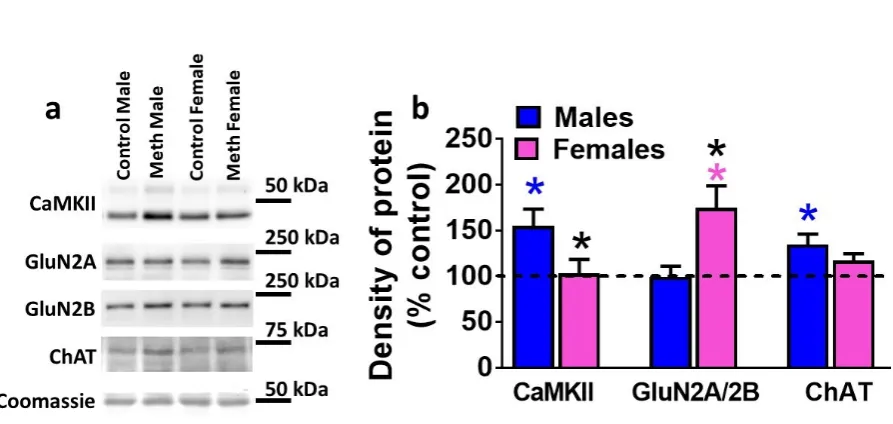
expression of CaMKII, GluN subunits and ChAT in the DG, protein levels were analyzed in controls and rats that experienced reinstatement (Figure 4a-b). Data is expressed as percent control, however, statistical significance was calculated from raw density values from control males, reinstated males, control females and females that experienced reinstatement. Two-way ANOVA demonstrated a significant sex x reinstatement interaction (F1,40 =5.9, p= 0.01) when density of CaMKII was analyzed (Figure 4b). Post-hoc analysis revealed higher expression of CaMKII in reinstated males compared
22 higher ratio of GluN2A/2B in females that experienced reinstatement compared to
control females and reinstated males (p<0.05; Figure 4b). Two-way ANOVA
demonstrated a significant sex x reinstatement interaction (F1,40 =4.3, p= 0.04) when density of ChAT was analyzed (Figure 4b). Post-hoc analysis revealed higher
expression of ChAT in reinstated males compared to control males (p<0.05; Figure 4b). Two-way ANOVA demonstrated a significant sex x reinstatement interaction (F1,45 =6.2, p= 0.01), significant main effect of reinstatement (F1,45 =5.1, p= 0.02), and significant main effect of sex (F1,45 =9.2, p= 0.004) when density of GABAA was analyzed (Figure 4b). Post-hoc analysis revealed lower expression of GABAA in reinstated males
compared to control males and females that experienced reinstatement (p<0.01; Figure 4b).
Density of mossy fiber tracts in the hilus and pyramidal projections of the dentate gyrus
are similarly effected by context-driven methamphetamine in male and female rats
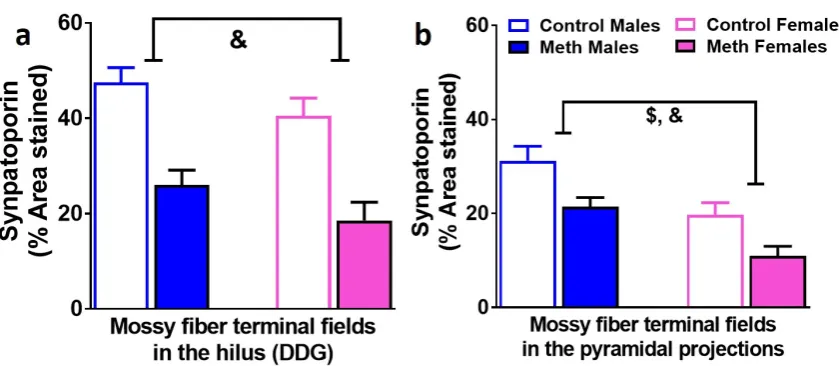
Immunohistochemistry with synaptoporin was performed to determine whether context-driven methamphetamine differentially effected mossy fiber density in male and female rats (Figure 5a-b). In the hilus, two-way ANOVA demonstrated a significant effect of reinstatement on the density of synaptoporin F1,42=25.9, p<0.0002). In the CA3 projections, two-way ANOVA demonstrated a significant effect of reinstatement
(F1,42=12.2, p=0.001) and sex (F1,42=17.9, p=0.0002) on the density of synaptoporin.
Analysis of 3D structure of Iba-1 cells demonstrates neuroimmune response in male
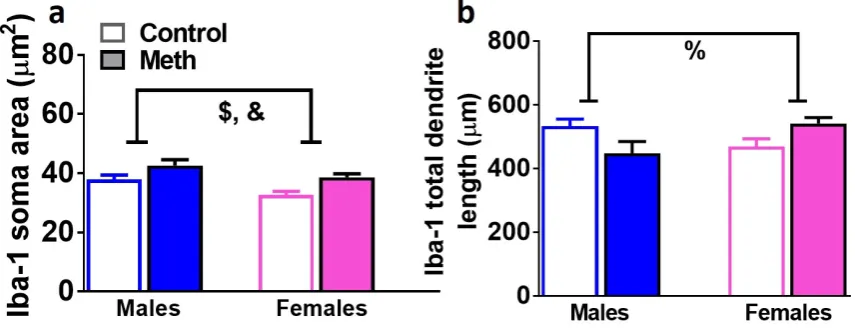
23 To confirm microglial activation, 3D Sholl analysis of Iba-1 positive cells was performed in controls and male and female rats that experienced reinstatement (Figure 6a-b). When soma area of Iba-1 cells was analyzed, two-way ANOVA demonstrated a significant effect of reinstatement (F1,33=5.2, p=0.02) and sex (F1,33=3.9, p=0.05). When the total length of dendrites of Iba-1 cells was analyzed, two-way ANOVA demonstrated a significant sex x reinstatement interaction (F1,33=4.6, p=0.03). Post-hoc analysis did not detect any group differences in total length of dendrites.
Discussion
Previous studies have examined sex differences in animal models of methamphetamine addiction and have focused on differences during
self-administration, extinction and drug- or cue-induced reinstatement of methamphetamine seeking (Roth & Carroll, 2004; Holtz et al., 2012; Reichel et al., 2012; Ruda-Kucerova et al., 2015; Bernheim et al., 2017; Cox et al., 2017; Pittenger et al., 2017; Weber et al.,
24 affect associated with withdrawal. Alternatively, higher active lever responses in females may be due to increased sensitivity to methamphetamine-induced psychomotor effects, since females exhibit greater locomotion and more stereotypy in response to
methamphetamine than males (Becker et al., 2001; Milesi-Halle et al., 2007; Ohia-Nwoko et al., 2017). This possibility is diminished because inactive lever responses did not differ between males and females, suggesting that active lever responses in
females is not a result of hyperactivity. It is also unlikely that the greater active lever responding in females than in males was due to sex differences in body weight, since methamphetamine dosing were proportional to body weight. In contrast, females did not show higher lever responses during PR session, indicating that males and females are equally sensitive to the motivational effects of methamphetamine. This effect is different from a report that showed that females exhibit higher breaking points on a PR schedule of methamphetamine reinforcement, and could be associated with the dose of
methamphetamine self-administered and the strain of rats used in the study (Roth & Carroll, 2004).
With respect to relapse to methamphetamine seeking, prior research in rats show that females and males do not show differences in responding on the first day of extinction when behavior is tested immediately or days after cessation of
self-administration (Fuchs et al., 2005; Kerstetter et al., 2008; Holtz et al., 2012; Reichel et al., 2012; Cox et al., 2013; Bernheim et al., 2017). Our findings reveal sex difference in
25 performance in the absence of context and cue presentation) and females have
reduced motivation to seek during extinction (Larson et al., 2015). While the current findings do not provide a time course of extinction sessions during early and protracted periods of abstinence, we speculate that these behavioral differences in males and females could be associated with the period of abstinence. Females show higher reinstatement of drug seeking behavior compared to males when reinstatement is triggered by drug, stress or pharmacological stressors (Kerstetter et al., 2008; Anker et al., 2009; Holtz et al., 2012; Reichel et al., 2012), or when behavior in not extinguished
prior to reinstatement (Ruda-Kucerova et al., 2015), however, males show higher seeking when reinstatement is triggered by drug cues (Fuchs et al., 2005). These data suggest that the direction of sex differences during reinstatement is dependent on the reinstatement stimulus (i.e., drug, stress, or cue). Given these stimulus dependent sex differences in drug seeking, it is notable that, sex differences in relapse to drug seeking driven by drug context have not been investigated previously, and were the focus of the current study. Our findings show that males are more susceptible to responding on a methamphetamine-paired lever in the presence of previously methamphetamine-paired context. Collectively, these results provide new findings to show that males may be somewhat more sensitive to the motivational effects of methamphetamine as they showed greater resistance to extinction and greater context-driven reinstatement when methamphetamine reinforcement was discontinued.
26 2018a; Galinato et al., 2018b). Previously, in male rats we injected BrdU immediately after an extended access methamphetamine self-administration session to tag dividing neuroblasts and progenitor cells during methamphetamine experience and continued extended access sessions for 4 weeks. Immunohistochemical analysis revealed that extended access methamphetamine self-administration reduced the number of twenty eight-day-old BrdU cells (mature cells that survived to become GCNs) during
methamphetamine experience (Mandyam et al., 2008). Parallel studies were conducted to determine the cellular mechanism underlying reduced survival of BrdU cells, and we showed that extended access methamphetamine self-administration reduced the number of actively dividing preneuronal neuroblasts and increased the number of dividing preneuronal progenitor cells (Yuan et al., 2011). These mechanistic studies suggest that a decrease in the survival of BrdU cells during methamphetamine self-administration is attributable to the decrease in the ability of neuroblasts to divide and produce stable progenitor cells.
In contrast to the diminishing effects of methamphetamine on progenitor cells during drug use, withdrawal and abstinence from extended access methamphetamine self-administration produce a rebound effect on progenitor cells. For example, we used BrdU to tag cells either 20h or 2 weeks after extended access methamphetamine self-administration, and our findings indicate that withdrawal and abstinence from
27 indicated that abstinence from drug use increased the population of progenitor cells that were neuroblasts or preneuronal progenitor cells (Recinto et al., 2012; Sobieraj et al., 2016; Galinato et al., 2018b). While these studies indicate opposing effects of
methamphetamine and abstinence on survival of BrdU cells and progenitor pool of cells, it is not known if tagging BrdU cells during methamphetamine experience and following it with abstinence from methamphetamine reduces or increases survival of BrdU cells. This will determine whether neuroblasts and progenitor cells born during
methamphetamine experience and born during withdrawal have distinct survival profiles in the DG. Our current study investigated this question, and our findings indicate that survival of BrdU cells born during methamphetamine experience is reduced, and this reduction is not dependent on continued methamphetamine access. Notably, this effect is evident in males that demonstrated context-driven reinstatement of
methamphetamine seeking, and is not evident in females that did not show
reinstatement of methamphetamine seeking. Our study also investigated whether the experience of reinstatement similarly effected Ki-67 cells in males and females, and our results in males confirmed our previous reports to show that reinstatement increases the number of Ki-67 cells in males compared to controls and, in contrast, our new findings show that the number of Ki-67 cells is reduced compared to controls in females that did not reinstate. We also investigated another endogenous marker of cell
maturation, e.g., doublecortin (DCX)-labeled immature neurons [DCX is expressed in cells committed to a neuronal phenotype (Brown et al., 2003)]. Our findings add to our
28 reduction in maturation of progenitors in concert with decreases in proliferation of
progenitors, indicating that contrasting adaptations in newly born GCNs in the DG may assist with predicting divergent responses during context-driven reinstatement (Galinato et al., 2018b). While the limitation of the current study is that the control groups were
behavior naïve, and a potential limitation in the interpretation of these results is that it may be difficult to distinguish the effects of reinstatement of methamphetamine seeking compared with seeking to a non-rewarding substance (e.g. saline), our previous
published report demonstrates that extended access saline self-administration did not alter neurogenesis in the DG (Galinato et al., 2018a). We are therefore confident with the current comparison groups and highlight the sex differences in the number of progenitors and neurogenesis in drug naïve state and in animals that experienced reinstatement of methamphetamine seeking.
29 GCNs are perhaps influenced to a greater extent in females than males, and in males are compensatory to the effects on mature progenitors. It is also evident that newly born progenitors contribute to neuroimmune responses in the DG (Klaus et al., 2016;
Marshall et al., 2016; Peng et al., 2017; Goodfellow et al., 2018). Furthermore, high doses of methamphetamine experience is associated with microglial activation in the DG (Buchanan et al., 2010). Although the cellular structure of microglial cells in the females that experienced reinstatement may support microglial activation, our findings do not support the contribution of microglial activation in the DG in male and females to context-driven reinstatement.
We wanted to determine whether adaptations in the DG during abstinence in males and females were confined to newly born GCNs or were also evident in mature GCNs. We have recently demonstrated that context-driven reinstatement of methamphetamine seeking in males is associated with decreases in excitability of mature GCNs
30 potentiation in the DG (Zhang et al., 2004; Sametsky et al., 2009; Williams et al., 2015; Crestani et al., 2018), which could result in an activity-dependent strengthening of synapses or network stability that is thought to underlie certain types of learning and memory, in our case preservation of extinguished responses. In males that reinstated, the opposing regulation of resting membrane potential and AHP to reduced excitability suggests that distinct neuroadaptations and perhaps compensatory to the other. Regardless, this likely has important implications for the modulation of hippocampal circuitry underlying context-driven reinstatement (Milshtein-Parush et al., 2017; Crestani et al., 2018).
Increases and decreases in intrinsic excitability of hippocampal neurons may serve as a metaplastic mechanism for memory formation and retention (Milshtein-Parush et al., 2017; Crestani et al., 2018), suggesting that functionally adaptive modulation of
31 regulating excitability of hippocampal neurons and their roles in learning and memory dependent on the hippocampus (Ohno et al., 2006; Sametsky et al., 2009; Milshtein-Parush et al., 2017; Crestani et al., 2018).
The neuronal properties of mature GCNs from males indicate that these neurons have dysregulated neuronal functioning in the basal state and altered functional plasticity that were associated with context-driven methamphetamine seeking. It is possible that newly born GCNs during abstinence could affect synaptic transmission in the DG and contribute to the altered intrinsic properties of mature GCNs
(Schmidt-Hieber et al., 2004; Ge et al., 2007; Marin-Burgin et al., 2012; Dieni et al., 2013; Brunner et al., 2014; Dieni et al., 2016; Galinato et al., 2018b). For example, newly born GCNs
32 1996; Smith et al., 2004). We therefore determined the release of acetylcholine via measuring the density of ChAT in the DG of male and female rats that experienced reinstatement, as release of acetylcholine positively correlates with expression of ChAT (Martin & Vyas, 1987). Our findings show a significant increase in the density of ChAT in males that showed context-driven reinstatement. Future studies are required to determine whether the forebrain-hippocampal circuitry is distinctly altered in males that reinstate drug seeking and whether neurogenesis mechanisms contribute to the
33
Acknowledgments: Funds from the National Institute on Alcoholism and Alcohol Abuse, National Institute on Drug Abuse (NIDA; AA020098 and DA034140 to CDM), start-up funds from VMRF (to CDM) and Department of Veterans Affairs
34
Figure 1. Distinct operant responses during extended access methamphetamine self-administration sessions in male and female rats. (a) Schematic of the experimental design indicating the age of animals in days (PND, postnatal days) and sessions during operant behavior. FR, fixed-ratio schedule; PR, progressive-ratio schedule; Rst,
reinstatement; IHC, immunohistochemistry; WB, Western blotting; Ephys,
electrophysiology. (b) Active and inactive lever responses of male and female rats self-administering 0.05 mg/kg/infusion of methamphetamine. (c) Lever responses during PR sessions. (d) Active and inactive lever responses during extinction sessions. (e) Percent context-driven reinstatement, calculated as a percent change in lever responses during reinstatement from last day of extinction. Data are represented as mean ± S.E.M.. n = 22 males, n = 17 females. %, significant sex x methamphetamine interaction; $, main effect of sex; *p<0.05 vs. inactive levers in males; *p<0.05 vs. males.
Figure 2. Developmental stages of neurogenesis in the DG are distinctly altered in males and females. (a, c, e) Photomicrographs of BrdU (a), Ki-67 (c) and DCX (e) from one control male rat. Arrowhead points to immunoreactive cells in each panel. Hil, Hilus; GCL, granule cell layer. Scale bar in (a) is 20um, applies to a, c, e. (b, d, f) Quantitative analysis of BrdU (b), Ki-67 (c) and DCX (e). Data are represented as mean ± S.E.M.. n = 4-19 males, n = 4-13 females. %, significant sex x reinstatement interaction; &, main effect of reinstatement; *p<0.05 vs. control males; *p<0.05 vs. control males.
Figure 3. Electrophysiological properties of GCNs are distinctly altered in male and female rats. (a-d) Representative traces of action potentials elicited by depolarizing current injections. Traces were recorded from GCNs from control male (a),
35 (f-l) Comparison of intrinsic and active membrane properties. Analysis across all cells indicated that under baseline conditions resting potential (f) and membrane resistance (g) showed a significant sex x treatment interaction. (h) Graphical relationship between the number of spikes elicited by increasing current injections in current-clamp recording. (i-l) Analysis of electrophysiological properties indicate that AP threshold, rheobase, AHP and inter-spike interval (ISI) showed significant interaction or main effect of sex or methamphetamine. Data shown are represented as mean ± SEM. Control males, n=8 cells; control females, n=6 cells; reinstated males, n=12 cells; reinstated females, n=19 cells. %, significant sex x reinstatement interaction; $, main effect of sex; *p<0.05 vs. control males; *p<0.05 vs. reinstated males; *p<0.05 vs. control males by post-hoc tests.
Figure 4. Plasticity related proteins are distinctly effected in male and female rats. (a) Representative immunoblots of each protein measured with observed molecular weight in kDa. (b) Quantitative analysis of density of proteins shown in b. Data shown are represented as mean ± SEM. n = 12-19 males, n = 8-13 females. *p < 0.05 vs. control males, *p<0.05 vs. reinstated males; *p < 0.05 vs. control females by post-hoc tests.
Figure 5. Mossy fiber tracts in the DG are distinctly altered in males and females. (a-b) Quantitative analysis of the density measures in the hilus (a) and CA3 pyramidal
projections (b). Data shown are represented as the mean ± SEM. n = 12-19 males, n = 8-13 females. &, main effect of reinstatement; $, main effect of sex by two-way ANOVA.
36 processes of Iba-1 cells. n = 6-12 males, n = 6-13 females. Data shown are represented as the mean ± SEM. %, sex x reinstatement interaction; &, main effect of reinstatement; $, main effect of sex by two-way ANOVA.
37
References
Anker, J.J., Perry, J.L., Gliddon, L.A. & Carroll, M.E. (2009) Impulsivity predicts the escalation of cocaine self-administration in rats. Pharmacol Biochem Behav, 93, 343-348.
Becker, J.B., Molenda, H. & Hummer, D.L. (2001) Gender differences in the behavioral responses to cocaine and amphetamine. Implications for mechanisms mediating gender differences in drug abuse. Ann N Y Acad Sci, 937, 172-187.
Bernheim, A., Leong, K.C., Berini, C. & Reichel, C.M. (2017) Antagonism of mGlu2/3 receptors in the nucleus accumbens prevents oxytocin from reducing cued methamphetamine seeking in male and female rats. Pharmacol Biochem Behav,
161, 13-21.
Bourque, M., Liu, B., Dluzen, D.E. & Di Paolo, T. (2011) Sex differences in
methamphetamine toxicity in mice: effect on brain dopamine signaling pathways. Psychoneuroendocrinology, 36, 955-969.
Brady, K.T. & Randall, C.L. (1999) Gender differences in substance use disorders. Psychiatr Clin North Am, 22, 241-252.
Brown, J.P., Couillard-Despres, S., Cooper-Kuhn, C.M., Winkler, J., Aigner, L. & Kuhn, H.G. (2003) Transient expression of doublecortin during adult neurogenesis. J Comp Neurol, 467, 1-10.
Brunner, J., Neubrandt, M., Van-Weert, S., Andrasi, T., Kleine Borgmann, F.B., Jessberger, S. & Szabadics, J. (2014) Adult-born granule cells mature through two functionally distinct states. eLife, 3, e03104.
Buchanan, J.B., Sparkman, N.L. & Johnson, R.W. (2010) A neurotoxic regimen of methamphetamine exacerbates the febrile and neuroinflammatory response to a subsequent peripheral immune stimulus. Journal of neuroinflammation, 7, 82.
Carroll, M.E., Anker, J.J. & Perry, J.L. (2009) Modeling risk factors for nicotine and other drug abuse in the preclinical laboratory. Drug Alcohol Depend, 104 Suppl 1, S70-78.
Chen, K. & Kandel, D. (2002) Relationship between extent of cocaine use and
38 Cooper-Kuhn, C.M., Winkler, J. & Kuhn, H.G. (2004) Decreased neurogenesis after
cholinergic forebrain lesion in the adult rat. J Neurosci Res, 77, 155-165.
Cora, M.C., Kooistra, L. & Travlos, G. (2015) Vaginal Cytology of the Laboratory Rat and Mouse: Review and Criteria for the Staging of the Estrous Cycle Using Stained Vaginal Smears. Toxicologic pathology, 43, 776-793.
Cox, B.M., Bentzley, B.S., Regen-Tuero, H., See, R.E., Reichel, C.M. & Aston-Jones, G. (2017) Oxytocin Acts in Nucleus Accumbens to Attenuate Methamphetamine Seeking and Demand. Biol Psychiatry, 81, 949-958.
Cox, B.M., Young, A.B., See, R.E. & Reichel, C.M. (2013) Sex differences in methamphetamine seeking in rats: impact of oxytocin.
Psychoneuroendocrinology, 38, 2343-2353.
Crestani, A.P., Krueger, J.N., Barragan, E.V., Nakazawa, Y., Nemes, S.E., Quillfeldt, J.A., Gray, J.A. & Wiltgen, B.J. (2018) Metaplasticity contributes to memory formation in the hippocampus. Neuropsychopharmacology.
Dieni, C.V., Nietz, A.K., Panichi, R., Wadiche, J.I. & Overstreet-Wadiche, L. (2013) Distinct determinants of sparse activation during granule cell maturation. J Neurosci, 33, 19131-19142.
Dieni, C.V., Panichi, R., Aimone, J.B., Kuo, C.T., Wadiche, J.I. & Overstreet-Wadiche, L. (2016) Low excitatory innervation balances high intrinsic excitability of
immature dentate neurons. Nat Commun, 7, 11313.
Dluzen, D.E. & Liu, B. (2008) Gender differences in methamphetamine use and responses: a review. Gender medicine, 5, 24-35.
Franklin, T.R. & Druhan, J.P. (2000) Expression of Fos-related antigens in the nucleus accumbens and associated regions following exposure to a cocaine-paired environment. Eur J Neurosci, 12, 2097-2106.
Fuchs, R.A., Evans, K.A., Mehta, R.H., Case, J.M. & See, R.E. (2005) Influence of sex and estrous cyclicity on conditioned cue-induced reinstatement of cocaine-seeking behavior in rats. Psychopharmacology (Berl), 179, 662-672.
39 B.W., Janda, K.D., Heyser, C., Koob, G.F. & Mandyam, C.D. (2018a) A synthetic small-molecule Isoxazole-9 protects against methamphetamine relapse. Mol Psychiatry, 23, 629-638.
Galinato, M.H., Orio, L. & Mandyam, C.D. (2014) Methamphetamine differentially affects BDNF and cell death factors in anatomically defined regions of the hippocampus. Neuroscience.
Galinato, M.H., Takashima, Y., Fannon, M.J., Quach, L.W., Morales Silva, R.J., Mysore, K.K., Terranova, M.J., Dutta, R.R., Ostrom, R.W., Somkuwar, S.S. & Mandyam, C.D. (2018b) Neurogenesis during Abstinence Is Necessary for Context-Driven Methamphetamine-Related Memory. J Neurosci, 38, 2029-2042.
Ge, S., Yang, C.H., Hsu, K.S., Ming, G.L. & Song, H. (2007) A critical period for enhanced synaptic plasticity in newly generated neurons of the adult brain. Neuron, 54, 559-566.
Gerdes, J., Lemke, H., Baisch, H., Wacker, H.H., Schwab, U. & Stein, H. (1984) Cell cycle analysis of a cell proliferation-associated human nuclear antigen defined by the monoclonal antibody Ki-67. Journal of Immunology, 133, 1710-1715.
Gong, W., Neill, D.B. & Justice, J.B., Jr. (1995) Increased sensitivity to cocaine place-preference conditioning by septal lesions in rats. Brain Res, 683, 221-227.
Goodfellow, M.J., Shin, Y.J. & Lindquist, D.H. (2018) Mitigation of postnatal ethanol-induced neuroinflammation ameliorates trace fear memory deficits in juvenile rats. Behav Brain Res, 338, 28-31.
Hiranita, T., Nawata, Y., Sakimura, K. & Yamamoto, T. (2008) Methamphetamine-seeking behavior is due to inhibition of nicotinic cholinergic transmission by activation of cannabinoid CB1 receptors. Neuropharmacology, 55, 1300-1306.
Holtz, N.A., Lozama, A., Prisinzano, T.E. & Carroll, M.E. (2012) Reinstatement of methamphetamine seeking in male and female rats treated with modafinil and allopregnanolone. Drug Alcohol Depend, 120, 233-237.
40 Imperato, A., Obinu, M.C., Mascia, M.S., Casu, M.A., Zocchi, A., Cabib, S. &
Puglisi-Allegra, S. (1996) Strain-dependent effects of dopamine agonists on acetylcholine release in the hippocampus: an in vivo study in mice. Neuroscience, 70, 653-660.
Jensen, E.C. (2013) Quantitative analysis of histological staining and fluorescence using ImageJ. Anatomical record (Hoboken, N.J. : 2007), 296, 378-381.
Kaneko, N., Okano, H. & Sawamoto, K. (2006) Role of the cholinergic system in regulating survival of newborn neurons in the adult mouse dentate gyrus and olfactory bulb. Genes Cells, 11, 1145-1159.
Kerstetter, K.A., Aguilar, V.R., Parrish, A.B. & Kippin, T.E. (2008) Protracted time-dependent increases in cocaine-seeking behavior during cocaine withdrawal in female relative to male rats. Psychopharmacology (Berl), 198, 63-75.
Kim, A., Zamora-Martinez, E.R., Edwards, S. & Mandyam, C.D. (2015) Structural reorganization of pyramidal neurons in the medial prefrontal cortex of alcohol dependent rats is associated with altered glial plasticity. Brain Struct Funct, 220, 1705-1720.
Klaus, F., Paterna, J.C., Marzorati, E., Sigrist, H., Gotze, L., Schwendener, S., Bergamini, G., Jehli, E., Azzinnari, D., Fuertig, R., Fontana, A., Seifritz, E. & Pryce, C.R. (2016) Differential effects of peripheral and brain tumor necrosis factor on inflammation, sickness, emotional behavior and memory in mice. Brain Behav Immun, 58, 310-326.
Klug, J.R., Mathur, B.N., Kash, T.L., Wang, H.D., Matthews, R.T., Robison, A.J., Anderson, M.E., Deutch, A.Y., Lovinger, D.M., Colbran, R.J. & Winder, D.G. (2012) Genetic inhibition of CaMKII in dorsal striatal medium spiny neurons reduces functional excitatory synapses and enhances intrinsic excitability. PLoS One, 7, e45323.
Kucerova, J., Vrskova, D. & Sulcova, A. (2009) Impact of repeated methamphetamine pretreatment on intravenous self-administration of the drug in males and
estrogenized or non- estrogenized ovariectomized female rats. Neuro Endocrinol Lett, 30, 663-670.
41 Mandyam, C.D., Wee, S., Crawford, E.F., Eisch, A.J., Richardson, H.N. & Koob, G.F.
(2008) Varied access to intravenous methamphetamine self-administration differentially alters adult hippocampal neurogenesis. Biol Psychiatry, 64, 958-965.
Marin-Burgin, A., Mongiat, L.A., Pardi, M.B. & Schinder, A.F. (2012) Unique processing during a period of high excitation/inhibition balance in adult-born neurons.
Science, 335, 1238-1242.
Marshall, S.A., Geil, C.R. & Nixon, K. (2016) Prior Binge Ethanol Exposure Potentiates the Microglial Response in a Model of Alcohol-Induced Neurodegeneration. Brain Sci, 6.
Martin, K.J. & Vyas, S. (1987) Increase in acetylcholine concentrations in the brain of 'old' rats following treatment with pyrithioxin (Encephabol). Br J Pharmacol, 90, 561-565.
Milesi-Halle, A., McMillan, D.E., Laurenzana, E.M., Byrnes-Blake, K.A. & Owens, S.M. (2007) Sex differences in (+)-amphetamine- and (+)-methamphetamine-induced behavioral response in male and female Sprague-Dawley rats. Pharmacol Biochem Behav, 86, 140-149.
Milshtein-Parush, H., Frere, S., Regev, L., Lahav, C., Benbenishty, A., Ben-Eliyahu, S., Goshen, I. & Slutsky, I. (2017) Sensory Deprivation Triggers Synaptic and Intrinsic Plasticity in the Hippocampus. Cereb Cortex, 27, 3457-3470.
Mohapel, P., Leanza, G., Kokaia, M. & Lindvall, O. (2005) Forebrain acetylcholine regulates adult hippocampal neurogenesis and learning. Neurobiol Aging, 26, 939-946.
Nelson, A.B., Gittis, A.H. & du Lac, S. (2005) Decreases in CaMKII activity trigger persistent potentiation of intrinsic excitability in spontaneously firing vestibular nucleus neurons. Neuron, 46, 623-631.
Ohia-Nwoko, O., Haile, C.N. & Kosten, T.A. (2017) Sex differences in the acute locomotor response to methamphetamine in BALB/c mice. Behav Brain Res,
42 Ohno, M., Sametsky, E.A., Silva, A.J. & Disterhoft, J.F. (2006) Differential effects of
alphaCaMKII mutation on hippocampal learning and changes in intrinsic neuronal excitability. Eur J Neurosci, 23, 2235-2240.
Paxinos, G. & Watson, C. (1997) The rat brain in stereotaxic coordinates. Academic Press, San Diego.
Peng, H., Geil Nickell, C.R., Chen, K.Y., McClain, J.A. & Nixon, K. (2017) Increased expression of M1 and M2 phenotypic markers in isolated microglia after four-day binge alcohol exposure in male rats. Alcohol, 62, 29-40.
Perry, J.L., Nelson, S.E. & Carroll, M.E. (2008) Impulsive choice as a predictor of acquisition of IV cocaine self- administration and reinstatement of cocaine-seeking behavior in male and female rats. Exp Clin Psychopharmacol, 16, 165-177.
Pittenger, S.T., Chou, S., Barrett, S.T., Catalano, I., Lydiatt, M. & Bevins, R.A. (2017) Nicotine- and cocaine-triggered methamphetamine reinstatement in female and male Sprague-Dawley rats. Pharmacol Biochem Behav, 159, 69-75.
Recinto, P., Samant, A.R., Chavez, G., Kim, A., Yuan, C.J., Soleiman, M., Grant, Y., Edwards, S., Wee, S., Koob, G.F., George, O. & Mandyam, C.D. (2012) Levels of neural progenitors in the hippocampus predict memory impairment and relapse to drug seeking as a function of excessive methamphetamine self-administration. Neuropsychopharmacology, 37, 1275-1287.
Reichel, C.M., Chan, C.H., Ghee, S.M. & See, R.E. (2012) Sex differences in escalation of methamphetamine self-administration: cognitive and motivational
consequences in rats. Psychopharmacology (Berl), 223, 371-380.
Richardson, N.R. & Roberts, D.C. (1996) Progressive ratio schedules in drug self-administration studies in rats: a method to evaluate reinforcing efficacy. J Neurosci Methods, 66, 1-11.
43 Roth, M.E. & Carroll, M.E. (2004) Sex differences in the acquisition of IV
methamphetamine self-administration and subsequent maintenance under a progressive ratio schedule in rats. Psychopharmacology (Berl), 172, 443-449.
Ruda-Kucerova, J., Amchova, P., Babinska, Z., Dusek, L., Micale, V. & Sulcova, A. (2015) Sex Differences in the Reinstatement of Methamphetamine Seeking after Forced Abstinence in Sprague-Dawley Rats. Frontiers in psychiatry, 6, 91.
Rungnirundorn, T., Verachai, V., Gelernter, J., Malison, R.T. & Kalayasiri, R. (2017) Sex Differences in Methamphetamine Use and Dependence in a Thai Treatment Center. J Addict Med, 11, 19-27.
Sametsky, E.A., Disterhoft, J.F. & Ohno, M. (2009) Autophosphorylation of alphaCaMKII downregulates excitability of CA1 pyramidal neurons following synaptic
stimulation. Neurobiol Learn Mem, 92, 120-123.
SAMHSA, C.f.B.H.S.a.Q. (2015) Behavioral Health Trends in the United States: Results from the 2014 National Survey on Drug Use and Health. Substance Abuse and Mental Health Services Administration (SAMHSA),, HHS Publication No. SMA 15-4927,.
Schindler, C.W., Bross, J.G. & Thorndike, E.B. (2002) Gender differences in the behavioral effects of methamphetamine. Eur J Pharmacol, 442, 231-235.
Schmidt-Hieber, C., Jonas, P. & Bischofberger, J. (2004) Enhanced synaptic plasticity in newly generated granule cells of the adult hippocampus. Nature, 429, 184-187.
Shaham, Y., Shalev, U., Lu, L., De Wit, H. & Stewart, J. (2003) The reinstatement model of drug relapse: history, methodology and major findings.
Psychopharmacology (Berl), 168, 3-20.
Smith, J.E., Vaughn, T.C. & Co, C. (2004) Acetylcholine turnover rates in rat brain regions during cocaine self-administration. J Neurochem, 88, 502-512.
Sobieraj, J.C., Kim, A., Fannon, M.J. & Mandyam, C.D. (2014) Chronic wheel running-induced reduction of extinction and reinstatement of methamphetamine seeking in methamphetamine dependent rats is associated with reduced number of periaqueductal gray dopamine neurons. Brain Struct Funct.
44 in methamphetamine dependent rats is associated with reduced number of periaqueductal gray dopamine neurons. Brain Struct Funct, 221, 261-276.
Somkuwar, S.S., Fannon-Pavlich, M.J., Ghofranian, A., Quigley, J.A., Dutta, R.R., Galinato, M.H. & Mandyam, C.D. (2016a) Wheel running reduces ethanol seeking by increasing neuronal activation and reducing
oligodendroglial/neuroinflammatory factors in the medial prefrontal cortex. Brain Behav Immun, 58, 357-368.
Somkuwar, S.S., Fannon, M.J., Staples, M.C., Zamora-Martinez, E.R., Navarro, A.I., Kim, A., Quigley, J.A., Edwards, S. & Mandyam, C.D. (2016b) Alcohol
dependence-induced regulation of the proliferation and survival of adult brain progenitors is associated with altered BDNF-TrkB signaling. Brain Struct Funct,
221, 4319-4335.
Staples, M.C., Fannon, M.J., Mysore, K.K., Dutta, R.R., Ongjoco, A.T., Quach, L.W., Kharidia, K.M., Somkuwar, S.S. & Mandyam, C.D. (2017) Dietary restriction reduces hippocampal neurogenesis and granule cell neuron density without affecting the density of mossy fibers. Brain Res, 1663, 59-65.
Takashima, Y., Fannon, M.J., Galinato, M.H., Steiner, N.L., An, M., Zemljic-Harpf, A.E., Somkuwar, S.S., Head, B.P. & Mandyam, C.D. (2018) Neuroadaptations in the dentate gyrus following contextual cued reinstatement of methamphetamine seeking. Brain Struct Funct.
van Welie, I. & du Lac, S. (2011) Bidirectional control of BK channel open probability by CAMKII and PKC in medial vestibular nucleus neurons. J Neurophysiol, 105, 1651-1659.
Vivar, C., Potter, M.C., Choi, J., Lee, J.Y., Stringer, T.P., Callaway, E.M., Gage, F.H., Suh, H. & van Praag, H. (2012) Monosynaptic inputs to new neurons in the dentate gyrus. Nat Commun, 3, 1107.
Weber, R.A., Logan, C.N., Leong, K.C., Peris, J., Knackstedt, L. & Reichel, C.M. (2018) Regionally Specific Effects of Oxytocin on Reinstatement of Cocaine Seeking in Male and Female Rats. Int J Neuropsychopharmacol, 21, 677-686.
45 Williams, M.R., DeSpenza, T., Jr., Li, M., Gulledge, A.T. & Luikart, B.W. (2015)
Hyperactivity of newborn Pten knock-out neurons results from increased excitatory synaptic drive. J Neurosci, 35, 943-959.
Yuan, C.J., Quiocho, J.M., Kim, A., Wee, S. & Mandyam, C.D. (2011) Extended access methamphetamine decreases immature neurons in the hippocampus which results from loss and altered development of neural progenitors without altered dynamics of the S-phase of the cell cycle. Pharmacol Biochem Behav, 100, 98-108.
46
47
48
49
50
51