© 2014, IJCSMC All Rights Reserved 170
Available Online atwww.ijcsmc.com
International Journal of Computer Science and Mobile Computing
A Monthly Journal of Computer Science and Information Technology
ISSN 2320–088X
IJCSMC, Vol. 3, Issue. 2, February 2014, pg.170 – 180
RESEARCH ARTICLE
Application of the Fuzzy Logic in Content
Based Image Retrieval using Color Feature
Aqeel M. Humadi
1, Hameed A. Younis
21
College of Computer Science - University of Basrah, Iraq
2
College of Computer Science - University of Basrah, Iraq
1
[email protected],
2[email protected]
ABSTRACT
Content Based Image Retrieval (CBIR) is a set of techniques for retrieving semantically-relevant images from an image database based on automatically-derived image features. Generally, in CBIR systems, the visual features (color, texture, and shape) are represented at low-level. They are just rigid mathematical measures that cannot deal with the inherent subjectivity and fuzziness of people understandings and perceptions (different people would have different understandings and descriptions of the same visual content). As a result, there is a gap between low-level features and high-level semantics.
To overcome this problem, we introduce a new system of visual features extraction and matching using Fuzzy Logic (FL) which is a powerful tool that deals with reasoning algorithms used to emulate human thinking and decision making in machines.
Specifically, color feature is widely used in content-based image retrieval because of its low computational cost and invariance to scaling, translation, and rotation. The classic system of color histogram creation results in very large 3-D histograms with large variations between neighboring bins. Thus, small changes in the image might result in great changes in the histogram. Manipulating and comparing 3-D histograms is a complicated and computationally expensive procedure. To overcome these problems, a new fuzzy system of color histogram creation, based on the L*a*b* color space, is applied, which links the three components of L*a*b* color space using fuzzy inference system and provides one-dimensional histogram which contains only 15 bins.
Keywords: Content Based Image Retrieval; Fuzzy Logic; Color Feature, Fuzzy Color Histogram; Fuzzy Colored Image.
I. INTRODUCTION
Very large collections of images are growing rapidly due to the advent of cheaper storage devices and the Internet.
© 2014, IJCSMC All Rights Reserved 171
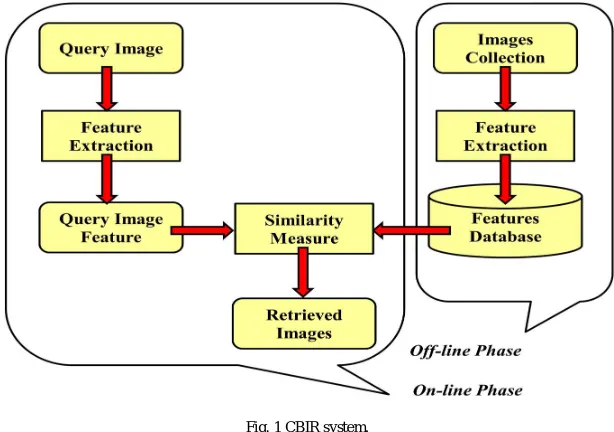
A typical content-based retrieval system is divided into two phases: off-line feature extraction and on-line image retrieval [2]. In off-line phase, the system automatically extracts visual attributes of each image in the database based on its pixel values
and stores them in a different database within the system called a feature database. In on-line phase, the user can submit a
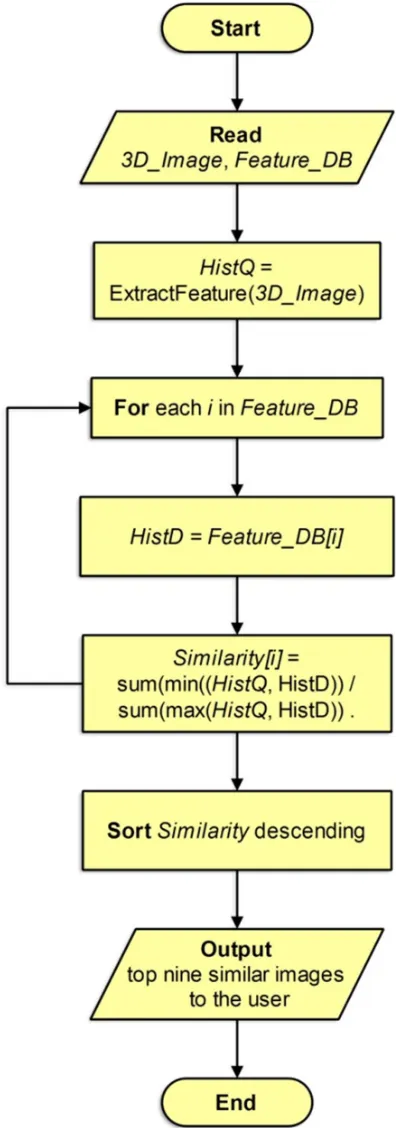
query example to the retrieval system. The system represents this example with a feature vector. The distances (i.e., similarities) between the feature vectors of the query example and those of the media in the feature database are then computed and ranked. The system ranks the search results and then returns the results that are most similar to the query examples.
Image data is fuzzy in nature and in content-based retrieval this property creates some problems such as [3]:
1. Descriptions of image contents usually involve inexact and subjective concepts.
2. Usually imprecision and vagueness exist in descriptions of the images and in some of the visual features.
3. User’s needs to image retrieval may be naturally fuzzy.
To overcome these problems, it is needed to introduce a score, and quantify the degree of truth, by which the available description permits a decision about a given query.
Fuzzy Logic (FL) is used in CBIR system because it is the nature of image data, and the nature of human perception and thinking process. So, it can minimize semantic gap between high level semantic and low level image features. Also, it is robust to the noise and intensity change in the images. Finally, the users are interested in results according to similarity (closeness) rather than equality (exactness).
Fig. 1 CBIR system.
In [4], a color histogram representation, called Fuzzy Color Histogram (FCH), is presented by considering the color
similarity of each pixel’s color associated to all the histogram bins through fuzzy-set membership function. An approach for computing the membership values based on fuzzy-means algorithm is developed. The proposed FCH is further exploited in the
application of image indexing and retrieval. Konstantinidis et al [5] proposed a fuzzy linking system for color histogram
creation in L*a*b* color space. It contains 10 bins, and 27 rules used to derive the final histogram. Kucuktunc et al [6]
proposed a fuzzy linking system for color histogram creation in L*a*b* color space. Their system contains 15 bins, and 27 rules used to derive the final histogram.
Our main goal here is to propose a FCH system that outperforms conventional systems for color image retrieval under varying illumination changes.
© 2014, IJCSMC All Rights Reserved 172
II. THE PROPOSED CBIR SYSTEM
Firstly, we should to select the appropriate color space for CBIR system. The color space used for CBIR system must have two important aspects [1]:
1) Device independency: It means that the color space is never affected by display devices, i.e., it requires a device-independent color space.
2) Perceptual uniformity: It means that the resulting mathematical distance between colors is proportional to the perceived difference between them by human eyes.
Most color spaces (e.g., RGB, CMY (K), and HSI family) are device-dependent and not perceptually uniform, but L*a*b* color space stays at the safe side away from these two problems. So, among all color spaces, the L*a*b* color space was selected because it is device-independent and perceptually uniform color space which approximates the way that humans perceive color [1].
Secondly, we have to build a fuzzy inference system (FIS), and then we create the required algorithms for relevant images retrieval.
A. Fuzzy Inference System for Color Feature Extraction
In L*a*b* color space, L* stands for luminance, a* represents relative greenness-redness and b* represents relative blueness-yellowness.
Building a fuzzy inference system (FIS) for extracting FCH, as shown in Fig. 7, is achieved by the following steps:
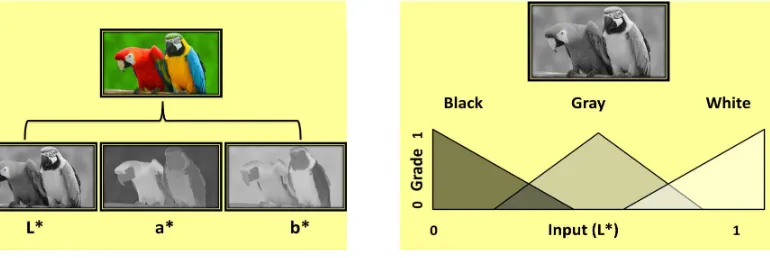
1) Fuzzification: After separating the three triplets of L*a*b* color space, as shown in Fig. 2, each one is fuzzified as an input variable to FIS.
Fig. 2 Three triplets of L*a*b* color space. Fig. 3 Fuzzification of L* component.
L* component does not contribute in providing any unique color but for shades of colors: white, black, and grey. Thus, the L* component receives a lower weight with respect to the other two components of the triplet. For this reason, we subdivided L* component into only three triangular-shaped fuzzy sets: Black, Gray and White, as shown in Fig. 3.
© 2014, IJCSMC All Rights Reserved 173
Fig. 4 Fuzzification of a* component. Fig. 5 Fuzzification of b* component.
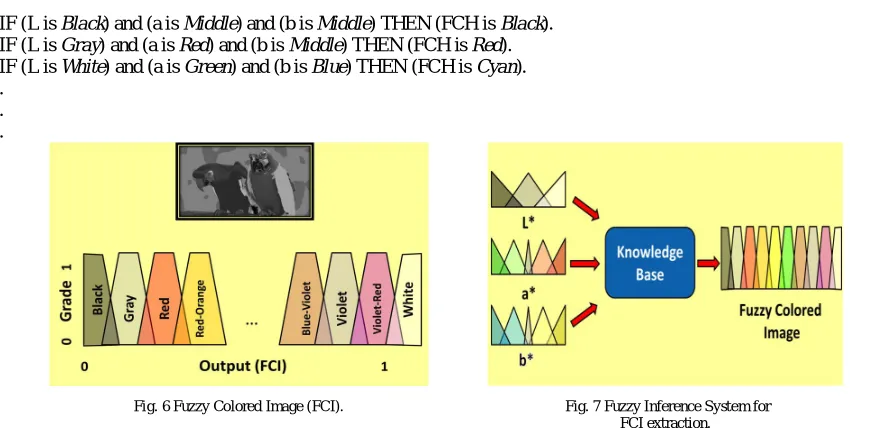
2) Defuzzification: The output variable of our FIS, which represents 2-D Fuzzy Colored Image (FCI), is divided into 15 equally divided trapezoidal-shaped fuzzy sets, as shown in Fig. 6. So, the output variable consists of only 15 bins approximately representing the following colors: Black, Gray, Red, Red-Orange, Orange, Yellow-Orange, Yellow, Yellow-Green, Green, Blue-Green, Blue, Blue-Violet, Violet, Red-Violet, and White.
3) Knowledge base (fuzzy IF-THEN rules): It is used for mapping from a pixel of three fuzzy inputs (L*, a*, and b*) to a pixel of only one fuzzy output. Our proposed FIS has 75 rules established through empirical conclusion. Some of these rules are listed below:
IF (L is Black) and (a is Middle) and (b is Middle) THEN (FCH is Black).
IF (L is Gray) and (a is Red) and (b is Middle) THEN (FCH is Red).
IF (L is White) and (a is Green) and (b is Blue) THEN (FCH is Cyan).
. . .
Fig. 6 Fuzzy Colored Image (FCI). Fig. 7 Fuzzy Inference System for FCI extraction.
This representation takes into account the uncertainty presents in the extraction process of features and consequently, increases the precision rate in the image retrieval process.
B. Off-line Feature Extraction Algorithm
© 2014, IJCSMC All Rights Reserved 174
C. 2-D Fuzzy Colored Image Calculation Algorithm
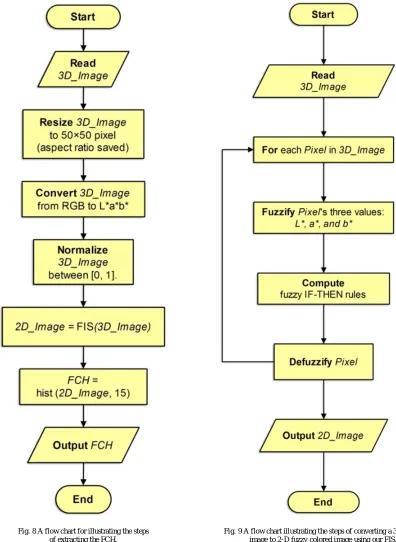
The 3-D image is read by the FIS, and then the three triplets of each pixel are fuzzified. These fuzzified triplets are entered into the fuzzy inference engine for computing fuzzy IF-THEN rules resident in the knowledge base. The three crisp components of each pixel in the input 3-D color image are converted into one crisp component in the output 2-D fuzzy colored image. This algorithm is illustrated in Fig. 9.
D. On-line Fuzzy Features Matching Algorithm
After obtaining the fuzzy color histogram as a visual feature of the query image using our FIS, described previously, we need to compare it with the FCHs of all images in the image database to specify the degree of similarity, and then retrieve the most relevant (similar) images to the user.
To achieve this goal, there are many fuzzy similarity measures. The similarity measures used in our proposed system is
called Min-max ratio. According to this measure, the similarity (S(A,B)) between two fuzzy sets is given by [7]:
( , ) =
∑∑ ( ( ), ( ))( ( ), ( ))
… (1),
where uA(i) and uB(i) are the membership values of the ith bin of histograms HAand HB, respectively. For an identical pair of
fuzzy sets, the memberships are equal and the similarity value will be equal to 1.
© 2014, IJCSMC All Rights Reserved 175
© 2014, IJCSMC All Rights Reserved 176
© 2014, IJCSMC All Rights Reserved 177
E. Relevance Feedback
As mentioned previously, there is a large gap between low level visual features and image semantic. Therefore, relevance feedback is used in CBIR systems to manipulate with this problem. Many complicated techniques of relevance feedback are available, but they are time consuming and computationally expensive.
In our system, the use of fuzzy logic technique has minimized this gap by applying human thinking process in the CBIR system. But, the problem has not totally eliminated (i.e., the gap is still existing although it has been minimized).
To tackle this problem, our CBIR system has been provided with another technique which is called relevance feedback.
Fuzzy logic application in the CBIR system has made a relevance feedback process very simple. The extracted FCH is very easy for the user to understand; therefore a specialized graphical interface is created to provide the user with an editable FCH of the submitted query image. After extracting the color feature of the query image, the resulting FCH is retrieved to the user. The user can now modify the FCH of the query image and then resubmit the modified FCH to the proposed CBIR system as relevance feedback.
III. EXPERIMENTAL RESULTS
The proposed system has been implemented using Matlab R2012a (7.14), and tested on a subset of 500 images of a general-purpose WANG database which form 5 classes of 100 images each. The WANG database is a subset of 1000 images of the Corel stock photo database, in JPEG format of sizes 384 × 256 and 256 × 386 [8].
A. Robustness to Noise
The conventional CBIR systems used for extracting 3-D color histograms are very sensitive to even very small noise in the perceptually relevant images and consider them as irrelevant. So, the noise is reflected on the color histograms as a very large distance measure between them. Therefore, the performance of these conventional CBIR systems decreases into the minimum.
In the proposed system, each bin in the FCH is represented by a fuzzy membership function, so the movement from one bin to the neighboring ones occurs gradually (not suddenly as in classic systems). Moreover, each pixel in given an image has a membership degree to multiple bins of the FCH ranges between [0, 1]. Therefore, any change in pixel’s triplet values is slightly reflected on multiple bins. This technique guarantees the retrieval of relevant images to the query image, despite the presence of the noise.
We have proven this fact practically by adding 15% of gaussian noise to the bus-1 image, then computing the similarity
measure between the original and its noisy copy. In Fig. 11, we used a conventional system for extracting a 3-D color histogram from these two images, then computing the degree of similarity between them using histogram intersection metric. Perceptually, these two images are identical, but statistically the similarity between them has never exceeded 59%.
Fig. 11 Similarity between the bus-1 image Fig. 12 Similarity between the bus-1 image and its 15% noisy copy using the classic color histogram and its 15% noisy copy using the FCH.
But, when we applied our system, the results were proportional to human perception. For the bus-1 image, the similarity
degree was 91%, as shown in Fig. 12.
B. Robustness to Illumination Change
© 2014, IJCSMC All Rights Reserved 178
suddenly. Therefore, any small change in illumination results in a large change in this part of color histogram, as shown in Fig. 13. Therefore, the performance of the CBIR system will decrease to the minimum.
There is no existence of this problem in the FCH, because it does not care of illumination change (all intensities of colors are represented by only one bin using fuzzy membership function), as shown in Fig. 14.
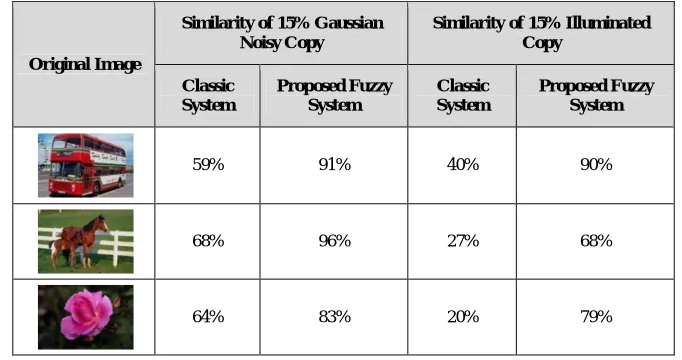
We can summarize the comparison results between classic and fuzzy systems of extracting the color histogram to show their different sensitivities to the noise and illumination changes in the matching phase in TABLE I.
Fig. 13 Similarity between the bus-1 image Fig. 14 Similarity between the bus-1 image and its 15% illuminated copy using the classic color histogram and its 15% illuminated copy using the FCH.
TABLE I SENSITIVITY COMPARISON of FUZZY and CLASSIC SYSTEMS to NOISE and ILLUMINATION CHANGES.
Original Image
Similarity of 15% Gaussian Noisy Copy
Similarity of 15% Illuminated Copy
Classic System
Proposed Fuzzy System
Classic System
Proposed Fuzzy System
59% 91% 40% 90%
68% 96% 27% 68%
64% 83% 20% 79%
C. Performance of the Proposed CBIR System
The images perceptually highly relevant to the submitted query image must have very small average of distance measures (very high average of similarity degrees) between them and the query image. Also, these distance measures between them must not suffer from variation (dispersion).
The average of similarity degrees is computed using the mean (µ), as follows [9]:
=
∑
… (2),
where N is the number of retrieved images, and xi is a FCH of i-th image.
The dispersion is computed by the standard deviation (σ) which shows how much variation or dispersion from the average exists, as follows [9]:
=
∑
(
−
)
… (3),
© 2014, IJCSMC All Rights Reserved 179
The conventional 3-D color histogram suffers from large distances between perceptually very similar images, and also
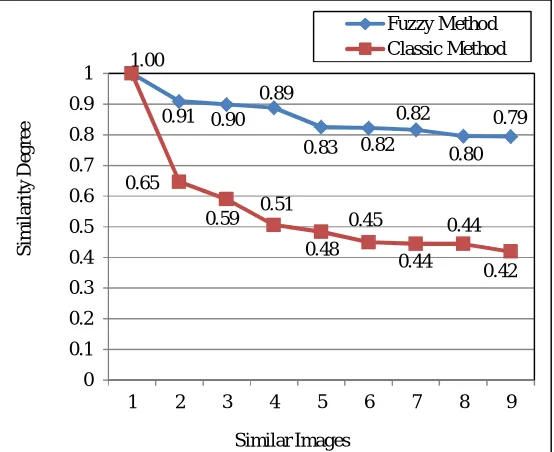
suffers from dispersion. For example, the top nine images relevant to rose-1 image have only 55% of mean, and 17% of
standard deviation. So, if we assigned a threshold of 80%, which indicates to very similar images, the number of relevant
images retrieved is only one! , as shown in Fig. 15. Suppose that the number of relevant images is X, then the recall measure,
which is the fraction of relevant images returned by the query, will be 1/X (a very small ratio). As a result, the performance of
the conventional system is not good.
Our proposed system does not have the previously discussed problem, i.e., the distance measures are proportional to the perceptual similarity of the relevant images, and there is no dispersion exists. So, if we assigned a threshold of 80%, which indicates to very similar images, the number of relevant images retrieved is seven images, as shown in Fig. 15. Suppose that the
number of relevant images is X, then the recall measure will be 7/X (a good ratio). Intuitively, 7/X recall measure of fuzzy
system is larger than 1/X recall measure of the conventional system; therefore, we can deduce that the fuzzy system has much
better performance than the conventional system.
Practically, we have proven that using multiple experiments applied on several images of WANG database, as shown in TABLE II.
Fig. 15 A difference in similarity degrees between classic and fuzzy systems in retrieving top nine images relevant to a rose-1 image.
TABLE II MEAN and STANDARD DEVIATION COMPARISON BETWEEN FUZZY and CLASSIC SYSTEMS.
Original Image
Mean of similarity degrees Standard deviation of similarity degrees
Classic System
Proposed Fuzzy
System Classic System
Proposed Fuzzy System
46% 87% 19% 5%
68% 88% 13% 5%
57% 85% 16% 7% 0.91 0.90
0.89
0.83 0.82
0.82
0.80 0.79 1.00
0.65
0.59 0.51
0.48 0.45 0.44 0.44 0.42 0 0.1 0.2 0.3 0.4 0.5 0.6 0.7 0.8 0.9 1
1 2 3 4 5 6 7 8 9
© 2014, IJCSMC All Rights Reserved 180
IV. CONCLUSIONS
From large variety of experiments applied on 500 images of WANG database, we have concluded the following results:
1. The FCH is robust to the noise and illumination changes in the images. As a result, it guarantees the retrieval of the
images relevant to the query image despite the presence of the noise and the change of the illumination, as proven practically in Fig. 12 and Fig. 14 and TABLE I. Therefore, the recall measure interestingly increases.
2. Even though the FCH is a vector of only 15 elements, it has improved the CBIR system performance, because it is
computed logically (human perception and thinking) not statistically (rigid measures), as shown in Fig. 15 and TABLE II.
3. The FCH minimizes the size of the features database and decreases the computational cost, because it is one-dimensional
descriptor with only 15 bins. In the conventional system, the color histogram is three-dimensional with more than 1000 bins. So, the size of the fuzzy color histogram is smaller than the color histogram of the conventional system at ration of (0.015), as shown.
4. The perceptually relevant images have very small distance measures (high similarity degrees) between them and the
query image, and they do not suffer from dispersion, because features extraction depends on perception (fuzzy) not on measure (crisp), as shown in Fig. 15 and TABLE II.
5. It is easy for users of the CBIR system to understand and directly modify the FCH of the query image, then submit the
modified FCH to the CBIR system again as feedback, because the human thinking process is applied in the FCH extraction. Therefore, the FCH seems very easy for users to understand and modify.
REFERENCES
[1] V. Castelli, and L. Bergman, Image Databases: Search and Retrieval of Digital Imagery, Wiley-Interscience, USA, 2002.
[2] F. Long, H. Zhang, H. Dagan, and D. Feng, Fundamentals of Content Based Image Retrieval, Springer-Verlag, Berlin Heidelberg New York, 2003. [3] L. Yan, and Z. Ma, Intelligent Multimedia Databases and Information Retrieval: Advancing Applications and Technologies, September - 2011. [4] Han, J., & Ma, K. K. (2002). Fuzzy color histogram and its use in color image retrieval. IEEE Transactions on Image Processing, 11(8), 944–952.
doi:10.1109/TIP.2002.801585
[5] K. Konstantinidis, A. Gasteratos, I. Andreadis, Image Retrieval Based on Fuzzy Color Histogram Processing, Optics Communications, vol.248, Issues 4-6, pp.375-384-6, 2005.
[6] O. Kucuktunc, and D. Zamalieva, Fuzzy Color Histogram-based CBIR System, March - 2009.
[7] X. Shaoping, L.Chunquan, J. Shunliang, Similarity measures for content-based image retrieval based on intuitionistic fuzzy set theory, ACADEMY PUBLISHER, July - 2012.
[8] http://savvash.blogspot.com/2008/12/benchmark-databases-for-cbir.html