Quantum Resistant Random Linear Code Based Public Key
Encryption Scheme RLCE
Yongge Wang
Department of SIS, UNC Charlotte, USA. [email protected]
January 15, 2016
Abstract
Lattice based encryption schemes and linear code based encryption schemes have received extensive attention in recent years since they have been considered as post-quantum candidate encryption schemes. Though LLL reduction algorithm has been one of the major cryptanalysis techniques for lattice based cryptographic systems, key recovery cryptanalysis techniques for linear code based cryptographic sys-tems are generally scheme specific. In recent years, several important techniques such as Sidelnikov-Shestakov attack, filtration attacks, and algebraic attacks have been developed to crypt-analyze linear code based encryption schemes. Though most of these cryptanalysis techniques are relatively new, they prove to be very powerful and many systems have been broken using them. Thus it is important to design linear code based cryptographic systems that are immune against these attacks. This paper proposes lin-ear code based encryption scheme RLCE which shares many characteristics with random linlin-ear codes. Our analysis shows that the scheme RLCE is secure against existing attacks. Example parameters for different security levels are recommended for the scheme RLCE.
Key words: Random linear codes; McEliece Encryption scheme; secure public key encryption scheme; linear code based encryption scheme
MSC 2010 Codes: 94B05; 94A60; 11T71; 68P25
1
Introduction
With rapid development for quantum computing techniques, our society is concerned with the security of current Public Key Infrastructures (PKI) which are fundamental for Internet services. The core compo-nents for current PKI infrastructures are based on public cryptographic techniques such as RSA and DSA. However, it has been shown that these public key cryptographic techniques could be broken by quantum computers. Thus it is urgent to develop public key cryptographic systems that are secure against quantum computing.
Since McEliece encryption scheme [24] was introduced more than thirty years ago, it has withstood many attacks and still remains unbroken for general cases. It has been considered as one of the candidates for post-quantum cryptography since it is immune to existing quantum computer algorithm attacks. The original McEliece cryptographic system is based on binary Goppa codes. Several variants have been introduced to replace Goppa codes in the McEliece encryption scheme. For instance, Niederreiter [27] proposed the use of generalized Reed-Solomon codes and later, Berger and Loidreau [5] proposed the use of sub-codes of generalized Reed-Solomon codes. Sidelnikov [32] proposed the use of Reed-Muller codes, Janwa and Moreno [17] proposed the use of algebraic geometry codes, Baldi et al [1] proposed the use of LDPC codes, Misoczki et al [26] proposed the use of MDPC codes, L¨ondahl and Johansson [20] proposed the use of
convolutional codes, and Berger et al [4] and Misoczki-Barreto [25] proposed quasi-cyclic and quasi-dyadic structure based compact variants of McEliece encryption schemes. Most of them have been broken though MDPC/LDPC code based McEliece encryption scheme [1, 26] and the original binary Goppa code based McEliece encryption scheme are still considered secure.
Goppa code based McEliece encryption scheme is hard to attack since Goppa codes share many char-acteristics with random codes. Motivated by Faugere et al’s [15] algebraic attacks against quasi-cyclic and quasi-dyadic structure based compact variants of McEliece encryption schemes, Faugere et al [14] designed an efficient algorithm to distinguish a random code from a high rate Goppa code. M´arquez-Corbella and Pellikaan [21] simplified the distinguisher in [14] using Schur component-wise product of codes.
Sidelnikov and Shestakov [31] showed, for the generalized Reed-Solomon code based McEliece en-cryption scheme, one can efficiently recover the private parameters for the generalized Reed-Solomon code from the public key. Using component-wise product of codes and techniques from [31], Wieschebrink [37] showed that Berger and Loidreau’s proposal [5] could be broken efficiently also. Couvreur et al [9] pro-posed a general distinguisher based filtration technique to recover keys for generalized Reed-Solomon code based McEliece scheme and Couvreur, M´arquez-Corbella, and Pellikaan [10] used filtration attacks to break Janwa and Moreno’s [17] algebraic geometry code based McEliece encryption scheme. The filtration attack was recently used by Couvreur et al [11] and Faugere et al [16] to attack Bernstein et al’s [6] wild Goppa code based McEliece scheme.
General Goppa code based McEliece schemes are still immune from these attacks. However, based on the new development of cryptanalysis techniques against linear code based cryptographic systems in the recent years, it is important to systematically design random linear code based cryptographic systems de-feating these attacks. Motivated by this observation, this paper presents a systematic approach of designing public key encryption schemes using any linear code. For example, we can even use Reed-Solomon codes to design McEliece encryption scheme while it is insecure to use Reed-Solomon codes in the original McEliece scheme. Since our design of linear code based encryption scheme embeds randomness in each column of the generator matrix, it is expected that, without the corresponding private key, these codes are as hard as random linear codes for decoding.
The most powerful message recovery attacks (not key recovery attacks) on McEliece cryptosystem is the information-set decoding attack which was introduced by Prange [29]. In an information-set decoding approach, one finds a set of coordinates of a received ciphertext which are error-free and that the restriction of the code’s generator matrix to these positions is invertible. The original message can then be computed by multiplying the ciphertext with the inverse of the sub-matrix. Improvements of the information-set de-coding attack have been proposed by Lee-Brickell [18], Leon [19], Stern [33], May-Meurer-Thomae [22], Becker-Joux-May-Meurer [3], and May-Ozerov [23]. Bernstein, Lange, and Peters [7] presented an ex-act complexity analysis on information-set decoding attack against McEliece cryptosystem. The attacks in [3, 7, 18, 19, 22, 23, 33] are against binary linear codes and are not applicable when the underlying field isGF(pm) for a prime p. Peters [28] presented an exact complexity analysis on information-set decoding attack against McEliece cryptosystem overGF(pm). These information-set decoding techniques (in partic-ular, the exact complexity analysis in [7, 28]) are used to select example parameters for RLCE scheme in Section 5.
Unless specified otherwise, we will useq=2morq= pmfor a primepand our discussion are based on
the fieldGF(q) through out this paper. Bold face letters such asa,b,e,f,gare used to denote row or column vectors overGF(q). It should be clear from the context whether a specific bold face letter represents a row vector or a column vector.
2
Goppa codes and McEliece Public Key Encryption scheme
In this section, we briefly review Goppa codes and McEliece scheme. For given parameters q,n ≤ q, andt, letg(x) be a polynomial of degree toverGF(q). Assume that g(x) has no multiple zero roots and
α0,· · ·, αn−1 ∈ GF(q) be pairwise distinct which are not root ofg(x). The following subspaceCGoppa(g)
defines the code words of an [n,k,d] binary Goppa code where d ≥ 2t+ 1. This binary Goppa code
CGoppa(g) has dimensionk≥n−tmand correctsterrors.
CGoppa(g)=
c∈ {0,1}n:
n−1
X
i=0 ci x−αi
≡0 modg(x) .
Furthermore, if g(x) is irreducible, thenCGoppa(g) is called an irreducible Goppa code. The parity check
matrixHfor the Goppa codes looks as follows:
Vt(x,y)=
1 1 · · · 1
α1 0 α
1
1 · · · α 1 n−1
. . . ... ... αt
0 α t
1 · · · α t n−1
1 g(α0)
...
1 g(αn−1)
(1)
wherex=[α0, . . . , αn−1] andy=
h 1
g(α0), . . . , 1 g(αn−1)
i .
The McEliece scheme [24] is described as follows. For the given parameters nandt, choose a binary Goppa code based on an irreducible polynomialg(x) of degreet. LetGsbe thek×ngenerator matrix for
the Goppa code. Select a random densek×knonsingular matrixS and a randomn×npermutation matrix
P. Note that the permutation matrix Pis required only if the supportα0,· · ·, αn−1is known to the public.
Then the public key isG= S GsPwhich generates a linear code with the same rate and minimum distance
as the code generated byGs. The private key isGs.
Encryption. For ak-bit message blockm, choose a random row vectoreof lengthnand weightt. Compute the cipher texty=mG+e
Decryption. For a received ciphertexty, first computey0 =yP−1. Next use an error-correction algorithm to
recoverm0 =mS and compute the messagemasm=m0S−1.
3
Random linear code based encryption scheme RLCE
The protocol for the Random Linear Code based Encryption scheme RLCE proceeds as follows:
Key Setup. Let n, k,d,t > 0, andr ≥ 1 be given parameters such that n −k +1 ≥ d ≥ 2t+ 1. Let
Gs = [g0,· · ·,gn−1] be a k×n generator matrix for an [n,k,d] linear code such that there is an efficient
decoding algorithm to correct at leastterrors for this linear code given byGs.
1. LetC0,C1,· · ·,Cn−1 ∈GF(q)k×rbek×rmatrices drawn uniformly at random and let
G1=[g0,C0,g1,C1· · ·,gn−1,Cn−1] (2)
be thek×n(r+1) matrix obtained by inserting the random matricesCiintoGs.
2. LetA0,· · ·,An−1 ∈GF(q)(r+1)×(r+1)be dense nonsingular (r+1)×(r+1) matrices chosen uniformly
at random and let
A= A0 A1 ...
An−1
be ann(r+1)×n(r+1) nonsingular matrix.
3. LetS be a random densek×knonsingular matrix andPbe ann(r+1)×n(r+1) permutation matrix.
4. The public key is thek×n(r+1) matrixG=S G1APand the private key is (S,Gs,P,A).
Encryption. For a row vector messagem∈ GF(q)k, choose a random row vectore = [e0, . . . ,en(r+1)−1] ∈ GF(q)n(r+1)such that the Hamming weight ofeis at mostt. The cipher text isy=mG+e.
Decryption. For a received cipher texty=[y0, . . . ,yn(r+1)−1], compute
yP−1A−1 =[y00, . . . ,y0n(r+1)−1]=mS G1+eP−1A−1
where
A−1=
A−01 A−11
...
A−n−11
(4)
Lety0 = [y00,y0r+1,· · ·,y0(n−1)(r+1)] be the row vector of lengthnselected from the lengthn(r+1) row vector
yP−1A−1. Theny0 = mS Gs+e0 for some error vectore0 ∈GF(q)n. Lete00 = eP−1 = [e00
0,· · ·,e
00
n(r+1)−1]
ande00i = [e00i(r+1), . . . ,e00i(r+1)+r] be a sub-vector ofe00fori≤ n−1. Thene0[i] is the first element ofe00i A−i1. Thuse0[i] , 0 only ife00i is non-zero. Since there are at most tnon-zero sub-vectors e00i , the Hamming
weight ofe0 ∈GF(q)nis at mostt. Using the efficient decoding algorithm, one can computem0 = mS and
m= m0S−1. Finally, calculate the Hamming weightw= weight(y−mG). Ifw ≤ tthen outputmas the decrypted plaintext. Otherwise, output error.
Comment 1. In the design of RLCE scheme, the permutation matrix Phas two purposes. The first pur-pose is to hide the supports of the underlying encoding scheme generator matrix (this is necessary if the supports of the underlying encoding scheme are unknown). The second purpose is to hide the positions and combinations of the column vectorsgiandCi.
Comment 2. In the RLCE decryption process, one checks whether the Hamming weightw= weight(y− mG) is smaller than t. This step is used to defeat chosen ciphertext attacks (CCA). In a CCA atack, an adversary gives a random vectory = [y0, . . . ,yn(r+1)−1] (which is not a valid ciphertext) to the decryption
oracle to learn a decrypted value. This decrypted value could be used to obtain certain information about the private generator matrixGs(see Section 4.2 for details). Alternatively, one may use an appropriate padding scheme to pad a message before encryption. Then it is sufficient for the decryption process to verify whether the decrypted message has the correct padding strings to defeat the CCA attacks.
4
Robustness of RLCE codes against existing attacks
4.1 Randomness of generator matrix columns
We first use the following theorem to show that any single column of the underlying generator matrixGs
could be completely randomized in a RLCE public keyG.
Theorem 4.1 Let Gs=[g0,· · ·,gn−1]∈GF(q)k×(n−1)be a linear code generator matrix. For any randomly chosen full rank k×(r+1)matrix R0∈GF(q)k×(r+1), there exists a k×k nonsingular matrix S , a(r+1)×(r+1) matrix A0, and a k×r matrix C0∈GF(q)k×rsuch that
R0=S[g0,C0]A0 (5)
Proof. By the fundamental properties of matrix equivalence, for two m×n matricesA, Bof the same rank, there exist invertiblem×mmatrixPandn×ninvertible matrixQsuch thatA= PBQ. The theorem
could be proved using this property and the details are omitted here.
Let R = [R0, . . . ,Rn−1] ∈ GF(q)k×n(r+1) be a fixed random linear code generator matrix. Theorem
4.1 shows that for any generator matrixGs (e.g., a Reed-Solomon code generator matrix), we can choose matricesS andA0so that the firstr+1 columns of the RLCE scheme public keyG(constructed fromGs)
are identical toR0. However, we cannot use Theorem 4.1 to continue the process of choosingA1, . . . ,An−1
to obtainG = RsinceS is fixed afterA0is chosen. Indeed, it is straightforward to show that one can use
Theorem 4.1 to continue the process of choosingA1, . . . ,An−1to obtainG = Rif and only if there exists a k×knonsingular matrixS such that, for eachi≤n−1, the vectorSgilies in the linear space generated by
the column vectors ofRi. A corollary of this observation is that ifRigenerates the fullkdimensional space, then each linear code could have any random matrix as its RLCE public key.
Theorem 4.2 Let R = [R0, . . . ,Rn−1] ∈ GF(q)k×n(r+1) and Gs = [g0,· · ·,gn−1] ∈ GF(q)k×n be two fixed MDS linear code generator matrices. If r+1 ≥ k, then there exist A0,· · ·,An−1 ∈ GF(q)(r+1)×(r+1) and C0,· · ·,Cn−1∈GF(q)k×rsuch that R=[g0,C0,· · ·,gn−1,Cn−1]A where A is in the format of (3).
Proof. Without loss of generality, we may assume thatr = k−1. For each 0 ≤ i ≤ n−1, choose a random matrixCi ∈GF(q)k×rsuch thatGi= [gi,Ci] is ank×kinvertible matrix. LetA=G−i1Ri. Then the
theorem is proved.
Theorem 4.2 shows that in the RLCE scheme, we must have r < k−1. Otherwise, for a given public keyG ∈ GF(q)k×n(r+1), the adversary can choose a Reed-Solomon code generator matrixGs ∈ GF(q)k×n and computeA0,· · ·,An−1 ∈GF(q)r×randC0,· · ·,Cn−1 ∈GF(q)k×rsuch thatG=[g0,C0,· · ·,gn−1,Cn−1]A.
In other words, the adversary can use the decryption algorithm corresponding to the generator matrixGsto
break the RLCE scheme
Theorem 4.2 also implies an efficient decryption algorithm for random [n,k] linear codes with
suffi-ciently small t of errors. Specifically, for an [n,k] linear code with generator matrix R ∈ GF(q)k×n, if
t ≤ n−2kk2, then one can divideR into m = 2t+ k blocks R = [R0,· · ·,Rm−1]. Theorem 4.2 can then be
applied to construct an equivalent [m,k] Reed-Solomon code with generator matrixGs ∈GF(q)k×m. Thus
it is sufficient to decrypt the equivalent Reed-Solomon code instead of the original random linear code. For McEliece based encryption scheme, Bernstein, Lange, and Peters [7] recommends the use of 0.75 (= k/n) as the code rate. Thus Theorem 4.2 has no threat on these schemes.
Fort≤ n−2kk2, the adversary is guaranteed to succeed in breaking the system. Since multiple errors might be located within the same blockRiwith certain probability, for a giventthat is slightly larger thann−2kk2, the adversary still has a good chance to break the system using the above approach. It is recommended thattis significantly larger than n−2kk2. For the RLCE scheme, this means thatrshould be significantly smaller than
k. This is normally true sincekis very larger for secure RLCE schemes.
In following sections, we list heuristic and experimental evidences that the RLCE public keyGshares the properties of random linear codes. We believe that the security of the RLCE scheme is equivalent to decoding a random linear code.
4.2 Chosen ciphertext attacks (CCA)
In this section, we show that certain information about the private generator matrix Gs is leaked if the
decryption process does neither include padding scheme validation nor include ciphertext correctness vali-dation. However, it is not clear whether this kind of information leakage would help the adversary to break the RLCE encryption scheme. We illustrate this using the parameterr=1.
Assume that G1 = [g0,r0,g1,r1,· · ·,gn−1,rn−1] andG = S G1AP. The adversary chooses a random
vectory = [y0, . . . ,y2n−1] ∈ GF(q)2n−1 and gives it to the decryption oracle which outputs a vector x ∈ GF(q)k. LetyP−1A−1=[y0
0, . . . ,y
0
2n−1] andAi =
"
ai,00 ai,01 ai,10 ai,11
#
. Then we have
xG−y = xS[g0,r0,g1,r1,· · ·,gn−1,rn−1]AP−y
= [· · ·,xS[gi,ri]Ai,· · ·]P−y
= [· · ·,[y02i,xSri]Ai,· · ·]P+e−y
= [· · ·,[y02i,y02i+1]Ai,· · ·]P+[· · ·,[0,xSri−y02i+1]Ai,· · ·]P+e−y
= y+[· · ·,[0,xSri−y20i+1]Ai,· · ·]P+e−y
= [· · ·,[(xSri−y20i+1)ai,10,(xSri−y02i+1)ai,11],· · ·]P+e
(6)
where eis a row vector of Hamming weight at most t. From the identity (6), one can calculate a list of potential values forci = ai,10/ai,11. The size of this list is
2n
2
. For each value in this list, one obtains the corresponding two column vectors [f0,f1]=S[gi,ri]Aifrom the public keyG. Then we have
[f0,f1] "
1 0
−ci 1
#
=S[gi,ri]
"
ai,00 ai,01 ciai,11 ai,11
# "
1 0
−ci 1
#
=S[gi,ri]
"
ai,00−ciai,01 ai,01
0 ai,11
#
(7)
That is, f0−cif1 = (ai,00−ciai,01)Sgi. Thus, for each candidate permutation matrix P, one can calculate
a matrixS GsBwhere B = diag[a0,00−c0a0,01,· · ·,an−1,00−cn−1an−1,01] is ann×ndiagonal matrix with
unknown diagonal elementsa0,00−c0a0,01,· · ·, andan−1,00−cn−1an−1,01.
On the other hand, for each ciphertexty = [y0, . . . ,y2n−1] ∈ GF(q)2n−1, letyP−1 = [z0,z1,· · ·,z2n−1].
The codeword corresponding to the secret generator matrix S Gs is [y00,y02, . . . ,y02n−2] where yP−1A−1 =
[y00, . . . ,y02n−1]. By the fact that
[y02i,y02i+1]=[z2i,z2i+1]A−i1 =
1
|Ai|[z2i,z2i+1]
"
ai,11 −ai,01 −ciai,11 ai,00
#
,
we havey02i = ai,11
|Ai|(z2i−ciz2i+1). For each candidate permutation matrixP, one first chooseskindependent
messagesx0,· · ·,xk−1and calculates the correspondingkindependent ciphertextsy0,· · ·,yk−1. UsingPand
the above mentioned technique, one obtain a generator matrixGa = S0Gsdiag
ha0,11
|A0|,· · ·,
an−1,11
|An−1|
i
. Thus in order to decode a ciphertexty, it is sufficient to decode the error correcting code given by the generator matrixGa. This task becomes feasible for certain codes. For example, this task is equivalent to the prob-lem of attacking a generalized Reed-Solomon code based McElience encryption scheme ifGsgenerates a
generalized Reed-Solomon code.
In order for the attacks in the preceding paragraphs to work, the adversary needs to have the knowledge of the permutation matrix P. Since the number of candidate permutation matricesPis huge, this kind of attacks is still infeasible in practice.
4.3 Niederreiter’s scheme and Sidelnikov-Shestakov’s attack
Sidelnikov and Shestakov’s cryptanalysis technique [31] was used to analyze Niederreiter’s scheme which is based on generalized Reed-Solomon codes. Letα=(α0, . . . , αn−1) bendistinct elements ofGF(q) and let v= (v0, . . . ,vn−1) be nonzero (not necessarily distinct) elements ofGF(q). The generalized Reed-Solomon
(GRS) code of dimensionk, denoted byGRSk(α,v), is defined by the following subspace.
GRSk(α,v)={(v0f(α0), . . . ,vn−1f(αn−1)) : f(x)∈GF(q)[x]k)}
whereGF(q)[x]k is the set of polynomials inGF(q)[x] of degree less thank.GF(q)[x]k is a vector space of
dimensionkoverGF(q). For each code wordc=(v0f(α0), . . . ,vn−1f(αn−1)), f(x)= f0+f1x+. . .+fk−1xk−1
is called the associate polynomial of the code wordcthat encodes the message (f0, . . . , fk−1).GRSk(α,v) is
an [n,k,d] MDS code whered=n−k+1.
Niederreiter’s scheme [27] replaces the binary Goppa codes in McEliece scheme using GRS codes. The first attack on Niederreiter scheme is presented by Sidelnikov and Shestakov [31]. Wieschebrink [36] revised Niederreiter’s scheme by inserting random column vectors into random positions ofGsbefore obtaining the public keyG. Couvreur et al [9] showed that Wieschebrink’s revised scheme is insecure under the product code attacks.
Berger and Loidreau [5] recommend the use of sub codes of Niederreiter’s scheme to avoid Sidelnikov and Shestakov’s attack. Specifically, in Berger and Loidreau’s scheme, one uses a random (k−l)×kmatrix
S0of rankk−linstead of thek×kmatrixS to compute the public keyG=S0Gs.
For smaller values ofl, Wieschebrink [37] shows that a private key (α,v) for Berger and Loidreau scheme [5] could be recovered using Sidelnikov-Shestakov algorithm. For larger values of l, Wieschebrink used Schur product code to recover the secret values for Berger-Loidreau scheme. LetG=S Gsbe the (k−l)×n
public key generator matrix for Berger-Loidreau scheme,r0,· · ·,rk−l−1be the rows ofG, and f0,· · ·, fk−l−1
be the associated polynomials to those rows. For two row vectors a,b ∈ GF(q)n, the component wise producta∗b∈GF(q)nis defined as
a∗b=(a0b0,· · ·,an−1bn−1) (8)
By the definition in (8), it is straightforward to observe that
ri∗rj =(v20fi(α0)fj(α0),· · ·,v2n−1fi(αn−1)fj(αn−1)). (9)
For 2k−1≤ n−2, if the code generated byri∗rj equalsGRS2k−1(α,v0) forv0 = (v02,· · ·,v2n−1), then the
Sidelnikov-Shestakov algorithm could be used to recover the values αandv. For 2k−1 ≤ n− 2, if the code generated byri∗rj does not equalGRS2k−1(n,v0), then the attack fails. Wieschebrink claimed that
the probability that the attack fails is very small. For the case of 2k −1 > n−2, Wieschebrink applied Sidelnikov-Shestakov algorithm on the component wise product code of a shortened code of the original
GRSk(α,v).
The crucial step in Sidelnikov and Shestakov attack is to use the echelon formE(G)=[I|G0] of the public key to get minimum weight codewords that are co-related to each other supports. In the encryption scheme RLCE, each column of the public keyGcontains mixed randomness. Thus the echelon formE(G)=[I|G0] obtained from the public keyGcould not be used to build any useful equation system. In other words, it is expected that Sidelnikov and Shestakov attack does not work against the RLCE scheme.
4.4 Filtration attacks
Using distinguisher techniques [14], Couvreur et al. [9] designed a filtration technique to attack GRS code based McEliece scheme. The filtration technique was further developed by Couvreur et al [11] to attack wild Goppa code based McEliece scheme. In the following, we briefly review the filtration attack in [11]. For two codesC1andC2of lengthn, the star product codeC1∗ C2is the vector space spanned bya∗bfor all pairs (a,b)∈ C1× C2wherea∗bis defined in (8). ForC1 =C2,C1∗ C1is called the square code ofC1.
It is showed in [11] that
dimC1× C2≤
(
n,dimC1dimC2− dim(C1∩ C1)
2
!)
. (10)
Furthermore, the equality in (10) is attained for most randomly selected codesC1andC2of a given length and dimension. Note that for C = C1 = C2 and dimC = k, the equation (10) becomes dimC∗2 ≤
minnn,k+21o.
Couvreur et al [11] showed that the square code of an alternant code of extension degree 2 may have an unusually low dimension when its actual rate is larger than its designed rate. Specifically, Couvreur et al created a family of nested codes (called a filtration) defined as follows, for anya∈ {0,· · ·,n−1}:
Ca(0)⊇ Ca(1)⊇ · · · ⊇ Ca(q+1). (11)
Roughly speaking,Ca(j) consists in the codewords ofCwhich correspond to polynomials which have a zero of order jat positiona. The first two elements of this filtration are just punctured and shortened versions of
Cand the rest of them can be computed fromCby computing star products and solving linear systems. The support valuesα0,· · ·, αn−1(the private key) for the Goppa code could be recovered using this nested family
of codes efficiently.
The crucial part of the filtration technique is the efficient algorithm to compute the nested family of codes in (11). For our RLCE scheme, the public key generator matrixGcontains random columns. Thus linear equations constructed in Couvreur et al [11] could not be solved and the nested family (11) could not be computed correctly. Furthermore, the important characteristics for a codeCto be vulnerable is that one can find a related codeC1of dimensionksuch that the dimension of the square code ofC1has a dimension significantly less than minnn,k+21o.
To get experimental evidence that RLCE codes share similarity with random linear codes with respect to the above mentioned filtration attacks, we carried out several experiments using Shoup’s NTL library [30]. The source code for our experiments is available at [35]. In the experiments, we used Reed-Solomon codes overGF(210). The RLCE parameters are chosen as the 80-bit security parametern=560,k= 380,t= 90, andr=1 (see Section 5 for details). For each given 380×560 generator matrixGsof Reed-Solomon code, we selected another random 380×560 matrixC∈GF(210)380×560and selected 2×2 matricesA0, . . . ,A559.
Each columnci inC is inserted in Gs after the columngi. The extended generator matrix is multiplied
by A = diag[A0, . . . ,A559] from the right hand side to obtain the public key matrixG ∈ GF(210)380×1120.
For eachi = 0,· · ·,1119, the matrixGi is used to compute the product code, whereGi is obtained from
Gby deleting theith column vector. In our experiments, all of these product codes have dimension 1119. We repeated the above experiments 100 times for 100 distinct Reed-Solomon generator matrices and the results remained the same. Since minn1119,3812 o = 1119, the experimental results meet our expectation that RLCE behaves like a random linear code. We did the same experiments for the dual code of the above code. That is, for a 180×560 generator matrixGsof the dual code, the same procedure has been taken. In this time, after deleting one column from the resulting public key matrix, the product code always had dimension 1119 which is the expected dimension for a random linear code. In an early draft of this paper, we used Maple 2015 to carry out the experiments. In that experiments, we did not check the invertible property of the randomly generated 2×2 matricesA0, . . . ,A559. Thus the previously reported experimental results
are not accurate. The experimental evidence confirms our expectatiohn that RLCE scheme behaves like a random linear code.
4.5 Algebraic attacks
Faugere, Otmani, Perret, and Tillich [15] developed an algebraic attack against quasi-cyclic and dyadic structure based compact variants of McEliece encryption scheme. In a high level, the algebraic attack from [15] tries to find x∗,y∗ ∈ GF(q)n such that Vt(x∗,y∗) is the parity check matrix for the underlying
alternant codes of the compact variants of McEliece encryption scheme.Vt(x∗,y∗) can then be used to break the McEliece scheme. Note that thisVt(x∗,y∗) is generally different from the original parity check matrix
Vt(x,y) in (1). The parity check matrixVt(x∗,y∗) was obtained by solving an equation system constructed from
Vt(x∗,y∗)GT =0, (12)
whereGis the public key. The authors of [15] employed the special properties of quasi-cyclic and dyadic structures (which provide additional linear equations) to rewrite the equation system obtained from (12) and then calculateVt(x∗,y∗) efficiently.
Faugere, Gauthier-Uma˜na, Otmani, Perret, and Tillich [14] used the algebraic attack in [15] to design an efficient Goppa code distinguisher to distinguish a random matrix from the matrix of a Goppa code whose rate is close to 1. For instance, [14] showed that the binary Goppa code obtained withm = 13 andr = 19 corresponding to a 90-bit security key is distinguishable.
It is challenging to mount the above mentioned algebraic attacks on the RLCE encryption scheme. Assume that the RLCE scheme is based on Reed-Solomon code. LetGbe the public key and (S,Gs,A,P)
be the private key. The parity check matrix for a Reed-Solomon code is in the format of
Vt(α)=
1 α α2 · · · αn−1
1 α2 α4 · · · α2(n−1)
... ... ... ... ...
1 αt+1 α2(t+1) · · · α(t+1)(n−1)
. (13)
The algebraic attack in [14, 15] requires one to obtain a parity check matrix Vt(α∗) for the underlying
Reed-Solomon code from the public keyG, where α∗ may be different from α. Assume that Vt(α∗) = [v0,· · ·,vn−1]∈GF(q)(t+1)×nis a parity check matrix for the underlying Reed-Solomon code. LetVt0(α∗)∈ GF(q)(t+1)×n(r+1) be a (t+1)×n(r+1) matrix obtained fromVt(α∗) by insertingr column vectors 0after
each column ofVt(α∗). That is,
Vt0(α∗)=[v0,0,v1,0,· · ·,vn−1,0]. (14)
Then we have
Vt0(α∗)GT1 = Vt0(α∗)[g0,C0,· · ·,gn−1,Cn−1]T
= Vt(α∗)[g0,· · ·,gn−1]T
= Vt(α∗)GTs
= 0.
(15)
We cannot build an equation system for the unknownVt0(α∗) from the public keyG= S G1APdirectly
since the identity (15) only shows the relationship betweenVt0(α∗) andG1. In other words, in order to build an equation system forVt0(α∗), one also needs to use unknown variables for the non-singular matrixAand the permutation matrixP. That is, we have
Vt0(α∗)(A−1)T(P−1)TGT =Vt0(α∗)(GP−1A−1)T =Vt0(α∗)GT1ST =0. (16) with an unknownα∗, an unknown permutation matrixP, and an unknown matrix A = diag[A0,· · ·,An−1]
which consists ofndense nonsingular (r+1)×(r+1) matricesAi ∈GF(q)(r+1)×(r+1)as defined in (3). In order
to find a solutionα∗, one first needs to take a potential permutation matrixP−1to reorganize columns of the public keyG. Then, using the identityVt0(α∗)(A−1)T(P−1)TGT =0, one can build a degree (t+1)(n−1)+1 equation system ofk(t+1) equations inn(r+1)2+1 unknowns. In case thatk(t+1)≥n(r+1)2+1, one may use Buchberger’s Gr¨obner basis algorithms as in [15] to find a solutionα∗. However, this kind of algebraic attacks are infeasible due to the following two challenges. First the number of permutation matricesPis too large to be handled practically. Secondly, even if one can manage to handle the large number of permutation matricesP, the Gr¨obner basis (or the improved variants such as F4or F5in Faugere [13, 12]) are impractical
for such kind of equation systems.
The Gr¨obner basis algorithm eliminates top order monomial (in a given order such as lexicographic order) by combining two equations with appropriate coefficients. This process continues until one obtains a univariate polynomial equation. The resulting univariate polynomial equation normally has a very high degree and Buchberger’s algorithm runs in exponential time on average (the worst case complexity is double exponential time). Thus Buchberger’s algorithm cannot solve nonlinear multicariate equation systems with more than 20 variables in practice (see, e.g., Courtois et al [8]). But it should also be noted that though the worst-case Gr¨obner basis algorithm is double exponential, the generic behavior is generally much better. In particular, if the algebraic system has only a finite number of common zeros at infinity, then Gr¨obner basis algorithm for any ordering stops in a polynomial time indn whered = max{di :diis the total degree of fi}
andnis the number of variables (see, e.g., [2]).
5
Practical considerations
In order to reduce the message expansion ratio which is defined as the rate of ciphertext size and corre-sponding plaintext size, it is preferred to use a smaller r for the RLCE encryption scheme. Indeed, the experimental results show thatr = 1 is sufficient for RLCE to behave like a random linear code. As
men-tioned in the introduction section, the most powerful message recovery attack (not private key recovery attack) on McEliece encryption schemes is the information-set decoding attack. For the RLCE encryption scheme, the information-set decoding attack is based on the number of columns in the public keyGinstead of the number of columns in the private keyGs. For the same error weightt, the probability to find error-free
coordinates in (r+1)ncoordinates is different from the probability to find error-free coordinates inn coordi-nates. Specifically, the cost of information-set decoding attacks on an [n,k,t;r]-RLCE scheme is equivalent to the cost of information-set decoding attacks on a standard [(r+1)n,k;t]-McEliece scheme.
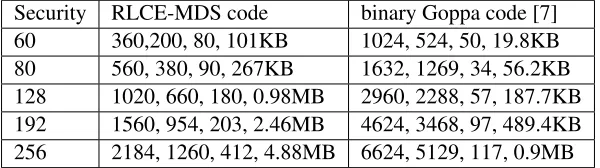
Taking into account of the cost of recovering McEliece encryption scheme secret keys from the public keys and the cost of recovering McEliece encryption scheme plaintext messages from ciphertexts using the information-set decoding methods, we generated a recommended list of parameters for RLCE scheme in Table 1 using the PARI/GP script by Peters’s [28]. For the recommended parameters, the default underlying linear code is taken as the Reed-Solomon code overGF(q) and the value ofris taken as 1. For the purpose of comparison, we also list the recommended parameters from [7] for binary Goppa code based McEliece encryption scheme. The authors in [7, 28] proposed the use of semantic secure message coding approach so that one can store the public key as a systematic generator matrix. For binary Goppa code based McEliece encryption scheme, the systematic generator matrix public key isk(n−k) bits. For RLCE encryption scheme overGF(q), the systematic generator matrix public key isk(n(r+1)−k) logqbits. It is observed that RLCE scheme generally has larger but acceptable public key size. Specifically, for the same security level, the public key size for the RLCE scheme is approximately four to five times larger than the public key size for binary Goppa code based McEliece encryption scheme. For example, for the security level of 80 bits, the binary Goppa code based McEliece encryption scheme has a public key of size 56.2KB, and the RLCE-MDS scheme has a public key of size 267≈5×56.2KB.
6
Conclusions
In this paper, we presented techniques for designing general random linear code based public encryption schemes using any linear code. Heuristics and experiments encourages us to think that the proposed schemes are immune against existing attacks on linear code based encryption schemes such as Sidelnikov-Shestakov attack, filtration attacks, and algebraic attacks. In addition to being a post-quantum cryptographic tech-nique, our scheme RLCE has recently been used by Wang and Desmedt [34] to design fully homomorphic
Table 1: Parameters for RLCE:n,k,t,q, key size (r = 1 for all parameters), where “360,200,80,101KB” under column “RLCE-MDS code” representsn=360,k=200,t=80.
Security RLCE-MDS code binary Goppa code [7]
60 360,200, 80, 101KB 1024, 524, 50, 19.8KB
80 560, 380, 90, 267KB 1632, 1269, 34, 56.2KB
128 1020, 660, 180, 0.98MB 2960, 2288, 57, 187.7KB
192 1560, 954, 203, 2.46MB 4624, 3468, 97, 489.4KB
256 2184, 1260, 412, 4.88MB 6624, 5129, 117, 0.9MB
encryption schemes.
Acknowledgments
I would like to thank several colleagues for very detailed comments and suggestionsto improve the presen-tation of this paper.
References
[1] M. Baldi, M. Bodrato, and F. Chiaraluce. A new analysis of the mceliece cryptosystem based on qc-ldpc codes. InSecurity and Cryptography for Networks, pages 246–262. Springer, 2008.
[2] M. Bardet, J.-C. Faugere, and B. Salvy. On the complexity of Gr¨obner basis computation of semi-regular overdetermined algebraic equations. In Proc. Int. Conference on Polynomial System Solving, pages 71–74, 2004.
[3] A. Becker, A. Joux, A. May, and A. Meurer. Decoding random binary linear codes in 2n/20: How 1+1=0 improves information set decoding. InEUROCRYPT 2012, pages 520–536. Springer, 2012.
[4] T.P. Berger, P.-L. Cayrel, P. Gaborit, and A. Otma˜ni. Reducing key length of the mceliece cryptosys-tem. InProgress in Cryptology–AFRICACRYPT 2009, pages 77–97. Springer, 2009.
[5] T.P Berger and P. Loidreau. How to mask the structure of codes for a cryptographic use. Designs, Codes and Cryptography, 35(1):63–79, 2005.
[6] D. Bernstein, T. Lange, and C. Peters. Wild McEeliece. InSelected Areas in Cryptography, pages 143–158. Springer, 2011.
[7] D.J. Bernstein, T. Lange, and C. Peters. Attacking and defending the McEliece cryptosystem. In
Post-Quantum Cryptography, pages 31–46. Springer, 2008.
[8] N. Courtois, A. Klimov, J. Patarin, and A. Shamir. Efficient algorithms for solving overdefined systems of multivariate polynomial equations. InEUROCRYPT 2000, pages 392–407. Springer, 2000.
[9] A. Couvreur, P. Gaborit, V. Gauthier-Uma˜na, A. Otmani, and J.-P. Tillich. Distinguisher-based attacks on public-key cryptosystems using Reed–Solomon codes. Designs, Codes and Cryptography, pages 1–26, 2013.
[10] A. Couvreur, I. M´arquez-Corbella, and R. Pellikaan. A polynomial time attack against algebraic ge-ometry code based public key cryptosystems. InProc. ISIT, pages 1446–1450. IEEE, 2014.
[11] A. Couvreur, A. Otma˜ni, and J.-P. Tillich. Polynomial time attack on wild McEliece over quadratic extensions. InAdvances in Cryptology–EUROCRYPT 2014, pages 17–39. Springer, 2014.
[12] J.-C. Faugere. A new efficient algorithm for computing Gr¨obner bases without reduction to 0 (F5). In
Proc. ISSAC, pages 75–83.
[13] J.-C. Faugere. A new efficient algorithm for computing Gr¨obner bases (F4). J. Pure and Applied Algebra, 139(1):61–88, 1999.
[14] J.-C. Faugere, V. Gauthier-Uma˜na, A. Otmani, L. Perret, and J.-P. Tillich. A distinguisher for high-rate mceliece cryptosystems. Information Theory, IEEE Transactions on, 59(10):6830–6844, 2013.
[15] J.-C. Faugere, A. Otmani, L. Perret, and J.-P. Tillich. Algebraic cryptanalysis of McEliece variants with compact keys. InEurocrypt 2010, pages 279–298. Springer, 2010.
[16] J.-C. Faugere, L. Perret, and F. De Portzamparc. Algebraic attack against variants of mceliece with goppa polynomial of a special form. In Advances in Cryptology–ASIACRYPT 2014, pages 21–41. Springer, 2014.
[17] H. Janwa and O. Moreno. Mceliece public key cryptosystems using algebraic-geometric codes. De-signs, Codes and Cryptography, 8(3):293–307, 1996.
[18] P. J. Lee and E. F. Brickell. An observation on the security of McEliece’s public-key cryptosystem. In
EUROCRYPT’88, pages 275–280. Springer, 1988.
[19] J. Leon. A probabilistic algorithm for computing minimum weights of large error-correcting codes.
IEEE Trans. Information Theory, 34(5):1354–1359, 1988.
[20] C. L¨ondahl and T. Johansson. A new version of mceliece pkc based on convolutional codes. In
Information and Communications Security, pages 461–470. Springer, 2012.
[21] I. M´arquez-Corbella and R. Pellikaan. Error-correcting pairs for a public-key cryptosystem. arXiv preprint arXiv:1205.3647, 2012.
[22] A. May, A. Meurer, and E. Thomae. Decoding random linear codes in ˜O(20.054n). InASIACRYPT 2011, pages 107–124. Springer, 2011.
[23] A. May and I. Ozerov. On computing nearest neighbors with applications to decoding of binary linear codes. InEUROCRYPT 2015, pages 203–228. Springer, 2015.
[24] R.J. McEliece. A public-key cryptosystem based on algebraic coding theory. DSN progress report, 42(44):114–116, 1978.
[25] R. Misoczki and P. Barreto. Compact mceliece keys from goppa codes. InSelected Areas in Cryptog-raphy, pages 376–392. Springer, 2009.
[26] R. Misoczki, J.-P. Tillich, N. Sendrier, and P. Barreto. MDPC-McEliece: New McEliece variants from moderate density parity-check codes. In Information Theory Proceedings (ISIT), 2013 IEEE International Symposium on, pages 2069–2073. IEEE, 2013.
[27] H. Niederreiter. Knapsack-type cryptosystems and algebraic coding theory. Prob. Control and Infor-mation Theory, 15(2):159–166, 1986.
[28] C. Peters. Information-set decoding for linear codes overFq. InPost-Quantum Cryptography, pages 81–94. Springer, 2010.
[29] Eugene Prange. The use of information sets in decoding cyclic codes.IRE Trans. Information Theory, 8(5):5–9, 1962.
[30] Victor Shoup. NTL: A library for doing number theory, 2001.
[31] V. M Sidelnikov and S. Shestakov. On insecurity of cryptosystems based on generalized Reed-Solomon codes. Discrete Mathematics and Applications, 2(4):439–444, 1992.
[32] V.M. Sidelnikov. A public-key cryptosystem based on binary reed-muller codes.Discrete Mathematics and Applications, 4(3):191–208, 1994.
[33] J. Stern. A method for finding codewords of small weight. InCoding theory and applications, pages 106–113. Springer, 1989.
[34] Y. Wang and Y. Desmedt. Towards fully homomorphic encryption schemes from codes. InSubmitted, pages 1–1. Springer Press, 2015.
[35] Yongge Wang. Random linear code based public key encryption implementation http://webpages.uncc. edu/yonwang/rlce.html, 2015.
[36] C. Wieschebrink. Two NP-complete problems in coding theory with an application in code based cryptography. InProc. IEEE ISIT, pages 1733–1737. IEEE Press, 2006.
[37] C. Wieschebrink. Cryptanalysis of the Niederreiter public key scheme based on GRS subcodes. In
Post-Quantum Cryptography, pages 61–72. Springer, 2010.