Proceedings of the IJCNLP-08 Workshop on NLP for Less Privileged Languages, pages 19–26,
Prototype Machine Translation System From Text-To-Indian Sign
Language
Tirthankar Dasgupta
IIT, Kharagpur
tirtha@
cse.iitkgp.ernet.in
Sandipan Dandpat
IIT, Kharagpur
sandipan@
cse.iitkgp.ernet.in
Anupam Basu
IIT, Kharagpur
anupambas@
gmail.com
Abstract
This paper presents a prototype Text-To-Indian Sign Language (ISL) translation system. The system will help dissemination of information to the deaf people in India. The current system takes English sentence as input, performs syntactic analysis, and generates the corresponding ISL structure. Since ISL does not have any written form, the output is represented in terms of pre-recorded video streams. The system uses Lexical Functional Grammar (LFG) for-malism for representing ISL syntax.
1
Introduction
The All India Federation of the deaf estimates around 4 million deaf people and more than 10 million hard of hearing people in India (Zeshan et al, 2004). Studies revealed that, one out of every five deaf people in the world is from India. More than 1 million deaf adults and around 0.5 million deaf children in India uses Indian Sign Language (henceforth called ISL) as a mode of communica-tion (Zeshan et al, 2004). ISL is not only used by the deaf people but also by the hearing parents of the deaf children, the hearing children of deaf adults and hearing deaf educators (Zeshan et al, 2004).
Due to their inability in accessing information through common broadcast modes like television, radio etc., and communication for the deaf com-munity in common places like railway, bank, and hospitals is difficult.
Efforts to extend the existing means of commu-nication for the hearing impaired include close cir-cuit captioning in television and communication through interpreter. The first approach assumes a
good knowledge in written languages like English, Hindi, or Bengali. The second approach is not al-ways practically feasible.
A large section of the hearing impaired in India uses ISL as their mode of communication. How-ever, due to the inherent difficulty in their written texts, an automatic Text-to-ISL translation system could help to make more information and services accessible to the hearing impaired. Moreover, the system will not only improve information access, but it can also be used as an educational tool to learn ISL.
Though some work has been done on machine translation (MT) from English to American or Brit-ish Sign Language (SL) (Huenerfauth, 2003), but for ISL, MT systems are still in its infancy. The underlying architecture for most of the systems are based on:
I. Direct translation: This requires knowledge of both the source and the target language. Moreover, word order of the output may not be the desired one.
II. Statistical MT: It requires large parallel cor-pora which is very difficult to collect. III. Transfer based architecture. As ISL does not
relate to other SLs of either Asia or Europe (Zeshan, 2003), the existing systems transfer grammar rules cannot be applied to translate English to ISL.
Further, some of the systems are domain specific in nature, and cannot be used to generic systems. Hence, most of the above systems remain unusable for the deaf community of India. This is the prime motivation behind building a generic English Text-to-ISL translation system.
The objective of this paper is to present a proto-type English-to-ISL generic machine translation
system. Currently the system takes simple English sentences as input and generates ISL-gloss which may then be converted into the Hamburg Notation System (HamNoSys)1 (Prillwitz et. al, 1989). The HamNoSys representation will provide signing instructions to the sign synthesis module, to gener-ate an animgener-ated representation of ISL to the user. Lexical Functional grammar (LFG) f-structure is used to represent ISL syntax.
The paper is organized as follows: Section 2 presents linguistic issues related to ISL. Section 3 presents a brief summery of the related works. tion 4 presents the overall system architecture. tion 5 presents system evaluation and results. Sec-tion 6 presents the sign synthesis via HamNoSys, and Section 7 presents conclusion and future work.
2
ISL Linguistic Issues
Indian Sign Language (ISL) is a visual-spatial lan-guage which provides linguistic information using hands, arms, face, and head/body postures. A sign is a sequential or parallel construction of its man-ual and non-manman-ual components. A manman-ual com-ponent can be defined by several parameters like hand shape, orientation, position, and movements where as non-manual components are defined by facial expressions, eye gaze, and head/body pos-ture (Zeshan, 2003). However, there exist some signs which may contain only manual or non-manual components. For example the sign “Yes” is signed by vertical head nod and it has no manual component.
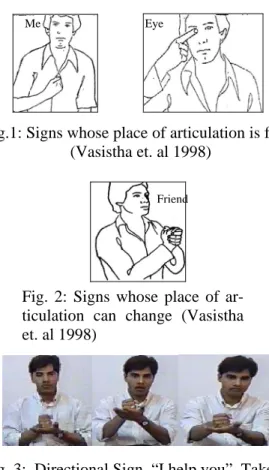
ISL lexicon is categorized according to the spa-tial behavior of the signs (Zeshan, 2003). There are three open lexical classes: i) Signs whose place of articulation are fixed, like, “hand”, “teeth”, “eye”, “me”, and “you” as shown in Fig. 1. ii) Signs whose place of articulation can change, like, “good,” “friend,” and “marry” as shown in Fig. 2. iii) Directional signs are those where there is a movement between two points in space. For exam-ple, in the sentence “I help him” the head word is “help” and direction of the sign is from subject “I” to the object “him” (Fig. 3). Directional signs gen-erally show verbal property (Zeshan, 2003). Apart from the directional signs, ISL morphology is mostly derivational in nature and there are no af-fixes in signs. The closed lexical class contains
1
www.sign-lang.uni-hamburg.de/Projekte/HamNoSys
classifier hand shapes, discourse markers, and non-manual signs (Zeshan, 2003). A classifier hand shape contains specification related to hand con-figuration that represents the characteristics of a referent. For example, consider the sentence “Put the cup on the table”. Here the hand configuration will contain shape of a “cup” added with a move-ment to express the event “put”.
ISL discourse structure is classified into manual and non-manual markers. Manual discourse mark-ers can occur either in clause final position (as in, “it’s over, what else we can do?”) or in clause ini-tial position (like, “well, I have nothing to say”). The non-manual marker like “head nodding” oc-curs only in clause final position after the last manual sign of the clause.
Me Eye
Fig.1: Signs whose place of articulation is fixed (Vasistha et. al 1998)
Friend
Fig. 2: Signs whose place of ar-ticulation can change (Vasistha et. al 1998)
Fig. 3: Directional Sign, “I help you”. Taken from AYJNIHH workbook video CD.
3
The State-of-Art for Text-to-Sign
Lan-guage
In spite of the advancements in modern computer science technology, there is a paucity of research in developing machine translation (MT) system on sign language particularly in India (Zeshan et al. 2004). Some of the MT systems for other sign
lan-guage are briefly described below. The underlying MT architecture can be classified into i) Direct translation system, ii) Transfer based architecture and iii) Statistical MT.
The direct translation approach generates the SL by direct replacement of the words of input English sentence. Generally the word order of the SL re-mains the same as that of the English text. How-ever, as in the case of English to ISL, the target SL may not allow the same word order. Also, the sys-tem assumes a strong knowledge of both the Eng-lish as well as the target SL.
Some of the direct translation systems include:
• TESSA: A Speech-To-British Sign Language (BSL) translation system that aims to provide a communication aid between a deaf person and a Post Office clerk. The system uses formulaic grammar approach where a set of pre-defined phrases are stored and translation is done by us-ing a phrase lookup table. However, the use of small set of sentences as templates makes TESSA a very domain specific system. It as-sumes a very restricted discourse between the participants (Cox, 2002).
• The SignSynth project (Grieve- smith 1998; Grieve-smith, 1999) uses ASCII-Stokoe model for the representation of Signs. The animated output is generated by converting ASCII-Stokoe into VRML (Virtual Reality Modeling Lan-guage). In his another project Grieve-Smith pro-posed a Text to American Sign Language (ASL) machine translation system. The system has been evaluated in the weather information domain. In a transfer architecture system, the source lan-guage representation is transformed into a suitable syntactically/semantically correct target language form by applying proper transfer grammar rules. These rules are dependent upon both the source and the target language. However, as the source/target language changes new rules are need to be added. The transfer grammar approach is not only used in text to SL MT systems but also in text-to-text MT systems, like the Shakti MT sys-tem which is used to translate English text to Hindi (Bharati et. al., 2001; Bharati et. al., 2003). The transfer architecture systems include:
• The ViSiCAST translator, which is a English to British Sign Language (BSL) translation tool
(Marshall & Sáfár, 2001; Bangham et al., 2000). The system uses HPSG (Pollard and Sag, 1994) formalism to represent source text into BSL and the grammar is implemented using a Prolog based system ALE. The system handles discourse phe-nomena by using Discourse Representation Struc-ture (DRS) (Bos et. al, 1994) and the phonology is represented in HamNoSys. This is one of the most successful system developed so far (Huenerfauth, 2003).
•The ASL workbench (Speers, 2001) is a Text-To-ASL MT system which uses Lexical Functional Grammar (LFG) (Kaplan, 1989) formalism to rep-resent English f-structure into ASL. The system uses a very sophisticated phonological model which is based on Movement-Hold principle of ASL phonology(Lidell & Johnson 1989).
•The TEAM project is a Text-To-ASL translation system where, the STAG (Synchronous Tree Ad-joining Grammar) formalism is used to represent source text into ASL syntactic structure (Zhao et al, 2000). The system maintains a bilingual lexicon to identify the valid word-sign pair. The output of the linguistic module was a written ASL gloss no-tation. The manual and non-manual information, including the morphological variation, are embed-ded with in the ASL gloss notation. The output of the synthesis module uses animated human models (Avatar).
In addition, An Example based MT system for English-Dutch sign language was proposed by (Morrissey and Way, 2005). Stein et.al. (2006) has proposed a statistical MT system which uses Hid-den Markov Model and IBM models for training the data. However, due to paucity of well anno-tated corpora, the system has been evaluated using a very small set of data.
3.1 Indian Scenario
INGIT is a Hindi-To-Indian Sign Language (ISL) Machine Translation system has been built for the railway reservation domain (Kar et. al, 2006). The system takes input from the reservation clerk and translates into ISL. The output of the system is an animated representation of the ISL-gloss strings via HamNoSys. INGIT is based on Hybrid-formulaic grammar approach unlike TESSA which uses purely formulaic approach. Here, Fluid Con-struction Grammar (FCG) (Steels and Beule, 2006)
is used to implement the Formulaic grammar. This is the only Hindi text-to-ISL machine translation tool encountered by us so far. However, the system is domain specific in nature and cannot be used for generic purpose. Further, the system does not have to handle any structural divergence between the source and the target language, as in most of the cases both Hindi and ISL show the same word or-der.
4
ISL MT Architecture
In order to overcome the above mentioned prob-lem, we initially developed a direct translation sys-tem, however due to its inherent drawbacks, as mentioned in section 3, we need some other ap-proach. One of the most popular techniques is to use statistical or case based MT system. However ISL does not have any written form, so it is very difficult to find any natural source of parallel cor-pora. Niedle et al. (2000) have proposed an ap-proach to collect corpus for statistical MT research, in his approach first, annotation standard for the various hand shape movements was developed, then the Sign Language performances were re-corded, and finally the recorded videos were manually transcribed. This is a very slow and ex-pensive process. Due to the difficulty in obtaining parallel corpora of ISL, the statistical MT ap-proaches may not be a feasible solution to our problem. Hence we decided to build a rule based transfer grammar MT system discussed in this sec-tion.
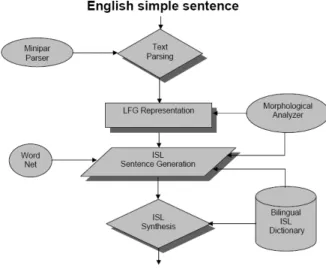
The system architecture of the proposed English Text-To-ISL MT system is composed of the fol-lowing four essential modules (see Fig. 4):
1. Input text preprocessor and parser 2. LFG f-structure representation 3. Transfer Grammar Rules 4. ISL Sentence Generation 5. ISL synthesis
4.1 Text Analysis & Syntactic Parsing
The current Text-To-ISL translator takes simple English sentence as an input to the parser. We de-fine simple sentence as, a sentence containing only one main verb. The input sentence is then parsed using the Minipar parser (Lin, 1998) and a depend-ency structure is constructed from the parse tree. However, before parsing, the input text is passed to
the preprocessing unit, where we try to identify the frozen phrases2 and temporal expressions3 which the syntactic parser is unable to identify. We pre-pare a phrase lookup table consisting of 350 frozen phrases and temporal expressions which are identi-fied before the input text is parsed. The parsing stage also includes classification of plural nouns. The plurality is identified using an English mor-phological analyzer.
Fig. 4:Architecture of the Text-to-ISL MT system
4.2 LFG Representation
The Minipar generated dependency structure is more akin towards the LFG functional structure (f-structure). The f-structure encodes grammatical relation (like subject, object, and tense) of the input sentence. It represents the internal structure of a sentence. This includes the representation of the higher syntactic and functional information of a sentence. This higher syntactic and functional in-formation of a sentence is represented as a set of attribute-value pairs. In an attribute-value pair, the attribute corresponds to the name of a grammatical symbol (e.g. NUM, TENSE) or a syntactic function (e.g. SUBJ, OBJ) and the value is the corresponding feature possessed by the concerning constituent. For example, Fig. 5 shows the attribute-value pair for the sentence “John Played Cricket”. The main advantage of f-structure is in its abstract represen-tation of syntactic and grammatical information of a sentence.
2
Phrases that are composed of Idioms, and Metaphor 3
F
4.3 ISL Generation
In the generation stage, English f-structure is con-verted to ISL f-structure by applying proper trans-fer grammar rules. Two main operations are per-formed during the generation phase: a) Lexical selection and b) Word order correspondence. Lexical selection is done using an English-ISL bi-lingual lexicon. For example word like “Dinner” in English is replaced by “NIGHT FOOD” in ISL and “Mumbai” is replaced by the sign of “BOMBAY”.
(1) English: “I had dinner with Sita”
ISL: “I SITA WITH NIGHT FOOD FINISH” ISL has essentially a Subject-Object-Verb word order (unlike English which is Subject-Verb-Object). For Example, (2) shows the change in word order from English to ISL.
(2) English: “I have a computer”
ISL: “I COMPUTER HAVE”.
However, in some cases the sign sentence de-pends upon the directionality of the verb as in (3).
(3) English: “I help you”
ISL: “HELP + < hand movement from to-YOU>”.
For sentences having only a subject and a verb, the subject always precedes the verb. Like:
(4) English: “The woman is deaf”
ISL: “WOMAN DEAF”.
However, if the sentence contains a dummy sub-ject (5), then the subject is removed from the out-put.
(5) English: “It is raining outside”
ISL: “OUTSIDE RAINING”
For negative sentences, a negation mark is used after the verb (6). The second bracket indicates a parallel non-manual component is attached with the sign “LATE”.
(6) English: “I am not late”
ISL: “I {LATE + NOT}”.
ig. 5:Attribute-Value pair for the sentence
ISL has separate rules to handle adjectives oc-curring before a noun. In most of the cases an ad-jective must occur after the noun. However, if the adjective specifies a color then it should precede the noun (see (7) & (8)).
“John Played Cricket”
(7) English: “The beautiful girl is playing”
ISL: “GIRL BEAUTIFUL PLAY”
(8) English: “I see a black cat”
ISL: “I BLACK CAT SEE”.
WH-Interrogative markers (like who, what, when, and why) always occur at the end of the sen-tence.
(9) English: “When is your birthday?”
ISL: “YOUR BIRTHDAY TIME+
QUESTION”.
In case of yes/no type of questions, the sentence is followed by a non-manual yes-no marker (Zeshan, 2004).
(10) English: “Is the man deaf?”
ISL: “MAN {DEAF} yes-no”
Since ISL does not have any articles or conjunc-tions, they are removed from the generated output as shown in example (2)-(10).
5
System Evaluation
Evaluating a Text-to-ISL MT system is difficult due to the absence of ISL written orthography. Hence, standard techniques for evaluating Text-Text MT systems are not applicable for Text- Text-to-ISL systems. However, we have evaluated the sys-tem based on the feedbacks of the ISL experts. The generated outputs of the system are shown to the ISL experts and are classified as either valid or invalid according to their understandability and quality. The system was evaluated on a set of 208
sentences4. Table 1.1 summarizes the performance of the system. The overall system performance is around 90%. Most of the errors are due to com-pound sentences and directional verbs5. To under-stand the relative performance of the system on the simple sentences, we conducted two experiments removing compound construction and directional verbs. From the current experimental set up, 7% errors are propagated due to directional verbs and around 4% errors are due to compound construc-tions.
No. of Sentences
Accuracy (%)
Overall Corpus size 208 89.4
Sentences without
di-rectional verbs 193 96.37 Sentences without compound construc-tions 201 92.53
6
ISL SynthesisThe ISL sentences thus generated are displayed via a stream of pre recorded videos or icons. However, it has been observed that the current approach of ISL synthesis is highly criticized (Grieve-Smith, 1999). As, representing ISL signs by pre-recorded video will result in loss of information related to discourse, classifier predicate, and directionality of sign. Also, storing sign video takes a lot of mem-ory overhead. To overcome this crisis further de-velopments are in progress. We represent ISL signs by HamNoSys and the generated HamNoSys string will be passed to the signing avatar.
6.1 HamNoSys
Sign language does not have any written form. In order to define a sign we need a notation system. The Hamburg sign language Notation system (HamNoSys) is a phonetic transcription system used to transcribe signing gestures. It is a syntactic representation of a sign to facilitate computer processing. HamNoSys is composed of several parameters by which a signing gesture can be de-fined like:
4
Corpus collected from “‘A’ level Introductory course in Indian Sign Language” Work Book AYJNIHH.
5
Verbs corresponding to directional signs.
• Dominant hand’s shape.
• Hand location with respect to the body.
• Extended finger orientation.
• Palm orientation
• Movements (straight, circular or curved)
• Non-manual signs.
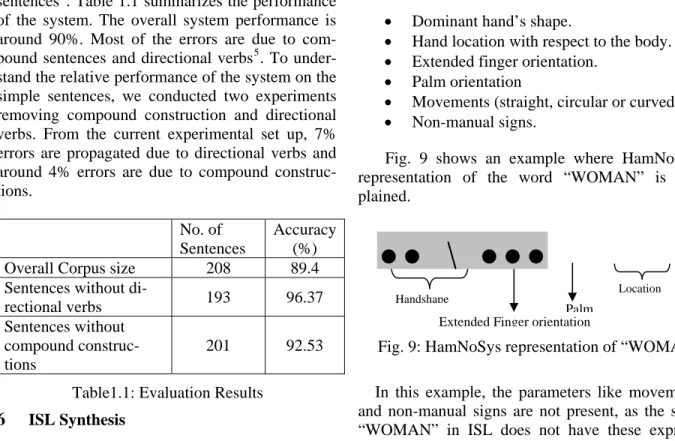
Fig. 9 shows an example where HamNoSys representation of the word “WOMAN” is ex-plained.
In this example, the parameters like movement and non-manual signs are not present, as the sign “WOMAN” in ISL does not have these expres-sions. Fig. 10 shows the ISL representation of “WOMAN”.
7
Conclusion and Future works
The paper presents a prototype text to ISL transla-tion system. Our approach uses LFG f-structure to represent ISL syntax. As ISL does not have any written form, there is no standard source of ISL corpus. Hence, statistical MT methods are not fea-sible under such a condition. Our system is still under development stage. The sign synthesis mod-ule using an animated avatar has not been devel-oped yet. We generate ISL output using pre-recorded ISL videos. Further morphological func-tionalities like, discourse, directionality, and classi-fier predicates are handled minimally
Table1.1: Evaluation Results
Fig. 9: HamNoSys representation of “WOMAN”
Fig. 10: Sign of “WOMAN” (Vashista et.al, 1998)
Extended Finger orientation
Handshape Location
Palm
In the next stage of our work, we will try to handle directional sign, discourse, and classifiers. The sign representation should be done using an animated avatar via HamNoSys notation. We will also develop the sign annotation tool and finally, a larger corpus will be built for a better evaluation and results.
References
N. Badler, R. Bindiganavale, J. Allbeck, W. Schuler, L. Zhao, S. Lee, H. Shin, and M. Palmer 2000. Param-eterized Action Representation and Natural Language Instructions for Dynamic Behavior Modification of Embodied Agents. AAAI Spring Symposium.
J. A. Bangham, S. J. Cox, R. Elliot, J. R. W. Glauert, I. Marshall, S. Rankov, and M. Wells. 2000. Virtual signing: Capture, animation, storage and transmission – An overview of the ViSiCAST project. IEEE Semi-nar on Speech and language processing for disabled and elderly people.
A. Bharati, D. M. Sharma, R. Sangal. 2001. AnnCorra : An Introduction, Technical Report no:
TR-LTRC-014, LTRC, IIIT Hyderabad, Mar 2001,
http://www.iiit.net/ltrc/ Publications/Techreports/TR-LTRC-14
A. Bharati, R. Moona, P. Reddy, B. Sankar, D.M. Sharma, R. Sangal, Machine Translation: The Shakti Approach, Pre-Conference Tutorial at ICON-2003.
J. Bos, E. Mastenbroek, S. McGlashan, S. Millies, M. Pinkal. 1994. A Compositional DRS-based Formal-ism for NLP Applications. Report 59. Universitaet des Saarlandes.
S. Cox, M. Lincoln, J. Tryggvason, M. Nakisa, M . Wells, M. Tutt, S. Abbott. 2002. Tessa, a system to aid communication with deaf people. Fifth interna-tional ACM conference on Assistive technologies. M. Huenerfauth. 2003. A Survey and Critique of
American Sign Language Natural Language Genera-tion and Machine TranslaGenera-tion Systems. Technical
Re-port MS-CIS-03-32, Computer and Information
Sci-ence, University of Pennsylvania.
A. Joshi, L. Levy and M. Takahashi. 1975. Tree Ad-junct Grammar. Journal of computer and system sci-ences.
P. Kar, M. Reddy, A. Mukherjee, A. M. Raina. 2007. INGIT: Limited Domain Formulaic Translation from Hindi Strings to Indian Sign Language. ICON. Ronald M. Kaplan. 1989. The formal architecture of
lexical-functional grammar. Journal of Information-Science and Engineering 5: 305-322.
Scott Liddell and R. E. Johnson. 1989. American Sign Language: The phonological base. Sign Language Studies 64: 195-277.
D. Lin. 1998. Dependency-based evaluation of MINI-PAR. In Workshop on the Evaluation of Parsing Sys-tems, Granada, Spain,
I. Marshall and É. Sáfár. 2001. Extraction of semantic representations from syntactic SMU link grammar linkages.. In G. Angelova, editor, Proceedings of
Re-cent Advances in Natural Lanugage Processing, pp:
154-159, Tzigov Chark, Bulgaria, September.
S. Morrissey and A. Way. 2005. An Example-Based Approach to Translating Sign Language. In Proceed-ings of Workshop Example-Based Machine Transla-tion (MT X -05), Phuket, Thailand.
C. Neidle, J. Kegl, D. MacLaughlin, B. Bahan, and R. G. Lee. 2000. The Syntax of American Sign Lan-guage: Functional Categories and Hierarchical
Structure. Cambridge, MA: The MIT Press.
C. J. Pollard, and I. A. Sag. 1994. Head-driven Phrase
Structure Grammar. University of Chicago Press,
Chicago, IL.
S. Prillwitz, R. Leven, H. Zienert, T. Hamke, and J. Henning. 1989. HamNoSys Version 2.0: Hamburg Notation System for Sign Languages: An Introduc-tory Guide, volume 5 of International Studies on Sign
Language and Communication of the Deaf. Signum
Press, Hamburg, Germany,
É. Sáfár and I. Marshall. 2001. .The architecture of an English-text-to-Sign-Languages translation system..
In G. Angelova, editor, Recent Advances in Natural
Language Processing(RANLP), pp: 223-228. Tzigov
Chark, Bulgaria.
G. Angus Smith. 1998. Sign synthesis and sign phonol-ogy. Proceedings of the First High Desert Student Conference in Linguistics.
G. Angus Smith. 1999. English to American Sign Lan-guage machine translation of weather reports. Pro-ceedings of the Second High Desert Student Confer-ence in Linguistics.
A. Speers. 1995. SL-Corpus: A computer tool for sign language corpora. Georgetown University.
A. Speers. 2001. Representation of American Sign
Lan-guage for Machine Translation. PhD Dissertation,
Department of Linguistics, Georgetown University. L. Steels and J. Beule. 2006, Unify and Merge in Fluid
Construction Grammar, In: Lyon C., Nehaniv, L. & A. Cangelosi, Emergence and Evolution of Linguistic
Communication, Lecture Notes in Computer Science.
D. Stein, J. Bungeroth and H. Ney. 2006. Morpho-Syntax Based Statistical Methods for Sign Language Translation. In Proceedings of the 11th Annual conference of the European Association for Machine Translation. Oslo, Norway.
M. Vasishta, J. Woodward and S. DeSantis. 1998. An Introduction to Indian Sign Language. All India Fed-eration of the Deaf (Third Edition).
Elizabeth Winston. 1993. Spatial mapping in compara-tive discourse frames in an American Sign Language
lecture. Doctor of Philosophy in Linguistics diss.,
Georgetown University.
L. Zhao, K. Kipper, W. Schuler, C. Vogler, N. Badler, and M. Palmer. 2000. A Machine Translation System from English to American Sign Language. Associa-tion for Machine TranslaAssocia-tion in the Americas. U. Zeshan. 2003. Indo-Pakistani Sign Language
Gram-mar: A Typological Outline. Sign Language Studies -
Volume 3, Number 2 , pp. 157-212.
U. Zeshan. 2004. Interrogative Constructions in Signed Languages. Crosslinguistic Perspectives Language - Volume 80, Number 1, pp. 7-39.
U. Zeshan, M. Vasishta, M. Sethna. 2004. Implementa-tion of Indian sign language in educaImplementa-tional settings- Volume 15, Number 2, Asia Pacific Disability Reha-bilitation Journal, pp. 15-35