ISSN: 2501 - 1235 ISSN-L: 2501 - 1235 Available on-line at: www.oapub.org/edu
Copyright © The Author(s). All Rights Reserved. doi: 10.5281/zenodo.1321742 Volume 4 │ Issue 9 │ 2018
COMPETITIVE BOUT MODEL
AS A TOOL FOR ESTIMATION OF
FEMALE KARATEKA SPECIFIC ENDURANCE
Albena Alexandrova1i, Radoslav Penov2, Lubomir Petrov1, Kostadin Cholakov3, Stefan Kolimechkov1
1Department of Physiology and Biochemistry,
National Sports Academy, Sofia, Bulgaria
2Department of Wrestling and Judo, Coaches Faculty,
National Sports Academy, Sofia, Bulgaria
3Security Solutions Institute ltd, Sofia, Bulgaria
Abstract:
The aim of this study was to establish the functional state of female karate practitioners during a Shotokan kumite competition by measuring changes in their lactate concentration and also by designing a training exercise model that matches the workload during competitions. Seven female karate practitioners, between the ages of 18 and 30, took part in this research, which was conducted in two stages: 1) in competitive conditions during the National Shotokan Karate Championship, where capillary blood lactate concentration was measured both after the warm-up and after each bout; 2) in training conditions, where again the blood lactate concentration was determined post warm-up and after performance of the karate kumite model, which consisted of a series of techniques designed to simulate competitive kumite, and in addition to this the heart rate was recorded continuously using a heart-rate telemetry system. According to the results from the maximal aerobic test, the training level of the female karatekas tested was comparable to that of internationally ranked competitors from other countries. The lactate concentrations measured during the competition were a more reliable predictor of the competitive ranking in comparison to VO2max. The
designed karate kumite training model simulated well the level of competitive load based on a comparison of the measured lactate concentrations and those determined during the competition. In all the women tested, the heart rate measured after the simulated kumite was close to the maximal values (about 180 bpm), and thus did not
i Corresponding author: Assoc. Prof. Albena Alexandrova, PhD, Department of Physiology and
adequately reflect the work intensity. In conclusion, since lactate concentration accurately reflects competitive output, and correlates with the exercise intensity during a designed training model, it could be used for evaluation of the physical load and specific endurance, particularly of female karate practitioners.
Keywords: heart rate, lactate concentration, Shotokan Karate, women
1. Introduction
Karate will join the Olympic sports at the 2020 Summer Olympic games in Tokyo (IOC, 2016). A karate tournament will comprise a kumite and a kata competition, as both competitions will be split equally between men and women. The goal of every athlete and coach is to achieve good sports results, especially at the Olympic Games. This requires adequate training that depends to a large extent on the coach’s knowledge and experience, and the athlete's efforts and persistence. One of the basic methods by which the coaches can obtain information about the athlete's functional status, comprehend the metabolic changes at different workloads, determine the work capacity and the degree of training, as well as the recovery process, is the changes in physiological and biochemical indicators of the athlete. The heart rate and blood lactate concentration are widely used to assess the physiological capacity of athletes and prescribe the duration and intensity of the exercise. Heart rate is the most readily available indicator of cardio-vascular system load (Dong, 2016), and is sensitive to any increase in intensity and resistance. The changes in lactate concentration during exercise reflect both the capacity of the central circulation to transport oxygen from the lungs to exercising muscles, and the peripheral capacity of the muscles to utilize the delivered oxygen (Jacobs, 1986).
In most cases during the training sessions, coaches do not make a distinction between women and men in the intensity and the duration of the workout (Atkinson, 1983). Existing data on the body's physiological responses to the karate workload are mostly for men. To the best of our knowledge, there are very few articles that have examined female karate practitioners (Doria et al., 2009; Imamura et al., 2002; Shaw and Deutsch, 1982; Tabben et al., 2014a). In the study of Shaw & Deutsch (Shaw and Deutsch, 1982) and Tabben et al. (Tabben et al., 2014b), although both male and female karate practitioners were studied, the results were not presented separately for both sexes. Imamura et al. (Imamura et al., 2002) explored the possibility of women karate practitioners achieving the threshold of effective aerobic capacity training, fat reduction and weight loss, as well as an increase in oxygen debt in a single training session. In the work of Doria et al. (Doria et al., 2009) only three women were included. The study of Tabben et al. (Tabben et al., 2014a) makes a comparative assessment between men and women karate practitioners, as the latter group included eight women ranked as national (n=4) and international (n=4) contestants.
model that matches the workload during the respective bouts in a women's kumite competition. The knowledge of physiological and biochemical changes in the body of women competing in Shotokan karate would contribute to the establishment of a training model that will best meet the requirements during competition and will be a prerequisite for achieving good sporting results.
2. Materials and methods
2.1 Participants
Seven female karate practitioners, between 18 and 30 years of age, competing in the kumite (point sparring) discipline in the age group of +18, took part in this study. All of them were members of the Shotokan Karate National Team, with numerous awards from prestigious tournaments.
All the participants were informed about the purpose and the conducting of the study, and signed informed consents were received, in accordance with the requirements of the Declaration of Helsinki for Human Researches.
Study design
Two studies were conducted:
1. In real competitive conditions during the National Championship Shotokan Karate Do at the Bulgarian Federation of Shotokan Karate. All seven participants in the study took either first, second, or third place in their respective categories at the championship in the discipline Kumite - women 18+ (Table 1).
Table 1: Results of the participants in this study at the 2016 National Shotokan Karate Championships in the discipline Kumite for women 18+ years of age
Practitioner № Category Rank
1 -55 kg 3rd place
2 +60 kg 2nd place
3 +60 kg 1st place
4 -60 kg 2nd place
5 -60 kg 3rd place
6 -60 kg 1st place
7 -55 kg 1st place
The capillary blood lactate concentration was measured during the competition post warm-up and after each bout of 2 minutes’ duration (effective time).
2. In training conditions during a pre-competitive camp of the national karate team. All of the women surveyed during the National Championship took part in this camp. An additional contestant who served as a sparring partner was included in the study (thus the number of women tested was eight). During the training sessions, they performed a series of techniques that simulated a highly intensive real bout (2 minutes, 100% effective time). The competitive bout model included: A. A 30-second performance of the kizami-zuki (front snap punch, or jab); both
B. A 30-second performance of the kizami-zuki (jab punch) - gyaku-zuki (reverse punch) combination; both partners performed the combination of a total of 10 strikes, one after another.
C. A 30-second performance of the combination of kizami-zuki - gyaku-zuki - maswashi geri (roundhouse kick); they took turns, performing the combination 4 times.
D. A 30-second performance of the Deai (direct (interception) counter against an attack) against kizami-zuki and a counter-strike with a gyaku-zuki; the partners took turns, performing the combination 10 times.
The heart rate was recorded during the performance, and before and after each exercise, the concentration of lactate was determined.
2.2 Physical characteristics
Body weight (BW) with accuracy of 0.05 kg, percent body fat (%BF) and muscle mass percentage (%MM) were measured using a Tanita Body Composition Monitor BC601. Body height (BH) was measured to the nearest 0.5 cm using a wall-mounted stadiometer.
Body mass index (BMI) was calculated as BW (kg) divided by BH (m) squared.
2.3 Maximal oxygen uptake
The maximal oxygen uptake (VO2max) was assessed by a maximal exercise test on a
cycle ergometer according to the following protocol: the duration of the step was 1 min 30 sec, the initial power was 60 W, the increase of each step was 30W, until exhaustion. The analysis of exhaled gases (O2 and CO2) was performed in real time using a
metabolic device (Jaeger-Pro, Germany).
2.4 Lactate concentration assay
The capillary blood lactate concentration was determined using Lactate Pro 2 LT-1730 (Arkray Global Business Inc., Japan). The capillary blood was taken from the pendant of the athlete's ear.
2.5 Heart rate recording
Heart rate (HR) was recorded using the TEMEO telemetry system (Security Solutions Institute, Bulgaria) (Mateev et al., 2012). The system also recorded the accelerations in three orthogonal axes (X, Y and Z) over 20 ms using a built-in three-dimensional accelerometer. The data obtained were processed using the specialized software.
2.6 Statistical analysis
3. Results
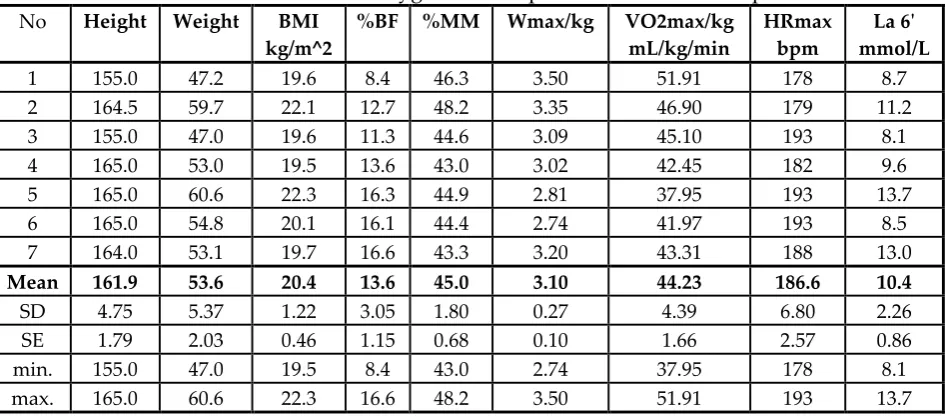
Presented in Table 2 are the basic anthropometric data of the female karate practitioners surveyed and their results from the maximal oxygen uptake test conducted.
Table 2: Results of the maximal oxygen consumption test of the karate practitioners
No Height Weight BMI kg/m^2
%BF %MM Wmax/kg VO2max/kg mL/kg/min
HRmax bpm
La 6' mmol/L
1 155.0 47.2 19.6 8.4 46.3 3.50 51.91 178 8.7
2 164.5 59.7 22.1 12.7 48.2 3.35 46.90 179 11.2 3 155.0 47.0 19.6 11.3 44.6 3.09 45.10 193 8.1 4 165.0 53.0 19.5 13.6 43.0 3.02 42.45 182 9.6 5 165.0 60.6 22.3 16.3 44.9 2.81 37.95 193 13.7 6 165.0 54.8 20.1 16.1 44.4 2.74 41.97 193 8.5 7 164.0 53.1 19.7 16.6 43.3 3.20 43.31 188 13.0
Mean 161.9 53.6 20.4 13.6 45.0 3.10 44.23 186.6 10.4
SD 4.75 5.37 1.22 3.05 1.80 0.27 4.39 6.80 2.26 SE 1.79 2.03 0.46 1.15 0.68 0.10 1.66 2.57 0.86 min. 155.0 47.0 19.5 8.4 43.0 2.74 37.95 178 8.1 max. 165.0 60.6 22.3 16.6 48.2 3.50 51.91 193 13.7
The results showed that the women had almost equal height (164-165 cm), as only two of them were shorter (155 cm). The average height of the athletes was 161.9 ± 4.75 cm, and the average weight was 53.6 ± 5.37 (min. 47.0 and max 60.6 kg), with the calculated body mass index (BMI) being within the norm, with an average of 20.4 ± 1.22 kg/m2.
Only two girls (No. 2 and No. 5) had higher indexes, of 22.1 and 22.3 kg/m2 respectively.
Athlete No. 2 had body fat percentage (%BF) of 12.7% and muscle mass percentage (%MM) of 48.2% (the highest value of all those measured), which indicated that she had a very well-developed musculature, which affects the weight and, hence, the BMI. Three of the women had %BF of about 16 (16.3, 16.1 and 16.6%). The lowest percentage of body fat was that of athlete No.1 - 8.4%, whose musculature was also well-developed, with her muscle mass percentage being 46.3%. This woman also showed the highest maximum oxygen consumption of 51.92 ml/kg/min, which was very close to the values measured in men (Chaabène et al., 2012). Despite this high value for VO2max/kg,
this karate practitioner took 3rd place in the competition in the category of up to 55 kg, and the winner (No. 7) had significantly lower VO2max/kg. Athlete No. 5 had the
lowest oxygen consumption - 37.95 mL/kg/min, and also had the highest lactate concentration values - 13.7 mmol/L. With regards to heart rate, the two athletes (No. 1 and No. 2) with the highest VO2max/kg showed the lowest heart rate values - 178 and
179 rpm, respectively. Average heart rates were calculated at 186.6 ± 6.80 bpm.
3.1 Research in competitive conditions
0.7 mmol/L (No. 3) and 1.7 mmol/L (No. 7), respectively. The lactate concentration values increased progressively after each bout. Karate practitioner No. 4 had a lower lactate concentration after the 3rd bout due to a significant drop in the pace of the contest. The average values of the lactate concentrations showed a statistically significant increase after the first bout compared to the warm-up (p <0.001), and after the second bout compared to the first (p <0.05). However, there was not a significant increase in the values obtained after the third bout compared to the second. This insignificance is most likely due to the small number of individuals tested, as only two participants reached the third bout. Their blood lactate concentration values were quite different at the end of the competition, which resulted in an increased standard deviation.
Table 3: Individual and mean values of blood lactate concentrations after warm-up, 1-st, 2-nd and 3-rd bout
Karate competitor after warm-up after 1-st bout after 2-nd bout after 3-th bout
1 1.0 4.8 6.2
2 1.2 4.1 4.9
3 0.7 3.4 4.7
4 0.9 3.2 5.5 4.1
5 0.9 4.5
6 1.3 4.0 6.3 9.1
7 1.7 3.1 8.2
Mean value 1.1 3.9*** 6.0∆ 6.6
SD 0.33 0.66 1.27 3.54
SE 0.13 0.25 0.52 2.50
*** - p < 0.001 vs lactate concentration after warm-up ∆ - p < 0.05 vs lactate concentration after 1-st bout
3.2 Research in training conditions
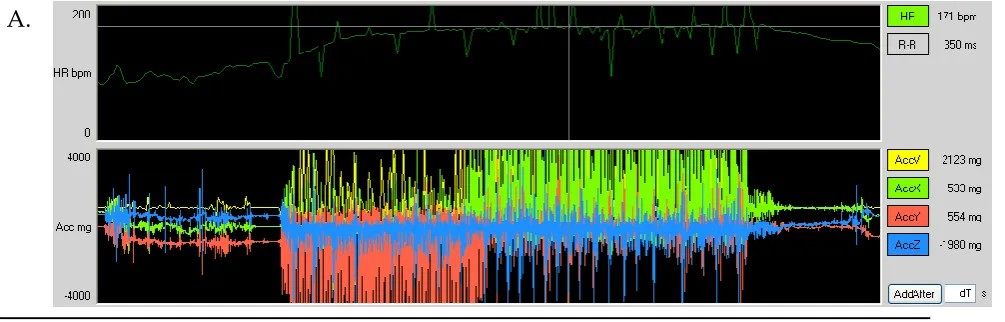
The women surveyed during the Championship performed simulated kumite for 3 minutes in training conditions. Heart rates were recorded throughout the training and the mean heart rate reached a value of 171 ± 4.14 bpm during the kumite performance. Figure 1A and B shows the records of athletes No. 1 and No. 5, respectively. The accelerometer data continuously showed constant physical load in all the records, with a slight decrease in performance rate at the end of the exercise.
B.
Figure 1: The HR (green line) and three-dimensional accelerometer data (AccX - green, AccY – red and AccZ –blue) of athletes No. 1 (A) and No. 5 (B).
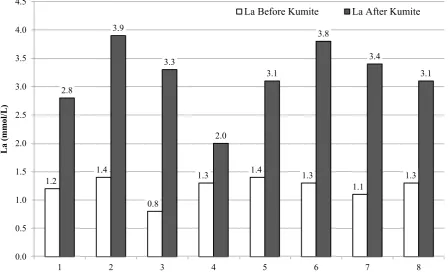
Lactate concentrations were measured prior to the warm-up, before the commencement of the kumite, and after the end of the sparring session. The individual lactate concentration values are presented in Figure 2. The baseline ranged from 0.8 mmol/L to 1.4 mmol/L. After the kumite performance, the lactate concentration increased in all women, with the highest values of 3.9 for athlete No. 2. The average values showed a significant increase in lactate concentration after the kumite performance in comparison to the baseline (3.2 ± 0.60 vs 1.2 ± 0.20 mmol/L).
1.2
1.4
0.8
1.3 1.4 1.3
1.1
1.3 2.8
3.9
3.3
2.0
3.1
3.8
3.4
3.1
0.0 0.5 1.0 1.5 2.0 2.5 3.0 3.5 4.0 4.5
1 2 3 4 5 6 7 8
La
(m
m
ol
/L)
La Before Kumite La After Kumite
4. Discussion
The data from the physical condition testing of the female karate practitioners who were tested showed that their BMI was within the normal range. Their average BMI (20.4 ± 0.46 kg/m2) completely matches the data of Doria et al. (Doria et al., 2009) and
Tabben et al. (Tabben et al., 2014a) (21.07 kg/m2 for international level practitioners and
20.52 kg/m2 for national level competitors). Bulgarian female karate practitioners
showed a significantly lower percentage of body fat (13.6 ± 1.15%) compared to the women examined by Tabben et al. (Tabben et al., 2014a) (20.5 ± 4.7% for international practitioners and 19.9 ± 4.8% for national competitors).
The athletes tested by us showed similar average scores of VO2max/kg (44.23 ±
1.66 ml/min/kg) to ‘top-level’, national and international karate practitioners, as evidenced by the data of Doria et al. (42.9 ± 1.6 mL/min/kg) (Doria et al., 2009) and of Tabbien et al. (44.0 ± 2.9 mL/min/kg) (Tabben et al., 2014a). For the international competitors tested by Tabbien et al. (Tabben et al., 2014a) the registered values were slightly higher - 48.0 ± 2.6 mL/min/kg. One of the women (No. 1) examined by us showed an excellent result for VO2max/kg (51.91 mL/min/kg), which is comparable to
the results for men (Tabben et al., 2014b).
During karate kumite fighting, the main energy provider for the movements is the aerobic system with a share of 77.8 ± 5.8% ; the system of immediate energy supply (ATP-CP) provides 16 ± 4.6%, while the anaerobic lactate system delivers only about 6.2 ± 2.4% of the total energy supply (Beneke et al., 2004). Probably for this reason, during the National Shotokan Karate Championship, we found relatively small increases in the mean blood lactate levels of the athletes tested compared to the baseline values (Table 2). To the best of our knowledge, there is no data on the dynamics of lactate concentration in real competitive conditions. Our data showed a progressive rise in lactate concentration after the first, second, and third kumite (3.9 ± 0.25, 6.0 ± 0.52 and 6.6 ± 2.5 mmol/L, respectively). This is due to the incremental increase of the workload between the individual bouts and the incomplete recovery between them. A similar dynamic was observed in the lactate concentration in the blood of the winners in the categories of up to 55 kg (No. 7) and up to 60 kg (No. 6). They started with the highest lactate values (1.7 mmol/L and 1.3 mmol/L, respectively) and finished with the highest (8.2 mmol/L and 9.1 mmol/L, respectively) (Table 3). During the final bouts of a tournament, the contestants exert a greater effort, which is associated with a higher glycolytic energy supply, leading to an increase in lactic acid in the blood.
The goal of this model was to incorporate all the basic karate kumite techniques and thus to approximate the workload in real competitive conditions. These are the most commonly used single-attack kizami-zuki, the most commonly used double attack-
kizami-zuki - gyaku-zuki, and the most commonly used triple attack kizami-zuki -
gyaku-zuki - maswashi geri. Finally, we also included the most commonly used counterattack Deai.
The concentration of lactate in the blood of the female karate practitioners, measured after this training model, reached values very close to those after the first bouts of the National Championship. The average values were as follows: 3.2 ± 0.28 mmol/L after the training exercise performance and 3.9 ± 0.25 mmol/L after the competitive bout. These data demonstrated that the designed bout model corresponds to the changes in energy production that occur in the body of the karate practitioners during a real competition.
The average heart rate of the tested women karate practitioners after the simulated kumite was 171 ± 4.14 bpm, which was maintained during all training sessions. This corresponded to aerobic exercise at 70-75% of VO2max and was within
the range of the recommended exercise heart rate for cardiovascular endurance (cardio workout) for about 15 minutes. Therefore, six consecutive designed kumite with a very short rest between them would provide a good cardio workout, and would be a model for a very heavy and long-lasting karate competition. It should be noted that some authors report higher HR values in female karate practitioners (Imamura et al., 2002; Tabben et al., 2014a) compared to HR in male karate practitioners (Imamura et al., 1999; Tabben et al., 2014a) during common karate training. Tabben et al. (Tabben et al., 2014a) indicates values for HR of 70.3 ± 4.1 versus 66.2 ± 6.3% HRmax, for women and men respectively. These results seem surprising, as it has been shown that cardiac output in men and women is similar in the same submaximal exercises (Kenney et al., 2012; Wilmore and Costill, 2004). Whereas men have a lower heart rate (due to the larger left ventricle and higher blood volume), women have a higher HR. On the other hand, HRmax values are generally the same for both sexes. Therefore, since HRmax is not gender-specific and HR is higher in women, probably in submaximal loads a higher percentage of women reach HRmax compared to men. Doria et al. (Doria et al., 2009) reported significantly higher HRmax in women competing in international competitions (97 ± 6% HRmax) during simulated sparring. On the basis of these data, it is difficult to draw conclusions due to the small number of subjects. Therefore, because of the heterogeneous and scarce information, further research is needed to confirm and explain these findings.
5. Conclusion
increases exponentially (after the lactate threshold), reflecting physical exercise intensity, is a better predictor of the energy output during a kumite competition, and is a better measure of the karate work intensity than heart rate.
Acknowledgements: This study was supported by Grant ЦРАС-06/06-04-2017 from the National Sports Academy, Sofia, Bulgaria
About the Authors
Corresponding author:
Associate Professor Albena Alexandrova, PhD
Department of Physiology and Biochemistry, National Sports Academy, Sofia, Bulgaria Academia.edu: https://bas.academia.edu/AlbenaAlexandrova
ORCID: https://orcid.org/0000-0002-7007-3665
Research Gate: https://www.researchgate.net/profile/Albena_Alexandrova
Google Scholar: https://scholar.google.co.uk/citations?user=xnEtifwAAAAJ&hl=en
e-mail: [email protected]
Assistant Professor Radoslav Penov, PhD
Department of Wrestling and Judo, National Sports Academy, Sofia, Bulgaria The Founder and President of Karate Fighters Club – NSA
e-mail: [email protected]
Associate Professor Dr. Lubomir Petrov, PhD
Department of Physiology and Biochemistry, National Sports Academy, Sofia, Bulgaria Academia.edu: https://nsa-bg.academia.edu/LubomirPetrov
ORCID: https://orcid.org/0000-0003-1209-959X
Research Gate: https://www.researchgate.net/profile/Lubomir_Petrov5
Google Scholar: https://scholar.google.co.uk/citations?user=9Wfrt3sAAAAJ&hl=en
e-mail: [email protected]
Kostadin Cholakov
IT Engineer, Security Solutions Institute ltd, Sofia, Bulgaria e-mail: [email protected]
Stefan Kolimechkov, PhD
Elite Gymnastics Academy CIC, London, United Kingdom
2015-2018: PhD student at the Department of Physiology and Biochemistry, National Sports Academy, Sofia, Bulgaria
Academia.edu: https://nsa-bg.academia.edu/StefanKolimechkov
ORCID: http://orcid.org/0000-0003-0112-2387
Research Gate: https://www.researchgate.net/profile/Stefan_Kolimechkov
Google Scholar:
https://scholar.google.co.uk/citations?user=5SexEjYAAAAJ&hl=en&oi=sra
References
1. Atkinson L (1983). Women in the martial arts : a new spirit rising (New York: Dodd, Mead).
2. Beneke R, Beyer T, Jachner C, Erasmus J, and Hütler M (2004). Energetics of karate kumite. European Journal of Applied Physiology 92:518–523.
3. Chaabène H, Hachana Y, Franchini E, Mkaouer B, and Chamari K (2012). Physical and physiological profile of elite karate athletes. Sports Medicine 42:829–843.
4. Dong JG (2016). The role of heart rate variability in sports physiology (Review). Experimental and Therapeutic Medicine 11:1531–1536.
5. Doria C, Veicsteinas A, Limonta E, Maggioni MA, Aschieri P, Eusebi F, Fanò G, and Pietrangelo T (2009). Energetics of karate (kata and kumite techniques) in top-level athletes. European Journal of Applied Physiology 107:603–610.
6. Imamura H, Yoshimura Y, Nishimura S, Nakazawa AT, Teshima K, Nishimura C, and Miyamoto N (2002). Physiological responses during and following karate training in women. Journal of Sports Medicine and Physical Fitness 42:431–437. 7. Imamura H, Yoshimura Y, Nishimura S, Nakazawa AT, Nishimura C, and
Shirota T (1999). Oxygen uptake, heart rate, and blood lactate responses during and following karate training. Medicine and Science in Sports and Exercise 31:342–347.
8. IOC (2016). IOC approves five new sports for Olympic Games Tokyo 2020 - Olympic News.
9. Jacobs I (1986). Blood lactate. Implications for training and sports performance. Sports Medicine 3:10–25.
10.Kenney WL, Wilmore JH, and Costill DL (2012). Physiology of sport and exercise (Champaign, USA: Human Kinetics).
11.Markovic G, Vucetic V, and Cardinale M (2008). Heart rate and lactate responses to taekwondo fight in elite women performers. Biology of Sport 25:135–146. 12.Mateev H, Simova I, Katova T, and Dimitrov N (2012). Clinical Evaluation of a
Mobile Heart Rhythm Telemonitoring System. ISRN Cardiology 1–8.
13.Shaw DK, and Deutsch DT (1982). Heart rate and oxygen uptake response to performance of karata kata. Journal of Sports Medicine & Physical Fitness Dec 22:461–468.
14.Tabben M, Chaabène H, Franchini E, Tourny C, Chamari K, and Coquart J (2014a). The influence of karate practice level and sex on physiological and perceptual responses in three modern karate training modalities. Biology of Sport 31:201–207.
15.Tabben M, Coquart J, Chaabène H, Franchini E, Chamari K, and Tourny C (2014b). Validity and reliability of a new karate-specific aerobic field test for karatekas. International Journal of Sports Physiology and Performance 9:953–958. 16.Wilmore JH, and Costill DL (2004). Physiology of sport and exercise (Human
Creative Commons licensing terms