ISSN: 1992-8645 www.jatit.org E-ISSN: 1817-3195
501
AGENT MODEL DEVELOPMENT BY USING ONTOLOGY
IN UNIVERSITY’S ARCHIVING
1
MUHAMMAD HASBI, 2 RETANTYO WARDOYO, 3 JAZI EKO ISTIYANTO,
4 KHABIB MUSTOFA 1
Computer Science Post Graduate Program, Faculty Of Mathematics And Natural Sciences,
Universitas Gadjah Mada Yogyakarta, Indonesia
2,3,4
Computer Science Post Graduate Program, Faculty Of Mathematics And Natural Sciences,
Universitas Gadjah Mada, Yogyakarta, Indonesia
E-mail: [email protected], [email protected], [email protected], [email protected]
ABSTRACT
Email classification, based on its subject targetted to the chief. The email should be targetted to the other unit appropriate with its email content. This research is limited with the email domain at university and aimed at making agent model using ontology classify emails based on their subject and content in the university’s archiving process. The use of agent to classify emails is done in order the process run autonomously. However, using agent with ontology to classify emails based on their subject and content is still becoming something interesting to study since there is no such research done before. Hence, this research is proposed to develop models to classify emails based on content by using agent with ontology to overcome the problem of archiving.
The agent used is the multi-agent which is reactive and proactive that can work autonomously. These agents classify emails and dispose them by ontology to certain unit in the university. The email classification method used is the Naive Bayesian method. The classification is based on the email’s content to determine the email’s topic which is the keyword of the unit’s job description in the university. The keyword then is used to enquery it to the ontology data. The query is aimed at determining the email’s target unit in the university. The ontology is the representative of the knowledge of the Unit’s job description in the organization structure of a university.
The use of ontology can result in the disposition target distributedly in the university’s units appropriate with its email subject and content. This model can be run precisely in determining the email’s disposition target to a certain unit in the university.
Keywords: Agent, Reactive, Classification, Disposition, Ontology.
1. INTRODUCTION
Archiving has come in various forms for centuries. The most basic electronic archiving is ing the world the file archiving. Email is a form of the most famous electronic archiving and the one to be discussed [1]. Archive can be in forms of documents [2]. Just imagine the world without document! No books, no magazines, no emails, no laws, and no recipies. Since prehistoric age, document has played significant role in managing the civilization. People could make arguments into sense that material and social progress is as dense as the document [3].
Recently, archiving is becoming a popular issue [1], archive is a document [2], digital mail
(email) [3], [4], that can be accessed through computer network. There have been several email classification [5] such as by using J48 [6], Support Vector Machine, Boost, Naive Bayesian [7], [8], [9], Random Forest [10], reversal propagation technique [11] and selection method [12].
ISSN: 1992-8645 www.jatit.org E-ISSN: 1817-3195
502 process data [14] has ever been carried out too. On the other hand, the use of agent in classifying and knowing the email’s content has not been carried out. In addition, the use of ontology in determining the email classification is to connect the word in the result of the email classification semantically so that it can suit the content of the ontology or the different perception of the term but with the same meaning.
Several researches on document classification have ever been done. They are the one using Hidden Markov Models [15] and using ontology [16], using agent with statistic method [17], classification of document’s title using agent [18], and using compressed method based on compound word with cluster analysis [19]. A research on the comparison between document classification using single agent (machine) and multi-agent in the computer network has also been done [20]. The single agent compared the vocabulary (thesaurus) with centrallized document while the multi-agent did it with the decentrallized ones. The agent in each computer network shared its role in classifying the documents. The criteria being compared were the responding time, the quality of classification, and the economical matter.
The use of ontology in managing archives (digital documents) has ever been studied. The cooperation of information agents in managing archives using ontology [21] and compiling ontology to manage digital archives semantically has also been researched [22]. So has the autonomous agent which locally archive the documents from the webs considered to be important [23].
There has also been a research on the use of agent to manage ontology [24], [25], [26], [27], [28]. However, the agent used explicitly was not reactive and proactive yet in managing the ontology although it was autonomous already. The ontology being used was based on the basis of logistic knowledge, omitted the query ambiguity and to make the access to the repository possible and automatically processed. Hence, the ontology involved had not used the source of knowledge of archive problems from the university.
The incoming email from other institutions which is targetted to the senate (in this case the rector/chief/director) actually is not only for the senate but also for the units under the senate. Manually, email disposition to the target is necessary to be done. There are several problems appear during the email disposition, such as (1)
when the senate is not in his place, there will be a time delay for the email disposition that is the time when the senate has come to his office and given disposition. (2) the email disposition also needs to comprehend the mail’s content (means, it needs time to read the email) to determine the disposition of the email to the unit which is suitable with the the targetted unit’s job description. This might bear the mistargetting of the email disposition since the senate does not really understand (or probably forget) the unit’s job description under him.
The question of the research is developing a model agent with ontology in email disposition in a university and how effective the model is. The other question is how the agent model explains the character of the proactive agent in classifying the email. The last, how the agent model with its reactive character use ontology in representing the combination of the knowledge of organization structure and the job description in the university can determine the email disposition target.
So far, there has not been any researches that use agents and ontology in archiving system. Neither has the development of reactive and proactive agent model to process email classification to determine the email target of certain unit. Hence, this is a new research proposal in case of developing agent model which is reactive and proactive and ontology to manage the email disposition in the university archiving.
2. RELATED WORKS
There has been a research on email classification to know spams that have ever been done [5] and [6] have used ontology but without agent. However this classification cannot work autonomously yet.
Adaptive ontology has been developed to filter spam email. This is of course very important to share this information since it can be used to filter spam more efficiently. On the other hand, classifying emails using Naive Bayesian using ontology to determine whether an email is necessary to be archived or not gave different result [6]. The classification of emails did not use agents yet [30] while the system being used was the passive one to observe emails and automatically classify them using ontology. This ontology is designed to capture several important characteristics of the email usage.
ISSN: 1992-8645 www.jatit.org E-ISSN: 1817-3195
503 random forest to automize filing e-mail to the folder and filter spam e-mail. The study shows that the random forest is the best choice for several duties such as big and high dimension. RF is more accurate than popular algorithm such as decision tree, Vector Support Machine and Naive Bayesian.
The more effective and efficient email classification that has ever been run is the one based on filtering method [12]. In its testing, an innovative filtering technique using instance selection method (ISM) to decrease the useless data case of training model and testing data classification was introduced. The goal of ISM is to identify cases (example, form) in the email. However, this method does not use agent so that it doesn’t work autonomously. It does not use ontology either. Consequently, for big source of knowledge and distributed, it will face difficulties in the matter of accuracy of the filtering result.
We can compare it to [14] those which uses email system for Data Processing System (DPS). A certain class in DPS does not need the processing of order or the sales reporting, does not need the real-time respon so that it can benefit email or protocol that might postphone or transfer messages. A proposal on two DPS models benefiting MTA (Mail Transfer Agent) to load data and manage data instruction. A concept of DUA (Data User Agent), called SendData, interacts with MTA, user, and application. This approach help decrease certain problems happening in DPS such as server, traffic in internet, and database query. Kwak et al did not use ontology so it suffered difficulties in equating the terms from several different knowledge sources.
3. PROPOSED METHOD 3.1 Model Development
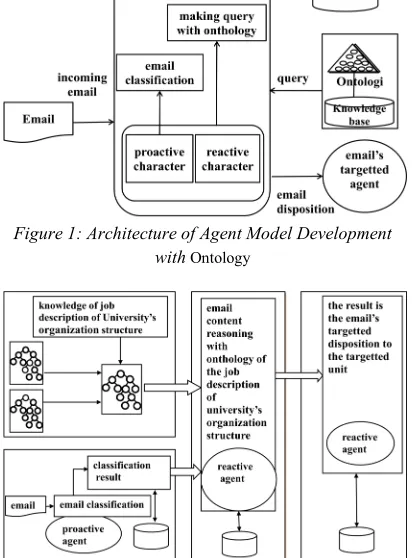
Agent environment will experience changes in the form of incoming email. This will then be responded by a proactive Secretary agent by classifying it [16]. The classification is aimed at determining the email topic in its content. Then the Agent will infer it based on the email topic. The inference is done by using ontology to determine the email target. Once the target is determined, the agent will make action to the environment. The action is in the form of notice to the target agent. Then with its proactive characteristic, the agent will monitor the status of its email disposition. The monitoring is done by communicating it with the targetted agent of the
email. The data involved will be saved in the database. The architecture of the model developmet is illustrated in Figure 1.
[image:3.612.320.527.243.522.2]The source of ontology is the Job description of each unit as described in the organization structure of the university. Then it will be the Agent’s Belief. The duty to classify emails is the Agent’s Desire (goal) and the action of making communication and sending information to the other Agent are the Agent’s Intension.
Figure 1: Architecture of Agent Model Development
with Ontology
Figure 2: General illustration of agent model using ontology in email disposition
ISSN: 1992-8645 www.jatit.org E-ISSN: 1817-3195
504
3.2 Agent Development
The agent’s character to be developed are the reactive and the proactive ones which is prominent in handling the process of email disposition in the university’s archiving system.
The reactive agent is the one that can see its environment and respond punctually to any changes happening in it in order to meet the agent’s goal. The proactive agent is the one that can show the behavior-goal directed to it and take any roles to meet the agent’s goal.
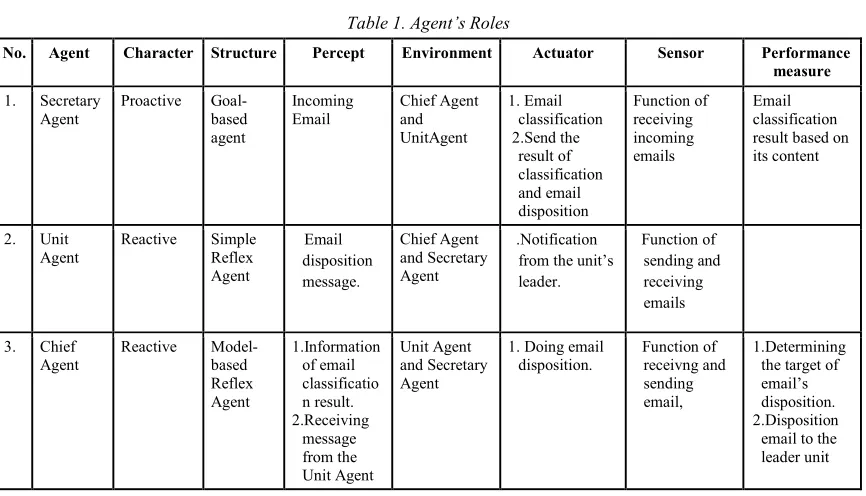
The agent involved in the email disposision process are secretary agent, chief agent and Unit agent. The email attribute comes from the email’s origin, email’s goal, subject, date and time, and the email’s content. The explanation of the agent development is clearly illustrated in Figure 3.
The process of the secretary agent’s proactive character is as follows: Secretary Agent autonomously uses a sensor to respond the environment’s change, that is the presence of the email. The email then is classified by using Naive Bayesian method. The classification result is the email topic that is the part of the job description of the university’s units. This email topic then is sent to the Chief Agent which will infer reactively based on its email topic using ontology. The inference determines the email’s target. Once the target is known, the Chief Agent will react by notifying the Unit Agent about the presence of the email. This communication is run using ACL Msg.
The proactive character of the agent is characterized as follows: the Chief Agent, with its sensor, monitors the status of the email disposition. The sensor is in the form of responding the time changing. Based on this time changing, the Chief Agent proactively sends a message to the Unit Agent asking about the status of the email periodically. The unit Agent will also answer it periodically.
[image:4.612.317.527.62.250.2]The chief Agent then will monitor the email disposition by conducting communication with the Unit Agent that has the email disposition. This monitoring is done periodically based on the email’s time duration. The goal is to know the email’s disposition status which can be “accomplished” and “not accomplished”.
Figure 3: Process of email disposition
The object used in this paper is university especially its email disposition process whose agent has its own roles. Secretary Agent, for example, uses its proactive character by responding emails and classifying it.
Each agent’s roles in the process of email disposition can be seen in Table 1.
3.3 Email Disposition
The email classification is conducted by agents so that the process runs automatically using Naive Bayesian method. The domain is the email disposition of the incoming email to the university. The classification is conducted by determining the keywords (features) of the terms (words) in the university’s domain. After that, email topic determination is run. The email topic is gained from the job description of units at the university. This email topic is the one that will be the class name.
The keyword (feature) is chosen from the numerous terms of job description at the university. Therefore, there must be a limitation for the scope of the keyword domain such as by limiting only on the academic department. In here, a simulation of determining the keyword of several terms is carried out.
The determination of the email topic that will be the class name is also limited to suit the domain of the keyword. Take an example the keyword is the academic department in a university, therefore the class topic is the description of the unit’s job in it. The number of the class topic is also limited due to the numerous class topic in the academic domain. In short, the class topics to be discussed are just a few.
ISSN: 1992-8645 www.jatit.org E-ISSN: 1817-3195
505 The email content classification is conducted by using Naive Bayesian [31].
3.4.1 Email data training.
The computation formula of Naive Bayesian method is:
p(Cj|K1,…, Kn ) = p(Cj) p(K1,…,K n|Cj) / p(K1,…,K n ) (1)
p(K1, K2, .. Kn |Cj) = p(K1|Cj) * p(K2|Cj)* …* p(Kn|Cj) (2)
p(Cj |K1, K2, .. Kn) = p(Cj) * p(K1, K2, .. Kn |Cj) (3)
p(Cj |K1, K2, .. Kn) =
p(Cj) * (p(K1|Cj) * p(K2|Cj)* …* p(Kn|Cj) ) (4)
Cnb = arg max cjϵC P(Cj) Πni=1 P(Ki|Cj) (5)
K1, K2, .. Kn = Attribute, they are keyword Ki p
(C1!K1, K2, ... Kn) p(Cj |K1, K2, .. Kn ) =
word probability of class Cj with features K1, K2, .. Kn
p(Cj) =Probability of each class Cj
p(K1|Cj)=Word probability of the word K1 in class Cj
p(K2|Cj)=Word probability K2 in class Cj
p(Kn|Cj)=Word Probability of the word Kn in class Cj
Cnb = Naïve Bayesian classification takes the best value
3.4.2 Email data testing
The data is continous, hence the probability value of each class P {words/class) is approached using formula of density Gauss normal distribution.
The Gauss density is represented in the following equation [32]:
(6)
ƒ(x) = Gauss density function x = the number of the word Ki
µ = the average of the word p (K1, K2, .. Kn |Cj)
σ = deviation standard of the word p(K1, K2, .. Kn |Cj)
Based on (4), (5), and (6), then we have (7)
arg max ∏
! !"! # (7)
3.5 Ontology Model Development
Ontology development is developed by developing the existing ontology, FOAF (friend of friend) developed by the ontology domain of the university. This will be used to determined the email disposition target.
The email content classification results an email topic that will be used as the base to infer with ontology. The use of ontology is aimed at determining the email target except the one that goes to the chief. The determination of the email
target without ontology will have difficulties in determining the target email except the one to the chief, in reality, all incoming emails are not for the chief always. This ontology plays a role to know the email target except to the chief by matching (inferring) the email topic (the result of the classification) with the job description ontology in the unit under the chief.
The Academic Institution Internal Structure Ontology (AIISO) [33] is the parent class of the developed Ontology of the job description of the university’s unit. AIISO consists of three sources namely participation scheme [34]), FOAF [35] and aiiso-roles [36].
Figure 4: Ontology Development of the Job Description of the University’s Unit (OJU).
The ontology is developed by reusing FOAF: person and FOAF: name. Reusing also uses the organizational Unit from AIISO [37] and Position/Title/the person in charge uses the responsibility Of from aiiso [38].
The addition of the knowledge uses the job description of the university’s Unit (OJU [39]). The result of the combination of the knowledge reuse and the job description is the ontology development as seen on Figure 4.
4. RESULT AND DISCUSSION 4.1 Agent Model
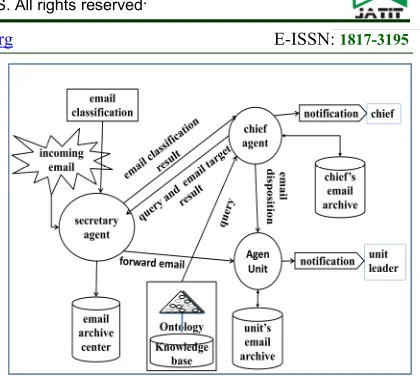
The general description of the agent model development is illustrated in Figure 5.
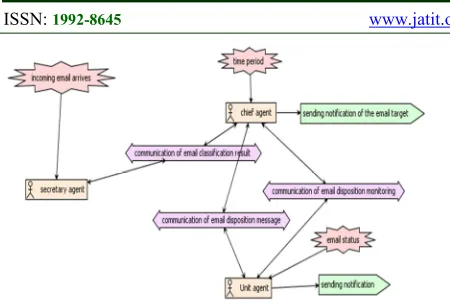
The communication conducted is that the Secretary Agent informs the result of email classification to the Chief Agent which then will inform the the email disposition to the Unit Agent and monitor its status.
The communication is illustrated in Figure 6 and Figure 7.
( )
2 2
2
2
1
)
(
σµ
σ
π
− −
=
x
e
x
ISSN: 1992-8645 www.jatit.org E-ISSN: 1817-3195
[image:6.612.89.314.72.226.2]506
Figure 5: the General Description of the Agent Model Development System in the email disposition
Figure 6: Communication between Secretary Agent and Chief Agent
Figure 7: Communication between Chief Agent and Unit
4.2. Email Classification
Simulation of Email Classification.
4.2.1 Email content data training
Stage 1: Form the data training manually by using Naive Bayesian classificator. In this case, the first thing to do is determining how many email classes that will be formed. For example, there will be email classes going to be formed: Research and Service Email, Academic Email, Quality Assurance Email, Student affairs Email, Chief Email and other emails.
Stage 2: determining the feature used to classify the email’s content that is all “words” being used.
Next is calculating the statistic parameter such as the probability of each class and the probability of each feature in which there are 32 features.
For example, the key word (feature) “student”, “research”, “student affairs”, “accreditation”, “foundation”, “academic”, “study“, “lam”, “lppm”, “research”, “position”, “assurance”,
“functional”, “service”, ”grant”, “curriculum”, “bidikmisi”, “institution”, “borang”, “ban”, “tracer”, “base”, “scholarship”, “serdos”, “jafa”, “kkni”, “reviewer”, “approach”, “instrument”, "scp", "extention", and "supply".
The number of the email data used for the data training is 489 emails.
4.2.2 Testing of email data
For example, there are incoming emails with the data: Emails with the words of “student”,=0, “research”=0, “student affairs”=0, “accreditation”=0, “foundation”=0, “academic”=0, “study:“=0, “lam=0”, “lppm”=0, “research”=0, “position”=0, “assurance”=0, “functional”=0, “service”=0, ”grant”=0, “curriculum”=0, “bidikmisi”=0, “institution”=0, “borang”=0, “ban”=0, “tracer”=0, “base”=0, “scholarship”=0, “serdos”=2, “jafa”=0, “kkni”0, “reviewer”=0, , “approach”0, and “instrument”=0, "scp"=0, "extention=0", "supply"=0.
[image:6.612.327.520.418.736.2]The number of the data testing used is 103 emails. A half of the email classification of the data testing in the formula (7) is illustrated in Table 2.
Table 2. The Result of Email Classification Data Testing
No Email Real Topic
(Class)
From System Topic (Class)
1 Email1 Research and
Service
Research and Service
2 Email2 Research and
Service
Research and Service
3 Email3 Research and
Service
Research and Service
4 Email4 Other Other
5 Email5 Academic Academic
6 Email6 Academic Chief *
7 Email7 Other Other
8 Email8 Other Other
9 Email9 Other Other
10 Email10 Academic Chief *
11 Email11 Student Affairs Student Affairs
12 Email12 Academic Chief *
13 Email13 Other Other
14 Email14 Student Affairs Student Affairs
15 Email15 Quality Assurance Academic *
16 Email16 Other Other
17 Email17 Chief other *
18 Email18 Other Other
20 Email20 Research and
Service
Research and Service
21 Email21 Chief other *
22 Email22 Research and
Service
Research and Service
23 Email23 Research and Service Research and Service
24 Email24 Other Other
ISSN: 1992-8645 www.jatit.org E-ISSN: 1817-3195
507
4.3. Ontology
The ontology used was by combining several sources of knowledge, in this case were from the rules and the unit’s job description in the university.
[image:7.612.94.299.247.348.2]The ontology was made based on the rule domain and each unit’s job description in the university. The many units and the various job description caused the research to be limited on its ontology presented in this paper. Figure 8 shows a quote of some parts of the university’s ontology that is the Academic Board of the University.
Figure 8: sample of the Ontology of the Unit’s Job Description at the university
4.4. Email Disposition
[image:7.612.317.534.333.721.2]Once the ontology was made, a query determined which unit at the university becoming the email target. The query was conducted by comparing the result of the email classification; email topic and ontology data of the unit’s job description at the university. The query was conducted to find the email’s target Unit.
Figure 9. Email Disposition Implementation
Figure 9 illustrates the process of email distribution to be implemented. The email server is the email from the university namely the secretary email that receives the emails from the outside of the system (from other institution). This email is, at certain time, checked
periodically by Secretary Agent which will then classify it by using Naïve Bayesian classification method. The result will then be sent to the Chief Agent. Based on this classification, the Chief Agent will determine the email target by querying the data ontology. The email target is the name and the address of the Unit in the university which will be sent to the Unit Agent as the email disposition. After receiving the name and the address of the Unit, the Secretary Agent forward the email to the Unit Agent.
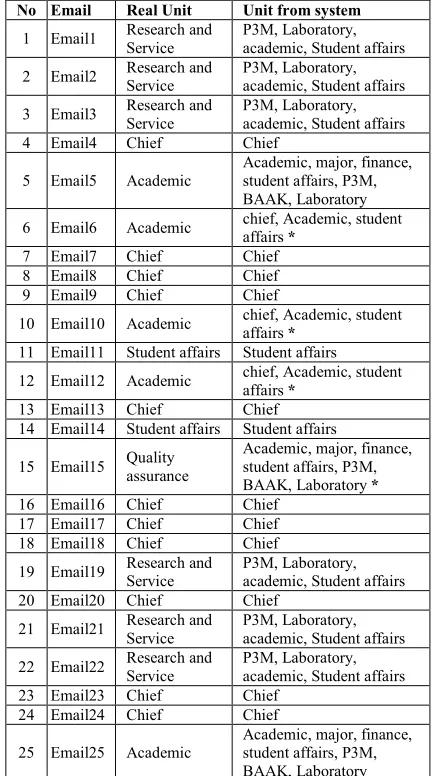
The result gained from the query is presented in Table 3 that is the Unit of the email target with a person to pose in that unit with his email. Meanwhile, the data is in RDF (Resource Description Framework) in which its quote is made based on the Unit’s Job Description at the university. See Figures 10.
Table 3. The units found in the ontology as the result of the email classification
No Email Real Unit Unit from system
1 Email1 Research and
Service
P3M, Laboratory, academic, Student affairs
2 Email2 Research and
Service
P3M, Laboratory, academic, Student affairs
3 Email3 Research and
Service
P3M, Laboratory, academic, Student affairs
4 Email4 Chief Chief
5 Email5 Academic
Academic, major, finance, student affairs, P3M, BAAK, Laboratory
6 Email6 Academic chief, Academic, student
affairs *
7 Email7 Chief Chief
8 Email8 Chief Chief
9 Email9 Chief Chief
10 Email10 Academic chief, Academic, student
affairs *
11 Email11 Student affairs Student affairs
12 Email12 Academic chief, Academic, student
affairs *
13 Email13 Chief Chief
14 Email14 Student affairs Student affairs
15 Email15 Quality
assurance
Academic, major, finance, student affairs, P3M,
BAAK, Laboratory *
16 Email16 Chief Chief
17 Email17 Chief Chief
18 Email18 Chief Chief
19 Email19 Research and
Service
P3M, Laboratory, academic, Student affairs
20 Email20 Chief Chief
21 Email21 Research and
Service
P3M, Laboratory, academic, Student affairs
22 Email22 Research and
Service
P3M, Laboratory, academic, Student affairs
23 Email23 Chief Chief
24 Email24 Chief Chief
25 Email25 Academic
[image:7.612.91.300.477.642.2]ISSN: 1992-8645 www.jatit.org E-ISSN: 1817-3195
508
Figure 10: a quote of some parts of RDF at a university
The email classification result from the Secretary Agent results a content topic of the email which is used by the Chief Agent to find the Unit’s Ontology of the university until the name of the Unit in the university to be the email target is found. After it is found, then the Chief Agent sends a message to it saying that it has received email as an email disposition from other institution. Table 3 shows the part of 103 the email data testing.
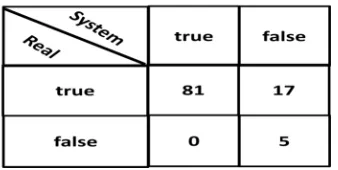
[image:8.612.118.287.522.607.2]The next step is to find out the result of the email classification using Confusion Matrix [40]. Based on the query result of the ontology data in Table 3, the researcher calculated the accuracy by using table of confusion matrix as seen in Table 4 (true positive (tp) = 81, false negative (fn) =17, false positive (fp) = 0, true negative (tn) = 5). In Table 3 the * mark shows the difference between Real Unit and Unit from system which is 22 of the 103 email testing in total.
Table 4. Confusion Matrix
Based on the data testing and the calculation of the confusion matrix (Table 4), the accuracy gained is 83% (tp+tn/(tp+fn+fp+tn).
5. CONCLUSION
The development of reactive and proactive agent model can handle the archiving system in a university. This archiving system is a process of email disposition whose goal is to result a Unit’s
correct email target. this model can determine which unit is to be the target of the email disposition.
The role of the proactive agent model conducted is classifying emails based on their subject and content autonomously. This email classification can be modelized by Naive Bayesian classification using agent.
The email classification can determine the topic of the email which then conducts a query in the ontology data. The query is done by the reactive agent autonomously to determine the target of the email disposition. The ontology data is sourced on the knowledge of standard emails, organization structure, and job description of each unit at a university.
The result of the research is the finding of agent model in classifying emails based on their subject and content using Naive Bayesian. The other finding is the agent model using ontology in determining the email disposition to the units in the university.
All hyphothesis are proven to be around 83% valid, the conclusion that can be drawn is that this research is valid considering that this research has been experimented and the result is just as it is hoped.
Agent model with ontology in email disposition can be used in institutions whose organization structure contains units that have their own job description.
The researcher suggests for the next research is to do the research by adding the scope of the research and by using different classification method.
This research is limited in the problems of the email disposition in the university’s archiving especially in the academic board, research and service, student affairs, quality assurance and the university’s senate. This limitations will influence the result of the accuracy if it is not compensated with the email data.
REFRENCES:
Olson, J., 2009. Database Archiving,
Burlington, MA 01803, USA: Elsevier Inc. All rights reserved. Available at: http://www.elsevier.com.
ISSN: 1992-8645 www.jatit.org E-ISSN: 1817-3195
509 Springer London Dordrecht Heidelberg New York.
[4] Nesic, S., Gasevi, D. and Jazayeri, M., 2008. Extending MS Office for sharing Document Content Units over the Semantic Web. Proceedings of Eighth International Conference on Web Engineering. IEEE, pp.350–353.
[5] Youn, S. and Mcleod, D., 2007. Efficient Spam Email Filtering using Adaptive Ontology. International Conference on Information Technology (ITNG’07) IEEE. [6] Taghva, K., Borsack, J., Coombs, J.,
Condit, A., Lumos, S. and Nartker, T., 2003. Ontology-based Classification of Email. Proceedings of the International Conference on Information Technology: Computers and Communications (ITCC’03) IEEE.
[7] Islam, M.R. and Zhou, W., 2007. An Innovative Analyser for Email Classification Based on Grey List Analysis. 2007 IFIP International Conference on Network and Parallel Computing - Workshops. IEEE, pp.178–184.
[8] Islam, M.R. and Zhou, W., 2007. Email Categorization Using Multi-Stage Classification Technique. Eighth International Conference on Parallel and Distributed Computing, Applications and Technologies. IEEE, pp.51–58.
[9] Koprinska, I., Poon, J., Clark, J. and Chan, J., 2007. Learning to Classify e-mail. Information Sciences 177 (2007) 2167– 2187. Elsevier Inc., 177(October 2005), pp.2167–2187.
[10] Islam, M.R., Zhou, W. and Chowdhury, U.M., 2008. Email Categorization Using (2+1)-tier Classification Algorithms. Proceedings of Seventh IEEE/ACIS International Conference on Computer and Information Science. IEEE, (1), pp.276– 281.
[11] Ayodele, T., Zhou, S. and Khusainov, R., 2010. Email Classification Using Back Propagation Technique. International Journal of Intelligent Computing Research (IJICR), Volume 1, Issue 1/2, March/June 2010, 1(1), pp.3–9.
[12] Islam, R. and Xiang, Y., Email Classification Using Data Reduction Method. Communications and Networking in China (chinacom), 2010 5th International ICST Conference on. IEEE.
[13] Cohen, W.W., Carvalho, V.R. and Mitchell, T.M., 2005. Learning to Classify Email into “ Speech Acts .” In Proceedings of SIGIR-2005.
[14] Kwak, J.D., Elmasri, R., Lee, K.K. and Mawr, B., 2000. Senddata : An Agent for Data Processing Systems Using Email. Journal Article IEEE, pp.264–270.
[15] McElroy, J., 2012. Automatic Document Classification In Small Environments. Faculty of California Polytechnic State University San Luis Obispo, (January). [16] Fang, J., Guo, L., Wang, X. and Yang, N.,
2007. Ontology-Based Automatic Classification and Ranking for Web Documents Ontology-Based. Fourth International Conference on Fuzzy Systems and Knowledge Discovery (FSKD 2007). [17] Fu, J., Chang, J,. Huang, Y., Lee, S. and
Teng, W., 2007. Toward an Intelligent Agent System using Document Classification Techniques. Journal of Computers Vol.18, No.1, April 2007, pp 31-34.
[18] Song, D,. Bruza, P., Huang, Z. and Lau, R., 2003. OpenAIR @ RGU The Open Access Institutional Repository at The Robert Gordon University Classifying Document Titles Based on Information Inference. 14th International Symposium, ISMIS 2003 Maebashi City, Japan, October 28-31,
2003 : Proceedings. (ISBN
9783540202561).
[19] Martinovic, J. and Dvorsky, J., 2007. Document classification based on The Topic Evaluation and its usage in Data Compression. 2007 Proceedings of IEEE/WIC/ACM International Conferences on Web Intelligence and Intelligent Agent Technology - Workshops, pp.204–207. [20] Peng, S., Mukhopadhyay, S., Raje, R.,
Palakal, M. and Mostafa, J., A Comparison Between Single-agent and Multi-agent Classification of Documents. Proceeding of the 15th International Parallel and Distributed Processing Symposium (IPDPS’01). IEEE.
[21] Bailin, S.C. and Trusz, W., 2001. Ontology Negotiation between Scientific Archives. IEEE, pp.245–250.
ISSN: 1992-8645 www.jatit.org E-ISSN: 1817-3195
510 Information Technology and Applications (icita’05). IEEE, pp.1–6.
[23] Brandli, C. and Rudin, H., 1997. Archiving Agents for the World Wide Web. IEEE, Intelligent Systems. pp.424–426.
[24] Smirnov, A., Pashkin, M., Chilov, N. and Levashova, T., 2001. Ontology Management in Multi-Agent System for Knowledge Logistics. IEEE, pp.2–7. [25] Potok, T.E., Elmore, M.T., Reed, J.W. and
Samatova, N.F., 2002. An Ontology-based HTML to XML Conversion Using Intelligent Agents Post Office Box 2008 , Mail Stop 6414 Computer Science and Mathematics Division. Proceedings of the 35th Hawaii International Conference on System Sciences - 2002. IEEE, 00(c), pp.1– 10.
[26] Medina, M.A., Sánchez, A. and Castellanos, N., 2004. Ontological Agents Model based on MAS-CommonKADS methodology. Proceedings of the 14th International Conference on Electronics, Communications and Computers (conielecomp’04). IEEE, pp.3–6.
[27] Rafi, M., Qureshi, H. and Khatoon, H., 2009. Ontology Maintenance via Multi-Agents. 2009 Fifth International Joint Conference on INC, IMS and IDC. IEEE, pp.955–959.
[28] Ruch, A., Supporting interoperability of distributed digital archives using authority-controlled ontologies. , (1), pp.1–7.
[29] Pardo, D.T., Giraldo, J.D. and Guzmán, J.A., 2008. A Semantic-Based Approach for the Management of Digital Documents. The 11th IEEE International Conference on Computational Science and Engineering - Workshops, pp.251–256.
[30] Cohen, W.W., Carvalho, V.R. and Mitchell, T.M., 2005. Learning to Classify Email into “ Speech Acts .” In Proceedings of SIGIR-2005.
[31] Islam M. S., Khaled S. M., Farhan K., Rahman M. A. and Rahman J., 2009, Modeling Spammer Behavior: Naïve Bayesian vs. Artificial Neural Networks. Institute of Information Technology, University of Dhaka, Dhaka-1000, Bangladesh. International Conference on Information and Multimedia Technology. IEEE.
[32] John, G. H., Langley, P., 1995, Estimating Continuous Distributions in Bayesian Classifiers. In procSeedings of the Eleventh Conference on Uncertainty in Artificial Intelligence, Morgan KaufmannPublishers. San Matco.
[33] http://vocab.org/aiiso/
[34] http://vocab.org/participation/schema [35] http://xmlns.com/foaf/spec/
[36] http://vocab.org/aiiso-roles/schema
[37]http://purl.org/vocab/aiiso/schema#organizatio nalUnit
[38]http://purl.org/vocab/aiiso/schema#respoensibil ityOf
[39] http://www.sinus.ac.id/onto-org.owl# [40] Gorunescu F., 2011, Data Mining Concepts,
ISSN: 1992-8645 www.jatit.org E-ISSN: 1817-3195
[image:11.612.92.525.98.346.2]511
Table 1. Agent’s Roles
No. Agent Character Structure Percept Environment Actuator Sensor Performance
measure
1. Secretary
Agent
Proactive
Goal-based agent
Incoming Email
Chief Agent and UnitAgent
1. Email classification 2.Send the
result of classification and email disposition
Function of receiving incoming emails
Email classification result based on its content
2. Unit
Agent
Reactive Simple
Reflex Agent
Email disposition message.
Chief Agent and Secretary Agent
.Notification from the unit’s leader.
Function of sending and receiving emails
3. Chief
Agent
Reactive
Model-based Reflex Agent
1.Information of email classificatio n result. 2.Receiving
message from the Unit Agent
Unit Agent and Secretary Agent
1. Doing email disposition.
Function of receivng and sending email,
1.Determining the target of email’s disposition. 2.Disposition