A Review on Various Routing Attacks on Wireless
Sensor Network
Rani Patel
1, Prof. Rakesh Pandit
2Pursuing M.Tech 1 , Ass. Profesor 2
Patel Group Of Institutions, Indore 1,2
[email protected] , [email protected]
ABSTRACT:
In wireless sensor networks, an adversary can confine and support nodes in sensor network, produce replicas of those nodes, and increase a diversity of attacks with the replicas he introduces into the network. These attacks are unsafe because they allow the attacker to control the cooperation of a few nodes to use control over much of the network. A number of replica node exposure schemes in the narrative have been proposed to defend against these attacks in standing sensor networks. These approaches based on fixed sensor locations and hence do not work in mobile sensor networks, where sensors are normal to move. In this work, we propose a fast and valuable mobile replica node exposure scheme using in the order Probability Ratio Test. To the best of our data, this is the first work to begin the problem of replica node attacks in mobile sensor networks. We show logically and through simulation research that our systems achieve efficient and strong replica detection capacity with reasonable overheads.
Introduction:
The relieve of deploying sensor networks gives to their demand. They can quickly extent to great constitutions, since managers can simply
drop new sensors into the required locations in the existing network. To unite the network, new nodes require neither executive interference nor communication with a support station; as an alternative, they normally initiate simple national detection procedures [6, 13] by broadcasting their pre stored records(e.g., their unique ID and/or the unique ID of their keys). Regrettably, antenna nodes usually utilize low cost product hardware constituents unprotected by the type of objective shielding that could prevent way in to a sensor’s recollection processing, sensing and communication components. Cost thoughts make it impossible to use shielding that could identify weight, voltage, and temperature changes [11, 33and 36] that an adversary strength use to way in a sensor’s inside state. Deploying unshielded sensor nodes in hostile situations make possible an opponent to capture, replicate, and introduce replica nodes at chosen network locations with small attempt. Thus, if the opponent cooperation even a particular node, she can replicate it definitely, spreading her control throughout the network. If left undetected, node replication leaves any network in danger to a huge class of dangerous attacks. Using replicated nodes, the opponent can undermine
data aggregation protocols by injecting false data or suppressing reasonable data. Further, blame for abnormal conduct can now be spread transversely the replicas, dropping the possibility that any single node exceeds the exposure threshold. Even more insidiously, node replicas placed at sensibly chosen locations can withdraw reasonable nodes and disconnect the network by triggering exact implementation of node revocation protocols that rely on threshold voting schemes previous approaches for detecting node replication typically rely on regional monitoring, since localized selection systems [6, 27] cannot sense distributed replication. In the network to transfer a list of their neighbours’ claimed locations to a central base position the centralized entity require all of the nodes that can examine the lists for incompatible location maintains.
Goal
As wireless sensor networks have been used in a lot of functions, monitor nodes in the network are needed for some uses. The important functions which need to be monitored are the communicated data connecting each node, the movement of joins, etc. The goal of this assignment is to devise a simulator which can be used to monitor wireless sensor and actuator networks on a useful level to estimate different functions, cooperation patterns, network topologies, and physical space, instance and incidentsituations. Though, there are a set of routing protocols which can be used in the wireless sensor systems, this simulator is new to test different routing algorithms as one part of
simulation. Furthermore, this simulator is extensive for the replication of sensor system uses such as enemy surveillance application and chemical gas make unclear use. The results of the replication can be shown in both text and graphical line for the events and for the design of network topology with the physical environment as background.
Location dependent:
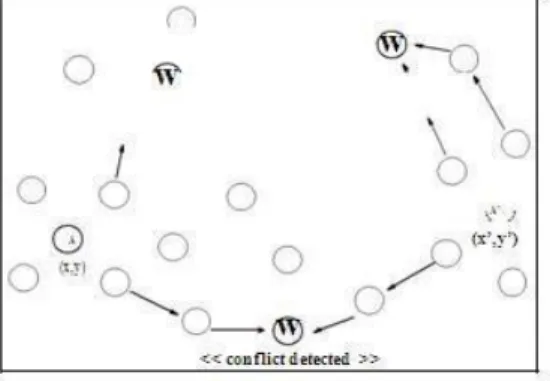
This system uses node‘s position in sequence to sense replica. In this system the position claim of a node is forwarded to a set of arbitrary generated observe nodes/location, or units, by its neighbouring nodes. Two or more different position-maintains for the same node result in a location variance, and a replica is detected. Location dependent replica detection is represented in Figure 3.1. The nodes denoted as W in the figure are witness nodes. On receiving the position maintain for node A from two different locations, the observer node W detects it as a replica. A node can figure its position in sequence each using GPS [4] or using the systems declare in [5, 19].
Figure 2.2: Group membership based replica detection
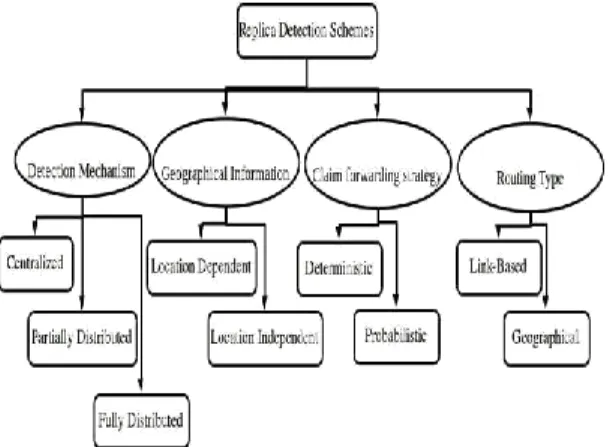
Figure 2.3: Classification of replica detection schemes in WSN
Previous Protocols:
Thus far, protocols for detecting node replication have relied on a trusted base station to present inclusive detection. For the sake of completeness, we also discuss the use of localized voting devices. We consider these protocols in the conceptual for specific examples of previous protocols, see Section 9. Until now, it was generally believed that these two alternatives exhausted the space of possibilities. This paper expands the design space to offer new alternatives with strong security and inefficiency characteristics.
Simulation:
To verify the exactness of our abstract predictions, we ran simulations to measure the communication requirements of our two main protocols, Randomized Multicast and Line decide on Multicast. Since Line-Selected Multicast relies on the topology of the system to sense node reproductions, we also evaluated its detection rate in a variety of network configurations. Examples of the network
topologies tested appear in Appendix .In our simulations; we deploy n nodes consistently at accidental within a 500 × 500 square, with n changing between 1,000 and 10,000. We assume the standard unit disc bidirectional message replica and we regulate the message range, so that each node will have approximately 40 neighbours on average6. We use an a enrage of the total number of messages sent or received per node as a measure of the communication conditions and we determine resiliency by together with the number of times we must run the protocol in order to detect a single node replication (i.e., we select a random node and insert one replica into the network). Thus, we calculate the probability of detection, Pd as: Pd =1# repetitions (16) For the Randomized Multicast protocol, we used p · d · g = √n which theoretically gives us a 63% probability to detect replication, and for Line-Selected Multicast we used r = 6 (i.e., each location claim creates six line segments).
For each network configuration, we generated twenty random charts and regular the results of ten experiments on every chart.
Conclusion:
We have considered various move toward used to detect node replication. In Section 3, we show how centralized approaches place extreme trust in the base position and extreme load on those nodes near it. Local voting schemes are not well able
To notice circulated node replication. In contrast, we present two schemes that enable
distributed detection of distributed events. The final scheme,
Line-Selected Multicast, provides excellent resiliency while achieving near optimal communication above your head with only reserved remembrance conditions. Both of our primary schemes illustrate the influence of evolving property in sensor networks. Given the opponent model representatively take for granted in sensor networks, we disagree that the protection of such networks will ever more depend on developing algorithms. Cost considerations and unattended exploitation will always put down character sensors vulnerable to cooperation. Since we cannot expect the exact nature or number of targets the opponent will select, the network must cooperatively resist report and withdraw compromised nodes in a manner that goes further than traditional interruption detection systems. We expect that developing algorithms will ultimately provide the best defines against these insidious attacks.
Future Work:
In the previous discussion, we have assumed that the nodes be in charge of led by the opponent continue to follow the protocols described. In our future work, we would like to look at additional methods to make sure that our protocols maintain to function even in the face of misbehaving nodes. For example, McCune et al. describe a system that uses vulnerable inherent sampling to notice nodes that contain or drop messages [23]. We could also use some of the techniques described in Section 8.2 to publication remove the network for replicas,
thus preventing the opponent from establishing a major grip in the network.
References:
[1] M. Bawa, H. Garcia-Molina, A. Gionis, and R. Motwani. Estimating aggregates on a peer-to-peer network. Technical report, Stanford University, 2003.
[2] C. Blundo and A. Cresti. Space requirements for broadcast encryption. In Advances in Cryptology
(EUROCRYPT),1995.
[3] C. Blundo, L. Mattos, and D. Stinson. Trade-offs between communication and storage in unconditionally secure schemes for broadcast encryption and interactive key distribution. In Advances in Cryptology (CRYPTO),1996.
[4] D. Braginsky and D. Estrin. Rumor routing algorithm for sensor networks. In Proceedings of ACM Workshopon Wireless Sensor Networks and Applications, 2002. [5] N. Bulusu, J. Heidemann, and D. Estrin. GPS-less lowcost outdoor localization for very small devices. IEEE Personal
Communications Magazine, October 2000.
[6] H. Chan, A. Perrig, and D. Song. Random key predistribution schemes for sensor networks. In Proceedings of IEEE Symposium on Security and Privacy, May 2003.
[7] T. Cormen, C. Leiserson, R. Rivest, and C. Stein. Introduction to Algorithms. MIT Press, 2001.
[8] L. Doherty, K. S. J. Pister, and L. E. Ghaoui. Convex position estimation in wireless sensor networks. In Proceedings of IEEE Infocom, 2001.
[9] D. Dolev and A. C. Yao. On the security of public key protocols. IEEE Transactions on Information Theory,1983.
[10] J. R. Douceur. The Sybil attack. In Proceedings of Workshop on Peer-to Peer Systems (IPTPS), Mar. 2002.
[11] J. Dyer, M. Lindemann, R. Perez, R. Sailer, L. vanDoorn, S.W. Smith, and S. Weingart. Building the IBM4758 Secure Coprocessor. IEEE Computer, 2001.
[12] J. Elson, L. Girod, and D. Estrin. Finegrained networktime synchronization using reference broadcasts. SIGOPS Oper. Syst. Rev., 2002.
[13] L. Eschenauer and V. Gligor. A key management scheme for distributed sensor networks. In Proceedings of the ACM Conference on Computer and