Original Research Article
A study on KAP regarding environment and global warming in
senior secondary school students in Kochi, Kerala
Amritesh Kumar
1*, Arun Jacob
2, Nimitha Paul
2, Rakesh P. S.
3INTRODUCTION
In the 21st century global warming is the most critical environmental subject to profoundly capture our attention.1 Global warming is a phenomenon of an increase in the earth‟s temperature across the globe thus making Mother Earth a much warmer place to support all forms of life. Just like in other countries, India is also feeling its catastrophic impact. Global warming is an environmental, social and economical threat to the present as well as the future generation. It has shown an
upward trend since the early 20th century and more significantly since the late 1970s, due to the increase in fossil fuel emissions. Greenhouse gases such as water vapor, carbon dioxide, methane, etc. existing in the atmosphere trap the rays of sun and make the earth‟s temperature warmer. The concentration of greenhouse gases has increased extensively since the industrial revolution.2,3
Due to man-made pollution, the atmospheric
concentration of CO2 has increased dramatically from the
ABSTRACT
Background: Global warming is a phenomenon of an increase in the earth‟s temperature. It leads to an environmental, as well as social loss, which has shown an upward trend since the industrial revolution. Greenhouse gases have been showing catastrophic consequences as well. This study aims to assess the knowledge, attitude and practice among students on the environment so as to discover the gaps and take steps to curb them.
Methods: A cross sectional study was conducted among 10th grade high school students. Purposive sampling was done. A pre-tested, semi-structured and self- administered questionnaire was used to collect data. The data was analyzed using SPSS V2.0.
Results: In this study, 48% of the students were boys and the remaining 52% were girls. A majority of the students were Hindu and belonged to the age group 15-16 years. A hundred percent of the students showed concern regarding the degrading environment. 85% agreed to fact that it can be restored by cumulative efforts. Everyone regarded the sun as the ultimate source of energy. The attitude on protecting the environment was high among the majority of the students. 50% of the students save electricity when not needed. 69% of the students had good knowledge, 65% had a good attitude and 53% had a poor level of practice concerning the environment.
Conclusions: In light of the scarcity of adequate literature this study was able to identify gaps among students. Appropriate measures are needed to strengthen their knowledge and attitude and improve their practice.
Keywords: Global warming, Environment, Sun, Pollution, School students
Department ofCommunity Medicine, 1Dr. Somervell Memorial C.S.I. Medical College, Thiruvananthapuram, 3Amrita Institute of Medical Sciences, Kochi, Kerala, India
2
Amrita Institute of Medical Sciences, Kochi, Kerala, India
Received: 17 August 2018
Revised: 26 November 2018
Accepted: 27 November 2018
*Correspondence:
Dr. Amritesh Kumar,
E-mail: [email protected]
Copyright: © the author(s), publisher and licensee Medip Academy. This is an open-access article distributed under the terms of the Creative Commons Attribution Non-Commercial License, which permits unrestricted non-commercial use, distribution, and reproduction in any medium, provided the original work is properly cited.
pre-industrial era (AD 1000–1750) concentration of approximately 280 parts per million (ppm) to today‟s 440 ppm. Emissions from cars and power plants drive the temperature up by increasing energy, which translates into heat.4 Ecosystems maintain themselves by processing energy and nutrients obtained from external sources. The energy flows from the first trophic level to the next levels. In marine ecosystems, contaminants such as “bio-accumulates” enter the food web at the bottom of the ladder. Organisms at higher trophic levels can be threatened even if the pollutant is introduced to the environment in very small quantities. The low rate of energy transfer between trophic levels makes decomposers generally more important than producers in terms of energy flow.5 In the oceans, light and nutrients are important controlling factors for productivity. Ocean acidification; a change in ocean chemistry is also likely to impact the fish reproduction cycle. Fish eggs are more sensitive to pH changes than adult fish. The population may dwindle if their impact is significant. Climate change will result in less oxygen in the oceans. Being a cold-blooded species, warmer water increases the fishes„ need for oxygen. The researchers‟ proposed “gill-oxygen limitation theory” states that a lack of oxygen forces fish to stop growing and makes them fulfill their needs with the little oxygen available.5,6 Most advances of human society over the past century have been facilitated by the use of plastics. Plastics go far beyond medicine and public health. Disposable plastic items such as latex gloves, intravenous (IV) bags and dialysis tubes are inexpensive and vital for patient safety and are time-saving, thus essential. Today, in the “age of plastics,” the environmental and health issues that human society face are of paramount importance. The grave situation catches the attention of the common man only after its large scale production and consumption of non-bio degradable conventional plastics becomes a menace at large.7-9
India‟s species contribution makes up about 8% of the world‟s biodiversity. India shares only 1.7 percent of its forest coverage. The irresponsible attitude of just consuming resources without ever trying to replenish them, has contributed to the destruction of the environment. This devastation has surpassed all other benefits of our partial development. India‟s 24.4% of land area is covered with forests and trees and accounts for only 2.4% of the world surface area. Students may work as ambassadors to bring about awareness for environmentally friendly plantation. Students‟ awareness about plantation is necessary in playing a vital role in protecting the environment.10-13
Rationale
As students are among the most impressionable sector of society, it is essential to discover their knowledge and perception of the greenhouse effect in order to prepare the best possible educational programs for them. Very few studies are conducted in India regarding the knowledge,
environment in school students. This study is an attempt to explore their thoughts.
Objective
To assess the knowledge, attitude and practice pertaining to the environment and global warming.
METHODS
A cross sectional study was conducted in an Anglo-Indian senior secondary school, which comes under the urban health center (UHC) field of practice area of Amrita Medical College and Hospital, Kochi, Kerala. The duration of this study was 6 months from May to October 2016.
All of the six senior secondary schools in the field practice area were approached for the study and all agreed to participate. One school was chosen by the lottery method. The highest standard was deliberately selected for the study. A universal sample of all students of the 10th grade was included in the study. All the students in 4 sections A,B,C,D, who were willing to participate, were included and students who did not give written consent were excluded from the study.
Written consent was obtained from the principal of the school. Pre-tested, semi-structured, self-administered questionnaires were used. Each questionnaire consists of 3 parts. Part one: knowledge about factors degrading the environment. Part 2: focus on their attitude about the environment and the last part deals with practice towards environmental conservation. The questionnaires were completed by students themselves under the supervision of their own class teachers with no time restriction. 176 students out of 192 eligible students participated in the study (response rate 91.6%)
To find out the level of knowledge and practice, all the correct responses were coded. The score for each correct answer was 1 and each wrong answer was 0. Frequency and percentage were calculated. Knowledge, attitude, and practice were categorized into good, average and poor based on the score obtained. Ethical approval was obtained from the ICE of AIMS, Kochin, Kerala before the study was conducted.
Data analysis
Data was collected by trained professionals for the duration of 3 months from May –July 2018. Data was analyzed through the SPSS package and descriptive statistics were used to find out the frequencies and percentages.
RESULTS
respondents made no attempt and the remaining 154 (90%) could correctly draw it.
To explore their habits of protecting the environment at a household level, more than half, 99 (56%), switch off their electrical devices like fans, lights, television, CD/DVD player etc. when not in use at home, whereas less than half, 77 (44%), do not have any such regular
habit. There was no practice of waste segregation at school at all. Similarly, 172 (97%) of the respondents had no similar practice of waste segregation at home either. Half of the respondents practiced indiscriminate waste discarding as a mode of garbage disposal at home. The majority of students, 153 (87%), expressed the practice of planting saplings either at home or at school in pots or in the ground.
Table 1: Socio demographic profile of the study participants.
Sl No.
1. Sex Male Female
92 (48%) 84 (52%)
2. Age (years) 15-16 Above 16
158 (90%) 18 (10%)
3. Religion Hindu Christians Others
106 (60%) 64 (36%) 7 (4%)
4. Socio economic status
n=112
Modified B.G. Prasad Classification; 2016,CPI(27)/ Multiplication factor 27
Class I Class II Class III
00 (00%) 84 (75%) 28 (25%)
5. Mode of Transport Walking Bicycle Public transport
140 (80%) 26 (15%) 10 (5%)
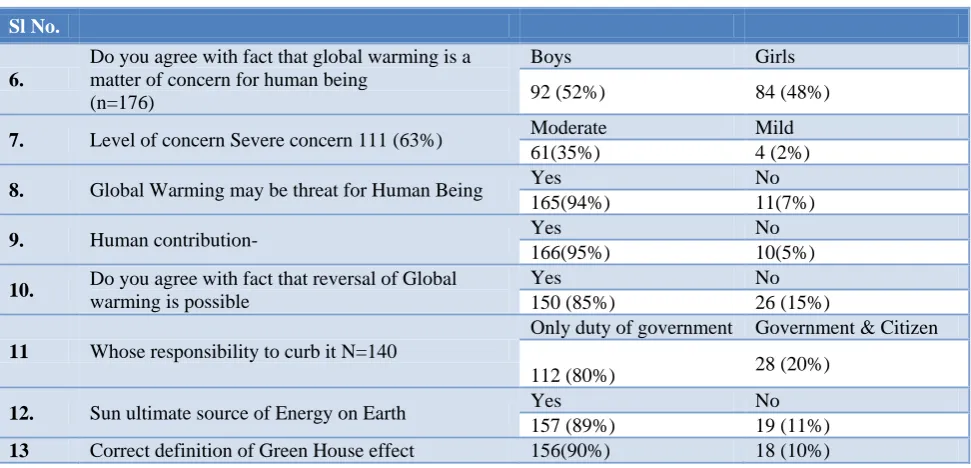
Table 2: Knowledge on subject of global warming and environment.
Sl No.
6.
Do you agree with fact that global warming is a matter of concern for human being
(n=176)
Boys Girls
92 (52%) 84 (48%)
7. Level of concern Severe concern 111 (63%) Moderate Mild
61(35%) 4 (2%)
8. Global Warming may be threat for Human Being Yes No
165(94%) 11(7%)
9. Human contribution- Yes No
166(95%) 10(5%)
10. Do you agree with fact that reversal of Global
warming is possible
Yes No
150 (85%) 26 (15%)
11 Whose responsibility to curb it N=140
Only duty of government Government & Citizen
112 (80%) 28 (20%)
12. Sun ultimate source of Energy on Earth Yes No
157 (89%) 19 (11%)
13 Correct definition of Green House effect 156(90%) 18 (10%)
Table 3: Level of knowledge.
Sl No. Score <25 Poor
Score 26> & <50 Average
Score >51 & <75 Good
Score >76 & <100 very Good
1. - (5%) (69%) (8%)
Marks on KAP were calculated on a scale of 0 to 100. A score of less than 25 was considered as poor, 26 to 50 as average, 51 to 75 as good, and above 75 as very good.
DISCUSSION
In this study, among 176 participants, (48%) were male students and (52%) were female students. The majority of students (90%) were of the age 15-16 years. Similar findings were seen in a study conducted on climate change in which (46%) were male and (53.9%) were female. One third of the students were children belonging to the age group 13 years.14 Likewise, in a study conducted by Sah, Bellad, (45.5%) of the study participants were male and the remaining (54.5%) were female students.6 In the same study (57.5%) were willing to walk/cycle in a daily routine and in our study the majority of participants, 140 (80%), travel to school by walking and (15%) by bicycle. The majority (94%) considered global warming as a threat for human beings and requires urgent attention. A study conducted by Zameel et al reported that (53%) of college students believed global warming affects human health.15 The majority of students (85%) agrees to the fact that global warming can be brought back to a desired non-hazardous level with conscious efforts. In a study, measures of the reversal of global warming were discussed as a mitigation of climate change by means of decreasing the use and dependency on fossil fuels, more use of renewable sources of energy, decreasing air pollution, training of the healthcare provider, and education of the masses.16 When asked who is responsible to curb it, the government or the people, the majority of students think that it is the sole duty of the government to curb environmental degradation. Similar findings were seen in a study conducted by Yousuf et al in Karachi, Pakistan.17 In this study, the majority of students, 157 (89%), considers the sun as an ultimate source of energy and 90% could correctly draw the energy flow as a food pyramid. Similar results were found in a study conducted by Severin et al a KAP on climate change in a focused group discussion among students.18 Surprisingly, the fact that global warming had adversely affected the marine ecosystem, thus has been included in SDG 2017, the majority of students responded that global warming will increase the number of fish in the future which is opposite to the finding of the UNDP project in Japan.19 In this study there was no practice of waste segregation at home and school. Although they had knowledge about it, its practice was grossly neglected due to the unavailability of separate bins. A similar finding was obtained in a study by Barloa et al on solid waste management among Undergraduate Students in a Philippine State University.20 In this study the majority of students (87%) expresses that they have planted saplings in the past which helps in curbing environment problems. Similar findings were seen in another study in which (37.5%) of the students agreed that green plants prevent pollution.21 In our study, 69% of the students had good knowledge, 65% had a good attitude and 47% had an average level of practice on global warming. Due to a lack of literature other variables could not be compared.
CONCLUSION
This study concludes that students have sufficient knowledge on the issues of global warning and a poor state of affairs about the environment. Most of the knowledge has been acquired from school teachings, which has been converted into a good attitude. But its practice is still not up to the desired level. Efforts should be made to fill the gaps and to instigate the required practices for them, since students are our future asset.
Limitation
Purposive sampling, small sample sizes and a few legends could not be compared due to lack of literature, thus requesting for apologies.
ACKNOWLEDGEMENTS
This study was supported by Amrita Institute of Medical Sciences, Kochin, Kerala, India. The authors are grateful to the students who participated in this study. Special thanks to Dr. Rakesh P.S., Dr. Arun Jacob, Mrs Nimita Paul and Mr Michael W. Hoover and others for their time and efforts in guiding us through the data collection and statistical analysis.
Funding: No funding sources Conflict of interest: None declared Ethical approval: Not required
REFERENCES
1. Skamp KR, Boyes E, Stainsstreet M. Global warming responses at the primary secondary interface:1 students‟ beliefs and willingness to act, Australian J Environ Educ. 2009;25:15-30.
2. Parashar P, Goel K, Ahmad S, Bansal R, Sharma S. Awareness and practices Regarding Global Warming And its Health Hazards Among the Medical students of Meerut. Int J Contemporary Med. 2013;1(1):37-41.
3. Yazdanparast T, Salehpour S, Masjedi MR,
Seyedmehdi SM, Boyes E, Stanisstreet M, et al. Global Warming: knowledge and views of Iranian students. Acta Medica Iranica. 2013;51(3):178-84. 4. Skamp KR, Boyes E, Stanisstreet M. Global
warming responses at the primary secondary interface: 1 students beliefs and willingness to act. Australian J Environ Educ. 2009;25:15-30.
5. Brechin, Steven R. page Comparative Public Opinion and Knowledge on Global Climatic Change and the Kyoto Protocol: The U.S. versus the World.
International J Sociol Social Policy.
2003;23(10):106-34.
6. Sah JK, Bellad AA. Awareness and knowledge about global warming among the school students of
south India, Al Ameen J Medical Sci.
7. Cimer, Sabiha O, Çimer A, Ursavas N. Student teacher‟s knowledge about global warming and changes their knowledge during pre-service education: A cross sectional study. Acad J. 2011;6(8):592-7.
8. North EJ, Halden RU. Plastics and Environmental Health: The Road AheadRev Environ Health. Available in PMC 2014.
9. Singh Z, Bhalwar R, Jayaram J, VwTilak VSM. An introduction to essentials of bio-medical waste management. Medical J Armed Forces India. 2001;57:144-7.
10. Ahmed MF. In Depth Country Study - India: Document AP FSOS/WP/26. FAO Rome, Bangkok. In Asia Pacific Forestry towards 2010: Report of the Asia Pacific Forestry Sector Outlook Study. FAO, 1998.
11. Singh RP, Jain N. A Study on Scope of Plantation in Indian Cities; IJEAR. 2013;3(1):42-4.
12. Vardhan H. India Among Top Ten Nations in the World in Terms of Forest Area” Press Information
Bureau Government of India Ministry of
Environment, Forest and Climate Change. 2018. Available at: http://pib.nic.in/newsite/PrintRelease. aspx?relid=176496. Assessed on 23 July 2018. 13. Odingo RS. The global impacts of climate change
on human health. Global Health Promotion 2009;16(1):68-71.
14. Knowledge, attitudes and practices survey on children and climate change. Prepared by CEED 2011. Available at: http://www.Unicef.org/.../KAP-survey-on-childrenand-climate-change.pdf.
Assessed on 23 July 2018.
15. Ali ZB, Chethan TK, N UK. Global Warming: its Implications Among The college students of
Manglore city. J Evol Med Dental Sci.
2013;2(28):5081-7.
16. Majra JP, Acharya D. Protecting health from climate change: preparedness of medical interns. Indian J Community Med. 2009;34:317-20.
17. Yousuf A, Bhutta S. Secondary school students‟ attitude towards environmental issues in karachi Pakistan. Int J Sci Eng Res. 2012;3(10).
18. Severin P, Small BJ. Knowledge attitude, practices / behaviour (kap/b) study on climate change, Saint Lucia Baseline Study 2016. Assessed on 29 July 2018.
19. UNDP documents, knowledge attitudes and practice study on climate change; Japan- Caribbean Climate Change Project, Belize, 2016.
20. Barloa EP, Lapie LP, de la Cruz CPP. Knowledge, Attitudes, and Practices on Solid Waste Management among Undergraduate Students in a Philippine State University. J Environ Earth Sci. 2016;6(6):146-53.
21. Seyda GUL. A Study on Primary and Secondary School Students‟ Misconceptions about Greenhouse Effect. Int Electronic J Environ Educ. 2011;1(3).