IJSRSET1841267 | Received : 10 Feb 2018 | Accepted : 20 Feb 2018 | January-February-2018 [(4) 1 : 1168-1178 ]
© 2018 IJSRSET | Volume 4 | Issue 1 | Print ISSN: 2395-1990 | Online ISSN : 2394-4099 Themed Section : Engineering and Technology
1168
Effectiveness of Structured Teaching Programme on
Knowledge Regarding Management of Febrile Convulsions
Among Mothers of Under Five Children
Syed Rafia Tabassum1, Nazimah Parvaiz2
1Department of Child Health Nursing, SKIMS, Soura, Srinagar, Jammu and Kashmir, India
2Department of Obstetrics and Gynaecological Nursing, SKIMS, Soura, Srinagar, Jammu and Kashmir, India
ABSTRACT
In this paper, the study was conducted with the aim to improve the knowledge of mothers of under five children regarding management of febrile convulsions thereby prevent the occurrence of febrile convulsions among under five children and reduce the childhood mortality and morbidity.
Objectives of The Study: To compare the pre-test and post-test knowledge scores regarding management of febrile convulsions among mothers of under five children. To determine the association of pre-test knowledge scores of mothers of under five children regarding management of febrile convulsions with their selected demographic variables (Age of mother, Type of family, Residence, Educational status, Occupational status, Monthly family income and No. of children).
Hypotheses: H1-There is significant difference between pre-test and post-test knowledge scores of mothers of under five children regarding management of febrile convulsions at p ≤ 0.05 level of significance. H2-There is significant association of pre-test knowledge scores of mothers of under five children with their selected demographic variables at p ≤ 0.05 level of significance.
Methodology: A pre -experimental one group pre-test and post-test design was used for the study. Using convenience sampling technique, 60 mothers of under five children were selected and the data was collected using structured interview schedule. After pre-test structured teaching programme was administered to mothers of under five children then on 4th day post-test was conduction by using same interview schedule to determine effectiveness of structured teaching programme. Whole data collected was analysed by using descriptive and inferential statistics.
of mother (p=0.01) at p≤0.05 level of significance and no association was found with other demographic variables.
Conclusion: The present study revealed that the structured teaching programme was significantly effective in improving the knowledge of mothers of under five children regarding management of febrile convulsions. Hence the study concluded that improved knowledge regarding management of febrile convulsions helps the mothers to provide proper care, safeguard the children during febrile convulsions and to prevent further complication.
Keywords: Structured Teaching Programme, Effectiveness, Knowledge, Mothers, Under Five Children, Febrile Convulsions.
I.
INTRODUCTION
Children are the nation’s supremely important asset. They determine the future of the nation1. Febrile convulsions are fits occurring in children associated with fever2. Fever is common manifestation present in most of the infections. In some children high grade fever can result convulsions. It accounts almost 50% of the convulsive disorders. Under five children are more vulnerable and prone to get any kind of infection. Children under five years of age are very small and their all systems are in developing stage. Childhood convulsions associated with febrile episodes are relatively common and represent the majority of childhood seizures. Because of their play activities, poor feedings and immaturity of immune system they get frequent attacks of infections like Respiratory Tract Infection, Otitis Media, Diarrhea, Gastroenteritis etc.
The National Institutes of Health (NIH) has defined a ‘febrile convulsion’ (FC) as a seizure event in infancy or childhood, usually occurring between 3 months to 5 years of age, associated with fever but without any evidence of intracranial infection, pathological or any traumatic cause. Febrile convulsions can be frightening to watch. However they don’t cause lasting harm. Intelligence and other aspects of brain development don’t appear to be affected by febrile convulsions. Having febrile convulsion doesn’t mean child has epilepsy. Febrile convulsions can occur with
infections or after immunizations that cause fever. In India the prevalence of febrile convulsions is 60/100,000 population and in Asia it is 3-9/1000 population. This rate is surprisingly similar to that of developed countries.
Approximately one in every 25 children will have at least 1 febrile convulsion and more than one third of these children will have additional febrile convulsions before they outgrow the tendency to have them. Febrile convulsions usually occur in children between the ages of 6 months to 5 years and are particularly common in toddlers. Children rarely develop their first febrile seizure before the age of 6 month or after 3 years of age.3.
Certain practices and customs regarding management of febrile convulsion may result in increasing risk of childhood mortality and morbidity. Febrile convulsions generate much anxiety among parents as they don’t have proper awareness regarding handling of baby with convulsions. Mother is pivotal (main) care provider. She is primarily responsible for the well being of children. The child is most precious possession of mankind, most loved and perfect in its innocence, they need to be cared delicately. It is crucial time for parents to understand and learn how to pass this challenging period smoothly. Nursing care should be directed towards educating the child’s family about condition, management of fever at home, first aid if child has convulsions and educate them about medical advice.
The conceptual framework of the present study is based on Ludwig Von Bertanloffys general systems theory (1950) or system model developed by WHO in 1985. In 1952 Bertanloffy introduced this theory as a universal theory that could be applied to many fields of study. This model is aimed at developing and evaluating the effectiveness of structured teaching programme on knowledge regarding management of febrile convulsions among mothers of under five children in selected hospital of Srinagar.
According to Bertanloffy, general system theory provides a way of examining interrelationships and deriving principles. Theorists described human being as an open system, for proper functioning of human beings depends on the quality and quantity of its input, throughput/ process, output and feedback. Being an open system a client is capable of receiving information and gain knowledge from its environment. Utilizing the capacity of clients, nurse researcher takes the opportunity to provide information regarding management of febrile convulsions.
II.
Methodology
In view of the nature of the problem under study and to accomplish the objectives of the study, quantitative research approach was found to be appropriate to assess the effectiveness of structured teaching
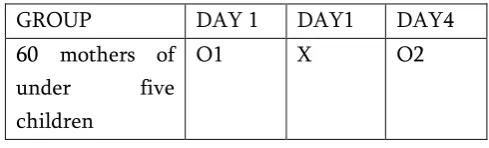
programme on knowledge regarding management of febrile convulsions among mothers of under five children. The research design selected for this study was Pre experimental one group pre-test and post-test design. In this design Structured Interview Schedule was administered to mothers of under five children as a Pre-test measure and the Intervention was given in the form of Structured Teaching Programme and Post-test was taken after giving Intervention. This design is presented in following table.
Table 1. Schematic Representation of Research Design
GROUP DAY 1 DAY1 DAY4
60 mothers of under five children
O1 X O2
Key:
O1: Knowledge test before intervention.
X: Structured teaching programme regarding management of febrile convulsions.
O2 : Knowledge test after intervention.
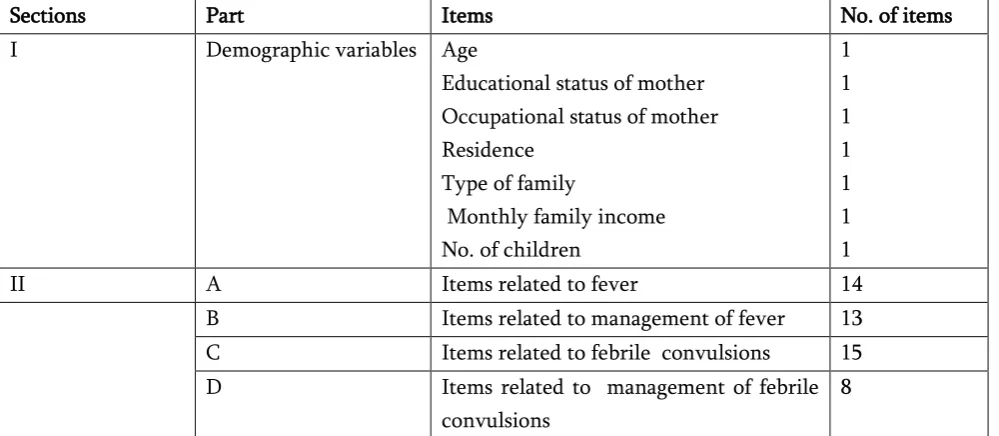
The investigation tool has been organized into 2 sections:
Section A: Demographic data related to the mothers of under five children includes; Age of mother, Type of family, Residence, Educational status, Occupational status, Monthly family income and No. of children (7 items)
Section B: Structured Interview Schedule that deals with knowledge assessment regarding management of febrile convulsions includes 4 parts
1. Part A consists of 14 items regarding fever 2. Part B consists of 13 items regarding
management of fever
3. Part C consists of 15 items regarding febrile convulsions
Table 2. Description of investigation tool
Sections Part Items No. of items
I Demographic variables Age
Educational status of mother Occupational status of mother Residence
Type of family
Monthly family income No. of children
1 1 1 1 1 1 1
II A Items related to fever 14
B Items related to management of fever 13 C Items related to febrile convulsions 15 D Items related to management of febrile
convulsions
8
The structured teaching programme was developed based on the topic of the study, review of the related research publication and unpublished research literature. The initial draft of structured teaching programme along with the tool was validated by 12 experts and their suggestions were incorporated. Data collection process: After self introduction, nature and objectives of study were explained to the mothers of under five children to obtain maximum co-operation. Anonymity and confidentiality were assured to them. Written consent was obtained from the mothers of under five children and they were made comfortable. 60 mothers of under five children
were selected by using convenience sampling technique; 20-25 minutes were taken for conducting interview. After pre-test the investigator administered structured teaching programme regarding management of febrile convulsions for 25 minutes using flip book. At the end of structured teaching programme 5 minutes were allotted for discussion. The post-test was conducted after 3 days using same structured interview schedule. Same procedure was followed with varying no. of mothers of under five children for pre-test and post-test on various days till investigator got the desired sample size. The whole data collection was done in systematic way.
Table 3. Data Collection Schedule
Day Date Total No. of
subjects
Area Action
Pre-test and
intervention
Post-test
Day (1-3) 11/5/15-13/5/15 20 Pediatric
medicine and Pediatric surgery
20 ×
Day (4-6) 14/5/15-16/5/15 23 -do- 3 20
Day (7-9) 17/5/15-19/5/15 15 -do- 12 3
Day (10-12)
20/5/15-22/5/15 10 -do- × 10
N.A(2)
15) medicine Day
(16-18)
26/5/15-28/5/15 13 Pediatric
medicine and Pediatric surgery
3 10
Day (19-21)
29/5/15-31/5/15 15 -do- 12 3
Day (22-25)
1/6/15-3/6/15 14 -do- 5 9
N.A(3)
Day (26) 4/6/15 5 -do- × 5
N.A= Not available
The data collected was analyzed by using descriptive and inferential statistics. The data was planned to be analyzed on the basis of objective and hypothesis of the study.
Descriptive statistics
1. Frequency and percentage distribution was used to describe the demographic variable.
2. Mean and standard deviation was used to assess the mean knowledge scores regarding management of febrile convulsions among mothers of under five children.
Inferential statistics
1. Paired ‘t’ test was used to compare the pre-test and post-test knowledge scores regarding management of febrile convulsions among mothers of under five children.
2. ANOVA used to analyze the association of pre-test knowledge scores of mothers of under five children with their selected demographic variables (Age, Type of family, Residence, Educational status, Occupational status, Monthly family income and No. of children).
Data Analysis: The collected data was organized, tabulated, analyzed and interpreted using descriptive and inferential statistics. This whole data was organized and presented based on the following objectives of the study.
Objectives of The Study:
1. To assess the pre-test knowledge scores regarding management of febrile convulsions among mothers of under five children.
2. To assess the post-test knowledge scores regarding management of febrile convulsions among mothers of under five children after structured teaching programme.
3. To compare the pre-test and post-test knowledge scores regarding management of febrile convulsions among mothers of under five children.
4. To determine the association of pre-test knowledge scores of mothers of under five children regarding management of febrile convulsions with their selected demographic variables (age of mother, type of family, residence, occupational status, educational status, monthly family income and no. of children). The substantive summary of the analysis was under the following sections:
Section 1: Description of demographic variables of subjects.
Section 2: Assessment of knowledge of subjects regarding management of febrile convulsions.
1. Comparison of pre-test and post-test mean Knowledge scores of subjects regarding management of febrile convulsions.
2. Comparison of pre-test and post-test level of Knowledge of subjects regarding management of febrile convulsions.
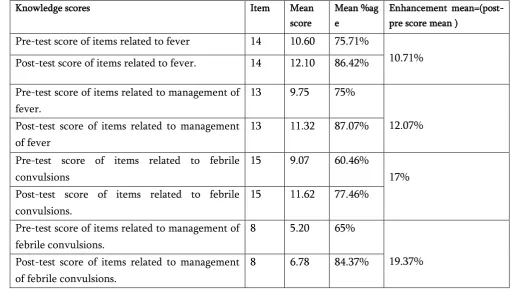
3. Aspect wise enhancement of mean percentage knowledge scores regarding items of fever, management of fever, febrile convulsions, management of febrile convulsions.
Section 3: Association of pre-test knowledge scores of subjects with their selected demographic variables (Age of mother, Type of family, Residence, Educational status, Occupational status, Monthly family income and No. of children).
Section I: Description of Demographic Variables.
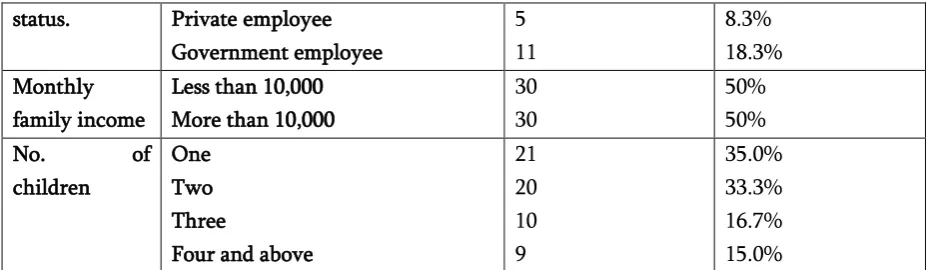
Table 4. Frequency and percentage distribution of subjects according to demographic variables. N=60
Variables Category Frequency Percentage
Age of mother Less than 30 yrs Greater than 30 yrs
33 27
55% 45% Type of family Nuclear
Joint
30 30
50% 50% Residence Rural
Urban
39 21
65% 35% Educational
status.
Illiterate Middle pass Secondary
Higher secondary Graduate
P.G
13 6 13 11 13 4
21.7% 10.0% 21.7% 18.3% 21.7% 6.7%
status. Private employee Government employee
5 11
8.3% 18.3% Monthly
family income
Less than 10,000 More than 10,000
30 30
50% 50%
No. of
children
One Two Three
Four and above
21 20 10 9
35.0% 33.3% 16.7% 15.0%
The data presented in Table 4 showed that majority of subjects (55%) were <30 years of age and rest (45%) were >30 years of age. Subjects share the same percentage in terms of type of family. Majority (65%) of subjects belong to rural area and rest (35%) were from urban area. 21.70% were illiterate, 10% were middle pass, 21.7% were educated up to secondary level, 18.30%were educated up to higher secondary level, 21.70% were graduates and 6.70% were post graduates. Majority (73.30%) of subjects were housewives, followed by Govt. Employees (18.30%) and least (8.30%) were Private Employees. 50% of the subjects had <10,000 monthly family income and the remaining 50% of the subjects had >10,000 monthly family income. Majority (35%)of subjects have one child, followed by 33.30% having two children, and then 16.70% have three and least (15%) having more than four children.
Section 2. Analysis and interpretation of knowledge scores of subjects regarding management of febrile convulsions.
Table 5. shows the mean, median, standard deviation, range of pre-test and post-test knowledge scores of subjects regarding management of febrile convulsions. N=60
Knowledge Scores
Mean Median Standard deviation
Minimum Maximum Range
Pre-test score 34.62 36.00 7.19 14 49 35
Post-test score 41.82 44.00 6.59 24 50 26
The data in Table 5 showed that pre-test mean score was 34.62, median was 36.00, standard deviation was 7.19 and range was 35; also post-test mean score was 41.82, median was 44.00, standard deviation was 6.59 and range was 26. This figure clearly indicates that mean pre-test scores are lower than mean post-test scores at p ≤ 0.05 level of significance.
Table 6. Comparison of pre-test and post-test mean knowledge scores of Subjects regarding management of febrile convulsions. N=60
Knowledge Scores
Mean score Mean score (%) Mean Difference P Value
Pre-test score 34.62 69.24% 7.20 ≤0.001
Post-test score 41.82 83.64%
To test research hypothesis following null hypothesis was formulated
The results in table 6 indicates that pre score mean percentage was 69.24% and post score mean percentage was 83.64% with mean difference of 7.20 at p value ≤0.001 which indicates that there was high significant difference between pre-test and post-test mean knowledge scores. So there is enough evidence that this change occurred due to intervention and not by chance. Therefore research hypothesis (H1: There is significant difference between pre-test and post-test knowledge scores of mothers of under five children regarding management of febrile convulsions at p≤0.05 level of significance.) is accepted and H0 is rejected.
Table 7. Comparison of pre-test and post-test level of Knowledge of subjects regarding management of febrile convulsions. N=60
Level of Knowledge Percentage Score Pre-test Post-test
Frequency Percentage Frequency Percentage
Inadequate ≤50% 9 15% 2 4%
Moderate 51-76% 32 53% 11 18%
Adequate >76% 19 32% 47 78%
Total 60 100% 60 100%
The data in Table 7 showed that in pre-test 9(15%) subjects were having inadequate, 32(53%) having moderate and 19(32%) having adequate knowledge and in post-test 47(78%) subjects were having adequate, 11(18%) having moderate and 2(4%) having inadequate knowledge regarding management of febrile convulsions.
Table 8. Aspect wise enhancement of mean percentage knowledge scores
Knowledge scores Item Mean
score
Mean %ag e
Enhancement mean=(post-pre score mean )
Pre-test score of items related to fever 14 10.60 75.71%
10.71% Post-test score of items related to fever. 14 12.10 86.42%
Pre-test score of items related to management of fever.
13 9.75 75%
12.07% Post-test score of items related to management
of fever
13 11.32 87.07%
Pre-test score of items related to febrile convulsions
15 9.07 60.46%
17% Post-test score of items related to febrile
convulsions.
15 11.62 77.46%
Pre-test score of items related to management of febrile convulsions.
8 5.20 65%
19.37% Post-test score of items related to management
of febrile convulsions.
8 6.78 84.37%
Section 3: Analysis and interpretation of data to find out an association of pre -test knowledge scores of subjects with their selected demographic variables.
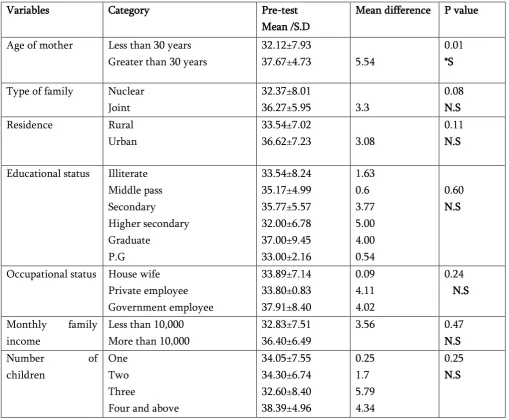
Table 9. Association of pre-test knowledge scores of subjects with their selected demographic variables. Here the researcher tests the null hypothesis H0 that there is no significant association of pre-test knowledge
scores of mothers of under five children with their selected demographic variables. N=60
Variables Category Pre-test
Mean /S.D
Mean difference P value
Age of mother Less than 30 years Greater than 30 years
32.12±7.93
37.67±4.73 5.54
0.01 *S Type of family Nuclear
Joint
32.37±8.01
36.27±5.95 3.3
0.08 N.S Residence Rural
Urban
33.54±7.02
36.62±7.23 3.08
0.11 N.S Educational status Illiterate
Middle pass Secondary Higher secondary Graduate
P.G
33.54±8.24 35.17±4.99 35.77±5.57 32.00±6.78 37.00±9.45 33.00±2.16
1.63 0.6 3.77 5.00 4.00 0.54
0.60 N.S
Occupational status House wife Private employee Government employee
33.89±7.14 33.80±0.83 37.91±8.40
0.09 4.11 4.02
0.24 N.S
Monthly family income
Less than 10,000 More than 10,000
32.83±7.51 36.40±6.49
3.56 0.47
N.S
Number of
children
One Two Three
Four and above
34.05±7.55 34.30±6.74 32.60±8.40 38.39±4.96
0.25 1.7 5.79 4.34
0.25 N.S
Note: N.S -Not significant. *S-Significant at p≤ 0.05 level
The data presented in the table 9 indicates that there was significant association of pre-test knowledge scores of subjects with demographic variable as Age of mother (p=0.01), evidenced that there was statistically association at p≤ 0.05 level of significance and no association was found with variables as Type of family, Residence, Educational status, Occupational status, Monthly family income and No. of Children.
III.
SUMMARY
A pre-experimental design was adopted in order to evaluate the effectiveness of structured teaching programme regarding management of febrile convulsions .Interview schedule was used to assess the knowledge regarding febrile convulsions and its management. Validity and reliability of the tool was tested. Pilot study was conducted to find the feasibility of the study. Data was collected from the subjects after obtaining permission from the concerned authority. Collected data was analyzed using descriptive and inferential statistics and presented in the form of tables and graphs.
IV.
DISCUSSION
The present study was undertaken to Assess the Effectiveness of Structured Teaching Programme on Knowledge Regarding Management of Febrile Convulsions among Mothers of under Five Children in Selected Hospital of Srinagar.
Related to Age group out of 60 mothers of under five children majority (55%) of mothers of under five children were <30 years of age. Related to residence majority (65%) of mothers of under five children were from rural area. Related to educational status majority (21.70%) of mothers of under five children were illiterate, secondary pass and graduates. Related to occupational status majority (73.30%) of mothers of under five children were housewives. Related to no. of children, majority (35%) of mothers of under five children had only one child.
In pre-test 9(15%), were having inadequate, 32(53%) were having moderate and 19(32%) were having adequate knowledge regarding management of febrile convulsions. In pre-test mean score was 34.62, median was 36.00, standard deviation was 7.19. The findings revealed that majority of mothers of under five children were having moderate knowledge so they need to be educated and informed about management of febrile convulsions.
The present study was supported by the findings of a prospective questionnaire-based study carried out at children's hospital Wildermeth, Biel (Switzerland) by Duffner PK, Baumann RJ, Berman P. in the year 2008 to investigate the effect of febrile seizures on the behavior and emotional situation of parents.135 parents were selected purposively for data collection. Questionnaire was used to assess the parent’s knowledge. Result of the study showed that 44% of the parents had insufficient knowledge and the study concluded that knowledge of febrile seizures among parents was insufficient. It suggests that information prior to the first febrile seizure is necessary to create awareness and thus lead to appropriate reactions in case of recurrence6.
In post-test 47(78%) mothers of under five children were having adequate knowledge, 11(18%) having moderate and 2(4%) having inadequate knowledge regarding management of febrile convulsions. In post-test mean score was 41.82, median was 44.00, and standard deviation was 6.59.The findings revealed that majority of mothers of under five children were having adequate knowledge and post-test mean score was increased indicating effectiveness of teaching programme.
The study concluded that compared with the mailed pamphlet, the educational programme had significant improvements in recommended practices7.
Mothers of under five children obtained mean knowledge score of 34.62 in pre-test and 41.82 in post-test. Thus improvement in score by 7.2 indicates the effectiveness of structured teaching programme. Consequently there was remarkable difference between pre-test and post-test knowledge scores at p ≤ 0.05 level of significance. Hence research hypothesis ( H1-There is significant difference between pre-test and post-test knowledge scores of mothers of under five children regarding management of febrile convulsions at p ≤ 0.05 level of significance) is accepted.
The present findings were supported by a pre-experimental one group pre-test and post-test study conducted in selected hospital at Salem by Parmar RC, DR Sahu, Bavedekar SB. In the year 2001to evaluate the effectiveness of Planned Nursing Intervention (i.e. increase in post-test score) on prevention of febrile convulsions in terms of knowledge and practice among mothers of child with fever .50 mothers selected randomly. Structured questionnaire was used
to collect data. The result shown that pre-test knowledge score was 47%. The pos-test knowledge score was increased to 66.8% at P≤ 0.05 level of significance. The study concluded that there was a significant improvement in the knowledge regarding management of febrile convulsions8.
The association of demographic variable with pre-test knowledge scores by using ANOVA revealed there is statistically significant association with variable i.e. Age of mother ( p=0.01) at p≤ 0.05 level and no association was found with variables as Type of family, Residence, Educational status, Occupational status, Monthly Family income and No. of Children. Hence research hypothesis (H2- There is significant association of pre-test knowledge scores of mothers of under five children with their selected demographic variables at p ≤ 0.05 level of significance) is rejected Similar results were found in a study conducted by Nayak.R in Karnataka where there was no association between religion, educational status, occupational status, type of family, income of family and source of information9.
V.
REFERENCES
[1].World Health Day Report. Nursing Journal of India. 1997;129: 3.
[2].Willacy H. Febrile convulsion [Online]. 2011 Jun
6 [Cited 2014 Oct 11].
URL:http://www.Pubmed.com
[3].National Institute of Neurologic Disorders and Stroke. Febrile convulsion fact sheet [Online]. 2011 Oct 31. URL:http://www.ninds.nih.gov [4].Farrell K, Ran D. The management of febrile
convulsion. BMCJ .2011 Jul 1; 53.
[5].American Academy of Pediatrics (AAP). Febrile Seizures. Retrieved on 2009 Nov 10 http://www.intelihealth.com/IH/int.
[6].Tanja flury, Christine Aebi, Filippo donati. ―Febrile seizures and parental anxiety: does
information helpline. Swiss med weekly 2001; 131, pp 556 - 560.
[7].Huang MC, Liu CC, Chi YC, Thomas K, Huang CC. Effects of educational intervention on changing parental practices for recurrent febrile convulsions epilepsia. 2002 Jan; 43(1):81-6. www.http//:[email protected]
[8].Essays, UK. (November 2013). Discussion of Effectiveness of Planned Nursing Intervention
Nursing Essay.
http://www.ukessays.com/essays/nursing/discussi on-of-research-on-prevention-of-febrile-fits-nursing-essay.php.