DOI: 10.5958/0976-4666.2015.00030.3
Growth and Export Performance of Ginger in India– An
Economic Analysis
V. Karthick
1*, T. Alagumani
2and A. Anbarassan
31,3Department of Agricultural Economics, Tamil Nadu Agricultural University, Coimbatore, Tamil Nadu, India- 641 003, 2Department of Market Extension, Tamil Nadu Agricultural University, Coimbatore, Tamil Nadu, India- 641 003.
*Corresponding author: [email protected]
Paper No. 213 Received: 11 January 2015 Accepted: 10 May 2015
ABSTRACT
India is rightly called as “spice bowl of the world” for its production of variety and superior quality of spices. Indian agriculture has to face competitiveness in international trade for each commodity due to liberalisation and agreement of WTO. Spices are the major exports from India and it is generally expected that trade policies would influence the spice trade. In the area of export ginger occupies fifth position in terms of quality and sixth position in export earnings among the spices. In recent years, there have been ups and downs in export of ginger from India. This situation called for a detailed study. Hence this study was conducted to analyze growth and export performance of ginger in India. The required data collected for the period of 29 years. The objectives are analyzed with nominal protection coefficient and growth rate analysis. The growth rate between pre and post-WTO period in terms of area and production were positive. The export growth of post WTO period in terms of quantity and values were found to be not significant and declining but unit price value were found to be significant and positive. Nominal protection coefficient was found to be more than one indicates the non profitability of export.
Keywords: Ginger, Export performance, Compound Growth Rate, Nominal Protection Coefficient
India is known for spice production and export all over the world. Other countries export spices are China, Japan, Indonesia, Australia, Nigeria, West Indies islands, Malaysia, Pakistan, Spain, Egypt and Tanzania. The share of spices to our country’s export earning was 1.24 per cent and its share in agricultural and allied product was 8.5%. From India spices like pepper, ginger, turmeric, chilli, tejpat, small and large cardamom, coriander, cumin and garlic etc are produced and exported. Ginger is one of the spices that support large number of farmers in the states of Kerala, Karnataka, Arunachal Pradesh, Orissa, West Bengal, Sikkim and Madhya Pradesh. Kerala ranks first in ginger production and nearly 1/3 production is from this state. The two popular varieties of Indian ginger in the international market are Cochin Ginger (NUGC) and Calicut Ginger (NUBK) Ginger. It is available in four forms such as oil, oleoresins, ground ginger and fresh ginger. Fresh ginger is used as vegetable produced mainly in Kerala, a major
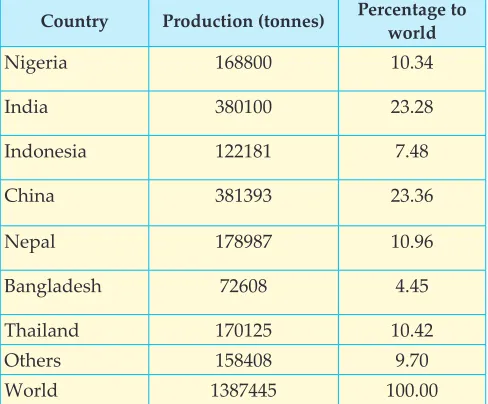
share of which is exported. Nearly 30 per cent of total production is converted into dry ginger, while half of the production is consumed as green ginger and the remaining is used as seed materials. Country wise production of ginger is presented in Table1. It is evident from the table that India ranks second in terms of production followed by China in 2009. Though India’s ginger production was the highest in the world its share in the export was found to be less than 10 percent.
World Trade of Ginger – A Scenario
are the major importers of India’s ginger. The main competitors of ginger export are China, Nigeria and Thailand. The export growth depends not only on domestic production and distribution but also on other factors such as world economic scenario, domestic prices relative to world prices, exchange rate, inflation rate in the countries competing with India for the world market and taxes and subsides on exports.
Table 1. Country Wise Ginger Production during 2009
Country Production (tonnes) Percentage to world
Nigeria 168800 10.34
India 380100 23.28
Indonesia 122181 7.48
China 381393 23.36
Nepal 178987 10.96
Bangladesh 72608 4.45
Thailand 170125 10.42
Others 158408 9.70
World 1387445 100.00
Source: www.fao.org
Objectives
Keeping the above aspect in view an attempt is made in this paper to analyze the growth and export performance of ginger with the overall objective is to assess the production and export of ginger during pre and post-WTO periods.
The specific objectives of the study are
(i) to study the growth of area, production and productivity and export of ginger in India; (ii) to assess the export competitiveness of
ginger; and
(iii) to suggest suitable policy measures.
Review of literature
Mahesh (2000) studied the export competitiveness of Indian tea by estimating the NPC and DRC under both importable and exportable hypotheses during the year 1998-99. The results revealed that under
importable hypothesis the NPC and DRC were 0.71 and 0.66 respectively. The NPC was below unity, which indicated that the domestic tea was an effective import substitute, where as the DRC was also less than one implying that the tea growers spend less than a rupee equivalent of foreign exchange on the production. Hence, it was profitable to use non-tradable inputs in the production of tea in India. Under exportable hypothesis, the NPC and DRC were 0.98 and 0.93 respectively. The NPC was less than unity which reveals that tea was competitive in the international market and it represents an effective export commodity where as DRC was also less than one implying its export competitiveness in the international market.
Jayesh (2001) studied the production and export performance of pepper and cardamom in south India. He found that all the south Indian states except Karnataka (-0.47 %) and Tamil Nadu (-1.62 %) recorded significant growth in area and production of pepper and in case of cardamom, all the states recorded a negative growth in area, while the productivity and production showed significant growth. A positive growth was found in the export quantity, value and unit value of pepper. But a negative growth was recorded in the export of
cardamom.
Jayesh (2001) used the nominal protection coefficient technique for the export competitiveness of Indian pepper. Under the exportable hypothesis, the nominal protection coefficient value were found to be lesser than unity (0.849) in Calicut and (0.817) in Sirsi markets, indicating that the Indian pepper is competitive in the international market and which is an efficient export oriented commodity.
Jose and Jayasekhar (2008) studied the growth trends in area, production and productivity of Arecanut in India during the period from 1971 to 2004. It revealed that the area and the production of Arecanut in India increased tremendously at the rate of 2.2 per cent and 3.2 per cent respectively. The rate of increase in both area and production is mainly due to favorable price prevailed during the period.
Methodology
The present study is based on secondary data.The time-series data on area, production, productivity, export quantity, value and domestic and world price were collected from published sources of the indiastat for the period of 29 years (from 1980-81 to 2008-2009). For analytical purpose, this entire period was divided subjectively into two sub periods, with the implicit assumption that each sub period has distinct nature and pattern of development due to the establishment of WTO. Pre-WTO period covers the period 1980-1981 to 1994-1995 and Post-WTO period covers 1995-1996 to 2008-2009. Secondary data on monthly domestic prices were collected from published source of the Spices Board for the period of five years (from 2004-05 to 2008-09). Annual domestic price were arrived by averaging monthly
data.
Compound Growth Rate of ginger was estimated for two periods’ viz., pre-WTO Period (1980-81 to 1994-95) and post-WTO Period (1995-96 to 2008-2009) periods. This grouping was done mainly to find out
the effect of WTO agreements and to compare the export performance of the ginger. The growth in area, production, productivity, quantity exported, export value and unit value realized from exports were estimated by using the exponential growth function of the form
Y = a bt . e
t ... (1)
Where, Y = Dependent variable, t = Time variable,et
= Error term, a and b are unknown constants to be
estimated. The unknown constants a and b were
found by applying methods of least squares by transforming the equation into logarithmic form
ln Y = ln a + t ln b ... (2) Where, log Y is natural logarithm of Y, log a and log b are similarly defined. The compound growth rate ‘r’ was computed by using the relationship
r = (Antilog of (ln b) – 1) x 100 ……….. (3) ∑ ( t ln Y ) – ( ∑ t ∑ ln Y ) / n
where, ln b = ∑ t2 – (∑ t) 2 / n
and n is number of time points.
The Nominal Protection Coefficient (NPC) is simplest coefficient used to assess the level of protection resulting from market distortions. It measures the export competitiveness. It is the ratio between the domestic price and world price. The NPC can be applied to both exportable and importable.
Results and Discussion
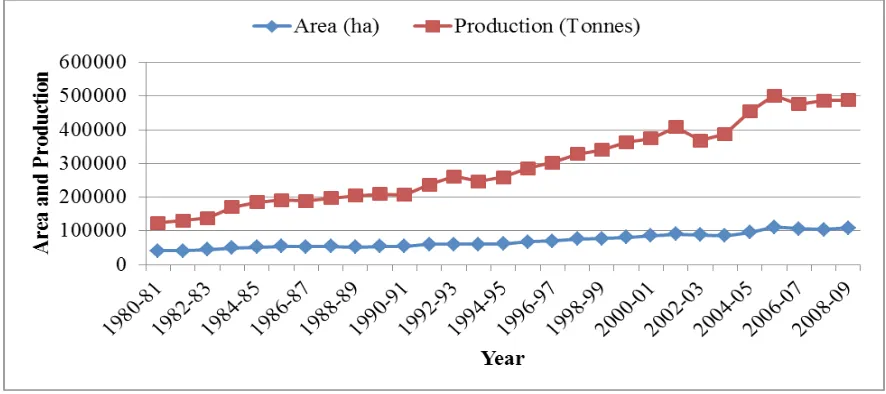
The area, production and productivity of ginger in India during 1980-81 to 2008-09 is provided in Appendix-I. Area under ginger crop during 1980-81 was 40450 ha and reached high level of 110600 ha during 2005-06. During Pre-WTO period (1980- 81 to 1994-95) increase in ginger area was around 20,000 ha and it was around 50,000 ha during Post-WTO period. Production of ginger was also high in Post-WTO than Per-WTO. This shows that WTO agreements provided opportunity for more export of ginger that resulted in increase in area and production. The area and production of ginger are also presented in the Fig 1. Area and production of ginger showed increasing trend during the study period.
Growth Analysis of Ginger
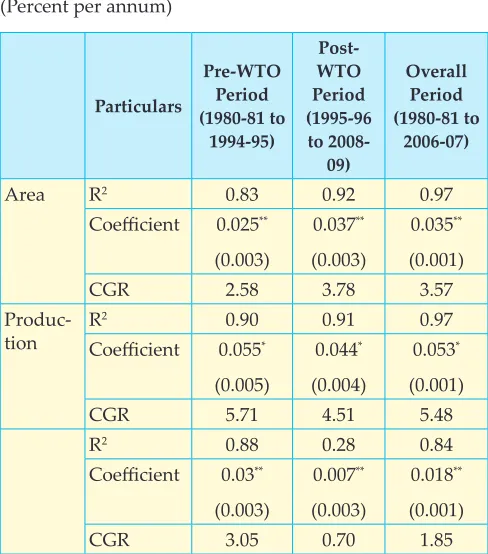
The Compound Growth Rates (CGRs) of Ginger crop for the periods 1980-81 to 1994-95 (Pre-WTO Period), 1995-96 to 2008-09 (Post-WTO Period) and 1980-81to 2008-09 (Overall Period) were estimated and are furnished in Table 2. The growth rates of ginger in terms of area, production and productivity showed variations. During Pre WTO Period, the compound growth rate for area (2.58 per cent) was positive and significant but it was lower than post-WTO period (3.78). It was concluded that the area of the ginger crop was increased during Post-WTO period. The ginger production had a high significant growth rate of 5.71 per cent during the Pre- WTO period as compared with lower growth rate of Post-WTO period (4.51) and Overall Period. Though the area increased from around 60,000 ha to 108,600 ha during Post-WTO period growth rate of production was less. It is mainly due to productivity.
Regarding the yield of ginger Pre-WTO Period had a high significant growth rate (3.05 per cent) as
compared with Post-WTO period (0.70) and Overall Period (1.85). This was reflected in production growth rate. It was concluded from the above results that the growth rate of ginger in terms of area was high during Post-WTO period. Productivity of ginger influences the production and hence technologies have to be developed to increase the ginger productivity. It was average of 3454 kgs/ha during the Post-WTO period.
Table 2. Compound Growth Rate of Area, Production, Productivity of Ginger in India
(Percent per annum)
Particulars Pre-WTO Period (1980-81 to 1994-95) Post-WTO Period (1995-96 to 2008-09) Overall Period (1980-81 to 2006-07)
Area R2 0.83 0.92 0.97
Coefficient 0.025**
(0.003)
0.037**
(0.003)
0.035**
(0.001)
CGR 2.58 3.78 3.57
Produc-tion R
2 0.90 0.91 0.97
Coefficient 0.055*
(0.005)
0.044*
(0.004)
0.053*
(0.001)
CGR 5.71 4.51 5.48
R2 0.88 0.28 0.84
Coefficient 0.03**
(0.003)
0.007**
(0.003)
0.018**
(0.001)
CGR 3.05 0.70 1.85
Note: Figures in the parentheses indicates Standard Errors of the respective Coefficient.
** - Significant at 1 per cent level; *-Significant at 5 percent level
Export Performance of Ginger
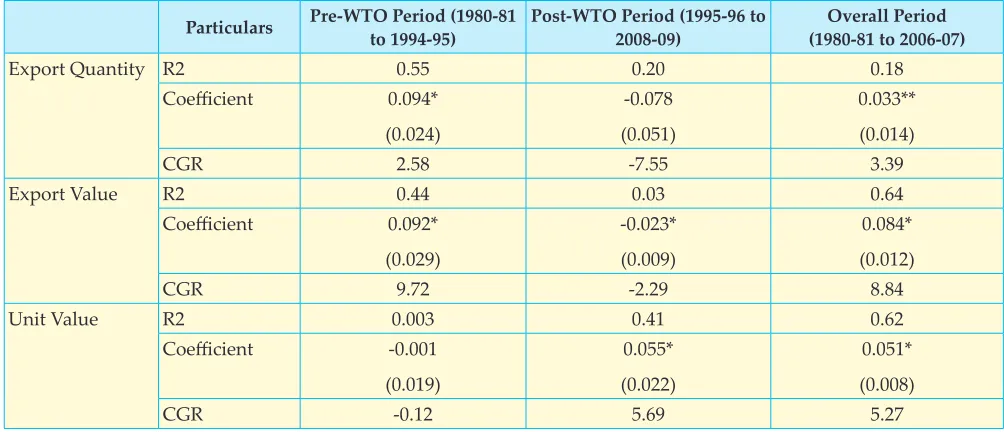
The export of ginger in India during 1980-81 to 2008-09 is given in Appendix-II. It could be seen that the export of ginger in 1980-81 was 6811 tonnes and it reached the higher level of 18442 tonnes in 1993-94. Export was found to be the highest i.e. 28268 tonnes in 1996-97.It showed declining trend from 1998-99 to 2003-04. Price per kg of ginger was less than `20
in most of the years during Pre-WTO period and it had increased during Post-WTO period. The highest price realised was `49.45/kg in 2006-07. This had contributed for higher export value of ginger during Post-WTO period.
significant. The stiff competition from other ginger exporting countries such as China, Nepal, Nigeria and Thailand had resulted in negative growth rate of ginger export from India. The growth rates for export value of ginger exhibits significant growth in Pre-WTO period and overall periods. But compared with overall Period, the Pre-WTO Period was registered high growth rate of 9.72 per cent. At overall, the growth of ginger significantly stands at 8.84 per cent. Decline in quantity exported during Post-WTO period is reflected in export value though there is positive growth in unit value during this period. The export unit value growth rate was non significant with -0.12 per cent during pre WTO period. However there was a positive and significant growth rate during post-WTO Period and overall period with 5.69 per cent and 5.27 per cent, respectively. It could be concluded from the above results that India’s export of ginger had declined during post-WTO period and also shows high variations. This needs attention.
Nominal Protection Coefficient (NPC) of Ginger
To assess the export competitiveness of ginger NPC was worked out for the years 2004-05 to 2008-09 and the same are presented in Table 4. It is evident from
the table that NPC is less than one in all the years which was mainly due to higher domestic price than the world price. So it is not profitable to Export. This may be the reason for decline in export of ginger from India. However it needs an indepth study covering all the stakeholders to find out the reasons.
Table 4. NPC of Ginger during 2004-05 to 2008-2009
Year price Rs/kgDomestic World price Rs/kg NPC
2004-05 130.36 39.77 3.28
2005-06 99.4 41.71 2.38
2006-07 54.81 49.45 1.11
2007-08 60.31 39.55 1.52
2008-09 92.12 48.98 1.88
Conclusion
The overall objective of this paper is to study the growth performance of area, production, productivity and export performance of ginger from India during pre-WTO and post- WTO periods. It was found that ginger area had increased during post-WTO period and growth rate of production and productivity were positive but lower than the pre-WTO period. This is mainly due to stagnation of productivity. Ginger had Table: 3 Compound Growth Rate of Ginger Export from India during 1980-81 to 2008-09
(Percent per annum)
Particulars Pre-WTO Period (1980-81 to 1994-95) Post-WTO Period (1995-96 to 2008-09) (1980-81 to 2006-07)Overall Period
Export Quantity R2 0.55 0.20 0.18
Coefficient 0.094*
(0.024)
-0.078 (0.051)
0.033** (0.014)
CGR 2.58 -7.55 3.39
Export Value R2 0.44 0.03 0.64
Coefficient 0.092*
(0.029)
-0.023* (0.009)
0.084* (0.012)
CGR 9.72 -2.29 8.84
Unit Value R2 0.003 0.41 0.62
Coefficient -0.001
(0.019)
0.055* (0.022)
0.051* (0.008)
CGR -0.12 5.69 5.27
Note: Figures in the parentheses indicates Standard Errors of the respective Coefficient. ** - Significant at 1 per cent level;
a negative growth rate in export quantity and value during post-WTO which was mainly due to stiff competition from other exporting countries. It can be concluded that WTO had not favored India’s ginger export. Hence it is suggested that the efforts are needed to address the constraints in production and efforts are needed to increase productivity through advanced technologies such as biotechnology and tissue culture. Development of market infrastructure, storage, warehousing and transport will pave for increased export. In order to face competition and increase India’s market share in the world market India need to consistently supply variety of quality ginger at competitive prices. Increase efficiency in production has to be increased so as to reduce unit cost of production. Organic ginger cultivation can be promoted.
References
Jose, CT. and Jayasekhar, S. 2008. The growth trends in area, production and productivity of Arecanut in India.
Agricultural Situation in India, 65(1): 135-140.
Jayesh, T. 2001. Production and Export Performance of Pepper and Cardamom in south India. – An Economic Analysis, M.Sc.(Agri) thesis, Uni. Agric. Sci., Dharwad.
Mahesh, K. 2000. Export trade pattern of Indian tea. M. Sc. (Agri.) Thesis, University of Agriculturla Sciences, Bangalore.
Sadesh. J., Pouchepparadjou. A., Anil Kuruvila, Rammohan.J. and Umamaheswari. L. 2007. An economic analysis- export performance of Indian Spices, Agricultural Situation in India. 49(5): 593-601.
Sharma, HR., and Sharma, RK. 2003. Production and Export Performance of Indian Tea - A Temporal and Cross-sectional Analysis, Agricultural Economic Research Review,
Appendix-I. Area, Production and Yield of Ginger in India during 1980-81 to 2006-07
S. No. Year Area (in ha.) Production (in tonnes) Yield (Kg/Ha.)
1 1980-81 40450 82440 2038
2 1981-82 41110 89710 2182
3 1982-83 43830 94170 2149
4 1983-84 48960 121310 2478
5 1984-85 51510 133860 2599
6 1985-86 53520 138020 2579
7 1986-87 52630 136010 2584
8 1987-88 54240 142840 2633
9 1988-89 51870 152120 2933
10 1989-90 53560 156120 2915
11 1990-91 53930 153450 2845
12 1991-92 59830 176950 2958
13 1992-93 59870 201630 3368
14 1993-94 60580 186200 3074
15 1994-95 61090 197650 3235
16 1995-96 66890 219300 3279
17 1996-97 70290 232510 3308
18 1997-98 75600 252100 3335
19 1998-99 77600 263200 3392
20 1999-00 80800 282600 3498
21 2000-01 86200 288000 3341
22 2001-02 90800 318000 3502
23 2002-03 88200 280200 3177
24 2003-04 85100 301900 3548
25 2004-05 95300 359000 3767
26 2005-06 110600 391200 3537
27 2006-07 105900 370300 3497
28 2007-08 104100 382600 3676
29 2008-09 108600 380100 3499
Appendix-II. Export of Ginger in India during 1980-81 to 2008-09
Year Export Quantity (Tonnes) Export Value (` Lakhs) Unit Value (`/Kg)
1980-81 6,811 367.97 5.4
1981-92 4,718 395.23 8.38
1982-83 3,955 588.49 14.88
1983-84 4,629 1190.16 25.71
1984-85 7,329 1872.76 25.55
1985-86 6,816 1089.35 15.98
1986-87 4,843 571.16 11.79
1987-88 2,628 488.99 18.61
1988-89 6,368 940.82 14.77
1989-90 8,139 1262.44 15.51
1990-91 6,555 1175.79 17.94
1991-92 14,259 2188.1 15.35
1992-93 9,825 1687.37 17.17
1993-94 18,442 2478.12 13.44
1994-95 12,022 1673.03 13.92
1995-96 18,483 3892.13 21.06
1996-97 29,737 5924.41 19.92
1997-98 28,268 7262.73 25.69
1998-99 8,683 4058.32 46.74
1999-00 8,923 3253.55 36.46
2000-01 6,288 2682.06 42.65
2001-02 6,464 2311.47 35.76
2002-03 8,461 2396.59 28.33
2003-04 5,000 2340.5 46.81
2004-05 14,908 5929.59 39.77
2005-06 10,981 4580.59 41.71
2006-07 9,661 4777.77 49.45
2007-08 8332 3296.08 39.55
2008-09 3229 1581.75 48.98