Vol. 12, No. 2, 2019, 294-331
ISSN 1307-5543 – www.ejpam.com Published by New York Business Global
Fuzzy Soft Sets over Fully UP-Semigroups
∗Akarachai Satirad1, Aiyared Iampan1,†
1 Department of Mathematics, School of Science, University of Phayao, Phayao 56000,
Thailand
Abstract. In this paper, we introduce ten types of fuzzy soft sets over fully UP-semigroups, and investigate the algebraic properties of fuzzy soft sets under the operations of (extended) intersection and (restricted) union. Further, we discuss the relation between some conditions of fuzzy soft sets and fuzzy soft UPs-subalgebras (resp., fuzzy soft UPi-subalgebras, fuzzy soft near UPs-filters, fuzzy
soft near UPi-filters, fuzzy soft UPs-filters, fuzzy soft UPi-filters, fuzzy soft UPs-ideals, fuzzy soft
UPi-ideals, fuzzy soft strongly UPs-ideals, fuzzy soft strongly UPi-ideals) of fully UP-semigroups.
2010 Mathematics Subject Classifications: 03G25, 08A72
Key Words and Phrases: UP-algebra, fully UP-semigroup, fuzzy soft set.
1. Introduction and Preliminaries
Several researches introduced a new class of algebras related to logical algebras and semigroups such as: In 1993, Jun et al. [10] introduced the notion of BCI-semigroups. In 1998, Jun et al. [13] renamed the BCI-semigroup as the IS-algebra. In 2006, Kim [14] introduced the notion of KS-semigroups. In 2015, Endam and Vilela [3] introduced the notion of JB-semigroups. In 2018, Iampan [6] introduced the notion of fully UP-semigroups.
A fuzzy subset F of a set X is a function from X to a closed interval [0,1]. The concept of a fuzzy subset of a set was first considered by Zadeh [27] in 1965. The fuzzy set theories developed by Zadeh and others have found many applications in the domain of mathematics and elsewhere. After the introduction of the concept of fuzzy sets by Zadeh [27], several researches were conducted on the generalizations of the notion of fuzzy set and application to many logical algebras such as: In 1998, Jun et al. [9] applied the notion of fuzzy sets to BCI-semigroups (it was renamed as an IS-algebra for the convenience of study), and introduced the concept of fuzzy I-ideals. In 2000, Roh et al. [21] considered the fuzzification of an associative I-ideal of an IS-algebra. They proved that every fuzzy associative I-ideal is a fuzzy I-ideal. By giving an appropriate example, they verified that
∗
This work was financially supported by the University of Phayao. †
Corresponding author.
DOI: https://doi.org/10.29020/nybg.ejpam.v12i2.3412
Email addresses: [email protected](A. Satirad),[email protected](A. Iampan)
a fuzzy I-ideal may not be a fuzzy associative I-ideal. They gave a condition for a fuzzy I-ideal to be a fuzzy associative I-ideal, and they investigated some related properties. In 2003, Jun and Kondo [11] proved that some concepts of BCK/BCI-algebras expressed by a certain formula can be naturally extended to the fuzzy setting and that many results are obtained immediately with the use of our method. Moreover, they proved that these results can be extended to fuzzy IS-algebras. In 2003, Jianming and Dajing [8] introduced the concept of intuitionistic fuzzy associative I-ideals of IS-algebras and they investigated some related properties. In 2007, Prince Williams and Husain [26] studied fuzzy KS-semigroups. In 2016, Endam and Manahon [2] introduced the notion of fuzzy JB-semigroups and they investigated some of its properties. In 2018, Satirad and Iampan [23] introduced the notion of fuzzy sets in fully UP-semigroups and they investigated some of its properties.
In 1999, to solve complicated problems in economics, engineering, and environment, we cannot successfully use classical methods because of various uncertainties typical for those problems. Uncertainties cannot be handled using traditional mathematical tools but may be dealt with using a wide range of existing theories such as the probability theory, the theory of (intuitionistic) fuzzy sets, the theory of vague sets, the theory of interval mathematics, and the theory of rough sets. However, all of these theories have their own difficulties which are pointed out in [18]. In 2001, Maji et al. [17] introduced the concept of fuzzy soft sets as a generalization of the standard soft sets, and presented an application of fuzzy soft sets in a decision making problem. In 2010, Jun et al. [12] applied fuzzy soft set for dealing with several kinds of theories in BCK/BCI-algebras. The notions of fuzzy soft BCK/BCI-algebras, (closed) fuzzy soft ideals and fuzzy soft p-ideals are introduced, and related properties are investigated.
Before we begin our study, we will introduce the definition of a UP-algebra.
Definition 1. [5]An algebra A= (A,·,0)of type (2,0)is called a UP-algebra where A is a nonempty set,·is a binary operation onA, and 0is a fixed element of A(i.e., a nullary operation) if it satisfies the following axioms:
(UP-1) (∀x, y, z ∈A)((y·z)·((x·y)·(x·z)) = 0),
(UP-2) (∀x∈A)(0·x=x),
(UP-3) (∀x∈A)(x·0 = 0), and
(UP-4) (∀x, y∈A)(x·y= 0, y·x= 0⇒x=y),
From [5], we know that the notion of UP-algebras is a generalization of KU-algebras (see [19]).
On a UP-algebraA= (A,·,0), we define a binary relation≤on A [5] as follows: (∀x, y∈A)(x≤y⇔x·y= 0).
Example 1. [24] Let X be a universal set and letΩ∈ P(X). LetPΩ(X) ={A∈ P(X)|
Example 2. [24] Let X be a universal set and let Ω∈ P(X). Let PΩ(X) ={A∈ P(X)| A⊆Ω}. Define a binary operation ∗ on PΩ(X) by putting A∗B =B∪(A0 ∩Ω) for all
A, B ∈ PΩ(X). Then (PΩ(X),∗,Ω) is a UP-algebra and we shall call it the generalized power UP-algebra of type 2 with respect to Ω.
In particular, (P(X),·,∅) is the power UP-algebra of type 1 and (P(X),∗, X) is the power UP-algebra of type 2.
In a UP-algebra A= (A,·,0), the following assertions are valid (see [5, 6]).
(∀x∈A)(x·x= 0), (1.1)
(∀x, y, z∈A)(x·y= 0, y·z= 0⇒x·z= 0), (1.2) (∀x, y, z∈A)(x·y= 0⇒(z·x)·(z·y) = 0), (1.3) (∀x, y, z∈A)(x·y= 0⇒(y·z)·(x·z) = 0), (1.4)
(∀x, y∈A)(x·(y·x) = 0), (1.5)
(∀x, y∈A)((y·x)·x= 0⇔x=y·x), (1.6)
(∀x, y∈A)(x·(y·y) = 0), (1.7)
(∀a, x, y, z∈A)((x·(y·z))·(x·((a·y)·(a·z))) = 0), (1.8) (∀a, x, y, z∈A)((((a·x)·(a·y))·z)·((x·y)·z) = 0), (1.9) (∀x, y, z∈A)(((x·y)·z)·(y·z) = 0), (1.10) (∀x, y, z∈A)(x·y= 0⇒x·(z·y) = 0), (1.11) (∀x, y, z∈A)(((x·y)·z)·(x·(y·z)) = 0),and (1.12) (∀a, x, y, z∈A)(((x·y)·z)·(y·(a·z)) = 0). (1.13) Definition 2. [4, 5, 7, 25] A nonempty subset S of a UP-algebra (A,·,0) is called
(1) a UP-subalgebra of A if (∀x, y∈S)(x·y∈S).
(2) a near UP-filter of A if it satisfies the following properties:
(i) the constant0 of A is inS, and
(ii) (∀x, y∈A)(x∈A, y∈S ⇒x·y∈S).
(3) a UP-filter of A if it satisfies the following properties:
(i) the constant0 of A is inS, and
(ii) (∀x, y∈A)(x·y∈S, x∈S ⇒y∈S).
(4) a UP-ideal of A if it satisfies the following properties:
(i) the constant0 of A is inS, and
(ii) (∀x, y, z ∈A)(x·(y·z)∈S, y∈S⇒x·z∈S).
(i) the constant0 of A is inS, and
(ii) (∀x, y, z ∈A)((z·y)·(z·x)∈S, y∈S⇒x∈S).
We know that the notion of UP-subalgebras is a generalization of near UP-filters, the notion of near UP-filters is a generalization of UP-filters, the notion of UP-filters is a generalization of ideals, and the notion of ideals is a generalization of strongly UP-ideals. Moreover, they also proved that a UP-algebraAis the only one strongly UP-ideal of itself.
Definition 3. [15] A nonempty subset S of a semigroup (A,∗) is called
(1) a subsemigroup of A if (∀x, y∈S)(x∗y∈S).
(2) an ideal of A if (∀x, y∈A)(x∈A, y∈S ⇒x∗y, y∗x∈S).
Clearly, an ideal is a subsemigroup.
Definition 4. [6] Let A be a nonempty set, ·and ∗ are binary operations on A, and 0 is a fixed element of A (i.e., a nullary operation). An algebraA= (A,·,∗,0)of type (2,2,0)
in which(A,·,0)is a UP-algebra and (A,∗) is a semigroup is called a fully UP-semigroup
(in short, an f-UP-semigroup) if the operation “∗” is distributive (on both sides) over the operation “·”.
Definition 5. [27] A fuzzy setFin a nonempty setU (or a fuzzy subset ofU) is described by its membership function fF. To every point x ∈ U, this function associates a real number fF(x) in the interval [0,1]. The number fF(x) is interpreted for the point as a degree of belonging x to the fuzzy set F, that is, F :={(x,fF(x))|x∈U}. We say that a fuzzy setF in U is constant if its membership function fF is constant.
Definition 6. [16] LetFandGbe fuzzy sets in a nonempty setU. ThenF≤Gis defined by fF(x)≤fG(x) for allx∈U.
Definition 7. [15] Let F and G be fuzzy sets in a semigroup A = (A,∗). Then the product of F and G, denoted by F◦G, is described by their membership function fF and
fG, respectively which defined as follows:
(∀x∈A)
(fF◦fG)(x) =
sup{min{fF(y),fG(z)}}x=y∗z if ∃y, z ∈A such that x=y∗z,
0 otherwise.
Rosenfeld [22] introduced the notion of fuzzy subsemigroups (resp., fuzzy ideals) of semigroups as follows:
Definition 8. A fuzzy setF in a semigroup A= (A,∗) is called
(1) a fuzzy subsemigroup of A if (∀x, y∈A)(fF(x∗y)≥min{fF(x),fF(y)}).
Clearly, a fuzzy ideal is a fuzzy subsemigroup.
Definition 9. [15] The semigroup A itself is a fuzzy set of A, denoted by A such that
fA(x) = 1 for all x∈A.
Lemma 1. [15] Let F be a fuzzy set in a semigroup A= (A,∗). Then
(1) Fis a fuzzy subsemigroup of A if and only if it satisfies the condition
F◦F≤F. (1.14)
(2) Fis a fuzzy ideal of A if and only if it satisfies the condition
A◦F≤FandF◦A≤F. (1.15)
Definition 10. [16] Let {Fi}i∈I be a nonempty family of fuzzy sets in a nonempty set U
where I is an arbitrary index set. The intersection of Fi, denoted by Ti∈IFi, is described
by its membership functionfT
i∈IFi which defined as follows:
(∀x∈U)(fT
i∈IFi(x) = inf{fFi(x)}i∈I).
The union ofFi, denoted bySi∈IFi, is described by its membership functionfSi∈IFi which defined as follows:
(∀x∈U)(fS
i∈IFi(x) = sup{fFi(x)}i∈I)
Somjanta et al. [25] and Guntasow et al. [4] introduced the notion of fuzzy subalgebras (resp., fuzzy filters, fuzzy ideals, fuzzy strongly ideals) of UP-algebras as follows:
Definition 11. A fuzzy set Fin a UP-algebra A= (A,·,0)is called
(1) a fuzzy UP-subalgebra of A if (∀x, y∈A)(fF(x·y)≥min{fF(x),fF(y)}).
(2) a fuzzy UP-filter of A if
(i) (∀x∈A)(fF(0)≥fF(x)), and
(ii) (∀x, y∈A)(fF(y)≥min{fF(x·y),fF(x)}).
(3) a fuzzy UP-ideal of A if
(i) (∀x∈A)(fF(0)≥fF(x)), and
(ii) (∀x, y, z ∈A)(fF(x·z)≥min{fF(x·(y·z)),fF(y)}).
(4) a fuzzy strongly UP-ideal of A if
(i) (∀x∈A)(fF(0)≥fF(x)), and
Now, we introduce the notion of fuzzy near UP-filters of UP-algebras as follows: Definition 12. A fuzzy setFin a UP-algebraA= (A,·,0)is called a fuzzy near UP-filter of A if
(i) (∀x∈A)(fF(0)≥fF(x)), and
(ii) (∀x, y∈A)(fF(x·y)≥fF(y)).
We know that the notion of fuzzy subalgebras is a generalization of fuzzy near UP-filters, the notion of fuzzy near UP-filters is a generalization of fuzzy UP-UP-filters, the notion of fuzzy UP-filters is a generalization of fuzzy UP-ideals, and the notion of fuzzy UP-ideals is a generalization of fuzzy strongly UP-ideals. Moreover, fuzzy strongly UP-ideals and constant fuzzy sets coincide in UP-algebras.
Satirad and Iampan [23] introduced the notion of fuzzy UPs-subalgebras (resp., fuzzy
UPi-subalgebras, fuzzy UPs-filters, fuzzy UPi-filters, fuzzy UPs-ideals, fuzzy UPi-ideals,
fuzzy strongly UPs-ideals, fuzzy strongly UPi-ideals) off-UP-semigroups as follows:
Definition 13. [23] A fuzzy setF in anf-UP-semigroup A= (A,·,∗,0)is called
(1) a fuzzy UPs-subalgebra of A if F is a fuzzy UP-subalgebra of (A,·,0) and a fuzzy subsemigroup of (A,∗).
(2) a fuzzy UPi-subalgebra ofA ifFis a fuzzy UP-subalgebra of(A,·,0)and a fuzzy ideal of (A,∗).
(3) a fuzzy UPs-filter of A if Fis a fuzzy UP-filter of (A,·,0)and a fuzzy subsemigroup of (A,∗).
(4) a fuzzy UPi-filter ofAif Fis a fuzzy UP-filter of (A,·,0)and a fuzzy ideal of(A,∗).
(5) a fuzzy UPs-ideal ofA ifF is a fuzzy UP-ideal of(A,·,0)and a fuzzy subsemigroup of (A,∗).
(6) a fuzzy UPi-ideal ofA if Fis a fuzzy UP-ideal of(A,·,0)and a fuzzy ideal of(A,∗).
(7) a fuzzy strongly UPs-ideal of A if F is a fuzzy strongly UP-ideal of (A,·,0) and a fuzzy subsemigroup of (A,∗).
(8) a fuzzy strongly UPi-ideal of A if F is a fuzzy strongly UP-ideal of (A,·,0) and a fuzzy ideal of (A,∗).
Now, we introduce the notion fuzzy near UPs-filters off-UP-semigroups (resp., fuzzy
near UPi-filters) as follows:
Definition 14. A fuzzy set Fin an f-UP-semigroupA= (A,·,∗,0)is called
(2) a fuzzy near UPi-filter ofA ifFis a fuzzy near UP-filter of(A,·,0)and a fuzzy ideal of (A,∗).
Clearly, a fuzzy near UPi-filter is a fuzzy near UPs-filter.
Example 3. Let A = {0,1,2,3} be a set with two binary operations · and ∗ defined by the following Cayley tables:
· 0 1 2 3
0 0 1 2 3 1 0 0 2 3 2 0 1 0 3 3 0 1 2 0
∗ 0 1 2 3
0 0 0 0 0 1 0 0 0 0 2 0 0 0 1 3 0 0 1 0
Then A = (A,·,∗,0) is an f-UP-semigroup. We define a membership function fF as follows:
fF(0) = 1,fF(1) = 0.4,fF(2) = 0.5,and fF(3) = 0.2.
ThenFis a fuzzy near UPs-filter ofA. SincefF(2∗3) = fF(1) = 0.40.5 = max{0.5,0.2}=
max{fF(2),fF(3)}, we have Fis not a fuzzy near UPi-filter of A.
From [7], we can easily prove Theorems 1, 2, 3, and 4.
Theorem 1. Every fuzzy near UPs-filter of anf-UP-semigroup is a fuzzy UPs-subalgebra.
The following example shows that the converse of Theorem 1 is not true.
Example 4. Let A = {0,1,2,3} be a set with two binary operations · and ∗ defined by the following Cayley tables:
· 0 1 2 3
0 0 1 2 3 1 0 0 1 3 2 0 0 0 3 3 0 1 1 0
∗ 0 1 2 3
0 0 0 0 0 1 0 0 0 0 2 0 0 0 0 3 0 0 0 1
Then A = (A,·,∗,0) is an f-UP-semigroup. We define a membership function fF as follows:
fF(0) = 1,fF(1) = 0.8,fF(2) = 0.9,and fF(3) = 0.7.
Then F is a fuzzy UPs-subalgebra of A. Since fF(1·2) = fF(1) = 0.8 0.9 = fF(2), we have Fis not a fuzzy near UPs-filter of A.
Theorem 2. Every fuzzy near UPi-filter of an f-UP-semigroup is a fuzzy UPi-subalgebra.
In Example 4, we have F is a fuzzy UPi-subalgebra of A but F is not a fuzzy near
UPi-filter ofA.
The following example shows that the converse of Theorem 3 is not true.
Example 5. Let A = {0,1,2,3} be a set with two binary operations · and ∗ defined by the following Cayley tables:
· 0 1 2 3
0 0 1 2 3 1 0 0 2 3 2 0 0 0 3 3 0 0 0 0
∗ 0 1 2 3
0 0 0 0 0 1 0 0 0 0 2 0 0 0 0 3 0 0 0 2
Then A = (A,·,∗,0) is an f-UP-semigroup. We define a membership function fF as follows:
fF(0) = 1,fF(1) = 0.7,fF(2) = 0.9,and fF(3) = 0.8.
Then F is a fuzzy near UPs-filter of A. Since fF(1) = 0.7 0.8 = min{1,0.8} =
min{fF(0),fF(3)}= min{fF(3·1),fF(3)}, we have F is not a fuzzy UPs-filter of A.
Theorem 4. Every fuzzy UPi-filter of an f-UP-semigroup is a fuzzy near UPi-filter.
In Example 5, we have F is a fuzzy near UPi-filter ofAbut it is not a fuzzy UPi-filter
of A.
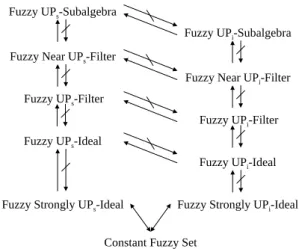
Hence, we get the diagram of generalization of fuzzy sets in fully UP-semigroups as shown in Figure 1.
Figure 1: Fuzzy sets in fully UP-semigroups
Theorem 6. [23] The union of any nonempty family of fuzzy strongly UPs-ideals (resp., fuzzy strongly UPi-ideals) of anf-UP-semigroup is also a fuzzy strongly UPs-ideal (resp., fuzzy strongly UPi-ideal).
Theorem 7. The intersection of any nonempty family of fuzzy near UPs-filters of an f-UP-semigroupA= (A,·,∗,0)is also a fuzzy near UPs-filter.
Proof. Let Fi be a fuzzy near UPs-filter of an f-UP-semigroup A = (A,·,∗,0) for all i∈I. Then
fT
i∈IFi(0) = inf{fFi(0)}i∈I ≥inf{fFi(x)}i∈I= f
T
i∈IFi(x),
fT
i∈IFi(x·y) = inf{fFi(x·y)}i∈I ≥inf{fFi(y)}i∈I = fTi∈IFi(y),and
fT
i∈IFi(x∗y) = inf{fFi(x∗y)}i∈I
≥inf{min{fFi(x),fFi(y)}}i∈I
= min{inf{fFi(x)}i∈I,inf{fFi(y)}i∈I}
= min{fT
i∈IFi(x),fTi∈IFi(y)}.
Hence,T
i∈IFi is a fuzzy near UPs-filter ofA.
The following example shows that the union of two fuzzy near UPs-filters of an f
-UP-semigroup is not a fuzzy near UPs-filter.
Example 6. By Cayley tables in Example 3, we know that A = (A,·,∗,0) is an f -UP-semigroup. We define two membership functions fF1 and fF2 as follows:
A 0 1 2 3
fF1 1 0.7 1 0.5 fF2 1 0.5 0.3 0.8
ThenF1 andF2 are fuzzy near UPs-filters ofAbutF1∪F2 is not a fuzzy near UPs-filter of A. Indeed,fF1∪F2(3∗2) = fF1∪F2(1) = 0.70.8 = min{0.8,1}= min{fF1∪F2(3),fF1∪F2(2)}. Theorem 8. The intersection of any nonempty family of fuzzy near UPi-filters of an f-UP-semigroupA= (A,·,∗,0)is also a fuzzy near UPi-filter.
Proof. Let Fi be a fuzzy near UPi-filter of an f-UP-semigroup A = (A,·,∗,0) for all i∈I. Then, by the proof of Theorem 7, we have fT
i∈IFi(0)≥fTi∈IFi(x) and fTi∈IFi(x·y)≥
fT
i∈IFi(y). Thus
fT
i∈IFi(x∗y) = inf{fFi(x∗y)}i∈I
≥inf{max{fFi(x),fFi(y)}}i∈I
≥max{inf{fFi(x)}i∈I,inf{fFi(y)}i∈I}
= max{fT
i∈IFi(x),fTi∈IFi(y)}.
Hence,T
Theorem 9. The union of any nonempty family of fuzzy near UPi-filters of an f -UP-semigroup A= (A,·,∗,0)is also a fuzzy near UPi-filter.
Proof. Let Fi be a fuzzy near UPi-filter of an f-UP-semigroup A = (A,·,∗,0) for all i∈I. Then
fS
i∈IFi(0) = sup{fFi(0)}i∈I ≥sup{fFi(x)}i∈I = f
S
i∈IFi(x),
fS
i∈IFi(x·y) = sup{fFi(x·y)}i∈I ≥sup{fFi(y)}i∈I = fSi∈IFi(y),and
fS
i∈IFi(x∗y) = sup{fFi(x∗y)}i∈I
≥sup{max{fFi(x),fFi(y)}}i∈I
= max{sup{fFi(x)}i∈I,sup{fFi(y)}i∈I}
= max{fS
i∈IFi(x),fSi∈IFi(y)}.
Hence,S
i∈IFi is a fuzzy near UPi-filter ofA.
2. Properties of Fuzzy Sets in UP-Algebras
In this section, we shall let A be a UP-algebra A = (A,·,0) and find some properties of fuzzy sets in UP-algebras.
Proposition 1. [25] If F is a fuzzy UP-subalgebra of A, then
(∀x∈A)(fF(0)≥fF(x)). (2.1)
Proposition 2. [23] If F is a fuzzy UP-filter of A, then
(∀x, y∈A)(x≤y⇒fF(x)≤fF(y)). (2.2)
Proposition 3. If F is a fuzzy set in A satisfying the condition
(∀x, y, z∈A)(z≤x⇒fF(x·y)≥min{fF(z),fF(y)}), (2.3) thenF is a fuzzy UP-subalgebra of A.
Proof. Let x, y ∈ A. By (1.1), we have x ≤x. It follows from (2.3) that fF(x·y) ≥
min{fF(x),fF(y)}. Hence, F is a fuzzy UP-subalgebra of A.
Theorem 10. If F is a fuzzy set in A satisfying the condition (2.3), then F satisfies the condition (2.1).
Proof. It is straightforward by Proposition 3.
Example 7. Let A={0,1,2,3}be a set with a binary operation·defined by the following Cayley table:
· 0 1 2 3
0 0 1 2 3 1 0 0 2 2 2 0 1 0 2 3 0 1 0 0
Then A= (A,·,0) is a UP-algebra. We define a membership function fF as follows:
fF(0) = 1,fF(1) = 0.6,fF(2) = 0.2,and fF(3) = 0.9.
Then F satisfies the condition (2.1) but it does not satisfy the condition (2.3). Indeed,
1≤1 but fF(1·3) = fF(2) = 0.20.6 = min{0.6,0.9}= min{fF(1),fF(3)}.
It is clear that we have the following proposition.
Proposition 4. If F is a fuzzy set in A satisfying the condition
(∀x, y, z ∈A)(fF(x·y)≥min{fF(z),fF(y)}), (2.4) thenF satisfies the condition (2.3).
The following example shows that the converse of Proposition 4 is not true.
Example 8. Let A={0,1,2,3}be a set with a binary operation·defined by the following Cayley table:
· 0 1 2 3
0 0 1 2 3 1 0 0 3 3 2 0 1 0 0 3 0 1 2 0
Then A= (A,·,0) is a UP-algebra. We define a membership function fF as follows:
fF(0) = 1,fF(1) = 0.1,fF(2) = 0.8,and fF(3) = 0.2.
Then F satisfies the condition (2.3) but it does not satisfy the condition (2.4). Indeed,
fF(1·2) = fF(3) = 0.20.8 = min{1,0.8}= min{fF(0),fF(2)}.
Proposition 5. If F is a fuzzy set in A satisfying the condition (2.2), then F is a fuzzy near UP-filter ofA.
Proof. Letx, y∈A. By (UP-3), we havex≤0. It follows from (2.2) that fF(0)≥fF(x).
By (1.5), we havey≤x·y. It follows from (2.2) that fF(x·y)≥fF(y). Hence, F is a fuzzy
near UP-filter ofA.
Proof. Let x, y, z ∈ A. By (1.5), we have y ≤ x ·y. It follows from (2.2) that fF(x·y)≥fF(y)≥min{fF(z),fF(y)}. Hence, F satisfies (2.4).
The following example shows that the converse of Theorem 11 is not true.
Example 9. Let A={0,1,2,3}be a set with a binary operation·defined by the following Cayley table:
· 0 1 2 3
0 0 1 2 3 1 0 0 2 3 2 0 0 0 3 3 0 0 0 0
Then A= (A,·,0) is a UP-algebra. We define a membership function fF as follows:
fF(0) = 1,fF(1) = 0.1,fF(2) = 0.7,and fF(3) = 0.8.
Then F satisfies the condition (2.4) but it does not satisfy the condition (2.2). Indeed,
3≤2 but fF(2) = fF(1) = 0.70.8 = fF(3).
Theorem 12. If Fis a fuzzy UP-subalgebra of A satisfying the condition
(∀x, y∈A)(x·y6= 0⇒fF(x)≥fF(y)), (2.5) thenF is a fuzzy near UP-filter of A.
Proof. Let x, y ∈A. If x·y = 0, then by (2.1), we have fF(x·y) = fF(0)≥fF(y). If x·y6= 0, then by (2.5), we have fF(x·y)≥min{fF(x),fF(y)}= fF(y). Hence, F is a fuzzy
near UP-filter ofA.
Proposition 6. A fuzzy setF in A satisfies the condition
(∀x, y, z ∈A)(z≤x·y⇒fF(y)≥min{fF(z),fF(x)}) (2.6) if and only if F is a fuzzy UP-filter of A.
Proof. Let x ∈ A. By (UP-3), we have x ≤ x·0. It follows from (2.6) that fF(0) ≥
min{fF(x),fF(x)} = fF(x). Let x, y∈ A. By (1.1), we have x·y ≤x·y. It follows from
(2.6) that fF(y)≥min{fF(x·y),fF(x)}. Hence, F is a fuzzy UP-filter of A.
Conversely, let x, y, z∈A be such thatz≤x·y. Then z·(x·y) = 0, so fF(x·y)≥min{fF(z·(x·y)),fF(z)}= min{fF(0),fF(z)}= fF(z).
Thus fF(y)≥min{fF(x·y),fF(x)} ≥min{fF(z),fF(x)}. Hence, F satisfies (2.6).
Proof. Let x, y ∈ A such that x ≤y. By (1.11), we have x ≤ x·y. It follows from (2.6) that fF(y)≥min{fF(x),fF(x)}= fF(x). Hence, F satisfies (2.2).
The following example shows that the converse of Theorem 13 is not true.
Example 10. LetA={0,1,2,3}be a set with a binary operation·defined by the following Cayley table:
· 0 1 2 3
0 0 1 2 3 1 0 0 2 2 2 0 1 0 1 3 0 0 0 0
Then A= (A,·,0) is a UP-algebra. We define a membership function fF as follows:
fF(0) = 0.9,fF(1) = 0.3,fF(2) = 0.6,andfF(3) = 0.2.
Then F satisfies the condition (2.2) but it does not satisfy the condition (2.6). Indeed,
1≤2·3 but fF(3) = 0.20.3 = min{0.3,0.6}= min{fF(1),fF(2)}.
Theorem 14. If Fis a fuzzy near UP-filter of A satisfying the condition
(∀x, y∈A)(fF(x·y) = fF(y)), (2.7) thenF is a fuzzy UP-filter of A.
Proof. Let x, y ∈ A. By (2.7), we have fF(y) ≥ min{fF(y),fF(x)} = min{fF(x· y),fF(x)}. Hence, F is a fuzzy UP-filter ofA.
Proposition 7. A fuzzy setF in A satisfies the condition
(∀a, x, y, z ∈A)(a≤x·(y·z)⇒fF(x·z)≥min{fF(a),fF(y)}) (2.8) if and only if F is a fuzzy UP-ideal ofA.
Proof. Letx∈A. By (UP-3), we havex≤x·(x·0). By (UP-3) and (2.8), we have fF(0) = fF(x·0)≥min{fF(x),fF(x)}= fF(x).
Letx, y, z ∈A. By (1.1), we have x·(y·z)≤x·(y·z). It follows from (2.8) that fF(x·z)≥min{fF(x·(y·z)),fF(y)}.
Hence, F is a fuzzy UP-ideal of A.
Conversely, let a, x, y, z ∈ A be such that a≤ x·(y·z). By Proposition 2, we have fF(a)≤fF(x·(y·z)). Thus
fF(x·z)≥min{fF(x·(y·z)),fF(y)} ≥min{fF(a),fF(y)}.
Proposition 8. If F is a fuzzy UP-ideal ofA, then
(∀a, x, y, z∈A)(a≤x·(y·z)⇒fF(a·z)≥min{fF(x),fF(y)}). (2.9) Proof. Leta, x, y, z∈A be such thata≤x·(y·z). Then a·(x·(y·z)) = 0, so
fF(a·(y·z))≥min{fF(a·(x·(y·z))),fF(x)}= min{fF(0),fF(x)}= fF(x).
Thus
fF(a·z)≥min{fF(a·(y·z)),fF(y)} ≥min{fF(x),fF(y)}.
Corollary 1. If F is a fuzzy set in A satisfying the condition (2.8), then F satisfies the condition (2.9).
Proof. It is straightforward by Propositions 7 and 8. Theorem 15. Let A be a UP-algebra satisfying the condition
(∀x, y, z∈A)(z·(y·x) =y·(z·x)). (2.10)
If Fis a fuzzy set in A satisfying the condition (2.9), then Fsatisfies the condition (2.8). Proof. Leta, x, y, z∈Asuch thata≤x·(y·z). By (2.10), we have 0 =a·(x·(y·z)) =
x·(a·(y·z)), that is,x≤a·(y·z). It follows from (2.9) that fF(x·z)≥min{fF(a),fF(y)}.
Hence, F satisfies (2.8).
Theorem 16. If F is a fuzzy set in A satisfying the condition (2.9), then F satisfies the condition (2.6).
Proof. Letx, y, z ∈A be such that z≤x·y. By (1.1) and (1.3), we have 0 =z·z≤ z·(x·y). By (UP-2) and (2.9), we have fF(y) = fF(0·y) ≥min{fF(z),fF(x)}. Hence, F
satisfies (2.6).
Corollary 2. If F is a fuzzy set in A satisfying the condition (2.8), then F satisfies the condition (2.6).
Proof. It is straightforward by Corollary 1 and Theorem 16.
The following example shows that the converse of Theorem 16 is not true.
Example 11. LetA={0,1,2,3}be a set with a binary operation·defined by the following Cayley table:
· 0 1 2 3
Then A= (A,·,0) is a UP-algebra. We define a membership function fF as follows:
fF(0) = 1,fF(1) = 0.9,fF(2) = 0.1,and fF(3) = 0.1.
Then F satisfies the condition (2.6) but it does not satisfy the condition (2.9). Indeed,
3≤1·(1·2) butfF(3·2) = fF(2) = 0.10.9 = fF(1) = min{fF(1),fF(1)}.
The following example shows that fuzzy set in a UP-algebra which satisfies the condi-tion (2.8) is not constant.
Example 12. LetA={0,1,2,3}be a set with a binary operation·defined by the following Cayley table:
· 0 1 2 3
0 0 1 2 3 1 0 0 2 3 2 0 1 0 3 3 0 1 2 0
Then A= (A,·,0) is a UP-algebra. We define a membership function fF as follows:
fF(0) = 0.7,fF(1) = 0.5,fF(2) = 0.4,andfF(3) = 0.4. Then Fsatisfies the condition (2.8)but it is not constant.
Theorem 17. If Fis a fuzzy UP-filter of A satisfying the condition
(∀x, y, z∈A)(fF(y·(x·z)) = fF(x·(y·z))), (2.11) thenF is a fuzzy UP-ideal of A.
Proof. Letx, y, z∈A. By (2.11), we have
fF(x·z)≥min{fF(y·(x·z)),fF(y)}= min{fF(x·(y·z)),fF(y)}.
Hence, F is a fuzzy UP-ideal of A.
Proposition 9. A fuzzy setF in A satisfies the condition
(∀a, x, y, z∈A)(a≤(z·y)·(z·x)⇒fF(x)≥min{fF(a),fF(y)}) (2.12) if and only if F is a fuzzy strongly UP-ideal ofA.
Proof. Let x ∈A. By (UP-3), we have x≤0 = x·0 = (0·x)·(0·0). By (2.12), we have fF(0)≥min{fF(x),fF(x)}= fF(x). Letx, y, z∈A. By (1.1), we have (z·y)·(z·x)≤
(z·y)·(z·x). By (2.12), we have fF(x) ≥ min{fF((z·y)·(z·x)),fF(y)}. Hence, F is a
fuzzy strongly UP-ideal of A.
Theorem 18. If Fis a fuzzy set in A satisfying the condition
(∀x, y, z∈A)(z≤x·y⇒fF(z)≥min{fF(x),fF(y)}), (2.13) thenF satisfies the condition (2.3).
Proof. Let x, y, z ∈A be such that z≤x. By (1.4), we have x·y ≤z·y. By (2.13), we have fF(x·y)≥min{fF(z),fF(y)}. Hence, F satisfies (2.3).
Proposition 10. A fuzzy set F in A satisfies the condition (2.13) if and only if F is a fuzzy strongly UP-ideal of A.
Proof. Let x ∈ A. By (UP-3), we have x ≤ 0 = 0·0. By (2.13), we have fF(x) ≥
min{fF(0),fF(0)}= fF(0). By Theorem 18 and Proposition 3, we have fF(0)≥fF(x). Thus
fF(x) = fF(0) for allx∈A, so F is constant. Hence, F a fuzzy strongly UP-ideal ofA.
The converse is obvious because F is constant.
Theorem 19. If Fis a fuzzy set in A satisfying the condition
(∀x, y, z ∈A)(z≤x·y⇒fF(z)≥fF(y)), (2.14) thenF satisfies the condition (2.3).
Proof. Letx, y, z ∈A be such that z ≤x. By (1.4), we have x·y ≤z·y. It follows from (2.14) that fF(x·y)≥fF(y)≥min{fF(z),fF(y)}. Hence, F satisfies (2.3).
Proposition 11. A fuzzy set F in A satisfies the condition (2.14) if and only if F is a fuzzy strongly UP-ideal of A.
Proof. Letx∈A. By (UP-3), we havex≤0 = 0·0. By (2.14), we have fF(x)≥fF(0).
By Theorem 19 and Proposition 3, we have fF(0) ≥ fF(x). Thus fF(x) = fF(0) for all x∈A, so F is constant. Hence, F is a fuzzy strongly UP-ideal ofA.
The converse is obvious because F is constant.
We have provided various important properties of fuzzy sets in various types in UP-algebras which will be used in the next section. We get the diagram of the properties of fuzzy sets in UP-algebras as shown in Figure 2.
3. Fuzzy Soft Sets over Fully UP-Semigroups
From now on, we shall let A be an f-UP-semigroupA = (A,·,∗,0) andP be a set of parameters. Let F(A) denotes the set of all fuzzy sets inA. A subsetE of P is called a
Figure 2: Properties of fuzzy sets in UP-algebras
Definition 15. Let E ⊆ P. A pair (Fe, E) is called a fuzzy soft set over A if Fe is a
mapping given by F :e E→ F(A), that is, a fuzzy soft set is a statistic family of fuzzy sets
in A. In general, for every e∈E, F[ee] :={(x,f
e
F[e](x))|x∈A} is a fuzzy set inA and it is called a fuzzy value set of statistice.
Definition 16. Let (Fe, E1) and(Ge, E2)be two fuzzy soft sets over a common universe U.
The union [17]of (Fe, E1) and(Ge, E2) is defined to be the fuzzy soft set(Fe, E1)∪(Ge, E2) =
(He, E) satisfying the following conditions:
(i) E=E1∪E2 and
(ii) for alle∈E,
e
H[e] =
e
F[e] if e∈E1\E2
e
G[e] if e∈E2\E1
e
F[e]∪G[e e] if e∈E1∩E2.
The restricted union [20]of (Fe, E1) and(Ge, E2) is defined to be the fuzzy soft set(Fe, E1)d
(Ge, E2) = (He, E) satisfying the following conditions:
(i) E=E1∩E2 6=∅ and
(ii) H[e e] =F[ee]∪G[e e] for alle∈E.
Definition 17. [20]Let(Fe, E1)and(Ge, E2) be two fuzzy soft sets over a common universe
U. The extended intersection of (Fe, E1) and (Ge, E2) is defined to be the fuzzy soft set
(Fe, E1)∩(Ge, E2) = (He, E) satisfying the following conditions:
(ii) for alle∈E,
e
H[e] =
e
F[e] if e∈E1\E2
e
G[e] if e∈E2\E1
e
F[e]∩G[e e] if e∈E1∩E2.
The intersection [1] of (eF, E1) and (Ge, E2) is defined to be the fuzzy soft set (eF, E1)e
(Ge, E2) = (He, E) satisfying the following conditions:
(i) E=E1∩E2 6=∅ and
(ii) H[e e] =F[ee]∩G[e e] for alle∈E.
3.1. Fuzzy Soft UPs-Subalgebras
Definition 18. A fuzzy soft set (eF, E) over A is called a fuzzy soft UPs-subalgebra based
one∈E (we shortly call ane-fuzzy soft UPs-subalgebra) of A if a fuzzy setF[ee]in Ais a
fuzzy UPs-subalgebra of A. If (eF, E) is an e-fuzzy soft UPs-subalgebra of A for all e∈E,
we say that (Fe, E) is a fuzzy soft UPs-subalgebra of A.
In the next theorem, we give necessary condition for fuzzy soft UPs-subalgebras of f-UP-semigroups.
Theorem 20. If (Fe, E) is a fuzzy soft set over A such that for alle∈E, a fuzzy setF[e e]
in A satisfies the conditions (2.3) and (1.14), then (eF, E) is a fuzzy soft UPs-subalgebra
of A.
Proof. It is straightforward by Proposition 3 and Lemma 1 (1). The proof of the following theorem can be verified easily.
Theorem 21. If (eF, E) is a fuzzy soft UPs-subalgebra of A and ∅ 6= E∗ ⊆ E, then
(Fe|E∗, E∗) is a fuzzy soft UPs-subalgebra ofA.
The following example shows that there exists a nonempty subset E∗ of E such that (Fe|E∗, E∗) is a fuzzy soft UPs-subalgebra ofA, but (Fe, E) is not a fuzzy soft UPs-subalgebra
of A.
Example 13. Let A be the set of four series of the iPhone, that is, A={5,6,7,X}.
Define two binary operations· and ∗ onA as the following Cayley tables:
· X 7 6 5
X X 7 6 5
7 X X 6 5
6 X 7 X 5
5 X 7 6 X
∗ X 7 6 5
X X X X X
7 X X X X
6 X X X 7
Then A= (A,·,∗,X) is an f-UP-semigroup. Let (Fe, E) be a fuzzy soft set over A where
E:={price,beauty,specifications,stability}
with F[eprice],F[e beauty],F[e specifications], and eF[stability] are fuzzy sets in A defined as
follows:
e
F X 7 6 5
price 0.8 0.3 0.7 0.1
beauty 0.5 0.3 0.2 0.4
specifications 0.9 0.8 0.5 0.6
stability 1 0.4 0.7 0.6
Then eF[stability] is not a fuzzy UPs-subalgebra ofA. Indeed,
f e
F[stability](5∗6) = fF[estability](7) = 0.40.6 = min{0.6,0.7}= min{feF[stability](5),feF[stability](6)}.
Hence, (Fe, E) is not a fuzzy soft UPs-subalgebra ofA. We take
E∗:={price,beauty,specifications}. Thus(Fe|E∗, E∗) is a fuzzy soft UPs-subalgebra of A.
Theorem 22. The extended intersection of two fuzzy soft UPs-subalgebras of A is also a fuzzy soft UPs-subalgebra. Moreover, the intersection of two fuzzy soft UPs-subalgebras of A is also a fuzzy soft UPs-subalgebra.
Proof. Let (Fe, E1) and (Ge, E2) be two fuzzy soft UPs-subalgebras of A. Assume that
(Fe, E1)∩(Ge, E2) = (He, E) withE=E1∪E2. Lete∈E.
Case 1: e∈ E1 \E2 (resp., e ∈ E2\E1). Then H[e e] = F[ee] (resp., H[e e] = G[e e]) is a
fuzzy soft UPs-subalgebra ofA.
Case 2: e ∈ E1 ∩E2. By Theorem 5, we have H[e e] = F[ee]∩G[e e] is a fuzzy soft
UPs-subalgebra.
Thus (He, E) is an e-fuzzy soft UPs-subalgebra of A for all e∈ E. Hence, (He, E) is a
fuzzy soft UPs-subalgebra ofA.
Theorem 23. The union of two fuzzy soft UPs-subalgebras of A is also a fuzzy soft UPs -subalgebra if sets of statistics of two fuzzy soft UPs-subalgebras are disjoint.
Proof. Let (eF, E1) and (Ge, E2) be two fuzzy soft UPs-subalgebras of A such that
E1∩E2 =∅. Assume that (Fe, E1)∪(Ge, E2) = (He, E) withE =E1∪E2. Lete∈E. Since
E1∩E2 =∅, we havee∈E1\E2 ore∈E2\E1.
Case 1: e∈E1\E2. Then H[e e] =F[e e] is a fuzzy soft UPs-subalgebra ofA.
Case 2: e∈E2\E1. Then H[e e] =G[e e] is a fuzzy soft UPs-subalgebra ofA.
Thus (He, E) is an e-fuzzy soft UPs-subalgebra of A for all e∈ E. Hence, (He, E) is a
fuzzy soft UPs-subalgebra ofA.
Example 14. By Cayley tables in Example 13, we know that A= (A,·,∗,X) is anf -UP-semigroup. Let (Ge1, E1) and (Ge2, E2) be two fuzzy soft sets over A where
E1 :={price,beauty,specifications}and E2:={price,stability}
withGe1[price],Ge1[beauty],Ge1[specifications],Ge2[price], andGe2[stability]are fuzzy sets in A
defined as follows:
e
G1 X 7 6 5
price 0.9 0.7 0.9 0.2
beauty 1 0.8 0.3 0.2
specifications 0.6 0.5 0.3 0.4
e
G2 X 7 6 5
price 0.9 0.3 0.2 0.8
stability 0.7 0.2 0.5 0.2
Then(Ge1, E1)and(Ge2, E2)are two fuzzy soft UPs-subalgebras ofA. Since price∈E1∩E2,
we have
(f e
G1[price]∪Ge2[price])(6∗5) = (fGe1[price]∪Ge2[price])(7) = 0.7
0.8
= min{0.9,0.8}
= min{(f e
G1[price]∪Ge2[price])(6),(fGe1[price]∪Ge2[price])(5)}. ThusGe1[price]∪Ge2[price]is not a fuzzy UPs-subalgebra ofA, that is,(Ge1, E1)∪(Ge2, E2)
is not a price-fuzzy soft UPs-subalgebra of A. Hence, (Ge1, E1)∪(Ge2, E2) is not a fuzzy
soft UPs-subalgebra ofA. Moreover, (Ge1, E1)d(Ge2, E2)is not a fuzzy soft UPs-subalgebra
of A.
3.2. Fuzzy Soft UPi-Subalgebras
Definition 19. A fuzzy soft set (Fe, E) over A is called a fuzzy soft UPi-subalgebra based
one∈E (we shortly call ane-fuzzy soft UPi-subalgebra)of A if a fuzzy set eF[e] inA is a
fuzzy UPi-subalgebra of A. If (Fe, E) is an e-fuzzy soft UPi-subalgebra of A for all e∈E, we say that (Fe, E) is a fuzzy soft UPi-subalgebra ofA.
In the next theorem, we give necessary condition for fuzzy soft UPi-subalgebras of f-UP-semigroups.
Theorem 24. If (Fe, E) is a fuzzy soft set over A such that for alle∈E, a fuzzy setF[e e]
in A satisfies the conditions (2.3) and (1.15), then (eF, E) is a fuzzy soft UPi-subalgebra
of A.
Theorem 25. Every e-fuzzy soft UPi-subalgebra of A is an e-fuzzy soft UPs-subalgebra. Moreover, every fuzzy soft UPi-subalgebra of A is a fuzzy soft UPs-subalgebra.
The following example shows that the converse of Theorem 25 is not true.
Example 15. In Example 13, we know that (Fe, E) is a price-fuzzy soft UPs-subalgebra of
A but F[eprice] is not a fuzzy UPi-subalgebra of A. Indeed,
f e
F[price](6∗5) = feF[price](7) = 0.30.7 = max{0.7,0.1}= max{fF[eprice](6),feF[price](5)}.
Hence, (Fe, E) is not a price-fuzzy soft UPi-subalgebra of A.
The proof of the following theorem can be verified easily.
Theorem 26. If (Fe, E) is a fuzzy soft UPi-subalgebra of A and ∅ 6= E∗ ⊆ E, then
(Fe|E∗, E∗) is a fuzzy soft UPi-subalgebra of A.
The following two theorems can be deduced in the same way as Theorems 22 and 23. Theorem 27. The extended intersection of two fuzzy soft UPi-subalgebras ofA is also a fuzzy soft UPi-subalgebra. Moreover, the intersection of two fuzzy soft UPi-subalgebras of A is also a fuzzy soft UPi-subalgebra.
Theorem 28. The union of two fuzzy soft UPi-subalgebras of A is also a fuzzy soft UPi -subalgebra if sets of statistics of two fuzzy soft UPi-subalgebras are disjoint.
The following example shows that Theorem 28 is not valid if sets of statistics of two fuzzy soft UPi-subalgebras are not disjoint.
Example 16. Let A be the set of four types of a music, that is, A={pop,rock,classic,disco}.
Define two binary operations· and ∗ onA as the following Cayley tables:
· pop rock disco classic pop pop rock disco classic rock pop pop disco disco disco pop rock pop disco classic pop rock pop pop
∗ pop rock disco classic pop pop pop pop pop rock pop pop pop pop disco pop pop pop pop classic pop pop pop pop
ThenA= (A,·,∗,pop)is anf-UP-semigroup. Let (Ge1, E1)and (Ge2, E2) be two fuzzy soft
sets overA where
withGe1[sorrow],Ge1[modernity],Ge2[modernity], andGe2[enjoyment] are fuzzy sets inA
de-fined as follows:
e
G1 pop rock disco classic sorrow 0.7 0.7 0.5 0.5
modernity 0.9 0.8 0.3 0.3
e
G2 pop rock disco classic modernity 0.8 0.3 0.4 0.5
enjoyment 1 0.9 0.1 0.1
Then (Ge1, E1) and (Ge2, E2) are two fuzzy soft UPi-subalgebras of A. Since modernity ∈
E1∩E2, we have
(f e
G1[modernity]∪Ge2[modernity])(rock·classic) = (fGe
1[modernity]∪Ge2[modernity])(disco) = 0.4
0.5
= min{0.8,0.5}
= min{(f e
G1[modernity]∪Ge2[modernity])(rock),(fGe1[modernity]∪Ge2[modernity])(classic)}. ThusGe1[modernity]∪Ge2[modernity]is not a fuzzy UPi-subalgebra of A, that is,(Ge1, E1)∪
(Ge2, E2) is not a modernity-fuzzy soft UPi-subalgebra ofA. Hence, (Ge1, E1)∪(Ge2, E2) is
not a fuzzy soft UPi-subalgebra of A. Moreover, (Ge1, E1)d(Ge2, E2) is not a fuzzy soft
UPi-subalgebra ofA.
3.3. Fuzzy Soft Near UPs-Filters
Definition 20. A fuzzy soft set (Fe, E) over A is called a fuzzy soft near UPs-filter based
one∈E (we shortly call ane-fuzzy soft near UPs-filter) of Aif a fuzzy set eF[e]inA is a
fuzzy near UPs-filter of A. If (Fe, E) is an e-fuzzy soft near UPs-filter of A for all e∈E,
we say that (Fe, E) is a fuzzy soft near UPs-filter of A.
In the next theorem, we give necessary condition for fuzzy soft near UPs-filters of f-UP-semigroups.
Theorem 29. If (Fe, E) is a fuzzy soft set over A such that for alle∈E, a fuzzy setF[e e]
in A satisfies the conditions (2.2) and (1.14), then (Fe, E) is a fuzzy soft near UPs-filter
of A.
Proof. It is straightforward by Proposition 5 and Lemma 1 (1). From Figure 1, we have the following theorem.
Theorem 30. Every e-fuzzy soft near UPs-filter of A is an e-fuzzy soft UPs-subalgebra. Moreover, every fuzzy soft near UPs-filter of A is a fuzzy soft UPs-subalgebra.
Example 17. Let A be a set of four foods, that is,
A={apple,banana,meat,rice}.
Define two binary operations· and ∗ onA as the following Cayley tables:
· rice apple banana meat rice rice apple banana meat apple rice rice apple meat banana rice rice rice meat meat rice apple apple rice
∗ rice apple banana meat rice rice rice rice rice apple rice rice rice rice banana rice rice rice rice meat rice rice rice apple
ThenA= (A,·,∗,rice) is anf-UP-semigroup. Let(Fe, E) be a fuzzy soft set overAwhere
E :={pig,monkey,chicken}
with eF[pig],F[e monkey], and F[echicken]are fuzzy sets in A defined as follows:
e
F rice apple banana meat pig 1 0.8 0.9 0.3
monkey 0.8 0.4 0.8 0.3
chicken 0.7 0.4 0.3 0.2
Then(Fe, E)is a pig-fuzzy soft UPs-subalgebra ofA. But(Fe, E)is not a pig-fuzzy soft near
UPs-filter of A since
f e
F[pig](meat·banana) = fF[epig](apple) = 0.8
0.9
= f e
F[pig](banana), that is, F[epig] is not a fuzzy near UPs-filter of A.
In the next theorem, we give necessary condition for fuzzy soft UPs-subalgebras as
fuzzy soft near UPs-filters off-UP-semigroups.
Theorem 31. If (eF, E) is a fuzzy soft UPs-subalgebra of A such that for all e ∈ E, a
fuzzy setF[e e]in A satisfies the condition (2.5), then (Fe, E) is a fuzzy soft near UPs-filter
of A.
Proof. It is straightforward by Theorem 12.
The proof of the following theorem can be verified easily.
Theorem 32. If (eF, E) is a fuzzy soft near UPs-filter of A and ∅ 6= E∗ ⊆ E, then
The following two theorems can be deduced in the same way as Theorems 22 and 23. Theorem 33. The extended intersection of two fuzzy soft near UPs-filters of A is also a fuzzy soft near UPs-filter. Moreover, the intersection of two fuzzy soft near UPs-filters of A is also a fuzzy soft near UPs-filter.
Theorem 34. The union of two fuzzy soft near UPs-filters of A is also a fuzzy soft near UPs-filter if sets of statistics of two fuzzy soft near UPs-filters are disjoint.
The following example shows that Theorem 34 is not valid if sets of statistics of two fuzzy soft near UPs-filters are not disjoint.
Example 18. In Example 14, we have (Ge1, E1) and (Ge2, E2) are two fuzzy soft near
UPs-filters of A. Since price∈E1∩E2, we have
(f e
G1[price]∪Ge2[price])(6∗5) = (fGe1[price]∪Ge2[price])(7) = 0.7
0.8
= min{0.9,0.8}
= min{(f e
G1[price]∪Ge2[price])(6),(fGe1[price]∪Ge2[price])(5)}. ThusGe1[price]∪Ge2[price]is not a fuzzy near UPs-filter of A, that is, (Ge1, E1)∪(Ge2, E2)
is not a price-fuzzy soft near UPs-filter of A. Hence, (Ge1, E1)∪(Ge2, E2) is not a fuzzy
soft near UPs-filter ofA. Moreover, (Ge1, E1)d(Ge2, E2) is not a fuzzy soft near UPs-filter
of A.
3.4. Fuzzy Soft Near UPi-Filters
Definition 21. A fuzzy soft set(Fe, E) over A is called a fuzzy soft near UPi-filter based
one∈E (we shortly call ane-fuzzy soft near UPi-filter) of A if a fuzzy setF[e e]in A is a
fuzzy near UPi-filter of A. If (Fe, E) is an e-fuzzy soft near UPi-filter of A for all e∈E,
we say that (Fe, E) is a fuzzy soft near UPi-filter of A.
In the next theorem, we give necessary condition for fuzzy soft near UPi-filters of f-UP-semigroups.
Theorem 35. If (Fe, E) is a fuzzy soft set over A such that for alle∈E, a fuzzy setF[e e]
in Asatisfies the conditions (2.2)and (1.15), then(Fe, E) is a fuzzy soft near UPi-filter of
A.
Proof. It is straightforward by Proposition 5 and Lemma 1 (2). From Figure 1, we have the following two theorems.
Theorem 37. Every e-fuzzy soft near UPi-filter of A is an e-fuzzy soft UPi-subalgebra. Moreover, every fuzzy soft near UPi-filter of A is a fuzzy soft UPi-subalgebra.
The following two examples show that the converse of Theorems 36 and 37 is not true. Example 19. In Example 13, we know that (Fe, E) is a price-fuzzy soft near UPs-filter of
A but F[eprice] is not a fuzzy near UPi-filter of A. Indeed,
f e
F[price](6∗5) = feF[price](7) = 0.30.7 = max{0.7,0.1}= max{fF[eprice](6),feF[price](5)}.
Hence, (Fe, E) is not a price-fuzzy soft near UPi-filter of A.
Example 20. In Example 17, we know that (Fe, E) is a monkey-fuzzy soft UPi-subalgebra
of A but F[emonkey] is not a fuzzy near UPi-filter of A. Indeed,
f e
F[monkey](apple·banana) = feF[monkey](apple) = 0.40.8 = feF[monkey](banana).
Hence, (Fe, E) is not a monkey-fuzzy soft near UPi-filter of A.
In the next theorem, we give necessary condition for fuzzy soft UPi-subalgebras as
fuzzy soft near UPi-filters of f-UP-semigroups.
Theorem 38. If(Fe, E) is a fuzzy soft UPi-subalgebra ofAsuch that for alle∈E, a fuzzy
setF[e e] in A satisfies the condition (2.5), then (Fe, E) is a fuzzy soft near UPi-filter of A. Proof. It is straightforward by Theorem 12.
The proof of the following theorem can be verified easily.
Theorem 39. If (eF, E) is a fuzzy soft near UPi-filter of A and ∅ 6= E∗ ⊆ E, then
(Fe|E∗, E∗) is a fuzzy soft near UPi-filter of A.
By using Theorem 9, we can obtain the following two theorems in the same way as Theorems 22 and 23.
Theorem 40. The extended intersection of two fuzzy soft near UPi-filters of A is also a fuzzy soft near UPi-filter. Moreover, the intersection of two fuzzy soft near UPi-filters of A is also a fuzzy soft near UPi-filter.
3.5. Fuzzy Soft UPs-Filters
Definition 22. A fuzzy soft set (Fe, E) over A is called a fuzzy soft UPs-filter based on
e∈ E (we shortly call an e-fuzzy soft UPs-filter) of A if a fuzzy set eF[e] in A is a fuzzy
UPs-filter ofA. If(Fe, E) is ane-fuzzy soft UPs-filter ofAfor alle∈E, we say that(Fe, E)
is a fuzzy soft UPs-filter of A.
In the next theorem, we give necessary condition for fuzzy soft UPs-filters of f
-UP-semigroups.
Theorem 42. If (Fe, E) is a fuzzy soft set over A such that for alle∈E, a fuzzy setF[e e]
in A satisfies the conditions (2.6) and (1.14), then (Fe, E) is a fuzzy soft UPs-filter of A.
Proof. It is straightforward by Proposition 6 and Lemma 1 (1). From Figure 1, we have the following theorem.
Theorem 43. Everye-fuzzy soft UPs-filter of A is ane-fuzzy soft near UPs-filter. More-over, every fuzzy soft UPs-filter of A is a fuzzy soft near UPs-filter.
The following example shows that the converse of Theorem 43 is not true. Example 21. Let A be a set of four coffees, that is,
A={Mocha(M),Americano(A),Cappuccino(C),Latte(L)}. Define two binary operations· and ∗ onA as the following Cayley tables:
· L A M C
L L A M C
A L L M C
M L L L C
C L L L L
· L A M C
L L L L L
A L L L L
M L L L L
C L L L M
Then A = (A,·,∗,Latte) is an f-UP-semigroup. Let (Fe, E) be a fuzzy soft set over A
where
E :={sweetness,strong,aroma}
with eF[sweetness],F[estrong], and eF[aroma] are fuzzy sets in A defined as follows:
e
F L A M C
sweetness 0.8 0.1 0.6 0.6
strong 0.7 0.7 0.6 0.5
aroma 0.5 0.3 0.4 0.1
Then (Fe, E) is a sweetness-fuzzy soft near UPs-filter of A but F[esweetness]is not a fuzzy
f e
F[sweetness](A) = 0.10.6 = min{0.8,0.6}= min{fF[esweetness](L),feF[sweetness](M)}= min{f
e
F[sweetness](M·A),fF[esweetness](M)}
Hence, (Fe, E) is not a sweetness-fuzzy soft UPs-filter of A.
In the next theorem, we give necessary condition for fuzzy soft near UPs-filters as fuzzy
soft UPs-filters off-UP-semigroups.
Theorem 44. If(eF, E)is a fuzzy soft near UPs-filter ofAsuch that for alle∈E, a fuzzy
set eF[e] in A satisfies the condition (2.7), then (eF, E) is a fuzzy soft UPs-filter of A.
Proof. It is straightforward by Theorem 14.
The proof of the following theorem can be verified easily.
Theorem 45. If (Fe, E) is a fuzzy soft UPs-filter of A and ∅ 6=E∗ ⊆E, then (eF|E∗, E∗)
is a fuzzy soft UPs-filter of A.
The following two theorems can be deduced in the same way as Theorems 22 and 23. Theorem 46. The extended intersection of two fuzzy soft UPs-filters ofA is also a fuzzy soft UPs-filter. Moreover, the intersection of two fuzzy soft UPs-filters of Ais also a fuzzy soft UPs-filter.
Theorem 47. The union of two fuzzy soft UPs-filters of A is also a fuzzy soft UPs-filter if sets of statistics of two fuzzy soft UPs-filters are disjoint.
The following example shows that Theorem 47 is not valid if sets of statistics of two fuzzy soft UPs-filters are not disjoint.
Example 22. In Example 14, we have(Ge1, E1)and(Ge2, E2)are two fuzzy soft UPs-filters
of A. Since price∈E1∩E2, we have
(f e
G1[price]∪Ge2[price])(6∗5) = (fGe1[price]∪Ge2[price])(7) = 0.70.8 = min{0.9,0.8}= min{(f
e
G1[price]∪Ge2[price])(6),(fGe1[price]∪Ge2[price])(5)}.
ThusGe1[price]∪Ge2[price]is not a fuzzy UPs-filter ofA, that is,(Ge1, E1)∪(Ge2, E2) is not
a price-fuzzy soft UPs-filter of A. Hence,(Ge1, E1)∪(Ge2, E2) is not a fuzzy soft UPs-filter
of A. Moreover,(Ge1, E1)d(Ge2, E2) is not a fuzzy soft UPs-filter of A.
3.6. Fuzzy Soft UPi-Filters
Definition 23. A fuzzy soft set (Fe, E) over A is called a fuzzy soft UPi-filter based on
e∈ E (we shortly call an e-fuzzy soft UPi-filter) of A if a fuzzy set F[ee] in A is a fuzzy
UPi-filter ofA. If(Fe, E) is ane-fuzzy soft UPi-filter ofAfor alle∈E, we say that(Fe, E)
is a fuzzy soft UPi-filter of A.
In the next theorem, we give necessary condition for fuzzy soft UPi-filters of f
Theorem 48. If (Fe, E) is a fuzzy soft set over A such that for alle∈E, a fuzzy setF[e e]
in A satisfies the conditions (2.6) and (1.15), then (Fe, E) is a fuzzy soft UPi-filter of A.
Proof. It is straightforward by Proposition 6 and Lemma 1 (2). From Figure 1, we have the following two theorems.
Theorem 49. Every e-fuzzy soft UPi-filter of A is an e-fuzzy soft UPs-filter. Moreover, every fuzzy soft UPi-filter of A is a fuzzy soft UPs-filter.
Theorem 50. Every e-fuzzy soft UPi-filter of A is an e-fuzzy soft near UPi-filter. More-over, every fuzzy soft UPi-filter of A is a fuzzy soft near UPi-filter.
The following two examples show that the converse of Theorems 49 and 50 is not true. Example 23. In Example 13, we know that (Fe, E) is a beauty-fuzzy soft UPs-filter of A
but eF[beauty]is not a fuzzy UPi-filter of A. Indeed,
f e
F[beauty](6∗5) = fF[ebeauty](7) = 0.30.4 = max{0.2,0.4}= max{fF[ebeauty](6),fF[ebeauty](5)}.
Hence, (Fe, E) is not a beauty-fuzzy soft UPi-filter of A.
Example 24. In Example 21, we know that (Fe, E) is a aroma-fuzzy soft near UPi-filter
of A but F[earoma]is not a fuzzy UPi-filter of A. Indeed,
f e
F[aroma](A) = 0.30.4 = min{0.5,0.4}= min{fF[earoma](L),feF[aroma](M)}= min{f
e
F[aroma](M·A),feF[aroma](M)}.
Hence, (Fe, E) is not a aroma-fuzzy soft UPi-filter of A.
In the next theorem, we give necessary condition for fuzzy soft near UPi-filters as fuzzy
soft UPi-filters of f-UP-semigroups.
Theorem 51. If(Fe, E)is a fuzzy soft near UPi-filter ofA such that for alle∈E, a fuzzy
set eF[e] in A satisfies the condition (2.7), then (eF, E) is a fuzzy soft UPi-filter of A.
Proof. It is straightforward by Theorem 14.
The proof of the following theorem can be verified easily.
Theorem 52. If (Fe, E) is a fuzzy soft UPi-filter of A and ∅ 6= E∗ ⊆E, then (eF|E∗, E∗) is a fuzzy soft UPi-filter of A.
Theorem 54. The union of two fuzzy soft UPi-filters of A is also a fuzzy soft UPi-filter if sets of statistics of two fuzzy soft UPi-filters are disjoint.
The following example shows that Theorem 54 is not valid if sets of statistics of two fuzzy soft UPi-filters are not disjoint.
Example 25. Let A be a set of four colors, that is,
A={blue,green,cyan,black}.
Define two binary operations· and ∗ onA as the following Cayley tables:
· black cyan blue green black black cyan blue green cyan black black blue blue
blue black cyan black cyan green black black black black
∗ black cyan blue green black black black black black cyan black black black black blue black black black black green black black black black
Then A = (A,·,∗,black) is an f-UP-semigroup. Let (Ge1, E1) and (Ge2, E2) be two fuzzy
soft sets over A where
E1 :={endurance,beauty}andE2:={endurance,warmth}
withGe1[endurance],Ge1[beauty],Ge2[endurance], andGe2[warmth]are fuzzy sets inAdefined
as follows:
e
G1 black cyan blue green endurance 1 0.5 0.7 0.5
beauty 0.4 0.3 0.2 0.2
e
G2 black cyan blue green endurance 1 0.6 0.5 0.5
warmth 0.9 0.4 0.5 0.4
Then(Ge1, E1)and(Ge2, E2)are two fuzzy soft UPi-filters ofA. Since endurance∈E1∩E2,
we have
(f e
G1[endurance]∪Ge2[endurance])(green) = 0.50.6 = min{0.6,0.7}= min{(f
e
G1[endurance]∪Ge2[endurance])(cyan),(fGe1[endurance]∪Ge2[endurance])(blue)}= min{(f
e
G1[endurance]∪Ge2[endurance])(blue·green),(fGe1[endurance]∪Ge2[endurance])(blue)}. Thus Ge1[endurance]∪Ge2[endurance] is not a fuzzy UPi-filter of A, that is, (Ge1, E1)∪
(Ge2, E2) is not a endurance-fuzzy soft UPi-filter of A. Hence, (Ge1, E1)∪(Ge2, E2) is not
a fuzzy soft UPi-filter ofA. Moreover,(Ge1, E1)d(Ge2, E2) is not a fuzzy soft UPi-filter of
3.7. Fuzzy Soft UPs-Ideals
Definition 24. A fuzzy soft set (Fe, E) over A is called a fuzzy soft UPs-ideal based on
e∈ E (we shortly call an e-fuzzy soft UPs-ideal) of A if a fuzzy set F[e e] in A is a fuzzy
UPs-ideal ofA. If(Fe, E)is an e-fuzzy soft UPs-ideal ofA for alle∈E, we say that(Fe, E)
is a fuzzy soft UPs-ideal of A.
In the next theorem and corollary, we give necessary condition for fuzzy soft UPs-ideals
of f-UP-semigroups.
Theorem 55. If (Fe, E) is a fuzzy soft set over A such that for alle∈E, a fuzzy setF[e e]
in A satisfies the conditions (2.8) and (1.14), then (Fe, E) is a fuzzy soft UPs-ideal of A.
Proof. It is straightforward by Proposition 7 and Lemma 1 (1).
Corollary 3. Let A be an f-UP-semigroup satisfying the condition (2.10). If(eF, E) is a
fuzzy soft set over A such that for all e∈E, a fuzzy set F[ee]in A satisfies the conditions
(2.9)and (1.14), then (Fe, E) is a fuzzy soft UPs-ideal ofA.
Proof. It is straightforward by Theorems 55 and 15. From Figure 1, we have the following theorem.
Theorem 56. Every e-fuzzy soft UPs-ideal of A is an e-fuzzy soft UPs-filter. Moreover, every fuzzy soft UPs-ideal ofA is a fuzzy soft UPs-filter.
The following example shows that the converse of Theorem 56 is not true.
Example 26. By Cayley tables in Example 16, we know that A = (A,·,∗,pop) is an f-UP-semigroup. Let(eF, E) be a fuzzy soft set over A where
E:={sorrow,relaxation,enjoyment}
with eF[sorrow],F[emodernity], and eF[enjoyment] are fuzzy sets in A defined as follows:
e
F pop rock disco classic sorrow 0.6 0.2 0.1 0.1
modernity 1 0.5 0.5 0.5
enjoyment 0.7 0.5 0.2 0.2
Then (eF, E) is a sorrow-fuzzy soft UPs-filter of A but F[e sorrow] is not a fuzzy UPs-ideal
of A. Indeed,
f e
F[sorrow](disco·classic) = fF[esorrow](disco) = 0.10.2 = min{0.6,0.2}= min{f
e
F[sorrow](pop),fF[esorrow](rock)}= min{fF[esorrow](disco·(rock·classic)),fF[esorrow](rock)}.
In the next theorem, we give necessary condition for fuzzy soft UPs-filters as fuzzy soft
UPs-ideals of f-UP-semigroups.
Theorem 57. If (eF, E) is a fuzzy soft UPs-filter of A such that for all e∈E, a fuzzy set e
F[e]in A satisfies the condition (2.11), then (Fe, E) is a fuzzy soft UPs-ideal ofA.
Proof. It is straightforward by Theorem 17.
The proof of the following theorem can be verified easily.
Theorem 58. If (Fe, E) is a fuzzy soft UPs-ideal of A and ∅ 6=E∗ ⊆E, then (eF|E∗, E∗)
is a fuzzy soft UPs-ideal of A.
The following two theorems can be deduced in the same way as Theorems 22 and 23. Theorem 59. The extended intersection of two fuzzy soft UPs-ideals of A is also a fuzzy soft UPs-ideal. Moreover, the intersection of two fuzzy soft UPs-ideals ofA is also a fuzzy soft UPs-ideal.
Theorem 60. The union of two fuzzy soft UPs-ideals of A is also a fuzzy soft UPs-ideal if sets of statistics of two fuzzy soft UPs-ideals are disjoint.
The following example shows that Theorem 60 is not valid if sets of statistics of two fuzzy soft UPs-ideals are not disjoint.
Example 27. In Example 14, we have(Ge1, E1)and(Ge2, E2)are two fuzzy soft UPs-ideals
of A. Since price∈E1∩E2, we have
(f e
G1[price]∪Ge2[price])(6∗5) = (fGe1[price]∪Ge2[price])(7) = 0.70.8 = min{0.9,0.8}= min{(f
e
G1[price]∪Ge2[price])(6),(fGe1[price]∪Ge2[price])(5)}.
ThusGe1[price]∪Ge2[price]is not a fuzzy UPs-ideal ofA, that is,(Ge1, E1)∪(Ge2, E2) is not
a price-fuzzy soft UPs-ideal of A. Hence,(Ge1, E1)∪(Ge2, E2) is not a fuzzy soft UPs-ideal of A. Moreover,(Ge1, E1)d(Ge2, E2) is not a fuzzy soft UPs-ideal of A.
3.8. Fuzzy Soft UPi-Ideals
Definition 25. A fuzzy soft set (Fe, E) over A is called a fuzzy soft UPi-ideal based on
e∈ E (we shortly call an e-fuzzy soft UPi-ideal) of A if a fuzzy set F[ee] in A is a fuzzy
UPi-ideal ofA. If(Fe, E) is ane-fuzzy soft UPi-ideal ofA for alle∈E, we say that(Fe, E)
is a fuzzy soft UPi-ideal ofA.
In the next theorem and corollary, we give necessary condition for fuzzy soft UPi-ideals
of f-UP-semigroups.
Theorem 61. If (Fe, E) is a fuzzy soft set over A such that for alle∈E, a fuzzy setF[e e]
Proof. It is straightforward by Proposition 7 and Lemma 1 (2).
Corollary 4. Let A be an f-UP-semigroup satisfying the condition (2.10). If(eF, E) is a
fuzzy soft set over A such that for all e∈E, a fuzzy set F[ee]in A satisfies the conditions
(2.9)and (1.15), then (Fe, E) is a fuzzy soft UPi-ideal of A.
Proof. It is straightforward by Theorems 61 and 15. From Figure 1, we have the following two theorems.
Theorem 62. Every e-fuzzy soft UPi-ideal of A is an e-fuzzy soft UPs-ideal. Moreover, every fuzzy soft UPi-ideal of A is a fuzzy soft UPs-ideal.
Theorem 63. Every e-fuzzy soft UPi-ideal of A is an e-fuzzy soft UPi-filter. Moreover, every fuzzy soft UPi-ideal of A is a fuzzy soft UPi-filter.
The following two examples show that the converse of Theorems 62 and 63 is not true. Example 28. In Example 13, we know that (Fe, E) is a price-fuzzy soft UPs-ideal of A
but eF[price] is not a fuzzy UPi-ideal ofA. Indeed,
f e
F[price](5∗6) = feF[price](7) = 0.30.7 = max{0.1,0.7}= max{fF[eprice](5),feF[price](6)}.
Hence, (Fe, E) is not a price-fuzzy soft UPi-ideal of A.
Example 29. In Example 26, we know that (Fe, E) is a enjoyment-fuzzy soft UPi-filter of
A but F[eenjoyment]is not a fuzzy UPi-ideal of A. Indeed,
feF[enjoyment](disco·classic) = fF[eenjoyment](disco) = 0.20.5 = min{0.7,0.5}=
min{f e
F[enjoyment](pop),fF[eenjoyment](rock)}= min{f
e
F[enjoyment](disco·(rock·classic)),fF[eenjoyment](rock)}.
Hence, (Fe, E) is not a enjoyment-fuzzy soft UPi-ideal ofA.
In the next theorem, we give necessary condition for fuzzy soft UPi-filters as fuzzy soft
UPi-ideals off-UP-semigroups.
Theorem 64. If (Fe, E) is a fuzzy soft UPi-filter of A such that for all e∈E, a fuzzy set e
F[e]in A satisfies the condition (2.11), then (Fe, E) is a fuzzy soft UPi-ideal of A.
Proof. It is straightforward by Theorem 17.
The proof of the following theorem can be verified easily.
Theorem 65. If (Fe, E) is a fuzzy soft UPi-ideal of A and ∅ 6=E∗ ⊆E, then (eF|E∗, E∗)
is a fuzzy soft UPi-ideal ofA.
Theorem 66. The extended intersection of two fuzzy soft UPi-ideals of A is also a fuzzy soft UPi-ideal. Moreover, the intersection of two fuzzy soft UPi-ideals ofA is also a fuzzy soft UPi-ideal.
Theorem 67. The union of two fuzzy soft UPi-ideals of A is also a fuzzy soft UPi-ideal if sets of statistics of two fuzzy soft UPi-ideals are disjoint.
The following example shows that the converse of Theorem 67 is not true.
Example 30. In Example 25, we have(Ge1, E1) and(Ge2, E2)are two fuzzy soft UPi-ideals
of A. Since endurance∈E1∩E2, we have
(f e
G1[endurance]∪Ge2[endurance])(black·green) = (fGe1[endurance]∪Ge2[endurance])(green) = 0.5 0.6 = min{0.6,0.7}=
min{(f e
G1[endurance]∪Ge2[endurance])(cyan),(fGe1[endurance]∪Ge2[endurance])(blue)}= min{(fGe
1[endurance]∪Ge2[endurance])(black·(blue·green)),(fGe1[endurance]∪Ge2[endurance])(blue)}. Thus Ge1[endurance]∪Ge2[endurance] is not a fuzzy UPi-ideal of A, that is, (Ge1, E1)∪
(Ge2, E2) is not a endurance-fuzzy soft UPi-ideal of A. Hence, (Ge1, E1)∪(Ge2, E2) is not
a fuzzy soft UPi-ideal ofA. Moreover, (Ge1, E1)d(Ge2, E2) is not a fuzzy soft UPi-ideal of
A.
3.9. Fuzzy Soft Strongly UPs-Ideals
Definition 26. A fuzzy soft set (Fe, E) over A is called a fuzzy soft strongly UPs-ideal
based on e∈E (we shortly call an e-fuzzy soft strongly UPs-ideal) of A if a fuzzy set F[e e]
in A is a fuzzy strongly UPs-ideal of A. If (Fe, E) is an e-fuzzy soft strongly UPs-ideal of
A for all e∈E, we say that (Fe, E) is a fuzzy soft strongly UPs-ideal ofA.
Definition 27. A fuzzy soft set (eF, E) over A is called a constant fuzzy soft set based
on e ∈ E (we shortly call an e-constant fuzzy soft set) of A if a fuzzy set F[ee] in A is
constant. If (Fe, E) is an e-constant fuzzy soft set over A for all e∈E, we say that(Fe, E)
is a constant fuzzy soft set over A.
From Figure 1, we have the following two theorem.
Theorem 68. Every e-fuzzy soft strongly UPs-ideal of A is an e-fuzzy soft UPs-ideal. Moreover, every fuzzy soft strongly UPs-ideal ofA is a fuzzy soft UPs-ideal.
Theorem 69. e-fuzzy soft strongly UPs-ideals and e-constant fuzzy soft sets coincide in A. Moreover, fuzzy soft strongly UPs-ideals and constant fuzzy soft sets coincide in A.
In the next theorem, we give necessary condition for fuzzy soft strongly UPs-ideals of f-UP-semigroups.
Theorem 70. If (Fe, E) is a fuzzy soft set over A such that for alle∈E, a fuzzy setF[e e]
inA satisfies the conditions (2.12) (or (2.13)or (2.14))and (1.14), then(Fe, E) is a fuzzy
Proof. It is straightforward by Propositions 9 (or 10 or 11) and Lemma 1 (1). The following example shows that the converse of Theorem 68 is not true. Example 31. Let A be a set of four brands of a pick-up truck, that is,
A={Toyota Hilux(TH),Mitsubishi Triton(MT),Ford Ranger(FR),Isuzu D-Max(ID)}. Define two binary operations· and ∗ onA as the following Cayley tables:
· MT FR ID TH
MT MT FR ID TH
FR MT MT ID TH
ID MT FR MT TH
TH MT FR ID MT
∗ MT FR ID TH
MT MT MT MT MT
FR MT FR MT MT
ID MT MT ID MT
TH MT TH MT MT
ThenA= (A,·,∗,Mitsubishi Triton) is anf-UP-semigroup. Let(eF, E) be a fuzzy soft set
over A where
E :={displacement,horse power,torque}
withF[e displacement],F[ehorse power], andF[e torque] are fuzzy sets inA defined as follows:
e
F MT FR ID TH
displacement 1 0.6 0.4 0.7
horse power 0.9 0.6 0.5 0.5
torque 0.9 0.7 0.6 0.5
Then (Fe, E) is a torque-fuzzy soft UPs-ideal of A but F[e torque] is not a fuzzy strongly
UPs-ideal of A. Indeed,
f e
F[torque](ID) = 0.60.7 = min{0.9,0.7}= min{fF[etorque](MT),feF[torque](FR)}= min{f
e
F[torque]((ID·FR)·(ID·ID)),fF[etorque](FR)}.
Hence, (Fe, E) is not a torque-fuzzy soft strongly UPs-ideal of A.
The proof of the following theorem can be verified easily.
Theorem 71. If (Fe, E) is a fuzzy soft strongly UPs-ideal of A and ∅ 6= E∗ ⊆ E, then
(Fe|E∗, E∗) is a fuzzy soft strongly UPs-ideal ofA.
By using Theorem 6, we can obtain the following two theorems in the same way as Theorems 22 and 23.
Theorem 72. The extended intersection of two fuzzy soft strongly UPs-ideals of A is also a fuzzy soft strongly UPs-ideal. Moreover, the intersection of two fuzzy soft strongly UPs-ideals of A is also a fuzzy soft strongly UPs-ideal.
3.10. Fuzzy Soft Strongly UPi-Ideals
Definition 28. A fuzzy soft set (Fe, E) over A is called a fuzzy soft strongly UPi-ideal
based on e∈E (we shortly call an e-fuzzy soft strongly UPi-ideal) of A if a fuzzy setF[e e]
in A is a fuzzy strongly UPi-ideal of A. If (Fe, E) is an e-fuzzy soft strongly UPi-ideal of
A for all e∈E, we say that (Fe, E) is a fuzzy soft strongly UPi-ideal of A.
From Figure 1, we have the following two theorem.
Theorem 74. Every e-fuzzy soft strongly UPi-ideal of A is an e-fuzzy soft UPi-ideal. Moreover, every fuzzy soft strongly UPi-ideal of A is a fuzzy soft UPi-ideal.
Theorem 75. e-fuzzy soft strongly UPi-ideals and e-constant fuzzy soft sets coincide in A. Moreover, fuzzy soft strongly UPi-ideals and constant fuzzy soft sets coincide in A.
Corollary 5. e-fuzzy soft strongly UPs-ideals, e-fuzzy soft strongly UPi-ideals, and e-constant fuzzy soft sets coincide in A. Moreover, fuzzy soft strongly UPs-ideals, fuzzy soft strongly UPi-ideals and constant fuzzy soft sets coincide in A.
Proof. It is straightforward by Theorems 69 and 75.
In the next theorem, we give necessary condition for fuzzy soft strongly UPi-ideals of f-UP-semigroups.
Theorem 76. If (Fe, E) is a fuzzy soft set over A such that for alle∈E, a fuzzy setF[e e]
inA satisfies the conditions (2.12) (or (2.13)or (2.14))and (1.15), then(Fe, E) is a fuzzy
soft strongly UPi-ideal of A.
Proof. It is straightforward by Proposition 9 (or 10 or 11) and Lemma 1 (2). The following example shows that the converse of Theorem 74 is not true.
Example 32. In Example 31, we know that(Fe, E) is a displacement-fuzzy soft UPi-ideal
of A but F[edisplacement]is not a fuzzy strongly UPi-ideal ofA. Indeed,
feF[displacement](ID) = 0.40.6 = min{1,0.6}=
min{f e
F[displacement](MT),fF[edisplacement](FR)}= min{f
e
F[displacement]((ID·FR)·(ID·ID)),fF[edisplacement](FR)}.
Hence, (Fe, E) is not a displacement-fuzzy soft strongly UPi-ideal ofA.
The proof of the following theorem can be verified easily.
Theorem 77. If (eF, E) is a fuzzy soft strongly UPi-ideal of A and ∅ 6= E∗ ⊆ E, then
(Fe|E∗, E∗) is a fuzzy soft strongly UPi-ideal of A.
Theorem 78. The extended intersection of two fuzzy soft strongly UPi-ideals of A is also a fuzzy soft strongly UPi-ideal. Moreover, the intersection of two fuzzy soft strongly UPi-ideals of A is also a fuzzy soft strongly UPi-ideal.
Theorem 79. The union of two fuzzy soft strongly UPi-ideals of A is also a fuzzy soft strongly UPs-ideal. Moreover, the restricted union of two fuzzy soft strongly UPi-ideals of A is also a fuzzy soft strongly UPi-ideal.
4. Conclusions
In this paper, we have introduced the notions of fuzzy soft UPs-subalgebras, fuzzy
soft UPi-subalgebras, fuzzy soft near UPs-filters, fuzzy soft near UPi-filters, fuzzy soft
UPs-filters, fuzzy soft UPi-filters, fuzzy soft UPs-ideals, fuzzy soft UPi-ideals, fuzzy soft
strongly UPs-ideals, and fuzzy soft strongly UPi-ideals of fully UP-semigroups and the
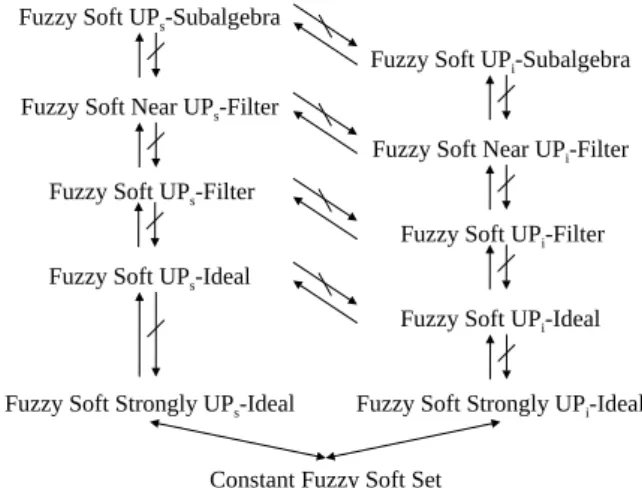
conditions for fuzzy soft sets over fully UP-semigroups, proved its generalizations and investigated some of its important properties. Then, we get the diagram of generalization of fuzzy soft sets over fully UP-semigroups as shown in Figure 3.
Figure 3: Fuzzy soft sets over fully UP-semigroups
Acknowledgements
The authors wish to express their sincere thanks to the referees for the valuable sug-gestions which lead to an improvement of this paper.
References