A Transition-based Algorithm for AMR Parsing
Chuan Wang
Brandeis University
[email protected]
Nianwen Xue
Brandeis University
[email protected]
Sameer Pradhan
Harvard Medical School
Sameer.Pradhan@
childrens.harvard.edu
Abstract
We present a two-stage framework to parse a sentence into its Abstract Meaning Repre-sentation (AMR). We first use a dependency parser to generate a dependency tree for the sentence. In the second stage, we design a novel transition-based algorithm that trans-forms the dependency tree to an AMR graph. There are several advantages with this ap-proach. First, the dependency parser can be trained on a training set much larger than the training set for the tree-to-graph algorithm, re-sulting in a more accurate AMR parser over-all. Our parser yields an improvement of 5% absolute in F-measure over the best previous result. Second, the actions that we design are linguistically intuitive and capture the regular-ities in the mapping between the dependency structure and the AMR of a sentence. Third, our parser runs in nearly linear time in practice in spite of a worst-case complexity ofO(n2).
1 Introduction
Abstract Meaning Representation (AMR) is a rooted, directed, edge-labeled and leaf-labeled graph that is used to represent the meaning of a sen-tence. The AMR formalism has been used to anno-tate the AMR Annotation Corpus (Banarescu et al., 2013), a corpus of over 10 thousand sentences that is still undergoing expansion. The building blocks for an AMR representation are concepts and rela-tions between them. Understanding these concepts and their relations is crucial to understanding the meaning of a sentence and could potentially bene-fit a number of natural language applications such
as Information Extraction, Question Answering and Machine Translation.
The property that makes AMR a graph instead of a tree is that AMR allows reentrancy, meaning that the same concept can participate in multiple rela-tions. Parsing a sentence into an AMR would seem to require graph-based algorithms, but moving to graph-based algorithms from the typical tree-based algorithms that we are familiar with is a big step in terms of computational complexity. Indeed, quite a bit of effort has gone into developing grammars and efficient graph-based algorithms that can be used to parse AMRs (Chiang et al., 2013).
want
police
The
arrest
to
Karras in
Michael
Singapore nsubj xcomp
det aux dobj prep
nn
pobj
(a) Dependency tree
want-01
police
arrest-01
person
Singapore
name
“Michael” “Karras” ARG0 ARG1
ARG0 ARG1
location
name
op1 op2
[image:1.612.314.540.425.538.2](b) AMR graph
Figure 1: Dependency tree and AMR graph for the sentence, “The police want to arrest Micheal Karras in Singapore.”
Linguistically, however, there are many similari-ties between an AMR and the dependency structure of a sentence. Both describe relations as holding be-tween a head and its dependent, or bebe-tween a parent and its child. AMR concepts and relations abstract away from actual word tokens, but there are regular-ities in their mappings. Content words generally
come concepts while function words either become relations or get omitted if they do not contribute to the meaning of a sentence. This is illustrated in Fig-ure 1, where ‘the’ and ‘to’ in the dependency tree are omitted from the AMR and the preposition ‘in’ becomes a relation of typelocation. In AMR, reen-trancy is also used to represent co-reference, but this only happens in some limited contexts. In Figure 1, ‘police’ is both an argument of ‘arrest’ and ‘want’ as the result of a control structure. This suggests that it is possible to transform a dependency tree into an AMR with a limited number of actions and learn a model to determine which action to take given pairs of aligned dependency trees and AMRs as training data.
This is the approach we adopt in the present work, and we present a transition-based framework in which we parse a sentence into an AMR by tak-ing the dependency tree of that sentence as input and transforming it to an AMR representation via a se-ries of actions. This means that a sentence is parsed into an AMR in two steps. In the first step the sen-tence is parsed into a dependency tree with a depen-dency parser, and in the second step the dependepen-dency tree is transformed into an AMR graph. One advan-tage of this approach is that the dependency parser does not have to be trained on the same data set as the dependency to AMR transducer. This allows us to use more accurate dependency parsers trained on data sets much larger than the AMR Annotation Cor-pus and have a more advantageous starting point. Our experiments show that this approach is very ef-fective and yields an improvement of 5% absolute over the previously reported best result (Flanigan et al., 2014) in F-score, as measure by the Smatch met-ric (Cai and Knight, 2013).
The rest of the paper is as follows. In §2, we describe how we align the word tokens in a sen-tence with its AMR to create a span graph based on which we extract contextual information as fea-tures and perform actions. In §3, we present our transition-based parsing algorithm and describe the actions used to transform the dependency tree of a sentence into an AMR. In§4, we present the learn-ing algorithm and the features we extract to train the transition model. In§5, we present experimental re-sults.§6 describes related work, and we conclude in §7.
2 Graph Representation
Unlike the dependency structure of a sentence where each word token is a node in the dependency tree and there is an inherent alignment between the word tokens in the sentence and the nodes in the depen-dency tree, AMR is an abstract representation where the word order of the corresponding sentence is not maintained. In addition, some words become ab-stract concepts or relations while other words are simply deleted because they do not contribute to meaning. The alignment between the word tokens and the concepts is non-trivial, but in order to learn the transition from a dependency tree to an AMR graph, we have to first establish the alignment be-tween the word tokens in the sentence and the con-cepts in the AMR. We use the aligner that comes with JAMR (Flanigan et al., 2014) to produce this alignment. The JAMR aligner attempts to greedily align every concept or graph fragment in the AMR graph with a contiguous word token sequence in the sentence.
want-01
police
arrest-01
person
name
“Micheal” “Karras” ARG0 ARG1
ARG0
ARG1
name
op1 op2
(a) AMR graph
s0,1:ROOT
s3,4:want-01
s2,3:police
s5,6:arrest-01
s6,8:
person+name ARG0
ARG1
ARG0
ARG1
[image:2.612.312.534.362.484.2](b) Span graph Figure 2: AMR graph and its span graph for the sen-tence, “The police want to arrest Micheal Karras.”
We use a data structure called span graph to represent an AMR graph that is aligned with the word tokens in a sentence. For each sentencew =
w0, w1, . . . , wn, where token w0 is a special root
symbol, a span graphis a directed, labeled graph G = (V, A), whereV ={si,j|i, j ∈(0, n)andj > i}is a set of nodes, andA⊆V ×V is a set of arcs. Each node si,j of G corresponds to a continuous span (wi, . . . , wj−1) in sentence w and is indexed
by the starting position i. Each node is assigned a
concept label from a set LV of concept labels and
of relation labels, respectively.
For example, given an AMR graphGAMRin Fig-ure 2a, its span graphGcan be represented as Fig-ure 2b. In span graphG, nodes3,4’s sentence span
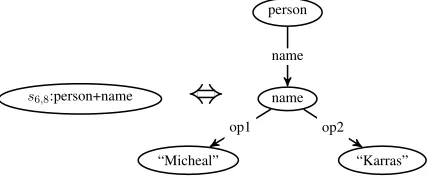
is (want) and its concept label is want-01, which represents a single nodewant-01in AMR. To sim-plify the alignment, when creating a span graph out of an AMR, we also collapse some AMR subgraphs in such a way that they can be deterministically re-stored to their original state for evaluation. For ex-ample, the four nodes in the AMR subgraph that cor-respond to span(Micheal, Karras)is collapsed into a single nodes6,8in the span graph and assigned the
concept labelperson+name, as shown in Figure 3. So the concept label set that our model predicts con-sists of both those from the concepts in the original AMR graph and those as a result of collapsing the AMR subgraphs.
person
name
“Micheal” “Karras”
s6,8:person+name
name
[image:3.612.84.300.314.406.2]op1 op2
Figure 3: Collapsed nodes
Representing AMR graph this way allows us to formulate the AMR parsing problem as a joint learn-ing problem where we can design a set of actions to simultaneously predict the concepts (nodes) and re-lations (arcs) in the AMR graph as well as the labels on them.
3 Transition-based AMR Parsing
3.1 Transition System
Similar to transition-based dependency pars-ing (Nivre, 2008), we define atransition systemfor AMR parsing as a quadruple S = (S, T, s0, St), where
• Sis a set of parsingstates(configurations). • T is a set of parsingactions(transitions), each
of which is a functiont:S→S.
• s0 is an initialization function, mapping each
input sentencewand its dependency treeDto aninitial state.
• St ⊆Sis a set ofterminal states.
Each state (configuration) of our transition-based parser is a triple(σ, β, G). σis a buffer that stores indices of the nodes which have not been processed and we writeσ=σ0|σ0to indicate thatσ0is the
top-most element ofσ.βis also a buffer[β0, β1, . . . , βj] and each elementβiofβindicates the edge(σ0, βi) which has not been processed in the partial graph. We also writeβ =β0|β0to indicate the topmost
el-ement ofβisβ0. We use span graphGto store the
partial parses for the input sentence w. Note that unlike traditional transition-based syntactic parsers which store partial parses in the stack structure and build a tree or graph incrementally, here we use σ andβ buffers only to guide the parsing process (which node or edge to be processed next) and the actual tree-to-graph transformations are applied to G.
When the parsing procedure starts,σis initialized with a post-order traversal of the input dependency treeDwith topmost elementσ0,βis initialized with
nodeσ0’s children or set to null ifσ0is a leaf node.
G is initialized with all the nodes and edges of D. Initially, all the nodes of G have a span length of one and all the labels for nodes and edges are set to null. As the parsing procedure goes on, the parser will process all the nodes and their outgoing edges in dependency treeDin a bottom-up left-right manner, and at each state certain action will be applied to the current node or edge. The parsing process will terminate when bothσandβare empty.
The most important part of the transition-based parser is the set of actions (transitions). As stated in (Sartorio et al., 2013), the design space of possi-ble actions is actually infinite since the set of pars-ing states is infinite. However, if the problem is amenable to transition-based parsing, we can design a finite set of actions by categorizing all the possi-ble situations we run into in the parsing process. In §5.2 we show this is the case here and our action set can account for almost all the transformations from dependency trees to AMR graphs.
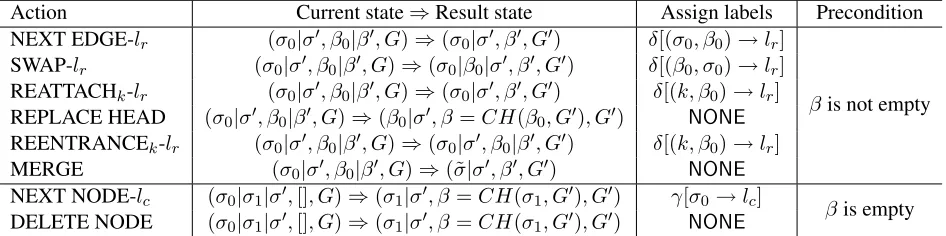
oth-Action Current state⇒Result state Assign labels Precondition NEXT EDGE-lr (σ0|σ0, β0|β0, G)⇒(σ0|σ0, β0, G0) δ[(σ0, β0)→lr]
βis not empty SWAP-lr (σ0|σ0, β0|β0, G)⇒(σ0|β0|σ0, β0, G0) δ[(β0, σ0)→lr]
REATTACHk-lr (σ0|σ0, β0|β0, G)⇒(σ0|σ0, β0, G0) δ[(k, β0)→lr] REPLACE HEAD (σ0|σ0, β0|β0, G)⇒(β0|σ0, β=CH(β0, G0), G0) NONE
REENTRANCEk-lr (σ0|σ0, β0|β0, G)⇒(σ0|σ0, β0|β0, G0) δ[(k, β0)→lr] MERGE (σ0|σ0, β0|β0, G)⇒(˜σ|σ0, β0, G0) NONE
[image:4.612.82.555.68.186.2]NEXT NODE-lc (σ0|σ1|σ0,[], G)⇒(σ1|σ0, β=CH(σ1, G0), G0) γ[σ0→lc] βis empty DELETE NODE (σ0|σ1|σ0,[], G)⇒(σ1|σ0, β=CH(σ1, G0), G0) NONE
Table 1: Transitions designed in our parser.CH(x, y)means getting all nodex’s children in graphy.
erwise, only the current nodeσ0is examined. Also,
to simultaneously make decisions on the assignment of concept/relation label, we augment some of the actions with an extra parameterlrorlc. We define γ : V → LV as the concept labeling function for nodes andδ:A→LAas the relation labeling func-tion for arcs. So δ[(σ0, β0) → lr] means assign-ing relation labellrto arc (σ0, β0). All the actions
update buffer σ, β and apply some transformation G ⇒G0to the partial graph. The 8 actions are
de-scribed below.
• NEXT-EDGE-lr (ned). This action assigns a relation label lr to the current edge (σ0, β0)
and makes no further modification to the par-tial graph. Then it pops out the top element of bufferβso that the parser moves one step for-ward to examine the next edge if it exists.
oppose
Korea
South and Israel
oppose
and
Korea
South Israel op1
Figure 4: SWAP action
• SWAP-lr (sw). This action reverses the de-pendency relation between nodeσ0andβ0and
then makes node β0 as new head of the
sub-graph. Also it assigns relation label lr to the arc(β0, σ0). Then it pops outβ0and inserts it
into σright afterσ0for future revisiting. This
action is to resolve the difference in the choice of head between the dependency tree and the AMR graph. Figure 4 gives an example of
ap-plying SWAP-op1 action for arc (Korea, and) in the dependency tree of sentence “South Ko-rea and Israel oppose ...”.
• REATTACHk-lr (reat). This action removes the current arc(σ0, β0)and reattaches nodeβ0
to some node k in the partial graph. It also assigns a relation label lr to the newly cre-ated arc(k, β0)and advances one step by
pop-ping outβ0. Theoretically, the choice of node
k could be any node in the partial graph un-der the constraint that arc(k, β0)doesn’t
pro-duce a self-looping cycle. The intuition behind this action is that after swapping a head and its dependent, some of the dependents of the old head should be reattached to the new head. Figure 5 shows an example where nodeIsrael needs to be reattached to nodeandafter a head-dependent swap.
oppose
and
Korea
South Israel op1 reattach
oppose
and
Korea
South
Israel op1 op2
Figure 5: REATTACH action
• REPLACE-HEAD (rph). This action removes nodeσ0, replaces it with nodeβ0. Nodeβ0also
inherits all the incoming and outgoing arcs of σ0. Then it pops outβ0 and inserts it into the
top position of bufferσ.βis re-initialized with all the children ofβ0in the transformed graph
G0. This action targets nodes in the dependency
graph and become a relation instead. An exam-ple is provided in Figure 6, where node in, a preposition, is replaced with node Singapore, and in a subsequent NEXT-EDGE action that examines arc (live, Singapore), the arc is la-beledlocation.
live
in
Singapore
live
Singapore
Figure 6: REPLACE-HEAD action
• REENTRANCEk-lr(reen). This is the action that transforms a tree into a graph. It keeps the current arc unchanged, and links nodeβ0to
ev-ery possible nodekin the partial graph that can also be its parent. Similar to the REATTACH action, the newly created arc(k, β0)should not
produce a self-looping cycle and parameterkis bounded by the sentence length. In practice, we seek to constrain this action as we will explain in §3.2. Intuitively, this action can be used to model co-reference and an example is given in Figure 7.
want
police arrest
reentrance
want
police ARG0 arrest
Figure 7: REENTRANCE action
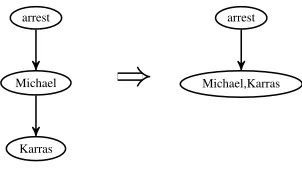
• MERGE (mrg). This action merges nodesσ0
andβ0into one nodeσ˜ which covers multiple
words in the sentence. The new node inher-its all the incoming and outgoing arcs of both nodes σ0 and β0. The MERGE action is
in-tended to produce nodes that cover a continu-ous span in the sentence that corresponds to a single name entity in AMR graph. see Figure 8 for an example.
arrest
Michael
Karras
arrest
[image:5.612.346.497.65.150.2]Michael,Karras
Figure 8: MERGE action
Whenβis empty, which means all the outgoing arcs of nodeσ0have been processed orσ0has no
outgo-ing arcs, the followoutgo-ing two actions can be applied:
• NEXT-NODE-lc (nnd). This action first as-signs a concept label lc to node σ0. Then it
advances the parsing procedure by popping out the top elementσ0of bufferσand re-initializes
bufferβwith all the children of nodeσ1which
is the current top element ofσ. Since this action will be applied to every node which is kept in the final parsed graph, concept labeling could be done simultaneously through this action. • DELETE-NODE (dnd). This action simply
deletes the nodeσ0and removes all the arcs
as-sociated with it. This action models the fact that most function words are stripped off in the AMR of a sentence. Note that this action only targets function words that are leaves in the de-pendency tree, and we constrain this action by only deleting nodes which do not have outgo-ing arcs.
When parsing a sentence of lengthn (excluding the special root symbol w0), its corresponding
de-pendency tree will have n nodes and n −1 arcs. For projective transition-based dependency parsing, the parser needs to take exactly2n−1steps or ac-tions. So the complexity is O(n). However, for our tree-to-graph parser defined above, the actions needed are no longer linearly bounded by the sen-tence length. Suppose there are no REATTACH, REENTRANCE and SWAP actions during the pars-ing process, the algorithm will traverse every node and edge in the dependency tree, which results in
space of all possible extra edges is(n−2)2and
re-visiting them only adds more actions linearly, the to-tal asymptotic runtime complexity of our algorithm isO(n2).
In practice, however, the number of applications of the REATTACH action is much less than the worst case scenario due to the similarities between the dependency tree and the AMR graph of a sen-tence. Also, nodes with reentrancies in AMR only account for a small fraction of all the nodes, thus making the REENTRANCE action occur at constant times. These allow the tree-to-graph parser to parse a sentence in nearly linear time in practice.
3.2 Greedy Parsing Algorithm
Algorithm 1Parsing algorithm
Input: sentencew=w0. . . wnand its dependency
treeDw
Output: parsed graphGp
1: s←s0(Dw, w)
2: whiles /∈Stdo
3: T ←all possible actions according tos 4: bestT ←arg maxt∈T score(t, c) 5: s←applybestT tos
6: end while
7: returnGp
Our parsing algorithm is similar to the parser in (Sartorio et al., 2013). At each parsing states∈ S, the algorithm greedily chooses the parsing action t ∈ T that maximizes the score function score(). The score function is a linear model defined over parsing actiontand parsing states.
score(t, s) =~ω·φ(t, s) (1)
where ~ω is the weight vector and φ is a function that extracts the feature vector representation for one possible state-action pairht, si.
First, the algorithm initializes the stateswith the sentence w and its dependency tree Dw. At each iteration, it gets all the possible actions for current states(line 3). Then, it chooses the action with the highest score given by functionscore()and applies it tos (line 4-5). When the current state reaches a terminal state, the parser stops and returns the parsed graph.
As pointed out in (Bohnet and Nivre, 2012), con-straints can be added to limit the number of possible actions to be evaluated at line 3. There could be for-mal constraints on states such as the constraint that the SWAP action should not be applied twice to the same pair of nodes. We could also apply soft con-straints to filter out unlikely concept labels, relation labels and candidate nodes k for REATTACH and REENTRANCE. In our parser, we enforce the con-straint that NEXT-NODE-lc can only choose from concept labels that co-occur with the current node’s lemma in the training data. We also empirically set the constraint that REATTACHk could only choose k amongσ0’s grandparents and great grandparents.
Additionally, REENTRANCEkcould only choosek among its siblings. These constraints greatly reduce the search space, thus speeding up the parser.
4 Learning
4.1 Learning Algorithm
As stated in section 3.2, the parameter of our model is weight vector~ωin the score function. To train the weight vector, we employ the averaged perceptron learning algorithm (Collins, 2002).
Algorithm 2Learning algorithm
Input: sentencew=w0. . . wn, Dw, Gw
Output: ~ω
1: s←s0(Dw, w)
2: whiles /∈Stdo
3: T ←all possible actions according tos 4: bestT ←arg maxt∈T score(t, s)
5: goldT ←oracle(s, Gw) 6: ifbestT 6=goldT then
7: ~ω←~ω−φ(bestT, s) +φ(goldT, s)
8: end if
9: s←applygoldT tos
10: end while
gold action for current statesis given by consulting span graph Gw, which we formulate as a function oracle()(line 5). If the gold action is equal to the best action we get from the parser, then the best ac-tion is applied to current state; otherwise, we update the weight vector (line 6-7) and continue the parsing procedure by applying the gold action.
4.2 Feature Extraction
Single node features
¯
σ0.w,σ¯0.lem,σ¯0.ne,σ¯0.t,σ¯0.dl,σ¯0.len
¯
β0.w,β¯0.lem,β¯0.ne,β¯0.t,β¯0.dl,β¯0.len
¯
k.w,¯k.lem,¯k.ne,¯k.t,k.dl,¯ ¯k.len
¯
σ0p.w,σ¯0p.lem,¯σ0p.ne,¯σ0p.t,¯σ0p.dl Node pair features
¯
σ0.lem+ ¯β0.t,σ¯0.lem+ ¯β0.dl
¯
σ0.t+ ¯β0.lem,σ¯0.dl+ ¯β0.lem
¯
σ0.ne+ ¯β0.ne,k.ne¯ + ¯β0.ne
¯
k.t+ ¯β0.lem,k.dl¯ + ¯β0.lem
Path features
¯
σ0.lem+ ¯β0.lem+pathσ0,β0
¯
k.lem+ ¯β0.lem+pathk,β0
Distance features distσ0,β0
distk,β0
distσ0,β0+pathσ0,β0 distσ0,β0+pathk,β0
Action specific features
¯
β0.lem+ ¯β0.nswp
¯
[image:7.612.80.301.195.488.2]β0.reph
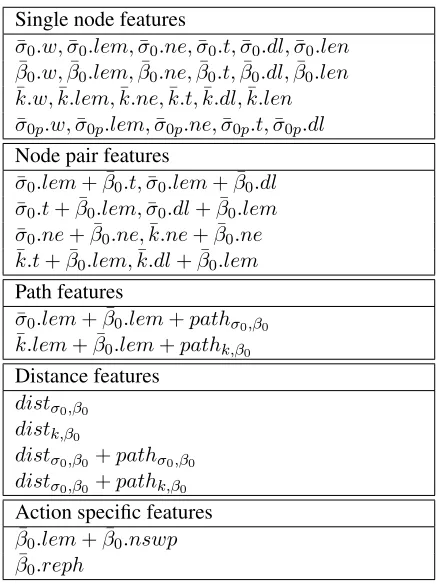
Table 2: Features used in our parser. ¯σ0,β¯0,¯k,σ¯0p represents elements in feature context of nodes σ0, β0, k, σ0p, separately. Each atomic feature is represented as follows:w- word;lem- lemma;ne -name entity;t- POS-tag;dl- dependency label;len - length of the node’s span.
For transition-based dependency parsers, the fea-ture context for a parsing state is represented by the neighboring elements of a word token in the stack containing the partial parse or the buffer containing unprocessed word tokens. In contrast, in our tree-to graph parser, as already stated, buffersσ andβ only specify which arc or node is to be examined next. The feature context associated with current arc
or node is mainly extracted from the partial graph G. As a result, the feature context is different for the different types of actions, a property that makes our parser very different from a standard transition-based dependency parser. For example, when evalu-ating action SWAP we may be interested in features about individual nodesσ0andβ0as well as features
involving the arc(σ0, β0). In contrast, when
evaluat-ing action REATTACHk, we want to extract not only features involving σ0 and β0, but also information
about the reattached nodek. To address this prob-lem, we define the feature context ashσ¯0,β¯0,k,¯ σ¯0pi, where each elementx¯consists of its atomic features of node xandσ0p denotes the immediate parent of nodeσ0. For elements in feature context that are not
applicable to the candidate action, we just set the el-ement toNONEand only extract features which are valid for the candidate action. The list of features we use is shown in Table 2.
Single node features are atomic features concern-ing all the possible nodes involved in each candi-date state-action pair. We also include path features and distance features as described in (Flanigan et al., 2014). A path featurepathx,y is represented as the dependency labels and parts of speech on the path between nodes xand y in the partial graph. Here we combine it with the lemma of the starting and ending nodes. Distance featuredistx,y is the num-ber of tokens between two node x, y’s spans in the sentence. Action-specific features record the his-tory of actions applied to a given node. For exam-ple,β¯0.nswprecords how many times nodeβ0 has
been swapped up. We combine this feature with the lemma of nodeβ0to prevent the parser from
swap-ping a node too many times. β¯0.reph records the
word feature of nodes that have been replaced with nodeβ0. This feature is helpful in predicting
rela-tion labels. As we have discussed above, in an AMR graph, some function words are deleted as nodes but they are crucial in determining the relation label be-tween its child and parent.
5 Experiments
5.1 Experiment Setting
We follow Flanigan et al. (2014) in setting up the train/development/test splits1 for easy comparison:
4.0k sentences with document years 1995-2006 as the training set; 2.1k sentences with document year 2007 as the development set; 2.1k sentences with document year 2008 as the test set, and only using AMRs that are tagged ::preferred. Each sentencew is preprocessed with the Stanford CoreNLP toolkit (Manning et al., 2014) to get part-of-speech tags, name entity information, and basic dependencies. We have verified that there is no overlap between the training data for the Stanford CoreNLP toolkit2and the AMR Annotation Corpus.
We evaluate our parser with the Smatch tool (Cai and Knight, 2013), which seeks to maximize the semantic overlap between two AMR annotations.
5.2 Action Set Validation
One question about the transition system we pre-sented above is whether the action set defined here can cover all the situations involving a dependency-to-AMR transformation. Although a formal theo-retical proof is beyond the scope of this paper, we can empirically verify that the action set works well in practice. To validate the actions, we first run the oracle()function for each sentencewand its depen-dency treeDwto get the “pseudo-gold”G0w. Then we compareG0
wwith the gold-standard AMR graph represented as span graph Gw to see how similar they are. On the training data we got an overall 99% F-score for allhG0
w, Gwipairs, which indicates that our action set is capable of transforming each sen-tence w and its dependency tree Dw into its gold-standard AMR graph through a sequence of actions.
[image:8.612.312.531.197.278.2]5.3 Results
Table 3 gives the precision, recall and F-score of our parser given by Smatch on the test set. Our parser achieves an F-score of 63% (Row 3) and the result is 5% better than the first published result reported in (Flanigan et al., 2014) with the same training and test set (Row 2). We also conducted experiments on the test set by replacing the parsed graph with gold 1A script to create the train/dev/test partitions is available at the following URL:http://goo.gl/vA32iI
2Specifically we used CoreNLP toolkit v3.3.1 and parser model wsjPCFG.ser.gz trained on the WSJ treebank sections 02-21.
relation labels or/and gold concept labels. We can see in Table 3 that when provided with gold concept and relation labels as input, the parsing accuracy im-proves around 8% F-score (Row 6). Rows 4 and 5 present results when the parser is provided with just the gold relation labels (Row 4) or gold concept la-bels (Row 5), and the results are expectedly lower than if both gold concept and relation labels are pro-vided as input.
Precision Recall F-score
JAMR .52 .66 .58
Our parser .64 .62 .63
Our parser +lgr .68 .65 .67
Our parser +lgc .69 .67 .68
[image:8.612.338.492.367.510.2]Our parser +lgrc .72 .70 .71
Table 3: Results on the test set. Here, lgc - gold concept label; lgr - gold relation label; lgrc - gold concept label and gold relation label.
5.4 Error Analysis
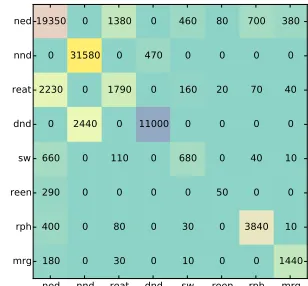
Figure 9: Confusion Matrix for actionshtg, ti. Ver-tical direction goes over the correct action type, and horizontal direction goes over the parsed action type.
cor-rect actiontgto take for a given states. A compar-ison betweentg and the best actiontactually taken by our parser will give us a sense about how accu-rately each type of action is applied. When we com-pare the actions, we focus on the structural aspect of AMR parsing and only take into account the eight action types, ignoring the concept and edge labels at-tached to them. For example, NEXT-EDGE-ARG0
and NEXT-EDGE-ARG1would be considered to be the same action and counted as a match when we compute the errors even though the labels attached to them are different.
Figure 9 shows the confusion matrix that presents a comparison between the parser-predicted actions and the correct actions given by oracle() func-tion. It shows that the NEXT-EDGE (ned), NEXT-NODE (nnd), and DELETENODE (dnd) actions ac-count for a large proportion of the actions. These actions are also more accurately applied. As ex-pected, the parser makes more mistakes involving the REATTACH (reat), REENTRANCE (reen) and SWAP (sw) actions. The REATTACH action is of-ten used to correct PP-attachment errors made by the dependency parser or readjust the structure result-ing from the SWAP action, and it is hard to learn given the relatively small AMR training set. The SWAP action is often tied to coordination structures in which the head in the dependency structure and the AMR graph diverges. In the Stanford depen-dency representation which is the input to our parser, the head of a coordination structure is one of the conjuncts. For AMR, the head is an abstract con-cept signaled by one of the coordinating conjunc-tions. This also turns out to be one of the more dif-ficult actions to learn. We expect, however, as the AMR Annotation Corpus grows bigger, the parsing model trained on a larger training set will learn these actions better.
6 Related Work
Our work is directly comparable to JAMR (Flanigan et al., 2014), the first published AMR parser. JAMR performs AMR parsing in two stages: concept iden-tification and relation ideniden-tification. They treat con-cept identification as a sequence labeling task and utilize a semi-Markov model to map spans of words in a sentence to concept graph fragments. For
rela-tion identificarela-tion, they adopt the graph-based tech-niques for non-projective dependency parsing. In-stead of finding maximum-scoring trees over words, they propose an algorithm to find the maximum spanning connected subgraph (MSCG) over concept fragments obtained from the first stage. In con-trast, we adopt a transition-based approach that finds its root in transition-based dependency parsing (Ya-mada and Matsumoto, 2003; Nivre, 2003; Sagae and Tsujii, 2008), where a series of actions are per-formed to transform a sentence to a dependency tree. As should be clear from our description, however, the actions in our parser are very different in na-ture from the actions used in transition-based depen-dency parsing.
There is also another line of research that attempts to design graph grammars such as hyperedge re-placement grammar (HRG) (Chiang et al., 2013) and efficient graph-based algorithms for AMR parsing. Existing work along this line is still theoretical in nature and no empirical results have been reported yet.
7 Conclusion and Future Work
We presented a novel transition-based parsing algo-rithm that takes the dependency tree of a sentence as input and transforms it into an Abstract Mean-ing Representation graph through a sequence of ac-tions. We show that our approach is linguistically intuitive and our experimental results also show that our parser outperformed the previous best reported results by a significant margin. In future work we plan to continue to perfect our parser via improved learning and decoding techniques.
Acknowledgments
References
Laura Banarescu, Claire Bonial, Shu Cai, Madalina Georgescu, Kira Griffitt, Ulf Hermjakob, Kevin Knight, Philipp Koehn, Martha Palmer, and Nathan Schneider, 2013. Abstract Meaning Representation for Sembanking. InProceedings of the 7th Linguistic Annotation Workshop and Interoperability with Dis-course, pages 178–186. Association for Computa-tional Linguistics.
Bernd Bohnet and Joakim Nivre. 2012. A transition-based system for joint part-of-speech tagging and la-beled non-projective dependency parsing. In Proceed-ings of the 2012 Joint Conference on Empirical Meth-ods in Natural Language Processing and Computa-tional Natural Language Learning, pages 1455–1465. Association for Computational Linguistics.
Shu Cai and Kevin Knight. 2013. Smatch: an evaluation metric for semantic feature structures. InProceedings of the 51st Annual Meeting of the Association for Com-putational Linguistics (Volume 2: Short Papers), pages 748–752. Association for Computational Linguistics. David Chiang, Jacob Andreas, Daniel Bauer, Karl Moritz
Hermann, Bevan Jones, and Kevin Knight. 2013. Parsing graphs with hyperedge replacement gram-mars. InProceedings of the 51st Annual Meeting of the Association for Computational Linguistics (Vol-ume 1: Long Papers), pages 924–932, Sofia, Bulgaria, August. Association for Computational Linguistics. Michael Collins and Brian Roark. 2004. Incremental
parsing with the perceptron algorithm. In Proceed-ings of the 42nd Annual Meeting on Association for Computational Linguistics, page 111. Association for Computational Linguistics.
Michael Collins. 2002. Discriminative training meth-ods for hidden markov models: Theory and experi-ments with perceptron algorithms. InProceedings of the ACL-02 conference on Empirical methods in natu-ral language processing-Volume 10, pages 1–8. Asso-ciation for Computational Linguistics.
Jeffrey Flanigan, Sam Thomson, Jaime Carbonell, Chris Dyer, and Noah A. Smith. 2014. A discriminative graph-based parser for the abstract meaning represen-tation. InProceedings of the 52nd Annual Meeting of the Association for Computational Linguistics (Vol-ume 1: Long Papers), pages 1426–1436, Baltimore, Maryland, June. Association for Computational Lin-guistics.
Dan Klein and Christopher D Manning. 2003. Ac-curate unlexicalized parsing. In Proceedings of the 41st Annual Meeting on Association for Computa-tional Linguistics-Volume 1, pages 423–430. Associ-ation for ComputAssoci-ational Linguistics.
Christopher D. Manning, Mihai Surdeanu, John Bauer, Jenny Finkel, Steven J. Bethard, and David McClosky. 2014. The Stanford CoreNLP natural language pro-cessing toolkit. InProceedings of 52nd Annual Meet-ing of the Association for Computational LMeet-inguistics: System Demonstrations, pages 55–60.
Joakim Nivre. 2003. An efficient algorithm for pro-jective dependency parsing. In Proceedings of the 8th International Workshop on Parsing Technologies (IWPT). Citeseer.
Joakim Nivre. 2007. Incremental non-projective de-pendency parsing. InHuman Language Technologies 2007: The Conference of the North American Chap-ter of the Association for Computational Linguistics; Proceedings of the Main Conference, pages 396–403. Association for Computational Linguistics.
Joakim Nivre. 2008. Algorithms for deterministic incre-mental dependency parsing. Computational Linguis-tics, 34(4):513–553.
Joakim Nivre. 2009. Non-projective dependency parsing in expected linear time. InProceedings of the Joint Conference of the 47th Annual Meeting of the ACL and the 4th International Joint Conference on Natural Language Processing of the AFNLP: Volume 1-Volume 1, pages 351–359. Association for Computational Lin-guistics.
Kenji Sagae and Jun’ichi Tsujii. 2008. Shift-reduce de-pendency dag parsing. InProceedings of the 22nd In-ternational Conference on Computational Linguistics-Volume 1, pages 753–760. Association for Computa-tional Linguistics.
Francesco Sartorio, Giorgio Satta, and Joakim Nivre. 2013. A transition-based dependency parser using a dynamic parsing strategy. InProceedings of the 51st Annual Meeting of the Association for Computational Linguistics (Volume 1: Long Papers), pages 135–144. Association for Computational Linguistics.