4678
Context-aware Embedding for Targeted Aspect-based Sentiment Analysis
Bin Liang1, Jiachen Du1, Ruifeng Xu1∗, Binyang Li2, Hejiao Huang1 1Department of Computer Science, Harbin Institute of Technology (Shenzhen), China
2 School of Information Science and Technology,
University of International Relations, Beijing, China
[email protected], [email protected] [email protected], [email protected]
Abstract
Attention-based neural models were employed to detect the different aspects and sentiment polarities of the same target in targeted aspect-based sentiment analysis (TABSA). However, existing methods do not specifically pre-train reasonable embeddings for targets and aspects in TABSA. This may result in targets or as-pects having the same vector representations in different contexts and losing the context-dependent information. To address this prob-lem, we propose a novel method to refine the embeddings of targets and aspects. Such piv-otal embedding refinement utilizes a sparse co-efficient vector to adjust the embeddings of target and aspect from the context. Hence the embeddings of targets and aspects can be refined from the highly correlative words instead of using context-independent or ran-domly initialized vectors. Experiment results on two benchmark datasets show that our ap-proach yields the state-of-the-art performance in TABSA task.
1 Introduction
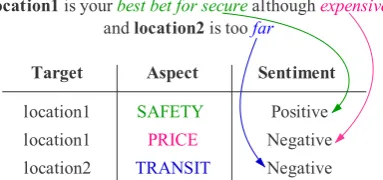
Targeted aspect-based sentiment analysis (TABSA) aims at detecting aspects accord-ing to the specific target and inferraccord-ing sentiment polarities corresponding to different target-aspect pairs simultaneously (Saeidi et al., 2016). For example, in sentence “location1 is your best bet for secure although expensive and location2 is too far.”, for target “location1”, the sentiment polarity is positive towards aspect “SAFETY” but is negative towards aspect “PRICE”. While “location2” only express negative polarity about aspect “TRANSIT-LOCATION”. This can be seen in Figure 1, e.g., where opinions on the aspects “SAFETY” and “PRICE” are expressed for target “location1” but not for target “location2”, whose
∗ ∗
Corresponding Author
corresponding aspect is “TRANSIT-LOCATION ”. Here, an interesting phenomenon is that, the opinion “Positive” towards aspect “SAFETY” is expressed for target “location1” will be change if “location1” and “location2” are exchanged. That is to say, the representation of target and aspect should take full account of context in-formation rather than use context-independent representation.
location1 is your best bet for secure although expensive and location2 is too far
Target
location1
Aspect
SAFETY
Sentiment
Positive
location1 PRICE Negative
[image:1.595.322.514.361.451.2]location2 TRANSIT Negative
Figure 1: Example of TABSA task. Highly correlative words and corresponding aspects are in the same color. Entity names are masked bylocation1andlocation2.
Aspect-based sentiment analysis (ABSA) is a basic subtask of TABSA, which aims at inferring the sentiment polarities of different aspects in the sentence (Ruder et al.,2016;Chen et al.,2017;Gui et al.,2017;Peng et al., 2018;Ma et al., 2018a). Recently, attention-based neural models achieve remarkable success in ABSA (Fan et al., 2018; Wang et al.,2016;Tang et al.,2016). In TABSA task, the attention-based sentiment LSTM (Ma et al.,2018b) is proposed to tackle the challenges of both aspect-based sentiment analysis and tar-geted sentiment analysis by incorporating exter-nal knowledge. For neural model improvement, a delayed memory is proposed to track and update the states of targets at the right time with external memory (Liu et al.,2018).
rep-resent targets and aspects, which losses the seman-tic information and ignores the interdependence among specific target, corresponding aspects and the context. Because the targets themselves have no expression of sentiment, and the opinions of the given sentence are generally composed of words highly correlative to the targets. For example, if the words “price” and “expensive” are in the sen-tence, it probably expresses the “Negative” senti-ment polarity about aspect “PRICE”.
To alleviate these problems above, we propose a novel embedding refinement method to obtain context-aware embedding for TABSA. Specifi-cally, we use a sparse coefficient vector to select highly correlated words from the sentence, and then adjust the representations of target and aspect to make them more valuable. The main contribu-tions of our work can be summarized as follows:
• We reconstruct the vector representation for target from the context by means of a sparse coefficient vector, hence the representation of target is generated from highly correlative words rather than using context-independent or randomly initialized embedding.
• The aspect embedding is fine-tuned to be close to the highly correlated target and be away from the irrelevant targets.
• Experiment results on SentiHood and Se-meval 2015 show that our proposed method can be directly incorporated into embedding-based TABSA models and achieve state-of-the-art performance.
2 Methodology
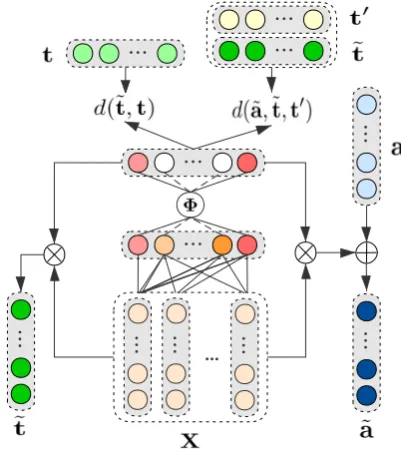
In this section, we describe the proposed method in detail. The framework of our proposed method is demonstrated in Figure 2.
We assume a words sequence of a given sen-tence as an embedding matrixX∈Rm×n, where nis the length of sentence,mis the dimension of embedding, and each word can be represented as an m-dimensional embeddingx ∈ Rm including the embedding of targett ∈ Rm via random ini-tialization and the embedding of aspecta ∈ Rm which is an average of its constituting word em-beddings or single word embedding. The sentence embedding matrixXis fed as input into our model to achieve the sparse coefficient vectoru0 via the fully connected layer and the step function succes-sively. The hidden outputu0is utilized to compute
the refined representation of target˜t∈Rmand as-pecta˜∈Rm. Afterwards, the squared Euclidean function d(˜t,t) and d(˜a,˜t,t0) are used to itera-tively minimize the distance to get the refined em-beddings of target and aspect.
...
...
···...
...
...
...
...
...
...
...
[image:2.595.313.514.141.366.2]...
Figure 2: The framework of our refinement model. ⊗ is element-wise product,⊕is vector addition,Φis step function.
2.1 Task Definition
Given a sentence consisting of a sequence of words s = {w1, w2, . . . , LOC, . . . , wn}, where
LOC is a target in the sentence, there will be 1 or 2 targets in the sentence corresponding to sev-eral aspects. There are a pre-identified set of tar-gets T and a fixed set of aspects A. The goal of TABSA can be regarded as a fine-grained sen-timent expression as a tuple (t, a, p), where p refers to the polarity which is associated with as-pect a, and the aspect a belongs to a target t. The objective of TABSA task is to detect the as-pect a ∈ A and classify the sentiment polarity p ∈ {P ositive, N egative, N one} according to a specific targettand the sentences.
2.2 Target Representation
The idea of target representation is to reconstruct the target embedding from a given sentence ac-cording to the highly correlated words in the con-text. By this means we can extract the correlation between target and context, the target representa-tion is computed as:
where ˜t is the representation of target, u0 is a sparse coefficient vector indicating the importance of different words in the context, defined as:
u0=Φ(u) (2)
whereΦis a step function given a real value:
Φ(ui) =
(
ui ui >mean(u)
0 ui < mean(u) (3)
where mean(·) is an average function, and the vectorucan be computed by a non-linear function of basic embedding matrixX:
u=f(X|·W+b) (4)
wherefis a non-linear operation function like sig-moid, W ∈ Rm andb ∈
Rn denote the weight matrix and bias respectively. The target represen-tation is inspired by the recent success of embed-ding refinement (Yu et al.,2017). For each target, our reconstruction operation aims to get a contex-tual relevant embedding by iteratively minimizes the squared Euclidean between the target and the highly correlative words in the sentence. The ob-jective function is defined as:
d(˜t,t) =
n X
i=1
Xm
j=1
(˜tji −tji)2+λu0i
(5)
whereλu0i aims to control the sparseness of vec-toru0. Through the iterative procedure, the vector representation of the target will be iteratively up-dated until the number of the non-zero elements of vectoru0 less than the threshold value: k 6c. Wherek is the number of the non-zero elements of vectoru0andcis a threshold to control the non-zero number of vectoru0.
2.3 Aspect Representation
Generally, the words of aspects contain the most important semantic information. Coordinate with the aspect itself, the context information can also reflect the aspect, such as the word “price” in the sentence probably has relevant to aspect “PRICE”. To this end, we refine the aspect representation ac-cording to target representation. By incorporating highly correlated words into the representation of aspect, every element in the fine-tuned aspect em-bedding˜ais calculated as:
˜
ai =ai+αXi∗u0i (6)
whereαis a parameter to control the influence be-tween aspect and the context.
For each aspect, the fine-tuning method aims to move closer to the homologous target and further away from the irrelevant one by iteratively mini-mizes the squared Euclidean. The objective func-tion is thus divided into two parts:
d(˜a,˜t,t0) = n
X
i=1 hXm
j=1
(˜aji−t˜ji)2−β(˜aji−t0ji)
2
+λu0i
i
(7)
where˜tis the the homologous target andt0 is the irrelevant one. β is a parameter that controls the distance from the irrelevant target.
3 Experiments
This section evaluates several deep neural mod-els based on our proposed embedding refinement method for TABSA.
Dataset. Two benchmark datasets: Senti-Hood (Saeidi et al.,2016) and Task 12 of Semeval 2015 (Pontiki et al.,2015) are used to evaluate our proposed method. SentiHood contains annotated sentences containing one or two location target mentions. The whole dataset contains 5215 sentences with 3862 sentences containing a single location and 1353 sentences containing multiple (two) locations. Location target names are
masked byLOCATION1andLOCATION2
in the whole dataset. Following (Saeidi et al., 2016), we only consider the top 4 aspects
(“GEN-ERAL”, “PRICE”, “TRANSIT-LOCATION”
and “SAFETY”) when evaluate aspect detec-tion and sentiment classificadetec-tion. To show the generalizability of our method, we evaluate our works in another dataset: restaurants domain in Task 12 for TABSA from Semeval 2015. We remove sentences containing no targets as well as NULLtargets like the work of (Ma et al.,2018b). The whole dataset contains 1,197 targets in the training set and 542 targets in the testing set.
Experiment setting. We use Glove (Pennington et al., 2014)1 to initialize the word embeddings in our experiments, and target embeddings (loca-tion1 and location2) are randomly initialized. We initializeWandbwith random initialization. The parameters ofc,αandβ in our experiment are 4, 1 and 0.5 respectively. Given a unit of texts, a list of labels(t, a, p)is provided correspondingly, the
Model Aspect Detection Sentiment Classification
Acc. (%) F1 (%) AUC (%) Acc. (%) AUC (%)
LSTM-Final — 68.9 89.8 82.0 85.4
LSTM-Loc — 69.3 89.7 81.9 83.9
SenticLSTM 67.4 78.2 — 89.3 —
RE+SenticLSTM†(ours) 73.8 79.3 — 93.0 —
Delayed-memory 73.5 78.5 94.4 91.0 94.8
[image:4.595.91.505.64.191.2]RE+Delayed-memory†(ours) 76.4 81.0 96.8 92.8 96.2
Table 1: Experimental results on SentiHood.†denotes average score over 10 runs, and best scores are in bold.
Model Aspect Detection Sentiment Classification
Acc. (%) F1 (%) AUC (%) Acc. (%) AUC (%)
SenticLSTM 67.3 76.4 — 76.5 —
RE+SenticLSTM†(ours) 71.2 78.6 89.5 76.8 82.3
Delayed-memory 70.3 77.4 90.8 76.4 83.6
RE+Delayed-memory†(ours) 71.6 79.1 91.8 77.2 84.6
Table 2: Experimental results on Semeval 2015.
overall task of TABSA can be defined as a three-class three-classification task for each (t, a) pair with labels Positive, Negative, None. We use macro-average F1, Strict accuracy (Acc.) and AUC for aspect detection, and Acc. and AUC for sentiment classification ignoring the class ofNone, which in-dicates that a sentence does not contain an opinion for the target-aspect pair(t, a).
Comparison methods. We compare our method with several typical baseline systems (Saeidi et al., 2016) and remarkable models (Ma et al., 2018b; Liu et al.,2018) proposed for the task of TABSA.
(1) LSTM-Final(Saeidi et al., 2016): A bidi-rectional LSTM model takes the final states to rep-resent the information.
(2)LSTM-Loc(Saeidi et al.,2016): A bidirec-tional LSTM model takes the output representa-tion at the index corresponding to the locarepresenta-tion tar-get.
(3)SenticLSTM(Ma et al.,2018b): A bidirec-tional LSTM model incorporates external Sentic-Net knowledge.
(4) Delayed-memory (Liu et al., 2018): A memory-based model utilizes a delayed memory mechanism.
(5) RE+SenticLSTM: Incorporating our pro-posed method into SenticLSTM.
(6) RE+Delayed-memory: Incorporating our
proposed method into Delayed-memory.
3.1 Comparative Results of SentiHood
The experimental results are shown in Table 1. The classifiers based on our proposed meth-ods (RE+Delayed-memory, RE+SenticLSTM) achieve better performance than competitor mod-els for both aspect detection and sentiment clas-sification. In comparison with the previous best-performing model (Delayed-memory), our best model (RE+Delayed-memory) significantly im-proves aspect detection (by 2.9% in strict accu-racy, 2.5% in macro-average F1 and 2.4% in AUC) and sentiment classification (by 1.8% in strict ac-curacy and 1.4% in AUC) on SentiHood.
[image:4.595.94.505.229.326.2]incor-porating external knowledge.
3.2 Comparative Results of Semeval 2015
To illustrate the robustness of our proposed method, a comparative experiment was conducted on Semeval 2015. As shown in Table 2, our em-bedding refinement method achieves better per-formance for both aspect detection and sentiment classification than two original embedding-based models, for aspect detection in particular. Conse-quently, our method is capable of achieving state-of-the-art performance on different datasets.
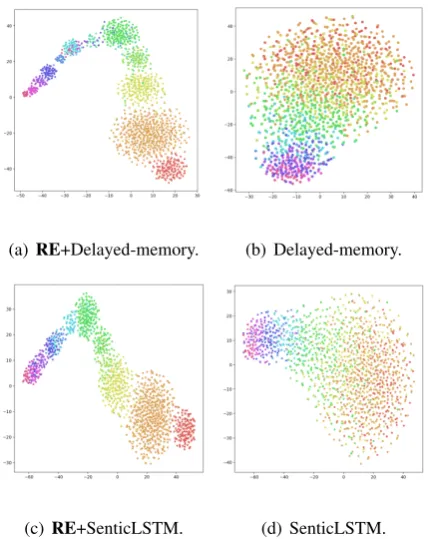
(a) RE+Delayed-memory. (b) Delayed-memory.
[image:5.595.74.290.243.513.2](c) RE+SenticLSTM. (d) SenticLSTM.
Figure 3: The visualization of intermediate embed-dings learned by embedding-based models. Different colors represent different aspects.
3.3 Visualization
To qualitatively demonstrate how the proposed embedding refinement improves the performance for both aspect detection and sentiment classi-fication in TABSA, we visualize the proposed context-aware aspect embeddings ˜a and origi-nal aspect embeddings a which are learned with Delayed-memory and SenticLSTM models via t-SNE (Maaten and Hinton, 2008). As shown in Figure 3, compared with randomly initialized em-bedding, it is observed a significantly clearer sep-aration between different aspects represented by our proposed context-aware embedding. This
in-dicates that different representations of aspects can be distinguished from the context, and that the commonality of a specific aspect can also be ef-fectively preserved. Hence the model can extract different semantic information according to differ-ent aspects, when detecting multiple aspects in the same sentence in particular. The results verify that encoding aspect by leveraging context information is more effective for aspect detection and senti-ment classification in TABSA task.
4 Conclusion
In this paper, we proposed a novel method for re-fining representations of targets and aspects. The proposed method is able to select a set of highly correlated words from the context via a sparse co-efficient vector and then adjust the representations of targets and aspects. Hence, the interdependence among specific target, corresponding aspect, and the context can be extracted to generate superior embedding. Experimental results demonstrated the effectiveness and robustness of the proposed method on two benchmark datasets over the task of TABSA. In future works, we will explore the extension of this approach for other tasks.
Acknowledgments
This work was supported by National Natu-ral Science Foundation of China U1636103, 61632011, 61876053, U1536207, Key Tech-nologies Research and Development Pro-gram of Shenzhen JSGG20170817140856618, Shenzhen Foundational Research Funding JCYJ20180507183527919, Joint Research Pro-gram of Shenzhen Securities Information Co., Ltd. No. JRPSSIC2018001.
References
Peng Chen, Zhongqian Sun, Lidong Bing, and Wei Yang. 2017. Recurrent attention network on mem-ory for aspect sentiment analysis. InProceedings of the 2017 Conference on Empirical Methods in Nat-ural Language Processing, pages 452–461.
Chuang Fan, Qinghong Gao, Jiachen Du, Lin Gui, Ruifeng Xu, and Kam-Fai Wong. 2018. Convolution-based memory network for aspect-based sentiment analysis. InThe 41st International ACM SIGIR Conference on Research & Develop-ment in Information Retrieval, SIGIR 2018, Ann Ar-bor, MI, USA, July 08-12, 2018, pages 1161–1164.
network for sentiment classification of product re-views. Knowledge-Based Systems, 124(C):34–45.
Fei Liu, Trevor Cohn, and Timothy Baldwin. 2018. Re-current entity networks with delayed memory update for targeted aspect-based sentiment analysis. In Pro-ceedings of the 2018 Conference of the North Amer-ican Chapter of the Association for Computational Linguistics: Human Language Technologies, pages 278–283.
Dehong Ma, Sujian Li, and Houfeng Wang. 2018a. Joint learning for targeted sentiment analysis. In
Proceedings of the 2018 Conference on Empirical Methods in Natural Language Processing, pages 4737–4742.
Yukun Ma, Haiyun Peng, and Erik Cambria. 2018b. Targeted aspect-based sentiment analysis via em-bedding commonsense knowledge into an attentive LSTM. In Proceedings of the Thirty-Second Con-ference on Artificial Intelligence,(AAAI-18), pages 5876–5883.
Laurens van der Maaten and Geoffrey Hinton. 2008. Visualizing data using t-sne. Journal of machine learning research, 9(Nov):2579–2605.
Minlong Peng, Qi Zhang, Yu-gang Jiang, and Xuan-jing Huang. 2018. Cross-domain sentiment classi-fication with target domain specific information. In
Proceedings of the 56th Annual Meeting of the As-sociation for Computational Linguistics (Volume 1: Long Papers), pages 2505–2513.
Jeffrey Pennington, Richard Socher, and Christopher Manning. 2014. Glove: Global vectors for word representation. In Proceedings of the 2014 Con-ference on Empirical Methods in Natural Language Processing (EMNLP), pages 1532–1543.
Maria Pontiki, Dimitris Galanis, Haris Papageorgiou, Suresh Manandhar, and Ion Androutsopoulos. 2015. Semeval-2015 task 12: Aspect based sentiment anal-ysis. InProceedings of the 9th International Work-shop on Semantic Evaluation (SemEval 2015), pages 486–495.
Sebastian Ruder, Parsa Ghaffari, and John G. Breslin. 2016. A hierarchical model of reviews for aspect-based sentiment analysis. In Proceedings of the 2016 Conference on Empirical Methods in Natural Language Processing, pages 999–1005.
Marzieh Saeidi, Guillaume Bouchard, Maria Liakata, and Sebastian Riedel. 2016. Sentihood: Targeted aspect based sentiment analysis dataset for urban neighbourhoods. In COLING 2016, 26th Inter-national Conference on Computational Linguistics, Proceedings of the Conference: Technical Papers, December 11-16, 2016, pages 1546–1556.
Duyu Tang, Bing Qin, and Ting Liu. 2016. Aspect level sentiment classification with deep memory net-work. In Proceedings of the 2016 Conference on Empirical Methods in Natural Language Process-ing, pages 214–224.
Yequan Wang, Minlie Huang, xiaoyan zhu, and Li Zhao. 2016. Attention-based lstm for aspect-level sentiment classification. InProceedings of the 2016 Conference on Empirical Methods in Natural Lan-guage Processing, pages 606–615.