Available Online atwww.ijcsmc.com
International Journal of Computer Science and Mobile Computing
A Monthly Journal of Computer Science and Information Technology
ISSN 2320–088X
IJCSMC, Vol. 4, Issue. 5, May 2015, pg.271 – 277
REVIEW ARTICLE
A Review on Traffic Route Optimizing by
Using Different Swarm Intelligence Algorithm
Ramnik Sharma
1*, Anita Kumari
2*¹Student, M. Tech, Electronics and Communication
²Assistant Professor, Department of Electronics and Communication *Rayat & Bahra Institute of Engineering & Bio-Technology, Mohali, India
Abstract— Traffic network control includes complex traffic conditions connected to traffic flow dynamics, driver behaviour, and traffic demand. The traffic management centre can control desired routes for drivers in order to optimize the performance of the traffic network by dynamic traffic routing. However, a traffic network may have thousands of links and nodes, resulting in a large-scale and computationally complex non-linear, non-convex optimization problem. This paper discusses methods for clustering to improve energy efficiency of homogeneous Wireless Sensor Networks (WSN). This paper proposes the analysis between Ant Colony Optimization (ACO), Bacterial Foraging Optimization (BFO) and Particle swarm optimization (PSO) which is used for optimize the traffic path. BFO and ACO as an algorithm for cluster head selection for WSN. BFO, PSO and ACO are chosen as the optimization method in this paper because of its powerful optimization heuristic for combinatorial optimization problems. ACO technology is for optimizing load by making Accident Warning System Model in vehicle to vehicle to avoid collision and efficient or optimal paths in traffic full area by distribution. Particle swarm optimization (PSO) is a probability based model which is used to optimize the traffic signals. An analysis of the literature allows one to conclude that ACO is a hugely viable approach to solve scheduling problems in VEHICULAR AD-HOC NETWORK.
Keywords— Ant Colony Optimization, Bacterial foraging Optimization, Particle swarm optimization, Accident Avoidance, Efficient path, Routing Protocols, optimizing traffic path
I. INTRODUCTION
impractical, and it often only temporarily relieves the burden of traffic networks rather than aiming for a long-term solution. Therefore, development of traffic control strategies is much more desirable.
Ant Colony Optimization
Ant Colony Optimization (ACO) is a meta-heuristic approach proposed by Colorni et al. in 1991 and further modified by Dorigo et al. in 1996 for the Ant Colony System [1]. It is used to solve numerous disconnected optimization problems and is considered as one of the swarm intelligent algorithm types [2]. ACO simulates the real ants to find shortest path between source and their nest, while searching the ant deposit chemical substance called pheromone along the past path. This pheromone value can be used by other ants as indicator to find the shortest path to food places [3]. The path with stronger pheromone value will be preferable for coming ants. If the number of ants decreased in a specific path, the pheromone evaporates with passed time and vice versa [3]. Different ant colony optimization algorithms have been proposed. All of them share the same idea. The original ant colony optimization is known as ANT system, and the two most successful variants max-min Ant system and ant colony system [4]. ACO is iterative algorithm, a number of artificial ants are generated at each time and build a solution to the considered optimization problem and exchange the quality information of these solutions via communication scheme [5]. A distributed heuristic solution like ACO routing algorithm shows many features that makes it particularly suitable for wireless sensor network [5]:
•
Algorithm is fully distributed that mean there is no single point of failure.•
The operations done in every node are simple.•
Autonomous interaction of ants, and the algorithm based on agents‟synchronous.•
It is self-organizing, thus robust and fault tolerant. There is no need to define path recovery algorithm.•
Intrinsically adapts to traffic without requiring complex, and yet inflexible metrics.•
It inherently adapts to all kinds of variations in topology and traffic demand, which are difficult to be taken into account by deterministic approaches.ACO Based Routing Protocols
Lately, many different ant-colony algorithms based are being considered to take optimal routing decisions in traffic paths. Vehicle-to-Vehicle Communication in a Road Intersection using NS-2 simulators was studied [6]. This focuses on sending information about the intersection from a node which may take several types of data such as voice, image, or video with different parameters such as number of vehicles, maximum speed of vehicles, and number of sent data packets which has better performance in terms of routing overhead and end-to-end delay.
PARTICLE SWARM OPTIMIZATION (PSO)
Particle Swarm optimization is a heuristic optimization introduced by Kennedy and Eberhart [7]. It was designed to solve non-linear continuous optimization problems [8]. It is a stochastic optimization technique based on the swarm movement and intelligence. PSO inspired from the sociological behaviour of bird flocking can obtain optimal results. In this algorithm each particle moves to search for the optimum solutions and hence has a velocity. It treats each particle as a point in N-dimensional space which accordingly adjusts its “flying” based on its experiences and each particle has a memory to store its previous best solutions. ACO and PSO both are the promising variants of swarm intelligence.
The PSO algorithm can be summarized in the following steps:
1. Randomly initialize a swarm with feasible discrete position vectors. 2. Randomly assign a suitable velocity vector to each particle. 3. Record the fitness of the entire population.
4. Determine the best particle performance among the group.
5. Update velocity and position vectors according to (6) and (7) for each particle. 6. Discrete the position vector.
7. If any particle flies outside the feasible solution space, restore the particle to its best previously achieved feasible solution.
BACTERIAL FORAGING OPTIMIZATION (BFO)
This procedure called foraging is crucial in natural selection, since the animals with poor foraging strategies are eliminated, and successful ones tend to propagate. Hence, to survive, an animal or a group of animals must develop an optimal foraging policy. Some of the most successful foragers are bacteria like the E Coli, which employs chemical sensing organs to detect the concentration of nutritive or noxious substances in its environment. The bacteria then moves through the environment by a series of tumbles and runs, avoiding the noxious substances and getting closer to food patch areas in a process called Chemotaxis. Besides, the bacteria can secrete a chemical agent that attracts its peers, resulting in an indirect form of communication. The foraging strategy is governed basically by four processes namely Chemotaxis, Swarming, Reproduction, Elimination and Dispersal a. Chemotaxis: Chemotaxis process is the characteristics of movement of bacteria in search of food and consists of two processes namely swimming and tumbling. A bacterium is said to be 'swimming' if it moves in a predefined direction, and 'tumbling' if moving in an altogether different direction
II. LITERATURE REVIEW
A vehicular ad-hoc network (VANET) is known as vehicular ad hoc network. It uses vehicles as mobile nodes that can send and receive any data to and from the neighbouring vehicles or road side unit. A VANET turns every vehicle into a wireless node or router. It is composed of vehicle to vehicle communication, vehicle to road side unit and inter-vehicle communications [9]. It is used to provide the drivers with public safety and private services using the wireless transceiver equipped on the car [10]. The VANET made a new strategy that leverage on vehicle to vehicle communication and vehicle to infrastructure. Information about (vehicle speed and vehicle position) on each vehicle can be exchanged among vehicles [10]. In VANET vehicles are used as real ants in our systems in order to collect accurate real time information using VANET infrastructure. VANET has been used as a road safety; avoid congestion and accidents in roads.
Doolan et al. 2013 studied a VANET-based routing algorithm which considered traffic conditions and road conditions efficient route. The advantage of Ants colony over these solutions is the innovative consideration of historical information which allows better prediction of future traffic conditions. EcoTrec, a novel eco-friendly routing algorithm for vehicular traffic which considers road characteristics such as surface conditions and gradients, as well as existing traffic conditions to improve the fuel savings of vehicles and reduce gas emissions was studied. EcoTrec makes use of the Vehicular Ad-hoc networks (VANET) both for collecting data from distributed vehicles and to disseminate information in aid of the routing algorithm [11]. The algorithm calculates the fuel efficiency of various routes and then directs the vehicle to a fuel efficient route, while also avoiding flash crowding. Simulation-based tests showed that by using EcoTrec, fuel emissions were significantly reduced, when compared with existing state-of-the-art vehicular routing algorithms
Review on recent research in various Traffic controlling system
Amilkar, Rafael and Francisco in 2010 analyzed the routine of ACO on various case studies in the Travelling
Salesman Problem (TSP) using a two stage approach and concluded the performance of ACO is optimal than
existing for TSP [12]. The two-stage approach will meet quickly for lesser nodes whereas it requires more meeting time, if number of nodes increases. All the above ACO based routing algorithms identify and apply all possible „n‟ no of paths, which degrade the performance of multipath routing algorithm [10]. The author concluded that the number of possible routes increases, the relative performance of multi-path routing also increases till „k‟ number of paths and when it exceeds the limit, the performance will be degraded. Therefore to choose only „k‟ path is an important consideration for implementing multi path routing and the optimal value of „k‟, may change in practice. In order to avoid the traffic merging, and to allow only „k‟ number of path, RLA algorithm along with ACO is proposed.
Multiple Ant Colonies Optimization (MACO) is a newly proposed framework for traffic routing pathways [13]. In this framework several colonies of artificial ants were utilized. These colonies were working cooperatively to solve an optimization problem using some interaction technique. Exploration technique was doing an essential job in this framework. This technique is responsible for directing the activity of utilized colonies towards the different parts of the huge search space. This paper describes the newly proposed MACO framework and proposes an effective exploration technique. Computational tests show that the new exploration technique can furthermore improve the IMACO performance.
ACO uses the stochastic sampling as a useful alternative, which is evaluated on seven benchmark sets. The Beam-ACO algorithm is currently a state-of the- art technique for the traveling salesman problem with time windows when travel-cost optimization is concerned.
Wireless sensor networks (WSNs) consist of a large number of autonomous and resource constrained sensor nodes which are equipped with sensing devices, wireless communication interfaces, limited processing and energy resources. The WSNs are used for distributed and cooperative sensing of physical phenomena and events of interests. The WSN is referred as a robotic network and/or as a sensor-actor network. The WSNs can be employed in a wide spectrum of applications in both civilian and military scenarios, which includes the environmental monitoring, surveillance for safety and security, automated health care, intelligent building control, traffic control, object tracking.
The routing in WSN are still is an issue, Saleem, Di Caro, and Farooq (2011) proposes the ACO framework with the other SI technique ABC, in which, five main modules with additional sub modules are implemented [15]. The main modules are: (i) mobile agent‟s generation and management, (ii) routing information database (RID), (iii) agent structure, (iv) agent communications, and (v) packet forwarding. The main modules and sub-modules implements the architecture and the operations at the node router, the author concludes the hybrid ACO and ABC routing model is optimal in the WSN.
Wenyu et al modifies ACO approach to solve delay constrained maximum energy residual ratio (DCEERR) QoS routing problem of WSN. The proposed protocol named (ACO-QoSR) [16] aim to find the best path that meet QoS requirement of WSN and balance between QoS requirements and complexity. The QoS metrics considered in the work are transmission delay and energy conservation ratio including energy balancing factor. The routing process achieved through three phases: forward ant phase, backward ant phase and maintenance phase. The forward ant starts at the source node by generating a number of forward ants these ants record their path information in the way to destination.
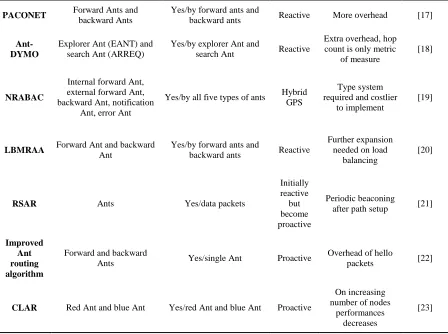
Table 1 shows the difference between various Ant-based routing schemes with respect to various metrics.
Table 1 Relative comparison of various Ant-based routing schemes.
PACONET Forward Ants and
backward Ants
Yes/by forward ants and
backward ants Reactive More overhead [17]
Ant-DYMO
Explorer Ant (EANT) and search Ant (ARREQ)
Yes/by explorer Ant and
search Ant Reactive
Extra overhead, hop count is only metric
of measure
[18]
NRABAC
Internal forward Ant, external forward Ant, backward Ant, notification
Ant, error Ant
Yes/by all five types of ants Hybrid
GPS
Type system required and costlier
to implement
[19]
LBMRAA Forward Ant and backward
Ant
Yes/by forward ants and
backward ants Reactive
Further expansion needed on load
balancing
[20]
RSAR Ants Yes/data packets
Initially reactive but become proactive Periodic beaconing
after path setup [21]
Improved Ant routing algorithm
Forward and backward
Ants Yes/single Ant Proactive
Overhead of hello
packets [22]
CLAR Red Ant and blue Ant Yes/red Ant and blue Ant Proactive
On increasing number of nodes
performances decreases
According to Table 1, a new Innovative ACO based Routing Algorithm (ANTALG) has considered the random selection of source and destination nodes and exchanges the Ants (agents) between them. In general, ANTALG algorithm operates using reinforcement learning to define a model of optimal routing behavior in MANETs. In such a model, optimal behaviour is not merely searching shortest-hop paths, but also considers the quality of the links which make up those paths. We have considered some of the unique features of Ants which are applicable to the routing problem. The movement of packets and Ant's agent through the network changes the routing policy and the paths which are used by future packets in a stochastic manner. We have found the ACO has better performance in comparison to other protocols
Yanfang Deng and Hengqing Tong (2010) proposed a PSO particle swarm optimization [24]. In there work, a hybrid PSO algorithm combined fluid neural network (FNN) to search for the shortest path in stochastic traffic networks is introduced. The algorithm overcomes the weight coefficient symmetry restrictions of the traditional FNN and disadvantage of easily getting into a local optimum for PSO algorithm. Simulation experiments have been carried out on different traffic network topologies consisting of 15–70 nodes and the results showed that the proposed approach can find the optimal path with good success rates and also can find closer sub-optimal paths with high success ratio for all the tested traffic networks. The shortest path algorithm is critical for dynamic traffic assignment and for the realization of route guidance in intelligent transportation systems (ITS) [24].
Ammar et al (2008) proposed a PSO to solve shortest path (SP) routing problems [25]. A modified priority-based encoding incorporating a heuristic operator for reducing the possibility of loop-formation in the path construction process is proposed for particle representation in PSO. Simulation experiments have been carried out on different network topologies for networks consisting of 15–70 nodes. It is noted that the proposed PSO-based approach can find the optimal path with good success rates and also can find closer sub-optimal paths with high certainty for all the tested networks. It is observed that the performance of the proposed algorithm surpasses those of recently reported genetic algorithm based approaches for this problem. The shortest path (SP) problem concerns with finding the shortest path from a specific origin to a specified destination in a given network while minimizing the total cost associated with the path. This problem has widespread applications. Some important applications of the SP problem include vehicle routing in transportation systems [25].
Raghavendra V. Kulkarni and Ganesh Kumar Venayagamoorthy (2011) proposed PSO is a simple, effective, and computationally efficient optimization algorithm. It has been applied to address WSN issues such as optimal deployment, no delocalization, clustering, and data aggregation. This paper outlines issues in WSNs, introduces PSO, and discusses its suitability for WSN applications [26]. Wireless-sensor networks (WSNs) are networks of autonomous nodes used for monitoring an environment. Developers of WSNs face challenges that arise from communication link failures, memory and computational constraints, and limited energy [27]. Many issues in WSNs are formulated as multidimensional optimization problems, and approached through bioinspired techniques. It also presents a brief survey of how PSO is tailored to address these issues.
CONCLUSIONS
This paper presents a literature review concerning the use of the ACO technique, BFO technique and PSO technique in scheduling problems. ACO is applied in always all engineering applications like continuous casting of steel, data reconciliation and parameter estimation in dynamic systems, traffic controlling and reducing vehicle collisions, design of automatic material handling devices, optimization of a rail vehicle floor sandwich panel, software design and vehicle routing design. The various level of experimental in the computer network using ACO as routing protocol [6] [28] shows that the ACO overtakes the existing research methodologies. A minute redefinition, updating and or modification of the procedural steps of ACO also will raise the performance dramatically. The ACO and BFO remains open many research issues and the ACO are optimally suit many engineering domains. Moreover, the PSO technique is used to find the node with the highest processing load in an ad-hoc collaborative computing system. The review shows the PSO algorithm significantly reduces the traffic overhead, computation complexity and convergence time of particles, in comparison to the other techniques.
in order to highlight the advantages of adopting an ACO approach. All paragraphs must be indented. All paragraphs must be justified, i.e. both left-justified and right-justified.
ACKNOWLEDGEMENT
Authors would like to express a deep sense of gratitude to the Chancellor, Vice Chancellor and the entire Department of Electronics and Communication, Rayat & Bahra Institute of Engineering & Bio-Technology, Mohali for their continuous encouragement and support.
REFERENCES
[1] M. Dorigo and L M. Gambardella, “Ant colony system: A cooperative learning approach to the traveling salesman problem,” IEEE Transactions on Evolutionary Computation, vol. 1, pp.53-66, 1997.
[2] M. Dorigo, M. Birattari, and T. Stutzle, “Ant colony optimization,” Computational Intelligence Magazine IEEE, vol. 1, pp. 28-39, 2006.
[3] T. Camilo, C. Carreto, J. S. Silva and F. Boavida, “An Energy-Efficient Ant Based Routing Algorithm for Wireless Sensor Networks,” Ant Colony Optimization and Swarm Intelligence, vol. 4150, pp. 49-59, 2006.
[4] Y. Sun, H. Ma, L. Liu, Y. Zheng, “ASAR: An ant-based service-aware routing algorithm for multimedia sensor networks,” Frontiers of Electrical and Electronic Engineering in China, vol. 3, pp. 25-33, 2008.
[5] S.M. Giriraj kumar, K. Ramkumar and S. Sharma, “Real Time Application of Ants Colony Optimization,” International Journal of Computer Applications, vol. 3, pp. 34-46, 2010.
[6] Duan H B and Wang D B., “A novel improved ant colony algorithm with fast global optimization and its simulation,” Information and Control, vol. 33, pp. 241-244, 2004.
[7] J. Kennedy and R. C. Eberhart, “Particle Swarm Optimization,” Proceedings of IEEE International Conference on Neural Networks, Perth, Australia, pp. 1942–1948,1995.
[8] R. C. Eberhart and J. Kennedy, “ A new optimizer using particle swarm theory,” in Proc. of the Sixth International Symposium on Micro Machine and Human Science, Nagoya, Japan, pp. 39–43,1995.
[9] Y. J. Wu and W.C. Sung, “A dynamic navigation scheme for vehicular ad hoc networks,” in Networked Computing and Advanced Information Management (NCM), 2010 Sixth International Conference on, pp. 231–235, 2010.
[10] M. Ferreira and P. M. Orey, “On the impact of virtual traffic lights on carbon emissions mitigation,” Intelligent Transportation Systems,IEEE Transactions on, vol. 13, pp. 284–295, 2012.
[11] R. Doolan and G. M. Muntean, “VANET-enabled Eco-friendly Road Characteristics-aware Routing for Vehicular Traffic,” in IEEEVehicular Technology Conference, pp. 1–5, 2013.
[12] P. Amilkar, B. Rafael and H. Francisco, “Analysis of the efficacy of a two-stage methodology for Ant Colony Optimization: Case of study with TSP and QAP,‟‟ Expert Systems with Applications, vol. 37, pp. 5443-5453, 2010.
[13] S. Bali, A. Jamoos, and M. Azouqa, “Investigation Of Vehicle-To-Vehicle Communication in A Road Intersection,” International Journal of Computer Communication and Processing, pp. 379- 386, 2009.
[14] L.I. Manuel and C. Blum, “Beam-ACO for the travelling salesman problem with time windows,” Computers & Operations Research, vol. 37, pp. 1570-1583, 2010.
[16] C. Wenyu, J. Xinyu, Y. Zhang, C. Kangsheng and R. Wang, “ACO Based QoS Routing Algorithm for Wireless Sensor Networks,” Ubiquitous Intelligence and Computing, Vol. 4159, pp 419-428, 2006.
[17] E. Osagie, P. Thulasiraman and RK. Thulasiram, “PACONET: improved ant colony optimization routing algorithm for mobile ad hoc networks,” In: Proceedings of the 22nd international conference on Advanced Information Networking and Applications (AINA 2008),Okinawa, pp. 204-21, 1 March 2008.
[18] JAP. Martins, S. Luis, OB. Correia and J. Celestino Junior, “Ant-DYMO: a bio-inspired algorithm for MANETS,” In: Proceedings of the 17th IEEE international conference on telecommunications Doha, pp. 748-54, 2010.
[19] S. Asadinia, MK. Rafsanjani and AB. Saeid, “A novel routing algorithm based-on ant colony in mobile ad hoc networks” In: Proceedings of the 3rd international conference on ubi-media computing (U-Media), Jinhua, pp. 77-82, 2010.
[20] AMA. Elmoniem, HM. Ibrahim, MH. Mohammed and AR. Hedar, “Ant colony and load balancing optimizations for AODV routing protocol,” Int J Sens Netw Data Commun; vol. 1, pp.1-14, 2011.
[21] Gupta R. RSAR: ring search based ant routing for MANETs. Int J Comput Appl 2012;38(11):22–6.
[22] S. Kaur, RS. Sawhney and R. Vohra, “MANET link performance parameters using ant colony optimization approach,” Int J Comput Appl, vol. 47, pp. 40–45, 2012.
[23] D. Sinha, U. Bhattacharya and R. Chaki, “CLAR: a novel cluster oriented agent based routing protocol for MANET,” Int J Found Comput Decis Sci, vol. 38, pp. 3–23, 2013.
[24] D. Yanfang; H. Tong, and X. Zhang, "Dynamic shortest path in stochastic traffic networks based on fluid neural network and Particle Swarm Optimization," Natural Computation (ICNC), 2010 Sixth International Conference on , vol.5, pp. 2325-2329, 10-12 Aug. 2010.
[25] W. Ammar, N.C. Sahoo and T. K. Geok, “Solving shortest path problem using particle swarm optimization,” Applied Soft Computing, Volume 8, Issue 4, pp. 1643-1653, September 2008.
[26] Kulkarni, R.V.; Venayagamoorthy, G.K., "Particle Swarm Optimization in Wireless-Sensor Networks: A Brief Survey," Systems, Man, and Cybernetics, Part C: Applications and Reviews, IEEE Transactions on , vol.41, no.2, pp.262-267, March 2011.
[27] J. Yick, B. Mukherjee, and D. Ghosal, “Wireless sensor network survey,”Comput. Netw., vol. 52, no. 12, pp. 2292–2330, 2008.
[28] F.B. Zahn, C.E. Noon, Shortest path algorithms: An evaluation using real road networks, Transport. Sci. 32 (1998) 65–73.