2018 International Conference on Computer, Electronic Information and Communications (CEIC 2018) ISBN: 978-1-60595-557-5
Co-Stabilized Performance of Ag-impregnated La
0.6Sr
0.4Co
0.2Fe
0.8O
3-δCathode for Intermediate Temperature Solid Oxide Fuel Cells
Zai-xing WANG, Feng-li LIANG
*and Jun-kui MAO
College of Energy and Power Engineering, Jiangsu Province Key Laboratory of Aerospace Power System, Nanjing University of Aeronautics and Astronautics, Nanjing, 210016, China
*Corresponding author
Keywords: Solid oxide fuel cells (SOFCs), Cathode, Cobalt alloying, Oxygen reduction reaction, Wet Impregnation.
Abstract. Performance of an La0.6Sr0.4Fe0.8Co0.2O3-δ (LSCF)––Ag/(Ag0.9Co0.1) cathode on a
Ce0.8Sm0.2O1.9 electrolyte was studied. The effect of Co alloying on Ag-impregnated Ag + LSCF cathode for the oxygen reduction reaction in intermediate temperature solid oxide fuel cells has been studied in detail. The results indicate that an addition of 10 mol.% Co effectively inhibits the growth and coalescence of Ag particles at high temperatures.As a consequence, the electrochemical performance and stability of the cathode are significantly improved. The electrochemical performance of the Ag + LSCF and Ag0.9Co0.1 + LSCF cathodes is much better than that of the mixed ionic and electronic conducting oxide cathodes LSCF.
Introduction
Due to the high cell efficiency, zero pollution and low emission, solid oxide fuel cells (SOFCs) are receiving more and more attention [1,2]. However, the biggest problem is that the operating temperature (800-1000°C) is so high that it cannot be commercialized. Reducing the working temperature of SOFC to intermediate temperature (IT) range (500-800 °C) is the best method to solve this problem [3,4]. Low operating temperature not only reduces the production costs but also expands the operating life. Unfortunately, new issues such as the cathode resistance increases would be brought when the temperature is decreased. Therefore, research and development of advanced cathode materials for SOFC is one of the key goals [5,6].
La0.6Sr0.4Co0.2Fe0.8O3-δ (LSCF) is a promising cathode material [7]. Unfortunately, the development of LSCF cathodes has been hindered by their performance degradation. An LSCF cathode, may suffer from low surface activity for ORR , which may correlate strongly with the change in surface chemistry of LSCF under service conditions [8].Adler et al. have reported that cathodic reaction of LSCF on GDC is dominated by both the oxygen ion transport and oxygen surface exchange processes [9].
It is an effective way to enhance the activity of the cathode by simply decorating the cathodes with traditional materials or other mental particles. Recently, various transition metal catalysts, such as noble metals Pd, Pt, Ag and non-noble metals Co, Fe [10,11] have been decorated the cathode to enhance the ORR activity, among which Ag has been considered as one of the most activity ones. However, like most of transition metal catalysts in nano-size, the Ag have low melting point and consequently its high tendency for agglomeration, leading the loss of the catalytic activity and durability performance. Thus, it is crucial to develop protection strategies to stabilize the mental nano-particles against agglomeration during the catalytic reaction. In our previous work, we have proved that such agglomeration can be inhibited by alloying Co into Pd. And we found that Pd0.90Co0.10 demonstrated the highest ORR activity and stability among the three alloys-Pd0.95Co0.05O, Pd0.90Co0.10O, and Pd0.80Co0.20O [12,13].
Experimental
Material Synthesis
EDTA-Citrate method (CEM) was used to synthesize La0.6Sr0.4Fe0.8Co0.2O3-δ powders. Stoichiometric amounts of Sr(NO3)2 (99%), La(NO3)2•6H2O (99%), Fe(NO3)3•9H2O(98.5%), and Co(NO3)2•6H2O (99%) were dissolved in distilled water. Next, EDTA and citric acid was dissolved by ammonia followed adding to metal solution to form an aqueous mixed solution. And then the aqueous mixed solution was evaporated to become gelatum, which was then dried in oven at 250 °C for 5 h to obtain the precursor. Finally, the precursor was calcined at 900 °C for 5 h to become the required materials.
Preparation of the Impregnating Solution
To make Ag or Ag0.9Co0.1 impregnated cathodes, the impregnating solution was prepared from AgNO3 or from an aqueous solution mixture of AgNO3 (0.5 mol•l-1) and Co(NO3)2•6H2O (0.5 mol•l-1, mole ratio of Ag+ : Co2+ = 90:10). A weighted amount of glycine was dissolved in a measured volume of ethylene glycol under stirring and heating at 40 °C, and then silver nitrate or silver/cobalt nitrate was added to the obtained solution. The solution was infiltrated into the porous LSCF electrode and heated at 400 °C for 0.5 h for repeat heating until required weight. The amount of silver in LSCF was about 10 wt.%
Cell Fabrication
Symmetric cells with La0.6Sr0.4Fe0.8Co0.2O3-δ| Sm0.2Ce0.8O1.9(SDC) | La0.6Sr0.4Fe0.8Co0.2O3-δ configuration were prepared for the electrochemical measurement. The SDC pellets were formed by dry pressing 0.35 g of SDC powders and sintering at 1350 °C for 5 h in air to get dense SDC electrolyte.
To obtain the cathode slurry, the La0.6Sr0.4Fe0.8Co0.2O3-δ powders were initially dispersed into a pre-mixed solution of glycerol, ethylene glycol and isopropyl alcohol, and then followed by planetary milling (Fritsch, Pulverisette 6) at 400 rpm for 0.5 h. The resultant slurry was symmetrically sprayed onto both sides of the SDC disks and then calcined at 900 °C for 2 h in air. Ag paste was painted on the surface of the symmetric cathodes and then dried as current collector.
Characterizations
The phase structure of Symmetric cells were determined through a powder X-ray diffraction (XRD, Bruker D8 Advance) with Cu-Kα radiation (λ=1.54056Å).
Electrochemical impedance spectra (EIS) of the symmetrical cells were measured on Solartron 1287 and 1260. Electrochemical workstations with a frequency range of 0.01 Hz to 100 kHz and an AC amplitude of 10 mV. The symmetrical cells were tested from 550 to 750 °C at intervals of 50 °C in air.
Results and Discussion
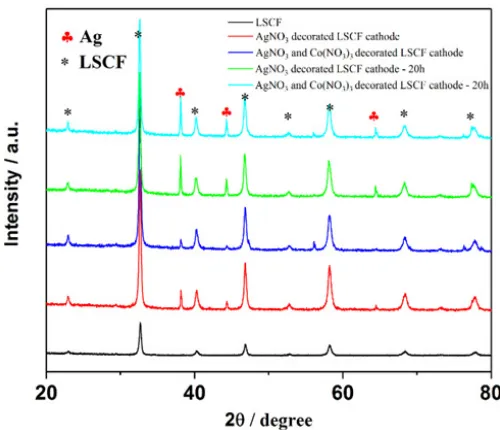
Figure 1. depicts the room-temperature XRD patterns of Ag-impregated LSCF and Ag0.9Co0.1
-impregated LSCF cathodes. All the XRD peaks can be indexed to LSCF and Ag phases and no other phases were observed, indicating that a solid solution on the surface of the LSCF porous structure.
Figure 1. Powder X-ray diffraction pattern of the LSCF, Ag + LSCF and Ag0.9Co0.1 + LSCF cathodes.
Figure 2 (a)-(d) display the electrochemical impedance spectroscopy (EIS) spectra of
symmetrical cells measured at550-750 °C in ambient air. There are two depressed arc in the impedance spectra, whose intercepts of the arc on the real axis corresponds to the total polarization resistance (Rp) of LSCF electrodes. The ohmic resistance generated by electrolyte and leading wires was normalized to zero for clearly comparing the cathode polarization resistance.
The electrode polarization resistances, RE for ORR on LSCF, Ag+ LSCF, Ag0.9Co0.1 + LSCF, Ag+ LSCF for 20 h and Ag0.9Co0.1 + LSCF for 20 h at 600 °C were around 0.96, 0.26, 0.19, 0.32 and 0.26 Ω·cm2. The polarization resistance increases with decreasing temperature from 750°C-600
°C, and the Ag0.9Co0.1 + LSCF shows the lowest resistance. The polarization resistances for Ag+ LSCF, Ag0.9Co0.1 + LSCF electrodes show highly improvement relative to pure LSCF. The resistance for Ag0.9Co0.1+ LSCF for 20 h (0.26 Ω·cm2) is slight higher than Ag0.9Co0.1 + LSCF (0.19 Ω·cm2), but lower than Ag+ LSCF for 20 h (0.32 Ω·cm2). It indicated that the Co-doped Ag
alloys-impregnated LSCF cathodes has the best performance stability.
Figure 2. Electrochemical impedance spectra of the LSCF, Ag+ LSCF and Ag0.9Co0.1 + LSCF cathodes measured at (a)
750 °C, (b) 7000 °C, (c) 650 °C, and (d) 600 °C, in air at open circuit; and (e)Arrhenius plot of Rp for the Ag+ LSCF
and Ag0.9Co0.1 + LSCF cathodes.
Summary
This work have displayed that Co alloying into Ag provides enhancement in the electrode performance stability and its oxygen reduction reaction (ORR) activities. At 600 °C, the
polarization resistance decreased in the order of LSCF (0.96 Ω·cm2), Ag+ LSCF (0.26 Ω·cm2),
Ag0.9Co0.1 + LSCF (0.19 Ω·cm2), highlighting the positive effect of Co towards ORR performance.
The Ag+ LSCF for 20 h (0.32 Ω·cm2) and Ag0.9Co0.1 + LSCF for 20 h (0.26 Ω·cm2) indicate that the
Ag0.9Co0.1 has the highest ORR activity and stability.
Acknowledgement
This work was enabled by financial support from the National Natural Science Foundation of China (51502138), and the Youth Fund in Jiangsu Province (BK20150738).
References
[1] P. Singh, N.Q. Minh, Solid Oxide Fuel Cells: technology status, Int. J. Appl. Ceram. Tech. 1 (2004) 5-15.
[2] N.A. Baharuddin, A. Muchtar, M.R. Somalu, Short review on cobalt-free cathodes for solid oxide fuel cells, Int. J. Hydrogen Energy. 42 (2017) 9149-9155.
[3] W. Winkler, J. Koeppen, Design and operation of interconnectors for solid oxide fuel cell stacks, J. Power Source. 61 (1996) 201-204.
[4] Y. Zhang, R. Knibbe, J. Sunarso, Y.J. Zhong, W. Zhou, Z.P. Shao, Z.H. Zhu, Recent progress on advanced materials for solid oxide fuel cells operating below 500 °C, Adv Mater. 29 (2017).
[5] E.V. Tsipis, V.V. Kharton, Electrode materials and reaction mechanisms in solid oxide fuel cells: a brief review, J. Solid State Electrochem. 12 (2017) 1039-1060.
[6] C.W. Sun, R. Hui, J. Roller, Cathode materials for solid oxide fuel cells: a review, J. Solid State Electrochem. 14 (2010) 1125-1144.
[7] L.W. Tai, M.M. Narsarallah, H.U. Anderson, D.M. Sparin, S.R. Sehlin, Structure and electrical properties of La1− xSrxCo1− yFeyO3. Part 1. The system La0. 8Sr0. 2Co1− yFeyO3. Solid State Ionics.76 (1995) 273.
[8] S. P. Simner, M. D. Anderson, M. H. Engelhard, J. W. Stevenson, Degradation Mechanisms of La–Sr–Co–Fe–O3 SOFC Cathodes, Electrochem Solid State. 9 (2006) 478-481.
[9] S. Adler, Factors Governing Oxygen Reduction in Solid Oxide Fuel Cell Cathodes, Chem. Rev. 104 (2004) 4791-4843.
[10]S. Wang, T. Kato, S. Nagata, T. Honda, T. Kaneko, N. Iwashita, M. Dokiya, Performance of a La0. 6Sr0. 4Co0. 8Fe0. 2O3–Ce0. 8Gd0. 2O1. 9–Ag cathode for ceria electrolyte SOFCs, Solid State Ionics. 146 (2002) 203.
[11]Y. Liu, M. Mori, Y. Funahashi, Y. Fujishiro, A. Hirano, Development of micro-tubular SOFCs with an improved performance via nano-Ag impregnation for intermediate temperature operation, Electrochem. Commun. 9 (2007) 1918.
[12]F.L. Liang, J. Sunarso, J.K. Mao, W. Zhou, Electrochemical performance and stability of nano-structured Co/PdO-co-impregnated Y2O3 stabilized ZrO2 cathode for intermediate temperature solid oxide fuel cells, Int. J. Hydrogen Energy. 42 (2017) 6978-6987.