© 2017, IRJET | Impact Factor value: 5.181 | ISO 9001:2008 Certified Journal | Page 2318
“AN EXPERIMENTAL STUDY ON PARTIAL REPLACEMENT OF CEMENT
WITH EGG SHELL POWDER IN CONCRETE”
Bandhavya G.B
1, Sandeep K
2, Bindhushree G.B
31
Assistant professor, Dept. Of civil Engineering NDRKIT, Hassan Karnataka, India
2Assistant professor, Dept. Of civil Engineering NDRKIT, Hassan Karnataka, India
3Design Engineer, Bremer Engineering India Pvt Ltd, Bangalore Karnataka, India
---***---Abstract: - currently India has taken a major initiative on
developing the infrastructure such as express highways, power projects and industrial structure etc., to meet the requirements of globalization, in the construction of building and other structure. Concrete plays the key role and a large quantum of concrete is being utilized in every construction practices. The egg shell usually which are disposed, is used as an alternate for the cement since the shell is made up of calcium. An egg shell are used in different combinations to find the feasibility of using the egg shells as an alternate to cement.Egg Shell powder replaces 0%,5%,10% and 15% of weight of cement. Concrete is cast and compressive test and tensile tests were carried out to find the best combination which results in optimum percentage of strength
Key Words: Egg shell, Compressive Strength, Tensile Strength, Egg Shell Powder
1.
INTRODUCTION
Concrete is being widely used for the construction of most of the buildings, bridges and it is also known as backbone to the infrastructure development of a nation. At present, for a variety of reasons, the concrete industry is not sustainable. Firstly, it consumes huge amount of natural resource due to which no virgin material will be left for future generation. Secondly, the major component of concrete is cement. Lot amount of green house gas will be emitted in the manufacturing processes of cement. Thirdly, concrete structure suffers from durability problem due to which natural resources are wasted. Therefore, there is a need to find an alternative method so that concrete industry becomes sustainable. The cement produces about 5% of CO2 emissions of the world. 900kg of CO2 for every 1000kg of cement produced. Hence, currently, the entire construction industry is in search of a suitable and effective the waste product that would considerably minimize the use of cements and ultimately reduces the construction cost. And also waste by products from agriculture and industry like fly ash, rice husk ash, egg shells, copper slag, quarry dust etc are creating environmental and health concern problems. Therefore, in the present study fly ash and egg shell powder are used in concrete as a partial replacement of cement. India stand third in the world electricity generation according to Global Energy Statistical Yearbook. In the past, fly ash obtained from coal combustion was simply and
dispersed into atmosphere. This created environmental and health concerns problems. Instead of dispersing it into atmosphere or sending it to land fill it can be effectively used in concrete production as supplementary material to cement. Fly ash is an ash produced during combustion of coal. There are two types of fly ash, one is class F fly ash and another one is class C. Class F fly ash contains less than 5% lime and class C fly ash contains more than 10% of lime. India ranks second in the world with annual egg production. These many egg shells will be a waste annually. Disposal of these egg shells is a big problem because if they are send to landfills attracts vermin and causes problems related to human health and environment. Egg shell are rich in calcium and has nearly same composition that of limestone. Use of eggshell waste instead of natural lime in cement can have benefits like conserving natural lime and utilizing waste material. The aim of the current study is to determine the potential use of these wastes as a cementing material for concrete.
© 2017, IRJET | Impact Factor value: 5.181 | ISO 9001:2008 Certified Journal | Page 2319 an addition to concrete had improved the resistance to
failure under bending and water absorption was reduced at initial stage. MTALLIB AND RABIU et al., (2009) carried out the investigation on properties of ESA as an admixture in concrete. They conducted consistency test on ESP. It was observed that higher the contents of ESA in the cement, the faster the setting of cement. The decreased setting time of OPC was due to addition of ESA portrays ESA as an accelerator. K. UMA SHANKAR Jet al., revealed that the use of egg shell powder, GGBS and saw dust ash as concrete. Egg shell plays a major role, as it is used in all the combination of the concrete cubes. The tests revealed encouraging results for the study. The sample of blended cement consists of 20% of egg shell powder, 50% of GGBS and 10% of saw dust ash. The proportion of the mineral admixtures is applied in testing cubes for their compressive strength. The results of the works can be concluded that egg shell powder, GGBS and saw dust ash mixed concrete cubes had maximum strength at 5%, 10% replacement. The 28 days compressive strengths of the ESP & GGBS mix concrete cubes shows maximum strength at 10% replacement with cement.
1.1
OBJECTIVES:
The objectives of this study are as follows
a) To investigate the best mix proportion of the partial replacement of egg shell powder for cement in concrete by the value of strength per weight ratio of sample specimen.
b) To investigate the feasibility of the partial replacement of above material in concrete by determining its compressive strength and split tensile strength. c) Based on the test results, to suggest most approximate
level of adding egg shell powder.
1.2
SCOPE OF THE STUDY
Consumption of cement can be reduced significantly if eggshell powder used as a partial replacement without compromising performance characteristics of concrete including durability. The scope of study is to establish to achieve the objectives and this study will be mainly concentrated on experimental works. Experiments regarding compression strength and split tensile strength on the partial replacement of egg shell powder in concrete will be carried out in order to study the behavior of concrete. All testing methods and procedure are specified according to Indian Standard
2. EGG SHELL POWDER
Eggshells are agricultural throw away objects produced from chick hatcheries, bakeries, fast food restaurants among others which can damage the surroundings and as a result comprising ecological issues/contamination which would need appropriate
wealth, the efficiency of adapting eggshells to advantageous application constitutes a concept worth-accepting. It is systematically acknowledged that the eggshell chiefly consists of compounds of calcium. Okonkwo has proficiently proposed that eggshell comprises 93.70% calcium carbonate (in calcium), 4.20% organic matter, 1.30% magnesium carbonate, and 0.8% calcium phosphate. It is estimated that roughly 90 milliontonnes of hen egg are generated throughout the world every year. In India 77.7 billion eggs are produced in the year 2010-2011.Tamil Nadu, amassing a share of around 20 per cent, is ranked second with almost 2,000 core eggs created in the state every year. The next in the list of prominent egg producing states in India comprise Maharashtra, Haryana, Punjab and West Bengal.
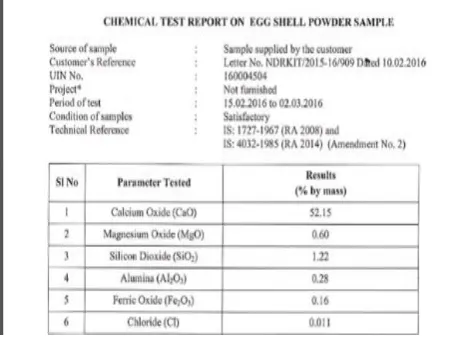
[image:2.595.312.547.357.527.2]In the present work, egg shells which was a waste material was collected from bakeries, fast food restaurants and are sun dried. Stored egg shell was powdered in flour mill. The grinded egg shells were sieved through the 90 micron sieve size and then packed to use it in the cement replacement
FIGURE 1: CHEMICAL TEST REPORT ON EGG SHELL POWDER SAMPLE
Table -1: PHYSICAL PROPERTIES OF EGG SHELL POWDER
SL. NO PHYSICAL PROPERTIES RESULTS
1 Specific gravity of eggshell
powder 2.66
T
[image:2.595.307.564.607.747.2]© 2017, IRJET | Impact Factor value: 5.181 | ISO 9001:2008 Certified Journal | Page 2320 FIGURE 3: EGG SHELL
3. METHODOLOGY&EXPERIMENTAL WORK
In the present study, we are used concrete cube moulds of size (150×150×150)mm for compression test and 150mm diameter, 300mm height cylinders for split tensile test. The specimens are casted for M25 grade concrete by replacement of cement by egg shell powder (0 to 15 %).Hand mixing is to be used for concrete mixing. After casting required specimens, the specimens will be cured by normal water curing at temp 270C ± 2 0C. After curing, the cubes are subjected to compression test for 3, 7 and 28 days and cylinders are subjected to tensile test for 28days by using compression testing machine at the rate of loading 140 kg/cm2 or 14N/mm2/min as per IS:516-1959.MIX PROPORTION is 1: 1.74: 2.93
TABLE -2: MIX PROPORTION PER CUBIC METER
Sl. No Egg shell powder
(%)
Cement (kg)
Fine aggregate
(kg)
Coarse aggregate
(kg)
Water (liters)
1 0 394 688 1156 197
2 5 374.3 688 1156 197
3 15 354.6 688 1156 197
4 20 334.9 688 1156 197
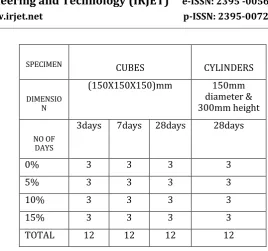
TABLE -3: DIMENSIONS OF SPECIMENS
SPECIMEN CUBES CYLINDERS
DIMENSIO N
(150X150X150)mm 150mm
diameter & 300mm height
NO OF DAYS
3days 7days 28days 28days
0% 3 3 3 3
5% 3 3 3 3
10% 3 3 3 3
15% 3 3 3 3
TOTAL 12 12 12 12
4. RESULTS AND DISCUSSION
4.1 COMPRESSIVE STRENGTH OF CONCRETE
From the test results it is observed that the 3days compressive strength of the conventional concrete is less than that of that Eggshell powder partially replaced with cement in concrete for the M25. From the test results it has been observed that the compressive strength of the conventional concrete is about 18.81Mpa concrete at the age of 3days and 19.40Mpa for the 5% Eggshell powder replaced concrete. Hence compressive strength of concrete replaced with 5% Eggshell powder is about 3.2 % increased than that normal conventional concrete at 3days. For 3days there is an increase in compressive strength of concrete replaced with 10% Eggshell powder is about 20.10Mpa which is 7 % more than conventional concrete. With the further increase in percent of Eggshell powder there will be decrease in compressive strength
TABLE -3: TEST RESULTS OF 3, 7 AND 28 DAYS COMPRESSIVE STRENGTH OF CONCRETE CUBES
PERCENTAGE OF
REPLACEMENT ( ESP )
COMPRESSIVE STRENGTH(MPA)
NO OF DAYS 3DAYS 7DAYS 28DAYS
0% 18.81 23.70 33.18
5% 19.40 24.59 35.70
10% 20.10 26.81 36.14
[image:3.595.37.289.82.280.2]© 2017, IRJET | Impact Factor value: 5.181 | ISO 9001:2008 Certified Journal | Page 2321 compressive strength of the conventional concrete is less
than that of the Eggshell powder partially replaced with cement in concrete for the grade of M25. From the test results it is observed that the compressive strength of the conventional concrete is about 23.70 Mpa concrete at the age of 7days and 24.59 Mp.a for the 5% Eggshell powder replaced concrete. Hence compressive strength of concrete replaced with 5% ESP is about 4% increased than that of normal concrete. For 7days there is an increase in compressive strength of concrete replaced with 10% ESP is about 26.81Mpa which is 13% more than conventional concrete. With the further increase in percent of Eggshell powder there will be decrease in compressive strength. From the test results, it is observed that there is a increase in compressive strength of the partially replaced concrete compared to the normal conventional concrete. The compressive strength of conventional concrete is about 33.18Mpa and 5% ESP replaced concrete is 35.70Mpa at the age of 28days. Hence 5% ESP replaced concrete has compressive strength of about 7.6% increased than the convectional concrete. For 28days there is an increase in compressive strength in 10% ESP replacement is about 36.14Mpa which is 9% more than conventional concrete. As the ESP particles exceeds 10%, increase water demand which leads to higher water cement ratio. This leads to a decrease in compressive strength.
17.5 18 18.5 19 19.5 20 20.5
0 5 10 15
Co
m
pr
es
si
ve
s
tr
en
gt
h
M
pa
Compressive strength results for 3 days
Perecentage of ESP
Chart -1: Graphical representation of 3 days compressive strength of concrete
0 5 10 15 20 25 30
0 5 10 15
Comp
re
ss
ive
s
tr
en
gth
M
pa
Compressive strength results for 7 days
Percentage of ESP
Chart -2: Graphical representation of 7 days compressive strength of concrete
28 29 30 31 32 33 34 35 36 37
0 5 10 15
Co
m
pr
es
si
ve
s
tr
en
gt
h
M
pa
Compressive strength in Mpa
Percentage of ESP
© 2017, IRJET | Impact Factor value: 5.181 | ISO 9001:2008 Certified Journal | Page 2322
0 5 10 15 20 25 30 35 40
0 5 10 15
co
m
p
re
ss
iv
e
st
re
n
gt
h
in
Mp
a
Percentage of ESP
compressive strength in Mpa
3 days 7 days 28 days
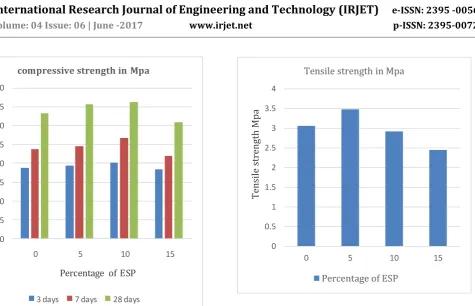
Chart -4: Graphical comparison between 3, 7 and 28 days compressive strength of concrete
4.2 SPLIT TENSILE STRENGTH OF CONCRETE
From the test results, it is observed that there is a increase in compressive strength of the partially replaced concrete compared to the normal conventional concrete. The tensile strength of conventional concrete is about 3.06Mpa and 5% ESP replaced concrete is 3.48 Mpa at the age of 28days. Hence 5% ESP replaced concrete has tensile strength of about 13.72% increased than the convectional concrete. For 28days there is an decrease in tensile strength in 10% ESP replacement is about 2.92Mpa which is 4.8% less than conventional concrete.TABLE -4: SPLIT TENSILE STRENGTH RESULTS @28 DAYS
PERCENTAGE OF
REPLACEMENT TENSILE STRENGTH AT 28DAYS
0 3.06
5 3.48
10 2.92
15 2.45
0 0.5 1 1.5 2 2.5 3 3.5 4
0 5 10 15
Te
ns
ile
s
tr
en
gth
M
pa
Tensile strength in Mpa
Percentage of ESP
Chart -5: Graphical representation of 28 days Tensile strength of concrete
5. CONCLUSION
Extensive experimentation has been carried out to determine utilization of the egg shell powder as cement replacement material by making the cement concrete. Based on the results obtained from the experimental work the following conclusions can be drawn
Compressive strength was higher than conventional concrete for 5 % and 10% ESP replacement at 3, 7 and 28 days of curing ages. ESP replacements greater than 10 %had lower strength than conventional concrete.
Split tensile strengths of ESP concretes were comparable with conventional concrete up to 15 % ESP replacement. However, concrete with 10 % and 15% ESP had lower split tensile strength than conventional concrete.
The split tensile strength of the egg shell powder concrete decreases with the addition of egg shell powder. This can be increased if the concrete is used with reinforcement.
The results demonstrated that, irrespective of ESP percentage replacement there was good relationship between compressive strength and split tensile strength.
6. REFERENCE
[1] Amarnath Yerrmalla andRamachandrudu. (2014),
[image:5.595.79.555.46.352.2]© 2017, IRJET | Impact Factor value: 5.181 | ISO 9001:2008 Certified Journal | Page 2323 Experimental Investigation of Egg Shell Powder as
Partial Replacement with Cement in Concrete,International Journal of Engineering Trends and Technology (IJETT) Volume 14..
[3] Praveen Kumar R, Vijaya Sarathy.R and Jose
Ravindraraj.B (2015), Experimental Study on Partial Replacement of Cement with Egg Shell Powder, International Journal on Innovations in Engineering and technology (IJIET)Volume 5.
[4] M.S. Shetty,Concrete Technology and Practice, 7th edition, S.Chand and company limited.
[5] IS: 10262-2009 --- Recommended guide lines for
concrete mix design.
[6] SP: 23-1982 --- Hand book on concrete mix design.
[7] IS: 456-2000 --- Code of practice for plain and
reinforced concrete.
[8] IS:8112 ---Specification for OPC cement.
[9] IS: 383-1970 --- Specification for coarse and fine
aggregate from natural source for concrete. [10] IS: 516-1959 --- Method of test for strength