2017 2nd International Conference on Software, Multimedia and Communication Engineering (SMCE 2017) ISBN: 978-1-60595-458-5
An Iterative Power Allocation Algorithm Aimed at Maximization of
System Capacity in Two-Tier Cellular Network
Hong-kui SHI
1,2, Tie-cheng SONG
2,*, Heng DONG
1and Hong WANG
11Nanjing Univ. of Posts and Telecommunications, No. 66 Xinmofan Road, Nanjing China 2Southeast Univ., No. 2 Sipailou, Nanjing China
*Corresponding author
Keywords: 5G, HetNet, Power allocation, Newton’s method.
Abstract. To fulfill the urgent requirement for ubiquitous information exchange, the infrastructure of the next-generation mobile system is developing toward a densely distributed cellular network with multiple tiers of base stations and access technologies serving users with different mobility styles and bandwidth demands. Therefore, the need for an advanced power control and interference mitigation strategy is even more prominent. This paper proposes an iterative power allocation algorithm for mobile users within a two-tier mobile network infrastructure. The algorithm is based on Newton’s method and is aimed at maximizing system capacity of the whole system. Simulation results prove that, compared to the traditional power control scheme, the proposed scheme remarkably improves utilization of latent system capacity and effectively reduces user power consumptions, and the algorithm possesses a favorable performance of convergence.
Introduction
With the rapid increase of mobile multi-media application service demands, the mobile network is developing at an unprecedented speed. As scheduled, compared to 4G network, the system capacity, frequency efficiency and averaged cell throughput of 5G mobile network will increase by 1000, 10 and 25 times respectively, and the peek data rate of a 5G single user at low- and high-speeds will be up to 10Gb/s and 1Gb/s respectively [1]. To accommodate for such targets, the infrastructure of 5G cellular network is evolving into a multi-tier heterogeneous network (HetNet) with higher channel capacities and flexible access modes. Small cells, such as micro-cells, pico-cells, femtocells, will be widely equipped within the 5G mobile systems to improve network coverage and enhance system capacity. Since small cells fully reuse macrocell frequency resources, inter-tier interference becomes unneglectable [2]. Moreover, as the small cells are massively equipped and randomly located, intra-tier interference also awaits a deep consideration. Therefore, interference mitigation is one of the key problems of multi-tier HetNet, and traditional power control schemes used in single-tier cellular networks no longer work effectively in multi-tier scenarios [3].
algorithm based on Stackelberg Gaming under incomplete channel state information. Authors in [10] also utilize a Stackelberg Gaming model and a penalty price to set up an interference management strategy in ultra-dense network. [11] proposed a set of joint solutions for throughput promotion in DenseNet, which consists of femtocell clustering, resource allocation and power allocation. [12] summarized the most recent research works concerning interference management technologies in 5G HetNets and provided the suggestions on future research works.
In this paper, we present a centralized power allocation scheme to be used in 5G two-tier cellular network with macrocells and femtocells. Unlike traditional power control strategies which assign fixed SINR thresholds to the users, the proposed scheme is based on the Newton’s iteration method and the goal of the algorithm is to maximize overall system capacity. We have testified the performance of the proposed scheme and reached an attractive conclusion that, compared with traditional power control schemes, the iterative scheme remarkably increases system throughput, but the transmitted powers of both macrocell users and femtocell users are reduced, and the algorithm presents a good feature of convergence.
The remainder of this paper is organized as follows. In Section 2, we set up the mathematical model of a two-tier cellular mobile network and give the theoretical deduction of the proposed power allocation scheme. Section 3 describes the execution steps of the algorithm in detailed steps. Section 4 provides the performance of the algorithm by way of visualized simulation results. Section 5 concludes the paper.
System Model and Theoretical Description
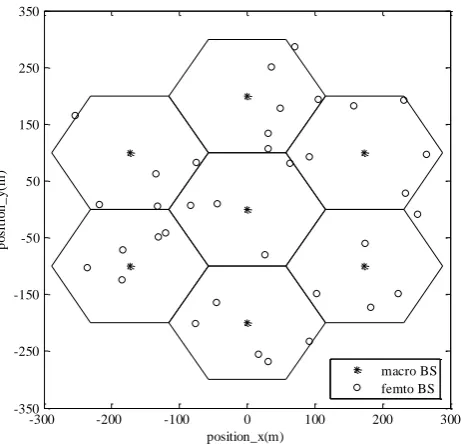
We herein suppose a two-tier mobile system which consists of macrocells and femtocells with overlapped coverage, as shown in Figure 1. We suppose femtocells are randomly distributed within the coverage area of macrocells. The system bandwidth is fully shared by the two tiers. Each mobile station is allocated with a single or multiple wireless sub-carriers according to its bandwidth demand and the current resource occupation condition of its attached access point (either a macro base-station or a femto one).
-300 -200 -100 0 100 200 300 -350
-250 -150 -50 50 150 250 350
position_x(m)
p
o
si
ti
o
n
_
y
(m
)
[image:2.595.178.409.477.699.2]macro BS femto BS
Figure 1. Layout of two-tier network.
expanding the parameters of its basic equation to the forms of vectors and matrices, as seen in this paper.
The following definitions are given before describing the algorithm: • B -- Bandwidth of each sub-carrier;
• k i
p -- Transmitted power allocated to the kth sub-carrier of ith mobile station; • k
ij
g -- Channel gain between mobile user i and the access point attached by user j at sub-carrier
k;
• k
U -- The set of all mobile users allocated with sub-carrier k;
• k
i
N -- Mean power of Gaussian noise received by user i’s attached access point at sub-carrier
k.
Based on Shannon’s theory, the upper bound of channel capacity acquired by user i occupying sub-carrier k can be expressed as
k i i U j k ji k j k ii k i k i N g p g p B C k 1log2 . (1)
Therefore, the accumulated capacity obtained by sub-carrier k within the studied network is
k k U i k i i U j k ji k j k ii k i k N g p g p BC log2 1 . (2)
Now the final target of our power allocation algorithm is to find out a solution which maximizes k
C . Since Ck is a function with multiple variables, we utilize the Hessian Matrix to find its maximal value. It can be observed that Ck is twice differentiable, so the Hessian Matrix can be defined as
2 2 2 2 1 2 2 2 2 2 2 1 2 2 1 2 2 1 2 2 1 2 k U k k k U k k k U k k U k k k k k k k k U k k k k k k k k k k k k k p C p p C p p C p p C p C p p C p p C p p C p C pf . (3)
where
T 2 1 , , k U k k k k k k k p C p C p C p . (4)
For each mobile user iUk, we yield
k i U j k ji k j k ii k i k i N g p g B p C k
2
k i i U j k ji k j k i U j k ji k j k ii k i i k i i i U i k i k i N g p N g p g g p B p C k k k ' ' ' ' ' ' ' ' ' ' , ' ' 2ln . (6)
By defining ik
U j k ji k j k
i p g N
k
R , Eq. 5 and Eq. 6 can be simplified to
k i k ii k i k
i B g p C R 2 ln
. (7) And
k
i k i i k i k i k ii k i i k i i i U i k i k i g p g g p B p C
k ' ' '' ' ' ' ' ' ' , ' ' 2
ln R R
. (8) Therefore,
i U i i
k i k i i k i k i k ii k i i k i k i k ii i i U i k i k i k i k i k i k k
k p g
g g p g B p C p C p C ' , ' ' ' '' ' ' ' ' ' ' , ' ' 2
ln R R R . (9)
On the basis of Eq. 9, the second partial derivatives of system capacity can be deduced as Eq. 10 and Eq. 11:
i i Ui ik ik iki ik k i i k i k i k ii k i i k i k i k ii i i U
i ik ik iki ik
k ii k i k i k i i k i k ii k ii k i i k i k i k ii k i k k k g p g p g g p g B g p g g p g g g p g B p C ' , ' 2 ' ' ' ' 2 ' ' ' ' ' 2 ' ' ' ' 2 2 ' , ' 2 ' ' ' ' 2 ' ' ' ' ' ' ' ' ' ' ' ' 2 2 2 2 2 2 ln 2 ln R R R R R R R R R
. (10)
j i i i Ui ik ik iki ik k i i k i k i k ji k ii k i i k i k j k ij k jj k i k ji k ii j i i i U
i ik ik iki ik
k ji k i k i k i i k i k ji k ii k i i k i k j k jj k j k j k ij k jj k j k j k ij k jj k i k ji k ii j i k j k i k k k g p g p g g g p g g g g B g p g g p g g g p g p g g p g g g g B p p C ' , ' , ' 2 ' ' ' ' 2 ' ' ' ' ' ' ' ' ' ' 2 2 ' , ' , ' 2 ' ' ' ' 2 ' ' ' ' ' ' ' ' ' ' ' ' 2 2 2 2 2 2 ln 2 ln R R R R R R R R R R R R R
. (11)
From Eq. 10 and Eq. 11, we can then form the Hessian Matrix expressed by Eq. 3.
According to theory of Newton’s method, the extreme value of Ck can be acquired iteratively by the following equation:
( )
( )
) ( ) 1(n k n k n 1 k n
k p f p Df p
p . (12) Where pk(n) is the nth iteration of
T 2
1, ,
k U k k k p p
p , and f
pk(n)
is the nth iteration of f
pk .Algorithm Description
downlink channel conditions, the algorithm is actually an “Open Loop” power control process. Nevertheless, it’s feasible to estimate downlink channel gains based on their uplink channel conditions. Such a fact indicates that our algorithm is most suitable in TDD mode.
Since our proposed algorithm is based on a centralized calculation, an entity which executes the calculation should be equipped into the system, which is called a “coordinator”. According to the theoretical model established in the previous section, we can now describe the process of our proposed power allocation algorithm as follows:
i) When a user applies for sub-carriers, its attached access point (either a macrocell or a femtocell) selects from its resource pool the candidate sub-carriers with minimum interference powers, and the coordinator temporarily allocates a transmitted power which guarantees a SINR threshold (e.g. 40dB) unless the power arrives upper bound;
ii) The mobile station measures the received powers of all access points surrounding it, calculates the channel gains (both from connecting access point and interfering ones) and reports these parameters to the coordinator;
iii) For each sub-carrier k used by the system, the coordinator forms a Hessian Matrix like Eq. 3. By utilizing channel gain parameters collected from mobile stations, and iteratively calculates the appropriate transmission powers of all the mobile stations allocated with this sub-carrier using Eq. 12 till condition of convergence is satisfied.
Based on the characteristic of Newton’s method, under the following two conditions, k
C will reach its maximum value if and only of:
i) 0
iUk
k i
k p C
;
ii) Df
pk is negative definite.However, to simplify the judgment of convergence, and considering that some certain pik will reach its upper bound before the above two conditions are fulfilled, we set a single condition to judge the convergence of the iteration process: Ck(n1)Ck(n)C, Where C0 is an appropriate constant.
Simulation Analysis
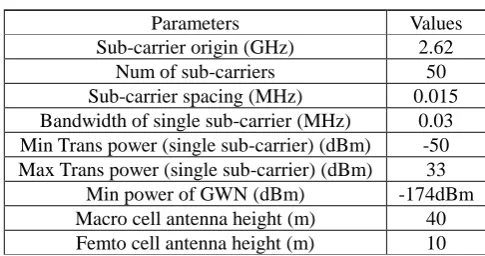
[image:5.595.175.418.620.748.2]To testify the performance of the proposed iterative algorithm, we consider a scenario of two-tier mobile system with 7 macrocell stations and a certain number of femtocell stations, as illustrated in Figure 1, which reveals the scenario of 5 femtocells per macrocell. The distance between adjacent macrocell stations is 200m, and the coverage radius of each femtocell station is 50m. A mobile station is allowed to be allocated up to 5 sub-carriers simultaneously. COST231-WI model [14] is utilized to simulate channel gains. Detailed simulation parameters are listed in Table 1.
Table 1. Sub-carrier and power parameters in simulation system. Parameters Values Sub-carrier origin (GHz) 2.62
Num of sub-carriers 50 Sub-carrier spacing (MHz) 0.015 Bandwidth of single sub-carrier (MHz) 0.03 Min Trans power (single sub-carrier) (dBm) -50 Max Trans power (single sub-carrier) (dBm) 33
Min power of GWN (dBm) -174dBm Macro cell antenna height (m) 40 Femto cell antenna height (m) 10
Table 2. User compositions of 4 simulation scenarios. Scenario
No.
Num of users per macro cell
Num of users per femto cell
Num of femtos per macro cell
Percentage of femto users ( )
1 10 4 5 66%
2 15 3 5 50%
3 20 2 5 33%
4 27 1 3 10%
For comparison, we also carry out the simulation based on a “traditional” power management algorithm under the same system scenarios, in which each mobile station independently adjusts its transmission power so that its SINR exactly reaches a default target value (40dB in our simulation).
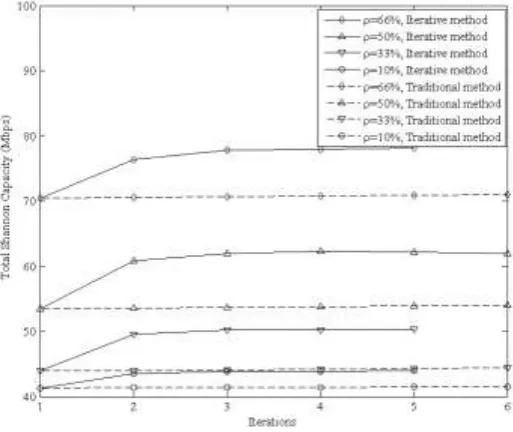
Figure 2. Total Shannon capacity vs. iteration times.
[image:6.595.166.423.238.454.2]The distributions of SINR acquired by the proposed iterative scheme after convergence are shown in Figure 3. It can first be noted that the distributions of macro user SINR under the 4 simulation scenarios differ little from each other. However, the difference becomes significant for femto users. In the proposed iterative scheme, SINR levels of femto users increase with their percentage due to less interferer from upper tier (macrocells) to the lower tier (femtocells). As revealed by our simulation result, the femto SINR levels go beyond their macro counterparts in 50% scenarios and vice versa. This is the key point of the Newton-Iteration algorithm that guarantees the maximization of system capacity.
For comparison, we plot the result of SINR acquired in the simulation of traditional scheme in Figure 4. In this figure we can see that, for lack of a smart optimization method, the mean levels of macro user SINRs in the traditional scheme are always lower than femto users regardless of , which certainly degrades overall network capacity especially in the 50% scenarios. In fact, for all 4 scenarios simulated, the overall system capacities obtained by the traditional scheme go below the iterative scheme (as seen in Figure 2.) mainly due to the unconstrained interference from lower tier to upper tier which draws down the macro user SINRs.
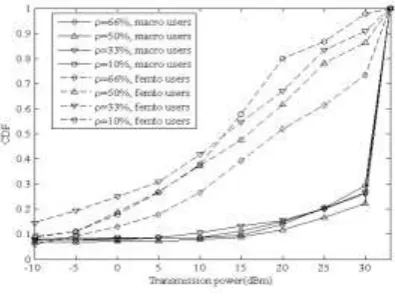
[image:7.595.313.515.73.233.2]Figure 5 plots the distributions of single sub-carrier transmission powers obtained in the 4 simulation scenarios by the proposed iterative scheme. Similar to Figure 3, the performance of macro user transmission powers show trivial differences by varying femto user percentages. However, the femto transmission powers are apparently lower than the macro users, which can be explained by their shorter transmission paths. On the other hand, the mean power value of femto users reduces with decrease of their percentage, which proves that the iterative scheme guarantees the maximization of total system capacity by allocating more powers to the tier with majority users.
[image:7.595.69.278.78.233.2]Figure 5. Distributions of transmission powers by iterative scheme.
Figure 6. Distributions of transmission powers by traditional scheme.
[image:7.595.75.273.488.637.2] [image:7.595.315.515.489.634.2]The distributions of transmission powers obtained by traditional scheme are shown in Figure 6, which indicates significant higher power consumptions for both macro users and femto users compared to iterative scheme. A typical example is the distribution of macro user powers under traditional power control method, which clearly shows that most of sub-carriers occupied by macro users should transmit at upper bound of powers to counteract the co-tier and inter-tier interference. To summarize, our proposed power allocation scheme dramatically helps to save energy and maximize overall system capacity simultaneously.
Conclusions
This paper introduces an iterative power allocation algorithm to be applied to two-tier cellular mobile network. The algorithm utilizes the basic theory of Newton Iteration, which helps to find the optimal power distribution scheme to reach the maximal system capacity. Simulation results show that, compared to the traditional power control scheme which independently adjusts each mobile user’s transmission power in order to reach a fixed SINR, the proposed scheme makes the most of unutilized system capacity, but the transmission powers of the mobile users are effectively reduced. The iterative power allocation scheme shows its most remarkable advantage over the traditional scheme when the femto users takes about 50% of the total cellular users within the system. Also, the convergence performance of the proposed scheme is pretty good.
Future research works include the improvement of fairness between upper- and lower- tiers, and design of a united optimization scheme which considers mobility management, resource management and power management. The complexity of the algorithm is also under further consideration.
References
[1] C. X. Wang, F. Haider, X. Q. Gao et al, Cellular architecture and key technologies for 5G wireless communication networks, J. IEEE Commun. Mag. 52 (2014) 122-130.
[2] .T. Zahir, K. Arshad, A. Nakata et al, Interference Management in Femtocells, J. IEEE Commun. Surveys & Tutorials, 15 (2013) 293-311.
[3] .E. Hossain, M. Rasti, H. Tabassum, et al, Evolution toward 5G multi-tier cellular wireless networks: an interference management perspective, J. IEEE Wireless Commun, 21 (2014) 118-127. [4] .M. Peng, C. Wang, J. Li et al, Recent advances in underlay heterogeneous networks: interference control, resource allocation, and self-organization, J. IEEE Commun. Surveys & Tutorials. 17 (2015) 700-729.
[5] .D. Lopez-Perez, I. Guvenc et al, Enhanced intercell interference coordination challenges in heterogeneous networks, J. IEEE Wireless Commun. 18 (2011) 22-30.
[6] .B. Soret, K. I. Pedersen, N. T. K. Jorgensen et al, Interference coordination for dense wireless networks, J. IEEE Mag.Commun. 53 (2015) 102-109.
[7] .V. N. Ha, L. B. Le, Distributed base station association and power control for heterogeneous cellular networks, J. IEEE Trans. Veh. Technol. 63 (2014) 282-296.
[8] .X. Kang, R. Zhang, M. Motani, Price-based resource allocation for spectrum-sharing femtocell networks: a Stackelberg Game approach, J. IEEE J. Sel. Areas Commun. 30 (2014) 538-549.
[9] .S. Bu, F. R. Yu, H. Yanikomeroglu, Interference-aware energy-efficient resource OFDMA-based allocation for heterogeneous networks with incomplete channel state information, J. IEEE Trans. Veh. Technol. 64 (2015) 1036-1050.
[11] J. Dai, S. Wang, J. Guo, Clustering-based interference management in densely deployed femtocell networks, C. IEEE/CIC ICCC Symposium on Wireless Networking and Multimedia, 2015. [12] F. Raisa, A. Reza, K. Abdullah, Advanced inter-cell interference management technologies in 5G wireless heterogeneous networks (HetNets), C. IEEE Student Conference on Research and Development (SCOReD), 2016.