ISSN: 1992-8645 www.jatit.org E-ISSN: 1817-3195
557
LINGUISTIC RULE-BASED TRANSLATION OF NATURAL
LANGUAGE QUESTION INTO SPARQL QUERY FOR
EFFECTIVE SEMANTIC QUESTION ANSWERING
NURFADHLINA MOHD SHAREF1, SHAHRUL AZMAN NOAH2, MASRAH AZRIFAH AZMI
MURAD3
1,2Intelligent Systems Research Group, Faculty of Computer Science and Information Technology, University of Putra Malaysia, Malaysia
1Knowledge Technology Group, Centre of Artificial Intelligence, Faculty of Technology and Information Science, National University of Malaysia
E-mail: [email protected], [email protected], [email protected]
ABSTRACT
Semantic question answering (SQA) demands different processing compared to the common information retrieval method because the semantic knowledge base is stored in the triples form. However, manipulating the knowledge requires understanding of its structure and proficiency in semantic query language such as SPARQL. Natural language interface (NLI) alleviates this by allowing user to input question in their human language. Then it produces an answer by translating the input into an equivalent SPARQL before it is executed to retrieve the answer. However, none of the existing research has presented a holistic computational model for the translation of NL question into an equivalent SPARQL for the semantic KB querying. Existing studies have focused mainly on the semantic disambiguation through consolidation where user interaction is initiated so that relevant concept can be chosen by the user to be inserted into the SPARQL. Besides, the linguistic understanding of the input has limited coverage where only one triple is constructed which loses many original expressions. There is a necessity to increase the linguistic understanding to involve multi-variables and multi-triples in the translated SPARQL so that accurate answer will be returned. Therefore, in this paper the linguistic challenge in NLI is addressed, specifically on the question complexity depth, processes that need to be performed to answer the question and gaps in existing study. A linguistic-rule-based translation model for natural language question is introduced that utilizes a set of observational variables to extract the information in the question; (i) checking if the focus is equals to subject, (ii) number of subjects, (iii) number of property, (iv) number of object, (v) checking if object is instance, (vi) checking if the question contains superlative expression, (vii) superlative orientation and (viii) checking if the question contains aggregates expression. The model is also aimed to reduce dependability on clarification dialogues. The results
show that the approach has managed to eliminate clarification dialogues and increase linguistic coverage of NLI.
Keywords: Semantic Question Answering, Natural Language Interface, Natural Language, SPARQL,
Semantic Search, Semantic Web
1. INTRODUCTION
Semantic web (SW) technologies offer potential enhancement in current knowledge-driven question answering (QA) systems [1]. The linked data initiative for instance offers huge resources of knowledge waiting to be tapped and queried. However, querying the so-called semantic-web enabled knowledge base (KB) requires the user to understand the formal query language such as the SPARQL Protocol and RDF Query Language
ISSN: 1992-8645 www.jatit.org E-ISSN: 1817-3195
558 The keyword-based method [3] has limited ability to link the semantic expression of the input with appropriate operations in SPARQL. For example the question ‘What is the longest river in Florida?’ where the expression ‘longest’ should be translated as the descending operation (‘DESC’) in the SPARQL query that refers to some concept ‘river’. In this case the keyword-based method is unable to map such natural language expression to the appropriate SPARQL aggregate expression. The CNL method on the other hand when posed with the same questions will iteratively checks the input and suggest list of words according to the content of KB. This inherently limits the input flexibility which require substantial amount of user interactions. Therefore, full NL input is the most convenient querying method [4].
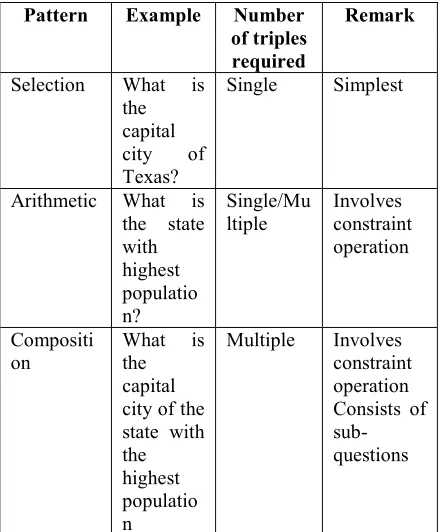
[image:2.612.80.300.458.724.2]However, full NL input incurs many challenges such as the ability to process the ambiguity inherited by the linguistic complexity in the question and the mapping of NL question with the KB structure. This is because question does not necessarily matches the structure of the knowledge in the SW data besides various complexity level of the NL input. NL input complexity (Sharef & Noah, 2013) can be divided into three patterns namely selection, arithmetic and composition as shown in Table 1.
Table 1: Natural Language Question Complexities
Pattern Example Number
of triples required
Remark
Selection What is the capital city of Texas?
Single Simplest
Arithmetic What is the state with highest populatio n?
Single/Mu ltiple
Involves constraint operation
Compositi on
What is the capital city of the state with the highest populatio n
Multiple Involves constraint operation Consists of sub-questions
The selection pattern is being addressed by most of the existing NLI because it is the easiest form of computation. The arithmetic question processing is handled in ORAKEL [6] but demands lots of customization to be reused because the linguistic argument structures are mapped to the relations in the KB [7]. FREyA [8] attempted arithmetic question processing by adopting clarification dialogues where user disambiguates the terms in their question according to the KB structure but to the cost of confused user and may lead to wrong answer. The compositional question processing has been attempted only in PowerAqua [9] however was not tested formally. Besides this, the technique used in the NL input to SPARQL query translation is mostly based on single triple (constituted by <subject, property, object>) rewriting which constraints the expression rewriting. Most NL-to-SPARQL translation techniques mainly focus on a specific pattern and ignore the other patterns.
Therefore, it is the interest of this research work to propose a technique which can be used for translating NL questions involving all the aforementioned three patterns. In this paper we introduce a NL-to-SPARQL translation model based on observational variables for deeper semantic question understanding consisting of:
(i) the focus of the question [10], (ii) the number and types of concepts
used, and
(iii) the constraint types.
For example, the NL question ‘What is the capital city of the state with the highest population?’, the proposed technique called MYAutoSPARQL will identify the ‘capital city’ as the focus, with ‘state’ as the subject, capitalOf as the object property and ‘population’ as datatype property. The ‘highest population’ will be identified as constraint. The MYAutoSPARQL translation model is tested on various NL input complexities and compared against FREyA [11]. FREyA is an NLI system that utilizes clarification dialogue so that the user can assist the system by disambiguating terms.
ISSN: 1992-8645 www.jatit.org E-ISSN: 1817-3195
559 section concludes the paper and presents future work.
2. EXISTING APPROACHES IN
SEMANTIC QUESTION
ANSWERING
Many research works on NL QA is based on information retrieval approach [12] which matches the content of the dataset in the corpus with the semantic-expanded keywords in the query. However, this does not guarantee that the answer is precise, as only matching document will be returned as results. Semantic web enabled KB querying through early NLI systems such as Querix [13], NLPReduce [14] and ORAKEL [7] allow limited NL question construction indicated by questions that begin with ‘What’, ‘Which’, ‘How Many’ and ‘Does’. This approach clearly constraints the expressiveness of semantic questions.
In order to allow semantic concepts querying, SemSearch [15] implements a Google-like Question Interface. However, SemSearch requires a list of concepts (e.g., classes, instances) as an input and separated by colon. Although this method reduces ambiguity problem in processing the question, this indicates that the user of SemSearch needs to have some knowledge on the schema of the KB. Besides, more flexible and expressive question input should be provided.
Improved NL input flexibility is processed by AquaLog [2] and PowerAqua [9] by dynamically identifying around 14 different question categories so that the system can process the solution. The categories include basic NL input requiring an affirmation/negation or a description as an answer; or the big set of queries constituted by a wh-question, where the relation is implicit or unknown or where no information about the type of the expected answer is provided. NL input that have two explicit relationships between terms such as containing conjuction or auxiliary verb, and a query can be a composition of two basic questions are also processed. In this case, the intermediate representation usually consists of two triples, one triple per relationship. The answer generation is driven by the triple categories and combination of the triples. However, identification of the NL input type is not always sufficient to find answers such as losing the main focus in the question.
FREyA [10] combines the syntactic parsing output of the question with heuristic rules in order to find the focus and the answer type. The focus is identified using syntactic parsing while the answer type is identified based on detection of the first ontology concept (FOC) in the question; whether a class or datatype property type. If the FOC refers to an object property, consolidation is performed with the domain or range of the classes of the object property, while if the FOC refers to an instance, consolidation is performed with a class of that instance. Besides the identification of question focus and answer type, the linguistic triples in the NL input are extracted [9,11]. The candidate triples are disambiguated in order to form semantic triples. Several approaches were adopted for this purpose such as utilizing string similarity matching, WordNet, lexicon and clarification dialogue. While the first three aims for automation, the fourth is executed to let user to choose the closest ontology concept that represents his intention. Users are involved to disambiguate their intention (i.e., when the relation is implicit or unknown or unclear) guided by confidence score (frequency of the suggestion being chosen). However, clarification dialogue is only efficient if the users have some background knowledge on the ontology scheme. Otherwise, it may be confusing to be used. Furthermore, correct result may not be reached if the interaction with the dialogue has lead towards wrong navigation and could not be answered by the reasoning engine.
ISSN: 1992-8645 www.jatit.org E-ISSN: 1817-3195
560 More recent research works for NLI have emphasized on the deep analysis of the queries and the techniques involved to translate the NL question into a SPARQL compliance [11,16–18]. Most approaches rely on the linguistic triple identification (subject, predicate and object) besides identifying answer entity type as class, data property, object property, annotation, axiom, instance and entity location in the ontology. The linguistic triple is then translated as a single triple in the SPARQL syntax before it is reasoned by the NLI engine to generate the correct answer. However, relying on linguistic triples identification is insufficient because of the complexity in the NL question patterns. This is due to the ambiguity issue to match the detected linguistic triples with the matching ontology triples and the composite question which contains information indicating constraints such as the FILTER expression, arithmetic operation (e.g, COUNT, SUM, etc.), comparative process (e.g, sort descending and ascending), and negation (e.g, outside, not, besides, etc.).
[19] proposed composite questions to be decomposed into atomic (simpler) ones so that they can be answered directly using existing QA capabilities. The final answer is generated by combining results from the atomic questions computation corresponding to the question type. Three facets are introduced; answer format, answer theme, and question qualifier, to characterize the questions and prescribing system functionality accordingly. The answer format has four possible values: single, multiple, descriptive, and yes/no. The answer theme is the class of the object sought by the question, such as PERSON, LOCATION, and DATE. The question qualifier indicates the semantic or pragmatic nature of a question and requires corresponding operations such as specification, superlative, ordering, definition, reason, method, comparison, negation, report and analysis. However, this paper is not tailored to semantic QA although the composite question characterization theory is very beneficial in classifying questions according to their complexity.
A variant of NL input complexity classification [20] emphasizes the number of triples and variables that are required to answer the question. There are four fact-oriented classes proposed namely Type 1: Single variable and single triple, Type 2: Multiple variables and single triple, Type 3: Single variable and multiple triples and Type 4: Multiple variables
and multiple triples. However, the scope of their work covers only query Type 1 and 3.
In this paper we present a method that can process questions of Type 1, Type 2, Type 3 and Type 4. Based on our preliminary work [5] on SPARQL construction for question answering, the methods that depend on the answer type solely are not sufficient in ensuring the coverage of the translated SPARQL from the question. This is because most of the translator system generates the SPARQL by utilizing the mapped identified predicate to the candidate properties from the ontology (typically the candidate properties are identified based on the loaded properties shared between the class of the subject and the class of the object). In fact, more than one property can be involved and this scenario is more prominent when composite queries such as those involving constraint expressions.
We also focus on the automation of disambiguation in our NL-to-SPARQL translation model by adding a set of observational variables. Our model enriches the existing question processing variables i.e., question focus, answer type and linguistic triples. We provide a deeper mining on the relationship among each of the variables, and do not restrict the linguistic triples to be in the standard <subject,predicate,object> form. Rather, we annotate the NL question according to possible ontology matching and form the linguistic triples and subtriples (when necessary). This means we process more than one class and property, which may also result to multi-triples. In the next section we describe the challenges in NL to SPARQL translation that can cover all four fact-oriented NL input types followed by a section on the translation model.
3. CHALLENGES IN TRANSLATING
NATURAL LANGUAGE QUESTION INTO SPARQL QUERY
We focus on the fundamental challenges in translating an NL question into its equivalent SPARQL under the question complexity perspective and semantic ambiguity in input-ontology mapping. This paper addresses these challenges through the translation model presented in the next section.
3.1 Question Complexity
ISSN: 1992-8645 www.jatit.org E-ISSN: 1817-3195
[image:5.612.95.293.190.326.2]561 needed. The type of questions can be characterised by three facets [19] namely answer format, answer theme, and question qualifier (as shown in Figure 1). However, [19] method is more suited to information retrieval based QA and is not enriched by the semantic representation.
Figure 1: Conceptual Space with Three Facets for Question Types [19]
[image:5.612.88.304.520.702.2]Figure 2 shows the perspective on question complexity consideration for semantic QA or NLI which covers four aspects namely the focus of the question, the depth of the question, the answer type and the operation needed in answering the question. The focus of a question can either be a class, a property, or an instance in the ontology. Identifying the focus is important to return a precise answer and also to manipulate the content of the ontology. The depth of the question determines the number of triples needed in answering the question.
Figure 2: Perspective on Question Complexity
Despite various question categorization methods in a semantic QA the triples determines whether the information requirement expressed in the question has been captured properly. The answer type determines the final answer to the question, such as a list of matching pattern based on the constructed SPARQL, a definition or affirmative answer. The operations needed to obtain the answer can generally be identified by detecting a vocabulary of indicative expressions; however the accuracy of the answer depends on the correct positioning of the operator amongst the triple.
3.1.1 Focus
The focus of the question indicates the most important variable that drives the translation of the input into triples to generate the final answer. The focus used in this paper is also known as the answer type in previous existing similar works [11]. The focus is identified based on the first encountered ontology concept. However, linguistic triple and focus are only sufficient for the computation of direct questions; which does not involve any constraint expressions.
There are three types of focus that relates to the kind of concepts needed as the answer namely class, property and instance. It is also identified based on the nearest encountered ontology concept to the question header. For example, in ‘What is the capital of Texas?’, the focus is ‘capital’. Once the linguistic triples are identified (in this case <?, capital, texas>, the connected properties between the focus and the linguistic property are loaded, resulting to ‘capitalOf’. Then, the triple can be constructed to generate the answer to the question.
3.1.2 Question depth
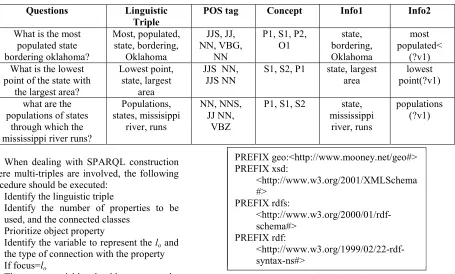
The depth of a question can be categorised according to the number of triples needed to produce the answer. The selection-typed question indicates that only one triple or a maximum of one variable is used in one triple needed in the translation. A more challenging scenario exists when dealing with composite questions that involve multi-triple and multi-variables. A composite question is processed by decomposing the original questions into atomic units, by either identifying the number of annotated concepts, utilizing conjunction tags (<IN>) and/or constraint expressions. Table 2 shows the variants of composite questions pattern. From the detected linguistic triple and the tagged POS the concepts are detected. These are then Focus
- Class
- Property - Instance
Answer Type
- List
- Definition - Affirmation
Question Depth
- Single
- Composite
Operation
- Superlative
ISSN: 1992-8645 www.jatit.org E-ISSN: 1817-3195
562 manipulated to detect the information needs denoted by info1 and info2.
Table 2: Composite Questions
Questions Linguistic
Triple
POS tag Concept Info1 Info2
What is the most populated state bordering oklahoma?
Most, populated, state, bordering,
Oklahoma
JJS, JJ, NN, VBG,
NN
P1, S1, P2, O1
state, bordering, Oklahoma
most populated<
(?v1) What is the lowest
point of the state with the largest area?
Lowest point, state, largest
area
JJS NN, JJS NN
S1, S2, P1 state, largest area
lowest point(?v1)
what are the populations of states
through which the mississippi river runs?
Populations, states, missisippi
river, runs
NN, NNS, JJ NN,
VBZ
P1, S1, S2 state, mississippi
river, runs
populations (?v1)
When dealing with SPARQL construction where multi-triples are involved, the following procedure should be executed:
1. Identify the linguistic triple
2. Identify the number of properties to be used, and the connected classes
3. Prioritize object property
4. Identify the variable to represent the lo and
the type of connection with the property 5. If focus=lo
6. The same variable should represent the same class, despite its connection as domain or range
[image:6.612.104.559.133.407.2]The challenge to automatically decompose the question into its sub-question increases when there are more than one aggregate expressions used, such as shown in Figure 3 where three triples are created so that each answers the sub-questions; (i) the smallest state, (ii) the capital of the smallest state, (iii) the population of the capital of the smallest state. Although the predicate can be identified from the question, challenge arises in arranging the triple according to their concepts connectivity. The focus of the question is also important because the aggregation operator is activated by the variable that represents the focus.
Figure 3: SPARQL query for ‘what is the population of the capital of the smallest state?’
A deeper analysis of the question needs to be performed for questions that contain comparative expression. Figure 4 shows the SPARQL syntax for the question ‘which states have points higher than the highest point in Colorado?’ where there are two information needed; info1=highest point in Colorado; and info2= states have points higher than info1. Therefore the identification of the observational linguistic triples should be done by first breaking the questions and then merging them according to the connecting property, in this case the comparison of variable ?e and ?z while the focus is ?s.
PREFIX geo:<http://www.mooney.net/geo#> PREFIX xsd:
<http://www.w3.org/2001/XMLSchema #>
PREFIX rdfs:
<http://www.w3.org/2000/01/rdf-schema#>
PREFIX rdf:
ISSN: 1992-8645 www.jatit.org E-ISSN: 1817-3195
[image:7.612.91.301.73.236.2]563
Figure 4: SPARQL Query For ‘Which States Have Points Higher Than The Highest Point In Colorado?’
3.1.3 Answer type
The answer type indicates the form of generated answer; be it list, definition or affirmation. The user friendliness of a QA system can be increased by utilizing NL generation technique where complete grammatical sentence can be returned along as the answer from the reasoned SPARQL query.
3.1.4 Operation
The NL questions that require negation and arithmetic operations such as comparative, superlative, and aggregation can generally be classified by the occurrence of the relevant expressions. Negation can be represented by the expressions such as ‘not’, ‘outside’, and ‘except’ while the comparative operation can be detected by the occurrence of the tagged part-of-speech pattern <JJR><IN> which parses fragments such as ‘larger than’, while the identification of superlative expression is by detecting the <JJS> tag.
The superlative verb lexicons such as ‘largest’, ‘smallest’, ‘greatest’, and ‘biggest’ can be stored to represent its orientation i.e., the orientation of ‘largest’, ‘greatest’ and ‘biggest’ is descending while for ‘smallest’ is ascending. The superlative verb lexicons are paired with the matching ontology property. Question identifier such as ‘How many’ and ‘How much’ which is tagged by <WHADP> or <JJ> indicates a quantification expression that requires the ‘COUNT’ operation while the ‘SUM’ operation is indicated by expressions such as ‘combination of’ and ‘sum of’.
3.2 Semantic Ambiguity in Input-Knowledge Base Mapping
The semantic ambiguity exists mainly due to the linguistic variance of terms used by the user in the NL question which may result to two issues; (i) indirect matching terms with the KB content and (ii) implicit needs of ontology concepts. Both issues affect the relevance of generated SPARQL query and returned answer because correct translation really depends on whether the information is represented in the KB.
In order to solve the first issue standard KB naming should be practised to make sure the translated SPARQL query is very close to the original NL question. This is a pressing problem especially in the concept annotation task which is among the crucial process in the NL-to-SPARQL translation because it provides information on the type of the ontology concepts required in the question. String matching formula and WordNet can also be used to obtain the most similar matching concepts. Clarification dialogues [9,11] has also been used where the user choose the recommended ontology concepts. For example, in the question ‘How many citizens live in Alabama?’ where the detected property ‘live’ has no direct match in the ontology. The correct concept to use in this case is ‘statePopulation’.
The second issues relates to ambiguous KB concept issue when in the NL question there is no occurrence of concept property so the NL-to-SPARQL translation model needs to disambiguate the necessary concepts which may lead to more multiple properties or multiple classes. For example in the question ‘what is the longest river in the US?’ the detected linguistic triple is <river, ?, ?> where the correct property name, ‘length’ cannot be detected directly and in ‘What state has the highest elevation?’ where the correct properties are ‘isHighestPointOf’ and ‘hiElevation’. In this situation there are two are possible solutions; utilizing an internal vocabulary or interacting with the user to choose closest matched property through clarification dialogue. Besides this, increased automation can be provided by loading the properties shared by the question focus and the detected linguistic triples.
4. TRANSLATING NATURAL
LANGUAGE QUESTION TO SPARQL
QUERY FOR SEMANTIC QUESTION
ANSWERING PREFIX geo:<http://www.mooney.net/geo#>
PREFIX xsd:
<http://www.w3.org/2001/XMLSchema #>
PREFIX rdfs:
<http://www.w3.org/2000/01/rdf-schema#>
PREFIX rdf:
<http://www.w3.org/1999/02/22-rdf-syntax-ns#>
PREFIX afn:
ISSN: 1992-8645 www.jatit.org E-ISSN: 1817-3195
564 The NL-SPARQL translation process consists of several steps starting from the identification of variables in the NL question, mapping the variables with the ontology concepts and arranging the mapped variables in a logical SPARQL syntax. The basic variables are the linguistic triple which is a set of potential ontology concepts identified from the tokenized and parsed NL question. However, this information is insufficient especially when more complex question patterns are input. This is also the main factor of NLI limitation to date. Therefore, in this section we present the variables and rules for NL to SPARQL translation.
4.1 Variables for Natural Language Question to SPARQL Query Translation
We use the Stanford DependenSee parser to transform the NL into their part-of-speech constituents. Then we match each of the noun phrases in the branch with the ontology concept and perform concept annotation. For example, in the question ‘How many states does the Colorado river run through?’ taken from the Mooney’s Geography NL query, ‘state’ and ‘river’ are annotated as class, ‘Colorado’ as instance of river and ‘runsThrough’ as object property. These are used to identify the linguistic triple based on the sequence of detected concept. This will generate three variables namely identifiedSubject (ls), identifiedPredicate (lp) and
identifiedObject (lo). The linguistic triples is
<state, Colorado, run> while the focus is ‘state’. The linguistic triples are then disambiguated to obtain the matching ontology triples resulting to ts, to and tp. However, this information is
insufficient to capture the whole expression in the original question and to translate to an equivalent SPARQL query.
We introduce eight observational variables to broaden the translator coverage namely classOfFocus (cf), classTypeOfObject (co) and
classTypeOfSubject (cs) identified by finding the
class of the closest matching namespace of the focus, ls and lo in the ontology. The arithmetic
typed questions are benefited from the hasSuperlativeExp and orientationIs variables which represent the orientation of the expression which is useful to know the type of sorting function to be inserted in the SPARQL syntax. The hasCount (example expression is ‘how many’) and hasSum (example expression is ‘total
of’) are introduced to represent expressions indicating aggregation function.
However, the ls, lp,lo, cs, co, focus,
hasSuperlativeExp, orientationIs, hasCount and hasSum variables are insufficient to process the translation of composite questions. These variables are useful when the ontology concepts can be mapped directly with the identified variables and they are limited to question that is translated to single triple (and with up to 3 variables) only. This is because these variables neglect the representation of multiple ontology concepts and their connections. For example in the question ‘which states have points higher than the highest point in colorado?’, these variables can only represent one property namely ‘isHighestPointOf’ and missed out ‘hiElevation’. Therefore we introduce isCompositeQuestions which is assigned a Boolean value of ‘true’ when more than one conjunction is detected and when more than two types of concepts are detected in the question. The hasComparativeExp variable is assigned a Boolean value of ‘true’ when the ‘than’ keyword is detected in the question. The comparative values are also observed to be assigned in the SPARQL query. The hasNegationExp variable is introduced to denote that the question contains negation expression. The parameters that involve negation are tracked to be assigned in the SPARQL query. In the next section we present the issues related to the automatic translation of composite NL question.
4.2 Rules for Natural Language Question
to SPARQL Query Translation
4.2.1 Natural language questions linguistic pattern
In this section we present twelve linguistic patterns of NL. The linguistic-based question understanding depends on the patterns In each case the characteristics of each pattern is described followed by the template that comply with the pattern (shown in the first column in every tables), followed by example of compliant question. The section is divided into two sections; for single triple and multi-triples.
4.2.1.1 Single triple.
Pattern 1-the focus is a property value and controlled by the sorting operation
ISSN: 1992-8645 www.jatit.org E-ISSN: 1817-3195
565 area of the largest state?’, where ‘area’ can be considered as an object property. The ls, lp, and cs
are known while lo is unknown. This type of
question is represented by the following template as SPARQL statement. The ORDER BY DESC operator is used to filter the answer to this question.
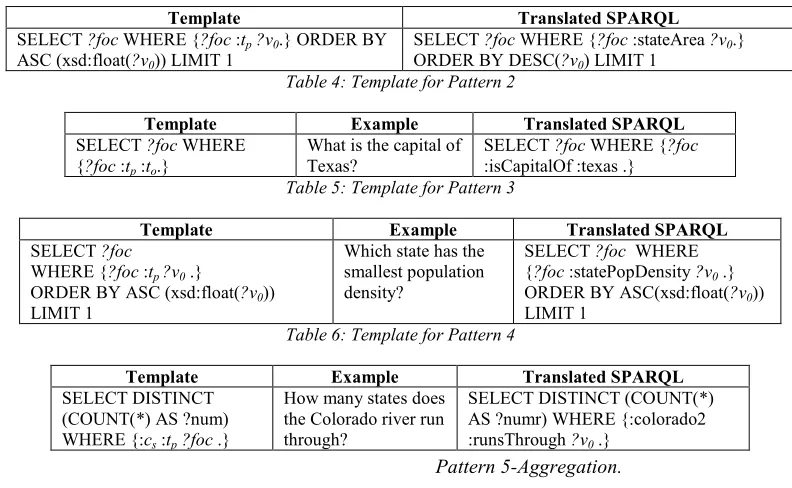
Pattern 2- focus is a class, and the answer is controlled by specified property and subject. Pattern 2 illustrates the linguistic pattern of NL question that has a class as its focus and the answer is controlled by specified property and subject, as shown in Table 4. For example, in ‘What is the capital of Texas?’, a specific instance, lo=texascan beidentified. The lp in the
triple is replaced by highest matching score loaded based on the properties connected to the co andthe lpdetected in the question. Since in this
example the focus is a class and it is the domain of the lp, focus is positioned as the subject of the
triple.
Pattern 3-Focus is a class and the answer is controlled by the operation of the property. Since only one class is detected and a numeric expression is detected with orientation ascending, the datatype properties that are connected to the class are loaded. The closest
matched property to the lp is identified by
executing similarity matching function. The suitable property (tp) is detected by loading the
properties connected to the ls. The variables in
the SPARQL are (i) the answer, denoted by focus (?foc); in this example the focus is equal to the subject and (ii) the assignment of the range of the datatype property. Table 5 shows the translation template for Pattern 3.
Pattern 4-Aggregate function .
An aggregate function is detected by the phrase ‘how many’. The focus of the question is defined by the concept that needs to be aggregated. The rest of the SPARQL construction is performed by identifying the ls, lp and lo. In the example
shown follows 4 linguistic triples are detected which are ‘state, colorado, river, run through’. The focus of the question is ‘state’ and a specific instance for the ‘river’ object is given, namely ‘colorado’. Therefore, to compute the aggregate function for the state, the namespace of ‘colorado’ as a river is obtained and inserted in the SPARQL query together with the property that matches the lp with the highest score (Table
6)
.
Table 3: Template for Pattern 1
Template Translated SPARQL
SELECT ?foc WHERE {?foc :tp?v0.} ORDER BY ASC (xsd:float(?v0)) LIMIT 1
[image:9.612.106.502.443.687.2]SELECT ?foc WHERE {?foc :stateArea ?v0.} ORDER BY DESC(?v0) LIMIT 1
Table 4: Template for Pattern 2
Template Example Translated SPARQL
SELECT ?foc WHERE {?foc :tp :to.}
What is the capital of Texas?
SELECT ?foc WHERE {?foc
:isCapitalOf :texas .}
Table 5: Template for Pattern 3
Template Example Translated SPARQL
SELECT ?foc
WHERE {?foc :tp ?v0 .} ORDER BY ASC (xsd:float(?v0)) LIMIT 1
Which state has the smallest population density?
SELECT ?foc WHERE {?foc :statePopDensity ?v0 .} ORDER BY ASC(xsd:float(?v0)) LIMIT 1
Table 6: Template for Pattern 4
Template Example Translated SPARQL
SELECT DISTINCT (COUNT(*) AS ?num) WHERE {:cs :tp?foc .}
How many states does the Colorado river run through?
SELECT DISTINCT (COUNT(*) AS ?numr) WHERE {:colorado2 :runsThrough ?v0 .}
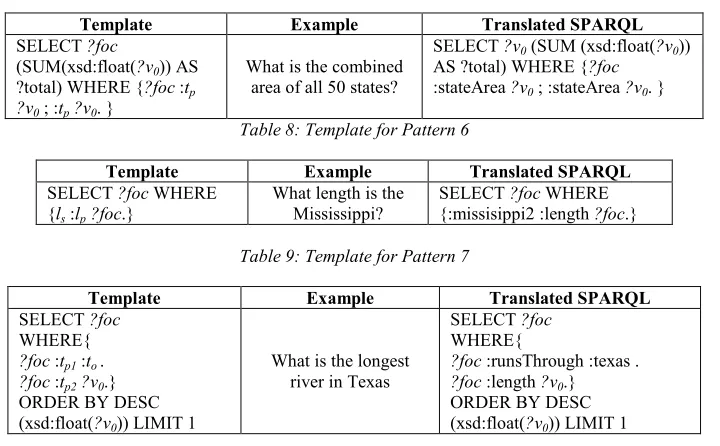
Pattern 5-Aggregation.
ISSN: 1992-8645 www.jatit.org E-ISSN: 1817-3195
566 linguistic triples detected are lp=area and ls=state.
Table 7 shows the template for Pattern 5.
Pattern 6-Ambiguity of object name.
In this pattern the focus is a datatype property value. The correct disambiguated linguistic triple is lo=mississippi and lp=length. The co=state with
the namespace ‘mississippi2’. Therefore the triple is arranged by highlighting the value of the ‘length’ as the answer type, as shown in Table 7.
Table 7: Template for Pattern 5
Template Example Translated SPARQL
SELECT ?foc
(SUM(xsd:float(?v0)) AS ?total) WHERE {?foc :tp
?v0 ; :tp?v0. }
What is the combined area of all 50 states?
SELECT ?v0 (SUM (xsd:float(?v0)) AS ?total) WHERE {?foc
[image:10.612.129.489.204.427.2]:stateArea ?v0 ; :stateArea ?v0. }
Table 8: Template for Pattern 6
Template Example Translated SPARQL
SELECT ?foc WHERE {ls :lp?foc.}
What length is the Mississippi?
SELECT ?foc WHERE {:missisippi2 :length ?foc.}
Table 9: Template for Pattern 7
Template Example Translated SPARQL
SELECT ?foc
WHERE{
?foc :tp1 :to.
?foc :tp2?v0.} ORDER BY DESC (xsd:float(?v0)) LIMIT 1
What is the longest river in Texas
SELECT ?foc WHERE{
?foc :runsThrough :texas .
?foc :length ?v0.} ORDER BY DESC (xsd:float(?v0)) LIMIT 1
4.2.2.2 Multi-triples
Pattern 7-Focus is a class and the answer is controlled by the operation on the property connected with a specified subject.
An implicit tp is detected and added to the
SPARQL by loading the concepts connected with the class of specified subject. In this pattern only ls and lo are detected. The correct properties
cannot be detected directly from the linguistic triple. In the example ls=river and to=texas,
therefore cs=river and co=state. The question also
contains a numerical expression with orientation ascending. Because of this, the datatype properties connected to the cs is loaded, leading
to the identification of tp=‘length’. However, the
‘length’ property is connected to ‘river’ as its domain and ‘float’ as its range. Since ‘texas’ is not represented as an instance of the ‘river’ class, the object properties that is connected to ‘river’
as a domain are loaded, leading to ‘runThrough’ and ‘hasRiver’. However, in the ontology used as example, ‘hasRiver’ is ignored because it is never used in the ontology; instead, ‘runThrough’ which is its inverse is used majorly. Therefore, the ‘length’ is tp1 and another
triple is created that use ‘runThrough’ as its property (tp2), and ‘texas’ is assigned as the to;
where the triple is <?foc :runsThrough :texas> and the second is <?foc :length ?v1>. The ?v0
variable is to denote the focus of the question while ?v1 denotes the length of the river. The ‘ORDER BY’ and ‘LIMIT 1’ operation are also appended to allow the computation of the longest ?v1as shown in Table 9.
Pattern 8-Identification of implicit property and no specified subject.
ISSN: 1992-8645 www.jatit.org E-ISSN: 1817-3195
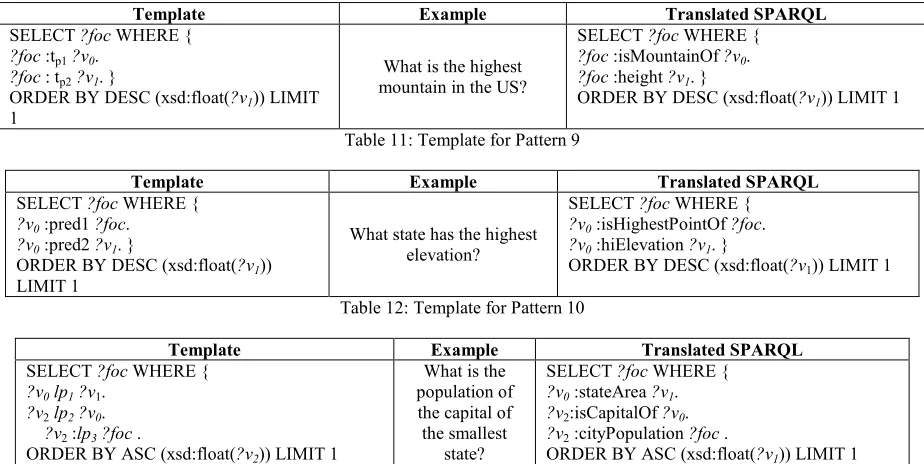
567 is controlled by the operation performed on the value of datatype property. Therefore the datatype property that is connected to ‘mountain’ is loaded, which is ‘height’. However, since the answer requires a class, the object property that is linked to the class of focus is loaded, in this example ‘isMountainOf’. Table 10shows the template for Pattern 8.
Pattern 9-Identification of implicit class and property.
This pattern illustrates usage of two classes; one explicit and another implicit. The focus is ‘state’ and the answer is controlled by ‘the highest elevation’. The detected linguistic triples is ls=state and lp=hiElevation. Although the usage
of ‘hiElevation’ as the property to be used complies with the previous analysed patterns, here the answer type cannot be detected from the triple generated from this property only. The challenge in this pattern is that the method used in the previous patterns is not suitable because the cs is not connected directly to lp. Instead, two
triples are needed where the domain of the most matching property name with lp is ‘HiPoint’. The
‘HiPoint’ class is connected to the ‘State’ class
by an object property called ‘isHighestPoint’. Therefore, the first connecting triple that utilizes ‘isHighestPoint’ is added in the SPARQL query (Table 11); and the algorithm should be generalized to extend into the detection of the connecting triple.
Pattern 10-Composite question.
The focus in this pattern is a property. This pattern as shown in Table 12 is an example of a composite query because multi-triple is involved. The detected linguistic triples are lp1=population,
lp2=capital and ls=state. However, this
information is insufficient to aid in building the equivalent SPARQL query to the original question. The question requires three triples:
w=ASC(stateArea(x)) LIMIT 1,
y=isCapitalOf(x), z=statePopulation(x) where x denotes the ‘state’, w denotes the stateArea of x, y denotes the ‘capital of x’ and z denotes the ‘population of state x’. To compute this question the following steps should be used: (i) create a triple based on the detected predicates which generates <?v0 :statePopulation ?v1> and <?v2
:isCapitalOf ?v0> (ii) create a triple that answers
the ‘smallest state’ expression will generates <?v0 :stateArea ?v3 ORDER BY (DESC(?v3))>.
Table 10: Template for Pattern 8
Template Example Translated SPARQL
SELECT ?foc WHERE {
?foc :tp1?v0.
?foc : tp2?v1. }
ORDER BY DESC (xsd:float(?v1)) LIMIT 1
What is the highest mountain in the US?
SELECT ?foc WHERE {
?foc :isMountainOf ?v0.
?foc :height ?v1. }
[image:11.612.75.537.454.686.2]ORDER BY DESC (xsd:float(?v1)) LIMIT 1
Table 11: Template for Pattern 9
Template Example Translated SPARQL
SELECT ?foc WHERE {
?v0 :pred1 ?foc.
?v0 :pred2 ?v1. }
ORDER BY DESC (xsd:float(?v1)) LIMIT 1
What state has the highest elevation?
SELECT ?foc WHERE {
?v0 :isHighestPointOf ?foc.
?v0 :hiElevation ?v1. }
ORDER BY DESC (xsd:float(?v1)) LIMIT 1
Table 12: Template for Pattern 10
Template Example Translated SPARQL
SELECT ?foc WHERE {
?v0lp1?v1.
?v2lp2?v0.
?v2 :lp3?foc .
ORDER BY ASC (xsd:float(?v2)) LIMIT 1
What is the population of the capital of the smallest
state?
SELECT ?foc WHERE {
?v0 :stateArea ?v1.
?v2:isCapitalOf ?v0.
?v2 :cityPopulation ?foc .
ISSN: 1992-8645 www.jatit.org E-ISSN: 1817-3195
568 Pattern 11-Comparative operation.
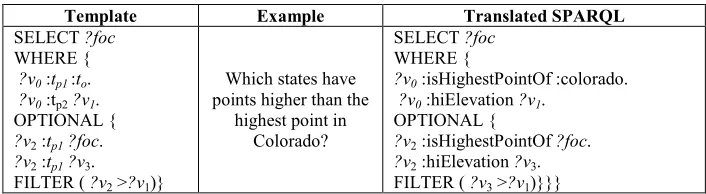
The pattern is another example of composite query but more challenging than the previous pattern because it involves the combination of constraints and has several multi-triples and multi-variables. From the question the detected linguistic triples are ls1=state, ls2=point and
lo=colorado. However, these linguistic triples are
insufficient to translate the question into its equivalent SPARQL, mainly because the question demands a constraint operator, in this example the expression indicating the necessity of constraint is ‘higher than’ and there is a specification to perform comparison given by the expression ‘the highest point in colorado’. The question requires three triples: x=isHighestPointOf(colorado) which represents the expression ‘the highest point in colorado’, y=hiElevation(x) which represents the expression ‘height of the highest point in colorado’; but cannot be detected directly from the question, b=isHighestPointOf(a) and c=hiElevation(b)
where a denotes the ‘state’, b denotes the highest point of a state, a, while c denotes the ‘high elevation (height) of b’. A comparative function namely ‘FILTER’ is used which can compare the value of c and y so that the correct answer can be computed. Table 13 shows the template of Pattern 11 translation.
Pattern 12-Negation.
This pattern illustrates negation expression in the NL question, which can be identified by ‘do not’. To process this question the negation expression is first removed from the question and the equivalent SPARQL is constructed. Then, the term that is connected to the negation operator, in this example ‘lake’ is detected. The variable that represents ‘lake’ is also identified. The negation statement is then inserted in the form of ‘FILTER(!bound(negationVar))’; as in Table 14.
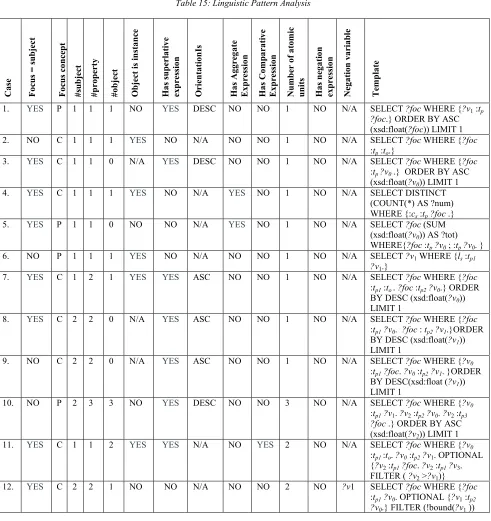
The summarised linguistic patterns are shown in
[image:12.612.129.482.418.515.2]Table 15.
Table 13: Template for Pattern 11
Template Example Translated SPARQL
SELECT ?foc
WHERE {
?v0 :tp1 :to.
?v0 :tp2 ?v1. OPTIONAL {
?v2 :tp1?foc.
?v2 :tp1?v3.
FILTER ( ?v2 >?v1)}
Which states have points higher than the
highest point in Colorado?
SELECT ?foc
WHERE {
?v0 :isHighestPointOf :colorado.
?v0 :hiElevation ?v1. OPTIONAL {
?v2 :isHighestPointOf ?foc.
?v2 :hiElevation ?v3. FILTER ( ?v3 >?v1)}}}
Table 14: Template for Pattern 12
Template Example Translated SPARQL
SELECT ?foc WHERE {
?foc :tp1?v0.
OPTIONAL{?v1 :tp2?v0.} FILTER (!bound(?v1 ))
Show the bordering states of the states that
do not have any lake
SELECT ?foc WHERE {
?foc :borders ?v0.
OPTIONAL{?v1 :isLakeOf ?v0.} FILTER (!bound(?v1))
ISSN: 1992-8645 www.jatit.org E-ISSN: 1817-3195
[image:13.612.63.554.96.617.2]569
Table 15: Linguistic Pattern Analysis
C a se F o cu s = s u b je ct F o cu s co n ce p t # su b je ct # p ro p er ty # o b je ct O b je ct i s in st a n ce H a s su p er la ti v e ex p re ss io n O ri en ta ti o n Is H a s A g g re g a te E x p re ss io n H a s C o m p a ra ti v e E x p re ss io n N u m b er o f a to m ic u n it s H a s n eg a ti o n ex p re ss io n N eg a ti o n v a ri a b le T em p la te
1. YES P 1 1 1 NO YES DESC NO NO 1 NO N/A SELECT ?foc WHERE {?v1 :tp
?foc.} ORDER BY ASC (xsd:float(?foc)) LIMIT 1 2. NO C 1 1 1 YES NO N/A NO NO 1 NO N/A SELECT ?foc WHERE {?foc
:tp :to.}
3. YES C 1 1 0 N/A YES DESC NO NO 1 NO N/A SELECT ?foc WHERE {?foc
:tp ?v0 .} ORDER BY ASC (xsd:float(?v0)) LIMIT 1 4. YES C 1 1 1 YES NO N/A YES NO 1 NO N/A SELECT DISTINCT
(COUNT(*) AS ?num) WHERE {:cs :tp?foc .} 5. YES P 1 1 0 NO NO N/A YES NO 1 NO N/A SELECT ?foc (SUM
(xsd:float(?v0)) AS ?tot) WHERE{?foc :tp?v0 ; :tp?v0. } 6. NO P 1 1 1 YES NO N/A NO NO 1 NO N/A SELECT ?v1 WHERE {ls :tp1
?v1.}
7. YES C 1 2 1 YES YES ASC NO NO 1 NO N/A SELECT ?foc WHERE {?foc
:tp1 :to. ?foc :tp2?v0.} ORDER BY DESC (xsd:float(?v0)) LIMIT 1
8. YES C 2 2 0 N/A YES ASC NO NO 1 NO N/A SELECT ?foc WHERE {?foc
:tp1?v0. ?foc : tp2?v1.}ORDER BY DESC (xsd:float(?v1)) LIMIT 1
9. NO C 2 2 0 N/A YES ASC NO NO 1 NO N/A SELECT ?foc WHERE {?v0 :tp1?foc. ?v0 :tp2?v1. }ORDER BY DESC(xsd:float (?v1)) LIMIT 1
10. NO P 2 3 3 NO YES DESC NO NO 3 NO N/A SELECT ?foc WHERE {?v0 :tp1?v1. ?v2 :tp2?v0. ?v2 :tp3
?foc .} ORDER BY ASC (xsd:float(?v2)) LIMIT 1 11. YES C 1 1 2 YES YES N/A NO YES 2 NO N/A SELECT ?foc WHERE {?v0
:tp1 :to. ?v0 :tp2?v1. OPTIONAL {?v2 :tp1?foc. ?v2 :tp1?v3. FILTER ( ?v2 >?v1)} 12. YES C 2 2 1 NO NO N/A NO NO 2 NO ?v1 SELECT ?foc WHERE {?foc
:tp1?v0. OPTIONAL {?v1 :tp2
ISSN: 1992-8645 www.jatit.org E-ISSN: 1817-3195
570
4.2 Translation Model for Natural
Language Question to SPARQL Query
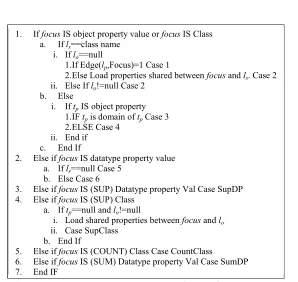
A NL-to-SPARQL translator called MYAutoSPARQL is built which is comprised of
[image:14.612.90.548.173.321.2]three processes namely preprocessing, variables initialisation and semantic mapping. Figure 5 shows MYAutoSPARQL architecture. The rules for the translator is shown in Figure 6 and the template for the SPARQL is shown in Table 16.
Figure 5. MYAutoSPARQL Architecture
Figure 6: NL-to-SPARQL Translation Rules
Variables Initialisation Pre-processing
Natural Language
Question Syntactic
Parsing
Concept Annotation
Linguistic Triple Identification and
Refinement
Observational Variables Assignments
Semantic Mapping
SPARQL Construction Ontology
WordNet
Similarity Matching
Rules
1. If focus IS object property value or focus IS Class a. If ls==class name
i. If lo==null
1.If Edge(lp,Focus)=1 Case 1
2.Else Load properties shared between focus and ls. Case 2 ii. Else If lo!=null Case 2
b. Else
i. If tp IS object property 1.IF tp is domain of tp Case 3 2.ELSE Case 4
ii. End if c. End If
2. Else if focus IS datatype property value a. If ls==null Case 5
b. Else Case 6
3. Else if focus IS (SUP) Datatype property Val Case SupDP 4. Else if focus IS (SUP) Class
a. If tp==null and lo!=null
i. Load shared properties between focus and lo ii. Case SupClass
b. End If
5. Else if focus IS (COUNT) Class Case CountClass
[image:14.612.160.458.338.620.2]ISSN: 1992-8645 www.jatit.org E-ISSN: 1817-3195
[image:15.612.88.505.64.254.2]571
Table 16: SPARQL Template for the Linguistic Cases in Figure 6
Case 1 SELECT ?foc WHERE ?foc :tp ?v0 . Case 2 SELECT ?foc WHERE ?foc :tp :to . Case 3 SELECT ?foc WHERE :cs :tp?foc . Case 4 SELECT ?foc WHERE ?foc :tp :cs . Case 5 SELECT ?v0 WHERE ?v0 :tp ?foc . Case 6 SELECT ?v0 WHERE ?:s :tp ?foc .
Case SupDp SELECT ?foc WHERE ?v0 :tp ?foc. ORDER BY DESC(?foc) Case SupClass SELECT ?foc WHERE ?foc :tp1 :lo. ?foc :tp2 :v0. ORDER BY
DESC(?v0) Case
CountClass
SELECT ?foc with SELECT DISTICT COUNT(*) AS ?num
Case SumDp SELECT ?foc (SUM(xsd:float(?v0)) AS ?total) WHERE {?foc :tp?v0 ; :tp?v0. }
5. EVALUATION AND RESULTS
An experiment is carried out to measure the effectiveness of implementing the set of observational variables in processing the semantic questions through MYAutoSPARQL. The FREyA1 system is used as a benchmark application. It is chosen because FREyA uses the same dataset for their development and testing. It is also easily accessed online.
The questions are split into three levels of complexities; selection (106 questions), arithmetic (64 questions) and composite (20 questions). A QA system should be evaluated based on the difficulty of questions that it can handle, besides the standard accuracy evaluation [19]. Furthermore, accurate answer to a question can only be produced given several circumstances; (i) the question is understood well and (ii) answer is available in the referral source.
5.1 Performance of Observational Variables
We first evaluate the performance of each of the observational variables. Table 17 shows the correctness score of each linguistic variable on different question complexity. Since there is no existing study that focuses on similar depth of linguistic analysis, evaluation is performed by comparing the result with expert judgment. In each cell the value is given by n/m where n denotes the correct extraction while m is the total number of occurrence of the variable in the question. N/A indicates that the variable does not exist in the question complexity. The isCompositeQuestions, hasComparative, and hasNegation are not observed because naturally they only exist in composite typed questions. Therefore, the isCompositeQuestions is always TRUE in this case, while the only
1
http://services.gate.ac.uk/freya/
hasComparative appears only in 1 case and no example of hasNegation is provided in the adopted dataset
The performance of the linguistic variables execution on the selection is the best followed by
arithmetic and composite. The
hasSuperlativeExp and orientationIs have perfect score because of the coverage effectiveness of using expression based identification. Among the triples identification, ls has the highest
performance and seconded by lo. This is because
the disambiguation challenge in lp is much higher
due to implicit expression in the question and low similarity score between the lp and the
property name in the KB. The identification of focus, cs and co is quite satisfying. However, the
major observation from this experiment is that the usage of the linguistic variables does not guarantee correctness of translated SPARQL especially in the composite question processing. This is because constructing the SPARQL requires adoption of several rules and connecting variables identification.
5.2 Performance in Clarification Dialogues
Reduction
The measurement parameters used to evaluate the performance in are (i) correct, to indicate accurate answer is generated by the system, (ii) partial correct indicates only part of the answer is correct, (iii) wrong means the answer is incorrect and (iv) failed score is counted based upon unsuccessful (no) action performed by the system. Since FREyA utilizes clarification dialogue and MYAutoSPARQL aims to eliminate user intervention in the answer generation, the number of dialogues involved is observed.
The comparison of FREyA against MYAutoSPARQL using the selection-typed
ISSN: 1992-8645 www.jatit.org E-ISSN: 1817-3195
572
Table 18. Besides higher score in terms of the
Correct and Fail computation,
MYAutoSPARQL has managed to eliminate 73.6% of clarification dialogues executed in FREyA. It is shown that MYAutoSPARQL achievement of 74.5% automation and correct translation is far better compared to FREyA’s ability to answer 28 (26.4%) questions correctly without any clarification dialogue. It is also discovered that MYAutoSPARQL ’s failed processed queries are smaller (13 questions) compared to FREyA’s 21 questions. However, when MYAutoSPARQL has processed 9 queries wrongly, FREyA has managed to answer 7 of them, 1 without any clarification dialogue and 6 with 1 dialogue. The 13 questions failed to be processed by MYAutoSPARQL has been
answered by FREyA; 2 questions automatically, 3 by involving 1 dialogue and 1 by involving 3 dialogues while another 7 is failed to be processed.
Table 19 shows the comparison of score between MYAutoSPARQL and FREyA in processing arithmetic-typed questions. MYAutoSPARQL has improved twice the performance of FREyA although the number of failed processing in MYAutoSPARQL is slightly larger than FREyA. The high score is mainly aided by the introduced observational variables. However, the lower score is caused by the weakness in mapping the correct property name.
[image:16.612.88.526.310.446.2].
Table 17: Result On Correctness Score Of Observational Variables
Question Complexity
Linguistic Variables
SP A R Q L ls lp lo focus cs co cf
hasSuper lativeExp
orientati onIs
hasAggr egateEx p
Selection
106/1 06
84/ 106
93/ 106
106/1 06
106/ 106
93/ 106
106/
106 N/A N/A N/A
79/ 106
Arithmetic 50/ 64
23/ 64
52/ 64
64/ 64
64/ 64
50/ 64
64/ 64
47/ 47
47/ 47
11/ 13
33/ 64
Composite 21/ 33
11/ 35
20/ 30
8/ 20
21/ 33
17/ 30
8/ 20
1/ 1
19/ 19
0/ 1
[image:16.612.70.543.483.625.2]1/ 20
Table 18: Statistics Of Clarification Dialogues Used In Freya For Selection-Typed Questions
Parameter Score Clarification Dialogues in FREyA
MYAutoSPARQL FREyA 0 Dialogue 1 Dialogue 2 Dialogues 3 Dialogues
Correct 79 73 24 30 11 8
Partial Correct 5 5 1 2 2 0
Wrong 9 7 1 6 0 0
Fail 13 21 17 3 0 1
Total 106 106 43 41 13 9
Table 19: Comparison Between Myautosparql And Freya For Arithmetic-Typed Questions
Parameter MYAutoSPARQL % FREyA %
Correct 33 51.56 17 26.56
Partial Correct 0 0.00 16 25.00
Wrong 15 23.44 18 28.13
Fail 16 25.00 13 20.31
ISSN: 1992-8645 www.jatit.org E-ISSN: 1817-3195
[image:17.612.105.508.125.220.2]573
Table 20: Statistics Of Clarification Dialogues Used In Freya For Arithmetic-Typed Questions
Parameter 0 Dialogue 1 Dialogue 2 Dialogues 3 Dialogues 4 Dialogues
Correct 0 10 7 0 0
Partial Correct 0 1 15 0 0
Wrong 1 5 4 5 3
Fail 1 5 6 1 0
Total 2 21 32 6 3
Table 20 shows the statistics of clarification dialogues used in FREyA for arithmetic-typed questions answering. FREyA has executed repeatedly dialogues to clarify the superlative expressions (e.g, smallest, lowest, etc.) to be related with constraint operations such as ‘max’ and ‘min’. This is burdening the user and FREyA should have adopted a method to automatically disambiguate the orientation of the superlative expressions with the suitable constraint operation.
Since FREyA could not process composite question no comparison is provided against MYAutoSPARQL . Part of the reason of FREyA’s failure is no ability to process composite queries, where it demands more than one property. Furthermore, their existing strategy to disambiguate is solely depending on the identification of superlative expressions. For example in the question ‘what is the shortest river?’, the first clarification dialogue will ask the user to clarify the term ‘shortest’, with all properties connected to ‘river’ is loaded. The closest property is either ‘runsThrough’ or ‘length’. However, the correct processing requires both properties to be executed.
6. DISCUSSION AND CONCLUSION
The fundamental steps in the translation of an NL question into a SPARQL query are identification of linguistic triples, mapping of linguistic triples with ontology concept and construction of the SPARQL. A lot of disambiguities may arise but the focus of the paper is instead on the translation process. We argue that linguistic triples are insufficient to represent the variants of linguistic patterns posed due to the inherited dynamicity in NL question formulation.
Our preliminary work on template-based translation for arithmetic question processing has shown that it is only efficient when single triple is involved in the translated SPARQL syntax. Although this is an advancement judging from the
current approaches available in arithmetic question processing, we discover more composite patterns which require deeper processing. In this paper we highlight a model for NL question processing for semantic search where equivalent SPARQL query is constructed. The MYAutoSPARQL model covers multi triples and multi variables which have not been processed by any of the existing technique in NL-SPARQL translation. On the contrary, current approach mainly focuses on the ambiguity reduction in semantic mapping by using the clarification dialogue; however this may be confusing and does not promise accurate translation.
In this paper twelve linguistic patterns are identified which are distinguished based on the type of focus, types of constraint modifier, occurrence of aggregate expression, negation typed questions and composite questions. We introduce 10 observational variables namely focus, cf, co, cs,
hasSuperlativeExp, orientationIs,
hasAggregateExp, isCompositeQuestions,
hasComparativeExp, hasNegationExp which can aid in tracking the information needs in the question. These variables also indicate the kind of operations needed in processing the question.
ISSN: 1992-8645 www.jatit.org E-ISSN: 1817-3195
574 question into its sub-questions and federating the final answer based on the connecting variables.
The suggested future work is on better computation for composite questions, adaptive semantic disambiguation techniques testing on other dataset. This area should be studied by more researchers towards higher system intelligence.
7. ACKNOWLEDGEMENTS
This paper reports the post-doctoral study as part of the national level project conducted in Malaysia entitled “Logical Semantic Structured Language Model for Knowledge-Based Society” (LRGS/TD/2011/UITM/ICT/03) sponsored by the Ministry of Education, Malaysia. I would like to thank the sponsor for the encouragement and to the project members for their cooperation on this work especially the members from the University Putra Malaysia (UPM). I would like to also extend my gratitude to the proof-readers and reviewers of this paper Associate Professor Dr. Masry Ayub and Dr. Masnizah Mohd from the Faculty of Technology and Information Science, National University of Malaysia. I owe an appreciation to several postgraduate researchers at the Faculty of Computer Science and Information Technology, UPM for numerous academic discussions on natural language interface and semantic search. Thank you for all your kind help.
REFERENCES
[1] Q.Q. Guo, M. Zhang, Question answering based on pervasive agent ontology and Semantic Web, Knowledge-Based Systems. 22 (2009) 443–448.
[2] V. Lopez, V. Uren, E. Motta, M. Pasin, AquaLog: An ontology-driven question answering system for organizational semantic intranets, Web Semantics: Science, Services and Agents on the World Wide Web. 5 (2007) 72–105.
[3] Q. Zhou, C. Wang, M. Xiong, H. Wang, Y. Yu, SPARK: Adapting Keyword Query to Semantic, in: Proceedings of the 6th International The Semantic Web and 2nd Asian Conference on Asian Semantic Web Conference, 2007: pp. 694–707.
[4] E. Kaufmann, A. Bernstein, How useful are natural language interfaces to the semantic web for casual end-users?, in: The Semantic Web, 6th International Semantic Web Conference, 2nd Asian
Semantic Web Conference, 2007: pp. 281– 294.
[5] N.M. Sharef, S.A. Mohd Noah, Natural Language Query Translation for Semantic Search, Journal of Digital Content, Technology and Applications. (2013) in press.
[6] P. Cimiano, P. Haase, M. Mantel, ORAKEL: A Portable Natural Language Interface to Knowledge Bases Introduction, 2007.
[7] P. Cimiano, P. Haase, J. Heizmann, M. Mantel, R. Studer, Towards portable natural language interfaces to knowledge bases – The case of the ORAKEL system, Data & Knowledge Engineering. 65 (2008) 325–354.
[8] D. Damljanovic, M. Agatonovic, H. Cunningham, Natural Language Interfaces to Ontologies : Combining Syntactic Analysis and Ontology-based Lookup through the User Interaction, in: Proceedings of the 7th Extended Semantic Web Conference (ESWC 2010), 2010: pp. 1–15.
[9] V. Lopez, M. Fernández, E. Motta, N. Stieler, PowerAqua: Supporting Users in Querying and Exploring the Semantic Web, Semantic Web. 3 (2012) 249–265. [10] D. Damljanovic, M. Agatonovic, H.
Cunningham, R. Court, P. Street, Identification of the Question Focus: Combining Syntactic Analysis and Ontology-based Lookup through the User Interaction, in: Proceedings of the International Conference on Language Resources and Evaluation (LREC 2010), 2010.
[11] D. Damljanovic, M. Agatonovic, H. Cunningham, FREyA: an Interactive Way of Querying Linked Data Using Natural Language, in: Proceedings of the 8th International Conference on The Semantic Web, 2011: pp. 125–138.
[12] A. Hogan, A. Harth, J. Umbrich, S. Kinsella, A. Polleres, S. Decker, Searching and browsing Linked Data with SWSE: The Semantic Web Search Engine, Web Semantics: Science, Services and Agents on the World Wide Web. 9 (2011) 365– 401.
![Figure 1: Conceptual Space with Three Facets for Question Types [19]](https://thumb-us.123doks.com/thumbv2/123dok_us/8909924.958738/5.612.95.293.190.326/figure-conceptual-space-facets-question-types.webp)