RESIDENTIAL SITE SELECTION BY COMBINING GIS AND
FUZZY DATABASE QUERY ON ANDROID DEVICE
1SUKMANA PRADIBTHA, 2I NYOMAN PIARSA, 3PUTU WIRA BUANA
123Department of Information Technology, Udayana University, Indonesia
E-mail: [email protected]
,
2[email protected], 3[email protected]
ABSTRACT
Residential sites are a crucial means for the survival of a family life in which currently the residential sector development increased. The increasing number of existing residences makes people difficult to determine the location of the residences in accordance with the needs of each individual. Geographic Information Systems (GIS) is an application that can overcome the problems of people in choosing the location of new residential sites accordance with the consideration of various aspects. Residential search options are provided by its location. However, if the residential data was not found then the users are recommended to change the criteria or choose higher priority criteria. Android-based Geographic Information Systems can be one of the major tools of interactive mobiles. The presence of GIS will describe the location of residential areas in real conditions on the map from the mobile phone. An analysis and visualization will be obtain to be used as a reference for users.
Keywords: GIS, Fuzzy Database Query, Site Selection, Google Maps, Android Device
1. INTRODUCTION
Lots of parameters can be used as a benchmark for person to determine where the location of residence in accordance with their need and want. The parameter can be a subjective assessment and objective assessment. The problem
is, sometimes someone gets confused in
determining the parameters taken in the decision-making, so that the choices made in accordance with what is expected. A decision support system is needed in dealing with these issues. An application is designed to help users in making decisions and can also be used as a site selection recommendation for residential system users. The input system is divided into two, namely the fuzzy input variables include distances and non-fuzzy input that covers the area.
A database is basically a collection of information, usually in a particular order. A database is a collection of data related to each other, stored outside the computer and using certain software to manipulate it [1]. In many real world conditions such as the process of selecting students who deserve scholarships, vague data needed for decision-making, that’s why researchers use fuzzy logic for database application [2]. Another research
result stated that fuzzy database provide
recommendations for academic supervisor to determine the interest field study students refer to
their support activities and the assessments of their abilities [3].
Fuzzy word is an adjective meaning vague, not clear. Fuzziness or vagueness or ambiguity or uncertainty always includes everyday people. Fuzzy logic is an appropriate way to map the input space into an output space [4]. Tahani fuzzy database models still use the standard relation, only this model using fuzzy set theory to obtain information on its query. The steps for create Tahani fuzzy database models are: [4]
1. Analysis of system requirements, consist of: a. Input requirements.
b. Output requirement 2. System design
a. Data flow diagram
b. Database design (table structures and relation between tables)
3. Member function 4. Query formation
Tahani describe a query processing method based on fuzzy with manipulation language called SQL (Structured Query Language).
2. FUZZY DATABASE QUERY CONCEPT
2.1 Fuzzy Query
querying system. Excess fuzzification queries that can achieve the flexibility of databases, automated error handling, flexible search, and the ability to respond empty [5,6,7]. The concept of a fuzzy relation in a DBMS using degree of membership μ defined on the a domain set X = {XI .... Xn}, and has been generated on the external relations by fuzzy middle value. Query syntax used is as follows:
Select <n or t> <atribut> from <relations> where <fuzzy condition>
Figure 1:Fuzzification Query
2.2 Fuzzy Tahani
Classical databases can only handle data that is definite and unequivocal. People often communicate in a language that is not clearly defined. To handle this then it is constructed a database with fuzzy logic approach. The database uses fuzzy approach not only store and manipulate the facts for sure, but also the subjective opinions of, decisions and values that can be described in linguistic terms. In general, there are two ways to incorporate fuzziness into a database, which is: 1. Fuzzy Database
Fuzzy database is a database that has the ability to store and manipulate data that contains uncertainty directly. That is, the user enters the information in which it contains elements of obscurity into the database. The database is also supported by the type of query that is fuzzy to obtain information.
2. Fuzzy Database Query
Fuzzy database query is making a fuzzy query against the database classics. Users create an application that can handle a query where the query is contained variable valued fuzzy query, or in other words that have linguistic variables. While the data in the database to be accessed is data that is for sure. The database proposed by Tahani is a form of Fuzzy Database Query. The database is still using the Tahani relation standard, this model only uses fuzzy set theory to obtain information on the the query [7].
Tahani developed a conceptual framework at the level of high-level fuzzy query processing on the conventional database environments. Tahani was formulating an architecture, and formal approach to deal with the fuzzy query database that is simple. The query language is used based on SQL.
A fuzzy database application program is a program to search the data by the method of linguistic search. This program is an application of
the theory of fuzzy database. Initial input in the program is user criteria, subsequent determination of fuzzy variables and determination of fuzzy sets will be used in the search. Once the data is entered and the user has selected search criteria on the linguistic search table, the next step is to calculate the degree of membership of a set the data in each variable based on the membership functions that have been use previously.
The data has the highest firestrength value indicates that the data that comes closest to search criteria. Conversely, data that has the smallest firestrength value indicates that the data is getting away from the search criteria. The results of the search are displayed in the table which is the nearest existing search criteria, with order the firestrength largest value until firestrength smallest value until indicates the order of the data that comes closest to the search criteria that is most distant from the search criteria [6,7].
Here it is assumed that a conventional (nonfuzzy) DBMS, and try to develop and implement a system of fuzzy logic queries. In this query fuzzy, system seeks to achieve a flexibility of a database which has a variation aspects such as automatic error correction, flexible search, the ability to avoid an empty response, the possibility of accuracy, greeting term or terms in a query. The first approach in the fuzzy query to the database is Tahani. The idea of a system of fuzzy database models Tahani is defining the concept of fuzzy relations in a DBMS with a degree of membership. In the process of appropriate recommendations for the user is to apply the research methods using the
Tahani Fuzzy Database Models. The
recommendation that firestrength value or level of conformity with the selection criteria above 0 (zero) to 1 (one). In the recommendation system, the system is expected to assist users in determining the most appropriate choice criteria. By using the Tahani fuzzy method the user can be helped in
determining the choice, users get some
recommendations from the system in accordance with the value of its firestrength [6].
3. SYSTEM DESIGN
The system is built using the Fuzzy Database System. Because the model used is the model Tahani, the relationships that exist in the database is still standard, with emphasis fuzzy on some of the fields in the tables that exist in the database. 1. Input Requirement
a. Fuzzy input, consisting of:
(i.) residential distance to schools, residential distance to shopping centers, residential distance to the hospital.
(ii) The lower limit, upper limit, and median values for the variables section (i.)
b. Non-fuzzy input, consisting of the location that you want to looking for based on region.
2. Output Requirement
The system output is recommendation residential accordance with the criteria desired by the user.
3.1 Overview GIS Using Google Maps API
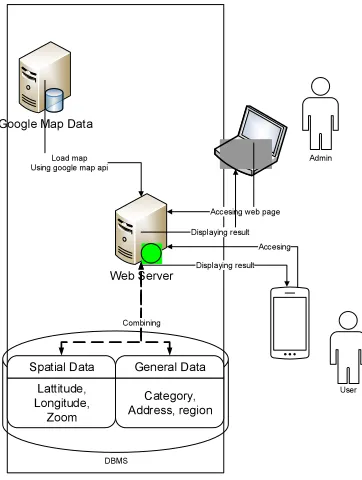
Google Maps offers an API that allows developers embed Google Maps in their own web pages. There is growing interest in the concept of online GIServices, which allow users to access data sets from remote geodata repositories[8]. Google maps api is commonly used in the manufacture of interactive maps. Along with the mapping development, spatial data such as latitude and longitude coordinates can be combined with regular data such as category and location, so it can made a decision support, shown in the following:
Web Server Google Map Data
Load map Using google map api
Accesing web page
Accesing
Lattitude, Longitude,
Zoom Spatial Data
Category, Address, region
General Data
Combining
Displaying result
Displaying result
Admin
User
DBMS
Figure 2: Overview The System
3.2 Context Diagram
A context diagram aims to illustrate the flow of data in the system generally. A context diagram shown in the following figure.
0
System
User recommendation Admin
limit set
distance to schools
[image:3.595.92.273.405.645.2]distance to shopping center distance to hospital criteria
Figure 3: Context Diagram
There are two entities that are connected with this system, which are User and Admin. Admin will provide residential data and the data of the boundary of fuzzy sets. The system accepts input in the form of data residential criteria that will be searched by User. Then the system will provide recommendations residential data according to user criteria.
In the process of calculating the value of firestrength obtained fuzzy value of Mu based formula that results will stored in the Mu table. While in the process of system recommendation, user must input residential data based on user criteria. System will be obtained one or more of the data relating to the above criteria along with firestrength value that indicates how much the recommendations provided by the system (this firestrength have values ranging from 0 to 1). A value of 1 indicates full recommendations, if firestrength worth is close to 0, the more the residential site is less recommended.
3.3 Data Flow Diagram
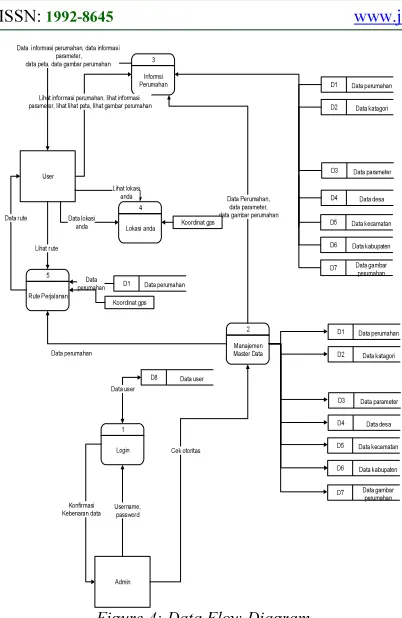
Data Flow Diagram representing the
Username, password Konfirmasi Kebenaran data
1
Login
Admin 3
Informsi Perumahan
2
Manajemen Master Data Lihat informasi perumahan, lihat informasi
parameter, lihat lihat peta, lihat gambar perumahan
User Data informasi perumahan, data informasi
parameter, data peta, data gambar perumahan
Data user
D8 Data user Data Perumahan, data parameter, data gambar perumahan
5
Rute Perjalanan Lihat rute Data rute
Cek otoritas Data perumahan
D1 Data perumahan Data
perumahan
D1 Data perumahan
D3 Data parameter D2 Data katagori
D4 Data desa
D6 Data kabupaten D5 Data kecamatan
D7 Data gambar perumahan 4
Lokasi anda Lihat lokasi
anda
Data lokasi
anda Koordinat gps
Koordinat gps
D1 Data perumahan
D3 Data parameter D2 Data katagori
D4 Data desa
D6 Data kabupaten D5 Data kecamatan
D7 Data gambar perumahan
Figure 4: Data Flow Diagram
Input processes on the master data in the DFD are used as the master data to be taken in the calculation of the membership function. The input processes include: distance hospitals, the schools, distance shopping center where the entity is Admin. The process input on the criteria is used as a reference to get a recommendation residential site.
The process input on the criteria is used as the reference range data in the calculation of membership function. The entity in this process is user. The process of calculating firestrength value is obtained Mu value based on fuzzy formula in which results will be stored in the Mu table. While use in the recommendation process, user will input data desired criteria and then will get one or more of the data related to the desired criteria along with firestrength value that indicates how much the recommendations provided by the system (this firestrength value has a value between 0 to 1). A value of 1 indicates full recommendation, if the value of firestrength worth is close to 0, then the residential site is less recommended.
3.4 The Membership Function
The membership function is a curve that shows the mapping of points of input data into membership value (often called the degree of membership) that has the interval from 0 to 1. The
residential distance between hospitals data, the residential distance between school data and the residential distance between shopping center data are used as a reference to determine the limits set on the membership function for each variable.
In each fuzzy variables use membership function parallelogram-shaped and triangle as an approach to obtain a degree of membership of a value in a fuzzy set.
3.5 User Interface Design 3.5.1 Main Menu
[image:4.595.89.290.107.416.2]First thing to be done by a user is to enter an ID and password. Then select the desired distance. If the user has entered all the data according to desired criteria then the user can click process button, then all the criteria that has been entered will be processed in a file rekomendasi.php. In this file all criteria data input is processed by using the SQL command to generate the residential data to be recommended.
Figure 5: Main Menu
3.5.2 Results of Recommendations
[image:4.595.355.458.372.549.2]Here is the result of the recommendation:
The image above shows residential lists with the ranking according to the value firestength. In the list it displayed the distance between the residential site and each parameter, if one of the list selected, it will redirect to the detail information of the residential, and will be directed to the location where the residential site is located.
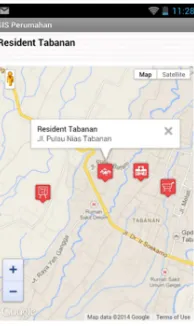
Figure 7: Details and Map Location of Residential Recommendations
The picture above is the result of the output if one of the options is in the select. The system shown on the residential location info with the recommended parameters in accordance with the criteria previously selected.
4. RESULT AND ANALYSIS
Tests on the software were conducted to determine whether the application which has been built has been going well and meet predetermined specifications. The process of testing is done to get a recommendation from the system if it matches the count value manually.
The experiments were conducted with the following input data:
a) Distance to hospital: Medium b) Distance to school: Close
c) Distance to shooping center: Medium The following is a manual calculation:
1
0 10 20
Close Medium Far
µ[X1]
[image:5.595.141.238.226.389.2]15
Figure 8: Distances Curve
Membership functions on a variable distance limit can be formulated as follows:
µ close distance limit [x1] =
1 x1 10ሺଵହି௫ଵሻ
ହ 10 x1 20
0 x1 20
µ medium distance limit [x1] =
0 x1 10 or x1 20 ௫ଵିଵ
ହ 10 x1 15
1ଶି௫ଵ
ହ 15 x1 20
µ far distance limit [x1] =
0 x1 15ሺ௫ଵିଵହሻ
ହ 15 x1 20
1 x1 20
Distance to hospital: Medium
1. Perumahan Jegu indah
Distance: 11.4
Mu(x) = (11.4-10)/5 = (1.4)/5=0.28
2. Candi Pratama
Distance: 15
Mu(x) = (15-10)/5 = 5/5=1
3. Alam Pesona
Distance: 14.1
Mu(x)= (14.1-10)/5 = 4.1/5=0.82
4. Taman Sejora
Distance: 13
Mu(x)= (13-10)/5 = 3/5=0.6
5. Graha Sejora Indah
Distance: 14.5
Mu(x)= (14.5-10)/5 = 4.5/5=0.9
6. Prima Garden
Distance: 10.5
Mu(x)=(10.5-10)/5=0.5/5=0.1
7. Pondok Trosobo Indah
Distance: 10.2
8. Wisma Trosobo Distance: 10.2
Mu(x)= (10.2-10)/5 =0.2 /5=0.04
9. Mutiara Kebon Agung
Distance: 10.1
Mu(x)= (10.1-10)/5=0.1/5=0.02
10. Griya Mapan Sentosa
[image:6.595.310.501.243.367.2]Distance: 7.1 Mu(x)= 0
Table 1: Results of Mu, Distance to hospital: Medium
No. Residents Mu (Close)
1 Perumahan Jagu Indah 0.28
2 Candi Pratama 1
3 Alam Pesona 0.82
4 Taman Sejora 0.6
5 Graha Sejora Indah 0.9
6 Prima Garden 0.1
7 Pondok Trosobo Indah 0.04
8 Wisma Trosobo 0.04
9 Mutiara Kebon Agung 0.02
10 Griya Mapan Sentosa 0
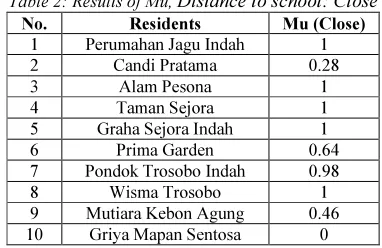
Distance to school: Close
1. Perumahan Jagu Indah
Distance: 8.9 Mu(x) = 1
2. Candi Pratama
Distance: 13.6
Mu(x) = (15-x)/5 = (15-13.6)/5=0.28
3. Alam Pesona
Distance: 6.5 Mu(x)=1
4. Taman Sejora
Distance: 7.6 Mu(x)=1
5. Graha Sejora Indah
Distance: 6.7 Mu(x)=1
6. Prima Garden
Distance: 11.8
Mu(x)=(15-x)/5=(15-11.8)/5=0.64
7. Pondok Trosobo Indah
Distance: 10.1
Mu(x)= (15-x)/5=(15-10.1)/5=0.98
8. Wisma Trosobo
Distance: 10 Mu(x)=1
9. Mutiara Kebon Agung
Distance: 12.7
Mu(x)= (15-x)/5=(15-12.7)/5=0.46
10. Griya Mapan Sentosa
[image:6.595.91.533.260.738.2]Distance: 26.6 Mu(x)= 0
Table 2: Results of Mu, Distance to school: Close
No. Residents Mu (Close)
1 Perumahan Jagu Indah 1
2 Candi Pratama 0.28
3 Alam Pesona 1
4 Taman Sejora 1
5 Graha Sejora Indah 1
6 Prima Garden 0.64
7 Pondok Trosobo Indah 0.98
8 Wisma Trosobo 1
9 Mutiara Kebon Agung 0.46
10 Griya Mapan Sentosa 0
Distance to shopping center: Medium
1. Perumahan Jegu indah
Distance: 11.4
Mu(x) = (11.4-10)/5 = (1.4)/5=0.28
2. Candi Pratama
Distance: 15
Mu(x) = (15-10)/5 = 5/5=1
3. Alam Pesona
Distance: 14.1
Mu(x)= (14.1-10)/5 = 4.1/5=0.82
4. Taman Sejora
Distance: 13
Mu(x)= (13-10)/5 = 3/5=0.6
5. Graha Sejora Indah
Distance: 14.5
Mu(x)= (14.5-10)/5 = 4.5/5=0.9
6. Prima Garden
Distance: 10.5
Mu(x)=(10.5-10)/5=0.5/5=0.1
7. Pondok Trosobo Indah
Distance: 10.2
Mu(x)= (10.2-10)/5=0.2/5=0.04
8. Wisma Trosobo
Distance: 10.2
Mu(x)= (10.2-10)/5 =0.2 /5=0.04
9. Mutiara Kebon Agung
Distance: 10.1
Mu(x)= (10.1-10)/5=0.1/5=0.02
10. Griya Mapan Sentosa
Table 3: Results of Mu, Distance to shopping center: Medium
No. Residents Mu (Close)
1 Perumahan Jagu Indah 0.28
2 Candi Pratama 1
3 Alam Pesona 0.82
4 Taman Sejora 0.6
5 Graha Sejora Indah 0.9
6 Prima Garden 0.1
7 Pondok Trosobo Indah 0.04
8 Wisma Trosobo 0.04
9 Mutiara Kebon Agung 0.02
10 Griya Mapan Sentosa 0
5. CONCLUSION
Conclusion results of experiments and analysis, it can be concluded after several experiments by changing the range or criteria, the output value of the system is valid by comparing
the calculations manually. Residential
recommendation accuracy is strongly influenced by a range of criteria.
Google Maps has an API (Application Programming Interface) so that developers Google Maps do not have to bother anymore to make a map and be able to focus on the data that will be used. Access time is required to retrieve content from the server applications either Google Maps relative or depending on the network used by the user. Especially for retrieval through GPS coordinates, if the users are in the building / buildings, access time is relatively long, sometimes even no response at all.
REFRENCES :
[1] Jogiyanto, Pengenalan Komputer. Yogyakarta:
Penerbit Andi, 1999.
[2] A. Sofiudin, “Perancangan dan Pembuatan
Fuzzy Query Database untuk
Perekomendasian Penerima Beasiswa,” 2006.
[3] M. I. Prasetiyowati and B. A. Seta,
“Implementasi Fuzzy Database untuk
Memberikan Rekomendasi Jalur Peminatan
Mahasiswa,” in Sistem dan Informatika, 2007.
Second SNSI 2007, pp. 162-167.
[4] S. Kusumadewi and H. Purnomo, Aplikasi
Logika Fuzzy untuk Pendukung Keputusan. Yogyakarta: Graha Ilmu, 2004.
[5] Amalia, L, Fananie, Z.B, dan Utama, D.N.
2010. “Model Fuzzy Tahani untuk Pemodelan
Sistem Pendukung Keputusan (SPK) (Kasus :
Rekomendasi Pembelian Handphone)”.
Makalah disajikan pada Seminar Nasional Aplikasi Teknologi, Yogyakarta.
[6] Eliyani, P.U, dan Rosyadi, D. 2009. “Decision
Support System untuk Pembelian Mobil
Menggunakan Fuzzy Database Model
Tahani”. Makalah disajikan pada Seminar Nasional Aplikasi Teknologi, Yogyakarta.
[7] Kusumadewi, S, dan Purnomo, H. 2004.
Aplikasi Logika Fuzzy untuk Pendukung
Keputusan. Yogyakarta : Graha Ilmu.
[8] Tao, C. V. 2001. Online GIServices. Journal