The Newton-Like Properties of the Updating
Mechanism of a Model-Reality
Differences Algorithm
Rohanin Ahmad & Mohd Ismail Abd Aziz
Department of Mathematics
Universiti Teknologi Malaysia, Skudai
81310 Johor Bahru, Malaysia.
Abstract The Dynamic Integrated Systems Optimization and Parameter Esti-mation (DISOPE) algorithm is an algorithm for solving nonlinear optimal con-trol problems and is of the gradient descent type. The updating step of DISOPE plays an important role in terminating the iterations of the algorithm and hence in determining its rate of convergence. In this paper, the mechanism was shown to have Newton-like properties and the order convergence established.
Keywords Composite maps, Newton’s method, Error function, Initial solu-tions, Order of convergence.
Abstrak Algoritma Dynamic Integrated Systems Optimization and Parame-ter Estimation (DISOPE) ialah suatu algoritma untuk menyelesaikan masalah kawalan optimum tak linear dan algoritma ini tergolong ke jenis penurunan gra-dien. Langkah pengemaskinian DISOPE memainkan peranan penting dalam pemberhentian lelaran algoritma ini dan seterusnya dalam penentuan kadar penumpuannya. Dalam kertas kerja ini, mekanisma tersebut ditunjukkan se-bagai mempunyai ciri-ciri mirip kaedah Newton dan peringkat penumpuannya ditentukan.
Katakunci Peta gubahan, Kaedah Newton, Fungsi ralat, Penyelesaian awal, Peringkat penumpuan.
1
Introduction
within the model is used for calculating the optimum [10]. The updating mechanism of this algorithm plays an important role in determining the convergence rate of the algorithm. In an earlier paper [1], the updating mechanism has been analyzed separately from the main algorithm by partitioning DISOPE into two distinct sub procedures based on theorems of composite mappings. One of the map is the main DISOPE algorithm and the other is the updating mechanism. The updating mechanism was treated as a full-fledged algorithm with an appropriate error function determined for it. The convergence of the updating mechanism was then established by comparing it with Newton’s Method. The Newton’s Method is one of the oldest methods for solving many root finding and optimization problems. In its simplest form, it converges only if the initial guess is sufficiently close to a solution [9]. Provided the initial guess is good enough, Newton’s iteration will converge at least quadratically to the required solution [5,7]. If the initial estimate of the solution is very inaccurate, Newton’s method converges with a very slow rate over the first few iterations [5] or it may even diverge [7]. This paper further investigates the convergence of DISOPE and its order of convergence. Its behavior with different set of initial solutions is also investigated.
2
The DISOPE approach
Consider the following unconstrained real optimal control problem (ROP), with given initial conditions:
minJ
u(t)
∗
= ϕ(x(tf)) +
Z tf
t0
L∗(x(t), u(t), t)dt,
subject to
˙
x = f∗(x(t), u(t), t), (1)
x(t0) = x0,
xi(tf) = xif;i∈[1, q], q < n,
defined over t ∈ [t0, tf], whereu(t) ∈ Rm and x(t)∈ Rn are the continuous control and
state vectors, respectively. L∗ :Rn×Rm →R is the real performance measure function
and f∗:Rn×Rm→Rn represents the real plant dynamics.
DISOPE does not work directly on ROP but rather modeled the reality into a Model Based Problem (MOP) which includes parameter estimatesγ(t)∈Randα(t)∈Rr. These two estimates take into account the value differences between reality and model. This model is then expanded into another optimal control problem, which is equivalent to ROP called Expanded Optimal Control Problem (EOP). EOP ties ROP and MOP together by including the following equality expressions of states functions and performance index from ROP and MOP as constraints.
f(z(t), v(t), α(t)) = f∗(z(t), v(t), t),
L(z(t), v(t), γ(t)) = L∗(z(t), v(t), t), (2)
u(t) = v(t),
whereL∗:Rn×Rm→Randf∗:Rn×Rm→Rn are, respectively, the performance index
and the plant dynamics of the model. Both are approximates of the real performance index L∗ and the plant dynamics f∗. v(t) ∈ Rm and z(t) ∈ Rn are introduced to distinguish between the state and control variables used in the optimization step and those used in the parameter estimation step. The convexification terms ku(t)−v(t) kand kx(t)−z(t) k
are introduced in the performance index to aid convergence. r1 and r2 are given scalar
convexification factors, with the following function H as the Hamiltonian:
H =L(x, u, γ) +pTf(x, u, α)−λTu−βTx+1
2r1ku(t)−x(t)k
2+1
2r2ku(t)−x(t)k
2.
Instead of solving the EOP, the following modified model based optimal control problem (MMOP) is solved. The MMOP is:
min J
u(t)e = ϕ(x(tf)) + Z tf
t0
L∗(x(t), u(t), γ(t))−λ(t)T −β(t)Tx(t)
+1
2r1ku(t)−x(t)k
2+1
2r2ku(t)−x(t)k
2dt, (3)
subject to
˙
x = f∗(x(t), u(t), α(t)),
x(t0) = x0,
xi(tf) = xif;i∈[1, q], q < n,
together with its optimality conditions
∇uH = 0,
∇xH+p(t) = 0, (4)
∇pH = 0,
For details please refer Roberts [10], Becerra [3], and Ahmad and Mohd Ismail [1].
3
The standard DISOPE Algorithm
For clarification the following algorithm is reproduced from Ahmad and Mohd Ismail [1].
Algorithm 1
Data f, L, ϕ, x0, t0, tf and means for calculatingf∗ andL∗.
Step 0 Compute or choose a nominal solutionu0(t), x0(t), and p0(t).
Seti= 0, v0(t) =u0(t), z0(t) =x0(t),pˆ0(t) =p0(t),t∈[t 0, tf].
Step 1 Compute the parametersαi(t) andγito satisfy (8). This is called the parameter estimation step.
Step 3 With specifiedα(t),γ(t),λ(t) andβ(t) solve the MMOP to obtain
ui+1(t), xi+1,andp1+1(t). This is called the system optimization step.
Step 4 This step tests the convergence and updates the estimate for the solution of the ROP.
vi+1(t) = vi(t)−kv(vi(t)−ui+1(t)), (5)
zi+1(t) = zi(t)−kz(zi(t)−xi+1(t)), (6)
ˆ
pi+1(t) = pˆi(t)−kp(ˆpi(t)−pi+1(t)), (7)
where kv, kz, kp ∈(0,1] are scalar gains. If vi+1(t) = vi(t) within a given tolerance stop,
else seti=i+ 1 and continue from step 1.
4
The Analysis of the Updating Mechanism
4.1
Decomposition of DISOPE
For the purpose of this analysis, DISOPE algorithm is decomposed as in Definition 1 [1] below.
Definition 1 (Map B and Map C)[1]
Let DISOPE algorithm be decomposed into two distinct maps; map B and map C, say. Then map B is steps 1 to 3 and map C is step 4 of Algorithm 1.
By viewing the algorithm as an application of the composite map CB[1], where B is known to be convergent andCcorresponds to the set of intermediate steps of the complex algorithm, the overall convergence of such a scheme would be established [2].
4.2
The Updating Mechanism as a Special Case of Newton’s Method
Out of the three equations representing map C, equation (5) plays the role of stopping criterion for DISOPE. For convenience (5) is rewritten here
vi+1(t) =vi(t)−kv(vi(t)−ui+1(t)) (8)
where ui+1(t) is the computed control variable produced by map B and vi+1(t) is the
estimated control variable of the updating mechanism. The iterations of the algorithm will
stop if the norm of the output of (8) is within a specified toleranceε > 0. Let equation (8) be map C(a). The norm of mapC(a) is then kvi+1(t)−vi(t)k< ε. This is the crucial
step where the convergence of the whole DISOPE algorithm is determined.
The following analysis of mapC(a)is based on the assumption that mapBconverges, that is, map B produces the values of the control variable ui+1(t). Let vi(t) = vi and
ui(t) =uiin the following analysis for ease of manipulation.
Proposition 1Let DISOPE algorithm be partitioned into two distinct maps as in Definition
1 and let map C(a) be equation (8). If map B converges and ε > 0is given such that
then map C(a) works at minimizing the total squared error of the output at each iteration; i.e. map C(a) works at minimizing the error function
E(vi) =1 2
vi−ui+1Tvi−ui+1.
Proof
Consider the generation of values of the control variables vi(t) andui+1(t) from equation
(8). The updating mechanism takes in the values of ui+1(t) and updates the values ofvi(t)
using equation (8). The updated values are then compared to the current values of vi(t)
and if
vi+1(t) =vi(t) (9)
the algorithm stops, else the whole process is repeated. Since DISOPE solves a problem numerically, (9) is satisfied by taking the difference between the two to be less then a specified tolerance, that is, (9) is satisfied by takingε→0,
kvi+1−vi k→0. (10)
From step 4 of Algorithm 1,kv∈(0,1],kv6= 0, hence (8) and (10) imply
kvi−ui+1k→0. (11)
Let E(vi) be some vector function to be minimized by equation (8) at the ith iteration.
The minimum ofE(vi) happens at ∂E(v
i)
∂vi = 0. Thus let
∂E(vi)
∂vi =E
0
(vi) =vi−ui+1. (12)
Integrating (12), we get the following function, referred to as the error function of the
modifier equation:
E(vi) =1 2
vi−ui+1Tvi−ui+1. (13)
Hence the updating mechanism of DISOPE works at minimizing the total squared error of the output at each iteration.
DISOPE relies on equation (9) for its stopping criterion. Furthermore, for (9) to be satisfied, (8) must converge. Hence this convergence analysis is restricted only to (8) which makes up map C(a). The following theorem proposes a characteristic of the algorithm, which implies its convergence.
Teorem 1LetE(vi) = 1 2[v
i−ui+1]T[vi−ui+1] be the error function to be minimized by
map C(a). If map B converges and E”(vi)≥1, then equation (8) is a special case of the
Newton’s Method.
Proof
Given the error function
E(vi) = 1 2
to minimize (12) means to set (13) to zero, that is,E0(vi) = 0. The minimizer of (14) is the
root of E0(vi) = 0. Letv=g(v) be an iteration function and letE0(vi) = 0 be equivalent
to v=g(v). It follows that, any solution toE0(vi) = 0 is a fixed point ofg(v)[5]. Being a fixed point, letvi+1 =g(vi). Rewrite
E0(vi) = 0
= λ(vi)E0(vi)
= v−v+λ(vi)E0(vi)
such that
v = v+λ(vi)E0(vi) and
g(vi) = vi+λ(vi)E0(vi) (15)
The following additional condition is required, that is, if ¯v is the solution to E0(vi) = 0,
then g0(¯v) = 0[5]. Then
g0(vi) = 1 +λ0(vi)E0(vi) +λ(vi)E00(vi). (16)
Whenvi= ¯v
g0(¯v) = 1 +λ0(¯v)E0(¯v) +λ(¯v)E00(¯v), (17)
with E0(¯v) = 0 and g(¯v) = ¯v. Hence (17) becomes g0(¯v) = 1 +λ(¯v)E00(¯v), implying λ(¯v) =−E001(¯v). Thus (15) becomes
g(vi) =vi− E
0(vi)
E00(vi). (18)
With vi+1=g(vi), (18)becomes
vi+1=vi− E
0(vi)
E00(vi). (19)
Because E(vi) is quadratic, it follows that E00(vi) is a constant and E00(vi) > 0. Let E00(vi)≥1, then 0< 1
E00(vi) ≤1. Taking
1
E00(vi) =kv, (19) becomes
vi+1=vi−kvE
0
(vi) (20)
which is exactly equation (8). If E0(vi) =f(x) then (19) can be rewritten as
xi+1 =xi− f(x)
f0(x) (21)
4.3
The Order of Convergence of the Updating Mechanism
Although convergence of an iterative process is desirable, it is the speed at which it converges that is important for practical purposes. Hence it is necessary to analyze the order of convergence of this algorithm to determine its speed and thus its practicality.
Definition 2(Convergence of order p)
One says that xn converges to αwith (at least) order p≥1 if kxn−αk≤εn holds with
lim
n→∞ εn+1
εpn
=c, c >0. Furthermore, if c = 1, we call this type of convergence sub linear;
if c= 0, or if the limit does not hold for any p >1, we call this type of convergence super
linear.
Following Theorem 1, we state this corollary:
Corollary 1
Map C(a) of DISOPE algorithm converges super linearly.
Proof
Following the proof of Theorem 1, let ¯v be a simple root of equation E0(vi) = 0; i.e.
E0(¯v) = 0. Subtract ¯vfrom both sides of equation (23).
vi+1−v¯=vi−v¯− E
0 (vi)
E00(vi) (22)
withE0(¯v) = 0, rewrite (1) as follows:
vi+1−v¯= (vi−¯v)
1−E
0
(vi)−E0(¯v) (vi−v)E¯ 00(vi)
(23)
Using the notation of [7] for Newton’s form of interpolation polynomial (see Appendix A), (23) becomes
vi+1−v¯= (vi−¯v)
1− [v
i,v]E¯ 0 [vi, vi]E0
(24)
where [vi,v]E¯ 0= E0(vi)−E0(¯v)
vi−v¯ and [v
i, vi]E0=E00(vi). Rewrite (24) as
vi+1−¯v = (vi−¯v)
[vi,v]E¯ 0−[vi,¯v]E0 [vi, vi]E0
= (vi−¯v)
[vi,vi]E0−[vi,¯v]E0
(vi−¯v) (v
i−v)¯
[vi, vi]E0
= (vi−¯v)2
[vi, vi,v]E¯ 0 [vi, vi]E0
where
[vi, vi,v]E¯ 0 = [v
i, vi]E0−[vi,v]E¯ 0
Therefore
vi+1−¯v (vi−¯v)2 =
[vi, vi,v]E¯ 0 [vi, vi]E0
Ifvi→v, then¯
lim
n→∞
vi+1−v¯ (vi−v)¯2 =
[¯v,¯v,v]E¯ 0 [¯v,¯v]E0 =
(E0(¯v))00 2(E0(¯v))0 =
E000(¯v) 2E00(¯v)
where [¯v,v,¯ ¯v]E0= 1 2!(E
0(¯v))00and [¯v,¯v]E0= 1 1!(E
0(¯v))0. SinceE(vi) is quadratic,E000(¯v) = 0, making
lim
n→∞
vi+1−¯v (vi−¯v)2 = 0
Hence DISOPE has a super linear convergence as is the case when f(x) is quadratic in Newton’s method
5
The Newton-like Properties
One of the attractive features of the algorithm is the integration of parameters from both the real problem and its model before arriving at the optimal solution. In view of the above analysis, DISOPE converges in just one iteration whenever no model-reality difference is introduced.
DISOPE requires an initial solution to start the iterations. A recommended one is the solution of the relaxed MMOP with α(t) = 0, r1 = r2 = 0. Since DISOPE is composed
of maps B and C, with map B supplying the input for map C, the initial solution is for map B. However, the initial solution ofB affects its output and hence the input for map C. Thus it is imperative that a good initial solution to mapBwould translate into a good input to map C.
It is a well-known fact that the choice of initial solution is crucial in Newton’s method to speed up convergence. The closer the initial guess, the faster it reaches the optimal solution. The same property is tested for DISOPE algorithm.
In DISOPE the real problems are modeled as linear quadratic regulators. It is customary for DISOPE to use the identities for Q and R; weights for the performance index. It is noticed however that other choices for Qand R; hence the initial solutions; have different effects on the rate of convergence. In fact the right choice of weights would tremendously cut down on the number of iterations as shown in the numerical examples below.
5.1
Numerical Examples
Example 1
Consider the continuous stirred tank reactor problem taken from Kirk [8]. The real opti-mization problem (ROP) is as follows:
min
u(x)J
∗=
Z 0.78
0
(x21+x22+ 0.1u2)dt
subject to
˙
x1 = −(x1+ 0.25) + (x2+ 0.5) exp 25x
1
x1+ 2
−(1 +u)(x1+ 0.25)
˙
x1 = 0.5−x2−(x2+ 0.5) exp 25x
1
x1+ 2
x(0) = [0.05 0]T
The modified model (MOP) used in DISOPE algorithm is:
min
u(x)J = Z 0.78
0
(xTQx+uTRu+γ(t))dt
subject to
˙
x =
4.25 1
−6.25 −2
x(t) +
−0.25 0
u(t) +α(t)
x(0) = [0.05 0]T
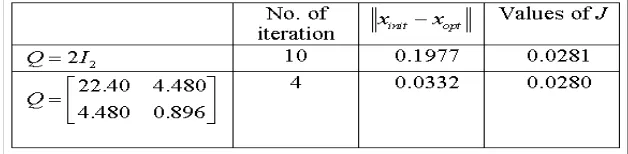
where x(t)∈R2, u(t)∈R, γ(t)∈R andα(t)∈R2. Two different initial solutions are used in the simulations of this proble. The first uses the value of the weighting matrix Q= 2I2.
Teh second initial solution uses the value ofQ=
22.40 4.480 4.480 0.896
. In both cases the value
ofRis kept constant atR= 0.2. During the iterations of DISOPE, no turning was done to the values of the parametersr1 andr2 andkv, kz andkp, that is,r1 andr2 are set to zero
andkv, kz andkpare set to one. The integration step taken ish= 0.01, and the tolenrance
considered for the convergence istol= 0.01.
Table 1: Results of simulations with different values of Q
Figure 1: : Comparisons of closeness between two different initial solutions and the optimal solution (a) Initial solution forQ= 2I2; (b) Initial solution forQ= [22.404.480; 4.4800.896].
Example 2
Consider a fourth order non-linear system representing a horizontal planar revolute/prismatic two degrees of freedom robot manipulator taken from Craig [6]. ROP is defined as:
min
u(t)
1 2
Z 4
t0
[x21+x42+x23+x44+u21+ 0.1u42]dt
subject to
˙
x1 = x2;x1(0) = 2, x1(4) = 0
˙
x2 =
u1−4x2x4(x3+ 0.5)
1 + 2(x3+ 0.5)
;x2(0), x2(4) = 0
˙
x3 = x4;x3(0) = 1, x3(4) = 0
˙
x4 = (x3+ 0.5)x22+ 0.5u2;x4(0) = 0, x4(4) = 0
where x1(t) andx2(t) are the angular position and velocity of link 1,x3(t) andx4(t) are
the angular position and velocity of the prismatic link 2. u1(t) and u2(t) are the driving
torque and force of the two links.
MOP is taken as a linear quadratic model representing small perturbations about the equi-librium point at the origin:
min
u(t)
1 2
Z 4
0
(xTQx+uTRu+γ(t))dt
subject to
˙
x = Ax+Bu+α(t)
with
A=
0 1 0 0
0 0 0 0
0 0 0 1
0 0 0 0
and B=
0 0
1 0
0 0
0 0.5
where x(t) ∈ R4, u(t) ∈ R2, γ(t) ∈ R and α(t) ∈ R4. In this example the value of the
weighting matrixQis kept constant at
Q=
0.015 0 0 0
0 0.01 0 0
0 0 0.001 0
0 0 0 0
The weighting matrix R on the other hand is given two different values; R = I2 and
R= 1.5I2.
With the choices of Q and R = I2 together with r1 = 1, r2 = 0, kv =kz = 0.25, kp = 1
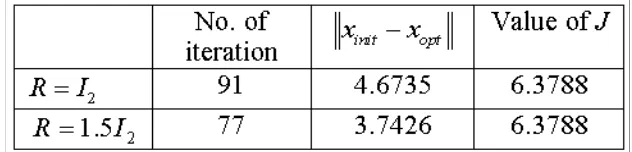
DISOPE converged in 91 iterations in the first simulation. The numerical integration step used was h= 0.05 and a tolerance of 0.01 was specified for convergence. To see the effect of different initial solution on the convergence rate of the algorithm, we simulated next R= 1.5I2. The value ofr1is now zero and the values of the other inputs are kept the same.
The result is a faster convergence. The algorithm converged in 77 iterations. The 2-norms between the two initial solutions and the optimal solution are calculated and summarized in Table 2 below.
Table 2: Results of simulations with different values of R
The two examples above show that the closer the initial solution to the optimal solution, the faster the convergence.
6
Conclusion
The algorithm converges in only one iteration if no model-reality difference is introduced. Furthermore DISOPE possesses the Newton-like property in the choice of the initial solu-tion used to start the iterasolu-tions. It is noticed from the two examples given, the closer the initial solution to the optimum, the faster the convergence.
References
[1] R. Ahmad, and B.A.A Mohd Ismail,“The Convergence Analysis of the Updating
Mech-anism of the Dynamic Integrated Systems Optimization Algorithm,”, Prosiding
Simpo-sium Kebangsaan Sains Matematik Ke-10,2002, pg 326-332.
[2] M.S. Bazaraa, H.D. Sherali and C.M. Shetty, “Nonlinear Programming: Theory and
Algorithms”, John Wiley and Sons, Inc., New York, 1993.
[3] V.M. Becerra,“Development and Applications of Novel Optimal Control Algorithms”, PhD Thesis, Dept. of Electrical, Electronics and Information Engineering, City Uni-versity, London, 1994.
[4] A.E. Bryson and Y.C. Ho,“Applied Optimal Control”, Hemisphere Publishing Corpo-ration, Washington D¿C., 1975.
[5] J.L Buchanan and P.R. Turner,“Numerical Methods and Analysis”, McGraw-Hill, Inc., New York, 1992.
[6] J.C. Craig,“, Introduction to Robotics”, Addison-Wesley, Reading, USA, 1989.
[7] W.Gautschi,“Numerical Analysis”, Birkhuser, Boston, 1997.
[8] D.E.Kirk,“, Optimal Control Theory”, Prentice-Hall Inc., Englewood Cliffs, 1970.
[9] E. Polak,“Optimization: Algorithms and Consistent Approximations”,Springer-Verlag New York Inc., New York, 1997.
[10] P.D. Roberts, “An Algorithm for Optimal Control of Nonlinear Systems with
Model-Reality Differences”, Proceedings of 12th IFAC World Congress on Automatic Control,
8(1993), 407-412.
[11] P.D. Roberts, “Two-Dimensional Analysis of an Iterative Nonlinear Optimal Control
Algorithm”, IEEE Transactions on Circuits and Systems-I: Fundamental Theory and
Appendix A
Newton’s Form of the Interpolation Polynomial [6]
Given n+ 1 pointsx0, x1, ..., xn and values offi=f(xi), of some function at these points,
a polynomialp∈ Pnsuch thatp(xi) =fi;i= 0,1, ..., ninterpolate f(x) at these points. We
denote the unique polynomialp∈interpolating f at the distinct pointsx0, x1, ..., xn by
pn = (f;x0, x1, ..., xn;x) =pn(f;x), n= 0,1,2, ...
pn(f;x) = a0+a1(x−x0) +a2(x−x0)(x−x1) +...+an(x−x0)(x−x1)...(x−xn−1)
The constants involved can be determined by
f0 = a0
f1 = a0+a1(x1−x0)
f2 = a0+a1(x2−x0) +a2(x2−x0)(x2−x1)
.. . = ...
Thus the constants are
a0 = f0 (25)
a1 =
f1−f0
x1−x0
(26)
a2 =
f2−f1
(x2−x0)(x2−x1)
(27)
The following notation is used to denote the constants:
an = [x0, x1, ..., xn]f, n= 0,1,2, . . . (28)
Hence (25),(26) and (27)respectively look like the following
a0 = f0
a1 = [x0, x1]f
a2 = [x0, x1, x2]f
The right hand side of (28) is called the nth divided difference of f relative to the nodes x0, x1, ..., xn. The name comes from the property
[x0, x1, ..., xn]f =
[x0, x1, ..., xk]f−[x0, x1, ..., xk−1]f
xk−x0
. (29)
Another property that will be useful in this analysis is
[x0, x0, ..., x0]f =
1 n!f
(n)(x
0). (30)
![Figure 1: : Comparisons of closeness between two different initial solutions and the optimalsolution (a) Initial solution for Q = 2I2; (b) Initial solution for Q = [22.404.480; 4.4800.896].](https://thumb-us.123doks.com/thumbv2/123dok_us/1266022.1159181/10.612.129.481.124.300/comparisons-closeness-dierent-solutions-optimalsolution-initial-solution-initial.webp)