1- Introduction
Cooperative communication has gained a significant interest in recent years as an efficient way to improve spectral efficiency, energy efficiency and symbol error rate (SER), specifically due to providing spatial diversity. Hence, cooperative communication is used in the fourth generation of wireless mobile telecommunication and is expected to be used in the fifth generation as well. One typical way of implementing cooperative communication is to utilize cooperating relay nodes. The relays help the source deliver its message to the destination via various paths. It is sometimes called virtual multi-in put multi-output (MIMO) scheme. The relaying strategies are classified as simple amplify-and-forward (AF), decode-and-amplify-and-forward (DF), or compress-and-forward (CF) schemes. In [1], potential benefits of the users cooperation are studied for the cooperating multiple access channel from an information-theoretic point of view. Space diversity for the cooperative chain of AF and DF relays are considered in [2].
A key concern in the next generation of wireless communication networks is the energy efficiency [3]. Therefore, optimizing energy efficiency is one of the main design parameters in cooperative wireless networks. Optimal power allocation policy to maximize the capacity bounds for the cooperative relay networks are investigated in [4]-[6]. In [7], a dual-hop multi AF and DF relaying scheme is considered to optimize power allocation as well as relay selection. For multi-hop multi-branch AF networks, the total consumed power subject to a given outage probability is minimized in [8]. Another performance metric could be maximizing the lifetime of a cooperative network subject to a given instantaneous signal to noise ratio [9]-[12]. Since SER is an effective performance metric to evaluate the quality of service, it is the main focus
The corresponding author; Email: [email protected]
of this paper. In [13], authors studied different cooperative diversity AF relaying schemes and derived the closed form term for average SER. For these cooperative networks, the optimal power allocation policy under a given SER at the destination is derived in [14]. Optimizing SER with total relay power constraint in the virtual MIMO cooperative network is considered in [15]. In [16] authors have studied the relay assignment and power allocation problem to maximize the network lifetime and minimize weighted total power consumption subject to a given SER. The performance analyses of opportunistic relaying and hybrid automatic repeat request incremental relaying in terms of SER are considered in [17]. In [18], authors propose a new scheme in which the selected DF relays cooperate in transmitting the decoded signal by using distributed Alamouti codes. Bit Error Rate (BER) estimation in two-hop AF relay networks by two methods; unifying BER analysis and measuring BER that is optimized with respect to its energy and spectral efficiency is studied in [19].
On the other hand, providing the required power for the information transfer in wireless communication networks is an issue. One way to overcome this problem is continually acquiring energy from the environment. The nodes with such a capability are named Energy Harvesting (EH) nodes. To know more details of EH please see [20] and the references within. In [21], authors maximize the short term throughput for battery limited and rechargeable nodes. EH multiple AF relays are studied in [22] in which optimal power splitting and time switching between harvesting and information transfer are derived. Joint cooperative beam-forming (CB) and energy signal (CB-ES) scheme for providing both secure communication and efficient wireless energy transfer are investigated in [23]. Optimal EH management in relay channels from information theoretic point of view are analyzed in [24]-[26].
In this paper, we study three different cooperative AF relaying AUT J. Elec. Eng., 50(1)(2018)33-42
DOI: 10.22060/eej.2017.13060.5131
Optimal Power Management to Minimize SER in Amplify-and-Forward Relay
Networks
M. Abedi, M. J. Emadi*
Electrical Engineering Department, Amirkabir University of Technology, Tehran, Iran
ABSTRACT: This paper studies optimal power allocation to minimize symbol error rate (SER) of amplify-and-forward cooperative diversity networks. First, we analytically solve optimal power allocation problem to minimize SER for three different scenarios, namely, multi-branch single-relay, single-branch multi-relay and multi-branch multi-relay cooperative diversity networks, all subject to a given total relay power consumption. In addition to the total relay power constraint, for the multi-branch single-relay scenario. Next, we assume that every single relay is subject to a maximum power constraint. To this end, we present an iterative algorithm to find the optimal power rates. Finally, we study an off-line scenario in which the relays are energy harvester and equipped with infinite-sized batteries. For this scenario, the maximum SER is minimized over the whole harvesting time slots. We propose a water filling algorithm for the classical relay channel and an iterative algorithm for the multi-branch single-relay cooperative scheme. Through the numerical results, it is shown that optimal power allocation policies enhance the system performance.
Review History: Received: 25 June 2017 Revised: 3 September 2017 Accepted: 3 September 2017 Available Online: 1 November 2017
Keywords:
scenarios. In contrast to the previous and related works, our focus is on minimizing the average SER subject to total power or maximum power constraints at the relays with and without EH capabilities. We introduce different optimization problems, prove their convexity, derive optimal power management, and propose iterative algorithms to find the optimal solutions. Our main contributions are as follows;
• Total power constraint at relays
For this scenario, we minimize average SER subject to a given sum power consumption at the relays for the three cooperative networks. This means that a source of energy is managing the required power at each node via wired or wireless power transfer. Here, the consumed power at all nodes in the network are correlated and relay power management subject to a sum relay power is desired. We prove that the optimization problems are convex, and by using the Lagrangian method optimal solutions are derived.
• Maximum power constraint at relays
In these optimization problems, in addition to the sum power consumption constraint, we assume that each relay’s power is restricted to a maximum amount. Here, we present iterative algorithms to optimally allocate power rates for minimizing SER.
• Optimal energy management for EH relays
In this problem, it is assumed that all relays are energy harvesters and we investigate a power allocation policy that makes the network reliable as much as possible during the whole harvesting time slots. In this case, we propose an iterative algorithm to find an optimal energy management such that the SERs at all time slots be at the lowest possible values.
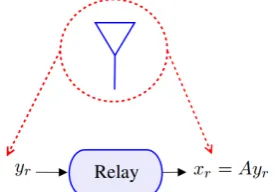
Fig. 1: Amplify and forward relaying scheme.
Fig. 2: Multi-branch single relay cooperative diversity transmission
The rest of this paper is organized as follows. System model is presented in section 2. In section 3, we consider sum relay power constrained optimization problem. Subject to maximum relay power constraint, optimal power allocation policy is derived in section 4. Optimal energy management for EH relays is studied in section 5. In section 6, we present numerical results and finally, the paper is concluded in section 7.
2- System Model
Assume that the source node, say S, sends the information to the destination node, say D, through cooperating relays. Three different cooperative diversity strategies, wherein some independent relays are cooperating to transmit data from the source to the destination, are investigated. Throughout the paper, it is presumed that relays apply AF relaying scheme as demonstrated in Fig. 1. In the following subsections, the three cooperative relaying scenarios are presented.
2- 1- Multi-Branch Single Relay Cooperative Diversity In this cooperating network, there are N parallel relays as depicted in Fig. 2. Relays receive the signal from S and amplify and retransmit over mutually orthogonal channels to D. Moreover, there is one direct data link from S to D. The received signal at the relays is formulated as
, 1, ...,
i i i
r s r
y
=
h x n
+
i
=
N
(1) where x is the transmitted symbol from S with E(x2) = ps,
h
siis the channel coefficient from S to ith relay, and
i
r
n
∼N(0,i
r
N
) is the Additive White Gaussian Noise (AWGN) at ith relay. The transmitted signal by the relays is given by, 1, ...,
i i
r i r
x
=
A y
i
=
N
(2) where Ai is the relay amplification factor andx
ri is the transmitted symbol from ith relay such that E( 2i
r
x
) = pi, which is the consumed power at the ith relay.Finally, the received signal at D is as follows
, 0,1, ...,
j j j j
d d r d
y
=
h x
+
n
j
=
N
(3)where ndj∼ N(0,ndj) is AWGN at the destination for all j,
0 d
h
denotes the direct link channel coefficient from source-to-destination,h
dj for j = 1, ..., N denotes the channel coefficient from jth relay to the destination. Note that0 r
Fig. 3: Single-branch multi-relay cooperative diversity transmission.
Applying the Maximum Ratio Combining (MRC) detection technique at the destination, the average SER becomes [14, Eq. 2]
(
)
1
, N 1 1 ,
r
sd sr rd
C N k
SER γ γ γ
=
= +
∏
(4) where ãsd =h p Nd02 s/ sd,2
ãsi=h p Nsi s/ ri and
2 ãid=h p Ndi i/ di are SNR of the links from S to D, S to relay, and relay to D, respectively. Also, k is a constant value dependent on the modulation type and C(N, k) is calculated as [13], [14]
(
)
(
)
1 1
1 2 1
2 1 !
, ,
N r
N r N C N k
k
+ =
+
−
+
=
∏
(5)where [.] denotes the floor function. For simplicity and without loss of generality, let Nsd =Nri =Ndi=1. Therefore, the SER for the multi-branch single relay scenario is rewritten as
(
)
0
2 2 2
1
, 1 1 ,
i i
N
i
s d s s i d
C N k SER
p h = p h p h
= +
∏
(6)2- 2- Single-Branch Multi-Relay Cooperative Diversity In this scenario, as shown in Fig. 3, the transmitted symbol by S is received by the first relay, then it is amplified and serially retransmitted to the other relays. Following the same transmission protocol, the destination receives the signal. The received signals by each node is represented by
1 , 1 1
, for 0,1, ...,
i i i
r i i r r
y
+=
h x
++
n
+i
=
N
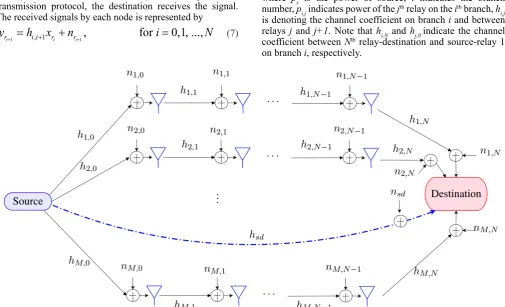
(7)Fig. 4: Multi-branch multi-relay cooperative diversity transmission.
where xriis the transmitted symbol by S with power of p0=
ps,xri is the transmitted symbol by the ith relay, the channel
coefficient between node i and node i+1 is denoted by hi,i+1, and nri+1∼N(0, Nri+1) represents the AWGN noise at node i+1.
The relays also utilize the AF relaying scheme based on (2) for transmission with power pi. Hence, the average symbol error probability is formulated as [13]
( )
0 , 1 1
1, N ,
i i i SER C k
γ
= +
=
∑
(8)where
γ
i i, 1+ is the average SNR at i + 1th relay. Assuming1 1
i
r
N + = , average SER is formulated as
( )
20 , 1 1 1, N
i i i i SER C k
p h
= +
=
∑
, (9)2- 3- Multi-Branch Multi-Relay Cooperative Diversity In this model, besides a direct link between the source and the destination, there exist M parallel paths such that on each one N serial AF relaying exists. Fig. 4 depicts this general cooperative scheme. Utilizing the MRC technique at the destination and following the same steps given in [14, Eq. 15] the average SER is derived as,
(
)
2 2 2
1 0
, ,0 , ,
, M 1 ,N 1
i j
s s d s i i j i j C M k
SER
p h = p h = p h
= +
∏
∑
(10)where ps is the power of source; i indicates the branch number, pi,j indicates power of the jth relay on the ith branch, h
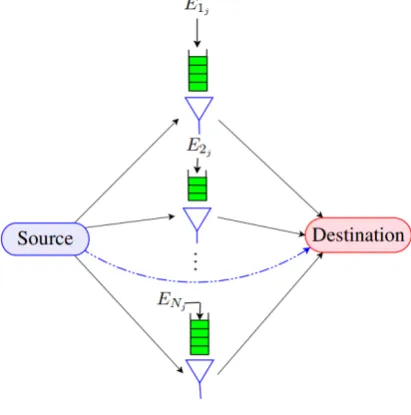
Fig. 5: EH model in multi-branch single relay network at time slot j=1, 2, ..., T
2- 4- EH Relays
In this part, we consider the case where the relays are EH nodes and they have infinite-sized batteries to save energy partially for the future use or consuming the energy for the current data transmission. Thus, we assume that total transmission time is divided by T equal harvesting time slots such that each one has the time duration of L. Also, the harvested energy at the beginning of each time slot at ith relay is denoted by
j i
E for 1 ≤ i ≤ N and 1 ≤ j ≤ T . The EH model for multi-branch single-relaysystem is shown in Fig. 5. SER at jth time slot with 1≤ j≤ T is denoted by SERj. Moreover, we apply offline policy, assuming that harvested energy values Eij for 1 ≤ i ≤ N and 1 ≤ j ≤ T are known beforehand. This policy is a classic assumption which can be accepted in practice through estimation.
Furthermore, the nodes cannot use the energy before the time it is harvested, which is called causalityconstraint. As a result, we have the following energy feasibility constraints at all relays;
1 1
, 1,2, , ,
j j
n n
i i
j j
p L
E
n
T
i
= =
≤
=
…
∀
∑
∑
(11)
where
p L
ij is the consumed energy at ith relay at time slot j. 3- Optimal Power Allocation for total Relay Power ConstraintIn this section, we analyze optimal power allocation (OPA) to minimize the average SER for the three network MIMO scenarios that will be discussed later, provided that total relay power constraint is met.
3- 1- OPA for Multi-Branch Single Relay Cooperative Diversity
Based on the average SER given in (6) for multi-branch single relay scenario, the optimization problem is given by
1 tot 1 , , Minimize
. .: P 0 N n i i i SER p p
s t p
p = … ≤ ≥
∑
(12) where Ptot is the total power consumption at the relays. Theoptimization problem (12) is a convex one [14, Theorem1], since the objective function and constraints presented at (6) are Posynomial functions [27]. Thus, using the same approach in [15], we have nonlinear N+1 equations and N+1 unknowns system as follows
(
)
0
2 2 2 1, 2 2
1
, 1 1 1, , .
l i i
N i i l
s d d s s i d
N l C N k
for i N
p h h p h p h
pl Ptot
λ = ≠
= + = … = ∑
∏
(13)This system of N+1 nonlinear equations and N+1 unknowns can be solved that lets us obtain the optimum relay power policy. OPA for Single-Branch with Multi-Relay Cooperative Diversity and Multi-Branch Multi-relay Cooperative Diversity is presented in [15].
4- Optimal Power Allocation with Maximum Relay Power Constraint
In this section, we consider power management policy for the multi-branch single-relay scenario. In addition, considering the sum relay power constraint, we assume a maximum power constraint at each relay. Hence, none of the relays can consume more energy than its finite-sized battery capacity. Here, we present a heuristic iterative optimization algorithms whose complexity is far less than the conventional optimization ones.
4- 1- OPA for Multi-Branch Single Relay with same power constraint at the relays
Assume that the maximum power constraint is the same for each relay. Therefore, the optimization problem is presented as
1
tot 1
, ,
0 P 1, , ,
1 Maximize
. .: P
N
N r r
p p
pi for r N
SER
s t
=p
…
≤ ≤ = …
≤
∑
(14)where P is the maximum power constraint at the relays. Note that the optimization problem (12) is a special case of the optimization problem (14) where P= ∞. We assume that *
1
p and * 2
p denote the optimum power vectors for optimization problems (12) and (14), respectively. The main idea for optimal solution of (14) is as follow: if Pxdenotes each relay maximum power limit, we first assume that Px is large enough. Then, we gradually reduce Px until Px = P. During the reduction, we find the relays which hold equality to Px step by step. Clearly, if P ≥ max(p1*), then p1*= p*2. To find optimum power policy for (14), we characterize the two following lemmas.
• Lemma 1. If P < max( * 1
p ), at least one element in vector *
2
p is equal to P.
Proof. Assume that all elements of * 2
p are less than P. Thus, rewriting (14) by eliminating the constraint 0 ≤ pr ≤ P for r=1, ...,N must not change the solution and it will lead to the same optimal power *
2
p . On the other hand, this constraint elimination reduces (14) to (12). Thus, we conclude that
* 1
p = *
2
p which is in contrast with the first assumption that
0 ≤ p2r ≤ P < max( * 1
• Lemma 2. If * P < max (p1*) in (14), then 2
p (argmax( * 1
p )) = P. Proof. Assuming that argmax( *
1
p ) is unique, we consider the case that P=max( *
1
p )−ε, where ε is sufficiently small. In this case, *
1
p ≠ *
2
p as the vector * 2
p does not include the element max( *
1
p ) anymore. It can be concluded that
1
SER
(' 1
p
) ≤1
SER
(* 2
p
) ≤1
SER
(* 1
p
), where '1
p = ( *1
1 p , *2
1
p , ..., max( * 1
p )− ε, ..., * 1N
p ) which is the same as *
1
p except in the element argmax( * 1
p ). Evidently, it can be easily observed that
1
SER
(' 1
p
) =1
SER
(* 1
p
)− O(ε)in which O(ε) small enough in the order of ε. It can be seen
that 1 SER(
* 1
p ) ≤ 1
SER( * 2
p ) ≤ 1
SER (δ * 1
p +(1−δ) * 2
p ) ≤ 1
SER( * 1
p
)for 0≤δ≤1, which is resulted from the concavity of SER1
function.
Inserting former equation into the latest inequality, we have 1
SER(p1*) − O(ε) ≤ 1 SER (δ
* 1
p +(1−δ) * 2
p ) ≤ 1
SER( * 1
p ) which shows that the middle phrase value is limited between two extremely close values. Now, if *
1
p and * 2
p
vary significantly more than O(ε) in one or some elements,
the phrase δ * 1
p +(1−δ) * 2
p for 0≤δ≤1 would be a relatively
long line which results in almost fixed and highest possible point for 1
SER function output, which is in contrast with SER1 concavity. In other words, rationally large distance between
* 1
p and * 2
p leads to the conclusion that
(
)
(
* *)
1 2 1 0 1 SER δ δ ∂ =∂ p + − p
for 0 ≤ δ ≤ 1 which contradicts 1
SER concavity. Thus,
( )
* * 1i 2i i å
p −p =O for all i. Knowing that * 1i i
P p− =L for all i
where Li is relatively large for i=1,2, ...,N and i ≠ argmax
( )
p1*, we conclude that * ( )
2i i i å
P p− = +L O for i = 1, 2, ..., N and
( )
* 1i argmax≠ p which is still relatively large. This shows that
if one relay has the maximum value in the optimal solution for (12), by constraining the problem with P for all relays slightly less than this maximum value, no other relay can reach at P. Furthermore, from Lemma 1, we know that if P <max( *
1
p ), at least one relay in the optimal solution for (14) must be equal to P. Hence,
( )
*1
argmax p is the only choice to
be equal with P.
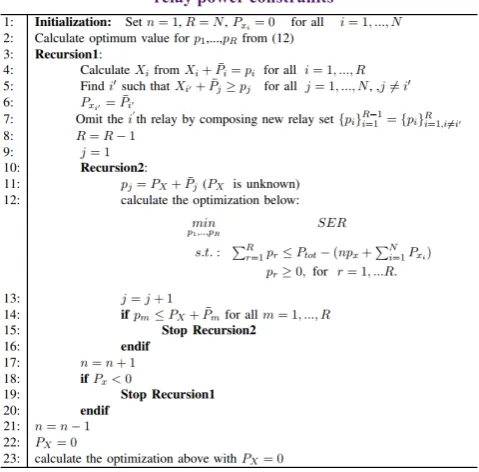
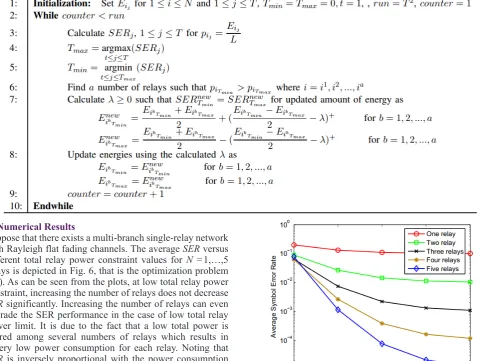
Based on these two lemmas, our proposed algorithm to solve the optimal power allocation problem (14) is given in Table I. Here, we use the solution of (12) to find the maximum relay power consumption. Using Lemma 1 and 2, we fix the power consumption at the mentioned relay at an unknown amount of power
p
x for the next steps. At each step, we find new relay whose power consumption is equal top
x and we calculatex
p
until it reaches at a point belowP
. Now with fixing the power consumptions of all relays, derived in the previous steps, atp
x=
P
, the power consumption at the remaining relays are calculated.4- 2- OPA for Multi-Branch Single Relay with individual power constraint at the relays
Now assume that each relay has its own individual maximum power constraint. Hence, the optimization problem is a modified version of (14), and we have
1 1 Maximize , , tot 1 0 P 1, , ,
. .: P
N SER
p p N
r r pi r for r N
s t p
…
=
≤ ≤ = …
≤
∑
(15)
Table 1. Minimizing SER for sum relays power and maximum relay power constraints
where Pr is the maximum power constraint at the relay r. Note that the optimization problem (14) is a special case of this extended optimization problem. Following the same steps as given in Table I, the optimal power allocation algorithm is presented in Table II. It is worth noting that following the same procedures, optimal solution of other scenarios with individual power constraints could be analyzed.
In (14) and (15), noting that pr ≠0 for all r, we have N+1 constraints (N maximum relay power constraints and one sum relay power constraints). Using the conventional method, we have N+1 Lagrangian multipliers along with N unknown relay power consumptions, i.e. p1, p2, ..., pN . Therefore, we have a system with 2N+1 equations and 2N+1 unknowns. On the other hand, using the algorithms presented in Table 1 and 2, we kept solving the optimization problems with only one constraint and the optimization problem is repeated M times where M ≤ N. Hence, we solve a system of N+1 equations and N+1 unknowns, which is much simpler than a system of (2N +1)×(2N +1). In this way, we prevent the problem from becoming more complex by adding more constraints because adding constraints at most increases the number of repeats, i.e. M.
5- optimal power allocation for eh relays
As will be discussed later, the total transmission time is divided by T equal EH time slots. The harvested energy at each relay in a given time slot could be used by the relay, or the relay could save the harvested energy in its infinite-sized battery for the future use and cannot use energy more than the harvested amount up to any time slot which is named the causality constraint. Without the loss of generality and for simplicity, we assume that the source power consumption is ps, and the statistics of fading channel coefficients of source-relay, i.e.
i s
h , and relay-destination, i.e. hdi, are fixed throughout all time slots.
Here, our goal is to minimize SER at all time slots as much as possible to have a reliable data link over time. Because of the stochastic nature of EH, the energy harvested by the relays in the time slot n might be dramatically less than the other time slot m where 1≤m<n≤T. As a result, SERn>SERm. Thus, the data transmission relay channel is unreliable in nth time slot. Intuitively speaking, the relay can store a part of its harvested energy in mth time slot to be used in nth time slot such that SERn=SERm. It can be done to reduce SERn and in return increases SERm. Although, SER increases in mth time slot, it causes drastic reduction in error rate in nth time slot and makes the system more reliable over the both time slots. In other words, we can store energy at previous slots for the future use to decline high SER. Therefore, in case of the average amount of harvested energy from nature being enough for sufficiently low SER in one time slot, one could expect a uniform reliable information transmission for all time slots. Therefore, by solving simultaneous optimization problems, we keep the sequence of {SERj} low enough at all the time slots.
5- 1- OPA for Single EH Relay
Assume the classical simple AF relay channel with only one relay which is EH. The optimization problem is formulated as
1
Minimize Max (SER | ) , ...,
1 1
0 1,…, ,
1, 2, ,
. .:
Tj m j T p p
n n
j j
j j
pj j T
n T
s t
p L
E
≤ ≤
= =
≥ =
= …
≤
∑
∑
(16)for a backward sequence of m=T, T−1, ..., 1, where Ej is the harvested energy at the beginning of jth time slot and
j p represents the consumed power at jth time slot by the relay.
• Lemma 3. The solution to the optimization problem (16) must satisfy the equality T1 T1
j j j j
p L E
= =
=
∑ ∑
Proof. Assuming that 1 1
T T
j j
j j
p L E
= =
<
∑ ∑ in the optimal solution. Thus,
there must exist a slot 1 ≤ l ≤ T , where some energy ǫ is not
stored but wasted. Now, we can store this amount of energy for the future slot to reduce SER. In this way, we can achieve less SER for the upcoming time slots which is consistent with the main problem objective function for SERj where l ≤ j. Therefore, the total energy is used to achieve the best performance.
• Lemma 4. In the optimal power management in (16), {SERj} is a non-increasing sequence.
Proof. Suppose that there exist k and l such SERk < SERl for
1≤k<l≤T. Therefore, the relay could save some parts of its energy at kth time slot to be used at lth time slot. As a result, we achieve less SER at kth time slot.
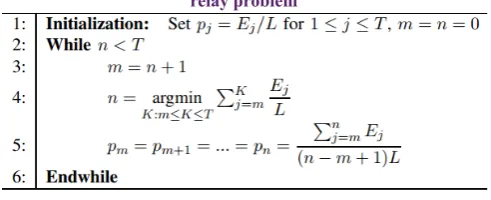
Therefore, we present a water filling solution on the harvested energy in Table III. In this algorithm, we allocate equal powers to each time slot as much as possible to ensure that there is no time slot with a relatively small amount of energy and high SER.
Table 3. Optimal power allocation algorithm for EH single relay problem
5- 2- OPA for Multi-Branch EH Relays
The multi-branch single-relay cooperative scheme depicted in Fig. 5 includes N parallel EH relays. We formulate the optimization problem as
1
Minimize Max (SER | ) , ...,
1,2,…, 1, 2, ,
1 1
0 1,2,…, 1,2,…,
. .:
j
j j
N j m j T
p p
n n
i N n T
i i
j j
pi i N j T
s t
p L
E
≤ ≤
= = …
= =
≥ = =
≤
∑
∑
(17)
for backward sequence of m= T, T−1, ..., 1, where
i
p := (pi1, pi2, ..., piT) for i= 1, 2, ..., N and j= 1, 2, ..., T , and SERj is SER at jth time slot.
Similar to the optimization problem (16), one can prove that the optimal solution must satisfy;
1 j 1 j
T T
i i
j j
p L E
= =
≤
∑
∑
, for 1 ≤ i ≤ N.for 1 ≤ l < l` ≤ T, we have SERl ≥ SERl′ .
Since it is assumed that channel statistics are fixed throughout harvesting period, that is hsi and hdi are fixed for
Table 4. Optimizing the EH multi-branch relay problem
6- Numerical Results
Suppose that there exists a multi-branch single-relay network with Rayleigh flat fading channels. The average SER versus different total relay power constraint values for N =1,…,5 relays is depicted in Fig. 6, that is the optimization problem (12). As can be seen from the plots, at low total relay power constraint, increasing the number of relays does not decrease SER significantly. Increasing the number of relays can even degrade the SER performance in the case of low total relay power limit. It is due to the fact that a low total power is shared among several numbers of relays which results in a very low power consumption for each relay. Noting that SER is inversely proportional with the power consumption at each relay, the low total power consumption leads to a high SER once a relatively large number of relays are active. As expected, for a high total relay power constraint, increasing the number of relays decreases SER. For instance, five active-relay is beneficial for the total relay power of Ptot= 50[dB]. However, for the total relay power of Ptot=30[dB], two relays are enough and increasing the number of relays is not effective in decreasing SER.
In Fig. 7, average SER versus total relay power of multi-branch single-relay network is depicted for optimal and non-optimal power allocations. Here, ps is 30 [dB] and the figure is sketched for five relays. As shown, SER for the equal power allocation policy is almost 10 times higher than that of the optimal power allocation. In Fig. 8, we provided the linear graph for the optimal solution for single-branch multi-relay network for ps=30[dB]. Here, the result for optimal power allocation for multi-branch single-relay network is provided for five relays that are cooperating serially. As expected, the total relay power needed for this scheme is considerably higher than the total relay power for multi-branch single-relay network for the same SER. The equal power allocation performance is also demonstrated for comparison. As displayed, this policy aggravates the system reliability by five times.
Fig. 6: Average SER versus total power constraint for multi-branch single relay network for different numbers of relays.
[See problem (12)].
Fig. 7: Average SER versus total power constraint for multi-branch single-relay network for optimal power policy and
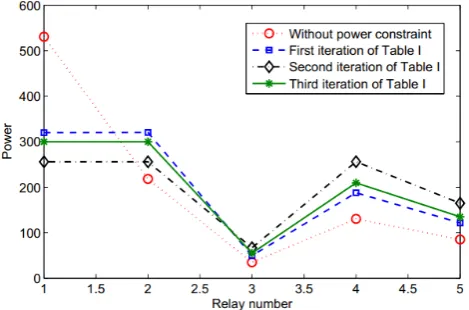
Fig. 8. Optimal power allocation for total and individual relay power constraints based on the iterative algorithm given in
Table 1.
Fig. 9. SER versus time slot index with and without optimal energy management.
Assume a Rayleigh flat fading multi-branch single-relay scenario with the same power constraint at each relay, that is the optimization problem (14), subject to N=5, P=300, and Ptot=1000. Fig. 9 demonstrates the optimal consumption power rates for the five relays based on the iterative algorithm given in Table I. First, we find the solution assuming that there is no power constraint for each single relay but exists total relay power constraint. The red circles denote the associated solution. We see that the power of relay 1 becomes greater than 300 and this solution is not acceptable. After three iterations based on the algorithm given in Table I, the optimal power allocation of all five relays are derived.
Fig. 10 demonstrates the optimal energy management for the single EH relay scenario, i.e. optimization problem (16). Before deriving the optimal energy management, SER is derived for each time slot based on the harvested energies and depicted with blue squares. It is clear that SER3 and SER7 are large and may not be acceptable, i.e. the harvested energies at time slots 3 and 7 have become low. On the other hand, SER2 and SER5 are low enough as the harvested energies at the slots 2 and 5 are high. To achieve minimum SER for all time slots, we have applied iterative algorithm proposed in Table III. Now, by saving some parts of energies at time slots 2 and 5, we can acquire significantly reliable network where SER at all slots is well under 10−3 as demonstrated in the figure.
7- Conclusions
We analyzed the SER minimization in AF relay cooperative networks. First, we introduced total relay power constraint for the three different relaying scenarios and we proved that the optimization problems are convex and the optimal power allocation are derived. Then, we conclude that activating a large number of relays can reduce SER significantly in the case of high total relay power constraint. Besides, we showed that in the case that we are confined with a low total relay power, relatively small number of relays must be activated to minimize SER. Next, we considered the maximum power constraint at each single relay and proved that in the case of no single-relay constraint, the relay at which maximum power is dedicated to the optimal power policy will satisfy single-relay power consumption with equality for the the case of single relay constrained problem. Using this lemma, we introduced two algorithms for the case of fixed and variable single-relay power constraint. At the end, we assumed that relays are EH nodes and the relays are equipped with an infinite-sized battery to save the arrival energy partially for future use and we minimized the maximum SER in all time slots. Here, for the case of single-relay channel, we took traditional water filling algorithm to avoid high SER as much as possible. Then, for the multi-branch single-relay scenario, we proposed near-optimal iterative algorithm by finding the time slots with maximum SER and saved energy from the previous slots to minimize SER through the whole time slots. References
[1] A. Sendonaris, E. Erkip, and B. Aazhang, User cooperation diversity. part i. system description, IEEE Transactions on Communications, 51 (2003) 1927-1938.
[2] J. N. Laneman, D. N. Tse, and G. W. Wornell, Cooperative diversity in wireless networks: Efficient protocols and outage behavior, IEEE Transactions on Information Theory, 50 (2004) 3062-3080.
[3] E. Hossain, V. K. Bhargava, and G. P. Fettweis, Green radio communication networks, Cambridge University Press, (2012).
[4] A. Host-Madsen and J. Zhang, Capacity bounds and power allocation for wireless relay channels, IEEE Transactions on Information Theory, 51 (2005) 2020-2040.
[5] A. Reznik, S. R. Kulkarni, and S. Verd´u, Degraded Gaussian multi-relay channel: capacity and optimal power allocation, IEEE Transactions on Information Theory, 50 (2004) 3037-3046.
[6] M. J. Emadi, A. G. Davoodi, and M. R. Aref, Analytical power allocation for a full-duplex decode and-forward relay channel, IET Communications, 7 (2013) 1338-1347.
[7] X. J. Zhang and Y. Gong, Joint power allocation and
relay positioning in multi-relay cooperative systems, IET communications, 3 (2009) 1683-1692.
[8] M. Mohammadi, M. Ardebilipour, Z. Mobini, and R.-A. S. Zadeh, Performance analysis and power allocation for multi-hop multi-branch amplify-and-forward cooperative networks over generalized fading channels, EURASIP Journal on Wireless Communications and Networking, 1 (2013) 1-13.
Lifetime maximization for amplify-and-forward cooperative networks, IEEE Transactions on Wireless Communications, 7 (2008) 1800-1805.
[10] Y. Chen and Q. Zhao, Maximizing the lifetime of
sensor network using local information on channel state and residual energy, in Proceedings of the conference on information science and systems (CISS), 23 (2005).
[11] S. E. Abdellaoui, M. Debbah, Y. Fakhri, and D.
Aboutajdine, Increasing network lifetime in an energy– constrained wireless sensor network, International Journal of Sensor Networks, 13 (2013) 44-56.
[12] S. Gupta and R. Bose, Energy-efficient joint routing and power allocation optimization in bit error rate constrained multi-hop wireless networks, IET Communications, 9 (2015) 1174–1181.
[13] A. Ribeiro, X. Cai, and G. B. Giannakis, Symbolerror
probabilities for general cooperative links, IEEE Transactions on Wireless Communications, 4 (2005) 1264-1273.
[14] B. Maham, A. Hjørungnes, and M. Debbah,
Power allocations in minimum-energy ser-constrained cooperative networks, Annals of Telecommunicationsannales Des T´el´ecommunications, 64 (2009) 545-555.
[15] M. Abedi and M. J. Emadi, Symbol error rate analysis in cooperative transmission: AF relaying scenarios and optimal power allocations, in Electrical Engineering (ICEE), 2016 24th Iranian Conference on, (2016) 161-166.
[16] S. Gupta and R. Bose, Energy-aware relay selection and
power allocation for multiple-user cooperative networks,
arXiv preprint arXiv:1606.02213, (2016).
[17] H. Y. Lateef, V. Dyo, and B. Allen, Performance
analysis of opportunistic relaying and opportunistic hybrid incremental relaying over fading channels, IET Communications, 9 (2015) 1154-1163.
[18] N. Hussain, K. Ziri-Castro, D. Jayalath, and M. Arafah, Decode-to-cooperate: a sequential Alamouticoded cooperation strategy in dual-hop wireless relay networks,
Telecommunication Systems, 64 (2017) 355-366.
[19] M. I. Khalil, S. M. Berber, and K. W. Sowerby, Bit error rate performance analysis in amplify-and-forward relay networks, Wireless Networks, 23 (2017) 947-957.
[20] S. Ulukus, A. Yener, E. Erkip, O. Simeone, M. Zorzi,
P. Grover, and K. Huang, Energy harvesting wireless communications: A review of recent advances, IEEE Journal on Selected Areas in Communications, 33 (2015) 360–381.
[21] K. Tutuncuoglu and A. Yener, Optimum transmission
policies for battery limited energy harvesting nodes, IEEE Transactions on Wireless Communications, 11 (2012) 1180–1189.
[22] P. Liu, S. Gazor, I.-M. Kim, and D. I. Kim, Noncoherent relaying in energy harvesting communication systems, IEEE Transactions on Wireless Communications, 14 (2015) 6940-6954.
[23] Y. Feng, Z. Yang, W.-P. Zhu, Q. Li, and B. Lv, Robust
cooperative secure beamforming for simultaneous wireless information and power transfer in amplify-andforward relay networks, IEEE Transactions on Vehicular Technology, 66 (2017) 2354–2366.
[24] X. Wang, J. Liu, C. Zhai, S. Ma, and Q. Wang, Energy
efficient relay networks with wireless power transfer from a multi-antenna base station, Transactions on Emerging Telecommunications Technologies, (2015).
[25] A. Arafa and S. Ulukus, Optimal policies for wireless networks with energy harvesting transmitters and receivers: Effects of decoding costs, IEEE Journal on Selected Areas in Communications, 33 (2015) 2611-2625.
[26] M. Abedi; M. J. Emadi, B. Shahrasbi, Optimal energy management for energy harvesting transmitter and receiver with helper, Information Theory and Its Applications (ISITA), 2016 International Symposium on, (2016) 562-566.
[27] S. Boyd and L. Vandenberghe, Convex optimization, Cambridge university press, (2004).
Please cite this article using:
M. Abedi and M. J. Emadi, Optimal Power Management to Minimize SER in Amplify-and-Forward Relay Networks, AUT J. Elec. Eng., 50(1)(2018) 31-39.