Experimental and predicted mechanical properties
of Cr
1
x
AI
x
N thin
fi
lms, at high temperatures,
incorporating
in situ
synchrotron radiation X-ray
di
ff
raction and computational modelling
†
Ehsan Mohammadpour,aZhong-Tao Jiang, *a
Mohmmednoor Altarawneh, b Nicholas Mondinos,aM. Mahbubur Rahman,aH. N. Lim,cN. M. Huang, d Zonghan Xie,eZhi-feng Zhoufand Bogdan Z. Dlugogorskib
Cr1xAlxN coatings, synthesised by an unbalanced magnetic sputtering system, showed improved microstructure and mechanical properties for 14–21% Al content. In situSR-XRD analysis indicated various crystalline phases in the coatings that included: CrN, AlN,a-Cr with small amounts of AlO2and Al2O3 over the 25–700C range. Al doping improves resistance to crystal growth, stress release and oxidation resistance of the coatings. Al doping also enhances the coating hardness (H) from 29 to 42 GPa, elastic modulus (E) from 378 to 438 GPa and increased the resistance to deformation. First-principles and quasi-harmonic approximation (QHA) studies on bulk CrN and AlN were incorporated to predict the thermo-elastic properties of Cr1xAlxN thin film coatings in the temperature range of 0– 1500C. The simulated results atT¼1500C give a predicted hardness ofH¼ 41.5 GPa for a21% Al doped Cr1xAlxN coating.
1.
Introduction
3-d transition metal nitrides, such as CrN and TiN, combine attractive physico-chemical, electronic, optical, magnetic, mechanical and thermal properties.1 These composite
mate-rials have shown a wide range of technical applications in various key industrial areas. For example, due to their extreme hardness, high melting point and superior chemical stabilities, nitride-based ceramic coatings have been used for high-speed machining,2 cold forming, moulding dies,3 sliding parts and
rocket nozzles.4It is noted that CrN has signicant superiority
over TiN in wear, corrosion resistance,5 and anti-oxidative
properties at temperatures up to 700C.6
Vacuum sputtering technique is an outstanding method for synthesising high quality CrN ceramic thinlm coatings with superior structural, mechanical and tribological properties.3,4
These studies have been extended to ternary combinations of CrN with doping of other elements,e.g., Al,7Si,8,9Ti,10V,11Nb12
or Cu.13The doping elements mainly distribute in the
amor-phous layers which surrounds the columnar structured nano-crystalline (nc-) CrN grains. These amorphous layers can effectively enhance many mechanical properties of such thin lm coatings. In particular, Al has shown great potential in improving the hardness14 as well as corrosion and oxidation
resistances.15,16This Cr–Al–N framework is of particular interest
as they can form aluminium oxides on the top surface layers which suppress the diffusion of oxygen into the coatinglm. Analysis indicated the thin lm coatings have enhanced chemical stability, good mechanical properties, good tribolog-ical properties, high temperature stability (up to 1000C) and exhibit excellent oxidation resistance.3,11,17
Characterisation at room temperature indicated that Al signicantly affected the preferred grain orientation of the thin lms.18TEM and XPS studies indicated that amorphous AlN
existed at the columnar CrN grain boundaries. The incorpora-tion of Al introduced compressive residual stress to the coating material lattice. Moreover, the mechanical properties such as hardness, elastic strain and plastic deformation resistance of the coatings showed signicant improvement over non doped CrN coating. These clearly indicated the crucial role of Al in aSurface Analysis and Materials Engineering Research Group, School of Engineering &
Information Technology, Murdoch University, Murdoch, WA 6150, Australia. E-mail: Z. [email protected]; Tel: +61 8 9360 2867
bSchool of Engineering & Information Technology, Murdoch University, Murdoch, WA
6150, Australia
c
Department of Chemistry, Faculty of Science, University Putra Malaysia, 43400 UPM Serdang, Selangor, Malaysia
dFaculty of Engineering, Xiamen University of Malaysia, Jalan Sunsuria, Bandar
Sunsuria, 43900 Sepang, Selangor Darul Ehsan, Malaysia
eSchool of Mechanical Engineering, University of Adelaide, SA 5005, Australia
fDepartment of Mechanical and Biomedical Engineering, City University of Hong Kong,
Kowloon, Hong Kong, China
†Electronic supplementary information (ESI) available. See DOI: 10.1039/c7ra00342k
Cite this:RSC Adv., 2017,7, 22094
Received 9th January 2017 Accepted 13th April 2017
DOI: 10.1039/c7ra00342k
rsc.li/rsc-advances
PAPER
Open Access Article. Published on 20 April 2017. Downloaded on 28/04/2017 02:42:03.
This article is licensed under a
Creative Commons Attribution 3.0 Unported Licence.
producing a combination of superior hardness and excellent damage resistance in nc-CrN frameworks.18
In the present work, in situ synchrotron radiation powder diffraction (SR-XRD) beamline was employed to quantitatively investigate the changes in phase composition and microstruc-ture of Cr1xAlxN thinlm coatings as a function of Al content at
different measurement temperatures in an atmospheric envi-ronment. Rietveld analysis of high resolution SR-XRD data and nanoindentation measurements will provide quantitative results, hence making a connection between microstate phases and mechanical properties of the coating. Density Functional Theory (DFT) calculations and Quasi-Harmonic Approximation (QHA) are employed to estimate the cell-volume, thermal expansion and hardness of Cr1xAlxN system at temperatures up to 1500C.
2.
Experimental
2.1 Thinlm coatings preparation
Cr1xAlxN coatings with a total lm thickness of 2 mm were
deposited on M2 high speed steel substrates at 550 C using a closedeld unbalanced magnetron sputtering system (Teer Coatings Ltd, UK) with a four-target conguration. The coating process were described in detail by Liet al.18and Woet al.19
2.2 In situSR-XRD characterizations
In situ SR-XRD experiments were performed on the Powder
Diffraction beamline at the Australian Synchrotron with monochromatic X-rays,l¼0.827A, veried by standard refer-˚ ence material (LaB6 660b) as supplied by the USA National Institute of Standards and Technology (NIST). The incidence angles of the X-ray beam (u) were in range of 4.1 to 5.9. The diffraction data were collected by a Mythen microstrip detector over the range of 10 # 2q # 89 in at-plate asymmetric reection geometry. The coated substrates were mounted on a Pt heating stage in an Anton Paar HTK-2000 high temperature furnace and aligned to the centre of rotation on the diff rac-tometer. The heating rate was 10 C min1 from ambient temperature up to 700C in air atmosphere.20The temperature
difference between the sample surface and Anton Parr furnace was calibrated manually before thein situexperiments carried out. Diffraction patterns were obtained at three temperatures (25, 200 and 500C) below and two temperatures (600 and 700 C) above the deposition temperature of 550 C due to time
constrains at the synchrotron facilities. Each data acquisition at designated temperature was 120 s.
The diffraction patterns were analysed with the TOPAS v5 academic soware21using the Rietveld method.22The atomic
positions for the structural models, based on the main identi-ed phases of the coating, were extracted from Crystallography Open Database.23Modelled peak shapes were used to determine
the volume-weighted mean crystallite sizes (Lvol) and micro-strain (e0). An accurate description of the peak shapes, in all of the diffraction patterns, was obtained by applying correctional functions for aat plate inxed incident beam geometry.24–26
The initial parameters for the renement, as well as phase determination, were obtained from the JCPDS cards.
2.3 Nanoindentation measurements
Young's modulus and hardness of the coatings were measured, at room temperature (25 C), by a calibrated Ultra-Micro Indentation System, UMIS-2000 equipped with a Berkovich indenter. A maximum load of 20 mN was applied in 10 incre-ments. The loading rate used was 2.5 mN s1and represented the static response of the materials. The area function of the indenter tip was calibrated using a standard fused silica spec-imen. Load control method with a maximum loading of 5 mN was employed for calibration. The peak loading is based on the considerations that the maximum displacement during inden-tation should be no more than 10% of the coating thickness. For better resolutions, the number of test points were 20 for loading and 20 for unloading.
2.4 DFT computational simulations
All structural optimizations and calculations were performed with the generalized gradient approximations (GGA) using the PW91 functional27 as implemented in the VASP package.28
Energy cut-offfor plane waves included in the expansion of wave functions was 500 eV. Pseudo-atomic calculations were per-formed for Cr: 3d54s1, Al 3s23p1and N 2s22p3.k-Point sampling for reciprocal space integration was optimised and adopted a 21
2121 Gamma scheme for cubic structures. CrN in contrast to other early transition metal (Ti, Sc, V,.) nitrides, needed additional effort due to the local magnetic moments of the Cr atoms in CrN structure. The calculations for bulk CrN was carried out for both paramagnetic (CrN-m) and non-magnetic (CrN-nm) structures.
The thermodynamic properties of cubic phases were explored using the quasi-harmonic Debye–Slater model as implemented in Gibbs2 code.29In all temperature dependent
property calculations, the Vinet's equation of state was adopted to t the energy–volume curves.30 To calculate the elastic
constants and determine the second derivatives, we used anite differences method as implemented in VASP package (IBRION¼6).
3.
Results and discussion
3.1 Structural analysisvia in situsynchrotron radiation XRD technique
The surface elemental composition and chemical bonding state, obtained from previous XPS analysis and full discussion of the coatings by Li et al.18 indicated the existence of CrN,
Cr2O3, AlN and Al2O3phases in the coating surface region, are summarised in Table 1.
The JCPDS cards used for phase identication in the SR-XRD spectra: 00-076-2494 (CrN), 00-025-1495 (AlN), 00-901-4565 (AlO2), 00-900-9676 (Al2O3), 00-035-0803 (Cr2N), 00-901-3484 (a -Fe) and 00-041-1351 (Fe3W3C). The atomic positions for Fe3W3C were taken from.31Thein situfull patterns of all samples, for all
temperatures, are included in the ESI section (Fig. S1–S4†). For clarity the spectra for each temperature are combined in one plot for each sample.
Open Access Article. Published on 20 April 2017. Downloaded on 28/04/2017 02:42:03.
This article is licensed under a
The Rietveld renement of the diffraction spectra resulted in R-weighted pattern (Rwp) values in the range of 15–20. The largest errors in the renement models are mainly due to the incom-plete crystallographic data for the substrate. An example of a typicaltted spectrum is indicated by Fig. 1, which shows the Rietveld renement for the C1 sample at 700C withR
wp¼15. The allowedhklvalues for each phase are indicated by the small vertical bars. The difference between experimental and modelled results is indicated by the difference plot above thehklbars.
Basically all 20 spectra shown in Fig. S1–S4 of the ESI† section were analysed by Rietveld analysis with similar plots as Fig. 1 producing data used for further analysis as indicated in Fig. 2–6. The phases of the C1 sample at different temperatures was similar to the sample (denoted as CrN-M2ST) recorded in Mohammadpouret al.20
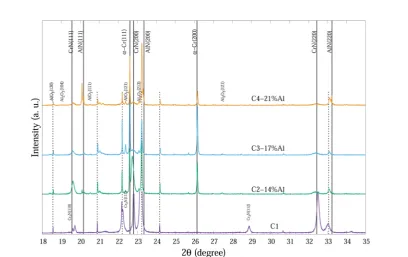
SR-XRD diffraction patterns at 25 C of as-deposited Cr1xAlxN coatings are depicted in Fig. 2. For clarity the 2q
range in Fig. 2 is from 18to 352qconsisting of the main peaks for each individual phase.
The compositions of the main phase in as-deposited CrAlN thinlm coatings were determined to be CrN and AlN phases.
Thin lm coating C1 showed strong intensity in (200), (220) directions at 22.8 and 32.4 2q, respectively for the CrN phase. In the Al doped samples the dominant orientations of the CrN phase are in the (200) and (111) planes. These diffraction peaks became broader and of lower intensity as the Al content increased (C3-17% Al and C4-21% Al) indicating a combination of small grain size and high concentration of possible amor-phous nature. The peaks at 20.2, 23.4and 33.32qin the C4-21% Al sample are identied as diffractions from c-AlN (111), (200) and (220) planes, with some overlap with substrate (a-Fe) diffraction peaks. The conrmation of the AlN phase in SR-XRD pattern agrees with the NEXAFS results by Mahbuburet al.32and
XPS analysis by Liet al.18from similar coatings. All samples in
as-deposited condition (25) had Al2O3and Cr2O3phases detected by XPS but SR-XRD did not show any noticeable peaks related to those oxides. This could be due to (i) most of oxygen accumulate in the top surface layers of thinlms, and (ii) possible amor-phous state of the oxide phases. However, at temperatures >500 C minor amounts of Al2O3 and metastable AlO2 were observed from the diffraction patterns (Fig. 3).
Fig. 3 indicates the main phases of these coatings at 700C. Diffraction spectra of CrAlN coatings at 700C showa-Cr, AlO2 and Al2O3phases. Peaks at 22.60, 26.16and 37.332qcan be determined asa-Cr (111), (200) and (220), respectively. Agouram et al.33concluded that the phase content of CrN
x-based coatings
is strongly inuenced by deposition processes. The presence of
a-Cr in CrNxcoatings can reduce the hardness; however, it may
improve the coating toughness or as a metallic source which diffuse outward and contribute in the formation of surface oxidation layers. Although hexagonal-structured Cr2N (h-Cr2N) exhibits higher hardness than cubic CrN, it is more susceptible to oxidation which can deteriorate the thermal stability of the
Table 1 Elemental composition of the Cr1xAlxN coatings determined
by XPS
Coating notation
Element (at%)
Cr Al N O
C1 33.4 0 34.9 31.7
C2-14% Al 27.5 14.2 31.8 26.6 C3-17% Al 16.6 17.2 29.4 36.8 C4-21% Al 19.1 21.4 30.4 29.0
Fig. 1 Experimental SR-XRD and Rietveld refinement profile of C1 coating at 700C. The allowedhklvalues for each phase are indicated by the
small vertical bars.
Open Access Article. Published on 20 April 2017. Downloaded on 28/04/2017 02:42:03.
This article is licensed under a
C1 thinlm with considerable h-Cr2N content especially at high temperatures.20 It seems Al doping successfully prevents the
formation of h-Cr2N in the CrAlN coatings even at lowest Al percentage (C2-14% Al) in the temperature range of study. Our observations did not conrm any possible existence of Cr2O3 crystalline phases in the column structure of coatings; that may indicate (i) small amorphous structures distributing in grain boundary regions, and (ii) either amorphous or crystalline
phase structure in the very top surface layers of thinlms where normal XRD cannot fully determine the phases (Grazing inci-dence SR-XRD would be able to provide more precise surface crystalline information). The shis of diffraction peaks from substrate, especially for Fe (111) at 23.8is probably due to the thermal expansion of the unit cells at elevated temperatures. Peaks related to CrN and AlN phases exhibited some sharpening with increasing temperature.
Fig. 2 SR-XRD diffraction patterns at25C of as-deposited Cr1xAlxN coatings with various Al contents. The dashed vertical lines indicate
substrate peaks.
Fig. 3 SR-XRD diffraction patterns at 700C of Cr1xAlxN coatings with various Al contents. The dashed vertical lines indicate substrate peaks.
Open Access Article. Published on 20 April 2017. Downloaded on 28/04/2017 02:42:03.
This article is licensed under a
From the Rietveld rened SR-XRD data, the lattice constants of the CrN and c-AlN phases in the Cr1xAlxN coatings were
calculated and plotted as a function of temperature in Fig. 4. The lattice constant of CrN decreases continuously from 4.21˚A to 4.17A for C1 and to 4.19˚ ˚A for the Al doped samples. The overall changes of the lattice constant for the CrN phase are slightly smaller in the samples with Al doping than without doping. Overall, the lattice parameter values agree with the experimental values from other sources, such as Barshiliaet al.34(4.09 to 4.16
˚
A) and Elangovanet al.35(4.15 to 4.17˚A). Lattice constants of
c-AlN (in sample C4-21% Al) increased steadily from approxi-mately 4.09˚A at room temperature to 4.1˚A at 700C indicating unit cell expansion by 0.5%. The lattice constant ofa-Cr phase, in all samples at 700C, were 3.65˚A10%.
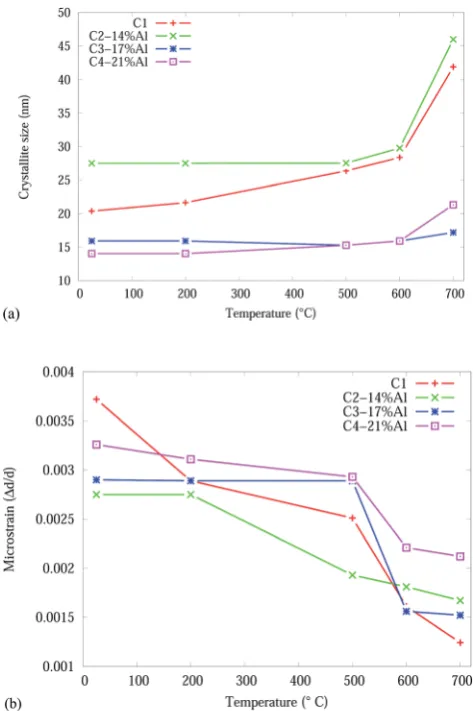
The crystallite size and microstrain as a function of temperature, from Rietveld analysis, for the CrN phase are shown in Fig. 5. The Effect of adding Al onto the microstructure of the as-deposited coatings is more pronounced in C3-17% Al and C4-21% Al coatings exhibiting about 30% smaller crystallite sizes compared to Al free and C2-14% Al samples. The crystallite sizes in all samples gradually increased in the temperature range 25 to 600C and then abruptly increased from 600 to 700 C. C1 and C2-14% Al show the highest crystallite size growth by 100% and 67%, respectively. The higher Al content in C3-17% Al and C4-21% Al effectively prevented the crystallite growth of CrN during heating below 700C. Above, 600C the CrN crystallite size in C4-21% Al increases by34%. The most stable crystallite size for CrN is exhibited by C3-17% Al with an 8% crystallite growth. The crystallite sizes of thea-Cr phase are 1832 (C2-14% Al), 1780 (C3-17% Al) and 828 (C4-21% Al) nm in the 700C Cr1xAlxN samples.
Our observations showed that microstrain in C1 sample decreased by67% during heating which is almost1.7of the microstrain release in samples with Al contents. The residual stress in these types of coatings could be due to two mechanisms (1) thermal stress and/or (2) accumulation of defects (dislocations, vacancies, etc.) in the coating layer. Thermal stress is a resultant of the difference in the coefficient
of thermal expansion (CTE) value for coating and substrate. The decline of internal stress in the coatings could be a result of absorption and annihilation of defects during annealing. It allows the defects to diffuse through the lattice and to be absorbed at grain boundaries and dislocation cores. This seems to be more pronounced in the binary CrN coating case. The presence of amorphous content in Cr1xAlxN coatings at grain
boundaries hinders stress release in the coatings which resist against coating soening.
The stress in the coating structure, from the changes in dspace for CrN (220), is shown in Fig. 6. Similar plots for the (111), (200) and (311) planes of CrN phase are included in Fig. S5–S7 of the ESI section.†The stress (s) in the coating were calculated based on eqn (1) using the elastic properties of CrN (elastic modulus,E¼300 GPa and Poisson ratio,n¼0.28).36
s¼ ð1EnÞ dd0
d0 (1)
wheredandd0are from the experimental diffraction patterns and JCPDS card of CrN, respectively. Renement data show that there is considerable amount of residual stress in the as-deposited coating structure. Stress values in Al free coating decreases progressively as temperature increases from 25 to
Fig. 4 CrN and c-AlN lattice constants, from Rietveld analysis, in
Cr1xAlxN coatings as a function of thein situexperiment temperature.
Fig. 5 Effect of temperature on the CrN phase in the Cr1xAlxN
coatings, from Rietveld analysis: (a) crystallite size (b) microstrain.
Open Access Article. Published on 20 April 2017. Downloaded on 28/04/2017 02:42:03.
This article is licensed under a
700C by56%. The stress release in samples containing Al is slower as Al content increases and reduced to only11% in C4-21% Al coating. Based on observations in Fig. 5(b) and 6, there is a direct correlation between residual strain, stress and Al at% in the coating composition.
3.2 Experimental mechanical properties of CrAlN coatings
Nano-indentation tests, for Cr1xAlxN coatings at as-deposited
conditions and aer the completion of the in situ SR-XRD experiment (heated samples), were undertaken at room temperature. The hardness (H) and elastic modulus (E) for these coatings are set out in Table 2 and Fig. S8 and S9 of the ESI section.†Analysis of Table 2 and the plots clearly indicate that there is no difference in H and E, within the experimental errors, between the as-deposited and heated sample. The resistance to deformation is indicated byH3/E2and plotted in Fig. S10 of the ESI section.†The coatings with smaller crystallite size/higher microstrain present greater hardness (C3-17% Al and C4-21% Al samples) in as deposited condition. Improve-ment in coating hardness conrms the microstructure rening effect of Al dopants.
Thesendings are consistent with the quantitative SR-XRD measurements of crystallite size and micro strains in the Al doped coatings that exhibited very little hardness drop aer heating. The calculated ratio ofH3/E2improved signicantly in samples containing Al compared to the reference sample (C1).
However, there is no change in resistance to deformation between as deposited and heated conditions of the samples. The combination of microstructure and nanoindentation studies indicate that the hardness of the as-deposited nano-crystalline coatings can be controlled by several parameters such as phase composition, crystallographic directions, crys-tallite size and residual stress/microstrain.37
3.3 Density functional theory modelling
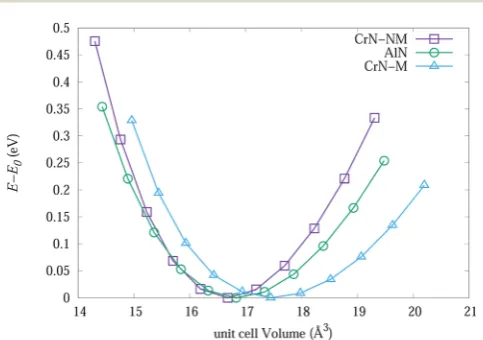
3.3.1 Structural optimization. The energy and lattice constant of bulk CrN-nm, CrN-m and c-AlN were optimized to nd the most stable ground state. Fig. 7 shows changes in energy of the unit cell (DE¼EE0)versusprimitive unit cell volumes for each structure used for predictions of thermody-namic properties.
Table 3 lists experimental lattice parameter values from SR-XRD data and DFT calculations from present work and available literature. The calculated lattice parameter for CrN-m (spin-polarised) is closer to SR-XRD results. The magnetic moment for each Cr atoms in CrM-m structure converged to 2.044mB which is within range of 1.9 to 2.28 mB from calculations of Filippettiet al.38
The QHA method (Debye model) was used to predict the thermal expansion of the studied bulk structures as a function of temperatures. Fig. 8(a) and (b) are plots of the experimental and theoretical lattice parameters, with respect to temperature, for bulk CrN and c-AlN phases in the temperature range 0– 1500 C, respectively. Fig. 8(a) also includes lattice constant calculated from the experimental thermal expansion coeffi -cient,a(T), of Zhouet al.46witha
0¼4.14˚A (standard CrN phase) at room temperature. Fig. 8(a) clearly shows the CrN-m model is highly compatible to the experimentally obtained data. The CrN lattice constant at room temperature for all samples differ from the simulation values within 1.6%. Interestingly these converge to the simulated results with increasing temperature resulting in a0.4% difference at 700C. The most signicant drop in lattice constant values of CrN occurs to C1 sample which is very close to QHA model at 700C.
Table 2 Nanoindentation, at 25 C, of Cr1xAlxN coatings:
as-deposited and heated samples
Sample
As-deposited Heated
H(GPa) E(GPa) H(GPa) E(GPa)
C1 292 37821 282 37622 C2-14% Al 353 40127 353 39625 C3-17% Al 393 42138 393 42130 C4-21% Al 423 43832 423 43632
Fig. 7 The change in energy of primitive unit cells for bulk CrN-nm,
CrN-m and c-AlN as a function of cell volume.
Fig. 6 Effect of temperature on the residual stress, from eqn (1), for
CrN (200) orientation in Cr1xAlxN coating.
Open Access Article. Published on 20 April 2017. Downloaded on 28/04/2017 02:42:03.
This article is licensed under a
Quasi-binary systems like Cr1xAlxN coatings with a mixture
of NaCl-structured CrN/AlN phases can form (Cr,Al)N solid solutions up tox¼0.75.47Phase segregation during deposition
results in a mixture of fcc-structured Cr-rich (Cr,Al)N and AlN28,48which will increase the coating hardness due to
activa-tion of solid-soluactiva-tion hardening mechanism. Theoretical49and
experimental47,50studies show that substitution of Cr atoms (r¼
1.4A) with Al atoms (r˚ ¼ 1.25A) can progressively decrease˚ lattice constant of CrN phase as Al content increases. However, smaller Al atoms can incorporate into interstitial positions in
CrN structure which can expand the lattice constant as observed for CrSiN coating.19,51
The c-AlN lattice parameter in C4-21% Al are in good agreement with experimental data from Tkadletz et al.52 as
indicated in Fig. 8(b). The experimental results are within
0.3%, of the simulated QHA results up to 700C.
Overall the differences between the simulated and experi-mental results is due to the use of pure homogeneous bulk material in the Debye (QHA) model calculations, and the solid solution of different nitride phases of the thinlm coatings.
3.3.2 Prediction of elastic constants. Three independent elastic constants are needed to describe the behaviour of cubic-structured materials to stress and can be used to describe the nature of the bonds between atoms in the crystals. These constants (C11,C12andC44) were calculated for CrN-nm, CrN-m and c-AlN at zero K and zero pressure and listed in Table 4. The mechanical stability of these phases can be ascertained by using the following criterion for cubic systems:53
C11+ 2C12> 0,C11C12> 0,C44> 0,C11> 0,C11>B>C12 (2)
All of these conditions were satised by the CrN and c-AlN phases indicating the mechanical stability of these structures. The overview of available literature as shown in Table 4 indicates that the reported calculated values for elastic constants and modulus are widely scattered and depend on the choice of k-points, cut-offenergies, functional (s) and simulation packages. As an example, Yanet al.42and Briket al.54used the CASTEP
module of Materials Studio package with different settings ofk points grids and cut offenergies for CrN-nm analysis. With 88
8 (400 eV) and 101010 (320 eV)kpoints grids the authors calculatedC11values of 526 and 546 GPa, respectively.
ESI section Tables S2 and S3†show the inuence ofk-points grids selection on the elastic constants of CrN-m and CrN-nm for the present project. To calculate the elastic constants for CrN-m and CrN-nm,k-point grids of 212121 and 3131
31 were chosen for the simulations. The results of these analyses are tabulated in Table 4. The calculated elastic constants for CrN-nm in present study are comparable (2%) with calculations of Zhou46who used similar approachviaVASP
package and projector-augmented wave (PAW) method. The values of C11 and C12 for c-AlN underestimate by 9% the calculations of Wanget al.45carried out by VASP package and
PAW method.
The positive difference betweenC11andC44(C11C44¼582 for CrN-nm), known as Cauchy pressure, indicates the metallic bonding nature of Cr-N structure55 which is comparable to
much smaller difference for AlN (C11 C44 ¼ 83). Cauchy pressure is also a sign of the ductility of materials, since it indicates the angular character of atomic bonding in metals. A positive Cauchy pressure reveals ductility of crystal, while a brittle material exhibits a negative value.56Bulk modulus (B),
shear modulus (G) and Young's modulus (E) for each phase were estimated by applying Voigt–Reuss equations57 and
compared with available literature.
Table 3 Lattice constant from experimental SR-XRD and DFT
calculations
Phase
Lattice constant,a(A)˚
Experimental Calculated
CrN-nm 4.17–4.20
4.12 (ref. 39) 4.05
4.18 (ref. 40) 4.051 (ref. 42) 4.145 (ref. 41)
CrN-m — 4.12
4.173 (ref. 43 and 44) c-AlN 4.07 4.068
4.06 (ref. 45)
Fig. 8 Theoretical and experimental lattice constants: (a) CrN and (b)
c-AlN phases.
Open Access Article. Published on 20 April 2017. Downloaded on 28/04/2017 02:42:03.
This article is licensed under a
The calculated results, at 0 K, from Table 4 are spread out but have similar magnitudes including the 2 experimental values at
25C. Thek-point grids that optimised the calculation of the elastic constants and unit cell volumes will be used in the DFT and QHA simulations.
QHA method for CrN and c-AlN are used to predict the hardness of two binary compounds (CrN and c-AlN) in a wide temperature range (25–1500 C). The method for calculating the hardness of materials is based on atomic potentials and bond strength developed by ˇSim˚unek and Vack´aˇr61 for
single crystals and then extended to binary compounds. The hardness of a crystal can be calculated by introducing its bond strength (Sij):
Sij¼
ffiffiffiffiffiffiffi
eiej p
dijnij
(3)
whereeiandejare atomic potentials ofiandjatoms,
respec-tively, and are dened as the valence electron number divided by the radius of the atom;dijis the distance of the nearest atomj
to atomiandnijis the number of bonds between atomiand its
neighbouring atomsj.
For binary compounds, the difference between atomic potentials is:
fe¼
"
eiej eiþej
#2
(4)
The hardness of such a system with volume (V) is dened as:
H¼
C V
ffiffiffiffiffiffiffie
iej p
dijnije
sfe (5)
whereCandsare constants (C¼1450 ands¼2.8).61The DFT
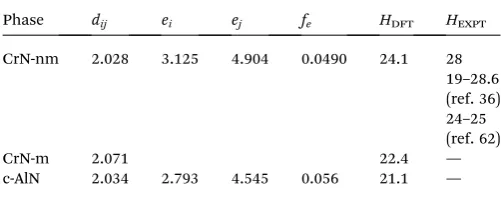
results (atT¼25C) for c-CrN and c-AlN are listed in Table 5. The difference between the calculated value and the experi-mental value for the CrN phase in C1 sample is15%. This difference can be explained by considering the columnar orientation of the coating which is completely different from an ideal single crystal.
Temperature dependent variations in unit cell volume for each structure were obtained from QHA modelling up to 1500C (Fig. 8). Subsequently the bond length,dij,as a function
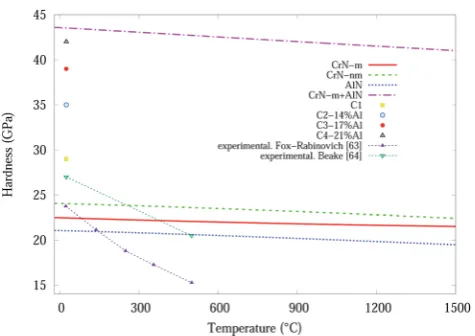
of temperature was deduced from the cell volumes and by use of eqn (5) the hardness values for CrN (CrN-nm and CrN-m) and c-AlN phases. The results of hardness over a wide range of temperatures are shown in Fig. 9. Also plotted in Fig. 9 are the high temperature (25–500C)in situnanoindentation data for commercially available Al0.7Cr0.3N coatings studied by Fox-Rabinovichet al.63and Beakeet al.64Room temperature
nano-indentation results for the current projects' Cr1xAlxN coatings
are also incorporated in Fig. 9.
Based on predicted material behaviours, hardness values for both phases reduced constantly at elevated temperatures. However, there are considerable differences in the reduction slopes depending on the phase type. Hardness values for CrN-nm structure showed the highest resistance to temperature while AlN was more susceptible to temperature. Experimental hardness in Table 2 of Cr1xAlxN samples showed that
nano-composites of CrN in amorphous AlN matrix can effectively improve the resistance to grain boundary sliding65which makes
these samples harder than C1 sample. In addition, the deposi-tion process and doping signicantly distorts the lattice of CrN/ AlN mixture, as is evident in microstrain and residual stress plots, which can also contribute to improve the deformation resistance of doped samples. According toˇSimunek and Vack´˚ aˇr61
the hardness of multicomponent compound systems is expected to be a geometrical sum of the values of hardness of all binary systems in the solid (given by their eqn (6)). Interestingly for the current multicomponent system (at 25 C), consisting of CrN and AlN phases,H¼ H1 +H2¼ 22.5 + 21¼43.5 GPa (H1for
Table 4 Calculated elastic constants (Cij), bulk modulus (B), Young's modulus (E), Poisson ratio (n) of CrN (non-magnetic and spin-polarized) and
c-AlN phases. Calculated and experimental data from literature are denoted by c and e, respectively
Phase C11 C12 C44 B(GPa) G(GPa) E(GPa) n
CrN-nm 588.0 215.1 5.9 340 44 126 0.43
526c,42 226c,42 5c,42 326c,42 35c,42 101c,42 0.43c,42
502c,54 214c,54 4.1c,54 310c,54 58c,58 163c,58 0.41c,58
580c,46 210c,46 8c,46 327c,58 100–250e,36
546c,58 184c,58 20c,58 340c,59
CrN-m 352 88.7 61.0 176.4 93.9 239.0 0.27 369c,42 125c,42 114c,42 192c,42 111c,25 279c,42 0.25c,42 348c,46 117c,46 74c,46
c-AlN 387 149 305 254.3 209 303 0.2788
423c,45 167c,45 306c,45 251c,45 221e,60
Table 5 DFT calculated hardness, atT¼25C, of bulk CrN, AlN based
ondij. Current project and literature experimental data included for comparison
Phase dij ei ej fe HDFT HEXPT
CrN-nm 2.028 3.125 4.904 0.0490 24.1 28 19–28.6 (ref. 36) 24–25 (ref. 62)
CrN-m 2.071 22.4 —
c-AlN 2.034 2.793 4.545 0.056 21.1 —
Open Access Article. Published on 20 April 2017. Downloaded on 28/04/2017 02:42:03.
This article is licensed under a
CrN-m and H2 for AlN) compares remarkably well with the experimental value of 42 GPa for the C4 sample. Here the values correspond to a numerical sum of eqn (5) as opposed to a geometric sum. To show this point more clearly, the simulated data for CrN-m and AlN are added and the plot included in Fig. 9.
The experimental results of Fox-Rabinovich et al.,63 are in
some agreement with the simulated CrN-m, CrN-nm and AlN results for temperatures up to 150 C while they deviate signicantly for higher temperatures up to500C, whilst Beake et al.64results are in agreement over the same temperature range.
It should be noted that the materials in Beake's investigation has a high percentage Al content (70%) whilst our materials have a maximum of21% Al content (C4). The hardness of experi-mental result from C4 and computational modelling from the summation of the CrN-m and AlN components are very similar at room temperature, see Fig. 9. If this is a real relationship, then the magnetic properties of the Cr are important for the formation of stable and hard Cr1xAlxN coatings.
Based on the results from both experiments and computa-tional calculation, the temperature dependent hardness of the synthesized CrN/AlN thin lm nanocomposites can be pre-dicted in the temperature range from 25C to 1500C, refer to Fig. 9. Furthermore a numeric sum for the hardness of the 2 components, atT¼1500C give a predicted hardnessH41.5 GPa. Only real experimental measurements at the 200–1500C range will show if the hardness of the CrN/AlN multicomponent thinlm has the predicted direct sum values.
4.
Conclusions
Synthesised Cr1xAlxN coatings, with a maximum Al content of
21%, by unbalanced magnetic sputtering system showed improved microstructure and mechanical properties compared to undoped CrN coating. Analysis ofin situsynchrotron X-ray diffraction at temperatures range of 200–700 C established: (i) remarkable resistance to crystal growth and stress release up
to 700C for coatings with Al doping greater than14%. (ii) Al-dopants improve oxidation resistance of the coatings by pre-venting the formation of Cr2N at high temperatures.
Nano indentation results at 25 C show: (i) Al doping improved the coating hardness (H) and elastic modulus (E) from 29 to 42 GPa and 378 to 438 GPa respectively, and (ii) resistance to deformation increased as the Al content increased.
First-principles and quasi-harmonic approximations (QHA) studies for bulk magnetic and non-magnetic CrN (CrN-m and CrN-nm) and AlN over the temperature range of 0–1500C were undertaken to calculate elastic constants (Cij) and hardness (H).
Comparison of DFT-QHA models and the nanoindentation results indicate that hardness of Cr1xAlxN coating with21%
Al content may be the sum of values from CrN-m and AlN phase. Our computational modelling predicts that the hardness (H) of Cr1xAlxN coating with the Al content of21% can reach to
about 41.5 GPa atT¼1500C.
Acknowledgements
Ehsan Mohammadpour is highly grateful to the Murdoch University for the awarded scholarship (MIPS). The authors wish to acknowledge the support provided by the Australian Synchrotron with the beamline proposal AS141/PD/7582. The study has also been supported by grants of computing time from the National Computational Infrastructure (NCI), Can-berra, Australia and the Pawsey Supercomputing Centre, Perth, Australia. We acknowledge the support from Dr M. Rowles (Curtain University) for invaluable discussions.
References
1 S. Zhang, Y. Li, T. Zhao and Q. Wang,Sci. Rep., 2014,4(5241), 1–7.
2 J. Y. Cheong, X. Z. Ding, B. K. Tay and X. T. Zeng,Key Eng. Mater., 2010,447–448, 725–729.
3 S. R. Pulugurtha, D. G. Bhat, M. H. Gordon, J. Shultz, M. Staia, S. V. Joshi and S. Govindarajan, Surf. Coatings Technol., 2007,202, 1160–1166.
4 J. Musil,Surf. Coatings Technol., 2012,207, 50–65.
5 X. Guan, Y. Wang, G. Zhang, J. Xin, L. Wang and Q. Xue,RSC Adv., 2016,6, 87003–87012.
6 P. Z. Shi, J. Wang, C. X. Tian, Z. G. Li, G. D. Zhang, D. J. Fu and B. Yang,Surf. Coatings Technol., 2013,228, S534–S537. 7 N. Bagcivan, K. Bobzin and S. Theiß,Thin Solid Films, 2013,
528, 180–186.
8 H. N. Shah, R. Jayaganthan and A. C. Pandey,Mater. Des., 2011,32, 2628–2634.
9 Z. Wu, F. Zhou, Q. Ma, Q. Wang, Z. Zhou and L. Kwok-Yan Li, RSC Adv., 2016,6, 76724–76735.
10 L. Lu, Q. M. Wang, B. Z. Chen, Y. C. Ao, D. H. Yu, C. Y. Wang, S. H. Wu and K. H. Kim,Trans. Nonferrous Met. Soc. China, 2014,24, 1800–1806.
11 P. Panjan, A. Drnovˇsek, J. Kovaˇc, P. Gselman, T. Bonˇcina, S. Paskvale, M. Cekada, D. Kek Merl and M. Panjan,ˇ Thin Solid Films, 2015,591, 323–329.
Fig. 9 Simulated hardness values as a function of temperature for bulk
CrN-m, CrN-nm and c-AlN. Nanoindentation hardness data, at high temperature for Al0.7Cr0.3N thinfilm coatings and room temperature for current Cr1xAlxN coatings.
Open Access Article. Published on 20 April 2017. Downloaded on 28/04/2017 02:42:03.
This article is licensed under a
12 E. Bemporad, C. Pecchio, S. De Rossi and F. Carassiti,Surf. Coatings Technol., 2004,188–189, 319–330.
13 S. Tan, X. Zhang, X. Wu, F. Fang and J. Jiang,Appl. Surf. Sci., 2011,257, 5595–5600.
14 Q. Luo, S. C. Wang, Z. Zhou and L. Chen,J. Mater. Chem., 2011,21, 9746–9756.
15 J. Xu, L. Liu, P. Munroe, Z. Xie and Z. Jiang,J. Mater. Chem. A, 2013,1, 10281–10291.
16 J. Xu, D. Lai, Z. Xie, P. Munroe and Z.-T. Jiang, J. Mater. Chem., 2012,22, 2596–2606.
17 Y. Long, J. Zeng, D. Yu and S. Wu,Ceram. Int., 2014, 40, 9889–9894.
18 Z. Li, P. Munroe, Z. Jiang, X. Zhao, J. Xu, Z. Zhou, J. Jiang, F. Fang and Z. Xie,Acta Mater., 2012,60, 5735–5744. 19 P. C. Wo, P. R. Munroe, Z. Li, Z.-T. Jiang, Z. H. Xie, Z. F. Zhou
and K. Y. Li,Mater. Sci. Eng. A, 2012,534, 297–308.
20 E. Mohammadpour, Z.-T. Jiang, M. Altarawneh, Z. Xie, Z. Zhou, N. Mondinos, J. Kimpton and B. Z. Dlugogorski, Thin Solid Films, 2015,599, 98–103.
21 A. A. Coelho,J. Appl. Crystallogr., 2003,36, 86–95.
22 R. W. Cheary, A. a. Coelho and J. P. Cline,J. Res. Natl. Inst. Stand. Technol., 2004,109, 1–25.
23 S. Graˇzulis, A. Daˇskeviˇc, A. Merkys, D. Chateigner, L. Lutterotti, M. Quir´os, N. R. Serebryanaya, P. Moeck, R. T. Downs and A. Le Bail, Nucleic Acids Res., 2012, 40, 420–427.
24 H. Toraya, T. C. Huang and Y. Wu,J. Appl. Crystallogr., 1993, 26, 774–777.
25 O. Masson, R. Guinebreti`ere and A. Dauger, J. Appl. Crystallogr., 1996,29, 540–546.
26 M. R. Rowles and I. C. Madsen,J. Appl. Crystallogr., 2010,43, 632–634.
27 J. P. Perdew and Y. Wang,Phys. Rev. B, 1992, 45, 13244– 13249.
28 G. Kresse and J. Hafner,Phys. Rev. B, 1993,47, 558–561. 29 A. Otero-De-La-Roza and V. Lua˜na,Comput. Phys. Commun.,
2011,182, 1708–1720.
30 P. Vinett, J. H. Rose, J. Ferrante and J. R. Smith,Phys. Rev. B, 1996,53, 5252–5258.
31 Pierre Villars, PAULING FILE, in Inorganic Solid Phases, SpringerMaterials (online database), Springer, Heidelberg Springer Materials Fe3W3C (W3Fe3C) Crystal Structure http://materials.springer.com/isp/crystallographic/docs/sd_ 1707470.
32 M. Mahbubur Rahman, A. Duan, Z.-T. Jiang, Z. Xie, A. Wu, A. Amri, B. Cowie and C.-Y. Yin, J. Alloys Compd., 2013, 578, 362–368.
33 S. Agouram, F. Bodart and G. Terwagne, Surf. Coatings Technol., 2004,180–181, 164–168.
34 H. C. Barshilia, N. Selvakumar, B. Deepthi and K. S. Rajam, Surf. Coat. Technol., 2006,201, 2193–2201.
35 T. Elangovan, P. Kuppusami, R. Thirumurugesan, V. Ganesan, E. Mohandas and D. Mangalaraj, Mater. Sci. Eng. B, 2010,167, 17–25.
36 L. Cunha, M. Andritschky, K. Pischow and Z. Wang, Thin Solid Films, 1999,355–356, 465–471.
37 D. Rafaja, C. W¨ustefeld, C. Baehtz, V. Klemm, M. Dopita, M. Motylenko, C. Michotte and M. Kathrein,Metall. Mater. Trans. A, 2011,42, 559–569.
38 A. Filippetti, W. E. Pickett and B. M. Klein,Phys. Rev. B, 1999, 59, 7043–7050.
39 Z. G. Zhang, O. Rapaud, N. Bonasso, D. Mercs, C. Dong and C. Coddet,Vacuum, 2008,82, 501–509.
40 S. Yang, E. Wiemann and D. G. Teer,Surf. Coatings Technol., 2004,188–189, 662–668.
41 F. Sanchette, C. Ducros, T. Schmitt, P. Steyer and a. Billard, Surf. Coatings Technol., 2011,205, 5444–5453.
42 M. F. Yan and H. T. Chen,Comput. Mater. Sci., 2014,88, 81–85.
43 I. Scanavino and M. Prencipe, RSC Adv., 2013, 3, 17813– 17821.
44 B. Alling, T. Marten and I. A. Abrikosov,Phys. Rev. B, 2010, 82, 1–9.
45 A. J. Wang, S. L. Shang, Y. Du, Y. Kong, L. J. Zhang, L. Chen, D. D. Zhao and Z. K. Liu,Comput. Mater. Sci., 2010,48, 705– 709.
46 L. Zhou, F. K¨ormann, D. Holec, M. Bartosik, B. Grabowski, J. Neugebauer and P. H. Mayrhofer,Phys. Rev. B, 2014,90, 184102.
47 Y. Makino and K. Nogi, Surf. Coatings Technol., 1998, 98, 1008–1012.
48 S.-K. Tien and J.-G. Duh,Thin Solid Films, 2006, 494, 173– 178.
49 B. Alling, T. Marten, I. a. Abrikosov and A. Karimi,J. Appl. Phys., 2007,102, 1–8.
50 A. Sugishima, H. Kajioka and Y. Makino,Surf. Coat. Technol., 1997,97, 590–594.
51 F. L. E. Martinez, R. Sanjines and O. Banakh, Thin Solid Films, 2004,446, 18–22.
52 M. Tkadletz, N. Schalk, R. Daniel, J. Keckes, C. Czettl and C. Mitterer,Surf. Coatings Technol., 2016,285, 31–46. 53 B. Kocak, Y. O. Cici, K. Colakoglu and E. Deligoz,Phys. B
Condens. Matter, 2012,407, 316–323.
54 M. G. Brik and C.-G. Ma, Comput. Mater. Sci., 2012, 51, 380–388.
55 M. E. Eberhart and T. E. Jones,Phys. Rev. B - Condens. Matter Mater. Phys., 2012,86, 1–7.
56 D. Wu, H. Wang, L. Wei, R. Pan and B. Tang, J. Magnes. Alloy., 2014,2, 165–174.
57 A. Lesar, M. Hodos and I. Introduction,Chem. Phys., 1998, 109, 9410–9416.
58 Y. Liang, X. Yuan and W. Zhang,Solid State Commun., 2010, 150, 2045–2048.
59 F. Rivadulla, M. Ba˜nobre-L´opez, C. X. Quintela, A. Pineiro,˜ V. Pardo, D. Baldomir, M. A. L´opez-Quintela, J. Rivas, C. a. Ramos, H. Salva, J.-S. Zhou and J. B. Goodenough, Nat. Mater., 2009,8, 947–951.
60 Q. Xia, H. Xia and A. L. Ruoff,J. Appl. Phys., 1993,73, 8198– 8200.
61 A.ˇSim˚unek and J. Vack´aˇr,Phys. Rev. Lett., 2006,96, 1–4. 62 H. Ichimura and I. Ando,Surf. Coatings Technol., 2001,145,
88–93.
Open Access Article. Published on 20 April 2017. Downloaded on 28/04/2017 02:42:03.
This article is licensed under a
63 G. S. Fox-Rabinovich, B. D. Beake, J. L. Endrino, S. C. Veldhuis, R. Parkinson, L. S. Shuster and M. S. Migranov, Surf. Coatings Technol., 2006, 200, 5738– 5742.
64 B. D. Beake, G. S. Fox-Rabinovich, S. C. Veldhuis and S. R. Goodes,Surf. Coatings Technol., 2009,203, 1919–1925. 65 S. Veprek and A. S. Argon,Surf. Coatings Technol., 2001,146–
147, 175–182.
Open Access Article. Published on 20 April 2017. Downloaded on 28/04/2017 02:42:03.
This article is licensed under a