Nursing and Physiotherapy students’ perceptions of
participating in Practice Based Peer Learning as a
vehicle for developing Interprofessional understanding.
F
IONA
A
NN
M
C
L
EOD
A thesis submitted in partial fulfilment of the requirements of the
University of the West of England, Bristol for the degree of Doctor of
Education
Faculty of Education, University of the West of England, Bristol
Acknowledgements
The doctoral journey and production of this thesis could not have happened without the
considerable support, patience and encouragement of my family, colleagues and supervisory team.
First of all, however, I would like to thank all the students who volunteered to participate in the peer learning programme; your contribution has certainly been the most essential and valuable.
To Professor Gaynor Attwood, Professor John Dwyfor Davies and Professor Margaret Miers, who was there every step of the way, thank you – I could not have wished for better guidance and support.
To my colleagues on the doctoral journey, it has been such a delight and pleasure to work with you – thank you and I wish you all every success for the future.
I would like to thank Bernhard Haas and Dr Jenny Freeman who facilitated the continued access to students at a crucial time.
To Richard, Rona, Kirsty and Caitlin – like so many other things in life, I could not have done this without you. Thank you.
This copy has been supplied on the understanding that it is
copyright material and that no quotation from the thesis may be
C
ONTENTS
Abstract
9Chapter 1
I
NTRODUCTION TO THE THESIS1.1 Introduction 10
1.2 Policy Background 10
1.3 Communication Skills 12
1.4 Research Aims 14
1.4.1 Key Influences 14
1.4.2 Time line 17
1.5 Structure of Thesis 19
1.6 Chapter Summary 19
Chapter 2
L
ITERATURE REVIEW ANDT
HEORETICAL FRAMEWORK2.1 Introduction 20
2.2 Literature Review 20
2.2.1 Peer Learning 20
2.2.2 Peer Tutoring 21
2.2.3 Peer Learning in the Practice Environment 22
2.3 Theoretical Framework 26
2.3.1 Collaborative vs Cooperative Learning 26
2.3.2 Social Interdependence Theory 27
2.3.3 Principles of cooperative learning 30
2.3.4 Design of the Peer Learning Programme 31
2.4 Interprofessional Learning 34
2.4.1 Theoretical frameworks for IPL in Practice 34
2.4.2 Intergroup Contact Theory 35
2.4.3 Problem Based Learning 37
2.4.4 Pre-registration IPL in Practice 38
2.4.5 Post-registration IPL in Practice 43
2.5 Peer Review 44
2.6 Chapter Summary 45
Chapter 3
M
ETHODOLOGY3.1 Introduction 46
3.2.1 Context 46
3.2.1a Environment 47
3.2.1b Nursing 48
3.2.1c Physiotherapy 48
3.2.1d Professional Programmes 49
3.2.1e Shared learning in the academic setting 49
3.2.2 Practical Considerations 50
3.2.3 Ethical Considerations 50
3.2.4 Personal Ontological Position 53
3.3 Case Study Research 54
3.3.1 Historical Perspective 55
3.3.2 Research Design 57
3.3.3 Choice of Data Collection Methods 58
3.3.4 Generalisation of research findings 61
3.4 Data Collection Methods 62
3.4.1 Questionnaires 62
3.4.2 Reflective Diary 63
3.4.3 Interview 65
3.5Summary of Data collected 65
3.6 Data Analysis Approach 66
3.7 Chapter Summary 69
Chapter 4
I
MPLEMENTATION OF THE PEER LEARNING PROGRAMME4.1 Introduction 70
4.2 Time Line 70
4.3 Recruitment and Consent 71
4.3.1 Influences on recruitment 72
4.3.2 Non Participant responses 73
4.3.3 Participant Profile 75
4.4 Modification of the Case Study Design 76
4.5 Individual Case Context 76
4.6 Peer Learning Programme One 79
4.7 Peer Learning Programme Two 84
Chapter 5
D
ATAA
NALYSIS5.1 Introduction 88
5.2 Individual Case Presentation 90
5.2.1 Group One 90
5.2.2 Group Two 98
5.3 Thematic Analysis 103
5.3.1 Interprofessional Learning 104
5.3.1a UWE IPQ results 120
5.3.2 Individual Learning 124
5.3.3 Peer Learning 133
5.3.4 Peer Learning Programme 141
5.4 Cross Group Analysis 154
5.4.1 Interprofessional Learning 154
5.4.1a UWE IPQ results 155
5.4.2 Individual Learning 158
5.4.3 Peer Learning 159
5.4.4 Peer Learning Programme 161
5.5 Chapter Summary 163
Chapter 6
D
ISCUSSION6.1 Introduction 164
6.2 Methodological Considerations 164
6.2.1 Study Population 166
6.3 Peer Learning Programme 167
6.3.1 Structure 167
6.3.2 Mentor / Clinical Educator Support 167
6.3.3 Clinical Activities 167
6.3.4 Peer Review 169
6.3.5 Peer Observation 170
6.4 Cooperative Learning 171
6.5 Preparation of Educators 173
6.6 Motivation to engage in IPL 175
6.7 Communication Skills 175
6.8 Timing of IPL 176
6.9 Concluding Thoughts 177
6.10 Recommendations for Practice 179
R
EFERENCES181
A
PPENDICES200
Appendix A
200Mentor / Clinical Educator Consent, Information and Interview Schedule
Appendix B
210Participant Consent, Information and Interview Schedule
Appendix C
227UWE Interprofessional Questionnaire (UWE IPQ)
Attitudes to Interprofessional Learning (RIPLS) Questionnaire Search Strategy
List of Tables
1. Data Sources, Types and Timing 58
2. Research Questions and Method of Evaluation 60
3. Student data collection by case 66
4. Summary of student data collected 66
5. Elements of cooperative learning behaviour 69
6. Responses to the non-participant questionnaire 73
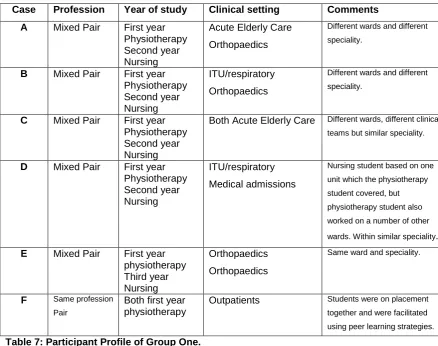
7. Participant Profile of Group One 75
8. Participant Profile of Group Two 76
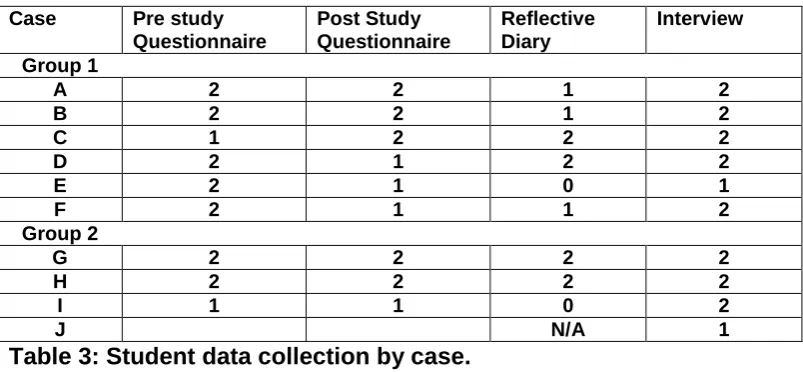
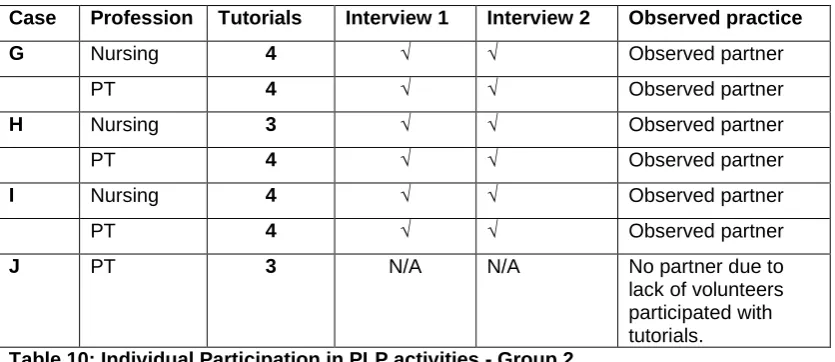
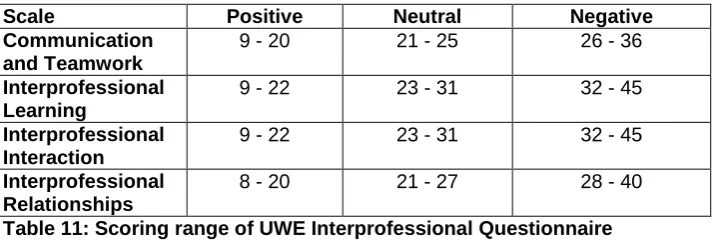
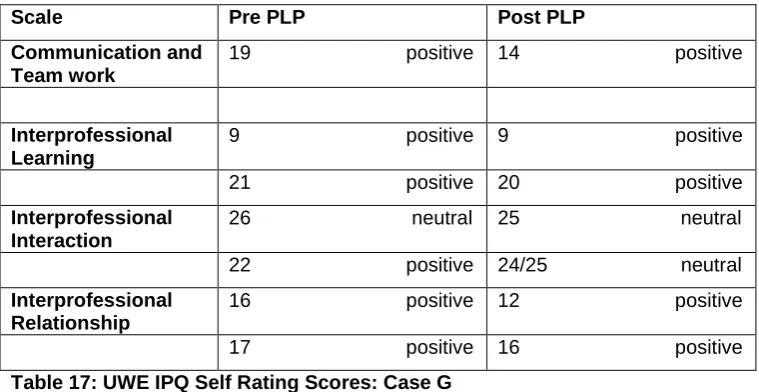
9. Individual Participation in PLP activities – Group One 79 10. Individual Participation in PLP activities – Group Two 84 11. Scoring Range of UWE Interprofessional Questionnaire 90 12. UWE Interprofessional Questionnaire Self rating Scores: Case A 92 13. UWE Interprofessional Questionnaire Self rating Scores: Case B 93 14. UWE Interprofessional Questionnaire Self rating Scores: Case C 95 15. UWE Interprofessional Questionnaire Self rating Scores: Case D 96 16. UWE Interprofessional Questionnaire Self rating Scores: Case E and F 98 17. UWE Interprofessional Questionnaire Self rating Scores: Case G 99 18. UWE Interprofessional Questionnaire Self rating Scores: Case H 101 19. UWE Interprofessional Questionnaire Self rating Scores: Case I 102
20. Overview of Thematic Analysis 103
21. Summary of UWE IPQ statement 30 with qualitative statements: Group One 105 22. Summary of UWE IPQ statement 30 with qualitative statements: Group Two 107 23. UWE Interprofessional Relationship Scale Group One 120 24. UWE Interprofessional Relationship Scale Group Two 120 25. Average UWE Interprofessional Relationship Scale by profession 121
26. UWE Interprofessional Learning Scale Group One 121
27. UWE Interprofessional Learning Scale Group Two 121
28. Average UWE Interprofessional Learning Scale by profession 122 29. UWE Interprofessional Interaction Scale Group One 122 30. UWE Interprofessional Interaction Scale Group Two 123 31. Average UWE Interprofessional Interaction Scale by profession 123 32. UWE Communication and Teamworking Scale Group One 124 33. Average UWE Communication and Teamworking scale by profession 126 34. UWE Communication and Teamworking Scale Group Two 127
List of Tables (cont)
36. Cross Group Case Matrix of identified themes and learning behaviours 152
37. UWE Interprofessional Relationship Scale 155
38. UWE Interprofessional Learning Scale 156
39. UWE Interprofessional Interaction Scale 157
Abstract
Peer learning has been successfully introduced into professional education within the practice setting (Secomb 2008). This thesis provides a chronological narrative presentation of a qualitative case study that evaluated an interprofessional peer learning programme designed to consolidate communication skills and develop interprofessional understanding among physiotherapy and nursing students.
The peer learning programme was implemented with two different groups of students over two four week periods when nursing and physiotherapy students overlapped during routine placements. It enabled students placed within the same hospital but in different clinical environments to work together in both a tutorial setting and on patient centred tasks. This included verbal peer review of interpersonal communication skills in both tutorial and practice settings.
The theoretical framework for the research was provided by cooperative learning, with a conceptual framework provided by social interdependence theory.
Ethical approval for the study was obtained from the University and NHS Research Ethics Committees. The peer learning programmes were implemented and evaluated between May and December 2007. Data collection included validated UWE Interprofessional Questionnaires before and after the programme, concurrent reflective diaries and semi-structured interviews following completion of the peer learning programme by students. Semi-structured interviews with clinicians involved in facilitating the programme along with RIPLS questionnaires were also gathered.
The interviews and reflective diaries were analysed using an inductive thematic analysis (Coffey and Atkinson 1996), single case study sheets were used to summarise data and a cross case analysis matrix (Stake 2006) was adopted.
Data analysis identified the focus on interpersonal and interprofessional communication skills was relevant for students at all levels; it complemented placement learning and enabled students to cooperate in practice and develop greater insight into each other’s role. Interprofessional peer observation and review within both tutorial and practice settings were found to be appropriate educational strategies. All agreed it was not threatening; it was valuable in gaining insight into another profession and for consolidating own professional knowledge. Students valued undertaking patient centred tasks together although an appropriate level of challenge and mentor support was required.
Chapter 1
Introduction to the Thesis
1.1 Introduction
Interprofessional learning (IPL) has become embedded in professional education. Despite an expanding research base there is no consensus as to how best facilitate interprofessional learning in the practice environment. However, the significance of combining academic and practice based interprofessional learning appears to be emerging (Morison and Jenkin 2007, Wilhelmsson et al 2009). Practice based peer learning strategies have an established evidence base within physiotherapy (CSP 2002) and have been successfully introduced into professional education (Secomb 2008).
This thesis presents a qualitative case study that evaluated an interprofessional peer learning programme designed to consolidate communication skills and develop interprofessional understanding among physiotherapy and nursing students.
The peer learning programme enabled students placed within the same hospital but in different clinical environments to work together and learn from each other in both a tutorial setting and on patient centred tasks.
Within this thesis the evidence base associated with the use of peer learning strategies within pre-registration physiotherapy practice education is reviewed and challenges associated with the use of these strategies highlighted. The origins of the principles associated with cooperative learning are considered and their relevance to the development of effective practice based interprofessional learning is explored. Consideration is given to the conceptual framework provided by social interdependence theory from which cooperative learning evolved.
This introductory chapter elucidates the policy background to the development of practice based interprofessional learning. The choice of communication skills as the focus of the peer learning programme is discussed and research aims identified. Key influences on the research design along with the initial development of the research proposal are considered and a timeline defined. Finally the structure of the remaining five chapters is provided.
1.2 Policy Background
Central government’s drive over the last 10 years to develop the NHS into an organisation which is patient centred (DoH 2005) and to respond to high profile failures (DoH 2001a, DoH 2003) has led to interprofessional learning becoming a required element of pre-registration professional
reinforcement of professional boundaries, hierarchies and did not enable good understanding of professional roles to be acquired.
The development of IPL was driven by a commonly held belief that this would have a positive impact on the quality of patient care. Recommendations from the Laming Report (DoH 2003) and the Bristol Inquiry (DoH 2001a) identified the need for a greater emphasis on team work; which has been implemented within the Knowledge and Skills Framework, while the Bristol Inquiry specifically identified a lack of skills training in communication, leadership and teamwork (DoH 2001a). There has been great difficulty in identifying any direct relationship between interprofessional learning and the quality of patient care, however, there has been an overwhelming acceptance of the need to facilitate greater understanding and cooperation across disciplines at all levels.
The evaluation of IPL initiatives has been influenced by the foci developed by Barr et al (2006) who undertook a systematic review of interprofessional education. Barr et al identified three symbiotic elements: individual preparation, cultivating collaboration and improving services. This enables initiatives to be considered not just at the level of direct impact on patient care but in the various stages that lead to the ability of an individual and or an organisation to engage in collaborative practice.
Barr et al (2006) proposed the development of “collaborative competencies” enhanced through competency based models of interprofessional education. The ability to communicate effectively across and within professional groups is identified as a core skill associated with the
Interprofessional Capability Framework developed by the Combined Universities Interprofessional Learning Unit (Walsh et al 2005)1.
Darzi (2008) proposes to provide more integrated services for patients; the NHS Next Stage Review highlights the need for effective teamwork and embeds a requirement to effectively work inter-professionally in every clinician’s role. “Creating an Interprofessional Workforce” has reported that IPL should be embedded in practice learning (DoH 2007).
When asked to identify aspects of practice required for, and meaningful to, interprofessional learning, students have identified communication skills and interprofessional relationships as core (Robson and Kitchen 2007, Pollard 2008). Interpersonal communication is something of which all students have knowledge and skills are summatively assessed throughout the curriculum.
In this research communication skills were chosen as the focus of the peer learning programme due to their central role in interprofessional learning and professional practice.
1
The last decade has seen an exploration and expansion of roles and responsibilities across professions. The development of extended roles and professional boundary blurring has been encouraged (Carmel 2006, Baxter 2008). Due to these rapid changes considerable discourse has been generated as to the aims of IPL, some considering it to be a suitable cloak for the
development of generic skills, while the majority agree a global aim is to develop real
understanding of one another’s role, mutual respect, the ability to communicate and enhance patient care through the development of a “seamless service” (Freeth and Nicol 1998, Freeth et al 2002, Morison et al 2003).
Interprofessional learning defined as occurring when “…two or more professions learn with, from and about each other to improve collaboration and the quality of care” (CAIPE 2002) is now embedded in all professional programmes. Multi-professional education occurs when “two or more professions learn side by side”. These definitions identify fundamental differences in the learning behaviour being facilitated. Interprofessional learning calls for engagement between professional groups to occur while multi-professional education facilitates individual learning behaviours with individuals learning alongside each other. When facilitating IPL it is essential therefore to adopt educational strategies that facilitate the cooperation and engagement between students inherent in the definition.
1.3 Communication Skills
All professional programmes assess communication skills throughout clinical practice to ensure these essential skills are acquired; communication skills, therefore, form a common competence. A systematic review of communication skills teaching in health and social care (Chant et al 2002) identifies a wide range of teaching strategies and methodologies. The move to patient centred consultations, where the patient is seen as a partner, with their ideas, concerns and expectations being considered along side their condition (Thistlethwaite and Jordan 1999) has been in response to research suggesting this improves patient satisfaction (Savage and Armstrong 1990, May 2001), and the effectiveness of medical management (Parkin and Skinner 2003).
Yet the Healthcare Commission reported in 2009 that 12 per cent of all complaints from patients in primary care and acute services concerned issues related to the standard of communication they received from Trusts (Healthcare Commission 2009).
One significant multi-institutional interprofessional project has recently developed interprofessional competency maps associated with communication skills, team working and ethical practice to aid interprofessional practice assessment (Holt et al 2009).
Yet there are considerable challenges with engaging students in communication skills
development. One study felt the need to “sugar the pill” by including communication skills within a course concurrently acquiring other clinical skills (Freeth and Nicol 1998). While students from different professions may hold different attitudes as to the relevance of communication courses on their professional development (Reynolds 1996); a study by Horsburgh et al (2001) identified that students felt communication skills should be learnt together, another found physiotherapy students identified communication skills as central to interprofessional teamwork (Robson and Kitchen 2007). It has also been proposed by the Department of Health (2001b) that communication skills be developed on a shared basis from the early stages of health care education and many shared and interprofessional education includes communication skill development as part of the curriculum. The majority of this is delivered in the academic setting.
Little research into IPL has been carried out which enables students to acquire core communication skills together in the clinical environment and through the consolidation of these skills explore each other’s professional roles and responsibilities.
Following a review of the common requirements from the NHS Knowledge and Skills Framework, Health Profession Council’s Standards of Professional Conduct, QAA benchmark statements and the GMC’s Tomorrows Doctors, this research focuses on the cooperative consolidation of generic skills related to the NHS Knowledge and Skills Framework core dimension 1; Communication, and the Health Profession Council’s Standards of Professional Conduct 6 and 7 which relate to acting within the limits of your knowledge, skills and experience and effective communication.
These skills are embedded in the Interprofessional Capability Framework (Walsh et al 2005) which requires that “the interprofessional team member consistently communicates sensitively in a responsive and responsible manner, demonstrating effective interpersonal skills in the context of patient/patient focused care” (p13, http://www.cuilu.group.shef.ac.uk/capability_framework.pdf accessed 07.01.09 10.30 a.m).
During professional programmes socialisation into the chosen profession occurs alongside developing clinical expertise. While individuals learn how to use a language specific to their
profession, it has also been suggested profession specific cognitive maps may develop (p582 Clark 2006). If professionals are able to understand not just each other’s roles but their perspectives, an
It has also been suggested that as students become more knowledgeable about their own profession, they may become less able to communicate with those without the similar knowledge base i.e. their patients (Billings-Gagliardi et al 2001).
By enabling the students to explore the application of these skills in practice and discuss the individuality of their interpretation of clinical situations, this common skills development aimed to promote a greater depth of understanding regarding professional roles.
1.4 Research Aims
The aim of this research was to evaluate the effects of a peer learning programme on
communication skills development and role understanding of nursing and physiotherapy students.
The research aimed to explore how suitable and practical it is to enable students to consolidate common core communication skills together in the clinical environment and to see if this enabled students to learn about each other’s professional roles.
The initial aims were focused into the following research questions:
1. Does the peer learning programme promote the development of an indepth understanding of other professional roles and responsibilities?
2. Does peer learning establish mutually beneficial relationships among peers which facilitate individual’s skill acquisition and consolidation?
3. Does the peer learning programme facilitate the student’s ability to collaborate effectively within a multi-professional team?
4. Can the peer learning programme increase the amount and type of pre-registration interprofessional learning within the current practice setting?
The tutorial content and clinical tasks integrated into the peer learning programme remained the same for all students. Students from years 1, 2 and 3 were involved.
1.4.1 Key Influences
My background is within physiotherapy education, having been involved in placement organisation and support for a number of years. Over those years I have developed an interest in facilitating and encouraging the adoption of peer learning strategies within the clinical environment. This initially occurred in response to a crisis in placement numbers when the commissioning of physiotherapy student places suddenly increased but later developed into an issue of quality as the effects of peer learning became apparent. For this research I wished to use my experience and understanding of peer learning strategies within the clinical environment to enable students from different
For the influence of myself as researcher to be evident throughout this thesis, I will follow a chronological narrative approach (Yin 1994). By exploring my experiences of developing, facilitating, responding to and analysing the research I plan to be clearly positioned within the decision making process. Within qualitative methodologies reflexive methodological accounting is understood in many ways. Seale (2000) identifies a range of positions from “confessional accounts” to “polyvocal or collaborative texts which seek deliberately to place the author well away from centre stage” (p172). Researcher self-awareness and reflexivity has been seen as a way of balancing their influence on data collection, analysis and presentation (Hall, S. 1996). There is consensus that disclosing “any personal and professional information that may have affected data collection, analysis and interpretation..” (p566 Quinn Patton 2002) improves the credibility of the researcher. My aim in writing reflexively is to enable the reader of this account not just to assess the transparency, trustworthiness and credibility of the work but to gain insight into my theoretical perspectives.
I am white, Scottish from a middle class christian background. As a Physiotherapist I have specialised within the field of elderly rehabilitation and experienced working in many
multiprofessional teams. My move into education was due to my enjoyment of clinical teaching and clinical education has always been a core interest.
This study explores using communication skills teaching within the practice environment as a vehicle for developing interprofessional understanding. It recognises individuals as the significant element of the social world. The attitudes these individuals hold, how they interact, their
experiences and the behaviours they exhibit constitute the evidence. Exploring the evidence generates knowledge but there are many interpretations available. Individual experiences are of equal significance and multiple realities accepted. However, this will be scrutinised within the framework of a case study allowing the triangulation of data to explore those perspectives at depth and from differing angles. Low and Howkins (2006) proposed members of different professions have different styles of learning, patterns of thinking and attitudes to authority, therefore, different constructs of reality. They suggested different value systems form due to each profession’s individual skills, knowledge and concepts.
The development work undertaken for this study was triggered by an interprofessional study day on peer learning which I co-ordinated with colleagues in July 2006. The day identified and explored the use of models of peer learning within the clinical environment among Allied Health Professions within Devon and Cornwall. The definition used on that day for peer learning was “student(s) learning with and from each other” (p3 Falchikov 2001).
international perspective which identifies curriculum structures, uni-professional learning styles, professional subcultures and hierarchies as significant barriers to effective interprofessional education (Cook, A. et al 2001, Barr et al 2006), no new limitations were found. They also raised concerns about the amount of time available within their clinical lives.
A challenge presented to the group was to identify how clinicians felt interprofessional education could develop within the clinical setting despite these acknowledged barriers. Participants identified their own clinical teams as sources of good practice. They proposed the development of student teams, so that students could become more aware of effective team working, the roles of team members and collaborative practice; core elements of interprofessional education. This was seen as a good way for the students to be exposed to team working and also be able to work together on patient centred activities by sharing a case load.
This model, popular on the day, has a positive evidence base. It has been shown to be effective, is highly regarded and can improve students’ team working and interprofessional collaboration as the students work together over a period of weeks (Freeth et al 2001, Lumague et al 2006, Pearson et al not dated, Wilhelmsson et al 2009). However, one of the challenges associated with the
curricular structure locally is that students in practice do not start placements at the same time, have varying lengths of placements and do not overlap for long periods of time.
This was addressed by one of the groups who proposed specific interprofessional days
pre-arranged throughout the year. This model is also supported within the literature as an effective way of enabling students passing through Trusts to work together for a period of time (Anderson et al 2006).
Despite the challenges, there was overwhelming endorsement of the implicit proposal that clinical placements were a suitable environment to facilitate the acquisition of interprofessional skills (Jacobs 1987, Cook, A. et al 2001, Department of Health 2001b, Hilton and Morris 2001, Lloyd-Jones et al 2007).
The value of real patient work had been a strong theme in the Common Learning Programmes data analysis (p75Pearson et al not dated). Students do not appear to automatically collaborate just by being placed in the same environment (Russell et al 2006), yet, once facilitated, patient centred workshops are valued and provide insight into complex fields which promote and require high levels of cooperative practice (Wee et al 2001). Evidence now suggests that to sustain
their own uni-professional learning (Morison et al 2003) or detract from their clinical experience (p63 Pearson et al not dated).
I am particularly interested in how to promote more collaboration among students who are placed within the same hospital at the same time but within a diverse range of teams. Some professional programmes have overcome this by facilitating interprofessional learning in practice through variations on the “Sole Interprofessional Placement” (Pearson et al not dated) where students undertake clinically based tasks to observe and reflect on the interprofessional working being demonstrated in practice. However, I was keen to identify an aspect of education which had the potential to more directly influence the quality of patient care, while getting students to physically work together in practice.
1.4.2 Time Line
In January 2007 the first broad outline of the proposal was written. The proposal was based on a literature search and personal knowledge of facilitating clinical educators in pre-registration peer learning within a uni-professional (physiotherapy) clinical context.
During a course run by the Centre for the Advancement of Interprofessional Education (CAIPE) I was able to present a draft proposal for peer review within a supportive multi-professional environment. One of the comments led to considerable reflection and some adaptation of my original proposal. Originally, I had emphasised the development of the students’ ability to facilitate each other’s learning using peer review within the clinical setting. It was suggested that the students observing each other in practice would find this very threatening - specifically that the physiotherapy students would threaten the nursing students. NHS research ethics submission was made on 20th March 2007, and the submission was supported with attendance at the Cornwall and Plymouth Research ethics committee meeting on 10th April 2007. When presenting my proposal to the local ethics committee a member of the committee expressed a similar opinion, suggesting the physiotherapy students would dominate the tutorials and control the clinical encounters. Ultimately this has led to the inclusion of a focus within data analysis to consider if peer review is an
appropriate strategy to use within an interprofessional context.
In my experience students have often found feedback from their peers extremely useful and this has been one of the strengths associated with uni-professional peer learning in clinical models (Crouch et al not dated). Literature on uni-professional peer learning identifies that while concerns are often expressed that individual students may overshadow each other, this rarely occurs (Zavadak et al 1995, CSP 2002, Martin et al 2004).
Some of my initial reflection focused around the definition of “peer” – while this can broadly be defined by someone of equal status, within the context of professional education this often refers to someone on the same course. It was clear from these comments that colleagues did not
necessarily see students from the two different professions as peers. Yet there is some evidence that pre-registration students early on in the professional socialisation process may view each other as being in similar less knowledgeable positions which could facilitate the ability to work as peers (Reeves and Pryce 1998). Within the interprofessional arena consideration clearly needed to be given to the power relationships among professional groups. Considering whether the students agreed with the perception expressed above or saw each other as peers is a focus for analysis (Pollard et al 2006).
Both occasions discussed above, demonstrate the inherent stereotypes held regarding different professional groups and reflected the culture within which the research would take place. They were, therefore, both an influence on design and significant factor to consider when analysing the data.
Within the Interprofessional Capability Framework (Walsh et al 2005) more complex skills
associated with co-mentoring across professions are being proposed to promote interprofessional working. Peer review is becoming embedded within professional cultures through appraisal and continuing professional development, and within the healthcare environment through clinical governance (Gopee 2001). Ways to standardise the use of peer review are being developed (Archer et al 2005) and the value of informal conversations are beginning to be explored (Phelan et al 2006). While uni-professional peer review is becoming common place, cross professional peer review is less common. However, interprofessional mentoring relationships are developing rapidly with the expansion of roles that include advanced practice (Fraser 2005). Introducing placement based peer review as a pre-registration interprofessional skill could support the further
development of co-mentoring across professions and introduce students to skills required for lifelong learning.
1.5 Structure of the Thesis
The thesis follows a chronological narrative approach proposed by Yin (1994) as one of the appropriate methods of presenting a case study. There are a further five chapters.
Chapter Two presents the literature review associated with uni-professional peer learning in the practice environment, followed by an in-depth review of cooperative learning and the conceptual framework provided by social interdependence theory. The association between a cooperative learning framework and Contact Theory is explored before presenting an overview of practice based models of interprofessional learning.
Chapter Three explores the case study methodology chosen, including practical, ethical and ontological considerations. It then considers the data collection methods followed by the process and structure of data analysis.
Chapter Four provides a chronological presentation of the implementation of the research. This is presented to corroborate my account, expose the initial design and identify modifications that occurred.
Chapter Five presents the data analysis. Individual cases are presented followed by a cross case analysis of group one and two. The cross case analysis has been divided into the three categories identified within the thematic analysis: Interprofessional Learning, Individual Learning and Peer Learning.
Chapter Six considers the relevance and significance of the findings. Limitations of the study are detailed. A case is then made for the unique contribution this thesis provides and recommendations for IPL in practice.
1.6 Chapter Summary
This chapter has presented the background leading to the embedding of interprofessional learning in pre-registration professional healthcare programmes. It identifies the growing relevance of combining academic and practice based IPL to facilitate the acquisition of interprofessional skills and the current lack of consensus regarding how best to structure IPL based in practice
Chapter 2
Literature Review and Theoretical Framework
2.1 Introduction
The theoretical principles underpinning the development of the peer learning programme relate to principles of cooperative learning informed by a conceptual framework provided by Social
Interdependence Theory (Johnson and Johnson 1998). The evidence base comes from a literature review focusing on the use of peer learning in physiotherapy practice education, specifically informed by the work of Richard Ladyshewsky (2002) who has written extensively on the use of peer learning in the clinical setting.
The power base associated with differing professions meant that it was essential for students participating in the research to attain equal status relationships; this is a principle of both cooperative learning, interprofessional facilitation and highlighted as significant by both Contact Theory (Pettigrew and Tropp 2006) and Social Identity Theory (Brown 2000).
This chapter starts by reviewing the evidence base associated with peer learning in physiotherapy including an overview of literature associated with facilitating professional development using peer learning among pre-registration healthcare students in the practice environment2. The literature was searched using key terms and phrases, literature which focused on student productivity alone were excluded.
The second half of this chapter moves on to consider the theoretical framework associated with cooperative learning, first a discussion identifying the difference between collaborative and cooperative learning approaches is presented. Social Interdependence Theory; the conceptual framework underpinning cooperative learning (Johnson and Johnson 1998) is then considered before defining the principles of cooperative learning and relating this to the design of the peer learning programme. Finally an overview of practice based IPL is presented and the relevance of a cooperative learning framework discussed.
2.2 Literature Review
2.2.1 Peer Learning
Peer learning is a generic term for all situations where peers “learn with and from each other” (p3 Falchicov 2001); it includes many strategies such as peer coaching, peer tutoring, peer
collaboration and cooperative learning which although similar have different pedagogic origins. The
2
lack of standardisation of terms relating to peer learning within the healthcare setting has been well documented and causes considerable challenges when reviewing the literature (Lincoln and McAllister 1993, Ladyshewsky 2000). Often the peer learning models used do not acknowledge the pedagogic origins or theoretical principles underpinning the programmes implemented.
Peer learning strategies have been used within the clinical field to facilitate peer support, skills development (Perkins et al 1999, Edgecombe and Bowden 2009, Welch and Dawson 2006) and improved clinical reasoning (Ladyshewsky 2002, Moore et al 2003). Within physiotherapy there is established evidence to support benefits such as a reduction in superficial questioning and peer support developing (Baldry Currens 2003). There is accruing evidence that peer learning promotes ’’deep learning’’ and improved clinical reasoning (Moore et al 2003, Ladyshewsky 2002). Within nursing peer learning strategies have been used to facilitate cooperative practice (Halse and Hage 2006) and in the academic setting, skills acquisition (Goldsmith et al 2006), within medicine among other aims the early development of interview skills within practice (Valkova 1997, Thistlethwaite and Cockayne 2004).
A systematic review of peer teaching and learning in clinical education concluded it was “an effective educational intervention for health science students on clinical placements” which could “increase students’ confidence in clinical practice and improve learning in psychomotor and cognitive domains” (p703 Secomb 2008). However, the review also identified some challenges associated with these strategies – students may have learning styles or personalities that are not compatible and they spent less time in one to one supervision with their mentor.
Peer learning is also used by students to facilitate their own learning; this may differ across
professional groups. A study by Salamonson et al (2009) used a comparative survey to explore the self – regulated learning strategies used by first year medical and nursing students. Peer learning was more commonly reported among the medical students, however, the medical students also followed a Problem Based Learning curriculum and it may be this facilitated the adoption of peer learning as a self – regulated strategy. An earlier small survey by Costello (1989) identified student nurses informally teaching each other practical skills while on placement.
2.2.2 Peer Tutoring
In early models peer tutors had both the advantage of greater knowledge and different status. Both of these elements – knowledge base and status are still significant when determining the type of facilitation chosen today and there are clear examples of this form of peer learning being used within professional education (Lake 1999, Perkins et al 1999, Goldsmith et al 2006). The boundaries between peer tutoring and other forms of peer learning are becoming increasingly blurred with “an increasing interest in same-ability tutoring” (Topping 1996). Theoretical frameworks such as those associated with cognitive development and social learning underpin peer tutoring and a comprehensive guide to peer tutoring in higher education by Nancy Falchicov (2001) includes many cooperative learning strategies. Indeed Gillies and Ashman (2003) suggest it was interest in empirical research in peer tutoring which was partly responsible for the resurgence in research into group dynamics in the 1970s.
It is important to draw a distinction between this research and any form of peer tutoring where a difference in level of expertise enables one group to act as tutors for another, or where a reciprocal peer tutoring relationship occurs where one student takes turns in adopting a peer tutoring role with a partner. This was not the approach used within this research. This research based its peer learning programme on cooperative learning strategies (Johnson and Johnson 1998).
2.2.3 Peer Learning in the Practice Environment
Within physiotherapy, peer learning strategies first came to prominence in the practice environment in the mid 1980s and 1990s due to concerns regarding the impact of student education on
productivity and cost along with a lack of clinical placements (Emery and Nalette 1986,
Ladyshewsky et al 1998, Huddlestone 1999). Much of this work was carried out in Canada and Australia, with UK interest developing slightly later but due to similar drivers (Holland and Hurst 2001). Prior to this within physiotherapy education, students had been allocated one clinical educator with whom they worked throughout their clinical placement. This was seen as the “traditional” model but limited the capacity of each placement (Huddlestone 1999). The need to consider the impact of students on clinical output and to increase the number of placements forced institutions providing physiotherapy education across a number of countries to consider alternatives to the traditional model of one supervisor3 to one student. They aimed to increase placement capacity within existing establishments while maintaining the quality of patient care by applying educational principles to the practice environment (Ladyshewsky et al 1994, Ladyshewsky 1995, Zavadak et al 1995, Dupont et al 1997, Martin and Edwards 1998, Holland and Hurst 2001, Nadasan et al 2001). Clinical educators explored how to facilitate more than one student at the same time within the same practice area. The move to a “paired” model of peer learning where one clinical educator facilitated two students, was found to be most successful when cooperative rather
than individualistic learning behaviours were facilitated (Zavadak et al 1995). This called for a fundamental change in the role of the clinical educator.
Considerable research activity occurred at this time with frequent reference to cooperative learning strategies. It is unclear which pedagogic origins most powerfully influenced the models. The references most often relate back to Ladyshewsky’s own work, (DeClute and Ladyshewsky 1993, Ladyshewsky 1993, Zavadak et al 1995, Nemshick and Shepard 1996, Dupont et al 1997) and a study by Emery and Nalette (1986) that describes the development of a structured model of group supervision. While the study by Emery and Nalette (1986) identified students developing a “highly cooperative, peer like atmosphere” (p10), the paper presented guidance on the structure and organisation of this model rather than a discussion of the underlying theoretical principles.
When reviewing the literature it is clear Richard Ladyshewsky has had considerable influence both in initiating change and influencing the approach taken by others – a central theme of his approach has been to promote cooperative practice among student peers rather than individualistic or competitive learning behaviours (Ladyshewsky 1993). One of the challenges when reviewing this literature is the synonymous use of the terms “cooperative” and “collaborative”, however, when the theoretical principles are referred to ensuring interdependent goals with individual accountability is promoted (Ladyshewsky 1993, Jung et al 1994, Ladyshewsky 2002).
With the development of similar research in the UK, Holland and Hurst (2001) evaluated what they termed the “Ladyshewsky Model” in the UK. Collaborative learning was defined as “a form of indirect teaching in which the instructor states the problem and organises the students to work it out independently” (p4 Holland and Hurst 2001). Key changes from the traditional model lay in the relationship of clinical educator to student. Students assumed the role for patient care monitored by the clinician, the students were responsible for their own caseload but encouraged to consult with each other, the clinical educator became a resource for the students and joint teaching occurred. This was not always seen as a positive change and one study identified clinical educators may have been uncomfortable delegating a substantial part of their caseload to the students (Ladyshewsky et al 1998).
interprofessional educator whose role is to facilitate learning and become a role model for students (Hammick 1998).
Peer learning incorporating independent patient assessment by student peers within physiotherapy has become established within the physiotherapy department of the Trust in which this research was based. This expertise was essential to ensure students would be able to use direct patient related activities safely and appropriately during the peer learning programme.
Considerable research within the UK followed the initial evaluation of Holland and Hurst (2001) due to a “crisis” in placement capacity (Currens and Bithell 2003, Moore et al 2003). The results
endorsed the existing research which suggested peer learning approaches could be successfully integrated into the existing structure of pre-registration physiotherapy and occupational therapy programmes (Baldry Currens 2003). Professional guidelines were produced by the Chartered Society of Physiotherapy (2002) to support the implementation of models of supervision using collaborative learning approaches.
Over the years, a variety of peer learning strategies have been developed. Peer group supervision has been used within Speech and Language Therapy to provide a supportive forum for trainees to present patients to their peers using video clips for observation, analysis, evaluation and discussion (Williams 1995). A clinician facilitates the group which becomes progressively more independent as the trainees acquire the ability to self facilitate.
Within Occupational Therapy peer group supervision has been used as a model of clinical
supervision (Martin and Edwards 1998, Mason 1999, Farrow et al 2000) and a form of cooperative enquiry (Mason 1999). Areas which emerged as being influential in ensuring effective group supervision included “a knowledge of group dynamics and learning styles, a focus on learning processes, particularly with regard to the development of generic skills and teamwork,
comprehensive feedback and evaluation, and attention to organizational consideration such as orientation and the pacing of learning tasks” (Mason 1999). These are central to the facilitation of cooperative learning.
Concerns that personality clashes, competition between students and differences in student competency would impact on the learning experience were often expressed, although rarely documented (Zavadak et al 1995, CSP 2002, Martin et al 2004).
A group model developed by Farrow et al (2000) was based on adult learning theory while using collaborative principles. No specific collaborative theoretical framework was identified, however, as part of the collaborative process students were expected to participate in self and peer evaluation (Farrow et al 2000). This study compared the group model with a traditional model of supervision and in their quantitative data found few statistical differences between the models. However, when the quantitative and qualitative data were combined, the group model was found to increase the breadth and diversity of clinical experiences. The ability to work collaboratively with peers was also seen as an advantage but the findings suggested “the group model may involve some feelings of competition between students” (p248 Farrow et al 2000).
Concerns competitive behaviour may inhibit peer learning have been an ongoing concern. A number of reasons for this have been suggested, a lack of resources or inequitable sharing of resources e.g. supervision time, may precipitate competition. If students are directly compared with each other, or one student is allowed to dominate, competitive behaviours may be promoted. In response to these findings specific strategies were developed to address this (Tiberius and Gaiptman 1985, Martin and Edwards 1998).
Zavadak et al (1995) identified one episode where an inequity of participation occurred due to personality and communication skills, this was resolved during the placement by facilitating self-awareness in one student and increasing the confidence of another.
It is not clear from the early literature exactly what theoretical framework other than adult learning theory was used. However, as a greater evidence base was generated, cooperative learning was evaluated specifically (DeClute and Ladyshewsky 1993, Ladyshewsky et al 1998, Martin and Edwards 1998). The theoretical perspectives proposed to support cooperative learning were cognitive developmental and behavioural learning approaches (Ladyshewsky 2000). The goal structures associated with the group’s tasks were explored and significance attributed to organising these cooperatively but the conceptual framework of Social Interdependence Theory was not identified (Ladyshewsky et al 1998).
2.3 Theoretical Framework
2.3.1 Collaborative vs Cooperative Learning
There is a similar lack of clarity in the literature when considering both collaborative and
cooperative forms of learning. Collaborative learning could be described as an umbrella term for many educational approaches involving joint intellectual effort by students or students and teachers together (Smith and MacGregor 1992), however, this is not a consensus opinion. Ladyshewsky suggests cooperative learning is an umbrella term for a diverse range of team learning approaches and defined collaborative learning as “two learners working together to solve a task that neither could do previously” (Ladyshewsky 2000). The terms cooperative learning and collaborative
learning often appear to be used synonymously (Cohn et al 2001, Copp 2002, Yazici 2005, Meseke et al 2007); within this research cooperative learning refers to a specific range of educational strategies based on the conceptual framework provided by Social Interdependence Theory (Johnson and Johnson 1998).
Although less commonly referred to in the UK, this framework has been widely applied to facilitate cooperative learning in the USA and Canada and has profoundly influenced educational practice at all levels (Cohen et al 1999, Slavin 1999, Copp 2002, Roseth et al 2008). It has been identified as being an appropriate strategy for interprofessional learning (D’Eon 2005), and is being advocated by some interprofessional education providers within the UK ( www.faculty.londondeanery.ac.uk/e-learning/interprofessional-education accessed Oct 2009). However, while the five principles of cooperative learning are discussed4, the conceptual framework at its core is often not mentioned.
There is significant overlap between collaborative and cooperative approaches; both come from a constructivist perspective where to learn new information, students must be actively involved, integrating new information with what they already know and reorganizing it thereby constructing new meaning. Both acknowledge the influence of the context on the learning activity and promote the development of higher order reasoning and problem solving along with the development of social skills. Both are goal and process oriented with groups working towards achieving a defined learning outcome. A significant distinction comes from the structure of the intervention, with cooperative learning being highly structured and collaborative learning allowing students the responsibility and freedom to manage their group. It has been suggested both are at ends of a spectrum in which cooperative learning form a highly structured intervention and collaborative learning harnesses the natural learning which occurs when students work together to “create their own learning situation” (p28 Johnson et al 1998, Smith et al 2005). Historically collaborative learning developed an established research base within the UK, while concurrently cooperative learning developed in the USA and Canada. The majority of the cooperative learning research
4
occurred within primary and secondary education (Cohen et al 1999), but a considerable number of experimental studies have compared working cooperatively, competitively or individualistically within various groups of students in higher education (Johnson et al 1998) and there is considerable research within higher education using both approaches across a wide range of subjects (Cohn et al 2001, Smith et al 2005, Yazici 2005, Meseke et al 2007) including healthcare education (Copp 2002) and the field of conflict resolution (Tjosvold and Fang 2004).
It is clear from the interprofessional literature structuring collaboration between different
professional groups can be challenging, yet Social Interdependence Theory provides a long history of research into how to effectively facilitate cooperative learning between diverse groups both culturally (Hertz-Lazarowitz 1999), socially and academically (Johnson et al 1998, Kirk 1999). The results are consistent and identify that cooperative learning promotes more positive relationships among “diverse and heterogeneous students” when compared with competitive or individualistic learning (p 8 Johnson and Johnson 1998, Kirk 1999). However, at times the quantitative results within the healthcare literature are less clear when assessing knowledge acquisition (Copp 2002).
Personally, I see placing the student at the centre of the educational experience a paradigm that evolved following the work of John Dewey and in which both collaborative and cooperative learning sit. The amount of student control of the situation varies considerably between both and is a tool to be used by an educator who is able to determine which strategy has most value for a given
situation. In interprofessional education where there may be potential conflict between members of the group (Hammick 1998), where developing social and team-working skills are an inherent aim and the students are working within a pressured acute practice environment, I felt a highly structured approach was appropriate.
From now on I will use the term “cooperative” learning to specifically refer to strategies or research directly influenced by the conceptual framework of Social Interdependence Theory.
2.3.2 Social Interdependence Theory
The origins of Social Interdependence Theory are in the field of social psychology and relate to group based instructional methods. In an historical review Gillies and Ashman (2003) identify May and Doob (1937) as first noting that “individuals co-operate when they are in close contact and expected to work together to achieve a shared goal” but compete when “they have limited contact and are not expected to achieve a shared goal” (p2).
were directly influenced by the arrangement of group goals (Deutsch 1949a). His research was based on an experimental design that involved a systematic comparison of cooperative and competitive classroom grading systems.
While his original experiment did not identify a difference in the amount of learning between
volunteers, there were more positive behaviours related to 5substitutability, cathexis and inducibility in the cooperative groups. These included attentiveness to fellow members, diversity in
contribution, co-ordination of efforts, quality of product, discussions and friendliness during discussions (Deutsch 1949b).
In the group structured competitively “the inter-communication of ideas, the co-ordination of efforts, the friendliness and pride in one’s group …..appear to be disrupted” (p230 Deutsch 1949b). Due to this Deutsch questioned the common usage of a competitive grading system – the challenge of this has since been well recognised and in professional healthcare education assessments are more commonly competence based rather than using a norm referenced approach.
These original findings still carry resonance when considering how to structure interprofessional encounters which involve participants from different subcultures with differing attitudes towards teamwork as the importance of developing social skills and the ability to communicate effectively between and across teams has been highlighted.
Deutsch’s theory of cooperation and competition was extended and applied to education by Johnson and Johnson in the early 1970s (Johnson and Johnson 1998) while Deutsch went on to study conflict as a way of exploring the conditions under which cooperative or competitive relationships would evolve (Deutsch 1991).
Deutsch concluded the constructive processes associated with conflict resolution are similar to cooperative processes of problem solving (Tjosvold and Fang 2004, Deutsch et al 2006). This is particularly interesting as constructive conflict resolution has been identified as an essential element in effective teamwork and proposed as an interprofessional competence (Hammick 1998).
Social Interdependence Theory has two aspects; one related to the structuring of goals, the other, the type of action taken by those involved, although the majority of papers refer primarily to the structure of goals. Johnson and Johnson explain “the basic premise of social interdependence theory is that the way in which interdependence is structured determines how individuals interact, and the interaction pattern determines the outcome of the situation” (p143 Johnson and Johnson
2003). Social Interdependence Theory assumes that cooperative efforts are based on intrinsic motivation6 (Johnson et al 1998, Johnson and Johnson 2003).
Goal structure
Social interdependence exists when group members share common goals and the goal
accomplishments of individuals are affected by the actions of each other. They fall into two broad categories: positive or negative. If goals are linked such that an individual can only attain their goal if the other group members attain the goal also, this is positive interdependence. If goals can only be attained when others do not gain their goal, this is negative interdependence – or as Deutsch puts it “if you are positively linked with another, then you sink or swim together; with negative linkage, if the other sinks, you swim, and if the other swims, you sink” (p 22 Deutsch et al 2006).
It is recognised situations are often a mixture of the two and so the relative strengths of the two types of interdependence will determine the outcome. Also interdependence may not be equally balanced between individuals and this would affect the power and influence of individuals within that scenario e.g. if a group had common learning outcomes but one member of the group was required to complete a summative assessment while other group members did not this would significantly affect the power and influence between group members.
Positive interdependence is suggested to produce promotive interaction which is when “individuals encourage and facilitate each other’s efforts to learn” (p29 Johnson et al 1998); it is this interaction which is said to produce the positive outcomes of this form of learning. In groups where
cooperative relations are developed and promotive interaction occurs, among other things they are proposed to demonstrate: more effective communication, friendliness, helpfulness, less
obstruction, coordination of effort, feeling of agreement with the ideas of others and define conflicting interests as a mutual problem to be solved by collaborative effort than in groups where cooperative behaviour does not occur (p26 Deutsch et al 2006).
Negative interdependence results in oppositional or obstructive competitive behaviour and no interdependence (social independence) results in the absence of interaction.
Along with the structure of goal accomplishment, Deutsch identifies effective action and “bungling” actions of individuals as influencing the predictable outcome of situations.
Group Dynamics
Not all groups work effectively, and while it is possible to structure a situation to facilitate
cooperative learning, promotive interaction may not always occur. When considering group work in general considerable challenges have been identified due to social loafing, individuals dominating, free riding, group thinking (Scribner and Donaldson 2001, Elliot and Higgins 2005, Yazici 2005, Chapman 2006). Within a cooperative learning environment Johnson and Johnson (p146 2003) suggest, “the movement from self-interests to mutual interests begins with perceiving that there are common goals and a mutual fate”.
Principles of cooperative learning have evolved from the conceptual framework provided by Social Interdependence Theory. There are five principles deemed essential to cooperative learning (Johnson and Johnson 1998):
Positive Interdependence
Individual accountability
Face to face promotive activity
Appropriate use of social skills
Group processing
2.3.3 Principles of Cooperative learning
Positive Interdependence
This relates to the structure of interdependence related to the goal accomplishment. It leads to individuals maximising their productivity and that of their fellow group members.
Individual accountability
Individual accountability is thought to be a significant variable, linked to interdependence. It relates to being personally responsible for completing your own share of the work and facilitating the efforts of others. If individual accountability is low, individuals are less motivated to contribute to the group as they see their efforts as non essential, reducing the feeling of personal responsibility in the attainment of the group’s goal.
Face to face promotive activity
challenging each other’s reasoning, and acting in a trustworthy way (Johnson and Johnson 1998, 1998).
Appropriate use of social skills
To work effectively in a group, students must get to know and trust each other, communicate effectively, accept and support each other and resolve conflicts constructively.
Group processing
This is a reflective process which enables the group to improve the effectiveness of the contributions of its members by discussing individual contributions and process.
2.3.4 Design of the peer learning programme.
This section will consider how the principles of cooperative learning have been applied to the peer learning programme. It has been placed here to allow for easy reference to the literature and to retain the chronological narrative approach that is being used to expose the synthesis between the theoretical framework and programme design.
The five principles of cooperative learning were central to the peer learning programme and underpinned the design. They were considered alongside principles of interprofessional learning which identified patient centred activities with participants attaining an equal status during the programme as key (Wee et al 2001, Bray and Howkins 2006).
While the peer learning programme was designed to facilitate the consolidation of interpersonal and interprofessional communication skills all participants knew they could achieve this through routine placement experiences and did not need to participate in the research. This meant there were no external assessment drivers as an additional motivating factor. This also meant there was no ultimate interdependent goal leading to a “sink or swim” outcome. However, due to this
interdependence was balanced among all group members.
It is recognised institutional support for the research from authority figures would influence attitudes towards participation (Dickinson 2009); support for the research was overtly present for
physiotherapy students only as a number of clinical educators had agreed to facilitate the clinical component of the peer learning programme.
Peer Learning Programme
The peer learning programme was four weeks long, however, the weekly time frame was limited due to concerns the programme may negatively impact on the placement. A one hour tutorial with 30 minutes clinical time per week was agreed. The combination of a group tutorial and paired clinical work was chosen to blend with the existing placement structure and maximise the
opportunities for learning from each other’s experience. The first tutorial started by refreshing and consolidation common basic interpersonal skills. This was specifically chosen so the level of skill was achievable by all, it aimed to be non-threatening but relevant to practice. Activities were designed to increase socialisation through discussion of personal histories and experiences of practice learning. During the first tutorial cross professional student pairs were established; these remained the same over the four week period.
Each pair was tasked with meeting before the next tutorial to undertake a patient centred clinical task aimed at consolidating the skills practised within the tutorial. From week two this included peer review of interpersonal communication skills following the clinical tasks. In weeks three and four the tutorial focus changed from interpersonal communication skills to interprofessional. The overall structure of the clinical tasks aimed to enable a cooperative relationship to be established before each student more formally represented their profession through observation. An overview of the programme can be found below.7
Overview of the Peer Learning Programme
Week One
Tutorial Topic: Effective Communication: The Impact on Patient Care
Clinical Task: Interview a patient regarding their experience of being in hospital.
Week Two
Tutorial Topic: Interview Skills
Clinical Task: Interview a patient about their hospital admission and management, including the patient’s understanding of their management.
7
Week Three
Tutorial Topic: Patient Centred Interview Skills.
The content of this tutorial was left to be developed by the group; this evolved into a discussion about professional stereotypes for both groups.
Clinical Task: A choice between task A or B
A. Shadow each other in practice undertaking a task which is central to your professional role. B. Arrange to jointly observe two collaborative experiences which involve interprofessional team working e.g. multidisciplinary meeting.
Week Four
Tutorial Topic: Interprofessional Communication
The content of this tutorial was free to be developed by the group; this became a discussion on the patient’s journey within an acute hospital environment and the role of both professions.
Clinical Task: As per week three.
Positive interdependence was structured into both the tutorial and practice elements. In the tutorial setting, the students were engaged in cooperative activities related to skills practice and discussion where they used each other as a resource and to provide feedback. Interdependence in the clinical environment related to the process of collaboration; pairs needed to arrange to meet and then work together to achieve their clinical tasks.
Interdependence related to content was dependent on promotive behaviours being established but was transparent in the aims. These aims were explicitly shared with the students at the first tutorial and in written information; the information sheet, the teaching plan and the information related to patient centred activities.
The aims of the Patient Centred Activities were to:
Give [the students] the opportunity to learn together in practice.
Facilitate an in depth understanding of the roles of each other’s profession, including identifying generic skills and common areas of practice.
Consolidate core communication skills through explanation and demonstration.
Develop the ability to give and receive appropriate, effective feedback.
Individual accountability will be discussed within the data analysis, although this was also integral to the process described above. The overall structure of the peer learning programme provided the environment for promotive behaviours to develop. This was facilitated through the focus on
interpersonal and interprofessional skills, inclusion of giving and receiving feedback on
the weekly clinical task rather than developing the group itself. This will also be further discussed during the data analysis.
2.4 Interprofessional Learning
2.4.1 Theoretical Frameworks for IPL in Practice
Collaborative learning theories are underpinned and strongly influenced by research associated with behavioural and cognitive – developmental theories and adult learning. The social and personal cognitive developmental approaches of Vygotsky (1978) and Piaget (1973) are well recognised within the professional healthcare environment. Collaborative student centred
interactive approaches often combining theories associated with experiential learning (Kolb 1983), reflective practice (Schon 2004) and adult learning (Knowles 1990) are common. This is reflected within the interprofessional literature (Hammick et al 2007, Hean et al 2009). Cooperative learning as defined above is less well known.
A much greater depth of understanding has developed regarding the intricacies of effective interprofessional practice with some proposing the development of a new pedagogy. While the initial development in interprofessional learning was underpinned using educational theories from adult learning and problem based learning, there is a growing recognition that the pedagogy of initiatives must be elucidated, to aid in the evaluation and development of effective strategies (Hammick 1998, Payler et al 2007, Payler et al 2008).
Theories from social psychology, sociology and education have been identified as being significant, with Contact Theory (Pettigrew and Tropp 2006), Social Identity Theory (Brown 2000) and Situated Learning (Lave and Wenger 1991) among others being increasingly used to develop evaluative frameworks with which to understand interprofessional collaboration. While aiming to establish theoretical frameworks to inform the effective design and evaluation of IPL initiatives, this expansion in perspectives could also be seen to limit accessibility, comparison and cause confusion (Hean et al 2009). It is impossible to review such a wide range of theoretical perspectives and so I have chosen to focus on those which relate to the utility of cooperative learning; Intergroup Contact Theory and Problem Based Learn