A MIXED METHODS STUDY OF HIGH SCHOOL TEACHERS’ AND ADMINISTRATORS’ PERCEPTIONS OF SCHOOL-WIDE POSITIVE BEHAVIOR
INTERVENTIONS AND SUPPORTS
A DISSERTATION SUBMITTED TO
THE COLLEGE OF EDUCATION AND HEALTH PROFESSIONS IN PARTIAL FULFILLMENT OF THE REQUIREMENTS
FOR THE DEGREE OF
DOCTOR OF EDUCATION IN EDUCATIONAL LEADERSHIP
COLUMBUS STATE UNIVERSITY COLUMBUS, GEORGIA
DEPARTMENT OF COUNSELING, FOUNDATIONS, AND LEADERSHIP
BY
JOSEPH E. DEAN
Copyright © 2018 Joseph E. Dean All Rights Reserved
A MIXED METHODS STUDY OF HIGH SCHOOL TEACHERS’ AND ADMINISTRATORS’ PERCEPTIONS OF SCHOOL-WIDE POSITIVE BEHAVIOR
INTERVENTIONS AND SUPPORTS
By Joseph E. Dean Committee Chair: Dr. Robert E. Waller Committee Members: Dr. Michael Richardson Dr. Christopher Garretson
Columbus State University July 2018
DEDICATION
ACKNOWLEDGMENTS
First, I’d like to thank my Lord and Savior Jesus Christ. I owe all I have ever accomplished to him.
I’d also like to thank my family. Without their love and support, none of this would have been possible. My wife, Sara, has been my rock throughout this journey. You were always there to listen to my ideas and give me feedback. You shouldered a lot of extra responsibilities to make sure I had time to work and believed in me when I did not believe in myself. To my children, Anna, Allie, and Carson, thank you for being patient and understanding the times I had to do school work. One of the greatest joys in my life is getting to be your dad. I love all three of you, and I am looking forward to watching you all grow up. Thank you to my parents, Oscar and Debbie Dean, who instilled in me both worth ethic and a drive to succeed, and taught me the value of education. To my father in-law and mother-in law, Terry and Cathy Sellers, thank you for supporting me and my family through this process.
Finally, thank you to Dr. Robert Waller for the many meetings to evaluate and offer feedback on my work, and for helping to keep me on pace to finish this dissertation. To Dr. Michael Richardson and Dr. Pamela Lemoine, thank you for your continued support through both my coursework and dissertation, and Dr. Christopher Garretson, whose feedback during the dissertation process was especially helpful.
VITA JOSEPH E. DEAN PROFESSIONAL EXPERIENCE
School District in Georgia 2016-Present
Coordinator of Student Services
• PBIS District Coordinator
• Behavior Intervention Team Supervisor
• Oversaw Mindset Training for the school system
Northside High School 2011-2016
Warner Robins, GA Assistant Principal
• Freshman Academy Administrator
• CTAE Supervisor
• Teacher Evaluations
• Title IX Coordinator
Veterans High School 2010-2011
Kathleen, GA English Teacher
• Taught Freshmen College Prep English
• Assistant Football Coach
• Assistant Wrestling Coach
Houston County High School 2004-2010
Warner Robins, GA English Teacher
• Taught Freshmen College Prep, Career Tech, and Remedial English
• Served on School Council (2007-2008)
• Head Varsity Basketball Coach (2007-2010)
• Assistant Basketball Coach (2004-2007)
• Assistant Football Coach
• ISS Coordinator
Rutland High School 2003-2004
Macon, GA English Teacher
• Taught Freshmen Intermediate English
Warner Robins High School 1999-2003
Warner Robins, GA English Teacher
• Taught Freshmen College Prep, Career Tech, and Remedial English
• Freshmen English Lead Teacher
• Assistant Football Coach
• Assistant Basketball Coach EDUCATION
Ed.D. Curriculum and Leadership 2018
• Columbus State University
Ed.S. Educational Leadership 2008
• Georgia College and State University
M.Ed. Educational Administration and Supervision 2006
• Albany State University
B.S. Secondary Education (English) 1999
ABSTRACT
Positive Behavior Interventions and Supports is a framework used by educators to improve school climates by developing student academic and social skills through the alignment of behavioral expectations, positive acknowledgement for appropriate
behaviors, the encouragement of positive staff and student relationships, and data-based decision making. Even though PBIS is comprised of three tiers of increased support, the majority of schools in the United States have only implemented the first tier, or School-Wide PBIS. Furthermore, due to barriers that are unique to high school settings, most of the schools that have implemented SWPBIS have been elementary and middle schools. The purpose of this explanatory, sequential mixed methods study was to examine teacher and administrator perceptions of SWPBIS in a Middle Georgia high school. The study school was in the first year of SWPBIS implementation and was only partially
implementing their framework at the time of the study. Twenty-seven teachers and three administrators at the study school completed the PBIS Perception Survey, and the results were averaged to establish a baseline for the qualitative portion of the study.
Additionally, eight teachers and two administrators participated in semi-structured interviews for the qualitative segment of the study. This study was developed around one overarching research question: What are high school teachers’ and administrators’ perceptions of SWPBIS? Additionally, three subquestions directed the research. 1) What are high school teachers’ perceptions of SWPBIS? 2) What are high school
administrators’ perceptions of SWPBIS? 3) To what extent is there a difference between high school teachers’ and administrators’ perceptions of SWPBIS? Through qualitative data analysis, four themes emerged which included teacher and administrator
understanding of SWPBIS, potential benefits, implementation barriers, and factors positively affecting implementation. Data results from the study indicated administrators had a more comprehensive understanding of SWPBIS even though both groups revealed the utilization of SWPBIS could provide potential benefits to the overall success of the school especially in regards to the climate. However, the teachers signified several school level factors needed to change in order for SWPBIS to completely impact the climate. Ultimately, a lack of teacher buy-in for the system existed because all areas of change were not addressed prior to the beginning of implementation. Even so, some positive effects on school climate were realized despite full implementation and a lack of teacher buy-in.
TABLE OF CONTENTS
DEDICATION... iv
ACKNOWLEDGMENTS ... v
VITA ... vi
ABSTRACT... viii
LIST OF TABLES... vii
LIST OF FIGURES ... viii
CHAPTER 1 INTRODUCTION ... 1
Statement of the Problem ... 7
Purpose of the Study ... 8
Conceptual Framework ... 9
Significance of the Study ... 9
Research Questions ... 10
Limitations ... 10
Delimitations ... 11
Definitions of Terms ... 11
Summary ... 12
CHAPTER 2 REVIEW OF LITERATURE... 14
Human Behavior ... 16
Psychological Elements of Behavior... 16
Applied Behavior Analysis... 18
The Four Contingencies... 21
The Token Economy ... 23
Student Behavior Management ... 25
Exclusionary Discipline... 26
PBIS ... 31
PBIS Framework ... 33
PBIS and Applied Behavior Analysis ... 35
Tier 1/SWPBIS... 36
Tier 2... 39
Tier 3... 41
Fidelity of SWPBIS... 42
SWPBIS Fidelity Instruments ... 44
SWPBIS in Elementary and Middle Schools ... 47
SWPBIS in High Schools... 52
SWPBIS Implementation Barriers... 55
Opposition to SWPBIS... 60
Negative Results of SWPBIS ... 61
Research Questions... 63 Research Design ... 64 Population... 65 Sample ... 66 Instrumentation... 66 Methodological Assumptions... 67 Methodological Limitations ... 67 Negotiating Access... 68 Researcher’s Role ... 68 Researcher as Instrument... 69 Trustworthiness ... 69 Credibility... 70 Transferability ... 70 Dependability... 71 Confirmability ... 71 Ethical Considerations... 71 Data Collection... 73 Response Rate... 76 Data Analysis... 76
Reporting the Data... 78
Summary... 78
CHAPTER 4 REPORT OF DATA AND DATA ANALYSIS ... 79
Introduction ... 79
Research Questions ... 81
Research Design... 81
Respondents ... 83
Participants’ Profiles... 84
Findings and Data Analysis ... 87
Quantitative Findings ... 88
Qualitative Findings ... 93
Results ... 108
Quantitative Results... 108
Qualitative Results... 110
Response to Research Questions... 113
Research Subquestion 1... 113
Research Subquestion 2... 116
Research Subquestion 3... 119
Summary ... 121
Analysis of Research Findings... 126
Research Subquestion 1... 127
Research Subquestion 2... 128
Research Subquestion 3... 129
Discussion of Research Findings ... 131
Relationship to Research... 140 Conclusions ... 145 Implications... 148 Recommendations ... 149 Dissemination... 150 Concluding Thoughts ... 150 REFERENCES ... 153
APPENDIX A: STUDIES ON SWPBIS AND REDUCTIONS IN SCHOOL DISCIPLINE PROBLEMS... 170
APPENDIX B: STUDIES ON NEGATIVE OUTCOMES OF SWPBIS... 176
APPENDIX C: PBIS PERCEPTION SURVEY ... 178
LIST OF TABLES
Table 1 Studies of School-Wide Positive Behavior Interventions and Supports (SWPBIS)
and Improvements in Elementary and Middle School Academics ... 50
Table 2 Study of Race and Socioeconomics as Nonfactors in Sustained Elementary and Middle School Implementation of School-Wide Positive Behavior Interventions and Table 3 Studies of School-Wide Positive Behavior Interventions and Supports (SWPBIS) Table 18 Administrator Perceptions of Factors Positively Affecting PBIS Implementation Table A1 Studies on School-Wide Positive Behavior Interventions and Supports (SWPBIS) and Reductions in Elementary and Middle School School Discipline Table A2 Studies on School-Wide Positive Behavior Interventions and Supports Supports (SWPBIS)... 51
and Improvements in High School Academics ... 54
Table 4 Relative Studies on Teacher and Administrator Perceptions of PBIS... 58
Table 5 Qualitative and Quantitative Data Item Analysis... 77
Table 6 Interview Respondent Demographic Data... 84
Table 7 Teacher Survey Findings ... 90
Table 8 Administrator Survey Findings... 92
Table 9 High School Teacher Perceptions of PBIS Categories and Themes ... 93
Table 10 High School Administrator Perceptions of PBIS Categories and Themes... 102
Table 11 Teacher Perceptions of Understanding of PBIS... 114
Table 12 Teacher Perceptions of Potential Benefits of PBIS ... 115
Table 13 Teacher Perceptions of Barriers to PBIS Implementation ... 115
Table 14 Teacher Perceptions of Factors Positively Affecting PBIS Implementation ... 116
Table 15 Administrator Perceptions of Understanding of PBIS ... 117
Table 16 Administrator Perceptions of Potential Benefits of PBIS... 118
Table 17 Administrator Perceptions of Barriers to PBIS Implementation... 118
... 119
Problems... 170
LIST OF FIGURES
Figure 1 Conceptual framework of the study of perceptions of school-based positive behavior interventions and supports (SWPBIS)... 9 Figure 2 Research framework of the study of perceptions of school-based positive
CHAPTER 1 INTRODUCTION
Student discipline was an important responsibility for public school officials in the United States because effective discipline practices were essential in ensuring well-managed classrooms, supporting student learning, and maintaining the physical safety of staff and students (Eckes & Russo, 2012; Mayworm & Sharkey, 2014; Sugai & Horner, 2002). However, beginning in the 1930s and progressing into the 2000s, student
behaviors school officials had to address became more severe (Eckes & Russo, 2012; Schiro, 1985; Stouffer, 1952; Toby, 1998). As a result, the consequential methods schools officials used became more severe as well (Casella, 2001; Eckes & Russo, 2012; Sugai & Horner, 2002).
Even though schools were intended to be safe havens from disruptive behavior, schools in the United States were often assemblages of troublesome behaviors (O’Neill & Bundock, 2015; Shepherd & Linn, 2015). Both students and educators experienced the negative effects of adverse student behavior (Arum & Velez, 2013; Owens, 2015). However, many educators did not fully understand the concept of behavior management (Maag, 2016).
Student behavior management could not be fully addressed without an understanding of human behavior. Behaviorism, first developed by John B. Watson (1913), suggested that behavior was the focus of psychology (Pierce & Cheney, 2013; Skinner, 1938). In the 1930s, B. F. Skinner developed radical behaviorism in which he suggested that learning was contingent upon stimuli, responses, and reinforcements (Maag, 2016; Shepherd & Linn, 2015; Skinner, 1938). Skinner’s work was the
foundation for applied behavior analysis, which consisted of both respondent and operant conditioning (Maag, 2016; Pierce & Cheney, 2013; Shepherd & Linn, 2015; Skinner, 1953).
Respondent conditioning occurred when a neutral stimulus associated with an unconditioned stimulus led to future automatic responses (Pierce & Cheney, 2013; Skinner, 1953). Conversely, operant conditioning, which was based on the contingencies of reinforcement, transpired when environmental stimuli produce consequences (Kazdin, 2012, 2013; Lattal & Perone, 1998; Pierce & Cheney, 2013). The contingencies of reinforcement were based on the association among antecedents, behavior, and consequences and included positive reinforcement, negative reinforcement, positive punishment, and negative punishment (Kazdin, 2012, 2013; Loovis, 2017; Pierce & Cheney, 2013, Shepherd & Linn, 2015; Skinner, 1953).
The use of rewards and reinforcement had a long history in education (Kaestle, 1973; Kazdin, 2012; Lancaster, 1803). However, incentive-based behavior systems based on operant conditioning, referred to as token economies, were not used until the 1960s, initially for patients in psychological institutions (Boerke & Reitman, 2011; Kazdin, 1982; Zlomke & Zlomke, 2003). The first uses of token economies in educational settings occurred in the 1970s and 1980s (Boegli & Wasik, 1978; Kazdin, 1982).
Regardless of the importance of effective discipline practices, not all educators agreed on which methods were most appropriate (Casella, 2006; Schiro, 1985; Stouffer, 1952; Toby, 1998). School officials traditionally used punitive consequences such as detention, Saturday school, in-school suspension (ISS), out-of-school suspension (OSS), and expulsion to punish or exclude students who exhibited inappropriate behaviors
(Allman & Slate, 2011; Eckes & Russo, 2012; Flannery, Frank, & Kato, 2012; Skiba, Arredondo, & Rausch, 2014). However, exclusionary discipline practices such as OSS and expulsion were found to be more harmful to students than helpful (Fabelo et al., 2011; Simson, 2014; Skiba et al., 2014). Furthermore, most school discipline policies did not address the teaching of appropriate behaviors (Fenning et al., 2012).
Exclusionary discipline practices led to increased absences. In order to obtain the full benefits of an education, students needed to attend school regularly; however, many school-aged children in the United States failed to attend school consistently (London, Sanchez, & Castrechini, 2016; Tanner-Smith & Wilson, 2013). As a result, chronic absenteeism became a major focus point for school officials because of the augmentation of academic difficulties and achievement gaps associated with habitual absenteeism (Tanner-Smith & Wilson, 2013). The definitive consequence of high absenteeism was an increased risk of students dropping out of school (London et al., 2016; Rumberger, 2011).
Another system that incorporated token economies as well as other principles of applied behavior analysis was positive behavior interventions and supports (PBIS; Sugai & Horner, 2002, 2006). PBIS was developed by researchers in the 1980s at the
University of Oregon as a process for managing, without the use of punitive
consequences, the behaviors of students with emotional and behavior disorders (Kincaid et al., 2015; Sugai & Simonsen, 2012). In school settings, PBIS was used as a framework for the implementation of practices that contributed to the academic and behavioral achievement of all students (Flannery, Frank, Kato, Doren & Fenning, 2013; Horner, 2013). PBIS was added to the Individuals with Disabilities Education Act (IDEA) in the
1997 reauthorization and was again included in the 2004 reauthorization as an
appropriate means of addressing student behavior (U.S. Department of Education, 2016). The implementation framework of PBIS was designed to enhance students’ academic and social skills through the utilization of behavioral interventions supported by data collection and monitoring (Carroll, Lawlor, & Phee, 2012; Coffey & Horner, 2012; Sugai & Simonsen, 2012). The basis of PBIS was the alignment of clear behavioral expectations, incentives for students who exhibited appropriate behaviors, the promotion of positive student and staff relations, and data-based decision-making (Coffey & Horner, 2012; Sugai & Horner, 2002). Overall, the use of the PBIS framework was meant to create positive school climates and proactive systems of providing and monitoring early interventions for students in need of behavioral assistance (Coffey & Horner, 2012).
The PBIS framework was comprised of three tiers that encompassed interventions for whole schools, individual classrooms, and specific students, as deemed necessary (Kincaid et al., 2015; O’Neill & Bundock, 2015; Sugai & Simonsen, 2012). These tiers were classified as Tier 1, primary or universal; Tier 2, secondary or targeted; and Tier 3, tertiary or intensive (Bradshaw, Pas, et al., 2012; Flannery et al., 2013; Kelm, McIntosh, & Cooley, 2014; Nocera, Whitbread, & Nocera, 2014). The PBIS model was similar to the response to intervention method as both were designed to increase student
interventions for learning as needed through tiered support (Nocera et al., 2014). Even though more than 22,000 schools implemented PBIS, the majority only utilized the primary tier elements because of the additional resources required for the secondary and tertiary tiers (Bradshaw, Pas, Debnam, & Johnson, 2015; Horner & Sugai, 2015). The primary tier, also referred to as school-wide positive behavior interventions
and supports (SWPBIS), was used as a deterrence of problem behaviors through proactive measures (Horner & Sugai, 2015; Sugai & Horner, 2002, 2006). SWPBIS included all school-related settings and incorporated not only students, but also staff members and families (Sugai & Horner, 2006). In addition, SWPBIS included the establishment and instruction of three to five behavioral expectations, a system for recognizing appropriate behaviors, and the formation of a PBIS team with the
responsibility of oversight and management of all SWPBIS processes (Flannery et al., 2013; Horner & Sugai, 2015; Kelm et al., 2014).
The secondary and tertiary tiers were designed for the provision of more intensive interventions for students who repeatedly demonstrated inappropriate behaviors
(Flannery et al., 2013; Kelm et al., 2014). Secondary tiered interventions were delivered though small-group formats, whereas students in the tertiary tier received individualized interventions (Flannery et al., 2013; O’Neill & Bundock, 2015). Typically, 10–15% of students required secondary supports, and 1–5% require tertiary supports (Horner & Sugai, 2015; Kelm et al., 2014).
Ensuring SWPBIS fidelity was necessary to achieve successful outcomes (Bohanon et al., 2012; Coffey & Horner, 2012; Sugai & Horner, 2006). As a result, SWPBIS fidelity assessment was vital because school officials used assessments to create implementation plans as well as measure student outcomes and human resources (Bruhn, Lane, & Hirsch, 2013). Extensively used SWPBIS assessment instruments found to be effective (Fallon, McCarthy, Hagermoster-Sanetti, 2014; George & Childs, 2012; Kelm et al., 2014) were the School-Wide Evaluation Tool (SET), Benchmarks of Quality (BoQ), and office discipline referrals (ODRs).
Most of the SWPBIS research was conducted in elementary and middle schools (Bradshaw, Waasdorp, & Leaf, 2015; Guillory, 2015; Kelm et al., 2014; Nocera et al., 2014). Behaviorally, the results of these studies included reductions in ODRs, ISS, and OSS (Bradshaw, Waasdorp, et al., 2015; Guillory, 2015; Kelm et al., 2014; Nocera et al., 2014). However, researchers also found SWPBIS correlated with academic gains
(Guillory, 2015; Kelm et al., 2014).
Only a small percentage of schools that implemented SWPBIS were high schools (Horner, 2013). Generally, the implementation of SWPBIS in high school settings was more difficult than in elementary and middle schools (Flannery et al., 2013).
Notwithstanding, researchers discovered that SWPBIS systems correlated with reductions in ODRs, bullying and peer victimization, and tardies (Bohanon & Wu, 2014; Bradshaw, Waasdorp, et al., 2015; Tyre, Feuerborn, & Pierce, 2011). Furthermore, despite the lack of available research on correlations between SWPBIS and academic success, researchers in two studies indicated positive relationships between SWPBIS and academic variables (Freeman et al., 2015; Gietz & McIntosh, 2014).
Even though the use of SWPBIS correlated with positive results, school staff at all levels were affected by barriers to the implementation process (Bohanon & Wu, 2014; Coffey & Horner, 2012; Lohrmann, Martin, & Patil, 2013; Swain-Bradway, Pinkney, & Flannery, 2015). Additionally, high school personnel were confronted with additional barriers, including structural barriers, student age and maturity levels, staff acceptance and commitment to SWPBIS processes, and the reformation of staff members’
2013). Generally, high school SWPBIS implementation was a longer process than at elementary and middle schools (Bradshaw, Pas, et al., 2015).
As discipline problems in schools continued to grow, teachers and administrators sought more proactive means of addressing these behaviors. Research studies indicated SWPBIS is an effective method for decreasing discipline infractions; however, few studies assessed SWPBIS in high school settings. Furthermore, teacher buy-in was found to be a critical aspect of SWPBIS effectiveness in elementary and middle schools, but little research was available on the importance of teacher buy-in of SWPBIS in high school settings. Thus, the researcher examined the effects of SWPBIS implementation in a high school setting by determining teacher and administrator perceptions of SWPBIS practices.
Despite the positive outcomes discovered by SWPBIS researchers, some parents and educators objected to the use of SWPBIS in schools because of concerns that the practices were demeaning to some students and produced negative school climates (Pierce & Cheney, 2013). Furthermore, some researchers found adverse effects related to the distribution of tangible items to students who displayed appropriate behaviors (Deci & Ryan, 1985; Pierce & Cheney, 2013). As a result, the debate remains on whether or not SWPBIS is an effective behavior management system for educational settings.
Statement of the Problem
Student discipline problems are a consistent hindrance to effective learning environments in American schools. The results of research studies conducted on the effectiveness of SWPBIS indicated that, when implemented with fidelity, the use of SWPBIS processes aided in the reduction of ODRs. However, due to a small percentage
of high schools among schools that have implemented SWPBIS, a limited number of studies have been conducted on SWPBIS in high school settings. Furthermore, in the few published studies, the researchers chose U.S. student populations concentrated in the Pacific Northwest and Midwest. Additionally, many of the researchers only utilized quantitative data and did not examine qualitative data. Therefore, gaps remain in the published research.
Purpose of the Study
In this explanatory, sequential, mixed methods study the researcher proposed to examine teacher and administrator perceptions of SWPBIS in a Middle Georgia high school. First, in the quantitative phase of the study, teacher and administrator perceptions of SWPBIS were analyzed through the obtainment of statistical, quantitative survey results. After the obtainment of the quantitative data, a purposefully selected group of teachers and administrators from the study school participated in one-on-one interviews to discuss their perceptions of SWPBIS. A total of seven teachers and three
administrators participated in one-on-one interviews.
The qualitative segment of the study was based on social constructivism. Social constructivists believe people seek understanding of both their work and home
environments (Creswell, 2014). The researcher’s philosophy aligns with social constructivism because of the researcher’s belief that there is not a single, observable reality (Merriam & Tisdell, 2016). Instead, there are numerous interpretations of single events (Merriam & Tisdell, 2016). Therefore, the goal of this research study was to rely on the views of the participants who had experiences with SWPBIS (Creswell, 2014).
Conceptual Framework
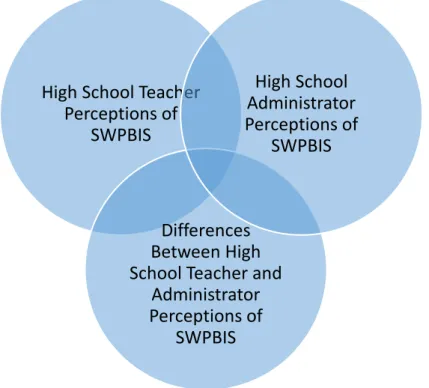
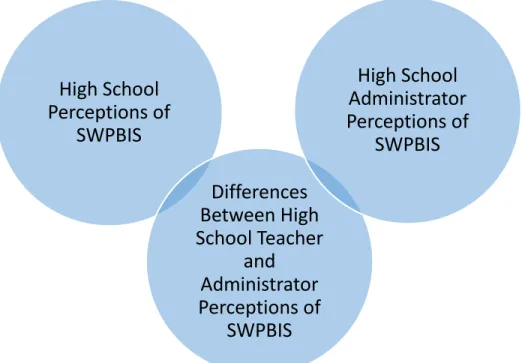
The conceptual framework of this study was based on the goal of gaining an understanding of how both high school teachers and administrators perceived SWPBIS and the differences in the perceptions of the two roles (see Figure 1). The researcher theorized that even though individuals in each position had different responsibilities, their perceptions would be similar because of the shared experiences of working in the same school. It was critical to examine both teacher and administrator perspectives to gain a complete understanding of both the positive and negative views of SWPBIS in a high school setting.
High School Teacher Perceptions of
SWPBIS
Differences Between High School Teacher and
Administrator Perceptions of SWPBIS High School Administrator Perceptions of SWPBIS
Figure 1. Conceptual framework of the study of perceptions of school-based positive behavior interventions and supports (SWPBIS).
Significance of the Study
literature on SWPBIS. Additionally, as staff buy-in was indicated to be a facilitator of sustained SWPBIS implementation (Bohanon & Wu, 2014), the results of this study may assist school leaders in employing the best strategies for acquiring staff buy-in.
Furthermore, high school personnel were found to discount research conducted on interventions if the research did not take place in high schools or the high schools were dissimilar to their own (Bohanon et al., 2012; Swain-Bradway et al., 2015). Therefore, the results of this study may add to the research base on high school SWPBIS.
Research Questions
Through the collection and analysis of quantitative and qualitative data, the researcher answered the following questions. The overarching research question was the following: What are high school teachers’ and administrators’ perceptions of SWPBIS? Three subquestions guided the research.
1. What are high school teachers’ perceptions of SWPBIS? 2. What are high school administrators’ perceptions of SWPBIS?
3. To what extent is there a difference between high school teachers’ and administrators’ perceptions of SWPBIS?
Limitations
One limitation of the study was that the researcher served in the capacity of PBIS coordinator for the school district where the study took place. Due to the researcher’s position, the teacher responses on both the survey and in the interviews might have been affected. The researcher attempted to limit this effect by ensuring anonymity of the study’s participants and using other interviewers not employed at the school.
The researcher assumed that as the principal in the study school volunteered the school to participate in the Georgia Department of Education version of SWPBIS, both the principal and school staff were willing to adapt their approaches to school-wide discipline to meet the criteria set forth by the Georgia Department of Education PBIS team. The researcher also assumed the school’s principal was willing to participate in this study. Finally, in regards to the study’s participants, the researcher assumed all responses were accurate and truthful.
Delimitations
One reason the researcher chose to study SWPBIS in a high school setting was the researcher’s background as a high school teacher and school-level administrator. The Georgia Department of Education PBIS team limited the number of schools that can begin SWPBIS implementation to 10 per year per school district. As this was Year 1 of SWPBIS implementation for the school district in which this study took place, the number of potential high schools that could participate in the study was limited to two.
Definitions of Terms
Explanatory, sequential, mixed methods design: This type of research design first involves the collection and examination of quantitative data followed by the collection and examination of qualitative data in the next phase (Creswell, Clark, Gutmann, & Hanson, 2007).
Positive behavior interventions and supports (PBIS): This framework is comprised of three tiers that encompass interventions for the whole school, individual classrooms or groups, and specific students as deemed necessary (Kelm et al., 2014).
Rather than punitive responses to student inappropriate behavior, PBIS emphasizes a proactive, positive approach.
School-wide positive behavior interventions and supports (SWPBIS): The primary tier of the PBIS framework is SWPBIS, which is used as a deterrence of problem
behaviors through proactive measures in all school-related settings. SWPBIS includes the establishment and instruction of three to five behavioral expectations, a system for
recognizing appropriate behaviors, and the formation of a PBIS team with the
responsibility of oversight and management of all SWPBIS processes (Bradshaw, Pas, et al., 2012).
Summary
Throughout the history of the United States, school officials traditionally used the most severe punitive consequences to address the most extreme student behaviors. However, the use of exclusionary discipline measures has been found to be more detrimental to student success than beneficial. Understanding the need for an alternate means of addressing inappropriate student behavior, researchers at the University of Oregon developed PBIS as a method for managing, without punitive consequences, the aggressive behaviors of students with emotional and behavior disorders. Based on tenets of applied behavior analysis, PBIS is a three-tiered intervention framework that is used school wide, in classrooms or groups, and with individual students as a method of positively affecting the behavioral and academic success of all students. Tier 1, which is also known as SWPBIS, has been successfully utilized by over 22,000 schools, most of which are elementary and middle schools. Even though SWPBIS has been employed much less extensively in high schools, researchers who conducted SWPBIS studies in
high schools in the Pacific Northwest and Midwest found correlations between SWPBIS and behavioral and academic outcomes.
Through a sequential, explanatory, mixed methods study, the researcher examined high school teacher and administrator perspectives of SWPBIS in one Middle Georgia high school. In the quantitative portion of the study, the researcher analyzed teacher and administrator statistical survey results about the perception of SWPBIS. Alternately, the qualitative phase was comprised of one-one-one teacher and administrator interviews about the perspectives of SWPBIS. The data collected during the interviews were used to expand on the quantitative results.
CHAPTER 2
REVIEW OF LITERATURE
This study examined SWPBIS in a Middle Georgia high school based on teacher and administrator perceptions regarding the effectiveness of SWPBIS and school-wide discipline practices. The conceptual framework for this study was guided by the conception that implementation of SWPBIS in schools establishes environments that decrease ODRs and enhance the effectiveness of discipline systems in schools. Therefore, it was appropriate to review the research and literature in the domains of human behavior and student behavior management. Several areas were investigated within the human behavior domain: behaviorism, applied behavior analysis, respondent conditioning, operant conditioning, the four contingencies, and token economies. Two subjects were examined within the student behavior-management domain: exclusionary discipline and PBIS. The domain of SWPBIS was reviewed more thoroughly, including description of tiers of support, fidelity of implementation, SWPBIS in different school levels, barriers to high school SWPBIS implementation, opposition to SWPBIS, and negative results of SWPBIS. These domains provided a framework for the study of SWPBIS in a Middle Georgia high school.
Discipline is an important aspect of public schools, and efficacious practices were essential in the maintenance of classroom management, the promotion of student
learning, and the insurance of overall school safety (Eckes & Russo, 2012; Freeman, Simonsen, Briere, & MacSuga-Gage, 2014; Mayworm & Sharkey, 2014; Mowen, 2014; Sugai & Horner, 2002). However, what school personnel and the general public viewed as the most critical school discipline issues changed over time (Casella, 2006; Crews &
Montgomery, 2001; Gilbert, 1986; Goldstein, Apter, & Harootunian, 1984; Mowen, 2014; Phaneuf, 2009; Schiro, 1985; Skiba & Losen, 2015; Stouffer, 1952; Toby, 1998). During the 1930s and 1940s, most Americans believed that student gum chewing, too much talking, and dress code violations were the most important discipline issues faced by school personnel (Goldstein et al., 1984; Schiro, 1985). In the early 1950s, disrespect to school personnel, theft, and vandalism were added as growing discipline concerns (Gilbert, 1986; Schiro, 1985; Stouffer, 1952).
As the United States moved into the Vietnam War era and the Civil Rights Movement of the late 1950s, 1960s, and 1970s, the most significant school discipline problems took a more violent shift, and Americans grew more concerned about increased violence and disrespect towards school officials (Blythe, 1980; Friere, 1992; Phaneuf, 2009; Stinchcombe, 1964; Toby, 1998). As a result of increased media coverage of school violence, the U.S. Congress passed the Safe Schools Act in 1974 that mandated a study be conducted to determine the seriousness of school violence (Schiro, 1985; Toby, 1998). The study, titled Violent Schools–Safe Schools, was published in 1977, and the researchers concluded that school violence was higher than in previous years but was not as dire as perceived (Schiro, 1985; Toby, 1998). In the 1980s, school discipline concerns moved to drugs and gang violence as the war on drugs escalated (Crews & Montgomery, 2001; Skiba & Losen, 2015). Finally, as a result of increased national concerns as well as highly publicized school shootings like the one that occurred in Columbine, Colorado, school officials began implementing security measures such as security cameras, metal detectors, school resource officers, and zero-tolerance policies in the 1990s and 2000s
(Casella, 2001, 2006; Eckes & Russo, 2012; Kupchick & Monahan, 2006; Sugai & Horner, 2002).
Human Behavior
Human behavior was a main topic in the arts, humanities, and science since the Renaissance (Lattal & Perone, 1998). The effects of behavior were most noticeable in U.S. schools even though they were intended to be places of safety (O’Neill & Bundock, 2015; Shepherd & Linn, 2015). Researchers from the National Center for Education Statistics (Robers, Kemp, Truman, & Snyder, 2013) indicated that up to 50% of schools reported problems with disruptive classroom behavior, physical assaults, gang activity, and bullying. Furthermore, student behavior in schools greatly influenced the ability of students to learn and teachers to teach (Arum & Velez, 2013). For example, Casillas et al. (2012) found that adverse student behavior contributed to poor academic performance. Additionally, a study conducted by Owens (2015) for the Georgia Professional Standards Commission revealed that 44% percent of Georgia teachers were leaving the profession within the first 5 years of teaching. Further examination of this crisis revealed that 97% of teachers leaving the profession cited reasons as a result of student discipline and classroom-management issues (Owens, 2015). Consequently, most educators understood the importance of behavior management despite the reality that behavior management was a greatly misunderstood concept that most educators harbored strong, yet often inaccurate ideas and feelings towards (Maag, 2016).
Psychological Elements of Behavior
Behavior denoted what individuals did, exhibited overtly and covertly, and executed as a means of interacting with the environment (Kearney, 2015; Lattal &
Perone, 1998; Maag, 2016; O’Reilly, Gevarter, Falcomata, Sigafoos, & Lancioni, 2014; Skinner, 1938). Throughout history, the causes of human behavior were attributed to a multitude of sources including internal entities such as the soul and external bases like the moon, astrological alignment, and the gods; however, these explanations were not
scientific (Pierce & Cheney, 2013). Conversely, behavior theory was the premise that all behavior was the result of intricate contact between inherent influence and environmental involvement (O’Reilly et al., 2014; Pierce & Cheney, 2013; Skinner, 1938; Zilio, 2016). This school of thought, known as behaviorism, began in the early 20th century with the work of Watson (1913), who redefined psychology as a branch of experimental science and suggested the prediction and control of behavior as the focus (Cooper, Heron, & Heward, 2007; Dixon, Vogel, & Tarbox, 2012; Malone & Garcia-Penagos, 2014; Shepherd & Linn, 2015; Staddon, 2014; Watrin & Darwich, 2012).
In the 1930s, B. F. Skinner emerged as a leading behaviorist (Cooper et al., 2007; Lattal & Perone, 1998; Schneider & Morris, 1987; Shepherd & Linn, 2015; Staddon, 2014; Watrin & Darwich, 2012). Skinner, whose model was known as radical
behaviorism, advocated for a science of behavior through scientific explanation, as opposed to other behaviorists who supported traditional scientific experimental methods (Baum, 2017; Cooper et al., 2007; Lattal & Perone, 1998; Shepherd & Linn, 2015; Skinner, 1938; Staddon, 2014). Skinner defined learning through the demonstration of a proper response after a particular environmental stimulus was presented and contended that the reinforcement of behaviors improved the likelihood of those behaviors being repeated (Cooper et al., 2007; Ertmer & Newby, 2013; Maag, 2016; Shepherd & Linn, 2015; Skinner, 1938; Staddon, 2014). Despite the differences, Skinner’s concept of
radical behaviorism was the direct intellectual successor to Watson’s classical view of behaviorism (Hillner, 1984; Staddon, 2014).
Applied Behavior Analysis
Skinner proposed that as behaviors evaluated in the laboratory were regulated by operant and respondent doctrine, the behavior of humans in the real world likely would be affected as well (Dixon et al., 2012; Kearney, 2015; Lattal & Perone, 1998; Skinner, 1953). This concept thus prompted the discipline of applied behavior analysis, defined as the application of behavior principles for the resolving of practical problems (Cooper et al., 2007; Dixon et al, 2012; Kearney, 2015; Maag, 2016; Pierce & Cheney, 2013; Shepherd & Linn, 2015; Watrin & Darwich, 2012). Applied behavior analysis was comprised of two types of conditioning: respondent and operant (Loovis, 2017; Pierce & Cheney, 2013; Skinner, 1953). The features of applied behavior analysis that made it a unique discipline were the focus on research, importance of conditioning, direct treatment of problem behavior, programming for generality, and a concentration on the social environment (Cooper et al., 2007; Pierce & Cheney, 2013). The use of applied behavior analysis spanned a wide breadth of fields, including practice of operant intervention techniques in the field of education (Dixon et al., 2012; Kazdin, 2013).
Respondent conditioning. Ivan Pavlov, who conducted laboratory research on animals in the 1800s and 1900s, was one of the innovators in respondent conditioning, which was also called classical or Pavlovian conditioning (Kazdin, 2012, 2013; Pierce & Cheney, 2013; Skinner, 1984). Pavlov found that digestive processes of dogs could be stimulated by the sight or preparation of food without direct physical contact with the food (Kazdin, 2013; Pierce & Cheney, 2013; Skinner, 1984). This type of learning came
to be referred to as respondent conditioning and transpired when a neutral stimulus, such as a bee buzzing, was combined with a stimulus that was unconditioned, such as the pain of a bee sting (Allen, 2007; Cooper et al., 2007; Foxall, 2016; Kazdin, 2013; Loovis, 2017; Pierce & Cheney, 2013; Skinner, 1953). The result of the combination usually led individuals to escape future encounters of bees buzzing (Pierce & Cheney, 2013;
Shepherd & Linn, 2015). As the evoked responses become automatic when the stimuli were presented, the responses were called unconditioned responses or respondents (Cooper et al., 2007; Kazdin, 2013; Pierce & Cheney, 2013; Skinner, 1953).
Operant conditioning. Edward Thorndike, who conducted research on the ways animals learn, was one of the innovators of operant conditioning (Allen, 2007). Operant conditioning occurred when behaviors within environments produced consequences, such as a baby whose smiling increased because the smile increased the likelihood of being picked up (Cooper et al., 2007; Foxall, 2016; Kazdin, 2012, 2013; Lattal & Perone, 1998; Loovis, 2017; Pierce & Cheney, 2013; Shepherd & Linn, 2015; Skinner, 1953). Operant conditioning was also based on the principle of contingencies of reinforcement, which denoted the relationship linking behaviors and the environmental occurrences that affected behavior (Ciapani & Schock, 2007; Kazdin, 2012, 2013; Kearney, 2015; Lattal & Perone, 1998; Maag, 2016; Meadan, Ayvazo, & Ostrosky, 2016; Meredith et al., 2014; Pierce & Cheney, 2013).
Contingencies of reinforcement consisted of the relationship among antecedent, behavior, and consequences; were delivered after the behavior; and were used to increase or reduce behavior (Boerke & Reitman, 2011; Ciapani & Schock, 2007; Dixon et al., 2012; Kazdin, 2012, 2013; Kearney, 2015; Lattal & Perone, 1998; Loovis, 2017; Maag,
2016; Meadan et al., 2016; Meredith et al., 2014; Pfiffner & Haack, 2015; Pierce & Cheney, 2013; Shepherd & Linn, 2015). For example, if a phone rang (antecedent), someone answered the phone (behavior), and the consequence was a conversation between the caller and the person who answered the phone (Kazdin, 2013; Maag, 2016; Pierce & Cheney, 2013). The development of effective behavior programs depended on the awareness of the effects of antecedents and consequences in relation to behavior in addition to how antecedents and consequences were used to stimulate, progress, and maintain behavior (Kazdin, 2013; Meredith et al., 2014).
Antecedents. Antecedents were the conditions present before behaviors were displayed (Boerke & Reitman, 2011; Cooper et al., 2007; Kazdin, 2013; Maag, 2016; Meadan et al., 2016; Meredith et al, 2014; Pfiffner & Haack, 2015; Sheperd & Linn, 2015). Additionally, antecedents stimulated behaviors that assisted in the avoidance of punishment or the obtainment of reinforcement (Maag, 2016; Shepherd & Linn, 2015). Antecedents were not the cause of behavior and instead only served as cues for behavior (Kazdin, 2013; Maag, 2016; Shepherd & Linn, 2015). Furthermore, antecedents were distinguished by three categories: prompts, setting events, and discriminative stimuli (Kazdin, 2013). Prompts were specific antecedents that directed execution of specific behaviors, setting events were the contextual conditions that induced behavior, and discriminative stimuli were stimuli associated with reinforcement (Ciapani & Schock, 2007; Kazdin, 2013).
Consequences. Consequences were the proceedings that follow behavior and included effects that proliferated, reduced, or had no impression on the behavior (Boerke & Reitman, 2011; Cooper et al., 2007; Kazdin, 2012, 2013; Maag, 2016; Meadan et al.,
2016; Meredith et al, 2014; Pfiffner & Haack, 2015; Shepherd & Linn, 2015).
Furthermore, consequences were categorized in one of two forms (Maag, 2016). First, a reinforcer referred to situations when a different stimulus was inserted into the
environment (Foxall, 2016; Kazdin, 2013; Loovis, 2016; Meadan et al., 2016; Pierce & Cheney, 2013). The second type of consequence, punisher, referred to instances when a stimulus that was already present was evaded, terminated, or separated from the
environment (Foxall, 2016; Kazdin, 2013; Maag, 2016; Pierce & Cheney, 2013). The most rudimentary aspect of consequences were the relation to behavior (Kazdin, 2013). However, a mistaken application of behavioral interventions emphasized only
consequences, which resulted in the belief that the practice of using behavioral interventions was ineffective (Kazdin, 2013; Meredith et al., 2014).
The Four Contingencies
For reinforcers to alter behavior, they were contingent upon the occurrence of the behavior (Ciapani & Schock, 2007; Critchfield & Miller, 2017; Kazdin, 2013; Pierce & Cheney, 2013). There were four main contingencies of reinforcement: positive
reinforcement, negative reinforcement, positive punishment, and negative punishment (Dixon et al., 2012; Foxall, 2016; Kazdin, 2013; Loovis, 2016; Pfiffner & Haack, 2015; Pierce & Cheney, 2013).
Reinforcement. Reinforcement involved stimuli that caused a behavior response to increase or maintain in frequency (Ciapani & Schock, 2007; Cooper et al., 2007; Critchfield & Miller, 2017; Foxall, 2016; Kazdin, 2012, 2013; Loovis, 2016; Meadan et al., 2016; Pfiffner & Haack, 2015; Pierce & Cheney, 2013). In other words,
2007; Dixon et al., 2012; Kazdin, 2013). The two types of reinforcers were termed positive and negative (Ciapani & Schock, 2007; Cooper et al., 2007; Dixon et al., 2012; Foxall, 2016; Kazdin, 2013; Loovis, 2016; Pfiffner & Haack, 2015; Pierce & Cheney, 2013).
Positive reinforcers were stimuli that were presented following a response that proliferated the frequency the reinforcers followed (Ciapani & Schock, 2007; Cooper et al., 2007; Dixon et al., 2012; Foxall, 2016; Kazdin, 2012, 2013; Pfiffner & Haack, 2015). Additionally, positive reinforcers were stimuli that people valued and thus wanted as a result and included food, money, and praise (Kazdin, 2012; Loovis, 2016; Pierce & Cheney, 2013). Conversely, negative reinforcers were aversive stimuli that increased the likelihood of removal of behavior (Ciapani & Schock, 2007; Cooper et al., 2007; Dixon et al., 2012; Foxall, 2016; Kazdin, 2012, 2013; Loovis, 2016; Pfiffner & Haack, 2015; Pierce & Cheney, 2013). For example, if the fear of getting detention stopped a student from talking in class, then this fear served as a negative reinforcer (Loovis, 2016). Negative reinforcers often were misinterpreted as punishers; however, negative reinforcement included procedures and effects that were very different from punishers (Ciapani & Schock, 2007; Kazdin, 2013; Pierce & Cheney, 2013).
Punishment. Unlike reinforcers that increased the probability of behaviors, punishment was the introduction or elimination of a stimulus after a response, which in turn decreased the probability of that response (Cooper et al., 2007; Kazdin, 2012, 2013; Loovis, 2016; Pierce & Cheney, 2013). In the everyday world, punishment was
considered to be a penalty for committing a wrongful act (Kazdin, 2013; Pierce & Cheney, 2013). However, behaviorally, punishment was only considered operant if it
decreased the likelihood of repeated behaviors (Kazdin, 2013; Loovis, 2016; Pierce & Cheney, 2013). The two types of punishments were referred to as positive and negative (Kazdin, 2013; Loovis, 2016; Pierce & Cheney, 2013).
Positive punishment consisted of the presentation of an adverse stimulus in response to an event (Cooper et al., 2007; Kazdin, 2013; Loovis, 2016; Pierce & Cheney, 2013). For example, spanking a child for misbehaving was considered positive
punishment if the child no longer performed the undesired behavior (Kazdin, 2013; Pierce & Cheney, 2013). Contrarily, negative punishment was the removal of a favorable stimulus in response to an event (Cooper et al., 2007; Kazdin, 2013; Loovis, 2016; Pierce & Cheney, 2013). For instance, the loss of desired privileges for misbehavior was
considered negative punishment (Kazdin, 2013; Loovis, 2016; Pierce & Cheney, 2013). Dixon et al. (2012) explained, “Skinner and many early behaviorists warned that
punishment may bring about undesirable side effects and that striving to promote control of behavior through positive reinforcement as much as possible was a valuable goal in and of itself” (p. 7).
The Token Economy
Most educators had, even at the most basic level, some knowledge of rewards and reinforcement use on student behavior management, and many incorporated the use of rewards and reinforcement as part of classroom-management plans (Akin-Little, Eckert, Lovett, & Little, 2004). The distribution of rewards such as stickers or pizza coupons for appropriate student behavior was employed for decades (Akin-Little et al., 2004; Slavin, 1997). However, the first known use of incentive-based behavior systems for classroom management was by Joseph Lancaster in England in the early 1800s (Kaestle, 1973;
Kazdin, 2012; Lancaster, 1803). Lancaster, who was responsible for the education of large enrollments of disadvantaged students, incorporated a ranking system where students and monitors were acknowledged for academic achievement and outstanding behavior (Kaestle, 1973; Kazdin, 2012; Lancaster, 1803).
Even though early incentive-based behavior systems such as Lancaster’s
supported the historical foundation for later applications, the earlier models were not built on the principles of operant conditioning (Kazdin, 2012). The first known incentive-based behavior system grounded in the operant conditioning theory was referred to as the token economy, defined as “formal descriptions of contingency relations” that were “intended to modify or influence behavior through the delivery of conditioned reinforcers” (Boerke & Reitman, 2011, p. 370). First used in the 1960s, the token economy was initially used in response to inadequate care for patients who were institutionalized (Boerke & Reitman, 2011; Kazdin, 1982). Aside from having operant conditioning roots, the token economy was also one of the first applications of applied behavior analysis (Boerke & Reitman, 2011).
An important aspect of the token economy was the distribution of token reinforcers to individuals who displayed desired behaviors (Zlomke & Zlomke, 2003). The token reinforcers were then exchanged for backup reinforcers such as food or special activities (Miltenberger, 1997). Much of the development of the token economy was credited to Ayllon and Azrin (1968), who researched its use on psychiatric patients, and Staats, Minke, and Butts (1970), who researched the correlation between use of the token economy and reading behavior in children. Through the 1970s and early 1980s, the first token-economy programs designed for classroom and whole-school use were
implemented (Boegli & Wasik, 1978; Kazdin, 1982; Rollins, McCandless, Thompson, & Brassell, 1974; M. Thompson, Brassell, Persons, Tucker, & Rollins, 1974).
Student Behavior Management
Even though effective discipline practices were significant criteria for the effective management of a school, researchers and other stakeholders disagreed in regards to what discipline methods educators should use (Eckes & Russo, 2012; Mayworm & Sharkey, 2014). Traditionally, school officials used student behavior management systems that encouraged discipline techniques that controlled behavior, which, in turn, increased compliance through the use of rules and expectations (Flannery et al., 2013; Mayworm & Sharkey, 2014; Sugai & Horner, 2002). One example was the perception that students complied with school rules out of fear of receiving consequences for noncompliance (Sugiai & Horner, 2002, 2006; Way, 2011). Such practices were characteristic of deterrence theorists who declared that punitive consequences were the most effective means of controlling behavior (Braga & Weisburd, 2011; Kleck & Barnes, 2013; Mayworm & Sharkey, 2014; Perry & Morris, 2014; Skiba, Arredondo, et al., 2014).
Discipline policies, or codes of conduct, were the documents by which school officials transmited behavior expectations to the entire school community (Eckes & Russo, 2012; Fenning et al., 2012; Sugai & Horner, 2002). In a study of six states, Fenning et al. (2012) found that most discipline policies tended to be punitive and rarely provided proactive strategies that incorporated the teaching of behavioral expectations. Some of the overuse of punitive discipline consequences correlated with the lack of preservice training teachers received in behavior management, as teachers often
expressed inadequacies in behavior-management techniques and interventions (Freeman et al., 2014; Osher, Bear, Sprague, & Doyle, 2010; Wehby & Kern, 2014). These punitive consequences include detention, Saturday school, ISS, OSS, and expulsion from school (Allman & Slate, 2011; Eckes & Russo, 2012; Flannery et al., 2012; Monahan,
VanDerhei, Bechtold, & Cauffman, 2014; Osher et al., 2010; Sugai & Horner, 2002; Tyre et al., 2011). However, the use of punitive consequences offered temporary solutions to what were often long-term problems (Osher et al., 2010; Simson, 2014; Sugai & Horner, 2002).
Exclusionary Discipline
Researchers found that the exclusionary discipline consequences of OSS and expulsion had more negative consequences than positive (Fabelo et al., 2011; Morgan, Salomon, Plotkin, & Cohen, 2014; Pane, Rocco, Miller, & Salmon, 2014; Simson, 2014; Skiba, Arredondo, et al., 2014; Skiba, Chung, et al., 2014). School officials commonly utilized suspensions and expulsions as a means of sustaining safe conditions within schools (Flannery et al., 2013; Morgan et al., 2014). In a study of over 900,000 students, Fabelo et al. (2011) found that 59.6% of students received at least one exclusionary discipline consequence between Grades 7 and 12, and half of the students who received these consequences had at least four violations that resulted in exclusionary discipline.
Despite the common use of exclusionary discipline techniques, further problems resulted from the disallowance of these students to attend school (Fabelo et al., 2011; Morgan et al., 2014; Pane et al., 2014; Perry & Morris, 2014; Simson, 2014; Skiba, Arredondo, et al., 2014; Steinberg, Allensworth, & Johnson, 2013). First, students who were excluded from school suffered academically due to a loss of instructional time
(Fabelo et al., 2011; Hilberth & Slate, 2012; Morgan et al., 2014; Whisman & Hammer, 2014). Fabelo et al. (2011) reported that students who received at least one exclusionary discipline consequence were much more likely to repeat a grade level than those who never received similar consequences. Furthermore, students who lost instructional time due to disciplinary issues were more inclined to have excessive absences as well as future suspensions, which increased absences and risk of dropping out (Morgan et al., 2014). Ultimately, school officials who overused suspensions and expulsions created a negative school climate where students felt insecurity about discipline consequences, undermining the intended purpose of the consequences: to maintain positive learning conditions (Morgan et al., 2014; Perry & Morris, 2014; Skiba, Arredondo, et al, 2014; Steinberg et al., 2013).
One unintentional result of exclusionary discipline practices was the increased risk of contact with the juvenile justice system due to criminal misbehavior (Monahan et al., 2014; Scott & Saucedo, 2013; Simson, 2014; Skiba, Arredondo, et al., 2014;
Vanderhaar, Munoz, & Petrosko, 2014). This concept, referred to as the school-to-prison pipeline, was defined as the processes and policies of a school that led to student removal for disciplinary infractions, which created a higher risk for criminal offenses (Scott & Saucedo, 2013; Skiba, Arredondo, et al., 2014). The elevated likelihood of arrest after receiving an exclusionary discipline consequence was universal among all races, ethnicities, and genders (Monahan et al., 2014). In comparison to students who had no discipline consequences at school, students who were disciplined by school officials were more likely to be charged by police for criminal violations (Fabelo et al., 2011).
for students who received these consequences than for students who did not (Monahan et al., 2014; Vanderhaar et al., 2014). Even though a link existed between the use of
exclusionary discipline techniques and increased risk of committing crimes, it was implausible to reason that the use of exclusionary discipline techniques led directly to criminal justice outcomes (Flannery, Fenning, Kato, & McIntosh, 2014; Skiba, Arredondo, et al., 2014a). Instead, criminal outcomes were more likely a result of the short-term consequences associated with exclusionary techniques, such as the loss of educational opportunities and negative school perceptions, which led to poor academic achievement (Skiba, Arredondo, et al., 2014a).
OSS. Despite an abundance of use, OSS was ineffective in eradicating
problematic behaviors or teaching desired behaviors (Bear, 2012; Sharkey & Fenning, 2012). One reason was that many students were not positively affected by OSS (Bear, 2012; Ryan & Goodram, 2013; Vanderhaar et al., 2014). Much like imprisonment in the criminal justice system, suspension was used by school officials to gain social control by removing students from learning environments (Perry & Morris, 2014). As a result of time spent out of school, the academic achievement of students who received OSS suffered (Flannery et al., 2012; Perry & Morris, 2014). Additionally, some students perceived suspension as a school holiday, thus reinforcing the likelihood that problematic behaviors persisted (Chin, Dowdy, Jimerson, & Rime, 2012). Furthermore, students who were suspended repeatedly exhibited increased risks of truancy, creating the inadvertent effect of driving students out of school (Flannery et al., 2012; Rumberger, 2011). Finally, in a research study in a large metropolitan school district in Kentucky, Perry and Morris
(2014) discovered schools with high rates of OSS also had high proportions of nonsuspended students with low academic achievement.
The use of OSS was also found to cause a negative school climate by creating mistrust, apprehension, and uneasiness even for students who were not considered discipline problems (Bear, 2012; Perry & Morris, 2014; Sharkey & Fenning, 2012). Many suspended students could neither grasp the consequences of the actions that resulted in the suspensions nor view the suspensions in the manner school administrators preferred (Chin et al., 2012; Moreno & Gaytán, 2012; Skiba et al., 2011). Typically, educators failed to address the underlying problems that resulted in suspensions and instead utilized the consequence as a short-term solution (Chin et al., 2012; Moreno & Gaytán, 2012). Therefore, those students prone to problematic behaviors should have received interventions and supports that addressed the causes of the behaviors along with the promotion of positive school climate and self-discipline (Bear, 2012; Moreno & Gaytán, 2012).
Discipline practices utilized to establish self-discipline, as opposed to student management, were more closely associated with the aim of creating high-character students (Mayworm & Sharkey, 2014). Such procedures included teaching self-discipline through student-centered methods within the framework of programs that incorporated the prevention of problematic behaviors and the development of social skills (Mayworm & Sharkey, 2014). Despite the results of researchers who found negative consequences in the use of OSS as a form of school discipline, school officials deemed OSS necessary for school safety because the use of OSS assisted in providing order and a conducive
Expulsion. Certain aspects of school expulsion policies, such as mandatory expulsion for firearm possession, were required by law; however, many other expulsion policies were determined at the district level and included offenses such as drugs, alcohol, violence, and nonfirearm weapons (Bruhn, Gorsh, Hannan, & Hirsch, 2014; Fabelo et al., 2011; Welch & Payne, 2012). Due to the discretionary nature of the employment of expulsion, its use as a disciplinary tactic increased over time (Fabelo et al., 2011). However, the regular application of expulsion did not create a climate that was any more conducive to the academic success of students when compared to schools with officials who used expulsion less often (Fabelo et al., 2011). School administrators tended to follow the rationale of using expulsion as a means of removing problematic students from classrooms so teachers could teach the other students without distractions, even though this was not an effective practice (J. Thompson, 2016).
Alternative schools. Theoretically, alternative school programs were constructed to serve the educational needs of students unable to be served in a traditional school environment because of disciplinary problems (Booker & Mitchell, 2011; Kim, 2011; Vanderhaar et al., 2014). In the early use, alternative schools were reserved for students who mainly violated zero-tolerance policies; however, many students were eventually placed in these schools for a variety of discretionary behavior violations (Booker & Mitchell, 2011; Kim, 2011). As a result, the placement in alternative schools of students labeled as unruly and dangerous became a regular occurrence (Vanderhaar et al., 2014). Thus, education leaders advocated for alternative schools based on the premise that the placement at alternative schools reduced student expulsions, maintained the safety at traditional schools, and lowered criminal offenses by juveniles (Vanderhaar et al., 2014).
Despite the theoretical purposes of alternative schools, problems existed in many of these programs. First, Vanderhaar et al. (2014) found that alternative school
placements correlated with a high probability of criminal offenses outside of the school. Furthermore, regardless of the reasons for placement, one of the goals of alternative education program facilitators was to improve student behavior so that the students could return to traditional school environments (Simonsen, Jeffrey-Pearsall, Sugai, & Mccurdy, 2016). Booker and Mitchell (2011) found that White students, who typically had more extreme behaviors, were likely to be reformed; however, ethnic-minority and older students were more likely to return to alternative settings. Additionally, many alternative education programs lacked the educational resources of traditional schools (Morgan et al., 2014). As a result, these students failed to receive an adequate education, and society as a whole incurred the negative consequences of increased crime rates and unskilled workforce laborers that subsequently occurred because of inadequate education (Geronimo, 2011).
PBIS
The effects of the increased pressure on school officials to establish safe and orderly environments led to an increase in the adoption of preventative forms of
discipline at both the state and district levels (Bradshaw & Pas, 2011; Bradshaw, Reinke, Brown, Bevans, & Leaf, 2008; Sugai & Horner, 2002, 2006). Students spent over 14,000 hours in school environments from kindergarten through high school graduation, thus providing incomparable opportunities for educators to teach and reinforce practices that further the academic, social, and behavioral development of students (Mathews,
1980s by researchers at the University of Oregon who were seeking an alternate means of behavior management that did not involve punitive consequences for individuals with emotional and behavioral disorders (Bradshaw, Koth, Bevans, Ialongo, & Leaf, 2008; Johnston, Foxx, Jacobson, Green, & Mulick, 2006; Kincaid et al., 2015; Safran & Oswald, 2003; Sugai & Simonsen, 2012). In 1997, IDEA was amended to specifically mention PBIS as a mechanism for appropriately addressing behavior needs; PBIS was again included in the 2004 reauthorization of IDEA (Bruhn et al., 2014; U.S. Department of Education, 2016). The inclusion of PBIS, the only behavior technique specifically mentioned, in the law was based on the perception in Congress that PBIS is a proactive instrument for responding to students with disabilities and behavioral needs (U.S. Department of Education, 2016).
The 1997 reauthorization of IDEA also created a grant for the establishment of a national PBIS center to assist schools with the distribution and support of PBIS practices with students diagnosed with emotional and behavioral disorders (Johnston et al., 2006; Sugai & Simonsen, 2012). This center was part of the U.S. Department of Education Office of Special Education and was termed the Office of Special Education Technical Assistance Center on PBIS (Johnston et al., 2006; Kincaid et al., 2015). Initially, PBIS centered on the behaviors of individual students; however, the Office of Special
Education Technical Assistance Center on PBIS altered directions to emphasize behavior supports for all students in a school-wide setting (Kincaid et al., 2015; Sugai &
PBIS Framework
PBIS was not a manualized program (Flannery et al., 2013; Horner, 2013; Kelm et al., 2014). Instead, PBIS was employed as a framework for school officials to adopt practices that supported positive academic and behavioral achievement of all students (Flannery et al., 2013; Horner, 2013; Kelm et al., 2014; Yeung et al., 2016). The implementation framework of PBIS was outlined to augment both the social and academic skills of all students through the utilization of data in the decision-making process for choosing, incorporating, and monitoring the progress of research-based behavioral interventions as well as the organization of resources and entities to enhance application fidelity (Carroll et al., 2012; Coffey & Horner, 2012; Flannery et al., 2013; Simonsen et al., 2016; Sugai & Simonsen, 2012; Yeung et al., 2016).
The goal of PBIS creators was the alteration of school environments through the creation of enhanced systems and procedures that inspired positive change in the actions of staff, thus prompting positive changes in student behavior and school climate
(Bradshaw, Koth, et al., 2008; Bradshaw, Pas, et al., 2015; Carroll et al., 2012; Kelm et al., 2014). Additionally, PBIS originators envisioned a program with clear behavioral expectations, incentives for students who met the expectations, promotion of positive interactions between both students and staff in the school, and incorporation of staff decision-making based on data (Bradshaw, Pas, et al., 2015; Coffey & Horner, 2012; Flannery et al., 2013; Freeman et al., 2015; Kelm et al., 2014; Sugai & Horner, 2002; Yeung et al., 2016). Data were also used to produce feedback and construct goals for the facilitation of PBIS (Kelm et al., 2014; Sugai & Horner, 2002; Yeung et al., 2016). Ultimately, the framework of PBIS was formed to help create a predictable and
reinforcing school climate for both students and staff as well as a system that allowed for the organization and monitoring of interventions and supports so that students were afforded early access when needed (Coffey & Horner, 2012; Freeman et al., 2015).
An assumption of PBIS implementers was that every student who attended school needed some level of support, dependent upon the problem behaviors each student
exhibited (O’Neill & Bundock, 2015; Safran & Oswald, 2003; Sugai & Horner, 2002). The framework was comprised of three tiers that included interventions for whole
schools, individual classrooms, and specific students as needed (Bradshaw, Waasdorp, & Leaf, 2012; Carroll et al., 2012; Flannery et al., 2013; Kelm et al., 2014; Kincaid et al., 2015; Nocera et al., 2014; O’Neill & Bundock, 2015; Sugia & Horner, 2006; Sugai & Simonsen, 2012; Swain-Bradway et al., 2015; Wehby & Kern, 2014; Yeung et al., 2016). These tiers were classified as Tier 1, universal; Tier 2, targeted, and Tier 3, intensive (Bradshaw, Pas, et al., 2012; Bradshaw, Waasdorp, et al., 2012; Bruhn et al., 2014; Carroll et al., 2012; Flannery et al., 2013; Kelm et al., 2014; McCamish, Reynolds, Algozzine, & Cusumano, 2015; Nocera et al., 2014; Simonsen et al., 2016; Sugai & Horner, 2006; Swain-Bradway et al., 2015; U.S. Department of Education, 2015; Yeung et al., 2016). For school officials instituting PBIS, the goal of this tiered approach was the prevention of troublesome behaviors and the improvement of the organizational climate through the creation and sustainment of support systems (Bradshaw, Pas, et al., 2012; Bruhn et al., 2014; Carr et al., 2002; Carroll et al., 2012; Flannery et al., 2013; Kelm et al., 2014; Simonsen et al., 2012; Waasdorp, Bradshaw, & Leaf, 2012).