R E S E A R C H
Open Access
Dynamical behavior of a third-order rational
fuzzy difference equation
Qianhong Zhang
1*, Jingzhong Liu
2and Zhenguo Luo
3*Correspondence:
1Key Laboratory of Economics
System Simulation, School of Mathematics and Statistics, Guizhou University of Finance and Economics, Guiyang, Guizhou 550025, People’s Republic of China Full list of author information is available at the end of the article
Abstract
According to a generalization of division (g-division) of fuzzy numbers, this paper is concerned with the boundedness, persistence and global behavior of a positive fuzzy solution of the third-order rational fuzzy difference equation
xn+1=A+
xn xn–1xn–2
, n= 0, 1,. . .,
whereAand initial valuesx0,x–1,x–2are positive fuzzy numbers. Moreover, some examples are given to demonstrate the effectiveness of the results obtained.
MSC: 39A10
Keywords: fuzzy difference equation; boundedness; persistence; global asymptotic behavior
1 Introduction
It is well known that difference equations appear naturally as discrete analogs and as nu-merical solutions of differential equations and delay differential equations having many applications in economics, biology, computer science, control engineering,etc.(see, for example, [–] and the references therein). Recently there has been a lot of work con-cerning the global asymptotic stability, the periodicity, and the boundedness of nonlinear difference equations. Moreover, similar results have been derived for systems of two non-linear difference equations.
Papaschinopoulos and Schinas [] investigated the global behavior for a system of the following two nonlinear difference equations:
xn+=A+ yn xn–p
, yn+=A+
xn yn–q
, n= , , . . . ,
whereAis a positive real number,p,qare positive integers, andx–p, . . . ,x,y–q, . . . ,yare
positive real numbers.
In , Yang [] studied the global behavior of the following system:
xn=A+ yn–
xn–pyn–q
, yn=A+ xn–
xn–ryn–s
, n= , , . . . ,
where p≥, q≥,r≥,s≥,Ais a positive constant, and initial values x–max{p,r}, x–max{p,r}, . . . ,x,y–max{q,s},y–max{q,s}, . . . ,yare positive real numbers.
In , Zhanget al.[] investigated the global behavior for a system of the following third-order nonlinear difference equations:
xn+=
xn– B+yn–yn–yn
, yn+=
yn– A+xn–xn–xn
,
whereA,B∈(,∞), and initial valuesx–i,y–i∈(,∞),i= , , .
Ibrahim and Zhang [] studied dynamics of the third-order system of rational difference equations
xn+=
αyn–
β+γxnxn–xn–
, yn+=
αxn–
β+γynyn–yn–
,
n= , , , . . . , where the parametersα,α,β,β,γ,γand initial conditionsx,x–,x–, y,y–,y–are positive real numbers.
Although difference equations and a system of difference equations are sometimes very simple in their forms, they are extremely difficult to understand through the behavior of their solutions. On the other hand, these models inherently process uncertainty or vague-ness. In order to consider these uncertain factors, fuzzy set theory is a powerful tool for modeling uncertainty and for processing vague or subjective information in a mathemati-cal model. Particularly, the use of fuzzy difference equations is a natural way to model the dynamical systems with embedded uncertainty.
Fuzzy difference equation is a difference equation where parameters and initial values are fuzzy numbers, and its solutions are sequences of fuzzy numbers. Due to the appli-cability of fuzzy difference equation for the analysis of phenomena where imprecision is inherent, this class of difference equations and its applications is a very important topic from theoretical point of view. Recently there has been an increasing interest in the study of fuzzy difference equations (see [–]). For example, fuzzy difference equations are suitable in finance problems. Chrysafiset al.[] studied the fuzzy difference equation of finance. Their research is in finance which is about the alternative methodology to study the time value of money, the method of fuzzy difference equations. Studies have shown that the fuzzy difference equations have a potential to be applied in the theory of fuzzy time series, fuzzy differential equations and stochastic fuzzy differential equations. Read-ers can refer to [–].
Motivated by the discussions above, according to a generalization of division (g-division) of fuzzy numbers, we study the behavior of solutions of the following fuzzy difference equation:
xn+=A+ xn xn–xn–
, n= , , . . . , ()
whereAand initial conditionsx–i,y–i∈(,∞),i= , , , are positive fuzzy numbers.
2 Preliminaries and definitions
For the convenience of the readers, we give the following definitions.
Definition .[] A:R→[, ] is said to be a fuzzy number if it satisfies conditions (i)-(iv) written below:
(i) Ais normal,i.e., there existsx∈Rsuch thatA(x) = ; (ii) Ais fuzzy convex,i.e., for allt∈[, ]andx,x∈Rsuch that
Atx+ ( –t)x
≥minA(x),A(x)
;
(iii) Ais upper semicontinuous;
(iv) the support ofA,suppA=α∈(,][A]α={x:A(x) > }is compact.
Forα∈(, ], we define theα-cuts of fuzzy numberAwith [A]α={x∈R:A(x)≥α}and
forα= , the support ofAis defined assuppA= [A]={x∈R|A(x) > }. It is clear that
[A]αis a closed interval. A fuzzy number is positive ifsuppA⊂(,∞).
It is obvious that ifA is a positive real number, thenAis a fuzzy number such that [A]α= [A,A],α∈(, ]. Then we say thatAis a trivial fuzzy number.
LetA,Bbe fuzzy numbers with [A]α= [Al,α,Ar,α], [B]α= [Bl,α,Br,α],α∈[, ], andk> ,
we define addition and multiplication as follows:
[A+B]α= [Al,α+Bl,α,Ar,α+Br,α], ()
[kA]α= [kAl,α,kAr,α]. ()
The collection of all fuzzy numbers with addition and multiplication as defined by Eqs. () and () is denoted byE.
Definition .[] The distance between two arbitrary fuzzy numbersAandBis defined as follows:
D(A,B) = sup
α∈[,]
max|Al,α–Bl,α|,|Ar,α–Br,α|
. ()
It is clear that (E,D) is a complete metric space.
Definition . [] LetA,B∈E haveα-cuts [A]
α= [Al,α,Ar,α], [B]α= [Bl,α,Br,α], with
/∈[B]α,∀α∈[, ]. The g-division÷gis the operation that calculates the fuzzy number C=A÷gBhaving level cuts [C]α= [Cl,α,Cr,α] (here [A]–α = [/Ar,α, /Al,α]) defined by
[C]α= [A]α÷g[B]α ⇐⇒
⎧ ⎪ ⎨ ⎪ ⎩
(i) [A]α= [B]α[C]α
or
(ii) [B]α= [A]α[C]–α
()
provided thatCis a proper fuzzy number (Cl,αis nondecreasing,Cr,αis nondecreasing, Cl,≤Cr,).
Remark . According to [], in this paper the fuzzy number is positive, ifA÷gB=C∈ Eexists, it is easy to see that the following two cases are possible.
Case (i). IfAl,αBr,α≤Ar,αBl,α,∀α∈[, ], thenCl,α=ABl,α
l,α,Cr,α=
Ar,α
Br,α.
Case (ii). IfAl,αBr,α≥Ar,αBl,α,∀α∈[, ], thenCl,α=ABr,α
r,α,Cr,α=
Al,α
The fuzzy analog of the boundedness and persistence (see [, ]) is as follows: a se-quence of positive fuzzy numbers (xn) persists (resp. is bounded) if there exists a positive real numberM(resp.N) such that
suppxn⊂[M,∞) resp.suppxn⊂(,N], n= , , . . . .
A sequence of positive fuzzy numbers (xn) is bounded and persists if there exist positive
real numbersM,N> such that
suppxn⊂[M,N], n= , , . . . .
A sequence of positive fuzzy numbers (xn),n= , , . . . , is unbounded if the normxn,
n= , , . . . , is an unbounded sequence.
xnis a positive solution of () if (xn) is a sequence of positive fuzzy numbers which sat-isfies (). A positive fuzzy numberxis called a positive equilibrium of () if
x=A+ x
x.
Let (xn) be a sequence of positive fuzzy numbers andx be a positive fuzzy number,
xn→xasn→ ∞iflimn→∞D(xn,x) = . 3 Main results
3.1 Existence of solution of Eq. (1)
Firstly we study the existence of positive solutions of (). We need the following lemma.
Lemma .[] Let f :R+×R+×R+×R+→R+be continuous,A,B,C,D be fuzzy num-bers.Then
f(A,B,C,D)α=f[A]α, [B]α, [C]α, [D]α
, α∈(, ]. ()
Theorem . Consider Eq. ()where A is a positive fuzzy number.Then,for any positive fuzzy numbers x–,x–,x,there exists a unique positive solution xnof()with initial con-ditions x–,x–,x.
Proof The proof is similar to that of Proposition . in []. Suppose that there exists a sequence of fuzzy numbers (xn) satisfying () with initial conditionsx–,x–,x. Consider
theα-cuts,α∈(, ],
[xn]α= [Ln,α,Rn,α], n= , , , . . . , [A]α= [Al,α,Ar,α]. ()
It follows from (), () and Lemma . that
[xn+]α= [Ln+,α,Rn+,α] =
A+ xn
xn–xn–
α
= [A]α+
[xn]α
[xn–]α×[xn–]α
= [Al,α,Arα] +
[Ln,α,Rn,α]
[Ln–,αLn–,α,Rn–,αRn–,α]
.
Case (i)
[xn+]α= [Ln+,α,Rn+,α] =
Al,α+ Ln,α Ln–,αLn–,α
,Ar,α+ Rn,α Rn–,αRn–,α
. ()
Case (ii)
[xn+]α= [Ln+,α,Rn+,α] =
Al,α+ Rn,α Rn–,αRn–,α
,Ar,α+ Ln,α Ln–,αLn–,α
. ()
If Case (i) holds true, it follows that forn∈ {, , , . . .},α∈(, ],
Ln+,α=Al,α+ Ln,α Ln–,αLn–,α
, Rn+,α=Ar,α+ Rn,α Rn–,αRn–,α
. ()
Then it is obvious that for any initial condition (Lj,α,Rj,α),j= –, –, ,α∈(, ], there
ex-ists a unique solution (Ln,α,Rn,α). Now we prove that [Ln,α,Rn,α],α∈(, ], where (Ln,α,Rn,α)
is the solution of system () with initial conditions (Lj,α,Rj,α),j= –, –, , determines the
solutionxnof () with initial conditionsx–,x–,xsuch that
[xn]α= [Ln,α,Rn,α], α∈(, ],n= , , , . . . . ()
From reference [] and sincexj,j= –, –, , are positive fuzzy numbers for anyα,α∈
(, ],α≤α, we have
<Lj,α≤Lj,α≤Rj,α≤Rj,α, j= –, –, . ()
We claim that
Ln,α≤Ln,α≤Rn,α≤Rn,α, n= , , , . . . . ()
We prove it by induction. It is obvious from () that () holds true forn= , , . Sup-pose that () are true forn≤k,k∈ {, , . . .}. Then, from (), () and () forn≤k, it follows that
Lk+,α=Al,α+
Lk,α Lk–,αLk–,α
≤Al,α+
Lk,α Lk–,αLk–,α
=Lk+,α
=Al,α+
Lk,α Lk–,αLk–,α
≤Ar,α+
Rk,α Rk–,αRk–,α
=Rk+,α
=Ar,α+
Rk,α Rk–,αRk–,α
≤Ar,α+
Rk,α Rk–,αRk–,α
=Rk+,α.
Therefore () are satisfied. Moreover, from () we have
L,α=Al,α+ L,α L–,αL–,α
, R,α=Ar,α+ R,α R–,αR–,α
, α∈(, ]. ()
thatL,α,R,α are also left continuous. Inductively we can get thatLn,α,Rn,α,n= , , . . . ,
are left continuous.
Now we prove that the support ofxn,suppxn=α∈(,][Ln,α,Rn,α] is compact. It is
suffi-cient to prove thatα∈(,][Ln,α,Rn,α] is bounded. Letn= , sincexj,j= –, –, , are
pos-itive fuzzy numbers andAis a positive fuzzy number, there exist constantsP> ,Q> ,
Mj> ,Nj> ,j= –, –, , such that for allα∈(, ],
[Al,α,Ar,α]⊂[P,Q], [Lj,α,Rj,α]⊂[Mj,Nj], j= –, –, . ()
Hence from () and () we can easily get
[L,α,R,α]⊂
P+ M
M–M–
,Q+ N
N–N–
, α∈(, ], ()
from which it is obvious that
α∈(,]
[L,α,R,α]⊂
P+ M
M–M–
,Q+ N
N–N–
, α∈(, ]. ()
Therefore () implies thatα∈(,][L,α,R,α] is compact and
α∈(,][L,α,R,α]⊂(,∞).
Deducing inductively we can easily obtain thatα∈(,][Ln,α,Rn,α] is compact, and
α∈(,]
[Ln,α,Rn,α]⊂(,∞), n= , , . . . . ()
Therefore, (), () and sinceLn,α,Rn,αare left continuous, we have that [Ln,α,Rn,α]
deter-mines a sequence of positive fuzzy numbersxnsuch that () holds.
We prove now thatxnis the solution of () with initial conditionsx–,x. Since for all
α∈(, ],
[xn+]α= [Ln+,α,Rn+,α]
=
Al,α+ Ln,α Ln–,αLn–,α
,Ar,α+ Rn,α Rn–,αRn–,α
=
A+ xn
xn–xn–
α
,
we have thatxnis the solution of () with initial conditionsx–,x–,x.
Suppose that there exists another solutionxnof () with initial conditionsx–,x–,x.
Then from arguing as above we can easily prove that
[xn]α= [Ln,α,Rn,α], α∈(, ],n= , , , . . . . ()
Then from () and () we have [xn]α= [xn]α,α∈(, ],n= , , , . . . , from which it
fol-lows thatxn=xn,n= , , . . . .
If Case (ii) holds, the proof is similar to that of Case (i). Thus the proof of Theorem .
3.2 Dynamics of Eq. (1)
To study the dynamical behavior of positive solutions of (), according to Definition ., we consider the following two cases.
Case (i)
Firstly, if Case (i) holds true, we give the following lemma.
Lemma . Consider the system of difference equations
yn+=p+
Working inductively, we conclude forn–k≥ that
Theorem . Consider fuzzy difference equation(),where A is a positive fuzzy number and the initial values x–,xare positive fuzzy numbers.Suppose that there exist positive numbers P,Q for allα∈(, ]such that <P≤Al,α≤Ar,α≤Q,then every positive solution xnof()is bounded and persists.
Proof (i) Letxnbe a positive solution of () such that () holds. From () it is obvious that
P≤Ln,α, P≤Rn,α, n= , , . . . ,α∈(, ]. ()
Then fromAl,α≥P> , () and Lemma . we get
[Ln,α,Rn,α]⊂[P,Tα], n≥, ()
where
Tα=max
P
P– +L,α, Q Q– +R,α
.
Then sincexnis a positive fuzzy number, there exists a constantT > such that for all
α∈(, ],
Tα≤T. ()
Therefore () and () imply that [Ln,α,Rn,α]⊂[P,T],n≥, from which we get forn≥,
α∈(,][Ln,α,Rn,α]⊂[P,T], and so
α∈(,][Ln,α,Rn,α]⊆[P,T]. Thus the positive solution
is bounded and persists.
To show that every positive solutionxnof system () tends to the positive equilibriumx
asn→ ∞, we need the following lemmas.
Lemma . Consider the difference equation
yn+=p+ yn yn–yn–
, n= , , , . . . . ()
Assume p>√
.Then the equilibrium point of()is asymptotically stable.
Proof Letybe an equilibrium point of (), it is easy to gety=p+
√
p+
. The linearized
equation associated with () about equilibrium pointyis
yn++
p+ +pp+ yn–
p+ +pp+ yn––
p+ +pp+ yn–
= , n= , , , . . . . ()
Sincep>√
, we can get
By virtue of Theorem .. in [], the equilibrium point of () is asymptotically
sta-ble.
Lemma . Consider the system of difference equations(),and assume that q>p>√ . Then every positive solution of()converges to equilibrium(y,z) = (p+
√
p+ ,
q+√q+ ).
Proof It is clear that system () has a unique equilibrium (y,z) = (p+
√
p+ ,
q+√q+
). Let
{yn,zn}be an arbitrary positive solution of (). Let
= lim
n→∞supyn, λ=nlim→∞infyn, =nlim→∞supzn, λ=nlim→∞infzn.
From Lemma ., we have <p<λ≤<∞, <q<λ≤<∞. This and () imply
that
≤p+
λ , ≤q+
λ, λ≥p+
λ
, λ≥q+
λ
,
which can lead to
≤λ, ≤λ.
Thus we have =λ and =λ. Then limn→∞yn and limn→∞zn exist. From the
uniqueness of the positive equilibrium (y,z) of (), we conclude that limn→∞yn=y,
limn→∞zn=z.
Theorem . Suppose that for allα∈(, ],Al,α> /
√
.Then every positive solution xn of()tends to the positive equilibrium x as n→ ∞.
Proof Suppose that there exists a fuzzy numberxsuch that
x=A+ x
x, [x]α= [Lα,Rα], α∈(, ], ()
whereLα,Rα≥. Then from () we can prove that
Lα=Al,α+ Lα L α
, Rα=Ar,α+ Rα R α
. ()
Hence from () we can have that
Lα=
Al,α+
Al,α+
, Rα=
Ar,α+
A r,α+
.
Letxnbe a positive solution of () such that () holds. SinceAl,α> /
√
,α∈(, ], we can apply Lemma . to system (), and so we have
lim
Therefore from () we have
This completes the proof of the theorem.
Secondly, if Case (ii) holds true, it follows that forn∈ {, , , . . .},α∈(, ],
We need the following lemmas.
Lemma . Consider the system of difference equations
yn+=p+
Working inductively, forn– k≥, it can concluded that
Lemma . Consider the system of difference equations(),if
p> , q> , √pq>max{p–q, q–p} ()
are satisfied,then the unique positive equilibrium point(y,z)is locally asymptotically sta-ble.
Proof From () the system of difference equations has a unique positive equilibrium
point (y,z) = (pq+
√
pq+pq p ,
pq+√pq+pq
q ). The linearized equation of system () about
the equilibrium point (y,z) is
Clearly,Dis invertible. Computing matrixDBD–, we obtain that
DBD–=
Furthermore, noting () we have
It is well known thatBhas the same eigenvalues asDBD–, we have that
This implies that the equilibrium (y,z) of () is locally asymptotically stable.
Lemma . Consider the system of difference equations()if p,q∈(, +∞)and√pq>
max{p–q, q–p}.Then every positive solution of()converges to the equilibrium point
(y,z).
Proof It is clear that system () has a unique positive equilibrium point
(y,z) =
from which we have
Combining Lemma . with Lemma ., we obtain the following theorem.
Theorem . Suppose that
Al,α> and
√
Al,αAr,α> Ar,α–Al,α, ∀α∈(, ]. ()
Then every positive solution of()tends to the positive equilibrium x as n→+∞.
Proof The proof is similar to that of Theorem .. Suppose that there exists a fuzzy num-berxsatisfying (). Then from () we can get
Lα=Al,α+ Rα R α
, Rα=Ar,α+ Lα L α
. ()
Hence we have from () that
Lα=
Al,αAr,α+
Al,αAr,α+ Al,αAr,α
Ar,α
, Rα=
Al,αAr,α+
Al,αAr,α+ Al,αAr,α
Al,α
.
Letxnbe a positive solution of () such that () holds. Since () is satisfied, we can apply
Lemma . and Lemma . to system (), and so we have
lim
n→∞Ln,α=Lα, nlim→∞Rn,α=Rα. ()
Therefore from () we have
lim
n→∞D(xn,x) =nlim→∞αsup∈(,]
max|Ln,α–Lα|,|Rn,α–Rα|
= .
This completes the proof of the theorem.
4 Numerical example
Example . Consider the following fuzzy difference equation:
xn+=A+ xn xn–xn–
, n= , , . . . , ()
we takeAand the initial valuesx–,x–,xsuch that
x–(x) =
x– , ≤x≤,
–x+ , ≤x≤, x–(x) =
x– , ≤x≤,
–x+ , ≤x≤, ()
A(x) =
x– , ≤x≤.,
–x+ , .≤x≤, x(x) =
x– ., ≤x≤,
–x+ ., ≤x≤. ()
From () we get
[x–]α= [ +α, – α], [x–]α= [ + α, – α], α∈(, ]. ()
From () we get
[A]α=
+
α, – α
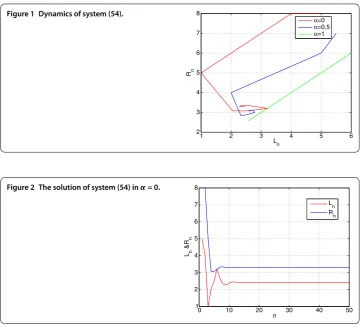
Figure 1 Dynamics of system (54).
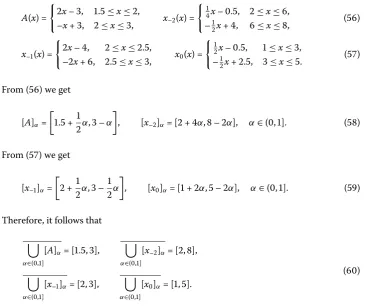
Figure 2 The solution of system (54) inα= 0.
Therefore, it follows that
α∈(,]
[x–]α= [, ],
α∈(,]
[x–]α= [, ],
α∈(,]
[x]α= [, ],
α∈(,]
[A]α= [, ].
()
From (), it results in a coupled system of difference equations with parameterα,
Ln+,α=Al,α+ Ln,α Ln–,αLn–,α
, Rn+,α=Ar,α+ Rn,α Rn–,αRn–,α
, α∈(, ]. ()
Therefore,Al,α> /
√
,∀α∈(, ], and the initial valuesx–i(i= , , ) are positive fuzzy
numbers. So from Theorem . we have that every positive solution xn of Eq. () is
bounded and persists. In addition, from Theorem ., Eq. () has a unique positive equi-libriumx= (., ., .). Moreover, every positive solutionxnof Eq. ()
con-verges to the unique equilibriumxwith respect toDasn→ ∞(see Figures -).
Example . Consider the following fuzzy difference equation:
xn+=A+ xn xn–xn–
Figure 3 The solution of system (54) inα= 0.5.
Figure 4 The solution of system (54) inα= 1.
whereAand the initial valuesx–,x–,xare satisfied
A(x) =
x– , .≤x≤,
–x+ , ≤x≤, x–(x) =
x– ., ≤x≤,
–x+ , ≤x≤, ()
x–(x) =
x– , ≤x≤.,
–x+ , .≤x≤, x(x) =
x– ., ≤x≤,
–x+ ., ≤x≤. ()
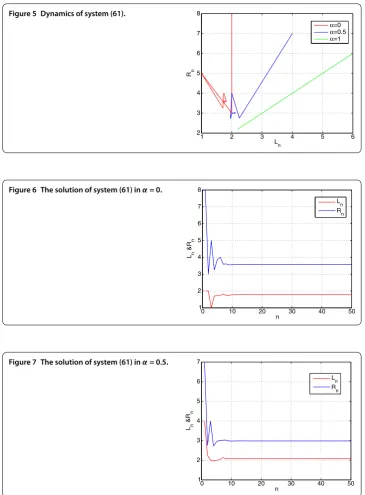
From () we get
[A]α=
. +
α, –α
, [x–]α= [ + α, – α], α∈(, ]. ()
From () we get
[x–]α=
+
α, – α
, [x]α= [ + α, – α], α∈(, ]. ()
Therefore, it follows that
α∈(,]
[A]α= [., ],
α∈(,]
[x–]α= [, ],
α∈(,]
[x–]α= [, ],
α∈(,]
[x]α= [, ].
From () it results in a coupled system of difference equations with parameterα,
Ln+,α=Al,α+ Rn,α Rn–,αRn–,α
, Rn+,α=Ar,α+ Ln,α Ln–,αLn–,α
, α∈(, ]. ()
It is clear that () is satisfied and the initial valuesx–i(i= , , ) are positive fuzzy
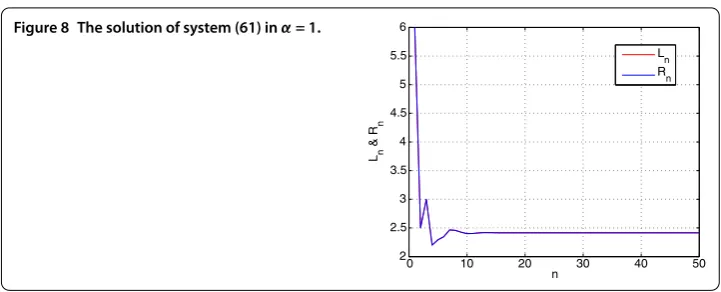
num-bers, so from Theorem ., Eq. () has a unique positive equilibriumx= (., ., .). Moreover, every positive solutionxnof Eq. () converges to the unique equilib-riumxwith respect toDasn→ ∞(see Figures -).
Figure 5 Dynamics of system (61).
Figure 6 The solution of system (61) inα= 0.
Figure 8 The solution of system (61) inα= 1.
5 Conclusion
In this work, according to a generalization of division (g-division) of fuzzy numbers, we study the fuzzy difference equationxn+=A+xn–xxnn–. The existence of positive solution
to () is investigated. Furthermore, we obtain the following results:
(i) The positive solution is bounded and persists ifAl,α> ,α∈(, ], every solutionxn
tends to the unique equilibriumxunder conditionAl,α> /
√
,α∈(, ]asn→ ∞. (ii) IfAl,α> and
√
Al,αAr,α> Ar,α–Al,α,α∈(, ], every solutionxnof () converges
to the unique equilibriumxasn→ ∞.
Competing interests
The authors declare that they have no competing interests.
Authors’ contributions
The authors indicated in parentheses made substantial contributions to the following tasks of research: drafting the manuscript (QHZ, JZL); participating in the design of the study (ZGL); writing and revision of paper (QHZ). All authors read and approved the final manuscript.
Author details
1Key Laboratory of Economics System Simulation, School of Mathematics and Statistics, Guizhou University of Finance
and Economics, Guiyang, Guizhou 550025, People’s Republic of China.2Department of Mathematics and Physics, Hunan
Institute of Technology, Hengyang, Hunan 421002, People’s Republic of China.3Department of Mathematics, Hengyang
Normal University, Hengyang, Hunan 421002, People’s Republic of China.
Acknowledgements
The authors would like to thank the editor and anonymous reviewers for their helpful comments and valuable suggestions, which have greatly improved the quality of this paper. This work was financially supported by the National Natural Science Foundation of China (Grant No. 11361012), the China Postdoctoral Science Foundation (No. 2013T60934), and the Scientific Research Foundation of Guizhou Provincial Science and Technology Department ([2013]J2083).
Received: 28 November 2014 Accepted: 5 March 2015 References
1. DeVault, R, Ladas, G, Schultz, SW: On the recursive sequencexn+1=A/xn+ 1/xn–2. Proc. Am. Math. Soc.126(11),
3257-3261 (1998)
2. Abu-Saris, RM, DeVault, R: Global stability ofyn+1=A+ynyn
–k. Appl. Math. Lett.16, 173-178 (2003)
3. Amleh, AM, Grove, EA, Ladas, G, Georgiou, DA: On the recursive sequencexn+1=A+xnxn–1. J. Math. Anal. Appl.233,
790-798 (1999)
4. He, WS, Li, WT, Yan, XX: Global attractivity of the difference equationxn+1=a+xnxn–k. Appl. Math. Comput.151,
879-885 (2004)
5. DeVault, R, Ladas, G, Schultz, SW: Necessary and sufficient conditions the boundedness ofxn+1=A/xnp+B/xqn–1.
J. Differ. Equ. Appl.3, 259-266 (1998)
6. Agarwal, RP, Li, WT, Pang, YH: Asymptotic behavior of a class of nonlinear delay difference equations. J. Differ. Equ. Appl.8, 719-728 (2002)
7. Kocic, VL, Ladas, G: Global Behavior of Nonlinear Difference Equations of Higher Order with Applications. Kluwer Academic, Dordrecht (1993)
8. Kulenonvic, MRS, Ladas, G: Dynamics of Second Order Rational Difference Equations with Open Problems and Conjectures. Chapman & Hall/CRC, Boca Raton (2002)
10. Su, YH, Li, WT: Global attractivity of a higher order nonlinear difference equation. J. Differ. Equ. Appl.11, 947-958 (2005)
11. Hu, LX, Li, WT: Global stability of a rational difference equation. Appl. Math. Comput.190, 1322-1327 (2007) 12. Papaschinopoulos, G, Schinas, CJ: On a system of two nonlinear difference equations. J. Math. Anal. Appl.219,
415-426 (1998)
13. Yang, X: On the system of rational difference equationsxn=A+yn–1/xn–pyn–q,yn=A+xn–1/xn–ryn–s. J. Math. Anal. Appl.
307, 305-311 (2005)
14. Zhang, QH, Yang, LH, Liu, JZ: Dynamics of a system of rational third-order difference equation. Adv. Differ. Equ.2012, 136 (2012)
15. Ibrahim, TF, Zhang, QH: Stability of an anti-competitive system of rational difference equations. Arch. Sci.66(5), 44-58 (2013)
16. Deeba, EY, De Korvin, A: Analysis by fuzzy difference equations of a model ofCO2level in the blood. Appl. Math. Lett.
12, 33-40 (1999)
17. Deeba, EY, De Korvin, A, Koh, EL: A fuzzy difference equation with an application. J. Differ. Equ. Appl.2, 365-374 (1996) 18. Papaschinopoulos, G, Schinas, CJ: On the fuzzy difference equationxn+1=
k–1
i=0Ai/xpin–i+ 1/xpkn–k. J. Differ. Equ. Appl.6,
75-89 (2000)
19. Papaschinopoulos, G, Papadopoulos, BK: On the fuzzy difference equationxn+1=A+B/xn. Soft Comput.6, 456-461
(2002)
20. Papaschinopoulos, G, Papadopoulos, BK: On the fuzzy difference equationxn+1=A+xn/xn–m. Fuzzy Sets Syst.129,
73-81 (2002)
21. Stefanidou, G, Papaschinopoulos, G: A fuzzy difference equation of a rational form. J. Nonlinear Math. Phys.12, suppl. 2, 300-315 (2005)
22. Papaschinopoulos, G, Stefanidou, G: Boundedness and asymptotic behavior of the solutions of a fuzzy difference equation. Fuzzy Sets Syst.140, 523-539 (2003)
23. Stefanidou, G, Papaschinopoulos, G, Schinas, CJ: On an exponential-type fuzzy difference equation. Adv. Differ. Equ. 2010, Article ID 196920 (2010). doi:10.1155/2010/196920
24. Zhang, QH, Yang, LH, Liao, DX: Behavior of solutions to a fuzzy nonlinear difference equation. Iran. J. Fuzzy Syst.9, 1-12 (2012)
25. Chrysafis, KA, Papadopoulos, BK, Papaschinopoulos, G: On the fuzzy difference equations of finance. Fuzzy Sets Syst. 159(24), 3259-3270 (2008)
26. Zhang, QH, Yang, LH, Liao, DX: On first order fuzzy Riccati difference equation. Inf. Sci.270, 226-236 (2014)
27. Kocak, C: First-order ARMA type fuzzy time series method based on fuzzy logic relation tables. Math. Probl. Eng.2013, Article ID 769125 (2013)
28. Ivaz, K, Khastan, A, Nieto, JJ: A numerical method of fuzzy differential equations and hybrid fuzzy differential equations. Abstr. Appl. Anal.2013, Article ID 735128 (2013)
29. Malinowski, MT: On a new set-valued stochastic integral with respect to semi-martingales and its applications. J. Math. Anal. Appl.408, 669-680 (2013)
30. Malinowski, MT: Some properties of strong solutions to stochastic fuzzy differential equations. Inf. Sci.252, 62-80 (2013)
31. Malinowski, MT: Approximation schemes for fuzzy stochastic integral equations. Appl. Math. Comput.219, 11278-11290 (2013)
32. Hua, M, Cheng, P, Fei, J, Zhang, J, Chen, J: Robust filtering for uncertain discrete time fuzzy stochastic systems with sensor nonlinearities and time-varying delay. J. Appl. Math.2012, Article ID 402480 (2012)