Cross-Layer Design of an Energy-Efficient Cluster
Formation Algorithm with Carrier-Sensing Multiple
Access for Wireless Sensor Networks
Chiara Buratti
IEIIT-BO/CNR, DEIS, University of Bologna and CNIT, Viale Risorgimento 2, 40136 Bologna, Italy Email:[email protected]
Andrea Giorgetti
IEIIT-BO/CNR, DEIS, University of Bologna and CNIT, Viale Risorgimento 2, 40136 Bologna, Italy Email:[email protected]
Roberto Verdone
IEIIT-BO/CNR, DEIS, University of Bologna and CNIT, Viale Risorgimento 2, 40136 Bologna, Italy Email:[email protected]
Received 1 July 2004; Revised 23 May 2005
A new energy-efficient scheme for data transmission in a wireless sensor network (WSN) is proposed, having in mind a typical application including a sink, which periodically triggers the WSN, and nodes uniformly distributed over a specified area. Rout-ing, multiple access control (MAC), physical, energy, and propagation aspects are jointly taken into account through simulation; however, the protocol design is based on some analytical considerations reported in the appendix. Information routing is based on a clustered self-organized structure; a carrier-sensing multiple access (CSMA) protocol is chosen at MAC layer. Two different scenarios are examined, characterized by different channel fading rates. Four versions of our protocol are presented, suitably ori-ented to the two different scenarios; two of them implement a cross-layer (CL) approach, where MAC parameters influence both the network and physical layers. Performance is measured in terms of network lifetime (related to energy efficiency) and packet loss rate (related to network availability). The paper discusses the rationale behind the selection of MAC protocols for WSNs and provides a complete model characterization spanning from the network layer to the propagation channel. The advantages of the CL approach, with respect to an algorithm which belongs to the well-known class of low-energy adaptive clustering hierarchy (LEACH) protocols, are shown.
Keywords and phrases:wireless sensor networks, routing algorithms, MAC protocols, energy savings strategies, cross-layer design.
1. INTRODUCTION
Wireless sensor networks (WSNs) are composed of low-cost low-energy nodes, whose battery is normally not replaced during network lifetime. Nodes sense the environment and are equipped with radio transceivers which allow them to act as both transmitters and route-and-forward devices.
Typical applications include a sink, which periodically triggers the WSN, and a large number of nodes deployed without detailed planning in a given area.
This is an open access article distributed under the Creative Commons Attribution License, which permits unrestricted use, distribution, and reproduction in any medium, provided the original work is properly cited.
The characteristics of WSNs and their applications make energy conservation and self-organization primary goals with respect to per-node fairness and latency [1, 2, 3,4]. As a result, the main performance figure in these cases is network lifetime, that is, the time elapsing between net-work deployment and the moment when the percentage of nodes still active falls below a given threshold which depends on the application. Accordingly, many self-organizing and energy-efficient protocols have been recently developed for data transmission in WSNs [5,6,7,8,9,10,11,12,13].
different CL approaches exist: the first considers a layered structure of protocols, with vertical entities providing ex-change of data between all layers; the second, instead, con-siders a protocol structure where the different layers cannot be distinguished. The former approach, instead, is simpler, as it keeps the existing protocol layer structure and provides additional exchange of information between layers via a sin-gle vertical entity [15]. In this approach, it is important to identify traditionally hidden interdependencies among lay-ers and find relevant metrics that capture such dependencies that have to be exchanged among layers to optimally adapt to network dynamics. Some CL works are based on this ap-proach, but most of them are focused on the interactions be-tween two layers only and consider, mainly, the performance in terms of network lifetime. In [16], the authors develop CL interactions between MAC and network layers to achieve en-ergy conservation; in particular, the MAC layer provides the network layer with information pertaining to successful re-ception of packets and the network layer, on its turn, chooses the route that minimizes the error probability. In [17], a clus-ter design method that allows the evaluation of the optimum number of clusters to realize power saving and coverage is developed; to do this, a dynamical adjusting of the number of clusters is proposed.
Our approach refers to the one described above, where a suitable interplay between MAC and routing protocols, and physical and MAC protocols are introduced; moreover, per-formance is evaluated either in terms of energy efficiency, or in terms of packets loss.
A routing protocol architecture that provides good re-sults in terms of energy efficiency for WSNs is low-energy adaptive clustering hierarchy (LEACH) [9,10]. LEACH in-cludes a distributed cluster formation technique, which en-ables self-organization of large numbers of nodes with one node per cluster acting as cluster head (CH), and algorithms for adapting clusters and rotating CH roles to evenly dis-tribute the energy load among all nodes. The nodes forward their data to the sink through the CH according to a two-hop strategy. Starting from the basic idea of LEACH, in [18], a new routing strategy, denoted as LEACH B, is proposed and the performance shows improvements in terms of network lifetime in a large range of situations.
As far as MAC aspects are concerned, two main families of protocols can be considered: those based on collision-free strategies and those relying on suitable retransmission tech-niques to overcome the potential collisions caused by unco-ordinated transmissions. The proper selection of the family of MAC protocols is a critical issue for energy efficiency.
In the original proposal of LEACH [9, 10], a time di-vision multiple access (TDMA) schedule is defined by the CHs to ensure that there are no collisions among data mes-sages. However, this centralized control at the CH requires suitable transmission of control packets which makes the protocol complex; moreover, this overhead creates energy inefficiency. In [19], a self-organization protocol for WSNs called self-organizing medium access control for sensor net-works (SMACS) is proposed. Each node maintains a TDMA-like frame in which nodes schedule different time slots to
communicate with its known neighbors. A different ap-proach, though still based on coordinated actions to avoid packet collisions, can be found in sensor-MAC (S-MAC) [20], which sets the radio in sleeping mode during transmis-sion of other nodes. The contention mechanism is the same as that in IEEE 802.11 using request-to-send (RTS) and clear-to-send (CTS) packets.
When dealing with collision-prone MAC techniques, carrier-sensing multiple access (CSMA) is a usual choice in WSNs [21]. The advantage here is that no extra signalling to schedule transmissions and coordinate data flows is required; on the other hand, collisions might occur, and suitable back-offalgorithms are needed to recover data.
An OMNET++ platform [22] is used in this paper to sim-ulate a WSN composed of several tens of nodes randomly and uniformly distributed over a square area, accounting for routing, MAC, physical, energy, and propagation aspects. In particular, we propose a novel cluster formation algorithm, that we name LEACH B+, which introduces the possibility for nodes to transmit to the sink, by using a direct path, when it is energetically efficient, and is based on a new CH election algorithm which significantly improves network lifetime. We also introduce a time division between the data transmission in the different phases of the algorithm, which allows the re-duction of the packet loss rate. Moreover, we employ a CSMA protocol based on IEEE 802.11 [23]. If collisions are reduced by suitably dimensioning the average cluster size, this choice leads to high energy efficiency. A relevant energy waste in CSMA protocols is owed to idle listening that occurs when the node is sensing the channel to check whether packets are sent. To avoid this energy loss, an ON/OFF modality which consists in turning offand on periodically radio components can be implemented as usual in WSNs [21].
We apply the CL paradigm to the design of a protocol for WSNs where MAC and routing (i.e., cluster formation) as-pects are jointly considered and optimized: the decisions to be taken for cluster formation rely on parameters extracted from the MAC; also, some physical layer parameters (like transmit power) are based on MAC layer protocol status.
We consider two different scenarios, in which the propa-gation channel fluctuations vary at different rates; it is shown that the protocol design can take advantage of the knowledge of the fading rate.
We study the network lifetime and the packet loss rate for the two different scenarios and we make a comparison between the protocols with and without the CL paradigm.
The paper is organized as follows. As in WSNs, the pro-tocol choices are application-specific,Section 2describes the reference scenario and application, and discusses the choice of the MAC protocol; Section 3refers to LEACH B+ rout-ing protocols, with the details on the CHs election and the cluster formation algorithms when no CLD is considered, for the two different scenarios. Then, inSection 4, the MAC strategy is presented. Sections5and6are devoted to the de-scription of the physical and energy aspects, respectively. The CL approach and its impact on the cluster formation algo-rithms previously presented in Section 3.2are discussed in
d
M Dmax
Figure1: Transmission flow during a round. Filled box: sink; filled circles: cluster heads; circles: noncluster-head nodes.
the conclusions are drawn in the final section. The appendix presents the new CH election algorithm proposed in this pa-per which shows very good pa-performance improvement with respect to the protocols previously presented in the litera-ture: the algorithm description is reported in the appendix to make the paper more readable.
2. REFERENCE SCENARIO AND APPLICATION
2.1. Reference scenario
The reference scenario we assume consists of NTOT sensors
randomly and uniformly distributed over a square area (hav-ing sideM) and a sink located at a given distancedfrom the center of the square, as shown inFigure 1. The network must be able to provide the information detected by nodes to a sink that periodically (everyTRseconds) broadcasts a short
packet that we call “start” and waits for the replies from the nodes. We denote by “round” the period of time between two successive start packets sent by the sink. During each round, all sensors should send their information to the sink.
The wireless channel is assumed to be characterized by random fluctuations that will be modeled as Gaussian distributed when being in logarithmic scale. A distance-dependent path loss is also considered. The model is moti-vated by the presence, in many cases for WSNs, of obstacles (ground, foliage, cars, human bodies, depending on the ap-plication).
2.2. Reference application and motivation for the choice of LEACH and CSMA
This work, though presenting ideas, approaches, and results which are much more general, has been inspired by a spe-cific application: the monitoring of a car parking area where nodes sense the presence of cars and interact to communi-cate to a sink, which provides information to cars entering the parking area about the better way to reach the closest free slot. Other specific applications that can be considered
are based, for example, on the estimation of a target multi-dimensional process such as, seismic waves through acoustic sensors arrays, the ground temperature variations in a small volcanic site, or structural monitoring of buildings, by means of samples captured by nodes randomly and uniformly dis-tributed. Samples are then transmitted to a sink with a self-organizing and distributed routing strategy.
As for network aspects, routing algorithms for WSNs can be classified into three categories: multihop flat, hierarchical, and location-based [24]. In the first category, each node plays the same role and sensors collaborate to perform the sensing task. The second category, instead, refers to protocols where sensors are organized in clusters, where particular tasks are assigned to cluster heads; thus, nodes have not all the same role in the network [25,26]. Finally, in the third kind of pro-tocols, sensors exploit the knowledge of their position in the network, obtained, for example, through GPS. The multihop flat protocols may include scalability issues, whereas the hi-erarchical protocols (unless the number of levels of the hier-archy is unlimited) can be applied only in those cases where the maximum distance between nodes and the sink is not too large. We will set values ofdandMnot larger than 100 mt, so cluster-based algorithms like those belonging to the LEACH family represent a good choice.
Concerning MAC, the selection of a protocol belonging to the families of collision-free or collision-prone strategies requires suitable comparison between the time elapsing be-tween two start packetsTRand the time coherence of the
en-vironment Tcohwhich is a measure of how slow or fast the
channel attenuation fluctuates.
In fact, when Tcoh is much larger than TR, a suitable
scheduling of transmissions, which requires extra signalling between nodes, can be kept fixed for many rounds, thus re-ducing the impact of the related energy wasted on network lifetime. On the other hand, if this condition does not oc-cur, the channel tends to be independent in different rounds, and a collision-free protocol which tries to schedule trans-missions in order to avoid collisions becomes energy ineffi -cient since the extra signalling to manage the scheduling is required at each round.
The application we consider is characterized by values of
TRwhich are larger than, or of the same order as,Tcoh, and
the natural choice in this case is CSMA.
In particular, we will consider two different cases: the first withTcohTR(scenario 1) and the second withTcohTR
(scenario 2); more precisely, in the former case, the chan-nel fluctuations are completely uncorrelated at each round, whereas, in the second scenario, we assume a block-fading model, where the random variables characterizing the prop-agation channel remain constant for two subsequent rounds, and then change according to a memoryless process.
The following assumptions concerning the application, are also made.
(i) Nodes and sink are still (no mobility). (ii) Nodes do not know their position in the area.
Starti+ 1 Starti
TR
t
TCF TIC TTS TCF
Figure2: Time axis showing the three phases of the routing pro-tocol. Clusters are formed in the cluster formation (CF) period, the CHs collect the packets sent by non-CH nodes in the intracluster (IC) period while CHs transmit toward the sink in the TS period.
described in the appendix), the sink includes the infor-mation about its position in the trigger, so that nodes are aware of it.
(iv) Each node can use power control to vary the transmit power.
3. THE ROUTING PROTOCOL—LEACH B+
We propose a new routing strategy which combines LEACH B [18] with a simple single-path routing protocol, which in-cludes the direct transmission to the final sink, without pass-ing through CH nodes, when it is energetically efficient.
Moreover, a new CH election algorithm is proposed. Two different versions of our new algorithm are suitably designed for scenario 1 and 2; we name them LEACH B+ v1 and LEACH B+ v2, respectively.
In case of LEACH B+ v1, a clustering protocol based on two phases, performed whenever nodes receive the start packet from the sink, is designed.
(1) Setup
Clusters are formed according to a two-step procedure: a dis-tributed self-election algorithm is run by nodes in order to elect the cluster heads (CHs), then each CH broadcasts a packet informing of its role and those nodes that did not elect themselves as CHs select the cluster to belong to, or decide to transmit directly to the sink. Details are given below.
(2) Transmission
Each non-CH node, belonging to a given cluster, transmits its packet to the respective CH, which, in turn, sends all packets received from the cluster, plus the one it generated, to the re-mote sink. Alternatively, nodes transmit directly to the sink.
In LEACH B+ v2, instead, the first phase is performed once every two rounds, because nodes, which elected them-selves as CHs, remain CHs for the following round and so the CH election algorithm is not carried out at every round (except for the case in which there are no CHs elected. In the latter case, in fact, the CH election algorithm is performed at the subsequent round, too). By using this strategy, CH nodes have to transmit the initial broadcast packet only once ev-ery two rounds, since the information about which sensors are CHs remains unchanged for two rounds. As we will see
inSection 8, this version allows the decrease of energy
con-sumption.
All other aspects of LEACH B+, which will be described in this section, and Sections4–6, do not change in the two versions (namely, v1 and v2).
In this paper, we also introduce a subdivision of the time axis into three periods, one for each phase of the algorithm (taking into account that the first phase is divided, on its turn, into two phases), to reduce collisions between packets
(seeFigure 2).
(1) TCF: during this period, the start packet and CHs
broadcast packets are sent.
(2) TIC: non-CH nodes send their packets to the CHs.
(3) TTSdenotes transmissions toward the sink.
3.1. Cluster-head selection algorithm
LEACH B+ forms clusters by using a distributed algorithm, where nodes make autonomous decisions without any cen-tralized control. When a node receives the start packet, it decides whether or not to become a CH for the current round. This algorithm allows the election of a certain num-ber of CHs, on average equal toN. Being a CH node is much more energy intensive than being a non-CH node. Therefore, LEACH incorporates a randomized rotation of the CH role among sensors to avoid draining the battery of a particular set of sensors in the network [10]. Ensuring that all nodes be-come CHs the same number of times, each node will be CH once inNTOT/Nrounds on average. The rationale behind the
determination of the value ofNis described in the appendix through suitable analytical formulation.
To do this, we consider an indicator functionCp(i) de-termining whether or not nodep, at theith round, has been a CH in the most recent R∗ = NTOT/N −1 rounds (i.e.,
Cp(i)=0 if nodephas been a CH and 1 otherwise), where xstands for the largest integer less than or equal tox. The decision to become or not a CH is made by nodepchoosing a random number between 0 and 1. If the number is less than a thresholdTp(i), the node becomes a CH. The threshold is set as
Tp(i)
=
0, Cp(i)=0,
Np NTOT−Np ·
i modNTOT/Np
, Cp(i)=1, R<R∗,
1, Cp(i)=1, R=R∗,
withi; while if a node does not elect itself CH forR∗ consec-utive rounds, it is forced to be a CH for the current round by settingTp(i)=1.
In conventional LEACH [10],Nis a fixed value and it is determined a priori. In LEACH B+, we propose a new adap-tive strategy to choose the CHs election frequency, varyingN
for each node in such a way that we consider the energy dis-sipation of each node the last time it has assumed the role of CH. As can be seen in [18], this strategy improves network lifetime.
If we consider an average situation, each CH has to send
NTOT/(N + 1) (as we will see below the (N + 1)th cluster
is formed by nodes that choose to transmit to the sink via a direct link) packets to the final sink with an energy con-sumption that is dependent on its position, plus the energy required to receiveNTOT/(N+ 1)−1 packets from non-CHs
that belong to the cluster. As explained inSection 5, we as-sume that the transmission power of each node (either CH or non-CH) is controlled adaptively in order to guarantee an adequate received power at the destination nodes with the minimum required energy. Therefore, since the energy dissi-pated by each CH is dependent on its position with respect to the sink, we can evaluate the worst and the best case in terms of energy consumption that is useful to perform our adaptive strategy,
ECH-far=
NTOT
N+ 1−1 ER+
NTOT
N+ 1 ET-far,
ECH-close=
NTOT
N+ 1−1 ER+
NTOT
N+ 1 ET-close, (2)
where
(i) ER is the energy spent to receive a packet (see
Section 6);
(ii) ET-far andET-closeare the energies spent to transmit a
packet, considering two different transmission ranges: the distance between the sink and the farthest point of the networkDmax, and that between the sink and the
closest oned−M/2.
Starting from the average of these energies
ECH-avg=ECH-far+ECH-close
2 , (3)
we fix two different thresholds as follows:
ECH-sup=ECH-avg+ 0.6·ECH-avg,
ECH-inf=ECH-avg−0.6·ECH-avg.
(4)
If the energy dissipated by node p the last time it as-sumed the role of CH is larger thanECH-sup, the value ofN
used by nodep,Np , is decreased by 1, so that this node will have smaller probability to become CH in the next rounds. At the opposite, if this energy is smaller thanECH-inf,Np is
increased by 1. Finally, if the energy dissipated is between the two thresholds, the value ofNp does not change.
Particular attention must be paid on the cluster election phase. In fact, the CH election should guarantee the mini-mum energy consumption by means of the cluster-head ro-tation algorithm presented. In order to assess the validity of the algorithm proposed, several simulations have been per-formed. As a result, we can state that in LEACH B+, the ma-jority of CHs are located, on average, on a circumference cen-tered in the sink, and having radius equal toDmax/2, which is
clearly an efficient condition from the energy consumption viewpoint.
3.2. Cluster formation algorithm
Concerning cluster formation, each node chooses its CH by evaluating the energy dissipated in the complete path be-tween itself and the final sink, via the CH, for the transmis-sion of its packet.
The start packet sent by the sink contains the information about the power used for its transmission, so every receiv-ing node can compute the loss between itself and the sink. The broadcast packet sent by each CH includes the value of power used for this transmission and the loss estimated previously. Every time a non-CH node receives a broadcast packet, it estimates the total path loss between it and all the CHs whose packets have been successfully detected by the node, and reads the loss between the CH and the sink. Ev-ery node selects the path characterized by the smallest total path loss, considering also the possibility to transmit directly its packet to the sink without passing through any CH. So ev-ery non-CH selects the link (through the CH or not) which corresponds to the lowest path loss.
Finally, if a non-CH node does not receive any broadcast packets correctly, it is forced to transmit directly to the sink.
4. THE MAC PROTOCOL PROPOSED
The access to the wireless channel is controlled through a CSMA protocol, whose mechanism has been inspired by the IEEE 802.11 standard [23]. According to this protocol, each node, before transmitting, invokes a carrier-sensing mecha-nism to determine the busy/idle state of the channel. After the sensing phase, one out of two situations may occur.
(1) Channel free: the node generates a random backoff pe-riodTbfor an additional deferral time before
transmit-ting its packet.
S APPT AMP PT
AT GT
U APPR
PR AR GR
D
Figure3: Transmission system block diagram.
The duration of the carrier-sensing phaseTsis not fixed; it is
considered to be random and given by
Ts=(1 +r)·DIFS, (5)
where the following exist.
(i) Distributed interframe space (DIFS) is the minimum sensing length and we take it equal to the data trans-mission time; assuming a negligible propagation delay, as is usually done for sensor networks [20], the data transmission time is the time during which the packet occupies the channel and is given by the ratio between the packet sizezand the bit rateRb.
(ii) ris a random number drawn from a uniform distribu-tion over the interval [0, 1).
The choice of a random sensing time [20] allows the reduc-tion of packet collision probability; there are two possible causes of collision: two or more nodes could select the same value ofr, so they end sensing at the same time and transmit simultaneously, or a node is not able to perceive a communi-cation in the channel and could decide to transmit its packet though the channel is busy (hidden node problem). By fixing a minimum received power for a successful channel sensing
PSmin, in fact, a node which receives a packet with a power
smaller than such value does not “hear” the transmitter. We assume a packet is captured by the receiver, even in case of packet collisions if
Pr0
N
i=1Pri
> α0, (6)
where
(i) Pr0is the power received from the useful signal;
(ii) Priis theith interference power;
(iii) Nis the number of colliding packets;
(iv) α0is the capture threshold which we set equal to 3 dB.
When condition (6) is not fulfilled, the packet is lost and the receiving node requires the packet retransmission. An acknowledge mechanism is not provided in this algorithm, because the transmission and the reception of these packets cause an increase of the energy spent. Thus, we consider only the use of retransmission requests, when nodes receive wrong packets.
To minimize collisions during contention between multi-ple nodes, as mentioned above, we introduce a backoff algo-rithm, namely the exponential backoffalgorithm adopted in the IEEE 802.11 MAC protocol [23]. According to this algo-rithm, nodes, once the sensing phase has ended, in the case of free channel do not transmit their packets immediately, but only after a random backofftime given by
Tb=rc·DIFS, (7)
where rc is a random integer drawn from a uniformly
dis-tribution over the interval [0,CW], whereCW is the con-tention window value, that is, an integer within the range of values CWmin andCWmax (CWmin < CW < CWmax).
We used the 802.11 standard values, soCWmin = 7 and
CWmax =255. The contention window parameter will take
the initial value ofCWmin. Then, in case of collision,CWis
augmented and the new value is computed as
CW=CWmin·2−1. (8)
So, there is an exponential increase of the contention window value up toCWmax, or till a packet is correctly received. In
both cases,CWwill be reset toCWmin.
The performance of CSMA protocols are mainly affected by the hidden node problem and the amount of data trans-mitted by nodes to the CHs. First of all, we want to point out that the random changing of the CHs can mitigate the hidden terminal problem. In fact, in every round in LEACH B+ v1, or every two rounds in LEACH B+ v2, the clusters change according to the cluster-head election algorithm de-fined. Therefore, if a node is unfortunately hidden during a round, this does not preclude that this situation changes in the following rounds. As far as the impact of the MAC pro-tocol on network performance is concerned, we have ana-lyzed its behavior for different packet sizesz. In particular, an increase of the packet size from 127 to 1016 bits corre-sponds to an expected decreasing of the network lifetime due to the augmented number of collisions, and a doubling of the packet loss rate.
5. PHYSICAL ASPECTS
5.1. Transmission system
In this section, we describe the transceiver scheme adopted for each node, the radio propagation channel, and the power required for the transmission. The block diagram of the transmitting and receiving parts that are considered in our analysis is reported inFigure 3.SandUare the source of bits and the final user, respectively. The block APPTis composed
of a coder, a modulator, and an up-converter, AMP repre-sents the power amplifier for the transmission, while APPR
is composed by a down-converter, a demodulator, and a de-coder. Finally, the blocks AT,ARrepresent the attenuations
As far as propagation is concerned, we assume a statis-tic channel characterized by a Gaussian distribution of loss, when measured in dB,
L(dB)=PT(dBm)−PR(dBm), (9)
wherePTandPRrepresent the generic transmit and receive
powers, respectively. The logarithmic value ofLhas mean de-pending on link distance, antenna gains, and so forth. More precisely, we assume the following expression for loss at dis-tanceD:
L(dB)= 4π fcd0/c
2
D/d0
α
Gant
(dB) +S, (10)
where
(i) fc(Hz) is the carrier frequency,c(m/s) is the speed of
light,d0(m) is a reference distance, andαis the path
loss exponent; (ii) Gantis given by
Gant= GTGR
ATAR
; (11)
(iii) Sis a Gaussian random variable, with varianceσ2and
zero mean.
In this paper, we fix two power thresholds: the smallest one is the minimum receiver sensitivityPSminand the other
is the receiver sensitivityPRmin. A packet is correctly detected
wheneverPRis larger thanPRminand it is “heard” whenPRis
larger thanPSmin.
As far as the transmission scheme is concerned, we as-sume a binary phase-shift keying (BPSK) modulation with a BCH(127, 50, 13) code, that is, with packet lengthz = 127 and information bitsk=50, able to correct up tot=13 bits.
5.2. Packet error probability
Assuming a transmission scheme based on BPSK modula-tion, the two thresholdsPRminandPSmincan be derived
start-ing from the bit error probability [27]
Peb=
1 2erfc
Eb
N0Rc
, (12)
where Eb is the received energy per information bit,Rc =
k/n=0.394 is the coding rate, and
W= PR
N0Rb
(13)
is the signal-to-noise ratio at the receiver input. In particu-lar,N0is the one-sided power spectral density of the additive
white Gaussian noise (AWGN) which depends on the noise figureFof the receiver, that is,
N0=KBFT0, (14)
Table1: Reference parameters.
Parameter Value Parameter Value
fc 5 GHz Rb 50 Mbps
d0 0.2 m Pep 10−2
α 2.5 WR 5.12 dB
σ 3 dB WS 3 dB
Gant −20 dB PRmin 5.92 pW
F 10 dB PSmin 3.4 pW
ηamp 0.8 POUTSN 0.01
PAPPT 3.63 mW POUTNS 0.05
PAPPR 11.13 mW POUTBr 0.2
PAPPS 5.565 mW tACT 0.5
tCF 0.01 tIC 0.25
whereKB is Boltzmann’s constant andT0 =290 K.
Consid-ering packets ofzbits, packet error probability is then given by
Pep=
z
i=t+1
z i
Pebi (1−Peb)z−i. (15)
Now, for a given value of Pep, we can derivePeb, and then
from (12)–(14), the corresponding received power can be evaluated. In particular, by fixing a packet error probability ofPep=10−2, we derive the receiver sensitivity as
PRmin=WRN0Rb, (16)
where WR is the signal-to-noise ratio needed to detect a
packet. By fixing a signal-to-noise ratio equal to 3 dB, the minimum receiver powerPSmin required to “hear” a packet
is derived. All the parameters involved in the derivation of these two power thresholds are reported inTable 1.
Having fixed the two aforementioned thresholds, the be-havior of nodes when they receive the start packet is as fol-lows.
(i) IfPR< PSmin, the node cannot perceive the packet, and
therefore it does not transmit its own packet for that round.
(ii) IfPSmin< PR< PRmin, it perceives the start packet but it
cannot compute the path loss between it and the sink, since the information about the transmit power used by the sink cannot be read.
(iii) IfPR> PRmin, it can compute the loss.
5.3. Power control
Now we consider the transmission power used in the diff er-ent phases of the LEACH B algorithm.
The start packet is transmitted using a value of power given by
PTmax=PRmin
4π fcd0/c
2
Dmax/d0
α Mf
Gant
where the transmission rangeDmax is the distance between
the sink and the point in the scenario farther from it (see
Figure 1). Mf is a fade margin suitably introduced to keep
under control the probability of packet failure owing to the random fluctuations of the channel; it can be written as
Mf=
√
2σ·erfc−1(2POUT), (18)
where POUTis the maximum outage probability which
de-pends on the type of transmission. The outage probability is the probability that the packet reception fails. For the trans-mission of the start packet, we use POUT = POUTSN. The
broadcast CHs messages are transmitted with
PBr= PRmin
4π fcd0/c
2
dbroadcast/d0
α Mf
Gant , (19)
whereMfis given by (18) withPOUT=POUTBranddbroadcastis
the area diagonal. As we explained, nodes do not know their position in the network, so they must behave like they were in the worst case.
In both cases (start and broadcast packets), the received power at the maximum distance is given by
PR(dBm)=PRmin(dBm) +Mf(dB)−S. (20)
Note that, depending on the value of the margin Mf, some
packets can be lost owing to the channel fluctuations. During each round, we assume a stationary channel, so losses between CHs and non-CHs do not change. With this assumption in mind, every node can transmit its packet to the CH by using the minimum power that allows its correct reception. Therefore, the transmit power used by a generic non-CH node to send its packet to the relevant CH is
PTx=PRmin·L, (21)
whereLis the path loss between the CH and the node that is transmitting.
Finally, we consider the transmission power of the mes-sages sent by the CHs to the sink, or any nodes directly trans-mitting to the sink. If these nodes succeeded in computing the loss between them and the sink, by extracting the infor-mation from the start packet regarding its transmit power and measuring the received power level, their transmit power is set according to (21) whereL, in this case, is the path loss between the transmitting node and the sink. If such node was not able to estimateL, it will transmit using the power level
PTmax. In this case,Mfis given by (18) withPOUT=POUTNS.
All parameter values not specified in the text of the paper are reported inTable 1.
6. ENERGY CHARACTERIZATION
The central problem for sensor networks is energy consump-tion. It is important to estimate the energy spent, during each round, by all nodes, when they transmit, receive, or sense the channel.
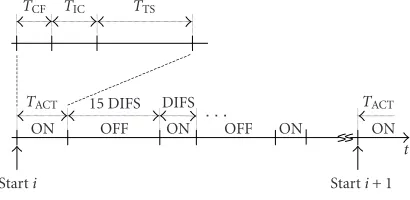
Starti+ 1 Starti
t TCF TIC TTS
TACT ON
15 DIFS DIFS
OFF ON OFF ON
TACT ON
· · ·
Figure4: Time axis for each node in the ON/OFF mode.
Transmission
The energy dissipated for the packet transmission depends on the value of the transmission power
ET=z·
PAPPT
Rbc +
PT
Rbc·ηamp , (22)
where (seeFigure 3)
(i) PAPPTincludes the power dissipated in the baseband,
oscillator, frequency synthesizer, mixer, filters, and so forth;
(ii) PT/ηampis the power dissipated within the power
am-plifier, wherePTis given by (17), (19), or (21),
accord-ing to the specific cases;
(iii) ηamp≤1 is the transmitter amplifier efficiency;
(iv) Rbc =Rb/Rcis the coded bit rate. Reception and Sensing
In the radio receiver model we use, there is no difference be-tween the energy levels dissipated during reception or sens-ing [20]. The energy needed to keep the node on is given by
Esens=PAPPS·T, (23)
wherePAPPSrepresents the power dissipated during the
sens-ing phase (see Table 1) and T is the time interval during which the node senses the channel.
In particular, the energy consumed to receive a packet is
ER=z·PAPPR
Rbc
, (24)
wherePAPPR represents the power dissipated during the
re-ceiving phase.
Note that in case nodes do not know when the following start packet will arrive, we have a high energy consumption due to the fact that nodes should be on between the end of a round and the beginning of the following one.
As we can see inSection 8, we investigate performance in terms of network “lifetime.” To extend the nodes lifetime, we introduced the ON/OFF modality (Figure 4) in which, after the start packet’s arrival, nodes stay on for a certain interval of time denoted asTACTand then they turn offand on
(i) the duration of the ON phase equal to DIFS, (ii) the duration of the OFF phase equal to 15·DIFS, according to suitable considerations, not reported for the sake of conciseness.
To be sure that a start packet is detected by each node regardless of the ON/OFF mechanism, the sink must trans-mit sixteen sequential starting packets so that every node is able to receive at least one of these. Note that this requires that the sink has no energy consumption problems. Through this modality, we obtain a significant improvement of perfor-mance in terms of system lifetime.
As mentioned inSection 3,TACTis divided in the three
periods of durationTCF,TIC, andTTS.
7. CROSS-LAYER DESIGN
7.1. Scenario 1—CLD v1
To improve network performance, we introduce a modi-fied version of LEACH B+ v1, based on the CL paradigm, denoted as CLD v1, where interactions between physical and MAC layers and MAC and network layers are intro-duced.
For the interaction between physical and MAC layers, a power control algorithm is proposed which accounts for the number of retransmissions required. As mentioned, when nodes, either CHs or non-CHs, do not know the loss be-tween themselves and the sink, they transmit with a high power level (obtained by assuming that the node is at a dis-tanceDmax from the sink). Since in this case nodes waste a
lot of energy, we impose that they transmit to the sink by using a power equal toPTmax/2, while they usePTmax when
they receive a retransmission request by the sink. In this way, the MAC layer affects the physical layer, namely the transmit power algorithm.
Concerning the CL interactions between the MAC and network layers, we use, once again, the number of retrans-missions requested to influence the CH election algorithm for the following rounds. InSection 3.1, we stated that the value ofNused by a nodep,Np , is decreased by 1 when the energy dissipated by the node the last time it assumed the role of CH is larger thanECH-sup, and it is increased by 1 when the
energy spent is less thanECH-inf. A possible CL interaction to
reduce the energy waste consists in increasing and decreasing
Np, by considering not only the energy dissipated, but also the number of retransmissions requested by the sink to a CH in the last round it assumed the role of CH. In particular,Np
is increased when the energy spent is low and the nodes have received less than 2 retransmission requests from the sink; at the opposite,Np is decreased when the CH has dissipated a lot of energy and has received more than 3 retransmission requests. By increasingNp , the probability that the node will be CH for the next rounds increases and, in this way, this op-portunity is given only to nodes that are in a good location with respect to the sink, either in terms of energy expense, or in terms of collisions.
Table2: Round when the first node expires.
LEACH B LEACH B+ v1
Nodes Nround/Joule Nround/Joule
30 16949 37284
25 22560 41985
20 29480 45143
15 32370 48205
10 42680 51550
5 48410 59375
0 56150 63900
7.2. Scenario 2—CLD v2
In this case, as stated previously, we assume that the loss be-tween two nodes remains unchanged for two rounds; a suit-able protocol design can take advantage of this. We define here a new version of LEACH B+, namely CLD v2, which in-cludes all the techniques already introduced in CLD v1 plus some additional features: the information about the request of retransmissions obtained at the first of the two rounds is used at the second round to change the structure of the clus-ter. At the first round, in fact, every non-CH node records the value of the loss between itself and the sink and the total losses between itself and the sink, passing through the CHs. At the beginning of the second round, if it has received one or more retransmission requests, it changes the cluster to which it belongs to. It will choose the CH, or also the sink, which corresponds to the smallest loss, avoiding the previous CH considered. No adaptive strategy is performed between the second and the third rounds, for example, because, owing to the fact that the channel changes, in the third round, there is a new election of the CH nodes and new clusters are formed. Moreover, when a non-CH node belonging to a certain cluster receives a retransmission request from its CH, to re-duce the packet losses, it transmits its packet directly to the sink, without passing through the CH. So, nodes can change the cluster they belong to according to the number of retrans-missions that occurred within the cluster. However, the direct transmissions to the sink are very energy expensive, in partic-ular for those nodes that are farther from the sink, so this CL protocol, even if advantageous in terms of packet loss rate, is expected to worsen network lifetime.
8. NUMERICAL RESULTS
We show the performance results obtained by means of a simulator implemented on an OMNET++ platform [22]. All simulation parameters related to a network withM = d =
100 mt are reported in Table 1. All values of time intervals are normalized with respect to TR; so, for example,tACTis
equal toTACT/TR, and so forth.
8.1. Improvement with respect to LEACH B
7
Figure5: Number of nodes still alive as a function of the number of rounds, normalized with respect to energy.
protocol by showing the clear improvement provided by our proposal. Note that inTable 2as well as in the following fig-ures, the value of the number of rounds is normalized with respect to the value of energy which equipped the sensors initially.
8.2. Scenario 1
In this section, we illustrate a comparison between the per-formance obtained in scenario 1 with the LEACH B+ v1 pro-tocol and with CLD v1 (i.e., without or with CL approach implemented, resp.).
InFigure 5, we compare the network lifetime of the two
protocols, considering a network ofNTOT=30 nodes. In
par-ticular, we show the number of nodes still alive as a function of time, expressed in terms of number of rounds. The figure shows that the CL approach allows an increase of network lifetime. InFigure 6, we show the round when the first node expires, as a function ofNTOT; this parameter increases by
in-creasingNTOT. As we can notice, the improvement due to the
CL approach is kept even by varyingNTOT(i.e., the density
of nodes).
Now, we consider the packet losses. The causes for these losses are the following.
(1) Fading: whenPR< PRmin, the packet is lost; the
mar-ginMf is set in order to control the packet loss probability
on each link, but the total packet loss rate in the network is different, as it is a combination of the events on the different links.
(2) Collisions: notwithstanding the use of a retransmis-sion mechanism, some packets could be lost. In fact, when a node transmits, it is not able to perceive a packet directed to itself, so it cannot ask for retransmission.
InFigure 7, we show the packet loss rate as a function of
NTOTfor the two protocols. The losses increase, by increasing
50
LEACH B+ with CLDSL
Figure6: Round when the first node expires as a function ofNTOT.
NTOT, owing to the larger traffic. As we can see, the two
pro-tocols have about the same values of packet loss rate, so we can conclude that CLD v1 improves network lifetime with-out increasing the packet loss rate.
Finally, in Figure 8, we show the round when the first node expires as a function of
β= PAPPS
PAPPR
(25)
to show that there is a strong dependence between network lifetime and the power spent in the sensing state. In fact, in our protocol, the time during which sensors are in a sens-ing state is high, so if in this state they spend the same en-ergy as in the receiving state (β=1), their life will be much shorter.
8.3. Scenario 2
This section is dedicated to show the comparison between LEACH B+ v2 and CLD v2.
50
Figure7: Packet loss rate as a function ofNTOT.
1
Figure8: Round when the first node dies as a function ofβ.
9. CONCLUSIONS
In this paper, a CSMA-based WSN composed of several tens of nodes uniformly distributed over a square area is ana-lyzed by means of simulations taking into account the com-plete stack of layers. We proposed four different versions of LEACH B+, a new protocol presented here which out-performs the other algorithms belonging to the same class (LEACH), previously presented in the literature. LEACH B+ is a hybrid protocol which allows nodes to use a single-or two-hop path towards the sink accsingle-ording to
energy-9
Figure9: Number of nodes still alive as a function of the number of rounds, normalized with respect to the energy.
50
Figure10: Packet loss rate as a function ofNTOT.
related considerations. Moreover, the distributed algorithm for cluster-head self-election has been suitably designed starting from some novel analytical descriptions of the en-ergy spent on the average at each round; this model was re-ported in the appendix to make easier reading of the paper.
We introduced the CL paradigm, which is shown here to improve performance. In particular, we focused on two dif-ferent scenarios, characterized by two different values of the ratio betweenTRandTcoh. The two different CL approaches,
the network lifetime (scenario 1) or the packet loss rate (sce-nario 2).
The paper jointly takes routing, MAC, physical, energy, and propagation aspects into account, and this makes the description of the model used rather complex. Owing to the many parameters of the model, the results shown rep-resent a sample among the many found by the authors, but it was found out that the conclusions drawn can be considered more general and applicable to other sets of input parame-ters.
APPENDICES
A. COMPUTATION OFN
Nis chosen in order to minimize the total transmission en-ergy, which is the sum of the energies dissipated by each node, CH and non-CH, in a round.
We assumed that there areNTOTnodes distributed
uni-formly in anM×Mregion. IfNnodes became CHs, there would beN+ 1 clusters, because we consider also the cluster formed by nodes which transmit directly to the sink. For the purpose of the determination ofN, we assume that allN+ 1 clusters are equally loaded, so in every cluster, there are on averageNTOT/(N+ 1) nodes (one CH andNTOT/(N+ 1)−1
non-CH nodes).
The total energy spent in a round is given on the average by
ETOT=ECH·N+Enon-CH→CH·Nnon-CH→CH
+Enon-CH→S·Nnon-CH→S,
(A.1)
where
(i) ECHis the energy dissipated by each CH;
(ii) Enon-CH→CHis the energy dissipated by each non-CH
which chooses a CH to transmit to and
Nnon-CH→CH=N·
NTOT
N+ 1−1 (A.2) is the total average number of non-CHs which trans-mit to a CH;
(iii) Enon-CH→S is the energy dissipated by each non-CH
which chooses to transmit to the sink and
Nnon-CH→S= NTOT
N+ 1 (A.3) is the number of non-CHs which transmit directly to the sink, on the average.
Each CH dissipates energy to send the broadcast packet to transmit its own packet and the packets of the other nodes to the final sink and to make sensing (the energy spent to receive packets can be neglected). We assume an average situation where the shadowing is not considered and we
suppose that there are not collisions in the system, thus we do not consider the energy dissipated for the retransmissions. Hence, the transmission energy dissipated by a CH at a given round, on average, can be written as
ECH=
NTOT
N+ 1−1 EAPPT+b d
α
CH-S
Non-CH packets
+EAPPT+b dCH-Sα
Own packet
+EAPPT+b dbroadcastα
Broadcast packet
+PAPPS·T
Sensing
,
(A.4)
wheredCH-Sis the distance between the CH and the external
sink,dbroadcastis the distance between the CH and the farthest
point of the observed area,EAPPT=z PAPPT/Rbcis the energy
spent by the block APPTduring a packet transmission, andb
is a constant that takes into account transmission parameters
fc,Gant,PRmin, and so forth, according to (17). Finally,Tis
the sensing period, which is set toTACT. So, contrary to the
LEACH B protocol, we take into consideration also the en-ergy spent for sensing, obtaining a more realistic evaluation ofN.
Each non-CH node only has to transmit its packet to the CH or to the sink and so the energy dissipated for each round is
Enon-CH→CH=EAPPT+b dp-CHα+PAPPS·T, (A.5)
where dp-CH is the distance between the pth node and the
CH. Moreover,
Enon-CH→S=EAPPT+b dp-Sα+PAPPS·T, (A.6)
where dp-S is assumed equal toDmax, which represents the
worst case.
In many practical scenarios, the energy spent in the block APPT in (A.4), (A.5), and (A.6) can be neglected, that is,
EAPPTb Dαfor every distanceD.
As developed in [10], the expected squared distance from a general nodepto the CH is given on average by
Ed2 p-CH
= M2
2πN, (A.7)
so that (A.5) can be approximated by
Enon-CH→CHPAPPS·T+b
M
2πN
α
Therefore, for each round, the total transmission energy dissipated in the network is on average
ETOT=N the optimum number of CHs can be evaluated easily by set-ting the derivative ofETOT performed with respect toN to
zero. We obtain
This equation can be solved only numerically. Note that each node can determine its own optimum number of CHs, owing to the fact that the values of the total number of nodes in the network, the path loss exponent, the network size, the distance considered in the transmission of broadcast packets, andTACTare contained in the trigger transmitted by the sink,
so they are known by nodes. Note that N does not depend on the distance between the CH and the final sink, so that distance could not be known.
REFERENCES
[1] I. F. Akyildiz, W. Su, Y. Sankarasubramaniam, and E. Cayirci, “A survey on sensor networks,”IEEE Commun. Mag., vol. 40, no. 8, pp. 102–114, 2002.
[2] V. Rajaravivarma, Y. Yang, and T. Yang, “An overview of wire-less sensor network and applications,” inProc. 35th Southeast-ern Symposium on System Theory (SSST ’03), pp. 432–436, Morgantown, WVa, USA, March 2003.
[3] M. Tubaishat and S. Madria, “Sensor networks: an overview,”
IEEE Potentials, vol. 22, no. 2, pp. 20–23, 2003.
[4] C.-Y. Chong and S. P. Kumar, “Sensor networks: evolution, opportunities, and challenges,” Proc. IEEE, vol. 91, no. 8, pp. 1247–1256, 2003.
[5] X. Hong, K. Xu, and M. Gerla, “Scalable routing protocols for mobile ad hoc networks,”IEEE Network, vol. 16, no. 4, pp. 11– 21, 2002.
[6] P. Chen, B. O’Dea, and E. Callaway, “Energy efficient system design with optimum transmission range for wireless ad hoc networks,” inProc. IEEE International Conference on Commu-nications (ICC ’02), vol. 2, pp. 945–952, New York, NY, USA, April–May 2002.
[7] A. Woo and D. Culler, “A transmission control scheme for me-dia access in sensor networks,” inProc. ACM/IEEE Interna-tional Conference on Mobile Computing and Networking (Mo-biCom ’01), pp. 221–235, Rome, Italy, July 2001.
[8] S. Lindsey, C. Raghavendra, and K. M. Sivalingam, “Data gathering algorithms in sensor networks using energy met-rics,”IEEE Trans. Parallel Distrib. Syst., vol. 13, no. 9, pp. 924– 935, 2002.
[9] W. B. Heinzelman, A. P. Chandrakasan, and H. Balakrishnan, “Energy-efficient routing protocols for wireless microsensor networks,” inProc. 33rd Hawaii International Conference on System Sciences (HICSS ’00), pp. 1–10, Maui, Hawaii, USA, January 2000.
[10] W. B. Heinzelman, A. P. Chandrakasan, and H. Balakrishnan, “An application-specific protocol architecture for wireless mi-crosensor networks,”IEEE Transactions on Wireless Communi-cations, vol. 1, no. 4, pp. 660–670, 2002.
[11] M. J. Handy, M. Haase, and D. Timmermann, “Low energy adaptive clustering hierarchy with deterministic cluster-head selection,” inProc. 4th International Workshop on Mobile and Wireless Communications Network (MWCN ’02), pp. 368–372, Stockholm, Sweden, September 2002.
[12] A. Conti and D. Dardari, “The effects of nodes spatial distri-bution on the performance of wireless sensor networks,” in
Proc. IEEE 59th Vehicular Technology Conference (VTC ’04), vol. 5, pp. 2724–2728, Milan, Italy, May 2004.
[13] R. Verdone, “An energy-efficient decentralised communica-tion protocol for a network of uniformly distributed sensors polled by a wireless transceiver,” inProc. IEEE International Conference on Communications (ICC ’04), vol. 6, pp. 3491– 3498, Paris, France, June 2004.
[14] Y. Zhang and L. Cheng, “Cross-layer optimization for sensor networks,” inProc. New York Metro Area Networking Workshop (NYMAN ’03), New York, NY, USA, September 2003. [15] M. Conti, G. Maselli, G. Turi, and S. Giordano,
“Cross-layering in mobile ad hoc network design,”IEEE Computer, vol. 37, no. 2, pp. 48–51, 2004.
[16] A. Safwat, H. Hassanein, and H. Mouftah, “Optimal cross-layer designs for energy-efficient wireless ad hoc and sen-sor networks,” inProc. IEEE 22nd International Performance, Computing, and Communications Conference (IPCCC ’03), pp. 123–128, Phoenix, Ariz, USA, April 2003.
[17] L.-C. Wang and C.-W. Wang, “A cross-layer design of cluster-ing architecture for wireless sensor networks,” inProc. IEEE International Conference on Networking, Sensing and Con-trol (ICNSC ’04), vol. 1, pp. 547–552, Taipei, Taiwan, China, March 2004.
[19] K. Sohrabi, J. Gao, V. Ailawadhi, and G. J. Pottie, “Protocols for self-organization of a wireless sensor network,”IEEE Pers. Commun., vol. 7, no. 5, pp. 16–27, 2000.
[20] W. Ye, J. Heidemann, and D. Estrin, “An energy-efficient MAC protocol for wireless sensor networks,” inProc. 21st Annual Joint Conference of the IEEE Computer and Communications Societies (INFOCOM ’02), vol. 3, pp. 1567–1576, New York, NY, USA, June 2002.
[21] C. Buratti, A. Giorgetti, and R. Verdone, “Simulation of an en-ergy efficient carrier sensing multiple access protocol for clus-tered wireless sensor networks,” inProc. International Work-shop on Wireless Ad-Hoc Networks (IWWAN ’04), Oulu, Fin-land, June 2004.
[22] OMNeT++: Objective Modular Network Testbed in C++,
http://www.omnetpp.org.
[23] IEEE 802.11, “Standard for Wireless LAN Medium Access Control (MAC) and Physical Layer (PHY) Specifications,” IEEE Std 820.11-1997 edition, The Institute of Electrical and Electronics Engineers, New York, NY, USA, 1997.
[24] J. N. Al-Karaki and A. E. Kamal, “Routing techniques in wire-less sensor networks: a survey,”IEEE Wireless Communica-tions, vol. 11, no. 6, pp. 6–28, 2004.
[25] M. Chatterjee, S. K. Das, and D. Turgut, “WCA: a weighted clustering algorithm for mobile ad hoc networks,” Cluster Computing, vol. 5, no. 2, pp. 193–204, 2002, Special Issue on Mobile Ad Hoc Networking.
[26] S. Basagni, “Distributed clustering for ad hoc networks,” in Proc. 4th International Symposium on Parallel Architec-tures, Algorithms, and Networks (I-SPAN ’99), pp. 310– 315, Perth/Fremantle, Western Australia, Australia, June 1999.
[27] J. G. Proakis, Digital Communications, McGraw-Hill, New York, NY, USA, 3rd edition, 1995.
Chiara Burattiwas born in Ravenna, Italy, on October 30, 1976. She received the M.S. degree (summa cum laude) in telecommu-nication engineering from the University of Bologna, Italy, in 2003. Her research inter-est is on wireless sensor networks, with par-ticular attention to MAC, routing, and con-nectivity issues, but she is also interested in Bluetooth and ZigBee networks. Since 2003, she has been involved in Network of
Excel-lence in Wireless COMmunications (NEWCOM), the NoE born within the Sixth Framework Program of the EC, and, in particu-lar, she has been working on Project A, dedicated to wireless ad hoc and sensor networks.
Andrea Giorgettiwas born in Cesena, Italy, on November 5, 1974. He received the Lau-rea degree in electronic engineering (with honors) and the Ph.D. degree in electronic engineering and computer science from the University of Bologna, Bologna, Italy, in 1999 and 2003, respectively. In 2003, he joined IEIIT-BO/CNR where he became a researcher in 2005. His research interests in-clude ultra-wideband systems, wireless
sen-sor networks, and MIMO systems. He is a Member of IEEE.
Roberto Verdone was born in Bologna, Italy, in 1965. He received the Laurea de-gree in electronic engineering (with honors) and the Ph.D. degree in electronic engineer-ing and computer science from the Univer-sity of Bologna, Bologna, Italy, in 1991 and 1995, respectively. From 1996 to 2001, he was a researcher with the Centre for Stud-ies in Computer Science and Telecommu-nication Systems of the National Research