
Volume 5, No. 8, Nov-Dec 2014
International Journal of Advanced Research in Computer Science
RESEARCH PAPER
Available Online at www.ijarcs.info
Tools for Creating Constructivist Learning Environment and Assessing Knowledge
Development using Concept Maps
Minakshi Sharma
Dept of Computer Science and Applications Panjab University
Chandigarh, India
Dr. Sonal Chawla
Dept of Computer Science and Applications Panjab University
Chandigarh, India
Abstract: Concept maps have been considered as effective tools for meaningful learning and knowledge development as well as for evaluation of knowledge gained and skills acquired during the process. These are also helpful in studying the changes taking place in cognitive structures of the learner, specially in the subject domains where content is in structured form. Many researchers have used concept maps as tools for creating constructivist learning environments for teaching different subjects and as tools to assess conceptual knowledge development among the learners. In addition to this, concept maps can also be used for analyzing the effectiveness of a learning system. This paper focuses on all these aspects and is divided into three parts. First part discusses the use of concept maps in designing teaching learning component in a Constructivist Learning Environment(CLE) along with different concept mapping tools to create a concept mapping network. Second part aims at studying and comparing different assessment methods available to measure both conceptual knowledge as well as skills acquired in applying the conceptual knowledge in practical scenarios. Third and the last part identifies and compares different tools available to analyse the results obtained from assessing concept maps. These tools can be used to draw conclusions while assessing the effectiveness of the learning system.
Keywords: Assessment of Concept Maps, Concept Maps, Conceptual Knowledge, Constructivist Learning Environments, Knowledge Development, Scoring of Concept Maps
I. INTRODUCTION
In traditional classroom environment, concepts are taught by the teachers and it is assumed that there is complete transmission of knowledge from teacher to the students. However, this is not true practically. Every student comes with some pre-notions about the concepts on a particular subject. Hence, it is equally important to consider these pre-notions in order to remove the misconceptions and create new, more acceptable knowledge. Modern educational theories, specifically, the constructivist approach, take into consideration this fact and propagate the involvement of learners more actively so that they are part of their own learning process. This, in addition to correcting their misconceptions, also leads to actual knowledge construction which helps them in applying the learnt concepts in solving practical problems. Concept maps provide an effective tool for implementing the constructivist approach in the form of constructivist learning environments (CLE) and there are many tools available that can be used for the purpose. To ensure that the quality of knowledge has really been improved, the learning outcomes should be measurable and the testing methods should be both valid and reliable. Again, concept maps have been proved to be equally effective in measuring learning outcomes among the learners. Various assessment tasks and scoring strategies can be used for the purpose, depending upon the knowledge component to be assessed.
II. RELATED WORK
Use of concept maps in teaching learning and assessing has been an active area of research in subjects like physics, biology, history etc., where knowledge structures can be defined in hierarchical manner. Research concerned
specifically with computer science education is a relatively recent field of interest [11], hence no established models of learning are available and most of the studies are empirical in nature. Some of the related work in the field of education is given below.
Meena Kharatmal and G. Nagarjuna[24] in their paper, used refined concept maps (RCM) as teaching aid in school students and showed that it was easy and feasible to use RCM by the school students as compared to other modes of knowledge representation. Michael E. Kane finds concept mapping as an appropriate learning strategy for understanding accounting-related processes by deaf and hard of hearing students in the classroom at the collegiate level in his research project [32]. Dev Thain[47] points that teaching through hierarchical concept maps has an advantage in the recall of science concepts when compared to other visual organizers with limited hierarchy. Deré Langford [27] used concept maps to teach chemical equilibrium to grade 12 physical science students. He concluded that learners became actively involved in the process of concept mapping as well as learning and there were no definite differences between higher performing and lower performing learners.
the data of many persons is aggregated and data mining approaches are used in analysis. Ambjorn Naeve et al [35] present knowledge manifold, which is an information architecture consisting of a number of linked context-maps, whose concepts can be filled with content. These are developed using a concept browser named Conzilla which is a knowledge management tool that supports the construction, navigation, annotation and presentation of the information in a knowledge manifold.
III. RESEARCH OBJECTIVES
Different students have different needs of learning based on previous knowledge and misconceptions, if any. Hence, it is important that process of learning is different for different individuals. Learner himself must be given a choice to decide on his misconceptions and correct them in order to promote self-guided learning with minimum teaching input This will enable the learner to choose his/her own path of learning. However, continuous assessment of the knowledge development should also be done with regard to the concept learning in individual students throughout the process to keep a continuous check on whether the learning is taking place in the right direction. Thus, two main components of a constructivist learning system should be- teaching and learning component and a component to assess the learning outcomes. There are many tools and methods available to design these components in order to create an effective CLE. The objectives of this study are to identify and compare these tools and methods. These objectives can be listed as given below-
a. To study the effectiveness of concept maps as tools for designing teaching learning component of a CLE and compare different tools for developing concept map networks.
b. To study the use of concept maps as tools for assessing the conceptual knowledge gained by the learner during the learning process.
c. To study and compare different assessment methods and scoring strategies to assess the acquired knowledge in the learner, which is represented in the form of concept maps.
d. To study the available methods to measure the skills of applying attained conceptual knowledge for problem solving.
e. To study different analysis techniques available to infer the results of testing the acquired knowledge. All this study has been done keeping in view the application of CLE under study in teaching learning programming.
IV. SIGNIFICANCE OF THE STUDY IN TEACHING LEARNING PROGRAMMING
In many science subjects where the content is hierarchical in nature, researchers have proposed constructivist models using concept maps in teaching but in the field of computer science education, not much work has been done. Establishing such models and tests for computer science is a valuable and necessary area of research [29]. Although many areas of computer science are well suited for constructivist approaches [34], its application in the field of programming needs to be explored. This is because it has been considered as one of the areas that are difficult to
understand by the students. A. Mühling emphasizes that “To become a competent computer scientist as well as a competent programmer, a person must acquire a certain set of skills as well as a certain body of knowledge” [34]. Moreover, this conceptual knowledge should be highly connected in order to to apply it to solve practical problems. “Even basic programming skills require factual knowledge about syntax elements and conceptual knowledge about program flow” [33]. As the study of programming languages is based on the structured content, it can be effectively represented using concept maps. Hence, designing teaching learning as well as assessment models based on concept maps can be an important area of further research.
V. THEORETICAL FOUNDATION
CLE in this study is based upon three main components -Theory of Constructivism, the educational theory providing the pedagogical base; Concept Maps, scaffolds or tools used to implement the theory; and Methods used for assessing and testing the learning outcomes. All of these are discussed, in brief, below -
A. Theory of Constructivism:
The constructivist view of learning was given by Piaget in 1975 which assumes that learning cannot be transmitted passively, but is attained through well-defined stages by active participation of a learner. Hence, theory of constructivism defines teaching and learning as a process where learners are actively involved in construction of their own knowledge. Learning activities based on constructivist theory allow learners to form their own representations of knowledge and uncover inconsistencies between their pre-existing knowledge and the newly acquired one. This allows learning to occur within a social context, where interaction between learners, peers and other members of the learning community takes place [17]. Hence, students are actively involved in identifying their misconceptions and removing them, leading to more acceptable knowledge.
There is also a change of role of teachers as constructivist approach advocates minimal teaching. Teachers are more of facilitators who may create scaffolds to give a direction or content related help or may emphasize on important concepts.
Further, cognitive constructivists advocate that learning environments should be designed in such a manner that learners are able to independently explore the knowledge repositories to get the content and information about related concepts. Also, these environments should be able to provide multiple paths or multiple representations of the reality to the learners which they can explore. Thus, in constructivist learning environment, the responsibility of learning is on the learners themselves, hence, encouraging learner-centered approach.
B. Concept Maps:
[45][10]. A concept map can serve as an advance organizer for students, helping them to integrate newly presented material into their personal cognitive structure [2]. Further, concept maps can help students to visualize the structures representing interrelationships of concepts rather than linear presentation as is done in traditional teaching.
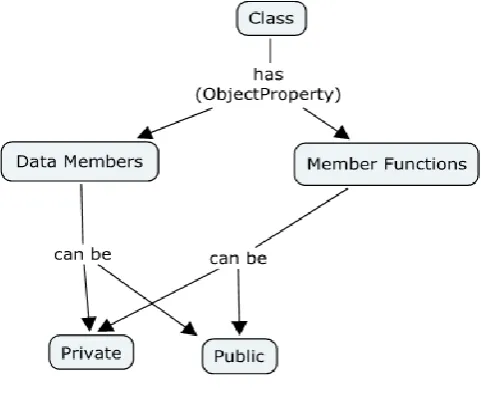
A Concept map has two main components: Concepts which are represented as labeled boxes and Propositions which are links between two concepts. These propositions may themselves be linked [40]. Third component may be added as a focus question to define a context and help focusing on relevant aspects more easily [36]. Fig. 1 shows an example concept map drawn using Cmap tool.
Figure 1. A Sample Concept Map
This research work proposes to use concept maps both as a tool for teaching learning as well as for assessing the development of conceptual knowledge in the students.
C. Assessing and Testing Learning Outcomes:
According to Trumpower et al, “Knowledge requires not only acquiring facts, procedures, and concepts, but also having an understanding of the interrelationships among those facts, procedures and concepts” [48]. Hence, it is important to learn about the actual knowledge acquired by the learners, both during the learning period and at the end of it. Moreover, the capability of the learner to use this conceptual knowledge in solving practical problems should also be assessed to have a clear picture about how much understanding of interrelationships among concepts and skills has been actually acquired. To assess the conceptual knowledge and skills, some kinds of methods supporting externalization of this acquired knowledge are required. These methods may be divided into two categories. First, the methods which externalize and test the conceptual knowledge, i.e., knowledge about the concepts and facts learnt and second, the methods that test the skills in applying this conceptual knowledge in problem solving. Different researchers have been using different methods for assessing the learning outcomes in the learners. To be effective, the assessment should be objective and reliable and should capture something of the structural nature of the subjects‟ knowledge” [31]. Also, the methods used should both be valid and reliable.
VI. METHODOLOGY
This section further studies the components namely Teaching Learning component and Assessment and Testing component. A third study related to various analysis methods and tools available is also added in order to be able to check the effectiveness of different CLEs designed using concept maps.
A. Teaching Learning Component:
Glaser[12] states that structure of organized knowledge is important for the development of learners as it enables inference capabilities, assists in the elaboration of new information, and enhances retrieval. It also provides potential links between existing and newly acquired knowledge, which facilitate learning and problem solving. Concept maps can be used as means to implement CLEs as they provide the tool which can be used to create an organized structure of the conceptual knowledge to be developed in the students. This is because it is easier to represent the interrelations between concepts using concept maps. Kinchan [25] also notes that “Concept mapping is a valuable tool that has enormous potential to support teaching and learning at all levels. Using concept maps should not be seen as an add-on activity, but as a core activity to stimulate the processing and synthesis of information”. Use of constructivism for teaching and educational presents a completely different environment for learning. “Above all, it will shift the emphasis from the student‟s „correct‟ replication of what the teacher does, to the student‟s successful organization of his or her own experience” [13]. So, the learner may be benefitted by having long lasting change in his knowledge structures as he himself is involved in the transformation of his misconceptions to more acceptable knowledge .
Network of inter related concept maps constitutes the teaching learning component in the proposed CLE and provides learning stimulus to the learners. Learning stimulus is defined as the educational processes, learning materials, activities of the learner etc.[33]. It greatly influences the acquisition of knowledge among the learners and success and failure of the process of learning greatly depends upon effectiveness of the learning stimulus. Following are the main characteristics of the learning stimulus that should be present in order to create an effective CLE to teach programming -
a. Interconnected network of expert designed concept maps provides an effective format to represent learning stimulus. These concept maps should be navigable in two ways. Concept maps having same concepts should be linked to enable learner to learn different aspects about a concept. Also, concept maps explaining the concepts in varying details should also be linked in order to help learner study a concept in more detail. This multiple representation of reality is in accordance with the principles of constructivist learning as it gives learner a choice to choose from multiple paths available.
b. Each concept node must also contain links to the various learning materials and activities in case the learner wants to self-evaluate his understanding of concepts.
deletions in content linked in their respective environment.
a) Tools for Concept Mapping:
There are many tools which are available for working with concept maps. Many researchers have used these tools in designing learning stimulus as well as for testing the learning outcomes among the learners. Some of the researchers however, create their own tools for the purpose.
Two such tools that are free to download and specially suit the requirements for designing a CLE are CMap tools and VUE. CMap Tools is an open source software tool developed by Institute for Human and Machine Cognition(IHMC) and is used to draw concept maps as well as link them to digital repositories. VUE is a free, open source concept mapping application written and developed by the Academic Technology group at Tufts University. It can also connect to
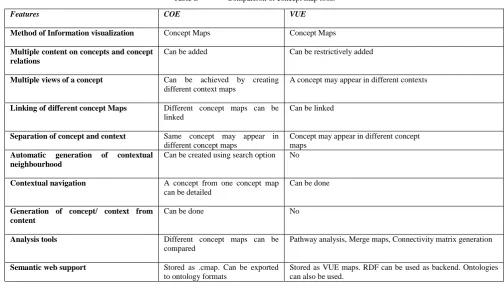
Table I. Comparison of concept map tools
Features COE VUE
Method of Information visualization Concept Maps Concept Maps
Multiple content on concepts and concept relations
Can be added Can be restrictively added
Multiple views of a concept Can be achieved by creating
different context maps
A concept may appear in different contexts
Linking of different concept Maps Different concept maps can be linked
Can be linked
Separation of concept and context Same concept may appear in different concept maps
Concept may appear in different concept maps
Automatic generation of contextual neighbourhood
Can be created using search option No
Contextual navigation A concept from one concept map
can be detailed
Can be done
Generation of concept/ context from content
Can be done No
Analysis tools Different concept maps can be
compared
Pathway analysis, Merge maps, Connectivity matrix generation
Semantic web support Stored as .cmap. Can be exported
to ontology formats
Stored as VUE maps. RDF can be used as backend. Ontologies can also be used.
and can filter the content of various digital repositories. Table I lists the comparison between these concept mapping tools based upon the features specially useful in meeting characteristics of learning stimulus described above.
Both COE and VUE provide rich set of features that are useful in designing an effective learning stimulus and choice between these tools depends upon the requirements of the designer and the subject domain for which it is to be created. Both can be used to create inter-connected concept maps and same concept may be shared in different maps. Although COE provides better means of providing multiple representations of concepts and propositions by adding multiple contents on each node, VUE provides better analysis tools. However, both of these can be extended to semantic web so that interoperability and reusability of concepts and concept maps can be enhanced.
B. Assessment of Knowledge Component:
Glaser [12] states that “all investigators agree that useful knowledge is not acquired as a set of general propositions, but by active application during problem solving in the context of specific goals”. Hence the assessment should be two-fold. First, the conceptual knowledge development should be tested and second, the acquisition of skills for problem solving should also be assessed.
a. Assessment of Conceptual Knowledge Development:
In order to test the development of conceptual knowledge in a learner, it should be externalized, i.e., there should be some method of representing the knowledge externally so that it can be visualized, measured and assessed. Many methods can be employed for the purpose like interviews, multiple choice tests or proper pen and paper tests etc. and these methods have been used by various researchers in their studies. Concept mapping is another such technique which can be used for externalization and further assessment of the conceptual knowledge of the learners. There are many benefits of using concept mapping for the assessment purposes like -
a) Assessment of conceptual knowledge can be automated if tests are represented using concept maps, hence leading to more subjective assessment.
the acquisition and accommodation of new knowledge as maps are modified over time.” [23]. It further emphasizes that “the information derived from analyzing student concept maps can be used to tailor lessons to the immediate needs of students, resulting in a richer, more meaningful science learning experience”.
Also, it has been seen in the previous studies that there is a major difference between the concept maps created by a novice and that of an expert and also that of rote learners and meaningful learners [9]. Also, concept mapping may be useful in assessing misconceptions [31],[19]. The quality of structure distinguishes between elements of knowledge that are loosely connected or structured in a logical way [8] and is related to the level of knowledge.
b. Assessment of Skills:
Regarding the assessment of acquisition of skills, some problem statement to be solved using programming is generally given to the students and their programs are analyzed using various parameters like presence of core concepts, correct implementation of these concepts along with actual execution of the program.
To assess the conceptual knowledge of learners, two techniques are important- assessment methods and scoring strategies. Both of these are discussed below-
c. Assessment Methods:
Concept maps drawn by the students form the basis of first type of assessment, i.e., assessment of conceptual knowledge. These can be quantified using various scoring methods to monitor the development of conceptual knowledge. An ideal assessment task “is objective and reliable, minimizes the influence of context on responses, and captures something of the structural nature of the subjects‟ knowledge” [31].
There are various methods used by various researchers for assessing the learner generated concept maps. Ruiz-Primo [42] has identified various components of concept map assessments in terms of: (a) an assessment task given to a student to externalize his or her knowledge structure in the form of a concept map, (b) a format for the student's response, and (c) a scoring system by which the student's concept map can be accurately and consistently evaluated. Most of the assessment techniques used by researchers have these components and various tasks under each component are described in the table II.
Figure 2. Concept map techniques according to directedness of the mapping tasks [43]
Ruiz-Primo and M. Araceli [43] state that a concept map task assessment could be characterized along a directedness continuum from high-directed to low-directed. High-directed concept map tasks provide students with the concepts, connecting lines, linking phrases, and the map structure. These are useful for activating student‟s knowledge. In low-directed concept map tasks, students are free to decide which and how many concepts they include in their maps, which concepts are related, and which words to use to explain a relationship. Hence, low-directed tasks demand more content knowledge [44]. Fig. 2 shows different mapping techniques on directedness scale[43]. Moreover, different concept mapping techniques do not provide the same information about the students‟ connected understanding [42], [44]. Hence, assessment tasks should be selected depending upon the skills and type of knowledge to be judged.
d. Scoring Strategies:
“A scoring system is a systematic method with which students‟ concept maps can be evaluated accurately and consistently” [42]. Scoring a concept map means assigning scores in the form of numbers in order to measure the acquired knowledge. This is done using scoring strategies. Some of the characteristics which can be considered while assigning scores to concept maps are- closeness of a concept map with a master map, number of concepts, number of relationships, number of valid prepositions, shape of concept maps and graph based measures. Scoring methods can be divided into two categories – quantitative and qualitative.
Table II. Components of Concept Map Assessment Tasks[42]
Component Tasks Examples
Assessment Tasks Task Demands
Define what a student has to do
to complete the task
Task Constraints The limitations that a student has to follow while solving a task
Task Content Structure Nature of the subject domain to be
mapped
Fill in the blanks in the given concept map, Constructing complete map from the scratch
Structure of map already given e.g. Hierarchical
Content to be mapped has a structure e.g. hierarchical, cyclic
Response format Response Mode
Characteristics of the Response Format
Mapper
Drawing a map or taking part in an interview
A skeleton map is given on a sheet of paper
Concept maps may be drawn by the respondent or the interviewer based on responses of the respondent
Scoring System Score the components of the student‟s map
Compare the student‟s map with a criterion map
In Quantitative assessment techniques, a numerical score is calculated for a given concept map which is then treated as a measure of a students‟ understanding of a particular domain. These methods arrange the evaluated maps in some order to represent understanding of different learners‟ and this data can be used for statistical analysis. Different quantitative assessment techniques are discussed below.
a) Holistic scoring method:
The holistic method was designed by McClure, Sonak and Suen [31]. In this method, concept maps are assigned a score on a given scale to evaluate the learner‟s overall understanding of the domain. It does not supply any algorithm, heuristics or guidelines to calculate the score.
b) Weighted component scoring methods:
These methods assign scores to certain concepts and/or links between concepts. The total score of a concept map is equal to the sum of these individual scores. The values assigned to components depend on their validity or the type of structure. Two important weighted component scoring methods are - the structural and relational scoring methods.
The structural scoring method was devised by Novak and Gowin [38] and is used to give scores to hierarchically structured knowledge. Table III summarises the structural scoring scheme.
Table III. Structural scoring scheme[38]
Component of Concept Map Score
Each meaningful, valid proposition 1
Subordinate concept more specific than the concept drawn above it
5
Each cross-link that is both valid and significant 10
Each cross-link that is valid but not significant 2
Valid examples 1
The relational scoring method was formulated by McClure, Sonak and Suen and awards points to each link between concepts in isolation. Higher scores are assigned to links that are correctly labelled and ones that express a basic relationship of the domain, such as taxonomical and causal relationships [31]. Table IV represents scoring scheme in relational scoring method.
Table IV. Relational scoring scheme [31]
Component of Concept Map Score
Link valid but not labeled correctly 1
Link valid and correctly labeled but does not represent a hierarchical, causal or sequential proposition
2
Link valid and correctly labeled and also represents a hierarchical, causal or sequential proposition
3
c) The closeness index:
The closeness index, was given by Goldsmith, Johnson and Action [14]. It calculates the similarity between learner‟s and expert‟s concept maps on the common concepts and propositions but ignores the labels of the propositions. The closeness index of a concept c, common between the learner‟s and expert‟s map is equal to the number of concepts directly linked to c in both maps divided by the number of concepts directly linked to c in either map. The overall
closeness index of two maps is the average closeness index of all nodes in these maps. Mathematically, the closeness index can be written as:
Where Ge is the concept map by expert, Gs represents concept map drawn by the student, V = Ve + Vs represents total number of concepts linked in both the concept maps.
Qualitative assessment methods provide descriptive assessment of concept maps. Instead of providing quantitative score, these methods provide descriptive diagnosis of the extent of understanding. Various qualitative methods include the following -
a) Linkage analysis:
Linkage analysis method was developed by Liu, Don and Tsai [30] and it aims to identify potential misconceptions of students by comparing the concepts to which each concept in a learner‟s and the expert‟s concept map is directly linked to.
b) Spoke, Chain, Net Structures:
Kinchin, Ian, Hay, David and Adams[26] identify three types of substructures in concept maps which indicate different levels of knowledge structures. These are spokes, chains and nets. Spoke represents a single level hierarchy, chain, a sequence of concepts and a net denotes a substructure where a pair of concepts are related to one another through different propositions. Table V represents analysis of these three structures.
Table V. Analysis of Spoke, Chain and Net substructures [26]
Substructure Analysis
Spoke Learner identifies concepts related to the given concept, but does not identify how the former concepts are related to one another.
Chain Chain indicates rote learning because most of the times sequence indicates the order in which concepts were introduced in the lecture
Net Concepts are integrated with one another more strongly, hence represents meaningful learning
c) Qualitative Simulation:
Qualitative simulation is a set of techniques which extrapolate the behaviour of physical systems in terms of qualitative descriptions and formalises system behaviour by means of mathematical models [22]. Example of such system is a qualitative simulation proposed by Biswas et al [3]. It proposes qualitative simulation model for the assessment of causal concept maps in which all links describe causal relations with a specific pre-defined semantics. It is used to teach an autonomous agent known as ”Betty‟s Brain”, about a particular type of system, by defining the agent‟s mental model.
each proposition on its own and using a criterion map was found to provide the highest reliability between several raters.
Novak [40] presents another scoring scheme using a combination of quantitative and qualitative aspects of scoring. It is based on two parts- “The taxonomy dealing with general structure of the concept maps, called the topological taxonomy and the rubric dealing with the quality of meanings called the semantic rubric”. The taxonomy is based on five criteria namely concept recognition, presence of linking phrases, degree of ramification, depth, and presence of cross-links and the criteria for the rubric are concept relevance and completeness, presence of dynamic propositions, number and quality of cross-links, and presence of cycles.
As discussed earlier, the choice of assessment techniques and scoring strategies also depend upon the knowledge component and its extent to be analysed.
C. Analysing Effectiveness of a Learning System:
In order to study the effectiveness of any concept map based CLE, results obtained from assessment of learning outcomes in the form of scored concept maps as well as the written programs must be analysed and compared with the similar data received from the groups that were taught using alternate methods. In constructivist environment, analysis can focus on two aspects- statistical techniques to measure the knowledge development. However, there are different ways of investigating the knowledge structures of multiple learners. Larraza-Mendiluze and Edurne [28] use the method of creation of a weighted graph from a set of maps to be evaluated and analyzing the resulting map with techniques of social network analysis. Many graph theory methods like pathfinder analysis, measuring subgraph frequencies, cluster analysis etc. can be used for analyzing the results obtained in the form of scored concept maps. Many tools are available which have inbuilt capabilities to perform above given analysis. Some of these tools are free/open source while others are commercial. Some researchers have developed their own tools to suit individual requirements.
a. Tools for Concept Map Analysis:
Many tools have been developed for automatic analysis of concept maps. Some of the analysis measures are included in concept mapping tools themselves like C-Tools [18], COMPASS [15] and CRESST [20] etc. But these tools are not available for evaluation of a large collection of concept maps for research purposes and are not extensible to include different types of assessment criteria to a set of maps [5].
statistical (linear and nonlinear modelling, classical statistical tests, time-series analysis, classification, clustering etc.) and graphical techniques, and is highly extensible.
CmapAnalysis is a software tool that facilitates the analysis of sets of concept maps using various algorithms, rubrics and techniques. It provides a set of assessment options by default and can be extended by the user to apply other assessment techniques defined by him. The result of the analysis is in the form of Excel spreadsheet which contains one row for each concept map and columns for the desired measures like count of concepts and propositions to more complex calculations like identifying the top three most central concepts in each map. In addition to the analysis measures already incorporated, users can add other measures also.
Another tool that can be used for quantitatively comparing multiple concept maps is Pathfinder Knowledge Network Organizing Tool (KNOT) developed by Schvaneveldt. Pathfinder networks[46] are graph based representations of the similarity (or dissimilarity) of entities and are useful in capturing latent organizational traits of knowledge. This tool has extensive analysis capabilities including simultaneous comparisons between multiple concept maps as well as the capability of combining multiple concept maps into a single group network representation [7]. This tool can work with concept maps drawn using CMap tools. Table VI lists various applications of all these tools.
Table VI. Various Analysis Software Tools
Features CMapAnalysis R KNOT
Functions Can be used to Extensibility Is extensible as
users can add their and depending upon the kind of analysis to be done, either of them or some combination of these tools can be used. Further, the list of tools is not exhaustive and there are many other tools available which may be explored depending upon the requirement of the study.
VII.CONCLUSION
knowledge development in these subjects. However, not much work has been done in the field of computer science education. Hence, this paper explores the odds of implementing a CLE in the field of computer science education, specially, in teaching learning programming with emphasis on both as teaching learning aid as well as assessment aid to measure the knowledge gained by the learner. Various assessment techniques and available software tools discussed in the paper are in reference to teaching and learning a programming language. Further, as it is important to study the effectiveness of the proposed method, analysis of the learning outcomes received in the form of concept maps should be done. There are many tools that are available freely for analysis purposes and three of them have been compared in this paper. Selection of all the tools, for creating concept maps, assessing and scoring methods as well as tools for analysis depends upon the kind of analysis to be made. Hence, this paper provides a study of theoretical foundations and tools required to create a complete CLE with concept mapping network as teaching and learning aid and use of concept maps for evaluating the development in the knowledge, both conceptual and skill based, in the learners.
VIII.REFERENCES
[1] Al-Kunifed, Ali & Wandersee, James H., “One hundred references related to concept mapping”, Journal of Research in Science Teaching, 27(10), 1990, pp. 1069– 1075.
[2] Ausubel, David Paul, “Educational psychology: A
cognitive view”, Holt, Rinehart et Winston, Montreal, 1968.
[3] Biswas, G., Leelawong, K., Schwartz, D., Vye, N. & The Teachable Agents Group at Vanderbilt, “Learning by teaching: a new agent paradigm for educational software”, Applied Artificial Intelligence,19, 2005, pp. 363–392.
[4] Cañas, Alberto J., Carff, Roger, Hill, Greg, Carvalho, Marco, Arguedas, Marco, Eskridge, Tom, Lott, James & Carvajal, Rodrigo, “Concept maps: Integrating knowledge and information visualization”, S.-O. Tergan & T. Keller (eds), Knowledge and Information Visualization, Vol. 3426 of Lecture notes in computer science, Springer Berlin Heidelberg, 2005, pp. 205–219.
[5] Cañas, J.A.; Bunch, L.; Novak, J.D. y Reiska, P., “Cmapanalysis: an extensible concept map analysis tool”, Journal for Educators, Teachers and Trainers, Vol. 4 (1),2013, pp. 36 – 46.
[6] Cho, Sungwoo, “A study on comparative advantages of concept map construction and self explanation”, Master‟s Thesis, Dept of Knowledge Service Engineering, Korea Advanced Institute of technology, 2011.
[7] Clariana Roy, Koul Ravinder, and Albright Kristen, “Using pathfinder KNOT analytic tools for comparing and combining concept maps”, poster paper, 2006.
[8] de Jong, Ton & Ferguson-Hessler, Monica G.M., “Types and qualities of knowledge”, Educational Psychologist 31(2), 1996, pp. 105–113.
[9] Derbentseva, Natalia, Safayeni, Frank & Cañas, Alberto J., “Concept maps: Experiments on dynamic thinking”,
Journal of Research in Science Teaching 44(3), 2007, pp. 448–465
[10] Ertl, Bernhard & Mok, Sog Yee, “Concept-mapping in informatics”, 2010, Log in (166/167), pp. 63–68.
[11] Fincher, Sally & Petre, Marian, “Computer science education research”, Routledge Falmer, London and New York, 2004.
[12] Glaser, Robert & Bassok, Miriam , “Learning theory and the study of instruction”, Annual Review of Psychology 40, 1989, pp. 631–666.
[13] Glasersfeld, Ernst von , “Learning as a constructive activity”, J. C. Bergeron(ed.), Proceedings of the 5th Annual Meeting of the North American Group of Psychology in Mathematics Education, Montreal, 1983, pp. 41–101
[14] Goldsmith, T., Johnson, P. & Action, W., “Assessing
structural knowledge, Journal of Educational
Psychology,1991, pp. 83,88–96.
[15] Gouli, E., Gogoulou, A., Papanikolaou, K., & Grigoriadou, M., “COMPASS: An adaptive web based concept map assessment tool”, A. J. Cañas, J. D. Novak & F. M. González (Eds.), Concept Maps: Theory, Methodology, Technology. Proceedings of the First International Conference on Concept Mapping, Vol. 1, 2003, pp. 295-302, Pamplona, Spain: Universidad Pública de Navarra.Gredler, 2001)
[16] Gouli, Evangelia, “Concept mapping in didactics of informatics assessment. As a tool for learning in web-based and adaptive educational environments”, PhD thesis, National and Kapodistrian University of Athens, Athen, 2007.
[17] Gredler, M. E., “Learning and instruction: Theory into practice”, 4th ed., 2001, New Jersey: Prentice Hall, Inc.
[18] Harrison, S. H., Wallace, J. L., Ebert-May, D., & Luckie, D. B., “C-TOOLS Automated Grading for Online Concept Maps Works Well with a Little Help from "WordNet"”, A. J. Cañas, J. D. Novak & F. M. González (Eds.), Concept Maps: Theory, Methodology, Technology. Proc. of the First Int. Conference on Concept Mapping , Vol. 2, 2004, pp. 211-214. Pamplona: Universidad Pública de Navarra.
[19] Hay, David B. & Kinchin, Ian M. , “Using concept maps to reveal conceptual typologies”, Education + Training 48(2/3), 2006, pp. 127–142.
[20] Herl, Howard E., O'Neil, Harold F., Jr., Chung, Gregory K.W.K., Dennis, Robert A., & Lee, John J., “Feasibility of an On-line Concept Mapping Construction and Scoring System”
[21] Hubbard T., “Concept map based software engineering”, Master‟s Thesis in Dept of Computer Science, Tufts University, 2007.
[22] Keppens, Jeroen & Hay, David, “Concept map assessment for teaching computer programming”, Computer Science Education 18(1), 2008, pp. 31–42.
[23] Kern, Cindy & Crippen, Kent J, “Mapping for conceptual change”, Science Teacher 75(6), 2008, pp. 32–38
Cañas, J. D. Novak, (Eds.), Concept Maps: Theory, Methodology, Technology, 2nd ICCM. San José, Costa Rica, 2006.
[25] Kinchin, Ian M., “Visualising knowledge structures in biology: discipline, curriculum and student understanding” , Journal of Biological Education 45(4), 2011, pp. 183–189.
[26] Kinchin, Ian M., Hay, David B. & Adams, Alan, “How a qualitative approach to concept map analysis can be used to aid learning by illustrating patterns of conceptual development”, Educational Research 42(1), 2000, pp. 43– 57.
[27] Langford Deré, “The use of concept mapping to enhance the teaching of chemical equilibrium in a grade 12 physical science tutoring classroom”, Masters‟ thesis, Cape Peninsula University of Technology, January, 2014.
[28] Larraza-Mendiluze, Edurne & Garay-Vitoria, Nestor, “Use of concept maps to analyze students‟ understanding of the i/o subsystems”, M.-J. Laakso & Simon (eds), Proceedings of the 13th Koli Calling International Conference on Computing Education Research, Koli, Finland, November 14-17 2013, Koli Calling ‟13, ACM, New York, pp. 67–76.
[29] Linck, B., Ohrndorf, L., Schubert, S., Stechert, P., Magenheim, J., Nelles, W., Neugebauer, J. & Schaper, N., “Competence model for informatics modelling and system comprehension”, 2013 IEEE Global Engineering Education Conference, Berlin, Germany, March 13-15 2013, IEEE, Piscataway, pp. 85–93.
[30] Liu, C.-C., L., Don, P.-H. & Tsai, C.-M., “Assessment based on linkage patterns in concept maps”, Journal of Information Science and engineering,21,2005, pp. 873–890.
[31] McClure, John R., Sonak, Brian & Suen, Hoi K., “Concept map assessment of classroom learning: Reliability, validity, and logistical practicality”, Journal of Research in Science Teaching 36(4), 1999, pp. 475–492.
[32] Michael E. Kane, “Concept mapping: A visual learning strategy benefiting post-secondary deaf and hard of hearing accounting students, Masters‟ Thesis, Rochester Institute of Technology, 2010.
[33] Mühling Andreas, “Investigating knowledge structures in computer science education”, PhD thesis, Jan, 2014.
[34] Mühling, Andreas, Hubwieser, Peter & Brinda, Torsten, “Exploring teachers‟ attitudes towards object oriented modelling and programming in secondary schools”, Proceedings of the Sixth international workshop on Computing education research, Aarhus, Denmark, August 9-10 2010, ACM, New York, pp. 59–68.
[35] Naeve A., “The Concept Browser - a new form of Knowledge Management Tool”, Proceedings of the 2 nd European Web-based Learning Environments Conference (WBLE 2001).
[36] Novak Joseph D. & Cañas Alberto J., “The theory underlying concept maps and how to construct and use them”, Technical Report IHMC CmapTools, Jan, 2006,
Rev Jan, 2008, Institute for Human and Machine Cognition, Florida.
[37] Novak, Joseph D. & Cañas, Alberto J., “The universality and ubiquitousness of concept maps”, in J. Sánchez, A. J. Cañas & J. D. Novak (eds), Concept Maps: Making
Learning Meaningful: Proceedings of the Fourth
International Conference on Concept Mapping, Viña del Mar, Chile, October 5-7, 2010, Vol. 1, Universidad de Chile, Chile, pp. 1–13
[38] Novak, Joseph D. & Gowin, Bob, “Learning how to learn”, Cambridge University Press, Cambridge and New York, 1984.
[39] Novak, Joseph D. & Musonda, Dismas, “A twelve-year longitudinal study of science concept learning”, American Educational Research Journal 28(1), 1991, pp. 117– 153.
[40] Novak, Joseph D., “Learning, creating, and using knowledge: Concept maps as facilitative tools in schools and corporations”, 2nd ed., 2010, Routledge, London.
[41] Passmore, Graham James , “Concept maps and the processes of comprehension: Explicating cognition and metacognition, structural knowledge and procedural knowledge”, PhD thesis, University of Toronto, Toronto, 1999.
[42] Ruiz-Primo, Maria Araceli & Shavelson, Richard J., “Problems and issues in the use of concept maps in science assessment”, Journal of Research in Science Teaching 33(6), 1996, pp. 569–600
[43] Ruiz-Primo, Maria Araceli, “Examining concept maps as an
assessment tool”, Concept Maps: Theory,
Methodology,Technology, Proc. of the First Int.Conference on Concept Mapping, Pamplona, Spain 2004
[44] Ruiz-Primo, Maria Araceli, Schultz, Susan E., Li, Min & Shavelson, Richard J. , “Comparison of the reliability and validity of scores from two concept-mapping techniques”, Journal of Research in Science Teaching 38(2), 2001, pp. 260–278.
[45] Sanders, Kate, Boustedt, J., Eckerdal, A., McCartney, Robert, Moström, Jan Erik, Thomas, Lynda & Zander, C., “Student understanding of object oriented programming as expressed in concept maps”, SIGCSE Bulletin inroads 40(1), 2008, pp. 332–336.
[46] Schvaneveldt, Roger W., Durso, Francis T. & Dearholt, Donald W., “Network structures in proximity data”, The Psychology of Learning and Motivation 24, 1989, pp. 249– 284.
[47] Thain Dev, “A study of semi-hierarchical organization in the construction of concept maps using the framework of cognitive load theory”, Masters‟ Thesis, Queen‟s University Kingston, Ontario, Canada, May, 2012.
![Figure 2. Concept map techniques according to directedness of the mapping tasks [43]](https://thumb-us.123doks.com/thumbv2/123dok_us/695197.1077163/5.595.276.560.406.764/figure-concept-map-techniques-according-directedness-mapping-tasks.webp)
