ISSN(Online): 2320-9801
ISSN (Print): 2320-9798
International Journal of Innovative Research in Computer
and Communication Engineering
(An ISO 3297: 2007 Certified Organization)
Vol. 3, Issue 5, May 2015
Development of Software for Flower
Recognition Using Image Processing
Technique
Er. Gurleen Kaur Marwa
1, Er. Salam Din
2M.Tech Student, Dept. of SEEIT, COAET, PAU, Ludhiana, India1
Assistant Professor, Dept. of SEEIT, COAET, PAU, Ludhiana, India2
ABSTRACT: Prototype of desktop based software is developed for flower recognition and is explained in this research paper. We tried to help common people to recognize every specie of flower and have their specification including their scientific name given to them with a digital image of that flower with white background in their hand. Only a digital image is required in this software and it compares the uploaded image with the images already present in data folder and provides you with appropriate result
.
KEYWORDS:Flower recognition; HSV Color Model; Histogram;
I. INTRODUCTION
Flower is a very important organ of a plant. Identification of flower can be substituted for identification of plant as mostly we identify a plant through its flower. Experienced taxonomists and botanists mostly do this identification of flower but a naïve person will have to have to consult flower guidebooks or browse any relevant web pages on the
Internet through keywords searching [1]. This is a system that recognizes the flower images captured by digital camera.
The feature that the software uses for flower recognition includes shape, color and also the most important characteristic used is stamen/pistil area, which gives the accurate result. A database including 24 species is used in the software for recognition. Infinite number of flower species exist all over the world that includes the remote places and the places where human life does not exist, and a large no of species are unknown. Everyday we see a large number of flower species in our house, in parks, roadsides, in farms, on mountains but we have no knowledge of that flower species or their origin[2]. We don’t even know its name. There are several guidebooks for flowers knowledge but it becomes quite difficult to search for name when have the picture. Even the Internet sometimes is not useful. But it is quite difficult for human brain to remember all the species they see. Even sometime the flowers of different species looks alike. Therefore, a digital image type approach is more successful and the software includes this approach. This software recognizes the flower with its digital image and displays to you its name and other specifications. This software works on scientific name of the flower.
With increase in number of researches and invention, new species of flowers are discovered frequently. Every human does not have knowledge of these flowers. We need expert’s experience and practical knowledge that is quite difficult. Searching on Internet also has many barriers. The searching on Internet is restricted to keywords. Therefore the Internet approach is also not practical. Hence digital images are more powerful approach for flower recognition. Nowadays everyone has a digital camera or every human has a smart phone with good clarity and it would be easier to identify the flower with the help of digital image. The most common difficulty that flower recognition software faces is to withdraw the accurate flower image with making the natural background disappear. When the original flower image is extracted, the features that include color, shape, area etc. are segmented[2].
ISSN(Online): 2320-9801
ISSN (Print): 2320-9798
International Journal of Innovative Research in Computer
and Communication Engineering
(An ISO 3297: 2007 Certified Organization)
Vol. 3, Issue 5, May 2015
The developed system is desktop-based software. In this proposed software color, edge and area detection algorithms are used for comparison of the images to find the exact flower. The main base of the software is a data folder, which keeps all the information related to the image of the flower species (scientific name and image) for comparison with the image uploaded. But the user needs to first sign up to the software application to best use its services. When user observes a flower but is unable to identify it and unknown of its scientific name he/ she captures an image of the flower through a digital camera. This image is supposed to have pure white background. After that the user signs in to this proposed software to submit this captured image to the data folder. As soon as the user uploads a sample of digital image to the software, its uploaded image is automatically compared with the stored images in the data folder[3]. If the uploaded image is matched with any image in the data folder with some required percentage then the corresponding image of the database is displayed. If more then one image is matched with the uploaded image, then the user himself/ herself will decide which flower image will best suit him/ her. The comparison process includes different parameter i.e. color, edge and area etc.
II. RELATED WORK
[4] gave us a technique of flower patent image indexing which takes a help of flower color and their structural location’s domain knowledge. Green, black, grey and brown are the color that hardly appears on flower region, also the images have background color that is usually visible and affect the software’s working. Therefore an automation withdrawal software was used which separated the real flower from the background as only color’s have the flower were used rather than complete colors of digital image. But using color information alone without the use of shape and area is not a sufficient approach.
[5] gave an approach based on region of interest. Region of interest i.e. ROI extracts the flower image from the whole image of flower including background. In addition to the approach of Das et al. color clustering method was included for segmentation. The scattering of colors of the flower region is represented by color histogram, along with which for exact comparing two shape features were included.
[3] proposed that trading of flowers, production of seeds, nursery and potted plants and segmentation of useful oil from flowers are included in floriculture. Firstly, the image gathered from different regions for the process is viewed and enhanced. Secondly, the image disporting is done to get the targeted parts of flower. Lastly, final analysis of the detected region is done. The histogram approach is used to detect the disease taking the help of stem value. Finally the agricultural experts are looking out for consultative approach.
[6] has an objective to build software for computers that uses leaf or flower to identify a plant. This software has 4 different modules i.e. acquisition of image, preprocessing of image, recognition of image and result display. In image acquisition the flower image or leaf are captured on a background of white paper. Different processing algorithms are applied on flower or leaf in image preprocessing part. In image recognition, 8 main features are used for extraction. Finally in display result, the results best matched are displayed.
ISSN(Online): 2320-9801
ISSN (Print): 2320-9798
International Journal of Innovative Research in Computer
and Communication Engineering
(An ISO 3297: 2007 Certified Organization)
Vol. 3, Issue 5, May 2015
III.DESIGN AND DEVELOPMENT OF PROPOSED SYSTEM
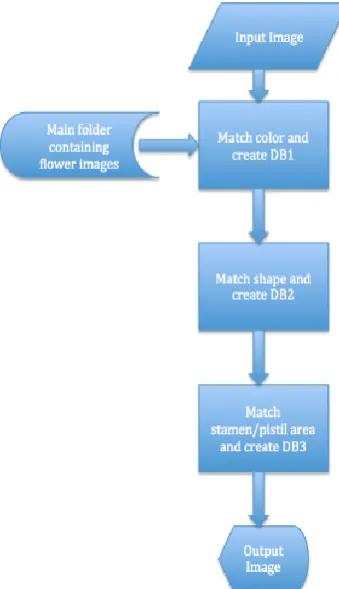
Figure 1: Data flow chart
The above given data flow chart shows how data is converted from input to output. Detailed explanation is given below.
1. Find flowers with same color as that of uploaded image and create DB1 1.1 RGB to HSV
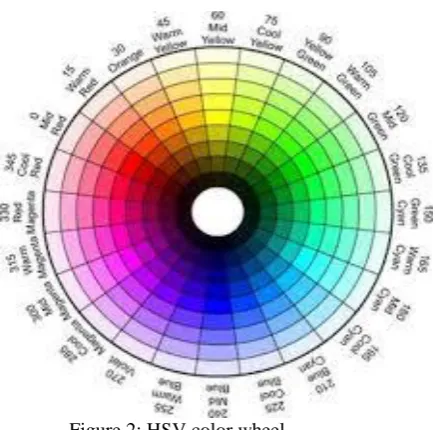
HSV (Hue, Saturation and Value) – defines a type of color space. The HSV color space is very comparable to the way in which humans perceive color. The HSV color space has three components: hue, saturation and value. In HSV, hue represents color. In this model, hue is an angle from 0 degrees to 360 degrees. Saturation indicates the range of grey in the color space. Value is the brightness of the color and varies with color saturation[8].
ISSN(Online): 2320-9801
ISSN (Print): 2320-9798
International Journal of Innovative Research in Computer
and Communication Engineering
(An ISO 3297: 2007 Certified Organization)
Vol. 3, Issue 5, May 2015
Figure 2: HSV color wheel 1.2 Histogram of H-plane
Here, as a first step of flower recognition process, we have to identify the color of the input flower. The H-plane in HSV color model represents color information. So color can be identified by finding histogram of H-plane. The Hue value at the maxima in histogram represents the color of the input flower as the background is assumed to be white. Hue is an angle from 0 degrees to 360 degrees as shown in figure 1.1 but in openCV, the range is 0 to 180.
OpenCv function used:calcHist();
1.3 Find Dominant color and create DB1
Once the histogram of H-plane is calculated, the hue value at maxima is compared with the hue ranges for different color. The color corresponding to the range in which the maxima falls is the dominant color of the input flower. DBI is created by collecting the same color flowers from the main database.
2. Find flowers with matching shape from DB1 and create DB2
2.1 Color image segmentation
Separating a portion of specific color from image is called color image segmentation. The flower can be segmented from the background after the color of the flower are saperated.
OpenCV function used: inRange();
2.2 Find contours and discard noise
While color image segmentation is carried out, we may find some unwanted noise or some non-connected parts of flower as noise. Area of the segments is the criteria to discard all these and select the flower only. For that, connected components (contours) are found first and then their areas are compared. The largest contour is picked.
ISSN(Online): 2320-9801
ISSN (Print): 2320-9798
International Journal of Innovative Research in Computer
and Communication Engineering
(An ISO 3297: 2007 Certified Organization)
Vol. 3, Issue 5, May 2015
2.4 create DB2
The method for comparing shapes will return a value (here matchingFactor) representing that how much match is there. The lower the value, higher is the match. DB2 is created by picking up the lowest three values of matchFactor provided that the value is less than particular threshold (here MATCH_FACTOR_TH) to ensure that only relevant shapes are picked.
3. Find flowers with relatively same area of pistal/stamen.
3.1 Locate the pistal/stamen
To locate the pistal/stamen of input flower, the flower itself has to be located in the whole image. To achieve that, a rectangle enclosing the flower(bounding box) is found first. Predefined region(here, start from 34% of height and 34% of width and take 1/3rd of height and 1/3rd of width) of that rectangle is selected to find the pistal/stamen.
OpenCV function used:boundingRect();
3.2 Find area of pistal/stamen
A little of petal that is considered as extra part in predefined region i.e. pistal/stamen is also visible which is not considered good. To discriminate better between pistal/stamen and petal, contrast stretching is applied. Same as section 1.2 and 1.3, histogram of H-plane is calculated and two maximas (lowerMaxPos and upperMaxPos) are found as pistal/stamen and petals are assumed to have different colors. After that, relative areas(with respect to the area of whole flower) for both the colors(pistal/stamen and petal) are found using the same concept of color image segmentation.
OpenCV functions used:1) normalize(); 2) calcHist(); 3) inRange();
3.3 Compare relative pistal/stamen area and show the output
Comparison of the pistal/ stamen area obtained by the formula mentioned above is done with those of the flowers in DB2 with some relaxation (here REL_AREA_TH).
So, ultimately the flower/flowers which passes through all the three levels of filtering (color,shape and pistal/stamen) are displayed as output with available data related to that flower(here name of the flower).
IV.RESULTS
ISSN(Online): 2320-9801
ISSN (Print): 2320-9798
International Journal of Innovative Research in Computer
and Communication Engineering
(An ISO 3297: 2007 Certified Organization)
Vol. 3, Issue 5, May 2015
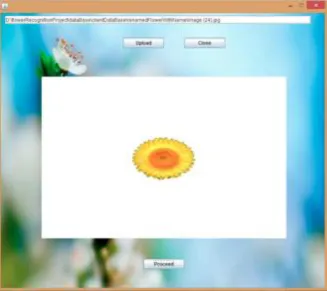
Figure 3: Screenshot of image uploading dialog box
ISSN(Online): 2320-9801
ISSN (Print): 2320-9798
International Journal of Innovative Research in Computer
and Communication Engineering
(An ISO 3297: 2007 Certified Organization)
Vol. 3, Issue 5, May 2015
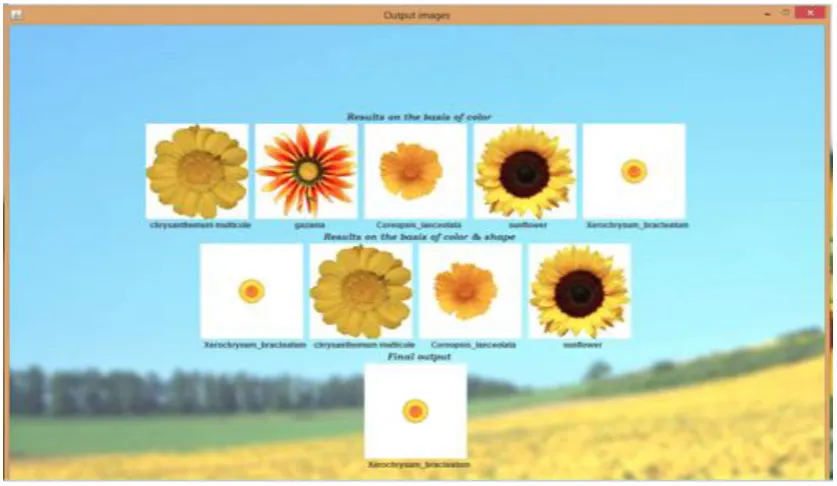
Figure 5: Screenshot of recognition of flower by software
In the above figure various results/outputs are shown which are achieved using various image processing techniques mentioned before in design and development of proposed software.
V. FUTURE WORK
Nowadays the computer technologies are used all over the world in every part of the country but many humans are unable to use them because of illiteracy. This software is easy to use and user friendly. By adding new images of flowers to the software’s database, we can update the software and use the more efficient and accurate software. New species of flowers along with its scientific name and images can be added to the software.
REFERENCES
1. Apriyanti D. H. , Arymurthy A. M. and Handoko L. T.(2013) Identification of Orchid Species Using Content-Based Flower Image
Retrieval. 2013 International Conference on Computer, Control, Informatics and Its Applications Jakarta, Indonesia :53-59
2. Tiay T. , Benyaphaichit P., and Riyamongkol P.(2014) Flower Recognition System Based on Image Processing. The 2014 Third ICT
International Student Project Conference (ICT-ISPC2014):99-102
3. Aleya K F and Samanta D (2013) Automated Damaged Flower Detection Using Image Processing. Journal of Global Research in
Computer Science 3:297-301.
4. Das M, Manmatha R and Riseman E M (1999) Indexing flower patent images using domain knowledge. IEEE Intell Syst 14:24–33
5. Hong A, Chen G, Li J, Chi Z and Zhang D (2004) A flower image retrieval method based on ROI feature. Journal of Zhejiang University
(Science) 5:764–772.
6. Pornpanomchai C. , Kuakiatngam C. , Supapattranon P. , and Siriwisesokul N. (2011) Leaf and Flower Recognition System (e-Botanist).
IACSIT International Journal of Engineering and Technology, Vol.3, No.4:347-351.
7. Saitoh T, Kaneko T (2000) Automatic recognition of wild flowers. Proc Int Conf Pattern Recogn 2:507– 510
8. Schwarz M. W. , Cowan W. M., Beatty J. C.(1987)An experimental comparison of RGB, YIQ, LAB, HSV, and opponent color models.
Journal ACM Transitions on graphics 6:123-158
9. Dash T and Nayak T (2012) A java based tool for basic image processing and edge detection. Journal of Global Research in Computer
Science 3:57-60
10. Fukuda K, Takiguchi T, Ariki Y (2008) Multiple classifier based on fuzzy c-means for a flower image retrieval. In: Proc. Int. Workshop
on Nonlinear Circuits and Signal Processing (NCSP’2008): 76–79.
11. Holmes S, Kapelner A and Lee P P (2009) An Interactive Java Statistical Image Segmentation System: GemIdent. Journal of Statistical
Software 30:1-20.
12. Nilsback M -E and Zisserman A (2006) A Visual Vocabulary for Flower Classification. Computer Vision and Pattern Recognition, 2006
ISSN(Online): 2320-9801
ISSN (Print): 2320-9798
International Journal of Innovative Research in Computer
and Communication Engineering
(An ISO 3297: 2007 Certified Organization)
Vol. 3, Issue 5, May 2015
13. Priya K L and Durairaj D C, (2013) Pest Control in Agricultural Plantations Using Image Processing. IOSR Journal of Electronics and
Communication Engineering 6: 68-74
14. Singh H and Kaur T (2013) Empirical Study of Various Edge Detection Techniques for Gray Scale Images. International Journal of
Advanced Research in Computer Science and Software Engineering 3:76–80
15. Yetirajam M and Nayak M R (2012),A Java Applet Based Tool for Histogram Equalization and Edge Detection. International Journal of
Advanced Research in Computer Engineering & Technology 1:90-94
16. Zou J and Nagy G (2004) Evaluation of model-based interactive flower recognition. Proc Int Conf Pattern Recogn 2:311–314
BIOGRAPHY
Gurleen Kaur Marwa is pursuing her M.Tech. degree from Punjab Agricultural University, Ludhiana(India). She had completed her B.Tech. degree from Guru Nanak Dev Engineering College, Ludhiana.