A QoS-oriented Distributed Routing Protocol
for Hybrid Wireless Networks
Ambuja Devidas Patil
Dept. of CSE, RVCE, Bengaluru, India
ABSTRACT: in this Wireless communication gains popularity, significant research has been devoted to supporting real-time transmission with stringent Quality of Service (QoS) requirements for wireless applications. At the same time, a wireless hybrid network that integrates a mobile wireless ad hoc network (MANET) and a wireless infrastructure network has been proven to be a better alternative for the next generation wireless networks. By directly adopting resource reservation-based QoS routing for MANETs, hybrids networks inherit invalid reservation and race condition problems in MANETs. How to guarantee the QoS in hybrid networks remains an open problem. In this paper, it proposes a QoS-Oriented Distributed routing protocol (QOD) to enhance the QoS support capability of hybrid networks. Taking advantage of fewer transmission hops and any cast transmission features of the hybrid networks, QOD transforms the packet routing problem to a resource scheduling problem. QOD incorporates five algorithms: 1) a QoS-guaranteed neighbor selection algorithm to meet the transmission delay requirement, 2) a distributed packet scheduling algorithm to further reduce transmission delay, 3) a mobility-based segment resizing algorithm that adaptively adjusts segment size according to node mobility in order to reduce transmission time, 4) a traffic redundant elimination algorithm to increase the transmission throughput, and 5) a data redundancy elimination-based transmission algorithm to eliminate the redundant data to further improve the transmission QoS.
KEYWORDS: QOD, QoS, MANET, Index Terms—Hybrid wireless networks, multihop cellular networks, routing algorithms, quality of service
I.INTRODUCTION
A. Wireless Network
Wireless is a more modern alternative to traditional wired networking that relies on cables to connect networkable de-vices together. Wireless technologies are widely used in both home and business computer networks. Wireless networks have been developed with various wireless applications, which have been used in areas of commerce, emergency, services, military, education and entertainment. The rapid improvement of Wi-Fi capable mobile devices including laptops and hand-held devices, for example the purpose of wireless internet users of smart phone in last three years. The usage of people watching video, playing games and making long distance video or audio conferencing through wireless mobile devices and video streaming applications on infrastructure wireless networks which connects directly to mobile users for video playing and interaction in real time are increased . The evolution and the anticipate future of real time mobile multimedia streaming services are extensively expanded, so the networks are in need of high Quality of Service(QoS) to support wireless and mobile networking environment.
B. Hybrid Wireless Network
C. Quality of service (QoS)
It is the overall performance of a computer network, particularly the performance seen by the users of the network. To quantitatively measure quality of service, several related aspects of the network service are often considered, such as error rates, bandwidth, throughput, transmission delay, avail-ability, jitter, etc. Quality of service is particularly important for the transport of traffic with special requirements. In particular, much technology has been developed to allow computer networks to become as useful as telephone networks for audio conversations, as well as supporting new applications with even stricter service demands. QOS provide high performance in terms of overhead, transmission delay Mobile resilience and scalability. Hybrid wireless network has proved a better network structure for next generation of wireless networks and help to tackle the stringent end to end QOS requirement for different applications.
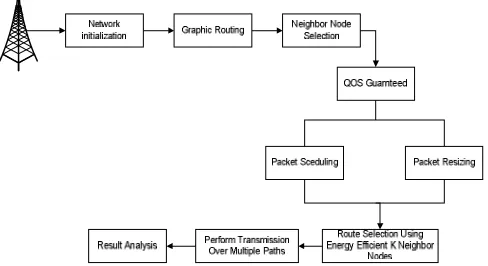
Fig 1: Block Diagram of illustrates the graphical representation
II.LITERATURESURVEY
Mathumathi et al [1] with the increasing level of wireless communication in today’s environment, people often required QOS for sharing their data between the nodes. For affording QOS to the user, many researchers proposed a very few methods to provide QoS guaranteed routing for hybrid networks, they strive to improve the network capacity and reliability but they evade constrain in QOS. For this problem our main objective of this paper is to improve the QOS and efficiency of routing approach with constrains over hybrid wireless data streaming using QOS_DARP protocol and MAR. This aims to develop the QOS based reliable architecture against the hybrid wireless routing issues. The system also aims at providing both proactive and reactive solutions for effective routing. The goal of this paper is to providing efficient dynamic routing management to deal the challenges of data transmission and data streaming in hybrid mobile environments.
Mithun Johny et al [3] As wi-fi interaction benefits reputation, significant research has been dedicated to assisting real-time transmission with strict Quality of Service (Quos) specifications for Wi-Fi programs. Simultaneously, a Wi-Fi multiple systems that integrate a mobile Wi-Fi ad hoc system (MANET) and a Wi-Fi facilities system have been proven to be a better alternative for the next creation Wi-Fi systems. By straight implementing source reservation-based Quos redirecting for MANETs, compounds networks inherit incorrect booking and competition condition problems in MANETs. How to assurance the Quos in multiple systems continues to be an open problem. In this document, we recommend a Quos-Oriented Allocated redirecting method (QOD) to improve the QoS support ability of hybrid networks. Using less transmitting trips and any cast transmitting features of the multiple systems, QOD transforms the bundle redirecting issue to a source arranging issue. QOD features five algorithms: 1) a QoS-guaranteed neighbor selection criteria to meet the transmitting wait need, 2) a distributed bundle arranging criteria to further reduce transmission wait, 3) a mobility-based section resizing criteria that adaptively adapts section size according to node flexibility in order to decrease transmitting time, 4) a traffic repetitive removal criteria to increase the transmitting throughput, and 5) a data redundancy elimination-based transmitting criteria to remove the repetitive information to further improve the transmitting QoS. Analytical and simulator results in accordance with the unique way-point design and the actual human flexibility design show that QOD can provide high QoS efficiency in terms of expense, transmitting wait, mobility-resilience, and scalability.
III.PROPOSEDSYSTEM
Below shows the network architecture of the proposed system, which consists of mobile nodes, source node and access points to access data and route the data to different destination using different paths.
Fig 2: Architecture of Proposed System
1. Routing Protocol:
Distributed packet scheduling module deals with the packet scheduling technique and the packet segmentation and resizing, takes place accordingly thus increasing the performance of the network.
Classification of Routing Protocols
a. Proactive routing
It is called as Table-driven Routing. This type of protocols maintains fresh lists of destinations and their routes by periodically distributing routing tables throughout the network.
2. Slow reaction on restructuring and failures. Examples of proactive algorithms are:
• Optimized Link State Routing Protocol (OLSR) • Optimized Link State Routing Protocol RFC 3626. • Babel RFC 6126
• Destination Sequence Distance Vector (DSDV)
b. Reactive routing
It is called as On-demand Routing. This type of protocols finds a route on demand by flooding the network with Route Request packets. The main disadvantages of such algorithms are:
1. High latency time in route finding. Neighbor Selection
Scheduling feasibility is the ability of a node to guarantee a packet to arrive at its destination within QoS requirements. As mentioned, when the QoS of the direct transmission between a source node and an AP cannot be guaranteed, the source node sends a request message to its neighbor nodes. In this algorithm, an intermediate node assigns the highest priority to the packet with the closest deadline and forwards the packet with the highest priority first.
c. Distributed Packet Scheduling
In this module the functions of selection of intermediate nodes that can guarantee the QoS of the packet transmission and assignment of traffic by the source nodes to the intermediate nodes to ensure their scheduling feasibility are carried out. In order to further reduce the stream transmission time, a distributed packet scheduling algorithm is proposed for packet routing.
This algorithm assigns earlier generated packets to forwarders with higher queuing delays and scheduling feasibility, while assigning more recently generated packets to forwarders with lower queuing delays and scheduling feasibility, so that the transmission delay of an entire packet stream can be reduced.
2. Excessive flooding can lead to network clogging. Examples of on-demand algorithms are:
• Ad hoc on-demand Distance Vector (AODV) (RFC3561) • Dynamic Source Routing (RFC 4728)
• Flow State in the Dynamic Source Routing • Power-Aware DSR-based
• Hybrid routing
This type of protocol combines the advantages of proactive and reactive routing. The routing is initially established with some proactively prospected routes and then serves the demand from additionally activated nodes through reactive flooding. The choice of one or the other method requires predetermination for typical cases.
The main disadvantages of such algorithms are:
1. Advantage depends on number of other nodes activated.
2. Reaction to traffic demand depends on gradient of traffic volume. Examples of hybrid algorithms are:
ZRP (Zone Routing Protocol) ZRP uses IARP as pro-active and IERP as reactive component.
d. Hierarchical routing protocols
With this type of protocol the choice of proactive and of reactive routing depends on the hierarchic level in which a node resides. The routing is initially established with some proactively prospected routes and then serves the demand from additionally activated nodes through reactive flooding on the lower levels. The choice for one or the other method requires proper attributation for respective levels. The main disadvantages of such algorithms are:
1. Advantage depends on depth of nesting and addressing scheme. 2. Reaction to traffic demand depends on meshing parameters. Examples of hierarchical routing algorithms are:
IV.RESULTS
2. Packet Resizing
The basic idea is that the larger size packets are assigned to lower mobility intermediate nodes and smaller size packets are assigned to higher mobility intermediate nodes, which increases the QoS-guaranteed packet transmissions. In a highly dynamic mobile wireless network, the transmission link between two node could is frequently broken down. The delay in the packet retransmission degrades the QoS of the transmission of a packet flow. On the other hand, a node in a highly dynamic network has higher probability to meet different mobile nodes and APs, which is beneficial to resource scheduling.
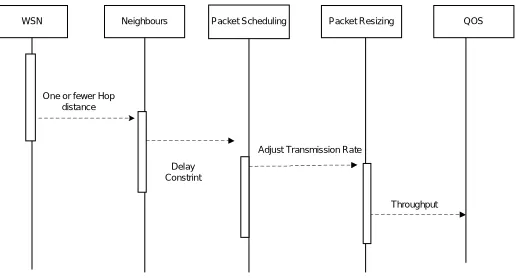
WSN Neighbours Packet Scheduling Packet Resizing QOS
One or fewer Hop distance
Delay Constrint
Adjust Transmission Rate
Throughput
Fig 3: Sequence Diagram
(C) (d)
(e)
(g)
(i)
(h)
(j)
(k)
(m)
(n)
(q) (r)
Figure4: (a) Service Provider login; (b) Opening file for Browsing (c) Opening file for Browsing; (d) Browsing file by Service Provider; (e) Checking the availability of file in Router; (f) Sending file by Service Provider to Router; (g) Communication between networks via Access points in Router; (h) Node details; (i) Router files details; (j) Registered User details ; (j) QOS Manager with node path and delay; QoS details; (k) File received by End User (Receiver); (l)Attacker; (m) Node details after attack by Attacker; (n) Resending same file from Service Provider to Router after attack by Attacker; Resending file from Router to QOS-Manager after attacking the node ; (o) Selected Node path after attack by Attacker; (p) Time delay after attack; : Selected Node path after attack by Attacker(q); Time delay after attack(r)
Figure 2 represents, In this module, the service provider should register before giving any service to receiver (Figure 7.1 below). After registration, the concerned service provider has to login by authorized username and password. After login, the service provider will do some tasks like browse, send and check the file availability in a router. Before sending any file to the receiver, the service provider has to check whether the file is available or not in a router. If the file is not available, then the service provider has to browse a file and send to the particular receivers (A, B, C, and D). After sending a file, the service provider will get response.
V.CONCLUSION
In this paper concluded Hybrid wireless networks that combine MANETs and infrastructure wireless networks have proven to be a better network structure for the next generation networks. However, little effort has been devoted to supporting QoS routing in hybrid networks. In this current thesis, a QoS-oriented distributed routing protocol (QOD) to enhance the QoS support capabilities of hybrid networks in a highly dynamic scenario is implemented. Specifically, QOD incorporates five algorithms. The QoS-guaranteed neighbor selection algorithm chooses qualified neighbors for packet forwarding to meet the transmission delay. The distributed packet scheduling algorithm to further reduce transmission delay. Packet resizing algorithm adjusts packet size to reduce transmission time and assigns smaller packets to nodes with faster mobility to guarantee the QoS routing in a highly changing environment, . In this current thesis, a QoS-oriented distributed routing protocol (QOD) to enhance the QoS support capabilities of hybrid networks in a highly dynamic scenario is implemented. Specifically, QOD incorporates five algorithms. The QoS-guaranteed neighbor selection algorithm chooses qualified neighbors for packet forwarding to meet the transmission delay. The distributed packet scheduling algorithm to further reduce transmission delay. Packet resizing algorithm adjusts packet size to reduce transmission time and assigns smaller packets to nodes with faster mobility to guarantee the QoS routing in a highly changing environment. The traffic redundant elimination-based transmission algorithm can further increase the transmission throughput. Data redundancy elimination-based transmission algorithm to eliminate the redundant data to further improve the transmission QoS.
REFERENCES
[1] Mathumathi1, Manjusha.T.M, “A QoS-oriented distributed routing protocol for hybrid wireless networks”, International Journal of Advanced Research in Computer and Communication Engineering Vol. 4, Issue 1, 2015.
[2] Ms.Nanthini.S, Dr.S.Rajalakshmi, “An Enhanced QoS-Oriented Distributed RoutingProtocol for Hybrid Wireless Networks”, International Journal on Engineering Technology and Sciences, Vol 1 Issue 8, 2014.
[3] Mithun Johny, Renju Samuel, “Enhanced QOS-Oriented Distributed Routing Protocol for Hybrid Wireless Networks”, International Journal of Science and Research (IJSR).
[4] S Ramya, B Lakshmi, “QoS Oriented Distributed Routing Protocol For Hybrid Wireless Networks”, Vol 2 Issue 4, 2015.
[5] S.Gowthami, Dr.V.Krishnaveni, R.Saveetha, “Qod-Sba: A Qos Oriented Distributed Routing Protocol for Hybrid Wireless Networks With Qualified Neighbour Node Selection”, Vol 3, Issue 11, 2015.
[6] S.Aakasham, S.R.Mugunthan, “A Secure QOS Distributed Routing Protocol for Hybrid Wireless Networks”, Volume 17, Issue 2, PP 50-58, 2015.
[7] Dr. P.Radha, K.S.Malarvizhi, “A Qos-Oriented Distributed Routing Protocol for Hybrid Wireless Networks With Qualified Neighbor Node Selection”, International Research Journal of Engineering and Technology (IRJET), Volume: 02 Issue: 06, 2015.
[8] Kishori Dharurkar, D.R Patil, “Study of Routing Algorithms on Hybrid Wireless Networks”, International Journal of Advanced Research in Computer Science and Software Engineering, Volume 5, Issue 7, 2015.