IJPSR (2013), Vol. 4, Issue 4 (Research Article)
Received on 17 December, 2012; received in revised form, 25 January, 2013; accepted, 21 March, 2013
DEVELOPMENT AND VALIDATION OF UV METHOD OF TEMOZOLOMIDE IN BULK AND CAPSULE FORMULATION
A. Abdul Razak*, Sk. Masthanamma, B. Omshanthi, V. Suresh and P. Obulamma
Department of Pharmaceutical Analysis, Sree Vidyanikethan College of Pharmacy, Tirupati, Andhra Pradesh, India
ABSTRACT: An UV spectrophotometric method for the quantitative determination of Temozolomide (TMZ) in bulk and capsule was developed in present work. The parameters linearity, precision, accuracy, limit of detection and limit of quantitation were studied according to International Conference on Harmonization guidelines. UV spectroscopic determination was carried out at an absorption maximum of 328 nm using 0.1N Hydrochloric acid as solvent. In the UV spectroscopic method linearity over the concentration range of TMZ was found to be 2-18 µg/ml with a correlation coefficient 0.999. The limit of detection and limit of quantification were found to be 0.5271 and 1.6454 mg/ml respectively. Results of the analysis were validated statistically and by recovery studies. The proposed method is simple, rapid, precise, accurate and reliable and can be used for the routine quantitative analysis of TMZ in bulk and pharmaceutical formulation.
INTRODUCTION: Temozolomide (3,4-dihydro-3-methyl-4-oxoimidazo[5,1-d]-as-tetrazine-8-carbo xamide, Fig. 1) is an alkylating agent of the Imidazotetrazine derivatives that exhibits broad-spectrum antitumor activity against murine tumors1. It is a 3-methyl analogue of mitozolomide [8-carbamoyl-3-(2-chloroethyl)-imidazo-[5, 1-d]-1, 2, 3, 5-tetrazin-4-(3H)-one] which was developed as a potential alternative to dacarbazine, 5-(3-dimethyltriazen-1-yl)-imidazo-4-carboxamide
(DTIC) in view of its demonstrated antitumor activity and better safety profile in preclinical assessments.
QUICK RESPONSE CODE
IJPSR: ICV (2011)- 5.07
Article can be accessed online on: www.ijpsr.com
Both and DTIC are cytotoxic alkylating agents. It has been suggested that they both exert their antitumor activity through the linear triazine, 5-(3- methyltriazen-1-yl)-imidazo-4-carboxamide 5-6. DTIC is metabolically converted to MTIC in the liver (N-demethylation), whereas temozolomide undergoes chemical degradation to MTIC at physiological pH 6. The cytotoxicity of MTIC is thought to be primarily due to alkylation at the O6 and N7 positions of guanine 7-10. In this process, MTIC itself is converted to 5(4)-aminoimidazole-4(5)-carboxamide.
FIG. 1: CHEMICAL STRUCTURE OF TEMOZOLOMIDE
Keywords:
Temozolomide, 0.1N Hcl, Estimation, Capsules, UV spectroscopy
Correspondence to Author: A. Abdul Razak
Department of Pharmaceutical Analysis, Sree Vidyanikethan College of Pharmacy, Tirupati, Andhra Pradesh, India
Literature review reveal there is reported a HPLC method for the analysis MTIC in human plasma 11 and stability study of Temozolomide using capillary electrophoresis 12. However, it has the disadvantage of being time-consuming. All these studies have further emphasized the need to perform rapid and sensitive quality-control analysis of pharmaceutical formulations containing Temozolomide. As these methods are expensive, we have made an attempt to develop a more precise, simple and economical spectrophotometric method with greater precision, accuracy and sensitivity for the analysis of Temozolomide in bulk and dosage forms.
EXPERIMENTAL SECTION
Apparatus:
Digital balance: Acculab (ALC 210.4) Sonicator: Eneritech (Ultra Sonicator) Photo stability chamber: Thermolab Hot air oven: Hicon
A double beam UV-Visible spectrophotometer (Shimadzu-1800) with UV probe.
Materials, reagents and chemicals: Temozolomide bulk drug were obtained as gift sample Dr. Reddys labs Pvt. Ltd. Hyd, Capsule formulation (Temolon 5, celon) containing 100 mg obtained from local pharmacy. Hydrochloric acid, double distilled water was used throughout the analysis. All other chemicals and solvents used were of Analytical grade.
Development of Method:
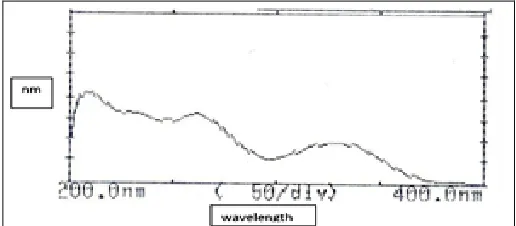
Selection of solvent: Solubility of drug was performed in several solvents like ethanol, methanol, Hcl and some buffers and then UV-spectra of drugs in these solutions were recorded. Absorbances of drug were higher at distinct λmax in 0.1N HCl and hence 0.1N HCl was selected as solvent for further studies.
FIG. 2: U.V. SPECTRUM OF TEMOZOLOMIDE DRUG (200-400nm)
Preparation of the standard stock and calibration curve: Accurately weighed quantity of 100 mg Temozolomide reference standard was transferred into 100 ml volumetric flask and dissolved and diluted up to the mark with 0.1N Hydrochloric acid to give a stock solution having strength 1mg/ml. This stock solution used for further dilutions and by using 0.1N HCl as solvent for estimation.
[image:2.612.318.575.285.434.2]The absorption maxima of temozolomide were found to be 328nm (Fig.1). Working standard solutions for the drug having concentration 2, 4, 6, 8 and up to 18µg/ml was prepared with 0.1N Hcl from the stock solution. The absorbance of resulting solutions were measured at wavelength of 328nm against solvent blank and a calibration curve was plotted to get the linearity and regression equation.
FIG. 3: CALIBRATION CURVE OF TEMOZOLOMIDE Analysis of marketed formulation: Remove the contents of 10 capsules and weigh a quantity of powder equivalent to 100mg of Temozolomide and transfer into a 100ml standard flask. And dissolve the formulation in 0.1N hydrochloric acid solvent and allowed to sonicate for 15–20 min. Then pipette out 10ml of solution and make up to 100ml leads to 10µg/ml concentration solution. The absorbance was measured against 0.1N hydrochloric acid solvent as blank at 328 nm. The drug content was estimated by using the standard graph.
TABLE 1: ANALYSIS OF CAPSULE FORMULATIONS OF TEMOZOLOMIDE
Drug Label claim mg/cap
Amount
found %Purity
Temozolomide 100 9.7mg 97 %w/v
[image:2.612.42.300.610.723.2] [image:2.612.313.577.635.702.2]Validation of the proposed method: The proposed method was validated for the following parameters.
Linearity and range: The absorbances of appropriate dilutions of standard stock solutions 2-18 μg/ mL were measured as per the developed method to confirm the linearity. The calibration curve for Temozolomide was constructed by plotting the absorbance temozolomide (Y) against concentration (X) and linearity was evaluated by linear regression equation. The slope, intercept and correlation coefficient values were recorded.
Accuracy: Accuracy is the percentage of analyte recovered by assay from known added amount. Data
from nine determinations over three concentration levels covering the specified range were obtained
Recovery studies: In order to check the accuracy and reproducibility of the proposed method, recovery studies were conducted. Recovery studies are done spiking method in this method the test sample having the concentration of 10µg/ml. to this the standard drug is spiked by adding into the test solution. Concentrations of 8, 10 and 12µg/ml are added to the sample solutions and the absorbance of the three spiked concentrations was taken. From this absorbance we can determine the amount of drug that can be recovered by the proposed method.
TABLE 2: RECOVERY STUDIES OF TEMOZOLOMIDE Test
(µg/ml)
Amount of standard
drug added (µg/ml) %Recovery Standard deviation %RSD
10
8 10 12
99.08 99.73 98.39
0.301 0.331 0.548
0.303 0.331 0.546
Precision: Precision was determined by studying the repeatability and intermediate precision. The standard deviation, coefficient of variance and standard error were calculated for the drug.
Inter-day and Intra-day precision: The intra-day concentration of the drug was calculated on the same day at an interval of two hour. Whereas the inter day concentration of drug was calculated on three different days within the laboratory conditions.
TABLE 3: TEMOZOLOMIDE INTRA-DAY AND INTER-DAY PRECISION Temozolomide
Concentration (µg/ml)
Absorbance %RSD
Intra Day Inter Day Intra Day Inter Day
10
0.229 0.225 0.223
0.240 0.232 0.238
1.35 1.761
Molar Absorptivity: This is the important factor for determining the absorptive property of a drug in 1 mole concentration. And this value can be useful in determining the absorbance of drug in molar concentrations. This for identifying the shifts of the maximum absorbance of the drug during the method development and the results are given in the table 1.
Limit of detection (LOD) and Limit of Quantitation (LOQ): Sensitivity of UV methods were determined from limit of detection (LOD) and limit of quantitation (LOQ). The LOD and LOQ of Temozolomide by the proposed method were determined using calibration standards. LOD and LOQ were calculated as 3.3σ /S and 10σ/S, respectively, where S is the slope of the calibration curve and σ is the standard deviation of response. The results are given in table 4.
RESULTS AND DISCUSSION: The
The recovery studies showed proposed method is accurate and reproducible. The results of recovery study revealed that any small change in the drug concentration in the solution could be accurately determined by the proposed method. Accuracy, reproducibility and precision of the proposed methods were further confirmed by percent recovery values, which were close to 100 with low values of standard deviation as shown in Table 3. Repeatability results indicated the precision under the same operating conditions over a short interval time and inter-assay precision. Intermediate precision study expresses within laboratory variation in different days. In both intra and inter-day precision study for the method RSD is not more than 2.0 indicate good intermediate precision. The low values of LOD and LOQ, 0.5271 μg mL-1 and 1.6454 μg mL-1 for Temozolomide indicated good sensitivity of proposed method (Table 4).
Table 4: METHOD VALIDATION PARAMETERS OF TEMOZOLOMIDE
Parameters Results
λmax 328 nm
Beer’s law limit 2-25 µg/ml Molar absorptivity 66.70994 g|l Regression equation (Y = mx + c) y = 0.01195x +
0.00406
Slope (m) 0.01195
Intercept (c) 0.00406 Correlation coefficient (r) 0.999 Precision
(%RSD)
Intra-day precision 1.306 Inter-day precision 1.76 Accuracy(%recovery) 99.04 LOD Value (μg mL-1) 0.527 μg mL-1
LOQ Value (μg mL-1) 1.6454 μg mL-1
CONCLUSION: The results and the statistical parameters demonstrate that the proposed UV spectrophotometric method is simple, rapid, specific, accurate and precise. Thus the developed methods can be easily applied for the estimation of Temozolomide in bulk and capsule dosage form.
ACKNOWLEDGEMENT: The authors are
thankful to Dr. Reddys labs pvt .ltd .Hyd, for providing sample of drug and also to the Sree Vidyanikethan College of Pharmacy, Tirupati for providing facilities to carry out the work, and also for their excellent guidance, supervision, continual technical support and invaluable encouragement in the laboratory.
REFERENCES
1. Stevens MFG, Hickman, JA, Stone R, Gibson NW, Baig GU, Lunt E, Newton CG: Antitumor imidazotetrazines. Part 31. The synthesis of isotopically labelled temozolomide and a multinuclear (1H, 13C, 15N) magnetic resonance investigation of temozolomide and mitozolomide. J. Med. Chem 1984, 27 -196
2. Newlands ES, Blackledge JA, Slack C, Goddard CJ, Brindley L, Holden MFG : Malignant gliomas & its treatment with chemotherapeutic agent Temozolomide .United Kingdom Children's Cancer Study Group Rep. 69 (1985) 801
3. Blackledge G, Roberts JT, Kaye S, Taylor R, Williams J, De Stavola B, Uscinska B: Phase I trial of temozolomide Bjc 1989 (CCRG 81045: M&B 39831: NSC 362856)
4. Harding M F G, Northcott D, Smyth J, Stuart NSA, Green JAE, Newlands : Phase II evaluation of mitozolomide in ovarian cancer., Br. J. Cancer, 1988 57 - 113.
5. Stevens MFG, Hickman JA, Langdon SP, Chubb D, Vickers L, Stone R, Baig G, Goddard C, Gibson NW, Slack JA, Newton C, Lunt E, Fizames C, Lavelle F, Cancer Res. 1987, 47 5846
6. Tsang LLH, Quarterman CP, Gescher A, Slack JA: Cancer Chemother.Pharmacol. 1991, 27, 342
7. Gibson NW, Hickman JA, Erickson LC : Antitumor Imidazotetrazine -XI: Effect of 8-carbamoyl-3-methylimidazo [5,1-d]-1,2,3,5-tetrazin-4(3H)-one [CCRG 81045; M and B 39831 NSC 362856] on poly(ADP-ribose) metabolism.bjc Cancer Res. 1984, 44, 1772
8. Hartley JA, Gibson NW, Kohn KW, Mattes WB : DNA sequence selectivity of guanine-N7 alkylation by three antitumor chloroethylating agents Cancer Res. 1986, 46, 1943
9. Meer L, Janzer RC, kleihues P, Kolar GF: Carcinogenicity of the antineoplastic agent, 5-(3, 3-dimethyl-1-triazeno)-imidazole-4-carboxamide, and its metabolites in rats. Pharmacol Biochem. 1986, 35, 3243
10. Skibba JL, Bryan GT : In vivo metabolism and reaction with DNA of the cytostatic agent, 5-(3,3-dimethyl-1-triazeno)imidazole-4-carboxamide (DTIC) Toxicol. Appl.1971,Pharmacol. 18,707 11. Vasanth kumar K, Anusha Reddy B, Sandeep K,
Kiran Kumar c, Krishna G : New, Simple, Precise, Rapid and Accurate Temozolomide RP-HPLC method has been developed and validated by using low cost materials to estimation of these Temozolomide in dosage forms. Int. J.Ph.Sci., 2012, 4(1):-1776-1782
solid-phase extraction. Journal of Chromatography B: Biomedical Sciences and Applications. 1995, Volume 667, Issue 2, Pages 291-300,F
13. Hong Kim, Paul Likhari, Donald Parker, Paul Statkevich, Aliceann Marco, Chin-Chung Lin : High-performance liquid chromatographic analysis and stability of anti-tumor agent temozolomide in human plasma. Journal of Pharmaceutical and Biomedical Analysis. 2001 ,Volume 24, Issue 3, Pages 461-468
14. Hong Ki Kim, Chin-chung Lin, Donald Parker, John Veals, Josephine Lim, Paul Likhari, Paul Statkevich, Aliceann Marco, Amin A Nomeir : High-performance liquid chromatographic determination and stability of 5-(3-methyltriazen-1-yl)-imidazo-4-carboximide, the biologically active
product of the antitumor agent temozolomide, in human plasma. Journal of Chromatography B: Biomedical Sciences and Applications, Volume 703, Issues 1–2, 5 December 1997, Pages 225-233 15. Melinda Andrasi, Rose Bustos, Attila Gaspar,
Frank A. Gomez, Almos Klekner: Analysis and stability study of temozolomide using capillary electrophoresis. Journal of Chromatography B, Volume 878, Issue 21, 1 July 2010, Pages 1801-1808
16. Melinda Andrási, Brigitta Törzsök, Álmos Klekner, Attila Gáspár : Determination of temozolomide in serum and brain tumor with micellar electrokinetic capillary chromatography. Journal of Chromatography B, Volume 879, Issue 23, 1 August 2011, Pages 2229-2233.
How to cite this article: