R E S E A R C H A R T I C L E
Open Access
Comparing different supervised machine
learning algorithms for disease prediction
Shahadat Uddin
1*, Arif Khan
1,2, Md Ekramul Hossain
1and Mohammad Ali Moni
3Abstract
Background:Supervised machine learning algorithms have been a dominant method in the data mining field. Disease prediction using health data has recently shown a potential application area for these methods. This study aims to identify the key trends among different types of supervised machine learning algorithms, and their performance and usage for disease risk prediction.
Methods:In this study, extensive research efforts were made to identify those studies that applied more than one supervised machine learning algorithm on single disease prediction. Two databases (i.e., Scopus and PubMed) were searched for different types of search items. Thus, we selected 48 articles in total for the comparison among variants supervised machine learning algorithms for disease prediction.
Results:We found that the Support Vector Machine (SVM) algorithm is applied most frequently (in 29 studies) followed by the Naïve Bayes algorithm (in 23 studies). However, the Random Forest (RF) algorithm showed superior accuracy comparatively. Of the 17 studies where it was applied, RF showed the highest accuracy in 9 of them, i.e., 53%. This was followed by SVM which topped in 41% of the studies it was considered.
Conclusion:This study provides a wide overview of the relative performance of different variants of supervised machine learning algorithms for disease prediction. This important information of relative performance can be used to aid researchers in the selection of an appropriate supervised machine learning algorithm for their studies.
Keywords:Machine learning, Supervised machine learning algorithm, Medical data, Disease prediction
Background
Machine learning algorithms employ a variety of statis-tical, probabilistic and optimisation methods to learn from past experience and detect useful patterns from large, unstructured and complex datasets [1]. These al-gorithms have a wide range of applications, including automated text categorisation [2], network intrusion de-tection [3], junk e-mail filtering [4], dede-tection of credit card fraud [5], customer purchase behaviour detection [6], optimising manufacturing process [7] and disease modelling [8]. Most of these applications have been im-plemented using supervised variants [4,5,8] of the ma-chine learning algorithms rather than unsupervised ones. In the supervised variant, a prediction model is devel-oped by learning a dataset where the label is known and
accordingly the outcome of unlabelled examples can be predicted [9].
The scope of this research is primarily on the perform-ance analysis of disease prediction approaches using
dif-ferent variants of supervised machine learning
algorithms. Disease prediction and in a broader context, medical informatics, have recently gained significant at-tention from the data science research community in re-cent years. This is primarily due to the wide adaptation of computer-based technology into the health sector in different forms (e.g., electronic health records and ad-ministrative data) and subsequent availability of large health databases for researchers. These electronic data are being utilised in a wide range of healthcare research areas such as the analysis of healthcare utilisation [10], measuring performance of a hospital care network [11], exploring patterns and cost of care [12], developing dis-ease risk prediction model [13,14], chronic disease sur-veillance [15], and comparing disease prevalence and
© The Author(s). 2019Open Access This article is distributed under the terms of the Creative Commons Attribution 4.0 International License (http://creativecommons.org/licenses/by/4.0/), which permits unrestricted use, distribution, and reproduction in any medium, provided you give appropriate credit to the original author(s) and the source, provide a link to the Creative Commons license, and indicate if changes were made. The Creative Commons Public Domain Dedication waiver (http://creativecommons.org/publicdomain/zero/1.0/) applies to the data made available in this article, unless otherwise stated.
* Correspondence:[email protected]
drug outcomes [16]. Our research focuses on the disease risk prediction models involving machine learning algo-rithms (e.g., support vector machine, logistic regression and artificial neural network), specifically - supervised learning algorithms. Models based on these algorithms use labelled training data of patients for training [8, 17, 18]. For the test set, patients are classified into several groups such as low risk and high risk.
Given the growing applicability and effectiveness of supervised machine learning algorithms on predictive disease modelling, the breadth of research still seems progressing. Specifically, we found little research that makes a comprehensive review of published articles employing different supervised learning algorithms for disease prediction. Therefore, this research aims to identify key trends among different types of super-vised machine learning algorithms, their performance accuracies and the types of diseases being studied. In addition, the advantages and limitations of different supervised machine learning algorithms are sum-marised. The results of this study will help the scholars to better understand current trends and hot-spots of disease prediction models using supervised machine learning algorithms and formulate their re-search goals accordingly.
In making comparisons among different supervised machine learning algorithms, this study reviewed, by following the PRISMA guidelines [19], existing studies from the literature that used such algorithms for dis-ease prediction. More specifically, this article consid-ered only those studies that used more than one supervised machine learning algorithm for a single disease prediction in the same research setting. This made the principal contribution of this study (i.e.,
comparison among different supervised machine
learning algorithms) more accurate and comprehen-sive since the comparison of the performance of a single algorithm across different study settings can be biased and generate erroneous results [20].
Traditionally, standard statistical methods and doc-tor’s intuition, knowledge and experience had been used for prognosis and disease risk prediction. This practice often leads to unwanted biases, errors and high expenses, and negatively affects the quality of service provided to patients [21]. With the increasing availabil-ity of electronic health data, more robust and advanced computational approaches such as machine learning have become more practical to apply and explore in disease prediction area. In the literature, most of the re-lated studies utilised one or more machine learning al-gorithms for a particular disease prediction. For this reason, the performance comparison of different super-vised machine learning algorithms for disease predic-tion is the primary focus of this study.
In the following sections, we discuss different variants of supervised machine learning algorithm, followed by presenting the methods of this study. In the subsequent sections, we present the results and discussion of the study.
Methods
Supervised machine learning algorithm
At its most basic sense, machine learning uses pro-grammed algorithms that learn and optimise their oper-ations by analysing input data to make predictions within an acceptable range. With the feeding of new data, these algorithms tend to make more accurate pre-dictions. Although there are some variations of how to group machine learning algorithms they can be divided into three broad categories according to their purposes and the way the underlying machine is being taught. These three categories are: supervised, unsupervised and semi-supervised.
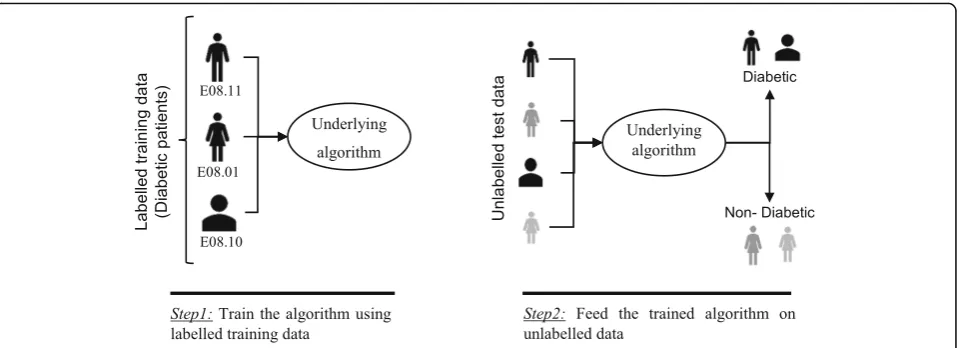
In supervised machine learning algorithms, a labelled training dataset is used first to train the underlying algo-rithm. This trained algorithm is then fed on the un-labelled test dataset to categorise them into similar groups. Using an abstract dataset for three diabetic pa-tients, Fig.1 shows an illustration about how supervised machine learning algorithms work to categorise diabetic and non-diabetic patients. Supervised learning algo-rithms suit well with two types of problems: classifica-tion problems; and regression problems. In classificaclassifica-tion problems, the underlying output variable is discrete. This variable is categorised into different groups or categories, such as‘red’or‘black’, or it could be‘diabetic’and ‘non-diabetic’. The corresponding output variable is a real value in regression problems, such as the risk of devel-oping cardiovascular disease for an individual. In the fol-lowing subsections, we briefly describe the commonly used supervised machine learning algorithms for disease prediction.
Logistic regression
Logistic regression (LR) is a powerful and well-established method for supervised classification [22]. It can be considered as an extension of ordinary re-gression and can model only a dichotomous variable which usually represents the occurrence or non-occurrence of an event. LR helps in finding the prob-ability that a new instance belongs to a certain class. Since it is a probability, the outcome lies between 0 and 1. Therefore, to use the LR as a binary classifier, a threshold needs to be assigned to differentiate two classes. For example, a probability value higher than 0.50 for an input instance will classify it as ‘class A’;
otherwise, ‘class B’. The LR model can be generalised
values. This generalised version of LR is known as the multinomial logistic regression.
Support vector machine
Support vector machine (SVM) algorithm can classify both linear and non-linear data. It first maps each data item into an n-dimensional feature space where
n is the number of features. It then identifies the
hy-perplane that separates the data items into two clas-ses while maximising the marginal distance for both classes and minimising the classification errors [23]. The marginal distance for a class is the distance be-tween the decision hyperplane and its nearest in-stance which is a member of that class. More formally, each data point is plotted first as a point in
an n-dimension space (where n is the number of
fea-tures) with the value of each feature being the value of a specific coordinate. To perform the classification, we then need to find the hyperplane that
differenti-ates the two classes by the maximum margin. Figure2
provides a simplified illustration of an SVM classifier.
Decision tree
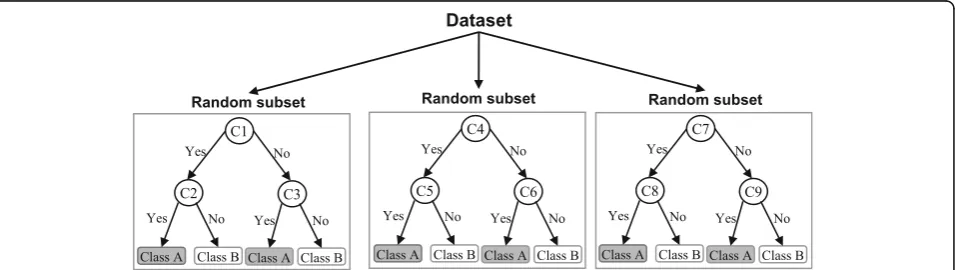
Decision tree (DT) is one of the earliest and promin-ent machine learning algorithms. A decision tree models the decision logics i.e., tests and corresponds outcomes for classifying data items into a tree-like structure. The nodes of a DT tree normally have mul-tiple levels where the first or top-most node is called the root node. All internal nodes (i.e., nodes having at least one child) represent tests on input variables or attributes. Depending on the test outcome, the classification algorithm branches towards the appro-priate child node where the process of test and
branching repeats until it reaches the leaf node [24]. The leaf or terminal nodes correspond to the decision outcomes. DTs have been found easy to interpret and quick to learn, and are a common component to many medical diagnostic protocols [25]. When tra-versing the tree for the classification of a sample, the outcomes of all tests at each node along the path will provide sufficient information to conjecture about its class. An illustration of an DT with its elements and rules is depicted in Fig. 3.
Random forest
A random forest (RF) is an ensemble classifier and consisting of many DTs similar to the way a forest is a collection of many trees [26]. DTs that are grown very deep often cause overfitting of the train-ing data, resulttrain-ing a high variation in classification Fig. 1An illustration of how supervised machine learning algorithms work to categorise diabetic and non-diabetic patients based on
abstract data
outcome for a small change in the input data. They are very sensitive to their training data, which makes them error-prone to the test dataset. The different DTs of an RF are trained using the different parts of the training dataset. To classify a new sample, the input vector of that sample is required to pass down with each DT of the forest. Each DT then considers a different part of that input vector and gives a sification outcome. The forest then chooses the
clas-sification of having the most ‘votes’ (for discrete
classification outcome) or the average of all trees in the forest (for numeric classification outcome). Since the RF algorithm considers the outcomes from many different DTs, it can reduce the variance resulted from the consideration of a single DT for the same
dataset. Figure 4 shows an illustration of the RF
algorithm.
Naïve Bayes
Naïve Bayes (NB) is a classification technique based on
the Bayes’ theorem [27]. This theorem can describe the
probability of an event based on the prior knowledge of conditions related to that event. This classifier assumes that a particular feature in a class is not directly related to any other feature although features for that class could have interdependence among themselves [28]. By considering the task of classifying a new object (white circle) to either ‘green’ class or ‘red’ class, Fig. 5 pro-vides an illustration about how the NB technique works. According to this figure, it is reasonable to be-lieve that any new object is twice as likely to have
‘green’ membership rather than ‘red’ since there are
twice as many ‘green’ objects (40) as ‘red’. In the
Bayesian analysis, this belief is known as the prior
probability. Therefore, the prior probabilities of
‘green’ and ‘red’ are 0.67 (40 ÷ 60) and 0.33 (20 ÷
60), respectively. Now to classify the ‘white’ object,
we need to draw a circle around this object which encompasses several points (to be chosen prior) irre-spective of their class labels. Four points (three ‘red’
and one ‘green) were considered in this figure. Thus,
the likelihood of ‘white’ given ‘green’ is 0.025 (1 ÷ 40)
and the likelihood of ‘white’ given ‘red’ is 0.15 (3 ÷
20). Although the prior probability indicates that the
new ‘white’ object is more likely to have‘green’
mem-bership, the likelihood shows that it is more likely to be in the ‘red’ class. In the Bayesian analysis, the final classifier is produced by combining both sources of information (i.e., prior probability and likelihood
value). The ‘multiplication’ function is used to
com-bine these two types of information and the product is called the ‘posterior’ probability. Finally, the poster-ior probability of ‘white’ being ‘green’ is 0.017 (0.67 ×
0.025) and the posterior probability of ‘white’ being
‘red’ is 0.049 (0.33 × 0.15). Thus, the new ‘white’
ob-ject should be classified as a member of the ‘red’ class according to the NB technique.
Fig. 3An illustration of a Decision tree. Each variable (C1, C2, and C3) is represented by a circle and the decision outcomes (Class A and Class B) are shown by rectangles. In order to successfully classify a sample to a class, each branch is labelled with either‘True’or ‘False’based on the outcome value from the test of its ancestor node
K-nearest neighbour
The K-nearest neighbour (KNN) algorithm is one of the simplest and earliest classification algorithms [29]. It can be thought a simpler version of an NB classifier. Unlike the NB technique, the KNN algorithm does not require to consider probability values. The ‘K’ is the KNN algo-rithm is the number of nearest neighbours considered
to take ‘vote’ from. The selection of different values
for ‘K’ can generate different classification results for
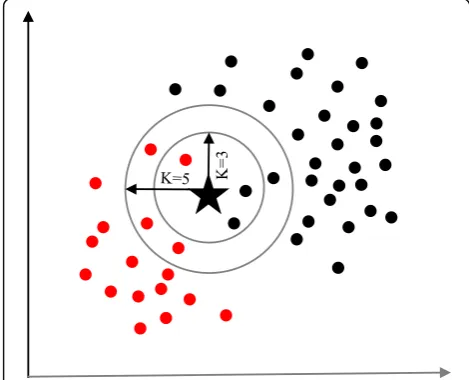
the same sample object. Figure 6 shows an illustration
of how the KNN works to classify a new object. For
K = 3, the new object (star) is classified as ‘black’; however, it has been classified as ‘red’ when K = 5.
Artificial neural network
Artificial neural networks (ANNs) are a set of ma-chine learning algorithms which are inspired by the functioning of the neural networks of human brain. They were first proposed by McCulloch and Pitts [30] and later popularised by the works of Rumelhart et al. in the 1980s [31].. In the biological brain, neu-rons are connected to each other through multiple axon junctions forming a graph like architecture. These interconnections can be rewired (e.g., through neuroplasticity) that helps to adapt, process and store information. Likewise, ANN algorithms can be repre-sented as an interconnected group of nodes. The out-put of one node goes as inout-put to another node for subsequent processing according to the interconnec-tion. Nodes are normally grouped into a matrix called layer depending on the transformation they perform. Apart from the input and output layer, there can be one or more hidden layers in an ANN framework. Nodes and edges have weights that enable to adjust signal strengths of communication which can be amp-lified or weakened through repeated training. Based on the training and subsequent adaption of the matri-ces, node and edge weights, ANNs can make a
pre-diction for the test data. Figure 7 shows an
illustration of an ANN (with two hidden layers) with its interconnected group of nodes.
Data source and data extraction
Extensive research efforts were made to identify arti-cles employing more than one supervised machine learning algorithm for disease prediction. Two data-bases were searched (October 2018): Scopus and PubMed. Scopus is an online bibliometric database developed by Elsevier. It has been chosen because of its high level of accuracy and consistency [32]. PubMed is a free publication search engine and incor-porates citation information mostly for biomedical Fig. 5An illustration of the Naïve Bayes algorithm. The‘white’circle
is the new sample instance which needs to be classified either to ‘red’class or‘green’class
Fig. 6A simplified illustration of the K-nearest neighbour algorithm. When K = 3, the sample object (‘star’) is classified as‘black’since it gets more‘vote’from the‘black’class. However, for K = 5 the same sample object is classified as‘red’since it now gets more‘vote’from the‘red’class
and life science literature. It comprises more than 28 million citations from MEDLINE, life science journals and online books [33]. MEDLINE is a bibliographic database that includes bibliographic information for articles from academic journals covering medicine, nursing, pharmacy, dentistry, veterinary medicine, and health care [33].
A comprehensive search strategy was followed to find out all related articles. The search terms that were used in this search strategy were:
– “disease prediction”AND“machine learning”;
– “disease prediction”AND“data mining”;
– “disease risk prediction”AND“machine learning”; and
– “disease risk prediction”AND“data mining”.
In scientific literature, the generic name of
“ma-chine learning” is often used for both “supervised”
and “unsupervised” machine learning algorithms. On
the other side, there is a close relationship between
the terms “machine learning” and “data mining”, with
the latter is commonly used for the former one [34].
For these reasons, we used both “machine learning”
and “data mining” in the search terms although the
focus of this study is on the supervised machine learning algorithm. The four search items were then considered to launch searches on the titles, abstracts and keywords of an article for both Scopus and PubMed. This resulted in 305 and 83 articles from Scopus and PubMed, respectively. After combining these two lists of articles and removing the articles written in languages other than English, we found 336 unique articles.
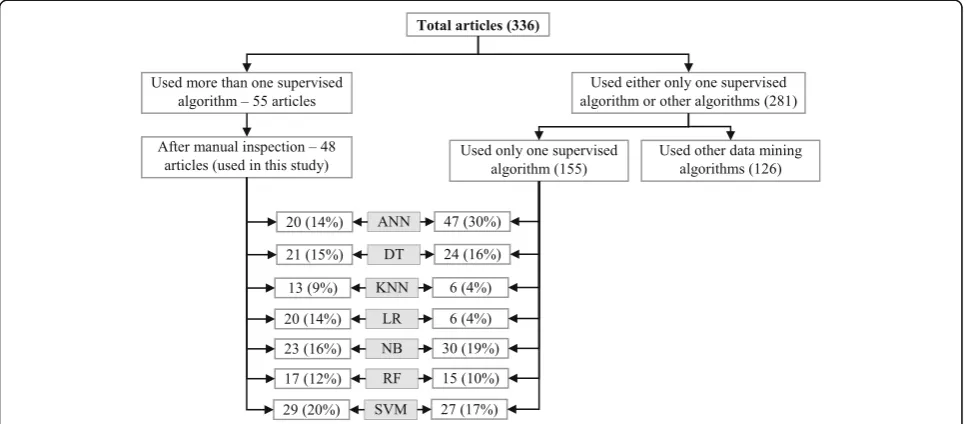
Since the aim of this study was to compare the per-formance of different supervised machine learning al-gorithms, the next step was to select the articles from these 336 which used more than one supervised ma-chine learning algorithm for disease prediction. For this reason, we wrote a computer program using Py-thon programming language [35] which checked the presence of the name of more than one supervised machine learning algorithm in the title, abstract and keyword list of each of 336 articles. It found 55 arti-cles that used more than one supervised machine learning algorithm for the prediction of different dis-eases. Out of the remaining 281 articles, only 155 used one of the seven supervised machine learning al-gorithms considered in this study. The rest 126 used either other machine learning algorithms (e.g.,
un-supervised or semi-supervised) or data mining
methods other than machine learning ones. ANN was found most frequently (30.32%) in the 155 articles, followed by the Naïve Bayes (19.35%).
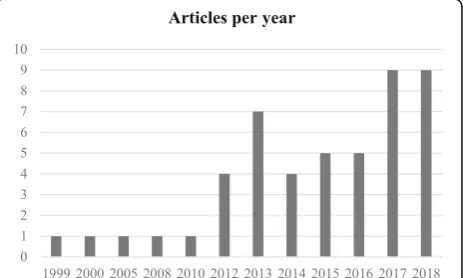
The next step is the manual inspection of all recov-ered articles. We noticed that four groups of authors reported their study results in two publication outlets (i.e., book chapter, conference and journal) using the same or different titles. For these four publications, we considered the most recent one. We further ex-cluded another three articles since the reported pre-diction accuracies for all supervised machine learning algorithms used in those articles are the same. For each of the remaining 48 articles, the performance outcomes of the supervised machine learning algo-rithms that were used for disease prediction were gathered. Two diseases were predicted in one article [17] and two algorithms were found showing the best accuracy outcomes for a disease in one article [36]. In that article, five different algorithms were used for prediction analysis. The number of publications per
year has been depicted in Fig. 8. The overall data
col-lection procedure along with the number of articles selected for different diseases has been shown in Fig. 9.
Figure 10 shows a comparison of the composition
of initially selected 329 articles regarding the seven supervised machine learning algorithms considered in this study. ANN shows the highest percentage difference (i.e., 16%) between the 48 selected articles of this study and initially selected 155 articles that used only one supervised machine learning algo-rithm for disease prediction, which is followed by LR. The remaining five supervised machine learning algorithms show a percentage difference between 1 and 5.
Classifier performance index
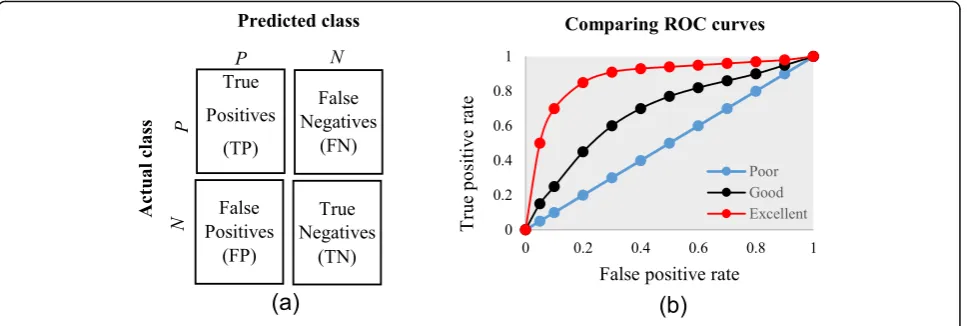
The diagnostic ability of classifiers has usually been determined by the confusion matrix and the receiver operating characteristic (ROC) curve [37]. In the ma-chine learning research domain, the confusion matrix is also known as error or contingency matrix. The
basic framework of the confusion matrix has been
provided in Fig. 11a. In this framework, true positives
(TP) are the positive cases where the classifier cor-rectly identified them. Similarly, true negatives (TN) are the negative cases where the classifier correctly identified them. False positives (FP) are the negative
cases where the classifier incorrectly identified them as positive and the false negatives (FN) are the posi-tive cases where the classifier incorrectly identified them as negative. The following measures, which are based on the confusion matrix, are commonly used to analyse the performance of classifiers, including those Fig. 9The overall data collection procedure. It also shows the number of articles considered for each disease
that are based on supervised machine learning algorithms.
Accuracy¼ TPþTN TPþTNþFPþFN
F1score¼
2TP
2TPþFNþFP
Precisioin¼ TP TPþFP
Sensitivity¼Recall¼True positive rate¼ TP TPþFN
Specificity¼ TN TNþFP
False positive rate¼ FP FPþTN
An ROC is one of the fundamental tools for diagnostic test evaluation and is created by plotting the true posi-tive rate against the false posiposi-tive rate at various thresh-old settings [37]. The area under the ROC curve (AUC) is also commonly used to determine the predictability of a classifier. A higher AUC value represents the superior-ity of a classifier and vice versa. Figure 11b illustrates a presentation of three ROC curves based on an abstract dataset. The area under the blue ROC curve is half of the shaded rectangle. Thus, the AUC value for this blue ROC curve is 0.5. Due to the coverage of a larger area, the AUC value for the red ROC curve is higher than that of the black ROC curve. Hence, the classifier that pro-duced the red ROC curve shows higher predictive accur-acy compared with the other two classifiers that generated the blue and red ROC curves.
There are few other measures that are also used to as-sess the performance of different classifiers. One such
measure is the running mean square error (RMSE). For different pairs of actual and predicted values, RMSE rep-resents the mean value of all square errors. An error is the difference between an actual and its corresponding predicted value. Another such measure is the mean ab-solute error (MAE). For an actual and its predicted value, MAE indicates the absolute value of their difference.
Results
The final dataset contained 48 articles, each of which implemented more than one variant of supervised ma-chine learning algorithms for a single disease prediction. All implemented variants were already discussed in the methods section as well as the more frequently used per-formance measures. Based on these, we reviewed the fi-nally selected 48 articles in terms of the methods used, performance measures as well as the disease they targeted.
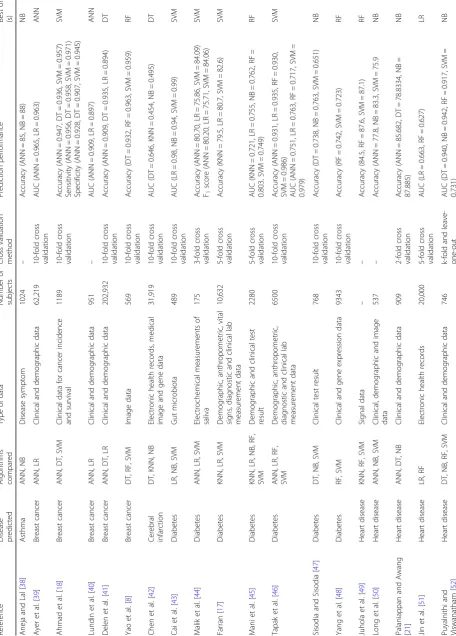
In Table 1, names and references of the diseases and
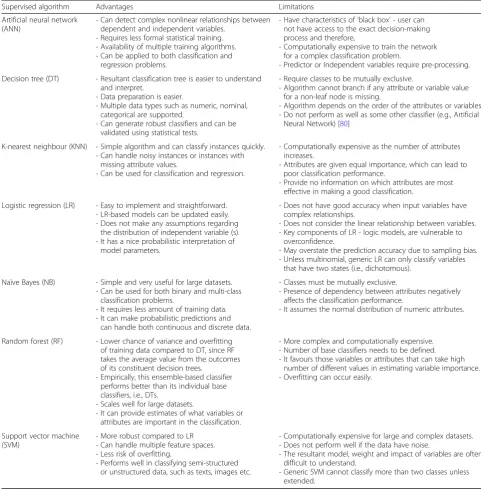
the corresponding supervised machine learning algo-rithms used to predict them are discussed. For each of the disease models, the better performing algorithm is also described in this table. This study considered 48 ar-ticles, which in total made the prediction for 49 diseases or conditions (one article predicted two diseases [17]). For these 49 diseases, 50 algorithms were found to show the superior accuracy. One disease has two algorithms (out of 5) that showed the same higher-level accuracies [36]. To sum up, 49 diseases were predicted in 48 arti-cles considered in this study and 50 supervised machine learning algorithms were found to show the superior ac-curacy. The advantages and limitations of different su-pervised machine learning algorithms are shown in Table2.
The comparison of the usage frequency and accuracy of different supervised learning algorithms are shown in
Table 3. It is observed that SVM has been used most
frequently (29 out of 49 diseases that were predicted). This is followed by NB, which has been used in 23 arti-cles. Although RF has been considered the second least number of times, it showed the highest percentage (i.e., 53%) in revealing the superior accuracy followed by SVM (i.e., 41%).
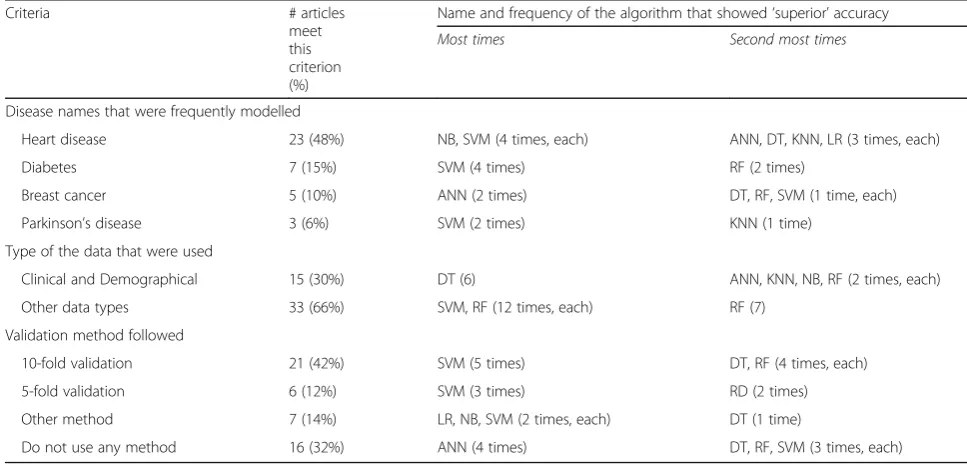
In Table 4, the performance comparison of different
supervised machine learning algorithms for most fre-quently modelled diseases is shown. It is observed that SVM showed the superior accuracy at most times for
three diseases (e.g., heart disease, diabetes and Parkin-son’s disease). For breast cancer, ANN showed the su-perior accuracy at most times.
A close investigation of Table 1 reveals an interesting result regarding the performance of different supervised learning algorithms. This result has also been reported in Table4. Consideration of only those articles that used clinical and demographic data (15 articles) reveals DT as to show the superior result at most times (6). Interest-ingly, SVM has been found the least time (1) to show
Table 2Advantages and limitations of different supervised machine learning algorithms
Supervised algorithm Advantages Limitations
Artificial neural network (ANN)
- Can detect complex nonlinear relationships between dependent and independent variables.
- Requires less formal statistical training. - Availability of multiple training algorithms. - Can be applied to both classification and
regression problems.
- Have characteristics of‘black box’- user can not have access to the exact decision-making process and therefore,
- Computationally expensive to train the network for a complex classification problem.
- Predictor or Independent variables require pre-processing.
Decision tree (DT) - Resultant classification tree is easier to understand and interpret.
- Data preparation is easier.
- Multiple data types such as numeric, nominal, categorical are supported.
- Can generate robust classifiers and can be validated using statistical tests.
- Require classes to be mutually exclusive.
- Algorithm cannot branch if any attribute or variable value for a non-leaf node is missing.
- Algorithm depends on the order of the attributes or variables. - Do not perform as well as some other classifier (e.g., Artificial
Neural Network) [80]
K-nearest neighbour (KNN) - Simple algorithm and can classify instances quickly. - Can handle noisy instances or instances with
missing attribute values.
- Can be used for classification and regression.
- Computationally expensive as the number of attributes increases.
- Attributes are given equal importance, which can lead to poor classification performance.
- Provide no information on which attributes are most effective in making a good classification.
Logistic regression (LR) - Easy to implement and straightforward. - LR-based models can be updated easily. - Does not make any assumptions regarding
the distribution of independent variable (s). - It has a nice probabilistic interpretation of
model parameters.
- Does not have good accuracy when input variables have complex relationships.
- Does not consider the linear relationship between variables. - Key components of LR - logic models, are vulnerable to
overconfidence.
- May overstate the prediction accuracy due to sampling bias. - Unless multinomial, generic LR can only classify variables
that have two states (i.e., dichotomous).
Naïve Bayes (NB) - Simple and very useful for large datasets. - Can be used for both binary and multi-class
classification problems.
- It requires less amount of training data. - It can make probabilistic predictions and
can handle both continuous and discrete data.
- Classes must be mutually exclusive.
- Presence of dependency between attributes negatively affects the classification performance.
- It assumes the normal distribution of numeric attributes.
Random forest (RF) - Lower chance of variance and overfitting of training data compared to DT, since RF takes the average value from the outcomes of its constituent decision trees.
- Empirically, this ensemble-based classifier performs better than its individual base classifiers, i.e., DTs.
- Scales well for large datasets.
- It can provide estimates of what variables or attributes are important in the classification.
- More complex and computationally expensive. - Number of base classifiers needs to be defined. - It favours those variables or attributes that can take high
number of different values in estimating variable importance. - Overfitting can occur easily.
Support vector machine (SVM)
- More robust compared to LR - Can handle multiple feature spaces. - Less risk of overfitting.
- Performs well in classifying semi-structured or unstructured data, such as texts, images etc.
- Computationally expensive for large and complex datasets. - Does not perform well if the data have noise.
- The resultant model, weight and impact of variables are often difficult to understand.
the superior result although it showed the superior ac-curacy at most times for heart disease, diabetes and Par-kinson’s disease (Table 4). In other 33 articles that used
research data other than ‘clinical and demographic’
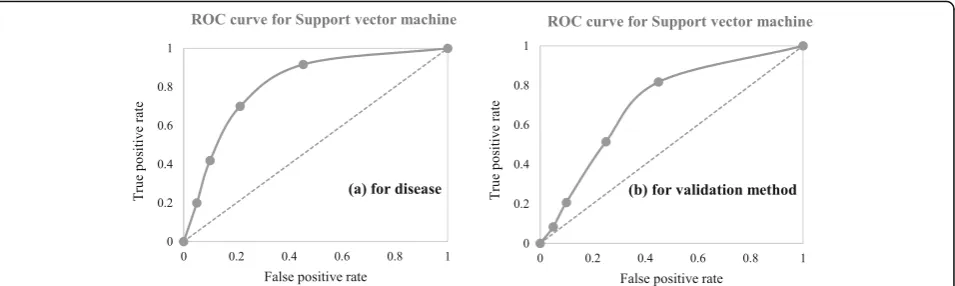
type, SVM and RF have been found to show the su-perior accuracy at most times (12) and second most times (7), respectively. In articles where 10-fold and 5-fold validation methods were used, SVM has been found to show the superior accuracy at most times (5 and 3 times, respectively). On the other side, articles where no method was used for validation, ANN has been found at most times to show the superior accur-acy. Figure 12 further illustrates the superior
perform-ance of SVM. Performperform-ance statistics from Table 4
have been used in a normalised way to draw these
two graphs. Fig. 12a illustrates the ROC graph for the
four diseases (i.e., Heart disease, Diabetes, Breast
can-cer and Parkinson’s disease) under the ‘disease names
that were modelled’ criterion. The ROC graph based on the ‘validation method followed’ criterion has been
presented in Fig. 12b.
Discussion
To avoid the risk of selection bias, from the literature we extracted those articles that used more than one super-vised machine learning algorithm. The same supersuper-vised learning algorithm can generate different results across various study settings. There is a chance that a perform-ance comparison between two supervised learning algo-rithms can generate imprecise results if they were employed in different studies separately. On the other side, the results of this study could suffer a variable se-lection bias from individual articles considered in this study. These articles used different variables or measures for disease prediction. We noticed that the authors of these articles did not consider all available variables from
Table 3Comparison of usage frequency and accuracy of different supervised machine learning algorithms
Supervised machine learning algorithms Number of published articles used this algorithm Number of times this algorithm showed superior accuracy (%)
Artificial neural network (ANN) 20 6 (30%)
Decision tree (DT) 21 7 (33%)
K-nearest neighbour (KNN) 13 4 (31%)
Logistic regression (LR) 20 5 (25%)
Naïve Bayes (NB) 23 7 (30%)
Random forest (RF) 17 9 (53%)
Support vector machine (SVM) 29 13 (41%)
Table 4Comparison of the performance of different supervised machine learning algorithms based on different criteria
Criteria # articles
meet this criterion (%)
Name and frequency of the algorithm that showed‘superior’accuracy
Most times Second most times
Disease names that were frequently modelled
Heart disease 23 (48%) NB, SVM (4 times, each) ANN, DT, KNN, LR (3 times, each)
Diabetes 7 (15%) SVM (4 times) RF (2 times)
Breast cancer 5 (10%) ANN (2 times) DT, RF, SVM (1 time, each)
Parkinson’s disease 3 (6%) SVM (2 times) KNN (1 time)
Type of the data that were used
Clinical and Demographical 15 (30%) DT (6) ANN, KNN, NB, RF (2 times, each)
Other data types 33 (66%) SVM, RF (12 times, each) RF (7)
Validation method followed
10-fold validation 21 (42%) SVM (5 times) DT, RF (4 times, each)
5-fold validation 6 (12%) SVM (3 times) RD (2 times)
Other method 7 (14%) LR, NB, SVM (2 times, each) DT (1 time)
the corresponding research datasets. The inclusion of a new variable could improve the accuracy of an under-performed algorithm considered in the underlying study, and vice versa. This is one of the limitations of this study. Another limitation of this study is that we consid-ered a broader level classification of supervised machine learning algorithms to make a comparison among them for disease prediction. We did not consider any sub-classifications or variants of any of the algorithms con-sidered in this study. For example, we did not make any performance comparison between least-square and sparse SVMs; instead of considering them under the SVM algorithm. A third limitation of this study is that we did not consider the hyperparameters that were chosen in different articles of this study in comparing multiple supervised machine learning algorithms. It has been argued that the same machine learning algorithm can generate different accuracy results for the same data set with the selection of different values for the under-lying hyperparameters [81,82]. The selection of different kernels for support vector machines can result a vari-ation in accuracy outcomes for the same data set. Simi-larly, a random forest could generate different results, while splitting a node, with the changes in the number of decision trees within the underlying forest.
Conclusion
This research attempted to study comparative perfor-mances of different supervised machine learning algo-rithms in disease prediction. Since clinical data and research scope varies widely between disease prediction studies, a comparison was only possible when a common benchmark on the dataset and scope is established. Therefore, we only chose studies that implemented mul-tiple machine learning methods on the same data and disease prediction for comparison. Regardless of the var-iations on frequency and performances, the results show
the potential of these families of algorithms in the dis-ease prediction.
Abbreviations
ANN:Artificial neural network; AUC: Area under the ROC curve; DT: Decision Tree; FN: False negative; FP: False positive; KNN: K-nearest neighbour; LR: Logistic regression; MAE: Mean absolute error; NB: Naïve Bayes; RF: Random forest; RMSE: Running mean square error; ROC: Receiver operating characteristic; SVM: Support vector machine; TN: True negative; TP: True positive
Acknowledgements Not applicable.
Authors’contributions
SU: Originator of the idea, data analysis and writing. AK: Data analysis and writing. MEH: Data analysis and writing. MAM: Data analysis and critical review of the manuscript. All authors have read and approved the manuscript.
Funding
This study did not receive any funding.
Availability of data and materials
The data used in this study can be extracted from online databases. The detail of this extraction has been described within the manuscript.
Ethics approval and consent to participate Not applicable.
Consent for publication Not applicable.
Competing interests
The authors declare that they do not have any competing interests.
Author details
1Complex Systems Research Group, Faculty of Engineering, The University of Sydney, Room 524, SIT Building (J12), Darlington, NSW 2008, Australia. 2Health Market Quality Research Stream, Capital Markets CRC, Level 3, 55 Harrington Street, Sydney, NSW, Australia.3Faculty of Medicine and Health, School of Medical Sciences, The University of Sydney, Camperdown, NSW 2006, Australia.
Received: 28 January 2019 Accepted: 11 December 2019
References
1. T. M. Mitchell,“Machine learning WCB”: McGraw-Hill Boston, MA:, 1997.
2. Sebastiani F. Machine learning in automated text categorization. ACM Comput Surveys (CSUR). 2002;34(1):1–47.
3. Sinclair C, Pierce L, Matzner S. An application of machine learning to network intrusion detection. In: Computer Security Applications Conference, 1999. (ACSAC’99) Proceedings. 15th Annual; 1999. p. 371–7. IEEE.
4. Sahami M, Dumais S, Heckerman D, Horvitz E. A Bayesian approach to filtering junk e-mail. In: Learning for Text Categorization: Papers from the 1998 workshop, vol. 62; 1998. p. 98–105. Madison, Wisconsin.
5. Aleskerov E, Freisleben B, Rao B. Cardwatch: A neural network based database mining system for credit card fraud detection. In: Computational Intelligence for Financial Engineering (CIFEr), 1997., Proceedings of the IEEE/ IAFE 1997; 1997. p. 220–6. IEEE.
6. Kim E, Kim W, Lee Y. Combination of multiple classifiers for the customer's purchase behavior prediction. Decis Support Syst. 2003;34(2):167–75. 7. Mahadevan S, Theocharous G.“Optimizing Production Manufacturing Using
Reinforcement Learning,”in FLAIRS Conference; 1998. p. 372–7. 8. Yao D, Yang J, Zhan X. A novel method for disease prediction: hybrid of
random forest and multivariate adaptive regression splines. J Comput. 2013; 8(1):170–7.
9. R. S. Michalski, J. G. Carbonell, and T. M. Mitchell, Machine learning: an artificial intelligence approach. Springer Science & Business Media, 2013. 10. Culler SD, Parchman ML, Przybylski M. Factors related to potentially
preventable hospitalizations among the elderly. Med Care. 1998;1:804–17. 11. Uddin MS, Hossain L. Social networks enabled coordination model for cost
Management of Patient Hospital Admissions. J Healthc Qual. 2011;33(5):37–48. 12. Lee PP, et al. Cost of patients with primary open-angle glaucoma: a
retrospective study of commercial insurance claims data. Ophthalmology. 2007;114(7):1241–7.
13. Davis DA, Chawla NV, Christakis NA, Barabási A-L. Time to CARE: a collaborative engine for practical disease prediction. Data Min Knowl Disc. 2010;20(3):388–415.
14. McCormick T, Rudin C, Madigan D. A hierarchical model for association rule mining of sequential events: an approach to automated medical symptom prediction; 2011.
15. Yiannakoulias N, Schopflocher D, Svenson L. Using administrative data to understand the geography of case ascertainment. Chron Dis Can. 2009; 30(1):20–8.
16. Fisher ES, Malenka DJ, Wennberg JE, Roos NP. Technology assessment using insurance claims: example of prostatectomy. Int J Technol Assess Health Care. 1990;6(02):194–202.
17. Farran B, Channanath AM, Behbehani K, Thanaraj TA. Predictive models to assess risk of type 2 diabetes, hypertension and comorbidity: machine-learning algorithms and validation using national health data from Kuwait-a cohort study. BMJ Open. 2013;3(5):e002457.
18. Ahmad LG, Eshlaghy A, Poorebrahimi A, Ebrahimi M, Razavi A. Using three machine learning techniques for predicting breast cancer recurrence. J Health Med Inform. 2013;4(124):3.
19. Moher D, Liberati A, Tetzlaff J, Altman DG. Preferred reporting items for systematic reviews and meta-analyses: the PRISMA statement. Ann Intern Med. 2009;151(4):264–9.
20. Demšar J. Statistical comparisons of classifiers over multiple data sets. J Mach Learn Res. 2006;7:1–30.
21. Palaniappan S, Awang R. Intelligent heart disease prediction system using data mining techniques. In: Computer Systems and Applications, 2008. AICCSA 2008. IEEE/ACS International Conference on; 2008. p. 108–15. IEEE. 22. Hosmer Jr DW, Lemeshow S, Sturdivant RX. Applied logistic regression.
Wiley; 2013.
23. Joachims T. Making large-scale SVM learning practical. SFB 475: Komplexitätsreduktion Multivariaten Datenstrukturen, Univ. Dortmund, Dortmund, Tech. Rep. 1998. p. 28.
24. Quinlan JR. Induction of decision trees. Mach Learn. 1986;1(1):81–106. 25. Cruz JA, Wishart DS. Applications of machine learning in cancer prediction
and prognosis. Cancer Informat. 2006;2:59–77. 26. Breiman L. Random forests. Mach Learn. 2001;45(1):5–32.
27. Lindley DV. Fiducial distributions and Bayes’theorem. J Royal Stat Soc. Series B (Methodological). 1958;1:102–7.
28. I. Rish,“An empirical study of the naive Bayes classifier,”in IJCAI 2001 workshop on empirical methods in artificial intelligence, 2001, vol. 3, 22, pp. 41–46: IBM New York.
29. Cover T, Hart P. Nearest neighbor pattern classification. IEEE Trans Inf Theory. 1967;13(1):21–7.
30. McCulloch WS, Pitts W. A logical calculus of the ideas immanent in nervous activity. Bull Math Biophys. 1943;5(4):115–33.
31. Rumelhart DE, Hinton GE, Williams RJ. Learning representations by back-propagating errors. Nature. 1986;323(6088):533.
32. Falagas ME, Pitsouni EI, Malietzis GA, Pappas G. Comparison of PubMed, Scopus, web of science, and Google scholar: strengths and weaknesses. FASEB J. 2008;22(2):338–42.
33. PubMed. (2018).https://www.ncbi.nlm.nih.gov/pubmed/.
34. Kavakiotis I, Tsave O, Salifoglou A, Maglaveras N, Vlahavas I, Chouvarda I. Machine learning and data mining methods in diabetes research. Comput Struct Biotechnol J. 2017;15:104–16.
35. Pedregosa F, et al. Scikit-learn: Machine learning in Python. J Mach Learn Res. 2011;12:2825–30.
36. Borah MS, Bhuyan BP, Pathak MS, Bhattacharya P. Machine learning in predicting hemoglobin variants. Int J Mach Learn Comput. 2018;8(2):140–3. 37. Fawcett T. An introduction to ROC analysis. Pattern Recogn Lett. 2006;27(8):
861–74.
38. Aneja S, Lal S. Effective asthma disease prediction using naive Bayes—Neural network fusion technique. In: International Conference on Parallel, Distributed and Grid Computing (PDGC); 2014. p. 137–40. IEEE. 39. Ayer T, Chhatwal J, Alagoz O, Kahn CE Jr, Woods RW, Burnside ES.
Comparison of logistic regression and artificial neural network models in breast cancer risk estimation. Radiographics. 2010;30(1):13–22.
40. Lundin M, Lundin J, Burke H, Toikkanen S, Pylkkänen L, Joensuu H. Artificial neural networks applied to survival prediction in breast cancer. Oncology. 1999;57(4):281–6.
41. Delen D, Walker G, Kadam A. Predicting breast cancer survivability: a comparison of three data mining methods. Artif Intell Med. 2005;34(2):113–27. 42. Chen M, Hao Y, Hwang K, Wang L, Wang L. Disease prediction by machine learning over big data from healthcare communities. IEEE Access. 2017;5: 8869–79.
43. Cai L, Wu H, Li D, Zhou K, Zou F. Type 2 diabetes biomarkers of human gut microbiota selected via iterative sure independent screening method. PLoS One. 2015;10(10):e0140827.
44. Malik S, Khadgawat R, Anand S, Gupta S. Non-invasive detection of fasting blood glucose level via electrochemical measurement of saliva. SpringerPlus. 2016;5(1):701.
45. Mani S, Chen Y, Elasy T, Clayton W, Denny J. Type 2 diabetes risk forecasting from EMR data using machine learning. In: AMIA annual symposium proceedings, vol. 2012; 2012. p. 606. American Medical Informatics Association.
46. Tapak L, Mahjub H, Hamidi O, Poorolajal J. Real-data comparison of data mining methods in prediction of diabetes in Iran. Healthc Inform Res. 2013; 19(3):177–85.
47. Sisodia D, Sisodia DS. Prediction of diabetes using classification algorithms. Procedia Comput Sci. 2018;132:1578–85.
48. Yang J, Yao D, Zhan X, Zhan X. Predicting disease risks using feature selection based on random forest and support vector machine. In: International Symposium on Bioinformatics Research and Applications; 2014. p. 1–11. Springer. 49. Juhola M, Joutsijoki H, Penttinen K, Aalto-Setälä K. Detection of genetic
cardiac diseases by Ca 2+ transient profiles using machine learning methods. Sci Rep. 2018;8(1):9355.
50. Long NC, Meesad P, Unger H. A highly accurate firefly based algorithm for heart disease prediction. Expert Syst Appl. 2015;42(21):8221–31.
51. Jin B, Che C, Liu Z, Zhang S, Yin X, Wei X. Predicting the risk of heart failure with ehr sequential data modeling. IEEE Access. 2018;6:9256–61. 52. Puyalnithi T, Viswanatham VM. Preliminary cardiac disease risk prediction
based on medical and behavioural data set using supervised machine learning techniques. Indian J Sci Technol. 2016;9(31):1–5.
53. Forssen H, et al. Evaluation of Machine Learning Methods to Predict Coronary Artery Disease Using Metabolomic Data. Stud Health Technol Inform. 2017;235: IOS Press:111–5.
54. Tang Z-H, Liu J, Zeng F, Li Z, Yu X, Zhou L. Comparison of prediction model for cardiovascular autonomic dysfunction using artificial neural network and logistic regression analysis. PLoS One. 2013;8(8):e70571.
55. Toshniwal D, Goel B, Sharma H. Multistage Classification for Cardiovascular Disease Risk Prediction. In: International Conference on Big Data Analytics; 2015. p. 258–66. Springer.
57. Mustaqeem A, Anwar SM, Majid M, Khan AR. Wrapper method for feature selection to classify cardiac arrhythmia. In: Engineering in Medicine and Biology Society (EMBC), 39th Annual International Conference of the IEEE; 2017. p. 3656–9. IEEE.
58. Mansoor H, Elgendy IY, Segal R, Bavry AA, Bian J. Risk prediction model for in-hospital mortality in women with ST-elevation myocardial infarction: a machine learning approach. Heart Lung. 2017;46(6):405–11.
59. Kim J, Lee J, Lee Y. Data-mining-based coronary heart disease risk prediction model using fuzzy logic and decision tree. Healthc Inform Res. 2015;21(3):167–74.
60. Taslimitehrani V, Dong G, Pereira NL, Panahiazar M, Pathak J. Developing EHR-driven heart failure risk prediction models using CPXR (log) with the probabilistic loss function. J Biomed Inform. 2016;60:260–9.
61. Anbarasi M, Anupriya E, Iyengar N. Enhanced prediction of heart disease with feature subset selection using genetic algorithm. Int J Eng Sci Technol. 2010;2(10):5370–6.
62. Bhatla N, Jyoti K. An analysis of heart disease prediction using different data mining techniques. Int J Eng. 2012;1(8):1–4.
63. Thenmozhi K, Deepika P. Heart disease prediction using classification with different decision tree techniques. Int J Eng Res Gen Sci. 2014;2(6):6–11. 64. Tamilarasi R, Porkodi DR. A study and analysis of disease prediction
techniques in data mining for healthcare. Int J Emerg Res Manag Technoly ISSN. 2015;1:2278–9359.
65. Marikani T, Shyamala K. Prediction of heart disease using supervised learning algorithms. Int J Comput Appl. 2017;165(5):41–4.
66. Lu P, et al. Research on improved depth belief network-based prediction of cardiovascular diseases. J Healthc Eng. 2018;2018:1–9.
67. Khateeb N, Usman M. Efficient Heart Disease Prediction System using K-Nearest Neighbor Classification Technique. In: Proceedings of the International Conference on Big Data and Internet of Thing; 2017. p. 21–6. ACM.
68. Patel SB, Yadav PK, Shukla DD. Predict the diagnosis of heart disease patients using classification mining techniques. IOSR J Agri Vet Sci (IOSR-JAVS). 2013;4(2):61–4.
69. Venkatalakshmi B, Shivsankar M. Heart disease diagnosis using predictive data mining. Int J Innovative Res Sci Eng Technol. 2014;3(3):1873–7. 70. Ani R, Sasi G, Sankar UR, Deepa O. Decision support system for diagnosis
and prediction of chronic renal failure using random subspace classification. In: Advances in Computing, Communications and Informatics (ICACCI), 2016 International Conference on; 2016. p. 1287–92. IEEE.
71. Islam MM, Wu CC, Poly TN, Yang HC, Li YC. Applications of Machine Learning in Fatty Live Disease Prediction. In: 40th Medical Informatics in Europe Conference, MIE 2018; 2018. p. 166–70. IOS Press.
72. Lynch CM, et al. Prediction of lung cancer patient survival via supervised machine learning classification techniques. Int J Med Inform. 2017;108:1–8. 73. Chen C-Y, Su C-H, Chung I-F, Pal NR. Prediction of mammalian microRNA
binding sites using random forests. In: System Science and Engineering (ICSSE), 2012 International Conference on; 2012. p. 91–5. IEEE. 74. Eskidere Ö, ErtaşF, Hanilçi C. A comparison of regression methods for
remote tracking of Parkinson’s disease progression. Expert Syst Appl. 2012; 39(5):5523–8.
75. Chen H-L, et al. An efficient diagnosis system for detection of Parkinson’s disease using fuzzy k-nearest neighbor approach. Expert Syst Appl. 2013; 40(1):263–71.
76. Behroozi M, Sami A. A multiple-classifier framework for Parkinson’s disease detection based on various vocal tests. Int J Telemed Appl. 2016;2016:1–9. 77. Hussain L, et al. Prostate cancer detection using machine learning
techniques by employing combination of features extracting strategies. Cancer Biomarkers. 2018;21(2):393–413.
78. Zupan B, DemšAr J, Kattan MW, Beck JR, Bratko I. Machine learning for survival analysis: a case study on recurrence of prostate cancer. Artif Intell Med. 2000;20(1):59–75.
79. Hung C-Y, Chen W-C, Lai P-T, Lin C-H, Lee C-C. Comparing deep neural network and other machine learning algorithms for stroke prediction in a large-scale population-based electronic medical claims database. In: Engineering in Medicine and Biology Society (EMBC), 2017 39th Annual International Conference of the IEEE, vol. 1; 2017. p. 3110–3. IEEE. 80. Atlas L, et al. A performance comparison of trained multilayer perceptrons
and trained classification trees. Proc IEEE. 1990;78(10):1614–9. 81. Lucic M, Kurach K, Michalski M, Bousquet O, Gelly S. Are GANs created
equal? a large-scale study. In: Proceedings of the 32nd International
Conference on Neural Information Processing Systems; 2018. p. 698–707. Curran Associates Inc.
82. Levy O, Goldberg Y, Dagan I. Improving distributional similarity with lessons learned from word embeddings. Trans Assoc Comput Linguistics. 2015;3: 211–25.
Publisher’s Note