Research Article
FORMULATION AND
EVALUATION OF
TRANSDERMAL PATCH
OF PROPRANOLOL
HYDROCHLORIDE
Kardile S.D*,Firodiya S.R.Ghule P.J
Mula Rural Institute of Pharmacy, Sonai, Taluka- Newasa, Dist. -Ahmednagar, Pin- 414105.
Date Received: 13th April 2017; Date accepted:
27st April 2017; Date Published: 30th April 2017
Abstract
The purpose of this research was to develop a ma-trix type transdermal patch containing Propranolol hydrochloride and combination of two hydrophob-ic Polymers Eudragit L-100 and Eudragit S-100 by Solvent Evaporation technique.Combination of two Plasticizers Glycerine and Dibutyl phthalate were used and their effect on drug release was studied
by changing their concentration in each
batch.Methanol and Dichloromethane solvent sys-tem was used in which methanol acts as a penetra-tion enhancer.Since oral bioavailibity of Proprano-lol Hydrochloride is poor due to high first pass metabolism transdermal patch is formed with the objective to get sustained release drug action with good bioavailibity.The Physicochemical compati-bility of the drug and polymers suggested by infra-red spectroscopy suggested absence of any incom-patibility.Formulated transdermal films were phys-ically evaluated for thickness, weight variation, drug content, moisture and folding endurance. All prepared formulation indicated good physical sta-bility.Invitro drug release studies were performed by using Franz diffusion cells and cellophane membrane.Sustained release drug action was achieved in optimized batches.The Drug irritancy study show that there was no any noticeable sign of erythma or oedema on rabbit skin throughout the period of 48 hrs.
Keywords: Propranolol, Eudragit L100, Eudragit S100, Hypertension, Bioavailibity.
Introduction
metopro-lol, mipindometopro-lol, captopril, verapamil and others. Propranolol hydrochloride is a well-known anti-hypertensive drug. It is available in the market in the form of tablet, capsule, and i.v solution. Here is attempt to formulate transdermal patch of propra-nolol hydrochloride. Proprapropra-nolol, the prototype of the beta-adrenergic receptor antagonists, in activi-ty.Propanolol is a racemic compound; the l-isomer is responsible for adrenergic blocking competitive, non-selective beta-blocker similar to nadolol with-out intrinsic sympatho mimetic activity. Proprano-lol competes with sympathomimetic neurotrans-mitters such as catechol amines for binding at beta (1)-adrenergic receptors in the heart, inhibiting sympathetic stimulation4. This results in a reduc-tion in resting heart rate, cardiac output, systolic and diastolic blood pressure, and reflex orthostatic hypotension. Propranolol HCL is selected drug for formulation of patch due to its short half-life i.e. 4hr, oral bioavailibity is 30% oral dose is 160 to 260 mg daily, mol wt. is 259.35, melting point is 96oC.The present work is planned with the objec-tive to prepare transdermal patch using various polymers and to obtain sustained Release drug action of the selected drug candidate5.The present work is planned with the objective to prepare transdermal patch using various polymers and to obtain sustained Release drug action of the se-lected drug candidate.
MATERIALS AND METHODS
All materials and chemicals used were of laborato-ry grade. Distilled water was prepared in the la-boratory using all glass distillation apparatus. The chemicals and reagents used arePropranolol HCL,
Eudragit L-100, Eudragit S-100, Methanol, Dibutyl phthalate, Glycerine, Potassium hydrogen phos-phate, Sodium hydroxide, Cellophane membrane. The drug is obtained as a gift sample from Dr.Reddy’s laboratories, Goa while excipients are obtained from Loba chemicals, Mumbai.5, 6
1) Determinationof λ max of propranolol in phosphate buffer pH 7.4 solution-
A) Preparation of propranolol HCL std stock tion (100µg/ml)in phosphate buffer pH 7.4 solu-tion-
Standard stock solution of propranolol was pre-pared by dissolving accurately weighed 10 mg of propranolol in little quantity of phosphate buffer pH 7.4 and then adjust volume upto mark in 100ml volumetric flask. Std stock solution of 100µg/ml is obtained.
B) Scanning of propranolol by UV spectrophoto-meter in phosphate buffer (pH 7.4) solution.From the standard stock solution,3ml was diluted to 10ml with phosphate buffer solution (pH 7.4).The resulting solution containing 30 µg/ml was scanned between 200 to 400 nm.11
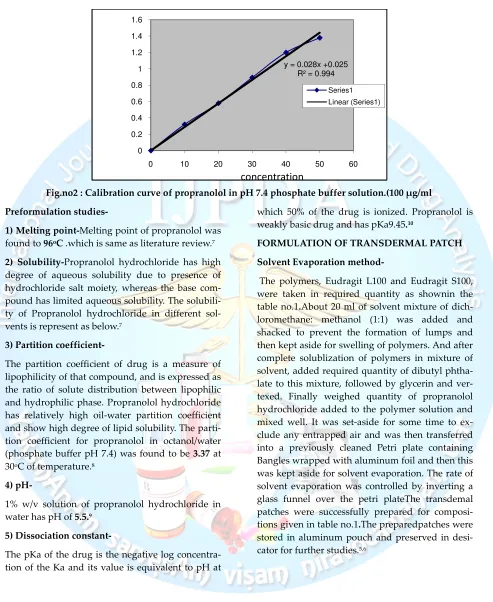
2) Calibration curve of propranolol in phosphate buffer solution (pH 7.4)-
Stock solution of 100µg/ml was prepared in phos-phate buffer pH 7.4.
Using this solution dilutions were done and solu-tions of concentration 10, 20,30,40,50 µg/ml were prepared and there absorbance was measured in
Fig.no2 : Calibration curve of propranolol in pH 7.4 phosphate buffer solution.(100 µg/ml Preformulation studies-
1) Melting point-Melting point of propranolol was found to 96oC .which is same as literature review.7
2) Solubility-Propranolol hydrochloride has high degree of aqueous solubility due to presence of hydrochloride salt moiety, whereas the base com-pound has limited aqueous solubility. The solubili-ty of Propranolol hydrochloride in different sol-vents is represent as below.7
3) Partition coefficient-
The partition coefficient of drug is a measure of lipophilicity of that compound, and is expressed as the ratio of solute distribution between lipophilic and hydrophilic phase. Propranolol hydrochloride has relatively high oil-water partition coefficient and show high degree of lipid solubility. The parti-tion coefficient for propranolol in octanol/water (phosphate buffer pH 7.4) was found to be 3.37 at 30oC of temperature.8
4) pH-
1% w/v solution of propranolol hydrochloride in water has pH of 5.5.9
5) Dissociation constant-
The pKa of the drug is the negative log concentra-tion of the Ka and its value is equivalent to pH at
which 50% of the drug is ionized. Propranolol is weakly basic drug and has pKa9.45.10
FORMULATION OF TRANSDERMAL PATCH Solvent Evaporation
The polymers, Eudragit L100 and Eudragit S100, were taken in required quantity as shownin the table no.1.About 20 ml of solvent mixture of dich-loromethane: methanol (1:1) was added and shacked to prevent the formation of lumps and then kept aside for swelling of polymers. And after complete solublization of polymers in mixture of solvent, added required quantity of dibutyl phtha-late to this mixture, followed by glycerin and ver-texed. Finally weighed quantity of propranolol hydrochloride added to the polymer solution and mixed well. It was set-aside for some time to ex-clude any entrapped air and was then transferred into a previously cleaned Petri plate containing Bangles wrapped with aluminum foil and then this was kept aside for solvent evaporation. The rate of solvent evaporation was controlled by inverting a glass funnel over the petri plateThe transdemal patches were successfully prepared for composi-tions given in table no.1.The preparedpatches were stored in aluminum pouch and preserved in desi-cator for further studies.5,6
y = 0.028x +0.025 R² = 0.994
0 0.2 0.4 0.6 0.8 1 1.2 1.4 1.6
0 10 20 30 40 50 60
Series1 Linear (Series1)
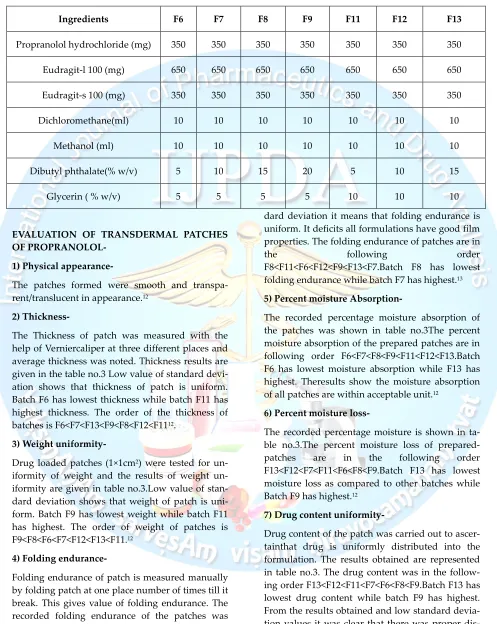
Table no 1: Formulation of Transdermal Patches
Ingredients F6 F7 F8 F9 F11 F12 F13
Propranolol hydrochloride (mg) 350 350 350 350 350 350 350
Eudragit-l 100 (mg) 650 650 650 650 650 650 650
Eudragit-s 100 (mg) 350 350 350 350 350 350 350
Dichloromethane(ml) 10 10 10 10 10 10 10
Methanol (ml) 10 10 10 10 10 10 10
Dibutyl phthalate(% w/v) 5 10 15 20 5 10 15
Glycerin ( % w/v) 5 5 5 5 10 10 10
EVALUATION OF TRANSDERMAL PATCHES OF PROPRANOLOL-
1) Physical appearance-
The patches formed were smooth and transpa-rent/translucent in appearance.12
2) Thickness-
The Thickness of patch was measured with the help of Verniercaliper at three different places and average thickness was noted. Thickness results are given in the table no.3 Low value of standard devi-ation shows that thickness of patch is uniform. Batch F6 has lowest thickness while batch F11 has highest thickness. The order of the thickness of batches is F6<F7<F13<F9<F8<F12<F1112.
3) Weight uniformity-
Drug loaded patches (1×1cm2) were tested for iformity of weight and the results of weight un-iformity are given in table no.3.Low value of stan-dard deviation shows that weight of patch is uni-form. Batch F9 has lowest weight while batch F11 has highest. The order of weight of patches is F9<F8<F6<F7<F12<F13<F11.12
4) Folding endurance-
Folding endurance of patch is measured manually
dard deviation it means that folding endurance is uniform. It deficits all formulations have good film properties. The folding endurance of patches are in
the following order
F8<F11<F6<F12<F9<F13<F7.Batch F8 has lowest folding endurance while batch F7 has highest.13
5) Percent moisture Absorption-
The recorded percentage moisture absorption of the patches was shown in table no.3The percent moisture absorption of the prepared patches are in following order F6<F7<F8<F9<F11<F12<F13.Batch F6 has lowest moisture absorption while F13 has highest. Theresults show the moisture absorption of all patches are within acceptable unit.12
6) Percent moisture loss-
The recorded percentage moisture is shown in ta-ble no.3.The percent moisture loss of
prepared-patches are in the following order
F13<F12<F7<F11<F6<F8<F9.Batch F13 has lowest moisture loss as compared to other batches while Batch F9 has highest.12
7) Drug content uniformity-
follow-tribution of propranolol in film formulations. Hence it was concluded that drug was uniformly distributed in all the formulations.12
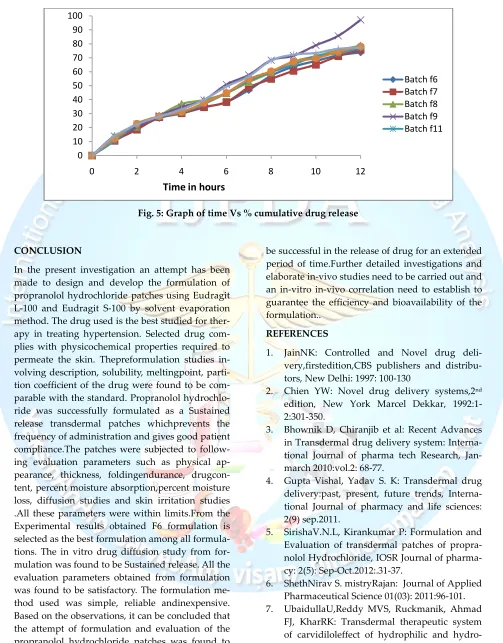
8)In vitro release
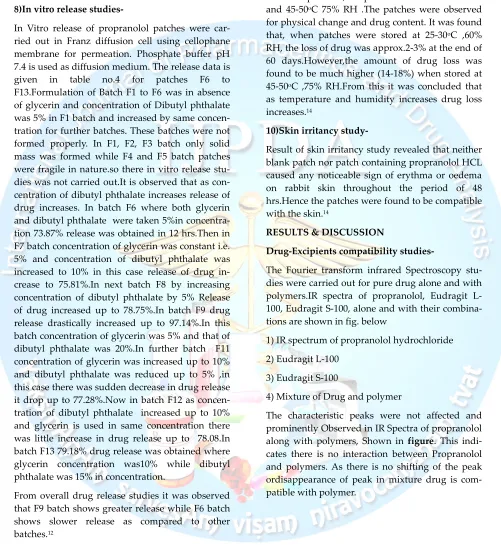
studies-In Vitro release of propranolol patches were car-ried out in Franz diffusion cell using cellophane membrane for permeation. Phosphate buffer pH 7.4 is used as diffusion medium. The release data is
given in table no.4 for patches F6 to
F13.Formulation of Batch F1 to F6 was in absence of glycerin and concentration of Dibutyl phthalate was 5% in F1 batch and increased by same concen-tration for further batches. These batches were not formed properly. In F1, F2, F3 batch only solid mass was formed while F4 and F5 batch patches were fragile in nature.so there in vitro release stu-dies was not carried out.It is observed that as con-centration of dibutyl phthalate increases release of drug increases. In batch F6 where both glycerin and dibutyl phthalate were taken 5%in concentra-tion 73.87% release was obtained in 12 hrs.Then in F7 batch concentration of glycerin was constant i.e. 5% and concentration of dibutyl phthalate was increased to 10% in this case release of drug in-crease to 75.81%.In next batch F8 by increasing concentration of dibutyl phthalate by 5% Release of drug increased up to 78.75%.In batch F9 drug release drastically increased up to 97.14%.In this batch concentration of glycerin was 5% and that of dibutyl phthalate was 20%.In further batch F11 concentration of glycerin was increased up to 10% and dibutyl phthalate was reduced up to 5% ,in this case there was sudden decrease in drug release it drop up to 77.28%.Now in batch F12 as concen-tration of dibutyl phthalate increased up to 10% and glycerin is used in same concentration there was little increase in drug release up to 78.08.In batch F13 79.18% drug release was obtained where glycerin concentration was10% while dibutyl phthalate was 15% in concentration.
From overall drug release studies it was observed that F9 batch shows greater release while F6 batch shows slower release as compared to other batches.12
9) Stability
studies-Stability studies were carried out for 60 days at
room temperature, temperature of 25-30oC 60% RH
and 45-50oC 75% RH .The patches were observed for physical change and drug content. It was found that, when patches were stored at 25-30oC ,60% RH, the loss of drug was approx.2-3% at the end of 60 days.However,the amount of drug loss was found to be much higher (14-18%) when stored at 45-50oC ,75% RH.From this it was concluded that as temperature and humidity increases drug loss increases.14
10)Skin irritancy study-
Result of skin irritancy study revealed that neither blank patch nor patch containing propranolol HCL caused any noticeable sign of erythma or oedema on rabbit skin throughout the period of 48 hrs.Hence the patches were found to be compatible with the skin.14
RESULTS & DISCUSSION
Drug-Excipients compatibility studies-
The Fourier transform infrared Spectroscopy stu-dies were carried out for pure drug alone and with polymers.IR spectra of propranolol, Eudragit L-100, Eudragit S-L-100, alone and with their combina-tions are shown in fig. below
1) IR spectrum of propranolol hydrochloride
2) Eudragit L-100
3) Eudragit S-100
4) Mixture of Drug and polymer
Fig:no.3: IR spectrum of propranolol Hydrochloride
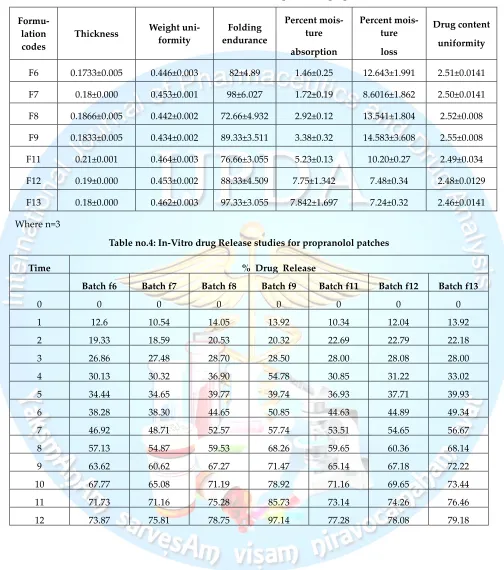
Table no.3: Evaluation of transdermal patches of propranolol
Formu-lation codes
Thickness Weight uni-formity
Folding endurance
Percent mois-ture absorption
Percent mois-ture loss
Drug content uniformity
F6 0.1733±0.005 0.446±0.003 82±4.89 1.46±0.25 12.643±1.991 2.51±0.0141
F7 0.18±0.000 0.453±0.001 98±6.027 1.72±0.19 8.6016±1.862 2.50±0.0141
F8 0.1866±0.005 0.442±0.002 72.66±4.932 2.92±0.12 13.541±1.804 2.52±0.008
F9 0.1833±0.005 0.434±0.002 89.33±3.511 3.38±0.32 14.583±3.608 2.55±0.008
F11 0.21±0.001 0.464±0.003 76.66±3.055 5.23±0.13 10.20±0.27 2.49±0.034
F12 0.19±0.000 0.453±0.002 88.33±4.509 7.75±1.342 7.48±0.34 2.48±0.0129
F13 0.18±0.000 0.462±0.003 97.33±3.055 7.842±1.697 7.24±0.32 2.46±0.0141
Where n=3
Table no.4: In-Vitro drug Release studies for propranolol patches
Time % Drug Release
Batch f6 Batch f7 Batch f8 Batch f9 Batch f11 Batch f12 Batch f13
0 0 0 0 0 0 0 0
1 12.6 10.54 14.05 13.92 10.34 12.04 13.92
2 19.33 18.59 20.53 20.32 22.69 22.79 22.18
3 26.86 27.48 28.70 28.50 28.00 28.08 28.00
4 30.13 30.32 36.90 54.78 30.85 31.22 33.02
5 34.44 34.65 39.77 39.74 36.93 37.71 39.93
6 38.28 38.30 44.65 50.85 44.63 44.89 49.34
7 46.92 48.71 52.57 57.74 53.51 54.65 56.67
8 57.13 54.87 59.53 68.26 59.65 60.36 68.14
9 63.62 60.62 67.27 71.47 65.14 67.18 72.22
10 67.77 65.08 71.19 78.92 71.16 69.65 73.44
11 71.73 71.16 75.28 85.73 73.14 74.26 76.46
Fig. 5: Graph of time Vs % cumulative drug release
CONCLUSION
In the present investigation an attempt has been made to design and develop the formulation of propranolol hydrochloride patches using Eudragit L-100 and Eudragit S-100 by solvent evaporation method. The drug used is the best studied for ther-apy in treating hypertension. Selected drug com-plies with physicochemical properties required to permeate the skin. Thepreformulation studies in-volving description, solubility, meltingpoint, parti-tion coefficient of the drug were found to be com-parable with the standard. Propranolol hydrochlo-ride was successfully formulated as a Sustained release transdermal patches whichprevents the frequency of administration and gives good patient compliance.The patches were subjected to follow-ing evaluation parameters such as physical ap-pearance, thickness, foldingendurance, drugcon-tent, percent moisture absorption,percent moisture loss, diffusion studies and skin irritation studies .All these parameters were within limits.From the Experimental results obtained F6 formulation is selected as the best formulation among all formula-tions. The in vitro drug diffusion study from for-mulation was found to be Sustained release. All the evaluation parameters obtained from formulation was found to be satisfactory. The formulation me-thod used was simple, reliable andinexpensive.
be successful in the release of drug for an extended period of time.Further detailed investigations and elaborate in-vivo studies need to be carried out and an in-vitro in-vivo correlation need to establish to guarantee the efficiency and bioavailability of the formulation..
REFERENCES
1. JainNK: Controlled and Novel drug
deli-very,firstedition,CBS publishers and distribu-tors, New Delhi: 1997: 100-130
2. Chien YW: Novel drug delivery systems,2nd edition, New York Marcel Dekkar, 1992:1-2:301-350.
3. Bhownik D, Chiranjib et al: Recent Advances in Transdermal drug delivery system: Interna-tional Journal of pharma tech Research, Jan-march 2010:vol.2: 68-77.
4. Gupta Vishal, Yadav S. K: Transdermal drug delivery:past, present, future trends, Interna-tional Journal of pharmacy and life sciences: 2(9) sep.2011.
5. SirishaV.N.L, Kirankumar P: Formulation and Evaluation of transdermal patches of propra-nolol Hydrochloride, IOSR Journal of pharma-cy: 2(5): Sep-Oct.2012:.31-37.
6. ShethNirav S. mistryRajan: Journal of Applied
Pharmaceutical Science 01(03): 2011:96-101.
0 10 20 30 40 50 60 70 80 90 100
0 2 4 6 8 10 12
Batch f6 Batch f7 Batch f8 Batch f9 Batch f11
phobic matrix on invitro and invivo characte-ristics AAPS pharm Sci Tech:2007:8(1):Article2.
8. SaraswatiR, Krishnan P.V: Formulation and
Evaluation of Transdermal Patches of Curcu-min, Scholars Research Library,Derpharmacia letter, 2010,2(5):117-126.
9. GadekarRadhikaetal: Study of formulation,
Characterisation and wound healing potential of transdermal patches of curcumin, Asian Journal of Pharmaceutical and Clinical Re-search, Rev and accept. On Oct:3, 2012.
10. The British pharmacopoeia: Vol-I London:
Hermajestys stationary office, 2001;472-73.
11. Indian PharmacopoeiaVol-III published by
Indian Pharmacopoeal Commission Gaziabad 2014;2579-81
12. Kooriyattil Naseera et al: Formulation, Opti-misation and Evaluation of matrix type of transdermal system of simvastatin using per-meation enhancers: International Journal of current Pharmaceutical Research ISSN-0975-7066,vol 4,Issue 2,2012.
13. Das MK, Bhattacharya, Ghoshal SK:
Trans-dermal delivery of Trazodone HCL from acryl-ic films prepared from aqueous latex.Indian J pharm sci 2006; 68(1):41-46.
14. Prabhakara.P, Koland M: Preparation and