Abstract — This research examines operational failure data from National Transportation Safety Board (NTSB) investigations. The data are coded using the Human Factors Analysis and Classification System (HFACS) and mathematically evaluated to assess the relative impact of human factor (HF) failure rates and non-HF failure rates to form a basis for comparison to the existing system readiness assessment (SRA) framework. From this initial examination a hypothetical system is proposed with both automated and human actor participation modes and used a basis for modeling SRA values. The research approach applies this system model to evaluate the impact of HF failure rates on SRA values with and without consideration of the human actor as an integrated system component.
Index Terms — fielded product, human factors, operational environment, system modeling, system readiness
I. PROBLEM STATEMENT
IELDED product data is a rich source of product usage information. How a product performs in the intended operational environment provides a significant feedback source for the design community. The use of fielded product information in the design of new aviation products to prevent failure recurrence is essential for effective new product development. As stated by NTSB Chairman Christopher A. Hart after the failure of Spaceship Two “. . . we must meticulously seek out and mitigate known hazards, as a prerequisite to identifying and mitigating new hazards” [1]. The use of field accident and incident data has resulted in a reduction in mechanical and environmental factor failures, but the same is not true for HF failures [2].
The specific problem addressed by this study is the consideration of common HF failure modes across a broad set of system domains. Previous studies have concentrated on specific domains. Studies show that 60% and 80% of aviation accidents are attributable, at least in part, to human error [3]. While the accident rate has declined over the last half century, reductions in human error-related accidents have not kept pace with the reduction of accidents related to
Manuscript received July 2, 2016; revised July 24, 2016.
Anthony J. Erjavac is a doctoral student at the School of Engineering and Applied Science, The George Washington University, Washington DC, USA 20052 (corresponding author phone: 818-223-1007; email: [email protected]).
Ronald Iammartino is a professor with the School of Engineering and Applied Science, The George Washington University, Washington DC, USA 20052.
John Fossaseca is a professor with the School of Engineering and Applied Science, The George Washington University, Washington DC, USA 20052.
mechanical and environmental factors [4]. The lack of studies evaluating HF failures across multiple domains using the Human Factors Analysis and Classification System (HFACS) with the intent to improve human-system integration (HSI) leaves a gap in current research which is especially relevant to the development of new systems and the associated assessment processes. As part of the design process, SRAs focus on products and processes while not specifically assessing the highly variable HSI aspects of the system until late in the design life cycle. Designers and program managers need methods to assess the HSI aspects of designs during readiness assessments to help drive designs that are more robust relative to the high failure source of HF.
II. LITERATURE REVIEW
Throughout history, designers have advanced technology to develop integrated human-technology systems to enhance human performance. The design process has been defined as a “systematic, intelligent process in which designers generate, evaluate, and specify concepts for devices, systems, or processes whose form and function achieve clients’ objectives or users’ needs while satisfying a specified set of constraints” [5]. The design process is the central activity of the engineering community [6].
As part of the design process, HF involves the integration of the human operator, user and maintainer throughout the lifecycle of the system. The goal of HF is to enhance human system performance by understanding how humans relate to the integrated system environment [7]. The ability to determine how the integrated human system may fail in the operational environment has been difficult to predict [8]. As part of the entire HF domain, “HSI focuses on all human and system roles during the system lifecycle when applying human-system performance assessment criteria and methods” [7].
The ultimate goal of the design process is to provide systems that meet the needs of the intended users within the scope of the defined requirements [7]. To that end, system developers have relied on information from previously fielded systems as a means to improve new designs. While the use of that information has had a significant impact on some aspects of human-technology integrated designs, the rate of HF failures in the aviation domain has remained fairly constant at roughly 70 to 80 percent of accidents for the past fifty years [4].
In the past, technology-centered designs have resulted in products that “are imposed on the intended users” [6]. Today’s design solutions take into account the human as an integral part of the system. These newer design processes
An Evaluation of Human Factors Failure Data
in Relation to System Readiness Assessment
Anthony J. Erjavac, Ronald Iammartino, John Fossaceca
are referred to as human-centered designs starting with the human as the focal point of the design effort [6]. With a design environment that considers the human as a component in the system the design community now requires methods to evaluate HSI as part of the system assessment process [7].
Systems designs integrate people, processes and products. To assess progress throughout the product life cycle, the SRA is used, but only considers the products and processes, failing to recognize the readiness of the people required to operate and maintain the systems [9]. While components and subsystems must achieve specific levels of maturity as part of the SRA , the same is not true for the human element [10]. An overall assessment of human readiness in relation to the system is not an element of the maturation process.
While trades must be made between system provision and human requirements, humans have normally been modeled as external to the system. Humans are often modeled as optimal performers whose interface with the system is highly consistent. The optimal human never wears down and can easily multitask with maximum utility [7]. With the release of ISO 15288:2015, Systems and software engineering -- System life cycle processes, humans have become an essential part of the overall system with associated requirements similar to any other system element [11]. This reflects the paradigm shift from technology-centered design to human-centered design [6].
To evaluate product development during current design processes reliability growth functions are employed. State of the art design processes employ reliability growth functions to evaluate product development concurrent with the design phase. Non-HF failures can be extrapolated as represented by a typical technology maturation life cycle; the same is not true for the HF failures. As proposed by Yang, et. al.[12], a human reliability growth analysis system (HRGAS) can be used to develop the human component of a system [12]. Yang, et.al. [12] evaluated the development of human-centric systems where the errors were solely attributed to the human performer. The realized growth demonstrated the ability to assess and development the human component of a system [12].
Similarly, Naranji. et. al. [13] demonstrated performance improvement in core pilot functions of heading, airspeed, altitude and course (2.39, 2.67, 2.35 and 1.66 times improvement respectively) associated with augmented cognition and automation during simulated aircraft operations [13]. This work validates how integrating the human user as a component of the system and designing system functions specifically as an augmentation to these core tasks has a positive effect on performance, i.e., a reduction in error rates [13].
The concept of assessing design maturity was first started by NASA in the late 1960s [14]. The goal was to provide insight into the risks associated with the system during the developmental life cycle to provide opportunities to mitigate those identified risks [14]. The Department of Defense uses the technology readiness assessment (TRA) process as a method to assess maturity as part of the systems engineering process [14]. Evidence exists that shows a positive
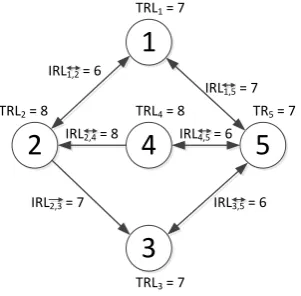
[image:2.595.306.457.302.450.2]schedule throughout the acquisition life cycle [14]. Therefore, designers and program managers need methods to assess the HSI aspects of designs during readiness assessments to help drive designs that are more robust relative to HF. Figure 1 illustrates how including the human actor as part of system may be considered during the SRA process. As shown in figure 1a, each component in a system is assigned a technology readiness level (TRL). Similary, each interface is assigned an integration readiness level (IRL}. These values are used to calculate an system readiness level (SRL) that represents system maturity. Figure 1b represents the addition of the human element. To provide a human readiness level (HRL) and a related IRL, a value is assigned derived from the failure rate of similarly reliable components. The recalculated SRL demonstrates the HSI effect on system maturity. Using a HRGAS and integrating the human user as part of the system enables assessment of the overall system maturation rather than solely the maturation and growth of the technological aspects of the system.
Fig. 1(a). Typical System Readiness Assessment considering technology and technology interfaces.
1
TRL1 = 7
5
TR5 = 7
4
TRL4 = 8
3
TRL3 = 7
2
TRL2 = 8
IRL1,5 = 7
IRL2,3 = 7
IRL1,2 = 6
IRL2,4 = 8
IRL3,5 = 6
IRL4,5 = 6
H
TR5 = 4
IRL3,H = 7
IRL5,H = 3
IRL1,H = 4
Fig. 1(b). System Readiness Assessment with the addition of the human actor as part of assessment.
III. FRAMEWORK AND HYPOTHESES
Based on the literature review, the research questions this study seeks to answer are:
1. Are there common HF failure modes across disparate aviation system domains?
2. What is the contribution to field failures of integrated technology versus the contribution from HF?
3. How can field failure data be used to enhance the
1
TRL1 = 7
5
TR5 = 7
4
TRL4 = 8
3
TRL3 = 7
2
TRL2 = 8
IRL1,5 = 7
IRL2,3 = 7
IRL1,2 = 6
IRL2,4 = 8
IRL3,5 = 6
[image:2.595.316.556.482.631.2]The hypotheses this research will evaluate are:
H10: When operating systems in their intended dynamic environments there is no significant difference in the comparative rate of human factor failures and other types of system failures.
H1a: When operating systems in their intended dynamic environments there is a significant difference in the comparative rate of human factor failures and other types of system failures.
H20: When operating systems in their intended dynamic environments there is no significant difference in the comparative rate of human factor failures between disparate system types.
H2a: When operating systems in their intended dynamic environments there is a significant difference in the comparative rate of human factor failures between disparate system types.
H30: When operating systems in their intended dynamic environments there is no significant difference in the types of human factor failures between disparate system types.
H3a: When operating systems in their intended dynamic environments there is a significant difference in the types of human factor failures between disparate system types .
IV. RESEARCH METHODOLOGY
This study evaluates NTSB accident/incident data using the HFACS to form a basis for the probability of error based on HFACS category for fielded aviation systems. A simulated model as shown in figure 1 is used based on the mathematical analysis of occurrence rates from the NTSB data to demonstrate the relevant effects of HSI considerations on the SRA process. The selected model represents an engine start system that can be operated in both automated and manual modes. This model provides the opportunity to evaluate the system with varying levels of integration of the human element. The goal of the model is to demonstrate that system readiness without full consideration of the human element is assessed higher than the actual level of the integrated human system.
To allow for comparison of failure rates over time, FAA operations data were used as a data normalizer. The annual airport operations (take-offs and landings) were used as a basis to normalize the data. These normalized rates of occurrence of different causal factors allows for comparison to determine if statistically significant differences exist. A statistically significant random sample of incidents investigated by the NTSB from the years 2006 through 2015 was used as the basis for the study. This ten year period was chosen for the study specifically to include a shift in the data mean which was tested for statistical significance.
The method used in the data analysis is derived from the work of Martinie, et.al. [15], who demonstrated an integrated system fault and human error (HE) analysis method incorporating the concept of criticality levels [15]. The output of this analysis at the highest abstraction level is an assessment of the probability of failure occurrence for system failures and HF. At lower abstraction levels the data are assessed on probability of failure by operational phase of activity and HFACS category.
These probable failure rates form the basis for the hypothetical analyses of readiness derived from empirical field failure data. Based on initial work by London, et.al. [16], demonstrating the relationship of SRL and reliability growth predictions and subsequent work on SRL mathematics, the stage has been set for further work correlating SRL and reliability growth applications [16]. London, et. al. [16] ultimately focused on the mathematics behind the SRL as a precursor to the extension of SRL to new areas [16]. London’s work significantly improved the SRL formulation methodology.
Relating failure probability to readiness is accomplished by forming a relationship between the empirical failure rates and reliability assessment methodology. Using the exponential reliability function shown in (1) and assuming fielded systems are sufficiently mature to provide the operational capability to satisfy mission needs, i.e., SRL ≥ 8, then the failure rate should be constant [17].
(1)
[image:3.595.310.544.376.512.2]The shape of the curve during development and how the constant failure rate portion was achieved is indeterminable, but the homogeneous population of aircraft represented by the NTSB data suggests a constant failure rate normalized by airport operations of 26.3 failures per million opportunities as shown in figure 2.
Fig. 2. Annual aircraft accident/incident rate per million airport operations.
Fig. 3. SRL relative to system lifecycle failure rate
V. RESULTS
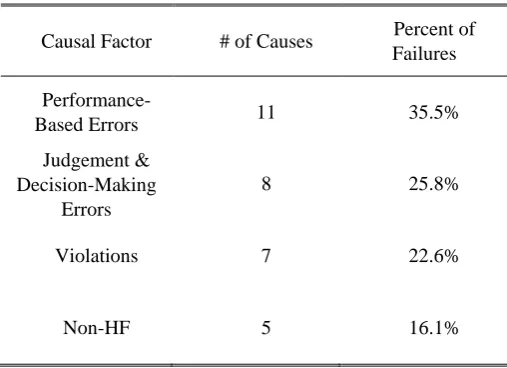
At the highest level of abstraction the data supports previous findings, i.e., 67% of the accidents represented by the data are attributable to human error. When the causal factors are examined in more detail using the HFACS, human error accounts for 83.9% of the causal factors. Table I represents the initial findings based on evaluation of a limited case study of nine aircraft accidents/incidents as reported by the NTSB.
Based on those data, since reliability growth models are derived solely from failures of technology, it can be extrapolated that the 16.1% failure rate of non-HF causal factors represent the expected failure rate due to system reliability. That accounts for only 4.24 field failures per million opportunities normalized by airport operations. The system reliability to account for the remaining 22.05 field failures per million opportunities is the result of the less mature HSI aspects of the fielded systems.
TABLE I
CAUSAL FACTOR ANALYSIS
Causal Factor # of Causes Percent of Failures
Performance-Based Errors 11 35.5%
Judgement & Decision-Making
Errors
8 25.8%
Violations 7 22.6%
Non-HF 5 16.1%
These findings expand the existing body of work by extracting and evaluating the HF failures as they affect system reliability in the operational environment. By examining the HF failures in isolation from other failure sources and understanding the types of failures within the context of the operational environment, these error sources form the basis for how the human component can be evaluated during the SRA process.
A closer examination of the reliability function for these type systems illustrates the maturation of the technology, but not the HSI. Typical reliability maturation based on an exponential distribution is represented in figure 4. The lack of similar assessment and development techniques for HSI during early life cycle phases to those used for technology maturation leaves a void in the data as represented by the early near steady state failure rate for HF causal factors.
Fig. 4. Comparison of non-HF and HF failure maturation based on reliability assessment.
VI. CONCLUSION
The findings presented here support previous studies that attribute 60% to 80% of aviation accidents to human error. The further assessment of these data indicate that while the non-HF aspects of the system can be evaluated with respect to reliability growth, the HF contribution to the failure rate cannot be similarly evaluated.
The key contribution of this study is to demonstrate the significance of the HF contribution to the overall steady-state system failure rate. These findings enable quantitative analyses of HF implications related to the SRA process. The results indicate there are common failure modes across a range of aviation system domains as defined within the context of the HFACS. Further work can continue to evaluate the failure rates across the disparate system types represented in the NTSB data.
Based on the work of Yang and Naranji, an assessment of the HF failure rates upstream in the design process can be modeled and tested. This theoretical context can be used to demonstrate the potential for implementation of the HRGAS and how these effects can be implemented to enhance the SRA criteria to increase the focus on HF.
Future studies could explore the application of these results to other comparable systems that may not readily have empirical data available. For instance, as the commercial spaceflight industry continues to develop, systems can be assessed based on common HF failures to assure the experience of other system designs are incorporated in the development of these fledgling systems.
REFERENCES
[1] NTSB Press Release. (2015) Lack of Consideration for Human Factors Led to In-Flight Breakup of SpaceShip Two. National Transportation Safety Board Office of Public Affairs. Accessed online:
[image:4.595.41.295.481.665.2]classification system. Aldershot, Hants, England; Burlington, VT: Ashgate.
[3] Shappell, S.A., Detwiler, C., Holcomb, K., Hackworth, C., Boquet, A. & Wiegmann, D.A. (2007). Human error and commerical aviation accidents: an analysis using the human factors analysis and classification system. Human Factors, 49(2), 227-242.
[4] Yacavone, D. (1993). Mishap trends and cause factors in naval aviation: A review of naval safety center data, 1986-90. Aviation, Space and Environmental Medicine, 64(5), 392-395. Retrieved from http://gw.summon.serialssolutions.com/
[5] Dym, C. L., Agogino, A. M., Eris, O., Frey, D. D., & Leifer, L. J. (2005). Engineering design thinking, teaching, and learning. Journal of Engineering Education, 94(1), 103-120. Retrieved from http://proxygw.wrlc.org/login?url=http://search.proquest.com/docvie w/217956366?accountid=11243
[6] Zoltowski, C. B., Oakes, W. C., & Cardella, M. E. (2012). Students' ways of experiencing human-centered design. Journal of Engineering Education, 101(1), 28-59. Retrieved from http://search.proquest.com.proxygw.wrlc.org/docview/1014006083?a ccountid=11243
[7] Madni, A. M. (2009). Integrating humans with software and systems: Technical challenges and a research agenda. Systems Engineering, 13(3), 232-245. doi: 10.1002/sys.20145
[8] Pons, D. (2015). Aviation human error modelled as a production process. The Ergonomics Open Journal, 8(1), 1; 1-12; 12.
[9] McConkie, E., Mazzuchi, T. A., Sarkani, S., & Marchette, D. (2013). Mathematical properties of system readiness levels. Systems Engineering, 16(4), 391-400. doi:10.1002/sys.21237
[10] Kujawski, E. (2013). Analysis and critique of the system readiness level. IEEE Transactions on Systems, Man, and Cybernetics: Systems, 43(4), 979-987. doi:10.1109/TSMCA.2012.2209868
[11] Orellana, D. W., & Madni, A. M. (2014). Human system integration ontology: Enhancing model based systems engineering to evaluate human-system performance. Procedia Computer Science, 28, 19-25. doi:10.1016/j.procs.2014.03.003
[12] Yang, C., Lin, C.J., Chen, J.C., (2006). Applying human reliability growth analysis to system performance enhancement. Human System Management, 25(1), 77-86.
[13] Naranji, E., Sharkan, S., Mazzuchi, T., (2015). Reducing Human/Pilot Errors in Aviation Using Augmented Cognition and Automation Systems in Aircraft Cockpit. Transactions on Human-Computer Interaction. 7(2), 71-96.
[14] Azizian, N., Mazzuchi, T., Sarkani, S., & Rico, D. F. (2011). A framework for evaluating technology readiness, system quality, and program performance of U.S. DoD acquisitions. Systems Engineering, 14(4), 410-426. doi:10.1002/sys.20186
[15] Martinie, C., Palanque, P., Fahssi, R., Blanquart, J., Fayollas, C., Sequin, C. (2016). Task Model-Based Systematic Analysis of Both System Failures and Human Errors. IEEE Transactions on Human-Machine Systems, 46(2).
[16] Mark A.London Thomas H.Holzer Timothy J.Eveleigh Shahryar Sarkani. (2014). Incidence matrix approach for calculating readiness levels. 23(4), 377-403. doi:10.1007/s11518-014-5255-8, pp. 35-77 [17] Sauser, B.J., Verma, D., Ramirez-Marques, J.E., & Gove, R. (2006).