TAGUCHI METHOD FOR THE DETERMINATION OF OPTIMISED SINTERING
PARAMETERS OF TITANIUM ALLOY FOAMS
S. Ahmad1,2, N. Muhamad1, A. Muchtar1, J. Sahari1, K. R. Jamaludin3, M. H. I. Ibrahim1 and N. H.
Mohamad Nor1
1. Faculty of Engineering and Built Environment, Universiti Kebangsaan Malaysia, 43600 UKM Bangi, Selangor, Malaysia.
2. Faculty of Mechanical and Manufacturing Engineering, Universiti Tun Hussein Onn Malaysia, Batu Pahat, Johor, Malaysia.
3. College of Science Technology, Universiti Teknologi Malaysia, Int Campus, Kuala Lumpur, Malaysia [email protected], [email protected]
ABSTRACT
Sintering is a key step in the preparation of metal foams. The present work focuses on the sintering effects on the properties of titanium foam prepared using the slurry technique. Sintering affects the density as well as the mechanical properties of the sintered parts. To achieve a high density of the titanium alloy foam, the effects of various parameters including temperature, time profile and composition have to be characterized and optimized. This paper reports the use of the Taguchi method in characterizing and optimizing the sintering process parameters of titanium alloys. The effect of four sintering factors: composition, sintering temperature, heating rate and soaking time to the density has been studied. The titanium slurry was prepared by mixing titanium alloy powder, polyethylene glycol (PEG), methylcellulose and water. Polyurethane (PU) foam was then impregnated into the slurry and dried at room temperature. This was later sintered in a high
temperature vacuum furnace. The various factors were assigned to an L9 orthogonal array. From
the Analysis of Variance (ANOVA), the sintering temperature was found to give the highest percentage of contribution (34.73) followed by the composition of the titanium alloy powder
(26.41) and the heating rate (0.64). The optimum density for the sintered titanium alloy foam was
1.4873±0.918 gcm-1. Confirmatory experiments have produced results that lay within the 90%
confidence interval.
1. INTRODUCTION
Metal foams possess a unique combination of properties, such as air and water permeability, impact energy absorption capacity, unusual acoustic properties, low thermal conductivity, good electrical insulating properties and high stiffness with very low specific weight [1]. There are several applications of open-celled metal foam which is widely used as light weight constructional materials, architectural materials, impact absorbers, silencers, filters, heat exchangers and implants [2].
There are many ways to produce metal foams. Some of them are liquid metallurgy, coating techniques and powder metallurgy. In this study the slurry method has been chosen to produce metal foams. This slurry method is included as a part of the powder metallurgy group because the starting material that was used is metal powder. Polyurethane foam templates are coated in slurry of metal powder followed by burning out of the template during the sintering process [3].
Among metal foams, titanium foams are preferred in many crucial applications in which aggressive media are involved, high temperatures occur or biocompatibility is required [1,4]. In this
study, alloy titanium (Ti6Al4V) has been chosen to produce alloy titanium foam using the slurry
method. Previous studies [5-7] have shown that the important factors of the sintering cycle are: composition, sintering temperature, sintering time and heating rate. These factors can affect the microstructure, pore size and shape, density and porosity of the samples. These, in turn, influence the mechanical properties of the samples after the sintering process. This paper presents work on optimisation of the sintering parameters of titanium alloy foam using the Taguchi method. The effects of four sintering factors were investigated and the optimum sintering condition was proposed and confirmation experiments were conducted.
2. MATERIALS AND METHOD
2.1 Raw materials
Titanium alloy powder was purchased from TLS tecnik GmbH & Co of Germany. The particles are spherical in shape and the diameters are less than 25µm. Polyethylene glycol (PEG) and methylcelluloses were used as binders. PEG and methylcellulose are water soluble materials.
2.2 Preparation of titanium slurry
for one hour. Next, a thickener (2% wt) was added to resulting slurry and stirring was maintained for one hour. Polyurethane (PU) foam was used in this research. The titanium slurry was used to impregnate the PU foam. PU foams were then dipped into the slurry. The dipping and drying processes were repeated until all the struts of the PU foam were coated with titanium slurry. The excess slurry was removed by pressing the foam under a roller.
2.3 Drying
The soaked samples were next dried in an oven for 24 hours at are 30oC.
2.4 Sintering
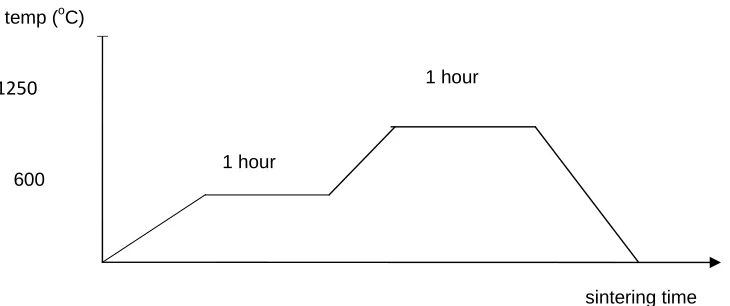
After drying, the samples were first heated to burn out the foam. This was done at 600oC for 60
minutes. Next, the samples were sintered in a vacuum furnace at 1200°C, 1250oC and 1300°C with
holding time of one hour. Figure 1 shows the flow chat to produce the titanium alloy foams and Figure 2 shows the sintering program for the samples.
2.5 Design of Experiment (DOE)
There are many sintering parameters that can affect the mechanical and physical properties of titanium alloy foam. A design of experiment (DOE) method is necessary for the experimental work which involves many inputs to minimise the number of experiments needed to be preformed. The most frequently used methods are partial or full factorial and the Taguchi approach. The Taguchi approach is mostly used for scientific research. The method is based on balanced orthogonal arrays
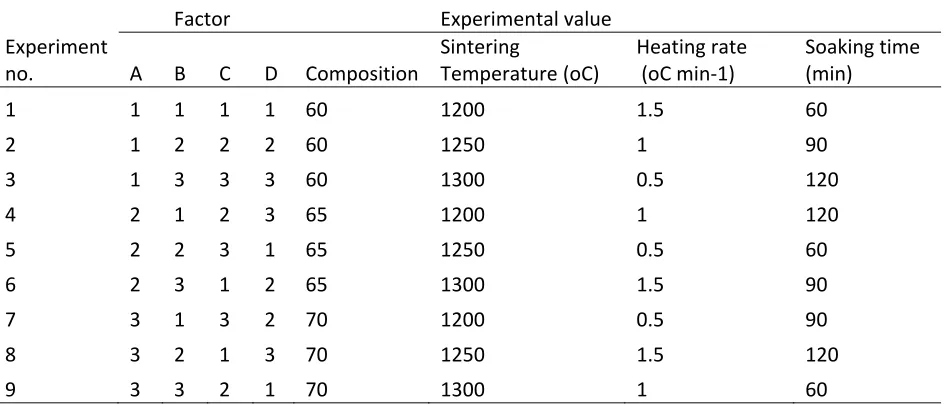
(OA)[8]. In this work, L9 (34) orthogonal array consisting of 9 experiment trials and 4 column is
sintering time (min)
1 hour
1 hour
600 1250
temp (oC)
Fig. 1 The flow chart for the sample preparation of titanium foam
Fig. 2 Sintering cycle for the preparation of the titanium foams
Binder (PEG + CMC) Distilled water
Binder is mixed
Prepared slurry of titanium
Dipping PU in titanium slurry
Drying the sample
Sintering the sample
Titanium foam Cutting the PU
Table 1: Factor level in the experiment and Orthogonal array
3.
RESULTS AND ANALYSIS
The density of the sintered samples was measured by the immersion density method. Three readings
(corresponding to the three replications) were recorded for each experimental condition as shown in
Table 2. The analysis of variance (ANOVA) technique was used to establish the relative
significance of the factors. ANOVA is a table of information that displays relative influences of
factor and interactions assigned to the column of an OA. Table 3 shows the results of the ANOVA
analysis.
Factor Experimental value
Experiment
no. A B C D Composition
Sintering
Temperature (oC)
Heating rate (oC min‐1)
Soaking time
(min)
1 1 1 1 1 60 1200 1.5 60
2 1 2 2 2 60 1250 1 90
3 1 3 3 3 60 1300 0.5 120
4 2 1 2 3 65 1200 1 120
5 2 2 3 1 65 1250 0.5 60
6 2 3 1 2 65 1300 1.5 90
7 3 1 3 2 70 1200 0.5 90
8 3 2 1 3 70 1250 1.5 120
Table 2: Results density of titanium alloy
Table 3 ANOVA for density of titanium alloy foam at
α
= 0.025
From the ANOVA table, the effects of sintering factors on the density were determined. The
composition of the sample and the sintering temperature offer significant effects on the density at
the 99.5% significance level. This is followed by the heating rate factor which was significant at the
90% significance level. As for the soaking time factor, the F ratio did not exceed 90% of
significance level but it still gave 1.38% contribution to this experiment. On the basis of ANOVA,
the main effects of the experiment were calculated. According to the optimum condition of “larger is
better”, the levels of the factors that contribute to the highest average values are preferred. From the
response graphs illustrated in Figure 3, the highest yield of the average density could be attained at
Experiment Replication, density (g/cm3) Average
R1 R2 R3
1 0.98 0.983 0.971 0.978
2 1.285 1.475 1.383 1.381
3 1.373 1.465 1.389 1.409
4 0.997 1.003 0.933 0.978
5 0.934 1.22 1.129 1.094
6 1.04 1.203 1.191 1.145
7 1.312 1.451 1.472 1.412
8 1.359 1.651 1.6 1.534
9 1.722 1.62 1.491 1.611
Sum Degrees of Variance, Variance Percentage of
squared Freedom, Vn ratio, Critical F value Contribution,
Variable , Sn fo Fn Pn
A 0.91098 2 0.45549 46.650 F0.005,2,18=7.2148 57.86
B 0.35821 2 0.17911 18.344 F0.005,2,18=7.2148 21.98
C 0.05489 2 0.02744 2.811 F0.1,2,18=2.6239 2.30
D 0.04077 2 0.02039 2.088 1.38
error 0.17575 18 0.00976 16.48
the combined settings of A
3(70% composition of titanium), B
3(1300°C of sintering temperature),
C
2(1°C/min of heating rate) and D
2(90 minute of soaking time).
Confirmation experiments were conducted by running another three replications at the
combined settings of A
3, B
3, C
2and D
2. Table 4 shows the results. It was found that the average
density obtained from the confirmation experiment, fell within the predicted 90% of confidence
interval (CI). The highest density at the optimum performance is 1.72 g/cm
3.
Table 4 Optimum sintering parameter, optimum performance and confirmation experiment
4.
DISCUSSION
From the analysis of the experimental results using the Taguchi method, the composition of titanium
was found to give the most significant effect on the density of the samples. When more particles of
titanium are present in the sample, the porosity of the sample decreased and thus the density of the
sample would increase [9,10]. The density can affect the mechanical properties of the samples.
The second factor which has a significant influence to the density is the sintering
temperature. When the sintering temperature was increased from 1200°C to 1300°C, there was less
porosity [11]. The density increased due to the higher densification at the highest temperature.
However, when the sintering temperature was increased higher than this, the density would decrease
because of the coarsening of the microstructure [11].therefore the most suitable temperature for
sintering of the titanium alloy foam was 1300°C.
As shown in the analysis of the results, the heating rate also affected the density. When the
heating rate was increased, the porosity of the samples was lower and the grain became finer so the
Optimum parameter:
A3 B3 C2 D2
(Composition, 70% of titanium powder; sintering temperature, 1300°C; Heating rate, 1.0°C/min;
soaking time, 90 minute)
Optimum performance:
1.70 g/cm3
Confident interval: ± 0.10 at 90% confident level (α =
0.1)
Range of optimum performance: 1.60 g/cm3 < µ < 1.79 g/cm3
Confirmation
experiment
Repeat 1 2 3 Average