One Translation per Discourse
Marine Carpuat
Center for Computational Learning Systems Columbia University
475 Riverside Drive, New York, NY 10115
Abstract
We revisit the one sense per discourse hypoth-esis of Galeet al. in the context of machine translation. Since a given sense can be lex-icalized differently in translation, do we ob-serve one translation per discourse? Analy-sis of manual translations reveals that the hy-pothesis still holds when using translations in parallel text as sense annotation, thus con-firming that translational differences repre-sent useful sense distinctions. Analysis of Statistical Machine Translation (SMT) out-put showed that despite ignoring document structure, the one translation per discourse hy-pothesis is strongly supported in part because of the low variability in SMT lexical choice. More interestingly, cases where the hypoth-esis does not hold can reveal lexical choice errors. A preliminary study showed that en-forcing the one translation per discourse con-straint in SMT can potentially improve trans-lation quality, and that SMT systems might benefit from translating sentences within their entire document context.
1 Introduction
The one sense per discourse hypothesis formulated by Gale et al. (1992b) has proved to be a simple yet powerful observation and has been successfully used in word sense disambiguation (WSD) and re-lated tasks (e.g., Yarowsky (1995); Agirre and Rigau
∗The author was partially funded by GALE DARPA Con-tract No. HR0011-06-C-0023. Any opinions, findings and con-clusions or recommendations expressed in this material are those of the authors and do not necessarily reflect the views of the Defense Advanced Research Projects Agency.
(1996)). In this paper, we investigate its potential usefulness in the context of machine translation.
A growing body of work suggests that transla-tional differences represent observable sense distinc-tions that are useful in applicadistinc-tions. In monolin-gual WSD, word alignments in parallel corpora have been successfully used as learning evidence (Resnik and Yarowsky, 1999; Diab and Resnik, 2002; Ng
et al., 2003). In Statistical Machine Translation (SMT), recent work shows that WSD helps trans-lation quality when the WSD system directly uses translation candidates as sense inventories (Carpuat and Wu, 2007; Chan et al., 2007; Gim´enez and M`arquez, 2007).
In this paper, we revisit the one sense per dis-course hypothesis using word translations in paral-lel text as senses. Our first goal is to empirically evaluate whether the one translation per document hypothesis holds on French-English reference cor-pora, thus verifying whether translations exhibit the same properties as monolingual senses. Our second goal consists in evaluating whether the one trans-lation per discourse hypothesis has the potential to be as useful to statistical machine translation as the one sense per discourse hypothesis to WSD. Cur-rent Statistical Machine Translation (SMT) systems translate one sentence at a time, ignoring any docu-ment level information. Impledocu-menting a one trans-lation per document constraint might help provide consistency in translation for sentences drawn from the same document.
After briefly discussing related work, we will show that the one translation per discourse hypoth-esis holds on automatic word alignments of manu-ally translated data. Despite ignoring any informa-tion beyond the sentential level, automatic SMT
put also strongly exhibits the one translation per dis-course property. In addition, we will show that hav-ing more than one translation per discourse in SMT output often reveals lexical choice errors, and that enforcing the constraint might help improve overall consistency across sentences and translation quality throughout documents.
2 Related Work
In the original one sense per discourse study, Gale
et al. (1992b) considered a sample of 9 polyse-mous English words. A total of 5 judges were showed pairs of concordance lines for these words taken from Grolier’s Encyclopedia and asked to identify whether they shared the same sense. Re-sults strongly support the one sense per discourse hypothesis: 94% of polysemous words drawn from the same document have the same sense. The ex-periment was replicated with the same conclusion on the Brown corpus. Yarowsky (1995) successfully used this observation as an approximate annotation technique in an unsupervised WSD model.
A subsequent larger scale study of polysemy based on the WordNet sense inventory in the SEM-COR corpus does not support the hypothesis as strongly (Krovetz, 1998). Only 77% of ambiguous words have a single sense per discourse. Analysis revealed that the one sense per discourse hypothesis is only supported for homonymous senses and not for finer-grained sense distinction.
In machine translation, discourse level informa-tion has only been indirectly used by adaptainforma-tion of translation or language models to specific genre or topics (e.g., Foster and Kuhn (2007); Koehn and Schroeder (2007)). While phrase-based SMT mod-els incorporate the one sense per collocation hypoth-esis by attempting to translate phrases rather than single words (Koehnet al., 2007), the one sense per discourse hypothesis has not been explicitly used in SMT modeling. Even the recent generation of SMT models that explicitly use WSD modeling to per-form lexical choice rely on sentence context rather than wider document context and translate sentences in isolation (Carpuat and Wu, 2007; Chan et al., 2007; Gim´enez and M`arquez, 2007; Stroppaet al., 2007; Specia et al., 2008). Other context-sensitive SMT approaches (Gimpel and Smith, 2008) and
global lexical choice models (Bangaloreet al., 2007) also translate sentences independently.
3 One translation per discourse in reference translations
In this section we investigate whether the one sense per discourse hypothesis holds in translation. Does one sense per discourse mean one translation per discourse?
On the one hand, one translation per discourse might be too strict a constraint to allow for variations in lexicalization of a given sense. While a WSD task produces a set of predefined sense labels, a single sense might be correctly translated in many differ-ent ways in a full sdiffer-entence translation.
On the other hand, if the author of the source lan-guage text is assumed to consistently use one sense per word per document, translators might also prefer consistent translations of the same source language word throughout a document. In addition, translated text tends to exhibit more regularities than original text, as shown by machine learning approches to discriminate between “translationese” and original texts (Baroni and Bernardini, 2006) although pat-terns of syntactic regularity seemed more informa-tive than lexical choice for those experiments.
3.1 Manual translation data
We will test the one translation per discourse hy-pothesis on a corpus of French and English trans-lations, using standard freely available MT data sets and software.
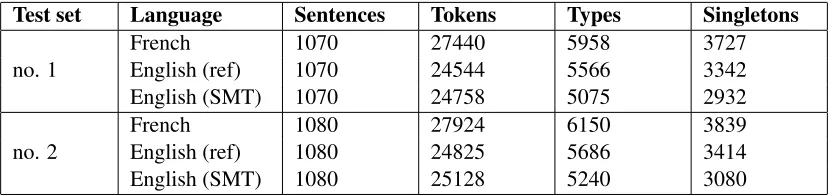
We use a corpus of 90 French-English news arti-cles made available for the WMT evaluations1. All
development data that contained article boundaries were used. The data is split into two sets of about 27k words each as described in Table 1. The arti-cles cover topics ranging from international and lo-cal politics to sports and music. They are drawn from a wide variety of newspapers and magazines originally published in various European languages. As a result, even though only a single English ref-erence translation is available, it was produced by several different interpreters. It would have been in-teresting to perform this analysis with multiple ref-erences, but this is unfortunately not possible with
Test set Language Sentences Tokens Types Singletons
no. 1 FrenchEnglish (ref) 10701070 2744024544 59585566 37273342
English (SMT) 1070 24758 5075 2932
no. 2 FrenchEnglish (ref) 10801080 2792424825 61505686 38393414
English (SMT) 1080 25128 5240 3080
Table 1: Data statistics for the bilingual corpus, including the French side, the manually translated English side (ref) and the automatic English translations (SMT)
the French-English data currently available.
Since golden word-alignments are not available, we automatically word align the corpus using stan-dard SMT training techniques. Using IBM-4 align-ment models learned on the large WMT training corpus (see Section 4.1 for more details), we align GIZA++(Och and Ney, 2003) to obtain the IBM-4 alignments in both translation directions, expand their intersection with additional links using the grow-diag-final-and heuristic (Koehn et al., 2007). This creates a total of 51660 alignment links, and about 89% of French tokens are aligned to at least one English token. Note that all links involving stop-words are not considered for the rest of the study.
3.2 One translation per discourse holds
For every French lemma that occurs more than once in a document, we compute the number of English translations. In order to allow for morphological and syntactic variations, we compute those statistics us-ing English lemmas obtained by runnus-ing Treetagger (Schmid, 1994) with the standard French and En-glish parameter settings2. A higher level of
general-ization is introduced by conducting the same analy-sis using stems, which are simply defined as 4-letter prefixes.
We have a total of 2316 different lemma types and 6603 lemma-document pairs. The scale of this em-pirical evaluation is much larger than in Gale et al.
(1992a) where only 9 target words were considered and in Krovetz (1998) which used the entire SEM-COR corpus vocabulary.
The resulting distribution of number of English translations per French word-document pair is given in the first half of Table 2. Remarkably, more than
2http://www.ims.uni-stuttgart.de/projekte/corplex/TreeTagger/
98% of the French lemmas are aligned to no more than 2 English translations and 80% of French lem-mas have a single translation per document. While these numbers are not as high as the 94% agreement reported by Gale et al. (1992b) in their empirical study, they still strongly support the one translation per discourse hypothesis.
Generalizing from lemmas to stems yields a 4.3 point increase in the percentage of French lemmas with a single translation per document. Note that using stems might yield to false positives since dif-ferent words can share the same prefix, however, since we only compare words that align to the same French word in a given document, the amount of noise introduced should be small. Manual inspec-tion shows that this increase is often due to varia-tions in the POS of the translation, more specifically variations between noun and verb forms which share the same 4-letter prefix as can be seen in the follow-ing examples:
verb vs. noun conclude vs. conclusion,
investigate vs. investigation,
apply vs. application, inject
vs. injection, establish vs.
establishment, criticize vs.
critism, recruit vs. recruitment,
regulate vs. regulation
3.3 Exceptions: one sense but more than one translation per discourse
reference SMT
lemmas stems lemmas stems
1 80.82% 85.14% 83.03% 86.38%
2 17.88% 13.91% 15.43% 12.47% 3 01.12% 00.95% 01.25% 00.85% 4 00.18% 00.00% 00.17% 00.22%
Table 2: Distribution of number of English translation per document using the word-aligned reference translations and the automatic SMT translations
a given French word, how semantically similar are the various English translations?
We measure semantic similarity using the shortest path length in WordNet (Fellbaum, 1998) as imple-mented in the WordNet Similarity package (Peder-senet al., 2004). The path length is defined as the number of WordNet nodes or synsets in a path be-tween two words: words that belong to the same synset therefore have a shortest path length of 1, while words that are related via a common synonym, hypernym or hyponym have a shortest path length of 2. Note that this similarity metric is only defined for two WordNet vocabulary words of the same POS.
For 57% of the French lemmas with multiple translations, those translations can be linked by a WordNet path of no more than 4 nodes. In 19% of the cases, the translations belong to the same synset, another 19% are separated by a path of length 2 only. Given that sense distinctions in WordNet are very fine-grained, these numbers show that the transla-tions have very similar meanings. In other words, while the one sense per translation hypothesis does not hold for those 57%, the one sense per discourse hypothesis still holds.
Examples of those synonymous translations are given below:
synonyms with SPL = 1 adjust and adapt, earn and gain, movie and film, education and training, holiday and day
synonyms with SPL = 2 travel and circulate, scientist and researcher, investigation and inquiry, leave and abandon, witness and eyewitness
synonyms with SPL = 3 ratio and
proportion, quiet and peace, plane
and aircraft
3.4 Exceptions: more than one sense per discourse
Among the words with a high WordNet path length or no existing path, we find translations that are not synonyms or semantically similar words, but re-lated words sometimes with different POS. They fall within two categories.
The first category is that of fine-grained sense dis-tinctions for which the one sense per discourse hy-pothesis has been showed to break for monolingual WordNet sense distinctions Krovetz (1998). How-ever, for those closely related words, it would be possible to write correct English translations that use the same English form throughout a document.
Nationality translation Tibet vs. Tibetan,
French vs. France, Paris vs.
Parisian, Europe vs. European,
French vs. Frenchman
Agent/entity policeman vs. police,
alderman vs. city
The second category of not identical but related translations is explained by a limitation of our ex-periment set-up: we are looking at single-word translations while the translation of a longer mul-tiword phrase should be considered as a whole. In the following example, the French word´emission
is aligned to bothemission and greenhousein
the same document, because French does not re-peat the long phrase´emission de gaz `a effet
de serre throughout the document, while the
more concise English translationgreenhouse gas emissionsis used throughout:
Fr apr`es la p´eriode de r´eduction des ´
emissions [...] la Hongrie a
pris l’engagement de r´eduire les
´
emissions de gaz `a effet de serre
de 6 pour cent [...]
En [...] to cut greenhouse gas
emissions after 2012 [...] Hungary agreed to cut its greenhouse gas emissions by 6 percent [...]
sense distinction in French and could not be cor-rectly translated in English with the same English word. These are cases where both the one sense per discourse hypothesis and the one translation per dis-course break, and where it is not possible to para-phrase the English sentences to fullfill either con-straints. In these instances, the French word is used in two different senses related by metonymy, but the metonymy relation does not translate into English and two non-synonym English words are used as a result. For instance, the French word
bureautranslates to bothofficeanddeskin the
same document, whileretraitetranslates both to
retirementandpension.
We found a single instance where two homonym senses of the French wordcoffreare in the same
sentence. This sentence seems to be a headline, which suggests that the author or translator delib-erately used the ambiguous repetition to attract the attention of the reader.
Fr un coffre dans le coffre
En a trunk in the boot
4 One translation per discourse in SMT We now turn to empirically testing the one transla-tion per discourse hypothesis on automatically trans-lated text.
While there is an implicit assumption that a well-written document produced by a human writer will not introduce unncessary ambiguities, most SMT systems translate one sentence at a time, without any model of discourse or document. This might suggest that the one translation per discourse hypothesis will not be as strongly supported as by manual transla-tions.
However, this effect might be compensated by the tendency of automatically translated text to exhibit little variety in lexical choice as MT systems tend to produce very literal word for word translations. As can be seen in Table 1 the reference translations use a larger vocabulary than the automatic translations for the same text.
4.1 Automatically translated data
We build a standard SMT system and automatically translate the data set described in Section 3.1. We
strictly follow the instructions for building a phrase-based SMT system that is close to the state-of-the-art in the WMT evaluations3, using the large training
sets of about 460M words from Europarl and news. We use the Moses phrase-based statistical ma-chine translation system (Koehn et al., 2007) and follow standard training, tuning and decoding strate-gies. The translation model consists of a stan-dard Moses phrase-table with lexicalized reorder-ing. Bidirectional GIZA++ word alignments are intersected using the grow-diag-final-and heuristic. Translations of phrases of up to 7 words long are collected and scored with translation probilities and lexical weighting. The English language model is a 4-gram model with Kneser-Ney smoothing, built with the SRI language modeling toolkit (Stolcke, 2002).
The word alignment between French input sen-tences and English SMT output is easily obtained as a by-product of decoding. We have a total of 56003 alignment links, and 96% of French tokens are linked to a least one English translation.
4.2 One translation per discourse holds
We perform the same analysis as for the manual translations. The distribution of the number of trans-lations for a given French word that occurs repeat-edly in a document still strongly supports the one translation per document hypothesis (Table 2). In fact, SMT lexical choice seems to be more regular than in manual translations.
4.3 Exceptions: where SMT and reference disagree
Again, it is interesting to look at instances where the hypothesis is not verified. We will not focus on the exceptions that fall in the categories previously ob-served in Section 3. Instead, we take a closer look at cases where the reference consistently uses the same English translation, while SMT selects differ-ent translation candidates.
There are cases where the SMT system arbitrar-ily chooses different synonymous translation candi-dates for the same word in different sentences. This is not incorrect but will affect translation quality as measured by automatic metrics which compare
Test set Decoding Input METEOR BLEU NIST
no. 1
Moses 49.05 20.45 6.135
+postprocess (transprob) 48.73 19.93 6.064 +postprocess (bestmatch) 50.01 20.64 6.220
+decode (transprob) 49.04 20.44 6.128
+decode (bestmatch) 49.36 20.70 6.179
no. 2
Moses 49.60 21.10 6.211
+postprocess (transprob) 49.20 20.43 6.128 +postprocess (bestmatch) 50.56 21.19 6.291
+decode (transprob) 49.58 21.02 6.201
+decode (bestmatch) 50.60 21.21 6.243
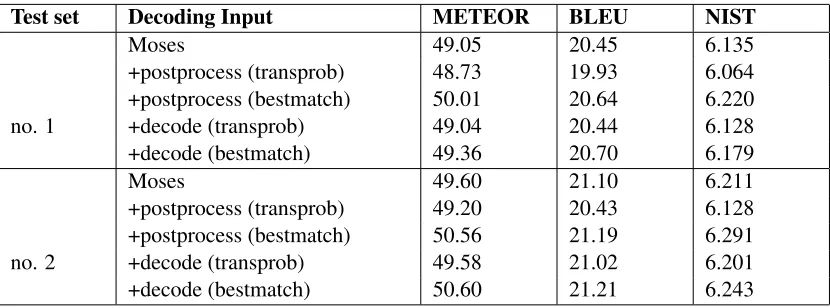
Table 3: Enforcing one translation per discourse can help METEOR, BLEU and NIST scores when using the super-vised sense disambiguation technique (bestmatch). Relying on the unsupersuper-vised context-independent SMT translation probabilities (transprob) does not help.
matches between SMT output and manually trans-lated references. For instance, in a single docu-ment, the French agents pathog`enestranslates
to both (1)pathogensand (2)disease-causing agents while the reference consistently translates
topathogens. Similarly, the French phraseparmi les d´etenusis inconsistently translated toamong
detainees andamong those arrested in the
same document.
Synonym translations detainees vs.
arrested, apartment vs. flat,
good vs. beautiful, unit vs.
cell
However, the majority of differences in trans-lation reflect lexical choice errors. For in-stance, the French adjective biologique is
in-correctly disambiguated as organicin the phrase fille biologiquewhich should be translated as
biological daughter.
SMT lexical choice errors conseiller:
advisor vs. councillor,
arrondissement: district vs.
rounding-off, bal: ball vs.
court, biologique: biological vs.
organic, assurance: insurance vs.
assurance, franchise: frankness
vs. deductible
While some of those translation distinctions can be explained by differences in topics, all of those French words occur in a large number of documents
and cannot be disambiguated by topic alone. This suggests that local sentential context is not sufficient to correctly disambiguate translation candidates.
5 Detecting SMT errors
Based on the observations from the previous sec-tion, we further evaluate whether breaking the one translation per discourse hypothesis is indicative of a translation error. For this purpose, we attempt to correct the translations provided by the Moses SMT system by enforcing the one translation per dis-course constraint and evaluate the impact on trans-lation quality.
5.1 Enforcing one translation per discourse
In order to get a sense of the potential impact of the one translation per discourse constraint in SMT, we attempt to enforce it using two simple postprocess-ing techniques.
Moses Young people under 25 years face various drawbacks when a contract with anassuranceat an accessible price , as can be the low experience in the conduct and seniority of driving licences .
+postprocess young people under 25 years against various drawbacks when a contract with aninsurance
at an accessible price , as can be the small experience in the conduct and seniority of driving licences .
Moses drivers the most far-sighted can opt for insurance any risk withfrankness, so that they get
blanketsinsurance to any risk but at a price more accessible .
+postprocess drivers the most far-sighted can opt for insurance any risk withexemption, so that they get
blanketsinsurance to any risk but at a price more accessible .
Moses “ These illare isolated , nurses puts gloves rubber and masks of protection and we have antibiotics adapted to treat them , ” said Tibor Nyulasi .
+postprocess “ Thesepatientare isolated , personnel puts gloves rubber and masks of protection and we have antibiotics appropriate to treat them , ” say Tibor Nyulasi .
Moses according to the Ministry of Defence , they alsoservedto make known to the public the real
aimsof the presence of the army abroad .
+postprocess according to the Ministry of Defence , they alsouseto make known to the public the real
purposeof the presence of the army abroad . Moses the public authorities alsoprepareChristmas . +postprocess the public authorities alsopuritanChristmas .
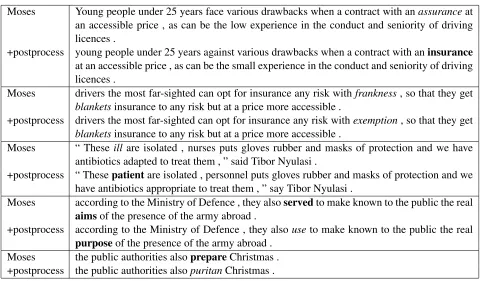
Table 4: Examples of translation improvement (bold) and degradation (italics) by enforcing the one translation per discourse constraint through postprocessing
(2) the supervised strategy picks, among the base-line SMT translations, the one that matches the ref-erence. Note that the supervised strategy does not predict perfect translations, but an approximation of the golden translations: in addition to noise in word alignments due to phrasal translations, the transla-tions selected are lemmas that might not be in the correctly inflected form for use in the full sentence translation.
Third, we integrate the selected translation candi-dates by (1) postprocessing the baseline SMT out-put - the translations of the French target word are simply replaced by the recommended translation, and (2) encouraging the SMT system to choose the recommended translations by annotating SMT in-put using the xml inin-put markup scheme - again, this approach is not optimal as it introduces ad-ditional translation candidates without probability scores and forces single word translation to compete with phrasal translation even if they are consistent.
5.2 Impact on translation quality
As reported in Table 3, small increases in METEOR (Banerjee and Lavie, 2005), BLEU (Papineniet al., 2002) and NIST scores (Doddington, 2002) suggest that SMT output matches the references better af-ter postprocessing or decoding with the suggested lemma translations. Examples of both improved and degraded lexical choice are given in Table 4.
sam-ple, changes only consisted of synonym substitution, morphological variations or local reorderings which did not impact translation quality.
Taken together, these results suggest that the “one sense per discourse” constraint should be useful to SMT and that it would be worthwile to integrate it directly into SMT modeling.
6 Conclusion
We investigated the one sense per discourse hy-pothesis (Galeet al., 1992b) in the context of ma-chine translation. Analysis of manual translations showed that the hypothesis still holds when using translations in parallel text as sense annotation, thus confirming that translational differences represent useful sense distinctions. Analysis of SMT out-put showed that despite ignoring document struc-ture, the one translation per discourse hypothesis is strongly supported in part because of the low vari-ability in SMT lexical choice. More interestingly, cases where the hypothesis does not hold can re-veal lexical choice errors in an unsupervised fash-ion. A preliminary study showed that enforcing the one translation per discourse constraint in SMT can potentially improve translation quality, and that SMT systems might benefit from translating sen-tences within their entire document context.
In future work, we will (1) evaluate whether one translation per discourse holds for other language pairs such as Arabic-English and Chinese-English, which are not as closely related as French-English and for which multiple reference corpora are avail-able, and (2) directly implement the one translation per discourse constraint within SMT.
References
Eneko Agirre and German Rigau. Word sense dis-ambiguation using conceptual density. In Pro-ceedings of COLING’96, pages 16–22, Copen-hagen, Denmark, 1996.
Satanjeev Banerjee and Alon Lavie. METEOR: An automatic metric for MT evaluation with im-proved correlation with human judgement. In
Proceedings of Workshop on Intrinsic and Extrin-sic Evaluation Measures for MT and/or Summa-rization at the 43th Annual Meeting of the
Associ-ation of ComputAssoci-ational Linguistics (ACL-2005), Ann Arbor, Michigan, June 2005.
Srinivas Bangalore, Patrick Haffner, and Stephan Kanthak. Statistical machine translation through global lexical selection and sentence reconstruc-tion. InProceedings of the 45th Annual Meeting of the Association of Computational Linguistics, pages 152–159, Prague, Czech Republic, June 2007. Association for Computational Linguistics. Marco Baroni and Silvia Bernardini. A new ap-proach to the study of translationese: Machine-learning the difference between original and translated text. Literary and Linguistic Comput-ing, 21(3):259–274, 2006.
Marine Carpuat and Dekai Wu. Improving statis-tical machine translation using word sense dis-ambiguation. In Proceedings of the 2007 Joint Conference on Empirical Methods in Natural Language Processing and Computational Natu-ral Language Learning (EMNLP-CoNLL 2007), pages 61–72, Prague, June 2007.
Yee Seng Chan, Hwee Tou Ng, and David Chi-ang. Word sense disambiguation improves statis-tical machine translation. In45th Annual Meeting of the Association for Computational Linguistics (ACL-07), Prague, June 2007.
Mona Diab and Philip Resnik. An unsupervised method for word sense tagging using parallel text. InProceedings of the 40th Annual Meeting of the Association for Computational Linguistics, pages 255–262, Philadelphia, Pennsylvania, July 2002. George Doddington. Automatic evaluation of
machine translation quality using n-gram co-occurrence statistics. In Proceedings of the Human Language Technology conference (HLT-2002), San Diego, CA, 2002.
Christiane Fellbaum, editor. WordNet: An Elec-tronic Lexical Database. MIT Press, 1998. George Foster and Roland Kuhn. Mixture-model
adaptation for SMT. In Proceedings of the Sec-ond Workshop on Statistical Machine Translation, pages 128–135, Prague, Czech Republic, June 2007.
senses in a large corpus. Computers and the Hu-manities, 26:415–439, 1992.
William A. Gale, Kenneth W. Church, and David Yarowsky. One sense per discourse. In Proceed-ings of the workshop on Speech and Natural Lan-guage, Harriman, NY, February 1992.
Jes´us Gim´enez and Llu´ıs M`arquez. Context-aware discriminative phrase selection for statistical ma-chine translation. InWorkshop on Statistical Ma-chine Translation, Prague, June 2007.
Kevin Gimpel and Noah Smith. Rich source-side context for statistical machine translation. InWorkshop on Statistical Machine Translation, Columbus, Ohio, June 2008.
Philipp Koehn and Josh Schroeder. Experiments in domain adaptation for statistical machine transla-tion. In Workshop on Statistical Machine Trans-lation, Prague, June 2007.
Philipp Koehn, Hieu Hoang, Alexandra Birch, Chris Callison-Burch, Marcello Federico, Nicola Bertoldi, Brooke Cowan, Wade Shen, Christine Moran, Richard Zens, Chris Dyer, Ondrej Bojar, Alexandra Constantin, and Evan Herbst. Moses: Open source toolkit for statistical machine trans-lation. In Annual Meeting of the Association for Computational Linguistics (ACL), demonstration session, Prague, Czech Republic, June 2007. Robert Krovetz. More than one sense per discourse.
InNEC Princeton NJ Labs., Research Memoran-dum, 1998.
Hwee Tou Ng, Bin Wang, and Yee Seng Chan. Ex-ploiting parallel texts for word sense disambigua-tion: An empirical study. InProceedings of ACL-03, Sapporo, Japan, pages 455–462, 2003. Franz Josef Och and Hermann Ney. A
system-atic comparison of various statistical alignment models. Computational Linguistics, 29(1):19–52, 2003.
Kishore Papineni, Salim Roukos, Todd Ward, and Wei-Jing Zhu. BLEU: a method for automatic evaluation of machine translation. InProceedings of the 40th Annual Meeting of the Association for Computational Linguistics, 2002.
Ted Pedersen, Siddharth Patwardhan, and Jason Michelizzi. WordNet::Similarity - Measuring the
relatedness of concepts. InProceedings of Fifth Annual Meeting of the North American Chap-ter of the Association for Computational Linguis-tics (NAACL-04), pages 38–41, Boston, MA, May 2004.
Philip Resnik and David Yarowsky. Distinguising systems and distinguishing senses: New evalua-tion methods for word sense disambiguaevalua-tion. Nat-ural Language Engineering, 5(2):113–133, 1999. Helmut Schmid. Probabilistic part–of–speech tag-ging using decision trees. InProceedings of the Conference on New Methods in Language Pro-cessin, pages 44–49, Manchester, UK, 1994. Lucia Specia, Baskaran Sankaran, and Maria das
Grac¸as Volpe Nunes. n-best reranking for the ef-ficient integration of word sense disambiguation and statistical machine translation. In Proceed-ings of the Conference on Computational Linguis-tics and Intelligent Text Processing (CICLing’08), Haifa, Israel, February 2008.
Andreas Stolcke. SRILM—an extensible language modeling toolkit. InInternational Conference on Spoken Language Processing, Denver, Colorado, September 2002.
Nicolas Stroppa, Antal van den Bosch, and Andy Way. Exploiting source similarity for smt using context-informed features. InProceedings of the 11th Conference on Theoretical and Methodolog-ical Issues in Machine Translation (TMI 2007), Skovde, Sweden, September 2007.