Available Online atwww.ijcsmc.com
International Journal of Computer Science and Mobile Computing
A Monthly Journal of Computer Science and Information Technology
ISSN 2320–088X
IMPACT FACTOR: 5.258IJCSMC, Vol. 5, Issue. 3, March 2016, pg.740 – 749
Improve Network Lifetime by using High
Energy First Clustering Hierarchy Algorithm
Mrs. P. Kalaiarasi
1, Mahizhan.P
2, Giridharan.A
3, Gokulakrishnan.K
4Asst.Professor1, Student2,3,4
DEPT OF E.C.E, Panimalar Engineering College, Anna University, Chennai
Abstract— Wireless sensor network (WSN) requires robust and energy efficient communication protocols to minimize the energy consumption as much as possible. However, Radio irregularity and fading in multi-hop WSN are the two main reasons because of what the lifetime of the sensor network reduces. In order to solve this problem a Cluster-based scheme was proposed. The proposed scheme extends High Energy First (HEF) clustering algorithm and enables multi-hop transmissions among the clusters by incorporating the selection of cooperative sending and receiving nodes. The performance of the proposed system is evaluated in terms of energy efficiency and reliability. Simulation results show that Hard network lifetime scheme is adopted among the clusters to achieve a tremendous energy saving. The network lifetime has been prolonged by the cooperative MIMO scheme with a 75% of nodes remaining alive as compared to LEACH protocol. In mobile adhoc networks, batteries are usually used to power up the nodes with limited energy. To prolong the network life, the energy consumption of the routing task is very important. In previous works, many topology control methods were provided to support the energy-efficient routing, while the most of them are designed for static network. In this paper, a novel topology control scheme is proposed for mobile nodes. Adhoc on demand distance vector routing protocol is specially designed for mobile adhoc networks with reduced overhead using Expanding Ring Search technique. Energy consumption is a fact to be considered in MANET due to battery constrain of the nodes.
Index Terms— WSN, HEF, MIMO, LEACH, MANET
I. INTRODUCTION
Sensor nodes are resource constrained in term of energy, processor and memory and low range Communication and bandwidth. Limited battery power is used to operate the sensor nodes and is very difficult to replace or recharge it, when the nodes die. This will affect the network performance. Energy conservation and harvesting increase lifetime of the network. Optimize the communication range and minimize the energy usage, we need to conserve the energy of sensor nodes .Sensor nodes are deployed to gather information and desired that all the nodes works continuously and transmit information as long as possible. This address the lifetime problem in wireless sensor networks. Sensor nodes spend their energy during transmitting the data, receiving and relaying packets. Hence, designing routing algorithms that maximize the lifetime until the first battery expires is an important consideration. Designing energy aware algorithms increase the lifetime of sensor nodes. In some applications the network size is larger required scalable architectures. Energy conservation in wireless sensor networks has been the primary objective, but however, this constrain is not the only consideration for efficient working of wireless sensor networks. There are other objectives like scalable architecture, routing .A latest version of LEACH protocol called the HEF protocol is used. In most of the applications of wireless sensor networks are envisioned to handled critical scenarios where data retrieval time is critical, i.e., delivering information of each individual node as fast as possible to the base station become an important issue. It is very important to make sure that the information is successfully received at the base station the first time instead of being retransmitted. In wireless sensor network, data gathering and routing are challenging tasks because of their dynamic and unique properties. Many routing protocols are developed, but among those protocols cluster based routing protocols are energy efficient, scalable and prolong the network lifetime .In the event detection environment nodes are idle most of the time and active at the time when the event occurs. In LEACH protocol we attain 50% energy efficiency, but in HEF protocol we can obtain a higher energy efficiency of 70%.Sensornodes periodically send the gathered information to the base station. Routing is an important issue in data gathering sensor network, while on the other hand sleep-wake synchronization are the key issues for event detection sensor networks.
II. PROPOSEDSYSTEMS Cluster heads are selected according to the probability of
III. ARCHITECTURALBLOCKDIAGRAM
Step 1: After starting the network, the wireless sensor nodes will be divided into several clusters in the WSN.
Step 2: A node will be chosen as the cluster head amongst the nodes in each cluster area. This cluster head will use a negotiation system to send joining messages to the nodes near the cluster head.
Step 3: After that, the cluster-heads will send invitations to the wireless sensor nodes in each cluster asking them to join the cluster-heads to form the clusters. The second phase includes the transferring data process and the distributing the role of cluster head process including the following three steps. The AODV routing protocol is responsible for sending the data from the source to the destination nodes. Based on the weight value, regularly selecting a set of new cluster heads determines the role of distribution.
ARCHITECTURE:
Step 4: When any wireless sensor node wants to send a message, the sensor node checks for the routing table and searches a path to the destination node. Therefore, if the route is available in the routing table, the message will be forwarded to the next node. Otherwise, the message will be saved in a queue, and the source node will send the RREQ packet to its neighbours to start up the discovery process.
Step 5: During the forwarding of the message to the destination, the power consumption rate of the cluster head will be calculated based on the energy model. If the speed of the energy consumption is high, then based on the value another node will be chosen as the cluster head .
Step 6: Then, the procedure will remove the route from the routing table of the source, which will lead the source node to initiate the discovery process in phase 2 again and a new path to the destination node through the new cluster head.
IV. MODULES
A. CLUSTER HEAD SELECTION:
The cluster heads may be special nodes with higher energy or normal node depending on the algorithm and application. Here base station is a cluster head performs computational functions such as data aggregation and data compression in order to reduce the number of transmission to the base station (or sink) there by saving energy. One of the basic advantages of clustering is that the latency is minimized compared to flat base routing and also in flat based routing nodes that are far from the base station lacks the power to reach it. The basic principle of its efficiency is that it operates on the rule of divide and conquers. Clustering along with reduction in energy consumption improves bandwidth utilization by reducing collision. Work is currently underway on the energy efficiency in WSNs which will result from the selection of cluster heads.
B. ENERGY CONSUMPTION:
Transmission in WSNs is more energy consuming compared to sensing, therefore the cluster heads which performs the function of transmitting the data to the base station consume more energy compared to the rest of the nodes. Clustering schemes should ensure that energy dissipation across the network should be balanced and the cluster head should be rotated in order to balance the network energy consumption.
C. ENERGY EFFICIENT ROUTING:
In contrast to simply establishing correct and efficient routes between pair of nodes, one important goal of a routing protocol is to keep the network functioning as long as possible. As discussed in the Introduction, this goal can be accomplished by minimizing mobile nodes’ energy not only during active communication but also when they are inactive.
Transmission power control and load distribution are two approaches to minimize the active communication energy, and sleep/power-down mode is used to minimize energy during inactivity.
V. PROPOSEDWSNSTRUCTURE
and make them do specific operations.Thepurpose of introducing SN is to closely monitor the operation of sensor nodes in a cluster and command them for specific operations.
Fig.2: Proposed WSN Structure
VI. SELECTIONOFMEMBERFORCLUSTERHEAD
When there is an uneven distribution of sensor nodes in clusters, the cluster head selection becomes highly challenging. In order to make the cluster head (CH) selection algorithm more accurate, we first identify the candidate sensor nodes for cluster head and then select the best among them. In order to select candidate cluster heads from each cluster use the K-theorem. The candidate cluster head is selected based on the bunch of sensor nodes and this main theme behind the K-theorem.
Each cluster is given a value by the Sensor node. The value is relative to the node density in a cluster and ratio of the cluster heads in a WSN. It is the product of the number of nodes in a cluster and ratio r. The value varies from 0.01 to 0.99 but not greater than 0.50. The lesser the value of, the greater the probability of getting a local optimal is. The value determines the number of best sensor nodes as candidate CHs. For each sensor node deployed in the cluster, we choose its nearest neighbors based on distance. The distance between sensor nodes can be calculated through received signal strength indicator (RSSI) that is described or any other localization technique. When the number of immediate (1-hop) neighbors is less than and distance is greater than the transmission range then multi-hop route is preferred. Multi-hop route is preferred over direct because of less energy consumption.
VII. CLUSTER-BASED SENSOR NETWORK
There are two different kinds of sensors in the network. Sensor acts as the cluster head and other sensors play the role of cluster members. The message transmitted from the cluster members to the cluster head are constrained to the bits. Each cluster member quantizes its observation to bits and sends the quantized data to the cluster head. The cluster head performs source extraction based on its own observation and the received quantized data from the cluster members. If the distribution of the observation s or sources are known, the optimal quantization rule may be derived. However, the distribution of sources are not specified in this work so as to accommodate different kinds of sources. Besides, the distributions may not be known a priori. The computational capability of the sensors are limited.
VIII. ENERGYCONSUMPTIONMODEL
HEF provides optimal cluster head selection with respect to network lifetime under the ICOH condition. Now, we are ready to address the key characteristic, and the deterministic predictability for a hard network lifetime of WSN. The amount of energy consumed by a sensor node depends on the role it serves, as well as the workload it handles. To analyze hard network lifetime for guaranteed schedulability, the worst-case energy consumption (WCEC) analysis is used. and the minimum energy consumed for a cluster head, and a regular node in around respectively. the energy consumption model does not consider energy consumed on the initialization tasks, and the failure routines. In other words, we assume a certain reserved energy for these events. To obtain analytical results about the network behaviors ofHC-WSN when HEF is used in a hard network lifetime environment. Hard network lifetime constraint of the timeliness analysis can be satisfied by the evaluation of the worst case temporal guarantees. In such frame works, energy consumption for computational and communication loads are supposed to be bounded and known in order to obtain the worst-case conditions. To obtain the energy consumption bound analytically, a specific system model is investigated. In particular, this section focuses on a model for energy consumption estimation in HC-WSNs. As mentioned previously, the more information that is available about the WSN operating environments (such as topology and contexts of other nodes), and the system behaviors (such as clustering algorithms), the more rigorous are the bounds of the system performance that can be found. Data are sensed and transmitted in each round periodically.
IX. CLUSTER FORMATION PHASE
In this phase, clusters are organized and cooperative MIMO nodes are selected according to the steps described below:
1) Cluster head advertisement
Initially, when clusters are being created, each node decides whether or not to become a cluster head for each round as specified by the original LEACH protocol. Each self-selected cluster head, broadcasts an advertisement (ADV) message using non-persistent carrier sense multiple access (CSMA) protocol. The message contains the header identifier (ID).
2) Cluster setup
3) Cooperative node selection
After the cluster formation, each cluster head will select J cooperative sending and receiving nodes for cooperative MIMO communication [5] with each of its neighbouring cluster head. Nodes with higher energy close to the cluster head will be elected as sending and receiving cooperative nodes for the cluster. At the end of the phase, the cluster head will broadcast a cooperative request (COOPERATE-REQ) message, which contains the ID of the cluster itself, the ID of the neighboring cluster head y, the ID of the transmitting and receiving cooperative nodes and the index of cooperative nodes in the cooperative node set of each cluster head to each cooperative node. The cooperative node on receiving the COOPERATE- REQ message, stores the cluster head ID and sends back a cooperate-acknowledgement (ACK) message to the cluster head.
X. DATA TRANSMISSION PHASE
During this phase, the data sensed by sensor nodes are transmitted to the cluster head and forwarded to the sink using multi-hop MIMO scheme according to the routing table.
1. Intra cluster transmission:
In this phase, the non-cluster head nodes send their data frames to the cluster head as in LEACH protocol during their allocated time slot. The duration and the number of frames are same for all clusters and depend on the number of non-cluster head nodes in the cluster.
2. Inter cluster transmission:
After a cluster head receives data frames from its cluster members, it performs data aggregation and broadcasts the data to cooperative MIMO sending nodes. When each cooperative sending node receives the data packet, they encode the data using space time block code (STBC) and transmit the data cooperatively. The receiving cooperative nodes use channel state information to decode the space time coded data. The cooperative node relays the decoded data to the neighboring cluster head node and forwards the data packet to the TCH by multi-hop routing.
XI. SCHEDULABILITYANALYSISOFHEF
The most important property of the WSN network lifetime is not longevity, but predictability. Schedulability tests are essential for the time-critical system because it provides predictability to complement online scheduling. Cluster head selection algorithms produced by empirical techniques often result in highly unpredictable network lifetimes. Although an algorithm can work very well to prolong the network lifetime for a period of time, a possible failure can be catastrophic, resulting in the failure of a mission, or the loss of human life. A reliable guarantee of the system behaviors is hence a requirement for systems to be safe and reliable. However, there are currently no known analytical studies on the network lifetime predictability for cluster head selection algorithms. apply the worst-case energy consumption analysis to derive the predictability of HEF.
A. HEF ALGORITHM
HEF selects the set of M highest ranking energy residue sensors for cluster heads τ at round where M denotes the required cluster numbers at round τ [1]. HEF is designed to select the cluster head based on the energy residue of each sensor to create a network-centric energy view. Intuitively, HEF is a centralized cluster selection algorithm.
B. Operation of HEF
The interactions and detailed operations between components are discussed as follows.
1) HEF selects cluster heads according to the energy remaining for each sensor node, and then the “setup” message (indicating cluster members, and the cluster head ID for each participated group) is sent to the cluster head of each cluster.
2) The cluster head of each group broadcasts the “setup” message inviting the neighbor sensor nodes to join its group.
3) After receiving the “setup” message at this round, the regular sensors send the “join” message to its corresponding cluster head to commit to associate with the group.
XII. SIMULATIONRESULTS
Fig.3 Network Formation
Fig.4 Cluster Head Selection
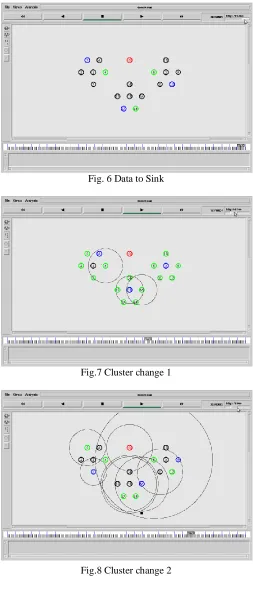
Fig. 6 Data to Sink
Fig.7 Cluster change 1
Fig.8 Cluster change 2
CONCLUSION:
the HEF algorithm. Our experiment results show that the HEF algorithm achieves significant performance improvement over LEACH, and HEF’s lifetime can be bounded.
REFERENCES
[1] T. V. U. Kiran Kumar and B. Karthik (2013) Improving Network Life Time using Static Cluster Routing for Wireless Sensor Networks ECE Department, Bharath University. Indian journal of science &technology,vol 6(5s)
[2] Zahmati A S, Abolhassani B et al. (2007). AN energy-efficient protocol with static clustering for wireless sensor networks. Word Academy of science, Engineering and Technology, issue 4,69-72.
[3] Muhamad W W, Dimyati K et al. (2010). Evaluation of Stable Cluster Head Election (SCHE) routing protocol for wireless sensor networks, International MultiConferance of Engineers and Computer Scientist, Hong Kong, vol 2.
[4] Babaie S, Zade A K et al. (2010). New clustering method to decrease probability.
[5] Babaie S, Zade A K et al. (2010). New clustering method to decrease probability of failure nodes and increasing the lifetime in WSNs, InternationalJournal of Computer Science and Information Security, vol 7, No. 2, 73–76.